History

In Kwethluk, the relics of the first-ever Yup’ik saint are unearthed

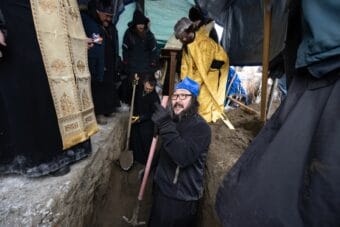
Fr. Michael Nicholai pauses to offer the shovel to another clergyman while uncovering the grave of Matushka Olga during the process of her exhumation in Kwethluk on Nov. 16, 2024. (Courtesy Katie Baldwin Basile)

Puffs of feathery snow drifted among the crowd gathered at the cemetery of the St. Nicholas Orthodox Church in Kwethluk on a bitter cold Saturday, Nov. 16. Clergy, Kwethluk residents, and people from as far away as Eastern Europe stood packed between the tight rows of graves, while dogs weaved through the crowd. The people sang a final blessing to St. Olga of Alaska before the task at hand began.

“We’re going to begin now the process of uncovering the relic of a saint,” said Bishop Alexei, the head of the Russian Orthodox Diocese of Sitka and Alaska, wearing a heavy fur-lined robe and holding a golden crozier topped with two serpents.

Bishop Alexei traveled to Kwethluk alongside clergy from across the state. With the blessing of Orthodox faithful from the region, the church is completing the next step in making Olinka “Arrsamquq” Michael, or Matushka Olga, the first female Orthodox saint in North America, and the first-ever Yup’ik saint.

“All of us, I think, must ask in our heart that holy Matushka Olga will help us, will bless us to do this thing which is not done anywhere,” Alexei said.

Fr. Nicholai Larson (third from left) advises his fellow clergymen to dig safely so no one is hurt during the process of uncovering Matushka Olga in Kwethluk on Nov. 16, 2024. (Courtesy Katie Baldwin Basile)

Half a dozen priests huddled under a tarped enclosure and drove steel bars into the frozen tundra where St. Olga was laid to rest 45 years ago. The ground quickly began to crack and peel away to reveal soft, sandy soil that the mid-November frost hadn’t yet touched.

For the entire, hours-long exhumation process, clergy took turns continuously chanting from the Gospels, the biblical account of the life and teachings of Jesus. Others kept a constant supply of incense and charcoal burning, which wafted through the crowd and over the growing hole.

Orthodox disciples from up and down the Kuskokwim and as far away as Slovakia watch as the remains of Olinka Arrsamquq Michael, known as Matushka Olga, are unearthed over several hours in Kwethluk on Nov. 16, 2024. (Courtesy Katie Baldwin Basile)

St. Olga’s granddaughter, Margaret Michael, stood placidly as the pile of dirt grew next to the grave. She said it’s an honor to see her grandmother made a saint, and to hear faraway accounts of her healing powers after her death. But Michael said, for her, St. Olga simply represents the strength and compassion of Yup’ik culture.

“For the most part, Yup’ik people are like how she was. So I thought of her, like, as a normal human being until those people started dreaming about her,” Michael said.

At the graveside, dirt from the grave was carefully packed into Ziploc bags, which were distributed through the crowd and tucked into backpacks and coats. The holy soil will be used as a tool for healing among the people that fill the cemetery and their congregations back home.

It’s been more than 50 years since a saint’s remains were exhumed in Alaska, but soil from St. Herman’s resting place on Spruce Island near Kodiak is still used in the same healing way today.

Dirt from Matushka Olga’s grave, a holy relic to Orthodox disciples that will be used for healing and ceremonial purposes, is carefully packed and distributed throughout the crowd during her exhumation in Kwethluk on Nov. 16, 2024. (Courtesy Katie Baldwin Basile)

At one end of the growing pile, Zoya Ayapan gathered up soil. She said she became sick as a newborn in Kwethluk, and that when she suddenly got well her parents named her after Matushka Olga.

“One of my names is Arrsamquq. I was born like a month before she passed away,” Ayapan said.

Ayapan said that the recognition of St. Olga is a blessing for Kwethluk.

“The stories that I’ve heard of Matushka Olga, she goes to anybody, and I think the healing is for everybody that needs healing,” Ayapan said. “I was talking to Fr. Vasily (Fisher) before all this, and I said, ‘I think Kwethluk is going to be on the map for a good thing this time, you know.’”

Up from the grave

After more than four hours of digging down into the tundra, the splintered wood cover overlaying St. Olga’s metal casket came up from the grave.

The priests fastened ropes to the corners of the casket, just as they were fastened on Nov. 8, 1979, when Matushka Olga was lowered into the ground.

The ropes stretched tight and held fast to the casket as it rose from the grave. Laypeople, priests, and pilgrims who persevered through the bitter cold suddenly began to sing a prayer for mercy in the ancient Church Slavonic language used throughout the Orthodox world.

A crowd of roughly 100 people follow Orthodox clergy as they carry the unearthed remains of Matushka Olga into St. Nicholas Orthodox Church in Kwethluk on Nov. 16, 2024. (Courtesy Katie Baldwin Basile)

There was some anxiety in the air. Despite detailed plans for the first exhumation by the church in Alaska in more than 50 years, it wasn’t clear what the condition of the grave would be, or whether the casket might fall to pieces under its own weight.

But under the bishop’s direction, a dozen priests found a way to carry the casket through the decaying headstones and along the snowy lane leading the short distance to the new church as the crowd followed behind, transfixed.

The priests worked as a team to make a final push up the stairs. As St. Olga’s relics disappeared inside, the church bell triumphantly rang out to announce her arrival.

The crowd was too large to fit inside the St. Nicholas Orthodox Church, and it spilled down the stairs and onto the boardwalk below. Inside, the bishop and priests transferred St. Olga’s relics to a new wood coffin crafted by monastic nuns from California.

When the nave of the church finally opened – more than five hours after the ceremony began – there was no speech or grand exaltation. The mood was solemn. Tears flowed across some of the faces in the crowd.

Matushka Olga’s body is laid to rest in a wooden coffin made by monastic nuns in California and adorned with her image, salmonberries and the words “God is wonderful in his saints” in Kwethluk on Nov. 16, 2024. (Courtesy Katie Baldwin Basile)

The new resting place was adorned with an icon of St. Olga, surrounded by salmonberries. Matushka Olga’s relatives were first in line to kneel and kiss the coffin. The blessings they received from their family member turned saint will soon be shared with pilgrims from across the world.

In June 2025, Bishop Alexei and leaders throughout the Orthodox Church in America will be back in Kwethluk for the final step in making her sainthood official, a process known as glorification.

“This is to allow the larger church to also show their love for blessed Matushka Olga. But the primary service is really for the Yup’ik people who have been so extremely gracious, so very giving,” Alexei said. “Our entire time here, they have literally given everything they have, precisely the way Matushka Olga had taught them.”

The glorification will be unprecedented. But the same can be said for everything that has happened over the past year to the woman and wife of a priest from Kwethluk known as a mother, a midwife, a healer, and now a saint.

Matushka Olga’s relics will remain on display in the nave of the Kwethluk church as the community prepares for the final step in her canonization.

US Navy apologizes for 1882 destruction of Angoon

Rear Adm. Mark Sucato offers a gift to Joe Zuboff in Angoon on Saturday, Oct. 26, 2024. (Clarise Larson/KTOO)

142 years ago, Angoon went up in flames.  

On Oct. 26, 1882, the U.S. Navy bombarded the Lingít village on Admiralty Island, destroying clan houses, food caches, 40 canoes, and leaving the community for dead. 

But the community of Angoon didn’t die. And, for decades, they’ve been asking for an apology from the federal government.  

On Saturday, close to a century-and-a-half after the horrific shelling, that apology finally came. 

Listen:

X’ash Kugé ka Yaanasax Barbara Cadiente-Nelson’s grandmother survived the bombardment as a young woman. 

“Can you imagine my grandmother, at 26, having to scramble and run with her family?” she said Saturday at the apology ceremony in Angoon. “And the fear, the real fear.”

According to written accounts of villagers who survived the bombardment, it all started because a Lingít shaman for the community was killed in a whaling accident. 

U.S. government documents at the time claimed other Lingít villagers took two of the white whaling crew as prisoners, and demanded compensation of 200 blankets from the whaling company. Lingít accounts deny that prisoners were taken.

Then the Navy got involved. They said the village wasn’t owed anything, and in fact would be fined 400 blankets for taking prisoners.

Joe Zuboff dances during the official Navy apology for the 1882 bombardment of Angoon. Saturday, Oct. 26, 2024. (Clarise Larson/KTOO)

“They scrambled to come up with blankets at the onset of winter. What were they going to do without blankets themselves?” Cadiente-Nelson said.

They only delivered about 80. As a result, the Navy attacked. Six children were killed in the shelling and an unknown number of others died in the following months from exposure and starvation.

Since the 1980s, representatives from Angoon have been asking for an apology. In June, the Navy announced they would issue one. They planned it with Angoon elders for the anniversary of the attack on Saturday. 

The destruction of Angoon led Cadiente-Nelsonʼs grandmother to move to Juneau, about 50 miles away. Her kids were later sent to boarding school, where they weren’t allowed to speak Lingít.

Cadiente-Nelson said Angoon holds an annual memorial for the children killed during the bombardment. And every year, leaders ask those in attendance if anyone from the Navy is there to make an apology. 

“And there was no reply. Today, it appears there will be a reply,” she said. 

Though it’s a long time coming, Cadiente-Nelson said many in the community have mixed emotions about the apology. 

“How do you restore a human being, how do you restore a family?” she said. “How do you restore a community who have been the target of annihilation?”

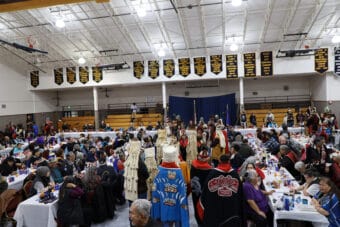
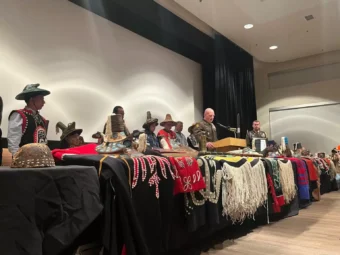
On Saturday, Lingít people from all over Southeast Alaska and beyond gathered in the Angoon High School gym to receive the apology. They danced in wearing regalia – button blankets, carved formline hats featuring bears, frogs, wolves and killer whales, with mother-of-pearl eyes and ermine pelt adornments.  

Dancers enter during the official Navy apology for the 1882 bombardment of Angoon. Saturday, Oct. 26, 2024. (Clarise Larson/KTOO)

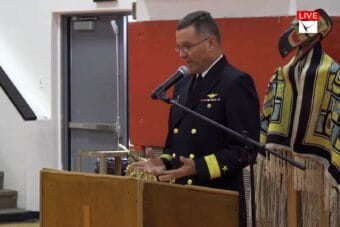
U.S. Navy Rear Admiral Mark Sucato presented the apology to hundreds in the room and the thousands watching on a livestream. 

“The United States Navy … apologizes on behalf of the United States Navy to all the Lingít peoples of Angoon for the pain, suffering and generational trauma inflicted by the bombardment of their village, acknowledges that the Lingít people of Angoon did not deserve nor provoke the bombardment and subsequent destruction of their village by US Naval forces,” he read. 

The gym filled with applause. One by one, starting with Deisheetaan leader Dan Johnson, Jr., clan elders responded to Admiral Sucato’s apology.  

“None of us in this room will ever forget. We will take it to our graves, we will teach it to our children,” Johnson said. “For our house, we accept the apology that you’ve provided.”

Shgendootan George grew up with this story. She taught in Angoon for years and would teach her students about the shelling and burning of their village. 

Shgendootan George cries during the official Navy apology for the 1882 bombardment of Angoon. Saturday, Oct. 26, 2024. (Clarise Larson/KTOO)

Apologies like this — that take ownership of colonial violence without justifications —  confirm the true history of this story. And George said she was excited to teach this part of the history now, too.

“It doesn’t matter how many times I talk about it and how many times I talk with students about what happens like every time I tear up, like the emotions never go away and that feeling of injustice and disrespect, it’s gonna be amazing to be able to say the right thing happened, finally,” she said.

The celebration lasted into the early morning hours on Sunday. 

The Navy also issued an apology last month for the burning and bombardment of the Southeast community of Kake in 1869. It’s expected to do the same for Wrangell. 

See a slideshow of photos from Saturday’s event:

Watch Sealaska Heritage Institute’s recording of the event here:

City and Borough of Juneau apologizes for 1962 burning of Douglas Indian Village

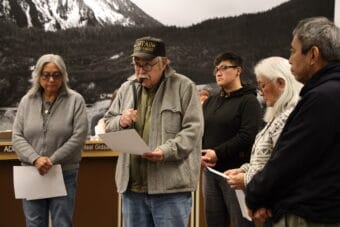
Butch Laiti responds to the City and Bureau of Juneauʼs formal apology for the 1962 burning of the Douglas Indian Village. Monday, Oct. 21, 2024. (Photo by Clarise Larson/KTOO).

The City and Borough of Juneau formally apologized for the 1962 burning of the Douglas Indian Village at a Juneau Assembly meeting on Monday. 

The apology was sudden, and not widely advertised, but it’s been on the mind of one Assembly member for years. 

Andrea Cadiente-Laiti is the Tribal Administrator for the Douglas Indian Association. She stood to receive the apology alongside other tribal members at the Juneau Assembly meeting. 

She said the burning of the village – where Savikko Park and the Douglas Harbor are now – happened more recently than many realize.

“People were shocked to find out we weren’t talking about 1862. We were talking about 1962,” she said.

That’s a little more than 60 years ago, recently enough that people who used to live in the village are still alive now. 

In 2018, the Douglas Indian Association raised a kootéeyaa – or totem pole – honoring the Yanyeidí Taku people who lost their homes. 

 “A kootéeyaa itself won’t heal the pain,” Cadiente-Laiti said. “The proclamation alone won’t but it’s a start, and it’s a wonderful start.”

The Yanyeidì Gooch (wolf) totem pole is raised in Savikko Park on June 6, 2018. (Photo by Adelyn Baxter/KTOO)
The Yanyeidí Gooch (wolf) totem pole is raised in Savikko Park on June 6, 2018. (Photo by Adelyn Baxter/KTOO)

DIA President Butch Laiti was also at the meeting to accept the apology. He said he wants more public awareness of the history of the site. 

“When I heard about this, I wrestled with this apology,” he said. “The problem I guess I have is the whole story is not out there, and I believe that to make this right, we have to tell the whole history of our relationship between Douglas, City of Douglas, Juneau, and the Lingít people.”

He said this history wasn’t taught when he was growing up, He had to learn about it through his own research.

Douglas Indian Association didn’t get much advance notice about the apology. Tribal administrator Cadiente-Laiti only heard about it days before. She said news of the apology was sudden, but welcome.

Mayor Beth Weldon said the reason for the timing of the apology is to honor the wish of departing Assembly Member ‘Wáahlaal Gidaag Barbara Blake. 

“‘Wáahlaal Gidaag said we never quite got to the apology for the burning of the village on Douglas Island,” Weldon said. “And so with that, we looked into it, and it took us a little long — longer than we thought — to get it going and everything so, but we wanted her to share in the formal apology to the Douglas Indian Association for the burning of that village.”

Blake later said this apology was fulfilling a campaign promise she made in 2021. It’s not nearly enough though. 

“It’s not okay,” she said. “We will do what we can to make it right, but this is at least the first step in that process.”

Blake chose not to run for reelection this fall, but said she plans to keep the pressure on the city to take this apology further and do more to commemorate what happened. 

“Just because I’m stepping off the assembly doesn’t mean I’m stepping away. I still live in Juneau,” she said. “I’m still going to be around and holding folks accountable. So I will be poking people if, if I don’t see some kind of movement.”

Blake said the other entities involved in the burning – like the Bureau of Indian Affairs – should also be apologizing. 

This weekend, a U.S. Navy Admiral will offer the Lingít people another long-overdue apology, for the 1882 bombardment of the village of Angoon. Sealaska Heritage Institute plans to livestream the event on their Youtube channel

Clarise Larson contributed to this story.

US Navy apologizes for burning and bombarding the village of Kake in 1869

Rear Adm. Mark Sucato issues a formal apology for the 1869 bombardment of Kake at the village’s community center on Saturday, Sept. 21, 2024. (Screenshot from Sealaska Heritage Institute livestream)

Over 150 years have passed since the U.S. Navy bombed Kake, a Tlingit village in Southeast Alaska. Navy representatives visited this weekend to formally apologize for the winter attack, which left many people to starve or die of exposure after the village was destroyed.

At Kake’s community center on Saturday, about a dozen elders walked or were wheeled to the front of the crowd, where they saluted the American flag as a Navy musician sang the Star-Spangled Banner. The men wore Tlingit button vests and blankets over their shoulders, and veterans’ caps on their heads denoting the military branch and foreign wars they served in — Korea, Vietnam, Iraq.

Joel Jackson is the president of Kake’s tribe, called the Organized Village of Kake. He said he couldn’t help but point out the irony.

“Our veterans have been in every major conflict,” Jackson said. “Even though they took our land, our men still went and fought for their country. I’m very proud of them for their service.”

To Jackson’s right, a totem pole, carved by local artist Rob Mills, stood behind the American flag. Half of the pole was blackened by fire, to represent the centuries of colonial violence endured by the Tlingit people.

Jackson said the Navy’s apology was a long time coming.

“I talked to a lawyer, and he said the military will never apologize or offer restitution for what they have done,” said Jackson. “I’m glad it’s happening in my lifetime.”

‘Wrongful military activity’

An unexploded shell from the 1869 bombardment of Kake. (Sealaska Heritage Institute)

The attack took place in January of 1869 — in the dead of winter.

The year before, American soldiers had attacked a Chilkat leader, Colchika, who left the fight with one of their rifles. Soon after, an army sentinel shot and killed two Kake Tlingit people who were trying to leave Sitka by canoe. The group’s lone survivor, a clan leader, asked the army garrison for compensation for their deaths. Gen. Jefferson C. Davis refused.

About a month later, in retribution, a party of Kake Tlingit people killed two white trappers on Admiralty Island. Jackson says they were acting in accordance with Tlingit law.

When Davis learned of those killings, he ordered the USS Saginaw to attack Kake. The warship’s crew found the village mostly empty, but they burned and bombed it to the ground — destroying homes, food caches, canoes, and totem poles.

The bombing left the people of Kake without food or shelter. Though historians haven’t determined the number of deaths, oral history records many — especially among elders and children.

In its apology, the Navy called the attack “wrongful military activity.” But Jackson calls it part of a series of acts of genocide

“It basically is still in our DNA today,” said Jackson. “Because it wasn’t just a bombardment, it was the boarding schools and all the pandemics that we had back then. Trying to erase our people from this land.”

‘The beginning of a dialogue’

U.S. Senator Lisa Murkowski, who is an adopted member of the Tlingit Deisheetaan clan, spoke at the ceremony. She said she hopes the Navy’s apology will promote healing.

“At some moment, there has to be the time that the healing can begin, and that moment needs to be now,” she said. “It is my hope that we can move together forward with respect and understanding for each other’s cultures, for each other’s worldviews, and that with these words of apology, respect is finally afforded to the people of Kake.”

Rear Admiral Mark Sucato stepped up to the podium and said the Navy regrets how long it took to apologize.

“The Tlingit people of Kake did not deserve the destruction of their villages by U.S. Naval forces,” he said. “We are invested in supporting Kake’s healing. This is the beginning of a dialogue towards making amends.”

Jackson, the tribal president, didn’t accept the apology outright. Instead, he turned to the clan leaders at the gathering.

“You all heard the apology — What do you think?” Joel asked. “You don’t have to answer, but as the tribal president, I believe we should acknowledge the apology and move forward.”

Some clan leaders then shared stories from their ancestors who survived the attack. Others thanked the visitors for the apology, which the tribe ultimately accepted.

But the Navy’s work isn’t over. Now they’re speaking with Wrangell and Angoon’s tribes to apologize to clans that also suffered in the series of attacks. Those ceremonies will take place later this fall.

KTOO 360TV will air the U.S. Navy’s apology for the Kake bombardment on Sunday, Sept. 29 at 12:30 p.m. 

Correction: A photo caption previously misidentified the year when the bombardment took place. 

Quakers return cultural artifacts to Kake at annual Dog Salmon Festival

Joel Jackson, President of the Organized Village of Kake (OVK) holds up up a couple carved wooden paddles, which were among the objects a group of quakers returned to Kake in August. (Photo courtesy of Juulie Downs)

A group of quakers from Oregon visited Kake last month for the annual Dog Salmon Festival. The visit to the remote Southeast Alaska village was part of an ongoing effort to apologize for the religious group’s participation in the forced assimilation of the Tlingit people. They were there to return an assortment of cultural artifacts that had been taken out of Kake over a century ago.

Baby booties, wooden paddles, blankets, a small household totem — these are some of the cultural artifacts a group of quakers returned to Kake from Portland, Oregon this summer. But according to Juulie Downs, who was part of the group who went to Kake, some items were easier to transport than others.

“Oh, a set of canoe paddles — gorgeous, absolutely gorgeous! And really hard to get through TSA,” Downs said, laughing.

“I wanted to carry them on board, because I wanted to be careful,” said Downs. “But TSA said, ‘Oh, no, you’re going to have to go back and check them, because they could be used as a weapon. You know, you could whack somebody with them!’ [And so I said,] ‘Yeah, okay, whatever.’”

Many of them had been passed down through Downs’ family, through her great-grandmother, Bell Gardner, who taught at the quaker school in Kake around the turn of the century. It was a day school where the kids went home at night.

Downs said bringing those pieces back was just the right thing to do, as a step towards repairing the harm of the forced assimilation of Alaska Native people. But in letting go of the items that had been with her family for three generations, she also learned something about them.

“There was one thing I could never figure out,” said Downs. “I couldn’t see what it could possibly be for — it made absolutely no sense of any kind. It’s a pouch with a handle. I asked somebody, I said, ‘Do you know what this is?’ And she looked at it, and she picked it up and she handled it. She [said] it was a medicine bag. So it was important!”

Juulie Downs (center) returning objects to Kake residents at the Dog Salmon Festival in August. (Photo courtesy of Cathy Walling)


Joel Jackson is the president of Kake’s tribe, the Organized Village of Kake. He said the gesture meant a great deal to the community. But, that Kake is still recovering from colonization. He said many of the community’s elders, who went to the quaker day school, don’t like to talk about their experiences there.

“I don’t know if they’re embarrassed or [if] they just feel that it’s something they want to put behind them,” said Jackson. “But the main thing I expressed about that school was the forced assimilation of our people into the Western world. And that’s what lot of people across Alaska, in the United States, you know, they feel that, you know … They were forced into going to school and following the Western ways, and they were forbidden to speak their language. “

The return of the objects was preceded by a formal apology in January. S’eiltin Jamiann Hasselquist is an Indigenous activist from Angoon. She was there to witness the apology as a descendant of a person from Kake, and said it wasn’t just a blanket apology for operating the day school.

“They talk about the horrific abuse conditions, the taking of culture, the sexual abuse,” said Hasselquist. “They speak of the things that happened in their apology, which is exactly how an apology should be when coming to make apologies to Indigenous people. It shouldn’t be vague. Because we know what happens to us. And apologies without reparations are just words that fall to the ground.”

A pair of beaded baby booties a group of quakers returned to Kake in August, 2024. (Photo courtesy of Cathy Walling)

Downs said it was hard for her to confront that part of her family’s history. She remembers her great grandmother as a gentle, kind person, and doubts that she participated in the worst of the abuse. But, she said it was ultimately necessary to reconcile her views of the world with what Bell Gardner, who she calls “Nana,” participated in.

“It it just struck me … still not connecting it to Nana at that point,” Downs said. “But just realizing that we, as white people, have often not really understood other people’s religions.”

Then, one day, when she was putting on a scrimshaw pin that her great grandmother had brought down from Kake, she said it hit her “like a ton of bricks.”

“I was getting dressed, I thought, well, I’m going to wear that pin,” said Downs. “And then I went: ‘Ah!’”

Downs was getting ready for a meeting, where Hasselquist was speaking about the lasting harm missions and boarding schools had brought upon Indigenous people across North America.

“I got up and said that there was this pin that came down in my family, and [then I] gave it to this woman that had been speaking,” said Downs. “And I’m telling you, there wasn’t a dry eye in the whole room. Quakers have a kind of a concept that sometimes in a group there’s a heaviness of the Holy Spirit comes down and just enshrouds everybody, like in a cloud. It was like that.”

Cathy Walling is with another quaker group: the Alaska Friends Conference. She helped organize the reconciliation effort — including the return of the artifacts. She says she didn’t want the apology to be an empty, self-congratulatory gesture.

She said that’s why the group put up over $92,000 to cover the insurance costs for the village’s healing center, which is in the works. Walling says she hopes this act inspires other organizations with histories of colonization to take similar reparative steps.

“I’m hoping this story just helps to uplift the importance of apology,” said Walling, “for healing journeys, [and] for, you know, really — how we move forward in good ways together, towards greater healing that moves us towards transformation on our planet. Because, boy do we need it. Boy, do we need it.”

Jackson says the return of the artifacts represents a step towards healing intergenerational trauma brought about by colonization, and that the monetary contribution to his brainchild — the community’s cultural healing center — made the gesture even more meaningful.

“We’ve been talking about this intergenerational trauma for … how long now?” said Jackson. “And I think it’s time that we start healing our people. I’ve had the cultural healing center in mind for … I don’t know how long. Quite a while. It came to me after I lost two of my brothers to alcohol.”

As for Downs? She says that she’s only a little bit sad to part with some of the items, which made her feel connected to all the hands they had passed through — those of her mother and grandmothers. But she says she knows it was ultimately the right thing to do, and that she hopes she traded in the artifacts for lasting friendship with the people of Kake.

U.S. Navy plans apologies to Southeast Alaska villages for century-old attacks

Angoon students prepare to paddle the unity canoe they built with master carver Wayne Price on June 19, 2023. It is the first canoe of its kind since the U.S. Navy bombardment of Angoon in 1882 that destroyed all the village’s canoes. The Navy plans to issue apologies to Kake and Angoon residents in the fall of 2024. (Photo by Claire Stremple/Alaska Beacon)

Two Tlingít villages in Southeast Alaska will receive apologies for wrongful military action from the U.S. Navy this fall.

The first of those apologies will take place in Kake this weekend, where U.S. Navy Rear Admiral Mark B. Sucato will acknowledge the harms of a bombardment in 1869. An apology in Angoon is scheduled for Oct. 26, the 142nd anniversary of the 1882 bombardment.

Navy ​​Environmental Public Affairs Specialist Julianne Leinenveber said it was determined that the military actions were wrongful because they resulted in loss of life, loss of resources, and inflicted multigenerational trauma on the affected communities.

“The pain and suffering inflicted upon the Tlingit people warrants this long overdue apology,” she wrote in an email.

Tlingit people have asked the U.S. government to apologize for decades. Leinenveber said the U.S. responded in the last few years with planning discussions at the highest levels of military leadership and the federal government about how to issue a substantive, meaningful apologies in a culturally appropriate manner. Lately, she wrote, military relationships with Alaska Native clans brought the matter to the attention of Navy leadership, who coordinated with the Office of the Secretary of Defense to formally apologize for the bombardments.

“The Navy will be issuing this apology because it is the right thing to do, regardless of how much time has passed since these tragic events transpired,” she wrote.

Joel Jackson, the president of the Organized Village of Kake, said the apologies are meaningful to the community even after a century.

“It’s a long time coming,” he said. “Hopefully, through this apology, we can start healing from the wrongs that were committed against us.”

Jackson said he is particularly concerned with the effects of intergenerational trauma, which he said he sees in his community today. The Navy apology will specifically acknowledge the U.S. government’s responsibility for that trauma.

Jackson said the military history of the event is not an accurate accounting of what happened. Many accounts refer to the bombardments as the Kake Wars.

“We never did go to war with them,” he said. “They attacked our communities.”

Military action in Kake

There are different accounts of the military events in Kake in 1869. Some refer to the events as a bombardment, while others refer to them as the Kake Wars.

What goes without much dispute is that a U.S. Navy vessel, the USS Saginaw, totally destroyed three village sites and two forts in the area of Kake in the winter. Soldiers then burned the villages and destroyed food and canoes. By all accounts, the destruction led to “many deaths.”

Descriptions of the events that precipitated the bombardment differ. An account from William S Dodge, one of two mayors of Sitka under the provisional government, printed in the Annual Report of the Department of the Interior, recounts that two Alaska Native men were killed by a sentry in Sitka when they were unaware there was an order not to leave the village there. Afterward, men from Kake killed two colonizers in retaliation, which caused the war, Dodge wrote.

A forthcoming book from Zachary R. Jones, Ph.D., is similar to this account, with the detail that a Kake clan leader asked for trade blankets and goods as compensation for the deaths in accordance with Tlingit law, but the general refused, which is why a “party of Kake Tlingits” killed two trappers on Admiralty Island in retribution. The information was released in advance of the book’s publication in a news release from the Sealaska Heritage Institute.

New relationships

Angoon School Principal Emma Demmert was invited by the U.S. Navy to take part in planning meetings early this summer for its October apology. She said she is hopeful for the future after working with Navy officials and seeing their openness and willingness to embrace Angoon’s cultural traditions.

“This is a really good step to healing for our community, and it’s really been enlightening to be a part of the team and meeting with the Navy on this whole topic,” she said.

Demmert said the apology is a shift in relations with the U.S. government and she credits the Biden administration, in part, for that change. She also pointed to the work Angoon students did to build a dugout canoe and shine light on the history of the bombardment as a reason for renewed attention to the issue.

In Kake, Joel Jackson said he was also looking to the future and to right relations with the U.S. military.

“Giving an apology is by no means the end of it. Definitely we’ll be looking for them helping us even more,” he said. Jackson pointed to Kake’s high unemployment rate.

“Helping to set up infrastructure, you know, to get in some totem poles, stuff like that. Hopefully a museum to commemorate what happened.”

Correction: One of the references to the year of the bombardment of Kake was incorrect in the original version of this article. 

Site notifications
Update notification options
Subscribe to notifications