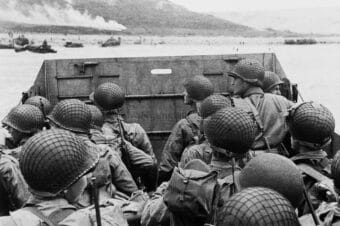
American soldiers huddle inside a landing craft approaching Utah Beach during the Allied invasion of Normandy, France, on D-Day. (U.S. Army Photo/AFP via Getty Images)
This is part of a special series where NPR looks back at our coverage of major news stories in the past.
Frank Walk was in a hurry.
The U.S. Army captain had been ordered to bring top-secret planning documents to Gen. Dwight D. Eisenhower’s headquarters, which at the time was a 19th-century manor near Portsmouth, England. It was just before the Allied invasion of Nazi-occupied Normandy, France, on June 6, 1944.
Walk said he remembered a speedy, cross-country jeep ride to make his delivery.
“That was a pretty hairy ordeal, and all the time, I was afraid that I wasn’t going to get back to our staging area in time to board the ship for the crossing,” he told NPR’s Talk of the Nation in 2004. Later, Walk said, he wished he’d missed the trip.
He was one of more than 150,000 U.S., British and Canadian troops who stormed the Normandy beaches on D-Day — and one of a handful who in the decades after told NPR about their experience. The invasion was the largest amphibious assault in history, and a crucial turning point in World War II.
More than 6,000 ships and landing craft crossed the English Channel in the mission. Before dawn, Allied gliders and paratroopers dropped behind enemy lines. There were more than 11,000 planes, including bombers that sought to weaken the so-called Atlantic Wall of German defenses.
Jim McLaughlin had a front-row seat: the top turret of a B-26 bomber.
“I couldn’t believe that there were that many ships in the whole world — all headed in the same direction,” he told NPR in 1994. “And then a few moments later to see that beach.”
Hitting the sand
Troops crowded into small, narrow landing craft, designed to hold about three dozen men in an area smaller than a parking space. Walk, a combat engineer tasked with clearing Nazi fortifications, was caught in strong winds and rough seas.
“We had a hard time getting into the boat in the first place. It was bouncing around, waves blowing over the side. Wasn’t long before all of us aboard that little boat were seasick,” he said. “Then we began to say, ‘Gee, when can we get to shore?’ ”
“Again, when we got there, we wished we weren’t there,” Walk added.
Allied troops landed at five beachheads along a 50-mile stretch of coastline. The beaches were codenamed Utah, Omaha, Gold, Juno and Sword. Cpl. William Dabney served with the First Army’s 320th Anti-Aircraft Barrage Balloon Battalion, an all-Black unit.
“We saw guys crying, we saw guys after they got off, they [were] throwing up,” he said. “Everybody was scared to death. But you did what you had to do. You tried to protect yourself and save your life.”
Soldiers charged head on into Nazi gunfire, landmines and barbed wire. Pvt. Harold Baumgarten remembered wading through neck-deep water, and a bullet striking his rifle near the trigger.
“A half-inch to either side would have gone through my chest,” Baumgarten told NPR’s Morning Edition in 1994.
What reporters saw on D-Day
Correspondents covered the invasion, including writer Cornelius Ryan. His 1959 book The Longest Day told the story of June 6, becoming a best-seller with an all-star film adaptation led by John Wayne.
Ryan remembered thousands of planes filling the sky.
“It was absolutely incredible,” he told NPR’s All Things Considered in 1972. “It was such an incredible, staggering sight that it was almost impossible to comprehend.”
There was another moment Ryan said he would never forget.
“I saw a French man and his son in a rowboat, rowing back and forth out from Omaha Beach picking up wounded and bringing them in,” he said. “We were never able to find out who that man was because if we had we would have had him decorated.”
CBS reporter Larry LeSueur came ashore, typewriter in tow, with the Army’s 4th Infantry Division. He saw dead soldiers and others badly wounded.
“I think everybody thinks of death coming as sort of a blinding flash in which you are no more. But you don’t think of being maimed or wounded,” he told All Things Considered in 1994.
LeSueur said D-Day’s human toll was at times too difficult to share to the American public.
“It never occurred to me to tell them about certain things I had witnessed. It wasn’t my place to do so,” LeSueur said. “I mean, everybody would think it was their own son — I didn’t have his name. Next of kin had to be notified anyway if a man were wounded or dead. It wasn’t my place.”
A pivotal moment
Securing the Normandy beaches gave the Allies a solid foothold on the European continent, but the victory came at enormous cost. More than 4,000 Allied troops were killed or wounded, including 2,501 Americans. There were several thousand German casualties.
As D-Day turned to D-Day “plus one,” Eisenhower said in a broadcast address that the invasion was “but the opening phase of the campaign in Western Europe.
“I call upon all who love freedom to stand with us now. Keep your faith staunch. Our arms are resolute. Together we shall achieve victory,” he said.
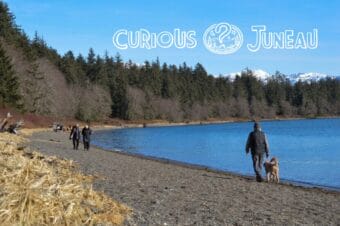
People walking at Aanchg̱altsóow, or Auke Recreation Area, on March 24, 2024. (Photo by Yvonne Krumrey/KTOO)
Every other June, canoes — or yaakw — arrive at a beach in Juneau. With carved formline paddles in hand, Southeast Alaska Native people row for days to get there.
They come for Celebration, the gathering of Lingít, Haida and Tsimshian people honoring the survival of traditional dancing, art, language and community.
Do you have a Curious Juneau question? Submit it at the bottom of the page.
Seikoonie Fran Houston is a spokesperson for the Áak’w Ḵwáan. She spoke in a 2022 Central Council of Tlingit and Haida Indian Tribes of Alaska video from the landing.
“The first one I saw that occurred — it brought tears to my eyes to witness this. And it also kind of gives you a little vision as to what our ancestors did,” Houston said.
But yaakw have been landing at this beach for much longer than the 40 years that have passed since the first Celebration. It’s the site of an old Lingít village called Aanchg̱altsóow. That means “the town that moved.”
A KTOO listener asked about the Áak’w Ḵwaan Village, fish camp, and garden that were once where Auke Recreation Area — or Auke Rec — is now.
Three yaakw built by Lingít carver Wayne Price arrive at the beach at Aanchg̱altsóow, also known as Auke Rec, on June 5, 2018 for Celebration. (Screenshot from KTOO video)
Aanchg̱altsóow: ‘It’s a good place, it has plenty of what we need.’
Auke Rec is a park along a beach north of the rest of Juneau, with stone picnic shelters and fire pits. On clear days, the beach is dotted with couples on walks, dogs sniffing around, and families having picnics.
Thereʼs a section of the beach thatʼs sandier and smoother, down an unofficial trail in the middle of the beach. Oral tradition says it was cleared of boulders and large rocks for easier yaakw launches and landings.
By the time Seikooni Fran Houston was growing up, Áak’w people weren’t living at the village site, but she knows the story of how they first got there.
“When we migrated, that was the first area — so in other words, we were the first Indigenous people of the area,” she said.
The oral history has it that the Áak’w people migrated from the south and deeper in the interior. From a distance, the clan leader saw Aanchg̱altsóow and sent scouts to it, Houston said.
“And they came back and they told the leader, ‘It’s a good place, it has plenty of what we need,’” she said. “So that’s the real short story of a long story.”
For hundreds of years, Áakʼw people lived at Aanchg̱altsóow.
An 1890 photo of Aanchg̱altsóow, the village that stood where Auke Recreation Area is today. (Alaska State Library ASL-P39-1172 Case & Draper Photo Collection)
The Forest Service takes over
Houston said that around the turn of the 20th century, people had started moving away from the village to Douglas and downtown Juneau to work as miners, and so their children could attend school.
But she said the land at Aanchg̱altsóow was always in use.
“There was a time, too, that there were some people who stated that we abandoned Auke Rec,” she said. “We didn’t. We still use it. Not only do we use it — we take what we need in the area — we use it for ceremonies. We didn’t abandon it.”
In the 1920s, the United States Forest Service claimed the land was unoccupied. They began to make campsites, trails and other infrastructure in the area. Then, in 1931, the Forest Service claimed full ownership.
Juneau researcher Peter Metcalfe wrote “A Dangerous Idea: The Alaska Native Brotherhood and the Struggle for Indigenous Rights.” He said settlers claiming that land was “abandoned” was a common land-grab tactic.
“That has been used in a legal sense against Native Americans from the beginning of contact in the Lower 48, as well as Alaska,” he said. “Most Native Americans would say ‘We never abandoned our land.’ And it’s true, in a moral sense. If we own something, and we haven’t sold it, we still own it. It doesn’t matter if we live there or not.”
During the same year when the Forest Service took control, over a dozen Áak’w Ḵwáan built cabins on the old village site to stake claim to the land. It didn’t work. In January 1932, a federal judge ruled that Lingít people had given up ownership by not occupying the land.
The judge gave the families a month to remove their cabins. Afterward, the Forest Service expanded their construction at the site, and by the 1940s, it looked much like it does today.
Metcalfe said the way the federal government claimed Auke Bay wouldn’t hold up today.
“The Forest Service was wrong about Auke Bay. When they thought they had won, they hadn’t really. They just put off a decision that was finally resolved in the Alaska Native Claims Settlement Act of 1971,” he said.
People dipping with Haa Tooch Lichéesh Coalition at Auke Recreation Area on March 24, 2024. (Photo by Yvonne Krumrey/KTOO)
‘Thereʼs no trace, except for those footprints’
Sitting on the beach on a sunny March day, Saan Jeen Jennifer Quinto was getting ready to lead a traditional ocean dip. After setting an intention and reflecting around a fire, Quinto guided participants into the water a little bit at a time.
Quinto said that, to her, Aanchg̱altsóow is a direct connection to her identity as Alaska Native.
“For me, thereʼs different layers of not only sacredness, but all the different emotions of life,” she said. “The way that this was also likely a place of joy for a lot of people, but also the heartache of the fact that weʼre not allowed to be connected in that way any longer to this place.”
She said the word “recreation” in “Auke Recreation Area” can cause people to treat the beach like itʼs a playground.
“I don’t think the way that itʼs currently used or represented just doesnʼt — people donʼt understand all of those layers that are happening here for those of us from the Native community,” Quinto said
Quinto said sheʼs often picking up trash from the sites of old longhouses. Indentations are still present in the trees along the shore.
“It always crosses my mind that people are respectful of gravesites, and in a lot of ways this area has that same sort of sacredness,” she said.
And Aanchg̱altsóow is a gravesite. In a 1987 Alaska Department of Natural Resources cultural resources survey, archeologists reported finding at least one set of human remains there.
Quinto said that if people could only see what it looked like when it was a lived-in village, they might treat it differently.
“You would have seen the house fronts, you would have seen the kootéeyaa, you would have seen our people out here. And now thereʼs no trace, except for those footprints,” she said.
She said that erasure was the start of a long history of reducing the footprints of Lingít people in Juneau — including the gradual shrinking of Juneau Indian Village downtown in the middle of the last century and the burning of Douglas Indian Village in 1962.
Rosa Miller (center), Fran Houston (left) and Angie Hunt (right) prepare to sing a traditional song to the spirits of the land at Auke Recreation Area, April 1997. (Photo courtesy of Dr. Thomas Thornton)
But events like traditional dips in the ocean and the canoe landings at Celebration bring Lingít traditions back to the land, and back to life, Quinto said.
“For Lingít people, we believe that everything has its own spirit, and has its own life,” she said. “And so, to me, when weʼre able to gather here for cultural events, those are moments that we get to restore that life to this area, and I donʼt think it happens enough.”
Seikoonie Fran Houston said that when she stands on the beach now, it fills her with gratitude for her ancestors.
“I go out there and I talk to my ancestors and I thank them every time I go out there,” she said. “Saying thank you for choosing this area, because it’s so pretty and so peaceful.”
Next week, paddlers will once again ask the Áak’w Ḵwáan for permission to come ashore, in recognition for the history and life of this piece of land.
Curious Juneau
Are you curious about Juneau, its history, places and people? Or if you just like to ask questions, then ask away!
Headlines from Alaska newspapers in the late 1940s covering the trials of Austin Nelson and Eugene LaMoore. (Library of Congress/KTOO)
When Mary Lou Spartz was a senior at Juneau High School in 1948, she says she could hear the sounds of construction at the federal jail a block away from her classroom on 5th and Main Street.
“We didn’t talk about it,” Spartz said. “But you’d sit in class and you’d hear the pounding on that building, and you couldn’t help but notice.”
Spartz said when the murder trial was all over the news she didn’t think much about it. But when preparations started at the federal jail — where the State Office building is today — it began to trouble her. She said she knew it was for an execution.
In 1948 and 1950, Juneau executed two Black men — Austin Nelson and Eugene LaMoore — for the murder of a local grocer. The trials, according to a legal historian who has researched them for decades, were riddled with misconduct and errors.
Seven years after the second execution, Alaska’s Territorial Legislature abolished the death penalty. At the time, one of the legislators leading the abolition movement pointed out that capital punishment had been used almost exclusively against Black and Alaska Native people.
Now, Spartz is 93 years old. She lives just on the other side of Telephone Hill from her old high school classroom. She still recalls how her teachers and parents would avoid talking about the execution and she was left to draw her own conclusions.
“All of a sudden, it kind of occurred to you that this was going to be taking the life of another person. I don’t think we thought of it that way. But there was something going on there that didn’t seem right,” Spartz said. “Didn’t seem right at all.”
Two men sentenced to death
On a December morning in 1946, grocer Jim Ellen was found dead in his store on Willoughby Avenue with his throat cut. Nelson, who had lived in Juneau for several years working odd jobs around town, was arrested the next day and charged with the murder.
In April 1947, a jury convicted Nelson of the murder and sentenced him to death. His lawyers never filed an appeal.
A second man would also be convicted for the murder ten months later. At Nelson’s trial, LaMoore took the stand to offer an alibi. He said he was with Nelson for some of the night and saw him on-and-off during the time when Nelson was accused of having committed the murder.
After LaMoore’s testimony, prosecutors believed that LaMoore must have been involved with the murder as well. They charged him with perjury, and put him in jail, for the purpose of collecting enough evidence to charge him with murder. In 1948, another jury convicted LaMoore and sentenced him to death as well.
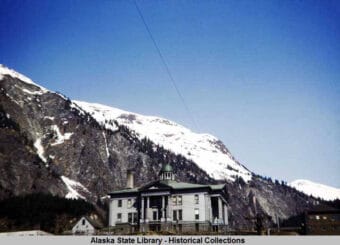
The Federal Jail in Juneau. Taken in April 1948. (Alaska State Library ASL-P417-071)
‘The duty to correct the record’
“LaMoore wasn’t charged until he had the audacity to try and testify on behalf of Nelson, at Nelson’s trial,” says Averil Lerman, a legal historian who has researched the two cases over the last 30 years. Sheʼs currently writing a book about these cases.
She said the executions of Nelson and LaMoore fit a broader pattern in Alaskaʼs history of capital punishment. Nationally, the death penalty has been applied disproportionately based on race, poverty and access to legal representation. Those factors, Lerman says, have more to do with whether a defendant gets the death sentence than the severity of the crime committed or the evidence.
Her research showed the same patterns held true in Alaska.
“The answer was pretty overwhelmingly clear,” she said. “After 1903, the only people who were executed in the territory of Alaska were people who were not white — or people who were viewed as not white by the dominant white majority.”
Lerman worked in criminal law for 20 years and as a post-conviction criminal defense lawyer, examining cases after the defendant received a guilty verdict to see if the conviction had been obtained legally and justly.
“A medical examiner is someone who examines the remains of a person to determine the cause of death and the instrumentality of death,” she said. “I’m kind of like a legal examiner who can look at a conviction and the surrounding information and figure out whether the conviction was probably righteous or not.”
And in the post-mortem of Nelsonʼs and LaMooreʼs cases, nearly 50 years later, Lerman found a trial transcript that has stuck with her since. It was the testimony of LaMoore, the last person executed in Juneau.
“The transcript that I found changed my life, and has tied itself to my ankle for all the years between now and 1994 when I found it,” she said. “It put a duty on me that I have not been able to shake. The duty to speak, the duty to correct the record.”
Lerman said the justice system failed Nelson and LaMoore at nearly every turn.
“There was extreme prosecutorial misconduct in both of these cases,” she said, as well as serious error by the defense and by the judge.
A retracted confession
The prosecution built their case without any reliable forensic evidence — like blood, hair or fingerprints — in either trial. There was testimony in Nelson’s trial regarding blood, but it was inconclusive, a fact that was admitted by a witness in a written report to the prosecutor, but papered over by the witness at trial. There was no such evidence at all introduced against LaMoore. Lerman says that instead, the prosecution relied on testimony from people who were put under pressure to tell a certain story.
“Much of the prosecutionʼs trial evidence in both of these trials was obtained by either taking advantage of either witnesses who were in terribly vulnerable positions to ensure that they said what the prosecutor wanted them to say or by placing them in incredibly vulnerable positions in order to secure that testimony,” she said.
The only physical evidence that tied Nelson to the crime was a check on the store counter with Nelson’s name on it, dated five days earlier.
At Nelson’s trial in 1947, the prosecution had one eyewitness: Dolly Silvers, who was held in the city jail for a month so she would testify against Nelson, Lerman said. Silvers told the jury she saw Nelson leaving Ellen’s store after two o’clock in the morning, by himself.
After Nelson’s trial, LaMoore was charged with perjury because he didn’t initially admit to a 20-year-old felony in the state of California, even though he corrected that testimony to the jury. Using that charge, he was kept in jail and in solitary confinement for months, during which he was repeatedly interrogated without appointed counsel.
Then, on June 30, 1947 — the day before Nelson was due to be executed — Nelson told investigators that LaMoore was with him during the crime. Federal investigators brought Nelson to LaMooreʼs cell that day. Nelson apologized to LaMoore for implicating him and begged LaMoore to help save his life.
The next day, LaMoore signed a typed confession. It said he went with Nelson to rob the store, and that LaMoore was in a different room when Nelson killed Ellen. The statement said LaMoore only found out about Ellen’s killing afterward, when he and Nelson left the store.
The prosecuting attorney filed for a stay of execution for Nelson that read, “it would be impossible to prove a murder charge against LaMoore without the testimony of said Austin Nelson.”
The federal jail in Juneau being demolished. (Alaska State Library ASL-P258)
At his trial, in April 1948, LaMoore testified that the “confession” he had signed was false, and that it had been made in order to try to save Nelson’s life. LaMoore said that Nelson had been framed and that he believed that could be proved.
“To give the man a chance to prove he was illegally prosecuted. He asked me to help him save his life,” LaMoore said on the witness stand when asked why he signed the confession.
Lerman says LaMoore’s confession doesnʼt line up with the evidence — or even with the story the prosecution told during Nelsonʼs trial about how the murder took place.
The confession said the murder occurred around 12:30 a.m. Meanwhile, Dolly Silvers repeated that she had seen Nelson entering and leaving the store much later, after 2 a.m.
Lerman said the prosecutors, the judge, and the investigators all likely knew the story didnʼt line up, but they wanted a conviction for the murder.
“The cases show that the convictions were obtained by prominent men who were determined to get that result,” she said. Lerman says that LaMoore’s confession was obtained through coercion and should have been thrown out by the judge.
After a three-day trial, a jury convicted LaMoore of murder and sentenced him to death. A few weeks after LaMoore’s conviction, Nelson was hanged on March 1, 1948. LaMoore’s attorneys filed for an appeal, but it was rejected. LaMoore was hanged at the federal jail on April 14, 1950.
Alaska abolishes the death penalty
No one has been executed by the government in Alaska since.
Lerman says that’s likely in part because of Nelson and LaMoore. Their trials and executions changed the public perception of the death penalty in Alaska as its leaders began to shape the new state’s laws.
“The men who suffered this fate changed history,” she said.
Warren Taylor was a member of the Territorial Legislature of Alaska in 1957. He and legislator Vic Fischer helped write the constitution for the territory, which was done to show the federal government that Alaska was ready for statehood.
Taylor asked Fischer if he wanted to co-sponsor a bill abolishing the death penalty, according to Fischer’s 2012 autobiography To Russia with Love: An Alaskan’s Journey.
“When the time came, Warren rose and gave the greatest speech I ever heard in the Legislature,” Fischer wrote. “He went through the history of the death penalty in Alaska, the eight men hung, only two of whom were white Americans, although most murders were committed by whites. He related the shoddy evidence and procedures that sent the men to death, in cases that no jury would convict today.”
Taylor addressed the disparities of the death penalty during the bill’s hearings.
“[The death penalty] now only falls on some poor, unfortunate, ignorant, homeless individual who was hornswoggled from the time he gets into court,” Taylor testified in 1957, the Fairbanks News Miner reported.
The Territorial Legislature voted to ban execution in 1957, two years before statehood.
Have things changed?
In the 1990s, the Alaska State legislature considered several bills to reinstate the death penalty. It wasn’t the first time Alaska Legislators introduced death penalty bills, but that’s when Lerman began studying the state’s history of capital punishment with the advocacy group Alaskans Against the Death Penalty.
She says that often when horrible crimes are committed, the community wants to see punishment and revenge, but those things aren’t the same as justice.
“Vengeance and justice are never going to be found in the same bed, by definition,” she said.
When the justice system looks for someone to blame, the most vulnerable people often take the fall, she said.
Juneau’s only other official execution happened in 1939. An Indigenous man living in Ketchikan named Nelson Charles was convicted of killing his mother-in-law. He claimed responsibility for her death after stabbing her.
But Charles, Nelson and LaMoore were not the only people convicted of homicide in Juneau. White men who committed murder rarely faced the same fate.
“Between 1939 when Nelson Charles was hanged, and 1950 when LaMoore was hanged, there were many other homicides in Juneau and Southeast Alaska. None of the other wrongdoers, however, were executed,” Lerman said in 1995.
One of the prosecuting attorneys in the trials of Nelson and LaMoore, Robert Boochever, also worked on the case of George Meeks, a white man who was convicted of killing a construction worker in 1948. He was sentenced to life in prison.
Lerman spoke to Boochever in 1995, when she was researching these trials.
“He stated that he believed that, if George Meeks had been black, he would have been sentenced to hang like Nelson and LaMoore. Instead, he was sent to the penitentiary,” she wrote.
Nationally, nearly 200 people have been exonerated from death row in the last 50 years, many by DNA evidence. While forensic science has come a long way, Lerman said the justice system still has many of the same problems it did in the 1940s, and she doesn’t want to look away from that.
“You cannot avoid the fact that people are still getting wrongly convicted all the time in our courts,” she said.
Since statehood, Alaska has never had a death penalty, but Lerman says it’s important to remember why that is. She’s close to completing her book about Nelson and LaMoore. She says it details the very human flaws of the justice system and the risks of giving it the power to kill.
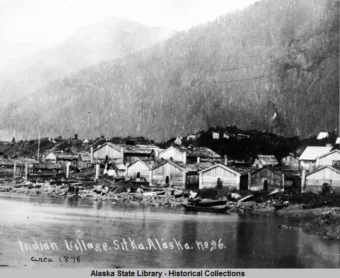
Sitka Indian Village pictured circa 1878. (Photo provided by Alaska State Library Historical Collections)
Sitka Indian Village was once home to over forty Lingít clan houses. Today, only eight of those are still standing, and even fewer serve as active clan houses. Now, the area has been recognized as one of 11 endangered historic places in the US. Organizers are hoping that the attention will inspire efforts to creatively conserve – and rebuild – a cultural hub that has fallen into disrepair.
Katlian Street stretches along the waterfront just north of downtown Sitka. Today, it’s a bustling commercial hub. Workers unload fish totes at the seafood processor, and cars whiz by on their way to the harbors. Dotted between the shops and restaurants are houses – some standing, others collapsed – that tell the story of this street’s past.
“Just this short little walk, there’s multiple clan houses here,” says Chuck Miller, gesturing to lots now occupied by metal shops and parking lots. He’s pointing out sites that once served as cultural centers for Lingít people – places where members of a clan gathered for meetings, ceremonies, and even wakes.
“I remember there were a few here by this parking lot,” Miller says. “The Whale House, the Sea Lion house used to stand here, and a few more Kaagwaantaan houses here.”
Miller is the caretaker for the Kayaash ka hít, or Porch House, one of the few standing clan houses in Sitka. He inherited that responsibility in the 90’s from his late maternal uncle. Under traditional law, that’s how clan houses are passed down. Under the western legal system, though, properties often go to a spouse or children, who aren’t in the same clan. In other cases, multiple clan members are on the deed, making it hard to rebuild or demolish.
“You have to have everybody’s signature on it,” Miller says. “So you can’t demolish something without having everybody’s permission. Sometimes people die, and then you can’t track down the descendants or they didn’t have any. So that’s the debacle we run into nowadays. That’s the clash of the worlds — you have the Western world law, and you have our traditional law.”
In the case of the Point House, a Kiks.ádi clan house that fell out of clan ownership when it was transferred in a will, the house was eventually demolished. Jerrick Hope-Lang, a member of the Kiks.ádi clan, worked with the legal owners torepatriate the land in 2022. He’s been the caretaker since then – and now he’s eager to tackle what he sees as a broader problem.
“We see the collapsed houses, and we see things falling into disrepair, so I wanted to shed light on what’s happening next to me, too,” Hope-Lang says. “Because it’s not just problematic for me, it’s problematic for other people.”
That’s why he asked the National Trust for Historic Preservation to recognize Sitka’s Indian Village as an endangered historic place.He worked with Sitka historian and adopted Kiks.ádi clan member James Poulson to submit the nomination.
“This nomination, although it’s about Sitka’s Indian Village and clan houses, isn’t situational to only Sitka,” Hope-Lang says. “Broadly speaking, Klukwan, Haines, Angoon, all of them are having similar issues.”
The National Trust recognizes 11 endangered historic places each year, prioritizing sites that highlight unique or underrepresented parts of American history. Sitka’s Odess Theater, formerly Richard Allen Memorial Hall, on the Sheldon-Jackson campus, made the 1999 list. In a statement announcing Sitka Indian Village on the 2024 list, National Trust president Carol Quillen said, “the Sitka Tlingit Clan Houses are a critically important part of both the history and the future of Tlingit culture. We hope that broader recognition of their significance will encourage rehabilitation and return of the houses to clan ownership.”
While the nomination doesn’t come with funding, it does come with a lot of publicity. Hope-Lang is hoping that attention will draw support for the neighborhood’s preservation.
“We don’t know what the implications of this nomination will give us but attention,” Hope-Lang says. “And how do we utilize that attention now?”
Figuring out what preservation looks like, though, will require creativity. Outside of tangled questions of ownership, Hope-Lang says that clan houses don’t fit neatly into western historic preservation systems, like the National Parks Service’s National Register of Historic Places.
“The Secretary of Interior has standards for preservation, and they’re often trying to preserve a section in time,” Hope-Lang says. “But those standards don’t really align with Indigenous standards. You know, clan houses can be rebuilt.”
In this case, he says, the actual structure of the house isn’t the most important part.
“It goes beyond just the structure of the building,” he says. “We’re saying, first of all, the land underneath is sacred. The Point House exists whether the building does or not.”
And because most clan houses are privately-owned, he says, it’s harder to get funding to maintain or rebuild them. Hope-Lang says he’s working to start a nonprofit to bypass those challenges and streamline ownership.
“We’re looking at legal structures of how to leave this plot in a way that is for more public-based use, not an individual landowner,” he says. “So sharing those mechanisms of success with other clans and other tribes, we’re navigating Western constructs.”
Those aren’t problems that can be easily solved, but Hope-Lang says the National Trust nomination makes an important statement.
“Our history is worth saving, you know, and that part of town is intrinsically valuable to us. We need to figure out a way to preserve it.”
In the meantime, both Miller and Hope-Lang are working to provide space that reflects what their clans need today. Miller often hosts events for other clans who don’t have active clan houses, and he hopes one of his nephews will become the caretaker someday.
“I’m very proud to take on the role of caretaker as I did,” Miller says. “I did it out of respect and honor for my uncles, you know, and one of these days, hopefully one of my nephews will take up that honor, take the torch up and keep this house going.”
Hope-Lang is working with a Lingít architect to design a 21st-century clan house on the Point House site. He wants it to be a space that not only preserves history, but that allows the clan to flourish today.
“We’re trying to preserve this cultural lifestyle for perpetuity, so this is an opportunity to do so,” Hope-Lang says.
He hopes that with innovative thinking and collaboration, clan houses around the region can flourish as centers for Lingít identity, ceremony, and tradition.
Built in 1921, the New Salem Baptist Church served Black coal miners and their families in Tams, W.Va. (Cody Straley/WV SHPO/National Trust for Historic Preservation)
There’s a lonely old church in the mountains of West Virginia that holds a hidden history. Black coal miners in a segregated camp worshipped there starting in the 1920s. Now, the New Salem Baptist Church is listed as one of America’s 11 most endangered historic sites.
The National Trust for Historic Preservation has released a list highlighting such places every year since 1988. Carol Quillen is the organization’s new president and CEO. Trained as a historian, she was the first female president of Davidson College in North Carolina.
“I studied the past largely through texts, not places,” Quillen told NPR. “And the difference between imagining one’s relationship to the past through experiencing a place and reading a book in a library is really profound. So I love the way these places, which themselves hold layers and layers of stories, and invite us in the present to connect our stories to the ones these places hold.”
Quillen said the push to preserve the New Salem Baptist Church came from a white Catholic woman whose father was the town’s milkman. She enlisted not just the descendants of the church’s original parishioners but also local ATV riders who could see and admire the church from a mountain trail.
“I love stories like that where a preservation project can mobilize folks who normally wouldn’t encounter one another to work together on something significant to all of them,” Quillen said. “And in that work, transform what the place can mean.”
Black residents of Eatonville, Fla., have been trying to preserve their hometown for decades. One of the first self-governing all-Black towns in the United States, Eatonville was immortalized in the classic 1937 novel Their Eyes Were Watching God by Zora Neale Hurston. The legendary Harlem Renaissance writer and anthropologist once described her hometown as “the city of five lakes, three croquet courts, 300 brown skins, 300 good swimmers, plenty guavas, two schools and no jailhouse.”
Hungerford Vocational School students in 1933 in Eatonville, Fla. (Preserve the Eatonville Community Archives/National Trust for Historic Preservation)
In a 2015 NPR story reported by Renata Sago, residents dreamed of an Eatonville reborn as a year-round heritage destination and remembered it as a refuge during the days of Jim Crow.
“We didn’t lock our doors and kids could go out and play,” recalled an elderly resident, Maye Saint Julian. “And everybody knew everybody. And all of these people that we honor so — James Brown, B.B. King, Lionel Hampton — these people came to Eatonville on a regular basis.”
Thomas House is the oldest structure in Eatonville and the original site of the St. Lawrence African Methodist Episcopal Church. (Melissa Jest/National Trust for Historic Preservation)
Ideally, Eatonville and many other sites on the list, such as the Cindy Walker House, could eventually become better-known cultural destinations. Located in Mexia, Texas, the ramshackle white frame structure was where a remarkable, unsung figure in country music lived for many years. Walker was one of the few female songwriters of her era. She wrote country standards and number one hits for Roy Orbison, Merle Haggard, Elvis Presley and more.
Country singer Cindy Walker’s home in Mexia, Texas. (Cindy Walker Foundation/National Trust for Historic Preservation)
After she died in 2006, Walker’s house was left abandoned. A handful of fans and heirs formed a foundation in her honor and purchased it in 2022.
“They found all kinds of things there,” Quillen said. “They found her typewriter. They found her country music awards. They found songs that no one had ever heard before.” One of those songs was a lost demo, called “Tennessee Rain,” that can be heard in the audio version of this story.
This press photo of country singer Cindy Walker was among many never-before-seen photos recovered from the home. (Cindy Walker Foundation/National Trust for Historic Preservation)
Over the past three decades, the National Trust has seen some triumphs with its annual list of endangered places. Dozens of them have been saved, including the Antietam National Battlefield in Maryland, which narrowly missed becoming the site of a shopping mall, and Little Rock Central High School, where young Arkansas students helped overturn a legacy of legal segregation in 1957.
Now established by Congress as a National Historic Site, it’s still a working public high school and a center for education about the country’s civil rights.
“We don’t want to spray these sites with ScotchgarEd, you know, and roll them off,” Quillen said. “We really want to reinvigorate them so that they’re active, exciting places for people to go so that they can continue to bring people together now and long into the future.”
Here are the rest of the endangered historic places on the list this year:
Tarps cover hurricane damage on the roof of the Estate Whim Great House. (St. Croix Landmarks Society/National Trust for Historic Preservation)
Estate Whim Museum, Frederiksted, St. Croix, U.S. Virgin Islands: “Established during the colonization of St. Croix by Denmark, Estate Whim was a plantation producing cotton and sugar for export. The lives and legacies of those enslaved by plantation owners and those who continued to labor there for meager wages for a century after emancipation are inextricably tied to the site, which now hosts a museum, library and archives, and public programming. Repeated hurricanes have damaged many of Estate Whim Museum’s historic buildings and structures.”
The Hudson-Athens Lighthouse is one of two “middle-of-the-river” lighthouses left standing on the Hudson River. (David Oliver/National Trust for Historic Preservation)
Hudson-Athens Lighthouse, Athens, N.Y.: “Opened in 1874, the Hudson-Athens Lighthouse used to be one of several ‘middle-of-the-river’ lighthouses on the Hudson River. Now, it’s one of only two left standing. However, due to erosion and other preservation challenges, engineering reports indicate the building is at risk of collapse within three years if no action is taken.”
1st Street is the major thoroughfare in Los Angeles’ Little Tokyo. Kristin (Fukushima/National Trust for Historic Preservation)
Little Tokyo, Los Angeles, Calif.: “Little Tokyo is one of only four remaining Japantowns in the United States and one of the oldest neighborhoods in Los Angeles, but its unique character is endangered by large-scale development and transit projects and displacement of legacy businesses and restaurants.”
Minute Men and British reenactors fire a musket salute off the North Bridge at Minute Man National Historical Park. (Neil Lynch/National Trust for Historic Preservation)
Minute Man National Historical Park, Walden, and nearby landmarks, Massachusetts: “Minute Man National Historical Park and the nearby areas of Concord, Lexington, Lincoln, and Bedford are home to places of great significance in American history, including Walden Pond and Woods and the preserved homesteads of authors and environmentalists: Little Women’s Louisa May Alcott, Nathaniel Hawthorne, Ralph Waldo Emerson, and Henry David Thoreau. A proposed major expansion of nearby Hanscom Field airport could significantly increase private jet traffic, leading to increased noise, vehicular traffic, and negative environmental and climate impacts.”
Theodore Roosevelt High School in Gary, Ind., in 2015. (Tiffany Tolbert/National Trust for Historic Preservation)
Roosevelt High School, Gary, Ind.: “Theodore Roosevelt High School in Gary was built in 1930 specifically to serve the educational needs of Black Americans and has graduated notable alumni including professional athletes, well-known actors, and members of The Jackson 5. The school has been unoccupied and deteriorating since 2019.”
A view of Sitka Indian Village from across Sitka Harbor, circa 1900-1930. (Library of Congress/National Trust for Historic Preservation)The Sitka Tlingit Village in 2024. (James Poulson/National Trust for Historic Preservation)
Sitka Tlingit Clan Houses, Sitka, Alaska: “The Sitka Tlingit Clan Houses in southeast Alaska are critically important to both the history and the future of the Lingít (commonly spelled in English as “Tlingit”). For many years, the matrilineal clan structure of multigenerational extended families living together in clan houses was discouraged in favor of the Western practice of living with nuclear families. Today, only eight of the original 43 clan houses remain and even fewer still function as clan houses in the traditional way.”
Tangier American Legation’s main courtyard. (Tangier American Legation Institute for Moroccan Studies/National Trust for Historic Preservation)
Tangier American Legation, Tangier, Morocco: “In 1821, the Tangier American Legation in Morocco was gifted to the United States by the Moroccan Sultan as a token of friendship, becoming the first American public property located abroad, and subsequently served as a U.S. diplomatic mission for a record 140 years. Now a cultural center, museum, and research library, the Legation is in urgent need of structural stabilization and repairs following the recent collapse of an adjacent building.”
A cannon on the Wilderness National Military Park. (Lori Coleman/American Battlefield Trust/National Trust for Historic Preservation)
Wilderness Battlefield Area, Orange County, Va.: “The Battle of the Wilderness marked a pivotal turning point in the Civil War, but today, not all the historically significant landscape is protected. Proposed large new developments, including millions of square feet of industrial data centers and thousands of homes, may negatively impact important historic sites and landscapes and degrade the visitor experience.”
Copyright 2024 NPR. To see more, visit https://www.npr.org.
Malin Babcock, 84, poses outside of KTOO in February, 2024. (Photo by Anna Canny/KTOO)
This is Tongass Voices, a series from KTOO sharing weekly perspectives from the homelands of the Áak’w Kwáan and beyond.
Malin Babcock, treasurer of the Gastineau Historical Society, has lived in Juneau for more than 80 years. Her personal history is deeply intertwined with the history of the city and the state.
From the traumatic loss of her grandparents in Juneau’s 1936 landslide, to her long career studying salmon across the state, Babcock reflects on her life in Southeast Alaska.
This transcript has been edited for length and clarity.
Malin Babcock: Well, my name is Malin Babcock, and my grandparents Hugo and Hilja Malin Peterson were both killed in the building. And my mother who was Lillian Peterson Babcock survived.
She was probably one of the first ones that was rescued, because she was on the south end of the slide and right at the very edge when she was hit by the mudslide coming down. And it was the worst disaster that has ever occurred within the City and Borough of Juneau.
My mother was in the hospital for two weeks and then released from the hospital. She talked about it very rarely.
My grandparents were Finnish immigrants. There’s a lot of stoicism that goes throughout that culture. So they emigrated to Juneau late in 1913. My uncle Elmer, and my grandfather were miners, and they both worked for the AJ Mine.
My mother was born on November 9th of 1914, and grew up here, went through high school here. And she obtained a secretarial job with a fella by the name of Frank DuFresne, who was the head of the Alaska Fish Commission at that time. And he did all the arrangement for the funeral and everything else for her parents, which was absolutely amazing.
She later married of fella by the name of Doug Babcock, my dad, who was an early member of the Territorial Sportsmen, plus being one of the first Taku River Rats. And he notably helped in some of the early experimentation for salmon and salmon eggs that led to DIPAC.
Years later – years later – when I went to school at Oregon State and then up to Fairbanks for my master’s degree, where I took ichthyology and fisheries courses, our textbook was by Frank DuFresne. And it was called Alaska Fishes. I mean, it’s absolutely amazing, the webs that we turn that we find out later, you know, and that end up surprising you.
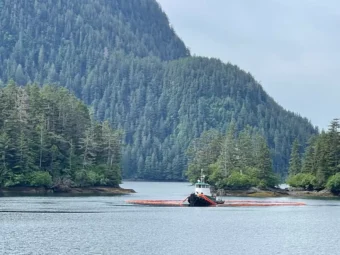
So I went to work at the Auke Bay Lab in 1969. There were not many women biologists, I think there were two when I started to work there. And I spent many, many a summer up in King Salmon in Bristol Bay. And I spent seven years walking the beaches of Prince William Sound working with with the effects of hydrocarbons after the Exxon Valdez oil spill. Anyway, it was just kind of a neat career and I’m very proud of myself.
Close
Update notification options
Subscribe to notifications
Subscribe
Get notifications about news related to the topics you care about. You can unsubscribe anytime.