History

Alaska officials echo federal push to promote healing after boarding schools report

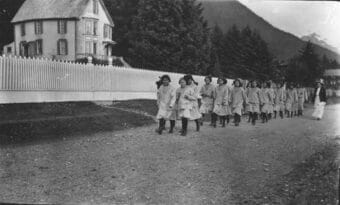
Children attend the Sheldon Jackson School in Sitka, in a photo dated between 1900 and 1930. (Library of Congress Prints and Photographs Division Washington, D.C.)

A new national report includes a series of recommendations from the U.S.’s top Indian Affairs official to promote healing from the forced assimilation of American Indian and Alaska Native children.

Twenty-two of the 417 federal Indian boarding schools that operated in the United States in the 1800s were in Alaska, according to an investigative report the U.S. Department of the Interior released on Tuesday.

Local research has found more evidence of boarding schools than the federal report did. Research from the Alaska Native Heritage Center shows there were more than 100 government-funded, church-run Alaska Native boarding schools in Alaska from the late 1800s through the 1960s.

The report documents the U.S. government’s role in operating the federal Indian boarding school system in which American Indian and Alaska Native children were removed from their families and forcibly assimilated from the 1800s through the 1960s.

Nearly 1,000 children died at such schools, the report said. Many living Alaskans have memories of abuse and cultural assimilation at such schools.

Assistant Interior Secretary Bryan Newland included several recommendations in the report, such as acknowledging, apologizing for and repudiating the forced assimilation policy. Other steps Newland recommended include: investing in culturally based community-driven healing efforts; building a national memorial to the board school experiences; returning the remains of children who died at the schools and never returned home; and returning the school sites to tribes at their request.

The news from the Federal Indian Boarding School Initiative comes as Alaska lawmakers push for more investigations and more healing.

U.S. Sen. Lisa Murkowski, R-Alaska, is the vice chair of the Senate Committee on Indian Affairs and has led a bipartisan effort with U.S. Sen. Brian Schatz, D-Hawaii, to create a Native-led commission tasked with revealing the full scope of what took place at boarding schools. In a statement, she said she welcomed the report.

“These findings affirm my resolve to get the Truth and Healing Commission legislation signed into law,” Murkowski said in the statement. “The more we understand the truth about this era, the more we are able to help all those affected find healing.”

In a text, Murkowski said the report is more than just words, but the stories of real Alaskans.

“It was particularly impactful to read some of the specific Alaska anecdotes throughout the report, including excerpts from Alaskan survivors on the road to healing. Their stories bring life to the harsh realities that these children faced— being stripped from their traditional clothing, becoming violently ill from being fed spoiled food, and facing acts of sexual abuse and physical harm,” she wrote, in part.

The commission would provide a platform for survivors to share their experiences and receive national acknowledgement. The Truth and Healing Commission on Indian Boarding School Policies Act has 32 cosponsors.

It also has the overwhelming support of Alaska Legislators, who nearly unanimously OK’d a resolution backing it that was sponsored by Rep. CJ McCormick, D-Bethel. House Joint Resolution 17 supports the commission and acknowledges the trauma Indian boarding schools inflicted on Indigenous communities in Alaska and across the country.

McCormick, who is from Bethel, said reports such as this one hit close to home.

He said the report made him think of boarding schools like the Moravian Children’s Home near Bethel. “Thinking about it in the context of rural Alaska, knowing how remote some of these schools are, it’s just really scary and very just sad to know that there might be hundreds of other children … who are perhaps killed, and lay somewhere like in an unmarked place that no one will ever know about,” he said.

McCormick said he was struck by the amount of money that went into operating these schools — nearly $32 billion in today’s dollars. He said it is now up to lawmakers to think of ways to put equal measure into healing the harm.

“As time goes on and more comes to light, I’m finding out people I’ve known my whole life have experienced things that I never knew about them, or never knew they were subjected to,” he said.

“​​It’s really, really striking, I think, how many people that I know who have gone on to be community leaders or really anything for that matter, that they had to endure that.”

Alaska Quakers have formally apologized for the state’s boarding schools; former Gov. Bill Walker did as well.

New statue at Tee Harbor commemorates mythical sole survivor of the SS Princess Sophia

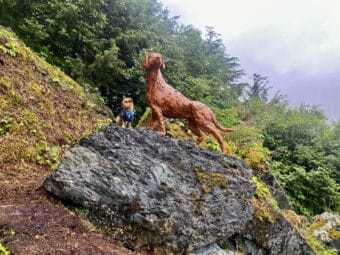
The Tommy statue at Tee Harbor was paid for and installed by an anonymous Juneau family (Photo by Anna Canny/KTOO)

A new guardian is watching over the treacherous waters of Lynn Canal, where several historic shipwrecks happened. Tommy, the mythical sole survivor of the sinking of the SS Princess Sophia, is now cast in bronze atop a boulder at Tee Harbor.

The Sophia — pronounced “so-FYE-ah” — set sail out of Skagway on October 23, 1918, carrying gold prospectors and others on the way to Vancouver and Victoria, Canada. But before the passenger liner could reach her final port, she ran aground on Vanderbilt Reef and, despite rescue efforts, sank almost two days later, on Oct. 25.

The disaster is sometimes called the “Titanic of the Pacific.”

“But like, people survived on the Titanic,” said Brian Weed, an amateur Juneau historian. “Nobody survived on this.”

More than 350 people went down with the ship, but as the story goes, Tommy the dog was able to swim through the frigid waters to reach the shore close to where the new statue now stands.

The steamship Princess Sophia grounded on Vanderbilt Reef. Photo courtesy of the Alaska State Library Historical Collections, Winter and Pond. Photographs, 1893-1943. ASL-PCA-87 ASL-P87-1702

The statue was funded by an anonymous Juneau family, and quietly installed on city land earlier this month. Then Weed, who was not involved, unveiled it on his popular Facebook page, Juneau’s Hidden History.

It’s accessible via the North Tee Harbor trail, which is a short hike down to the rocky shoreline. Weed led the way recently, accompanied by his own dog, Doug, a tiny Yorkshire terrier mix.

On the day the SS Princess Sophia ran aground, rain was pouring and wind was howling as a violent storm bore down on the ship. But on the morning Weed visited the statue, it was just drizzling. Doug was wearing a blue and gray raincoat to stay dry.

On the boulder where the statue stands, a small plaque identifies Tommy as a Chesapeake Bay retriever, though the actual likeness to the breed is vague. The metal is sculpted into wispy fur, and the dog’s strangely long neck is craned towards the rocky surface of the distant reef, which just barely breaks the surface of the water.

The Tommy statue is at least the third canine monument in Juneau. On the cruise ship docks there’s a sculpture of Patsy Ann, the bull terrier who greeted ships coming into port back in the 1930s. And near the Mendenhall Glacier there’s a plaque for Romeo, a wild black wolf who sometimes struck up friendly relationships with pet dogs.

“Juneau has always been a huge dog town,” Weed said.

But our dogs have not always walked on leashes, or slept in beds or worn raincoats, for that matter.

That’s why local scuba diver Annette Smith is skeptical about the miraculous story of the dog who survived. Smith has visited the wreck of the Sophia dozens of times and has done countless hours of research on the ship’s story.

She says there was a fish cannery at Tee Harbor in the early 1900s.

“The people that worked there had dogs. And they were not groomed, right? They did not sleep in the house. They were oily and greasy,” Smith said. “That’s where I think the dog from the dog story came from – (it) was probably one of those.”

In a story published in the Alaska Daily Empire in March 1919, a few months after the shipwreck, cannery workers described the arrival of a half-starved dog, whose white and brown spotted coat was covered in oil.

Unnamed at the time, it was believed to be a thoroughbred English Setter belonging to Captain James Alexander, who went down with the ship.

Setters are decent swimmers, but to make it to Tee Harbor, Tommy would have had to paddle nearly 15 miles.

“Let’s say yes, a dog survived. Let’s say yes, it managed to fight against five plus foot seas, 50 mile an hour winds that were pushing it,” Smith said. “Where’s it gonna come ashore? Well, the first place it’s going to come ashore is Amalga, not Tee Harbor.

To Smith, the story seems unlikely.

Then, a few years ago, researchers at the British Maritime Museum examined the dog’s survival story again, and they found a letter written by the administrator of the late Alexander’s estate, which instead described the dog that had been found in Juneau as a Chesapeake Bay Retriever.

Chesapeake Bay Retrievers have thick, water-resistant coats and strong paddle-like tails. It is believed that the breed descended from two puppies that survived a Newfoundland shipwreck in 1807.

That makes Tommy’s feat seem slightly more plausible. But we’ll probably never really know for sure.

Stories of dogs surviving shipwrecks are common. Three small dogs actually did survive the Titanic, when their owners carried them onto the lifeboats. But an enduring story of Rigel, a heroic black Newfoundland who supposedly helped save people when the Titanic went down, has been proven false.

Whether they’re real or fake, these stories often get passed down. Tommy’s survival was even featured as the climax of the Princess Sophia opera, a theater production that commemorated the 100th anniversary of the tragedy in 2018. Smith understands why.

“There’s people trying to make sense of this horrible tragedy and having a dog or something survive provides some hope. Right? And gives a little bit of meaning,” she said.

But to her, the tragic human side of the Princess Sophia story is more compelling.

Did people really used to race down Gold Creek on the Fourth of July?

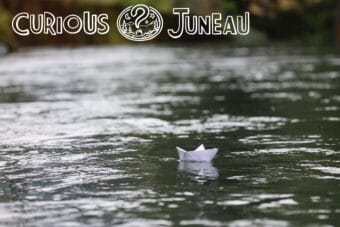
A paper boat made by KTOO staff braves Gold Creek. July 11, 2024. (Photo by Clarise Larson/KTOO)

Alaskans celebrate the Fourth of July in a myriad of ways, whether it’s log-rolling competitions, launching cars off of cliffs, or jumping high in the air in the blanket toss.

Do you have a Curious Juneau question? Submit it at the bottom of the page.

In Juneau, we have our fireworks on the third, an old tradition that let miners sleep off their hangovers. But KTOO listener Mary McEwen wrote in to ask about a different July 4 tradition — one her father told stories about.
“It’s kind of been a piece of family lore that, you know, ‘Oh you know I once won a race down Gold Creek on a piece of Styrofoam,’” she said. 

It’s true. Some brave Juneauites used to celebrate Independence Day by racing down Gold Creek on improvised rafts — something akin to the Red Green Regatta, on speed. 

For this Curious Juneau, we talked to some of the people who did it — like Jim Williams.

“There were probably 15 or 20 idiots that attempted it,” he said.

Williams said that when he did the race in the 1960s, dozens of people came to watch the racers from the banks of the creek in downtown Juneau. 

Gold Creek runs in a paved channel, and the water flows fast over the concrete. The race started in Cope Park and wound through downtown, so the racers sped past the Federal Building and Foodland before getting dumped into Gastineau Channel.

The Gold Creek sluice. Going over this sluice was the starting point for the race. July 11, 2024. (Photo by Clarise Larson/KTOO)

People went down the creek one at a time, riding everything from proper inflatable rafts to wooden doors. Williams rode an air mattress.

It didn’t go well.

“I just remember going over something and immediately popped my raft, so I was dead last in the race,” he said. “I had to walk all the way down Gold Creek because the only way to get out of there was to get down by Foodland.”   

Williams competed with his friend Gary Rosenberger, a high school sophomore at the time. Rosenberger said he laid on his air mattress like a surfboard and paddled with his arms. 

“I had to hold on to it going over the falls, and then it was smooth sailing from then,” he said.

Old newspaper stories said the fastest time in 1967 was nearly two-and-a-half minutes. The next year, the currents must have been stronger — the winner came in at a minute and a half.

Gary Rosenberger said he may have won the race once if he hadn’t gotten out of the water too soon.

“But I didn’t know there was an end — where the end was,” he said. “So everybody was yelling at me, but I didn’t know what they were yelling because it had to be six or seven people all yelling the same thing.” 

Gary Rosenberger at Gold Creek, where he competed in a race almost 60 years ago. July 10, 2024. (Photo by Yvonne Krumrey/KTOO)

And Mary McEwen’s dad? Duane McEwen said he won the race on a raft built from Styrofoam with a wooden frame. 

“I think I made a paddle out of a broom handle and a piece of wood — it was strictly homemade,” he said. 

But then he left his raft outside all year, and the foam was heavy and waterlogged by the next July.

“The second year I came in last place,” McEwen said. “I dragged bottom all the way down there.” 

It’s not clear just how enduring this tradition was — the race did not get a lot of news coverage. Williams said it seems like it only happened once or twice more.

“I think they decided there was some liability there. Which, I don’t know why they would have ever thought that,” he said. 

But another listener wrote to say he remembered the race continuing well into the 1980s. And a 1967 story in the Alaska Daily Empire calls that year’s running the “75th annual sluice race down Gold Creek” — though Curious Juneau could not find anything to back that up.

Rosenberger said it would be more dangerous now. Since the 1960s, some large rocks have been placed at the end of the creek.

“You wouldn’t — I don’t think — drown or anything,” he said. “But you’d probably be embarrassed if everybody was watching you.”

Correction: This story has been edited to include new information about what years the race took place.


Curious Juneau

Are you curious about Juneau, its history, places and people? Or if you just like to ask questions, then ask away!

Anchorage cemetery tour celebrates the contributions of past Black leaders

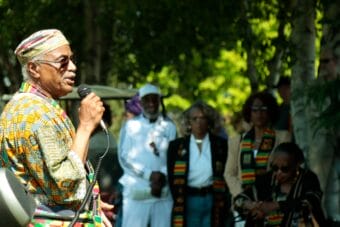
Cal Williams leads the Soul in the Cemetery tour through Anchorage Memorial Park Cemetery on June 22, 2022. (Leigh Walden/Alaska Public Media)

On one of the nicest Saturdays so far this summer, about 200 people competed for space surrounding a tombstone at the Anchorage Memorial Park Cemetery.

Their host for the afternoon: Cal Williams.

For over two hours, Williams led the lively group on a journey through the cemetery, recounting the lives of prominent Black Alaskans who are now buried there. It was the second annual “Soul in the Cemetery” Juneteenth event — an opportunity for the community to not only celebrate Black history in Alaska and the lives of Black leaders, but also to remember elements of change that residents continue to work toward today.

“As I visit these graves,” Williams said, “it causes me to reflect on how much more they could have given if they were still here and the great joy and wonders of what they did in the time that they were here.”

Williams is a longtime Alaska resident who personally knew many of the people highlighted on the tour. At each grave on Saturday, he introduced the individual laid to rest there to the crowd.

The group’s first stop: the tomb of Elgin Jones, who founded the multi-cultural publication, The Anchorage Gazette. And in his later years, he worked tirelessly with Kids Kitchen, a group estimated to have served over one million free meals to local children in need.

Williams then welcomed members of the crowd who knew Jones to recount the impact he had on Anchorage. Several people vied for the microphone. They remembered Jones as someone who deeply loved helping children and who worked through all sorts of logistical challenges to do his work in aiding them.

“Brother Elgin…went by the rule of: If you’re gonna do it, do it right for the children,” said Rev. Wilbert Mickens of New Hope Baptist Church.

Cal Williams and Rev. Wilbert Mickens laugh together while Mickens tells a story about his late friend, Rev. William Lyons. (Leigh Walden/Alaska Public Media)

The tour continued to the graves of a variety of other notable Black leaders including Richard and Anna Watts, Helen and Toby Gamble, Johnnie L. Gay, Rebecca Kinney and Rev. William B. Lyons, Sr. Their impact within Alaska spanned many realms of life, from hairdressing to chairing the Anchorage branch of the NAACP to carpentry to serving as the president of the Licensed Practical Colored Nurses of Louisiana.

At the grave of Helen Gamble, Robin Cole Barden introduced some of the interwoven life stories of the late Gamble and her family.

“Helen Gamble got here by my grandfather. He drove Helen Gamble from Oakland, California,” he said. “Before it was a state, when it was a territory, it was a total different land, total different community. And they thrived here because of that. Once it became a state with federal law there were Jim Crow laws and so the African Americans in Alaska and in Anchorage had to rebuild to thrive.”

Williams said so many people don’t know that part of Alaska’s history, and that’s why this tour is so special.

“Oftentimes many people have asked: I didn’t know that there were Black people here because most of the books that we’ve seen and most of the advertisement and PR about Alaska did not include — not only Black people, but not Native people,” Williams said. “And so today we acknowledge that by our presence, we appreciate those who have called upon us to pay tribute to those who have gone before us.”

The grave of Rebecca Kinney, a celebrated Anchorage cosmetologist. (Leigh Walden/Alaska Public Media)

Those honored throughout the event are just a fraction of the Black Alaskans who did work to build a robust Black presence in Alaska —  work that event organizers say is ongoing.

It’s important work, said Ted Ellis, acting chair of the 400 years of African American History Commission, a federally appointed committee established in 2019 with the goal of rediscovering the 400 years of history since Africans were first brought to English colonies in 1619. Ellis and other members of the group attended Saturday’s tour.

“It’s so critically important that we realize the legacy of those who have come before us,” he said, “that we preserve those memories and those stories, that we take that and we share that and we grow and we do better as we continue to move toward excellence.”

One of the leaders that continues this work is Williams himself. The commission recognized him during the event as one of America’s 400 African American History Keepers. Williams has lived in Alaska for decades, is a past president of the NAACP Alaska chapter and committed activist working toward Black advancement nationwide.

“It is humbling and exciting to do this work,” Williams said. “I’m so happy that Darrel Hess came up with the crazy idea of going and visiting graves in this cemetery that entombed African Americans who made significant strides in development here in Anchorage, Alaska.”

Williams and the organizers of Soul at the Cemetery say they look forward to many more events to come.

Cal Williams carries his drum while walking with a member of the 400 Years of African American History Commission through Anchorage Memorial Park Cemetery. (Leigh Walden, Alaska Public Media)

A Chilkat robe returns to Southeast Alaska, but SHI needs help identifying it

Sealaska Heritage Institute Director of Archives and Collections Emily Galgano shows the back of a Chilkat robe on loan from the Rahr-West Museum in Wisconsin. June 20, 2024. (Yvonne Krumrey/KTOO)

In the basement of the Walter Soboleff building on a recent afternoon, Emily Galgano opened a huge white cabinet. She pulled out a long drawer with a Chilkat robe laying inside. The robe’s colors are faded. 

“So it could be very old, or it could be less old. I’m assuming at least 100, 150 years old,” she said. “But it’s hard to say exactly.”

In May, a Wisconsin museum sent a Chilkat robe that it’s had for the last 80 years to Sealaska Heritage Institute in Juneau to identify which clan it belongs to and, hopefully, give it back to them. 

Galgano is Sealaska Hertiage Institute’s archives and collections director. She said the robe is a diving whale design. Some of the black coloring has faded to purple and rust. Other spots are still rich and dark, which could indicate a different batch of dye. 

With gloves on, Galgano flipped a corner of the robe to reveal colors much closer to how they might have looked when the robe was new: dark blacks and bright yellows. 

Earlier this month, the robe was on display during Celebration. Galgano had hoped that people might see it and know something about its origins. 

“We’re always working with the community to try and crowdsource that sort of information,” she said. “This is the first time I’ve done something with an object like this, that’s of this scale — but we have done similar, smaller projects.”

The robe is on loan from the Rahr-West Museum in Manitowoc, Wisconsin. Greg Vadney, the museum’s executive director, said they don’t have anything else like it — he believes it came to the museum in the 1940s from someone who served in the U.S. Coast Guard in Alaska.

“We have nothing else that we know that even comes from the Pacific Northwest, let alone Alaskan tribal culture,” Vadney said. “So we were excited to be able to return it to its home. And we’re also very excited that hopefully, while it’s at Sealaska Heritage, some of the gaps in the history that we don’t know about — some of that detail can get filled in in this partnership.”

He said the idea to reach out to SHI came from Manitowoc artist Skip Wallen, who designed the whale sculpture in Juneau’s Overstreet Park.

A Chilkat robe on loan from the Rahr-West Museum in Wisconsin. Sealaska Heritage Institute is looking for any information that could help identify it. June 20, 2024. (Photo by Yvonne Krumrey/KTOO)

Vadney said Rahr-West is eager to return the robe to its original owners. 

“Certainly as a museum, oftentimes we kind of, unfortunately, look at the things as things, and forget about the material culture of it and the human element,” he said. “And in this case, the spiritual element that is inherent to it.”

The robe is on loan to SHI for the next year, but it could stay in Juneau long term while the organizations decide next steps. 

“Our thought process is, this is a step towards repatriation,” Vadney said. 

Galgano said SHI’s next step will be gathering expert weavers to study the robe. 

“If it belongs to a clan, and it’s something like at.oo — where it’s a clan-owned object — then we also have a process where clans can long-term loan items here, where we’ll still care for it. It’ll still be in our climate-controlled vault and taken care of here, but it won’t belong to the museum, and they can then check it out for ceremonies, things like ku.eek,” she said.

Galgano said she wants anyone who thinks they may have information about the robe to make an appointment to come see it by emailing her at emily.pastore@sealaska.com. 

Accidental discovery of sunken ship near Sitka reveals surprising history

A dive team investigated the site of a sunken wooden vessel in Herring Cove on Friday, June 14, 2024. (Katherine Rose/KCAW)

On June 9, a mariner fouled his anchor in Herring Cove. Every time he tried to move the anchor, a little oil sheen and debris would pop up.

“He called us to check and make sure that there wasn’t any known debris in the area, and to try to see if there was a known snag,” said Petty Officer First Class Heather Darce in an interview with KCAW. Darce is a marine science technician with the Coast Guard’s Marine Safety Detachment in Sitka.

“We were able to check local charts, [and] there was nothing down there that was charted,” Darce said.

Darce says the mariner then hired a local diver to help retrieve his anchor. In doing so, the diver discovered a sunken boat, an 80-foot wooden vessel, attached to a smaller boat. The boat’s sinking hadn’t been reported to the Coast Guard. But they were able to find its vessel number and name.

“So the Dragon Lady is the last name that she held, but the boat was actually built in the ’40s and went through a bunch of different iterations,” Darce said.

The Coast Guard immediately hired a marine salvage crew to contain the oil and figure out if it was purging any more oil– and it wasn’t. So Darce says they began to research the boat to figure out where its fuel tanks might be so they could dive down and remove the fuel safely. They found the builder, Wheeler, in Brooklyn, New York, and requested diagrams of the boat.

“They didn’t have anything that old, but they did go ahead and let us know that that hull number corresponded to a vessel that was built by them in 1943 for use by the United States Coast Guard,” Darce said.

“That sort of changed…things on a little bit of an emotional level for us, knowing that, as Coasties, that this was a Coast Guard Cutter.”

Wheeler built over 230 patrol boats for the Coast Guard during World War 2. According to the Wheeler Yacht Company, 48 of them were at Omaha Beach on D-Day. Before the Dragon Lady got her name, Darce  said she was Coast Guard Cutter 83482.

“The military was basically pumping out equipment to get it to the frontlines as fast as possible,” Darce said. “And none of the 238 cutters that were built by Wheeler during those years were actually named, they were given a hull number.”

Darce said they dove deeper into the history of the cutter, and discovered the vessel was delivered to Guam in 1943.

“Her delivery would have taken place prior to the Battle of Guam, which happened in summer of 1944,” Darce said. “So she very well have maintained on that service during the Battle of Guam.”

Coast Guard cutter 83482 being delivered to Guam in 1943. (USCG Photo)

After the War was over, Coast Guard Cutter 83482 was decommissioned and turned into a private craft. She was in Portland for a while, was used as a fishing vessel and brought to Alaska, sold again to become the Dragon Lady, a charter yacht, and eventually became a liveaboard toward the end of her life.

It’s unclear exactly when the Dragon Lady sank — it had been anchored in Herring Cove for a while. Darce said they were able to contact the boat’s owner who wasn’t in the area when it began taking on water, but the owner has been cooperating with the Coast Guard. But salvaging the boat isn’t in the cards.

“Even if somebody really wanted to bring up the Dragon Lady, she’s a wooden hulled vessel built in the ’40s. She’s been underwater for a significant period of time, and she’s 80 years old,” Darce said. “So even if for some reason we could not get to the tanks, in her case she’s not necessarily a good candidate even to try to move or roll, especially with her size.”

Darce doesn’t believe there’s much fuel on the boat, but a dive team has been diligently working to remove any remaining fuel to prevent future environmental risk. Once they’ve emptied the vessel and sealed up vents, Darce said they’ll update charts to show Herring Cove as the resting place for the Dragon Lady.

The most recent known photo of the F/V Dragon Lady (Coast Guard)
Site notifications
Update notification options
Subscribe to notifications