History

Alaska flag designer Benny Benson granted honorary doctorate

Daren Herman, grandson of Alaska flag designer Benny Benson, was in the state for the first time to accept an honorary degree on his late grandfather’s behalf. (Photo by Adelyn Baxter/KTOO)
A special visitor touched down at Ted Stevens Anchorage International Airport on April 24. Daren Herman, grandson of Alaska flag designer Benny Benson, was in the state for the first time to accept an honorary degree on his late grandfather’s behalf. It had been almost a century since Benson’s unlikely win in a flag design contest for Alaska schoolchildren.

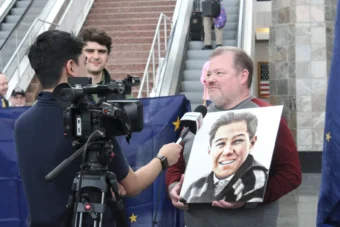
Herman descended the airport lobby escalator to a crowd cheering, singing the Alaska Flag Song, waving the iconic blue and gold starred banner, and performing traditional Unangax̂ dances. He knew there would be a reception, but not how big it would be.

Livingston showed Herman around Anchorage, bringing him to local landmarks, including those named after Benson. (Photo courtesy of Mike Livingston)

“I can’t even put words to it. I would have never dreamt anything like this,” he said. “This is just awesome, it’s crazy.”

Herman is from North Dakota, but has deep family roots in Alaska. His grandfather was the boy who overcame unlikely odds and prejudice to become the first and only known Native person to design an American state flag. Benson died in 1972 at age 59, and received an honorary doctorate in humane letters from Alaska Pacific University on April 26.

Mike Livingston, a regional historian whose work centers on overlooked Alaska Native stories in the Aleutians and beyond, served as Herman’s guide. He showed Herman around Anchorage, bringing him to local landmarks, including those named after Benson.

Livingston is a fixture of cultural justice efforts in the region he calls home. He played a part in recognizing the World War II service of Unangax̂ soldier Pfc. George Fox, and in bringing traditional Unangax̂ names back to Aleutian sites with offensive monikers like “Nip Hill” and “Nazi Creek.” He was also part of a team recognized by the Alaska press corps last month for shedding light on the state’s Missing and Murdered Indigenous People.

“It brings me a lot of satisfaction to recognize our heroes who have, in a real sense, been forgotten,” Livingston told KUCB.

Livingston said Benson receiving an honorary doctorate is “pretty dang cool.”
(Photo courtesy of Mike Livingston)

He spent years researching Benson’s life and heritage, and was the lead author of a 2022 paper that sought to correct a misconception that Benson was Alutiiq or Sugpiaq, not Unangax̂. Livingston pushed to have Benson posthumously enrolled as a member of the Qawalangin Tribe of Unalaska, which was approved the same day Benson’s grandson landed in Alaska.

Livingston said Benson receiving an honorary doctorate is “pretty dang cool.”

“He really should have received it when he was still with us, but it’s never too late to correct wrongs,” he said.

Benson grew up in the Jesse Lee Home for Children, a boarding school in Unalaska that later moved to Seward. He experienced firsthand discrimination during the flag design contest when a panel of judges, some of whom were members of the Seward press, wrote offensive things about him based on his ethnicity. This lit a spark in him, and in the 1960s, he successfully advocated for his inclusion in the Kodiak Elks Lodge, opening the door for other Alaska Natives to join the Elks.

Livingston called Benson “a positive role model.”

“He was a brave young man who stayed in the contest and won the contest,” he said. “If it hadn’t been for Benny, we probably would have another boring state flag with a blue background and the state seal in the middle of it.”

At the commencement, around 120 graduates were recognized, including Benson.

Alaska Pacific University President Janelle Vanasse credited his contributions to the state.

“Today, we Alaskans are proud of our flag. Our state song echoes the words that young Benny submitted with his very design,” she said. “We have our flag because of Benny’s resolve.”

The room was packed with family and friends of the graduates, many of whom are Alaska Native. Herman walked onstage and accepted his grandfather’s doctorate to applause.

After the ceremony, Herman said as busy as it was, his first visit to Alaska was “awesome” and a learning experience.

“A lot of this stuff’s new to me, and it’s great to hear the story and be a part of it,” he said.

KTOO’s Adelyn Baxter contributed reporting.

Alaska lawmakers pass bill designating March as Women’s History Month

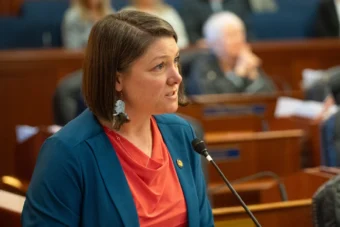
Rep. Carolyn Hall, D-Anchorage, speaks in support of a bill designating March as Women’s History Month in state law on March 28, 2025. (Eric Stone/Alaska Public Media)

The Alaska Legislature passed a bill Friday that would, if signed by the governor, designate March as Women’s History Month in state law.

Backers say it’s an effort to recognize the important contributions women have made to Alaska and the nation as a whole.

The main sponsor in the House, Rep. Carolyn Hall, D-Anchorage, introduced the bill by reading the names of more than 50 notable Alaska women, starting with Gail PhillipsVera AlexanderCarol BeeryEllen PaneokNellie CashmanElizabeth Peratrovich and Tina DeLapp.

“How many names mentioned have everyday Alaskans heard of before? How many of us know their accomplishments, their leadership, or their fortitude?” she said.

Establishing a particular month in state law to honor their contributions would help Alaskans better appreciate the female leaders who came before them, she said.

“This is why it’s so important for Alaska to honor and preserve Women’s History Month,” she said. “The purpose is to lift up, recognize and integrate women’s experiences into our state’s narrative.”

This year, for the first time, women outnumber men in the Alaska House of Representatives, a fact Hall noted in her speech supporting the bill.

Sen. Elvi Gray-Jackson, an Anchorage Democrat, wrote the bill and carried it through the Senate.

“Alaska is a land of resilience, where survival depends on strength, adaptability and community, and for generations, women have been at the heart of it all — leaders, trailblazers and defenders of culture and justice,” Gray-Jackson said during debate on the bill on March 3. “Too often, their contributions have been overlooked.”

Gray-Jackson said she hoped the observance would help inspire the next generation of female leaders.

The bill passed 19-0 in the Senate and 33-2 in the House with broad, bipartisan support in both chambers.

Republican Reps. Julie Coulombe of Anchorage and Mike Prax of North Pole were the only lawmakers voting no. Prax and Coulombe said after the vote they thought women should be recognized for their accomplishments rather than their gender. Coulombe said designating a month for women’s history wouldn’t make a meaningful difference in women’s lives.

“This isn’t going to help women. I want policies that actually help women, and us just passing resolutions and days doesn’t do anything,” she said. “We keep hearing that we have a majority of women in the Legislature, and I take offense that I’m a ‘woman legislator.’ I’m just a legislator.”

Gov. Mike Dunleavy’s communications director, Jeff Turner, declined to say whether the governor would sign the bill.

Tongass Voices: Betsy Longenbaugh and Ed Schoenfeld on the skeletons in Juneau’s closet

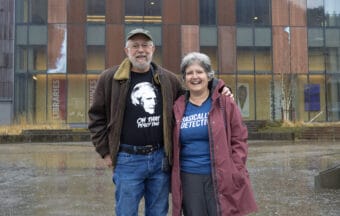
Ed Schoenfeld and Betsy Longenbaugh research old true crime stories in Southeast Alaska together at the Alaska State Archives on March 7, 2025. (Photo by Yvonne Krumrey/KTOO)

This is Tongass Voices, a series from KTOO sharing weekly perspectives from the homelands of the Áak’w Kwáan and beyond.

A retired couple in Juneau has picked up an interesting hobby — researching true crime stories in Southeast Alaska’s history. Betsy Longenbaugh and Ed Schoenfeld host walking tours and talks, and Longenbaugh has turned the research into two books, with another in progress.
Her first work of fiction, Death in the Underworld, is based on a crime committed in Douglas in 1916. And they have two upcoming presentations — called Death with Dessert — in April and May. 

Betsy Longenbaugh: Our daughter, when we talked about Alaska’s first serial killer, made a cheesecake with a cereal crust. So she’s very deliberate about choosing, choosing the desserts and tailoring them to our presentation.

Ed Schoenfeld: We had a story about dismemberment and dismemberment, and she created a dismembered lemon meringue pie.

Betsy Longenbaugh: I’m Betsy Longenbaugh.

Ed Schoenfeld: I’m Ed Schoenfeld.

Betsy Longenbaugh: Well, both of us retired. We’ve been retired now for somewhere between six and seven years, and our passion after we retired, very unexpectedly, became looking into historic murders in not just Juneau, but some of the other communities in Southeast Alaska.

Ed Schoenfeld: And we call our effort True Crime Alaska, because everybody needs to be branded, right? And we research historic true crime. And it’s not just to do blood and guts, you know, like so much of the true crime reporting is these days, but we really like to talk about what’s going on in the community, and it really gives you a window into a community at a different point of time. I mean, Juneau in 1904 or, you know, Tenakee in the 1930s.

Betsy Longenbaugh: 1906, to be precise.

Ed Schoenfeld: And beyond that, it also just gives us a chance to talk about not only the particular cases, but how the justice system worked, how the community responded to times of crisis, which, in a small town, a murder generally, is a crisis.

And also to examine how the judicial system, the police, etc, responded to crimes against women and people of color, because obviously there was a lot of discrimination in those days.

Betsy Longenbaugh: But also how the media covered it. I mean, one of the things that have been interesting and frustrating is when we do our research, we know that there are Alaska Native women and men being killed. There’s very little coverage about them in the newspapers. There might be an account that it happened. But often it’s not much more than a name or two and maybe a charge.

In my second non fiction book, I just wrote a piece about a murder that happened in Petersburg, it was a horrible murder. It was a woman and child, and you would think it would have been a very sensational story that got a lot of coverage, but they were Chinese and their killer was Japanese, and they were all cannery workers. So there was actually very little coverage about the crime itself, even in Petersburg, where it happened.

Because we rely so heavily on newspapers as a resource for research, it’s upsetting and a little frustrating when the newspaper turns a blind eye to really these terrible things that are happening and we can’t get a handle on it.

We’re basically dealing with stories that don’t involve it, involve any live witnesses in all. But one case, the new book is going to have a story that happened in Sitka in the late 1950s and I actually was able to talk to two witnesses to that case, simply because I grew up in Sitka. So I was able to sort of track down these old timers, one of a former nurse who just turned 100 and was sharp as a tack and really helpful in the story.

So not having people who were there, having to rely on all third hand resources, so not having live witnesses, and then trying to figure out bits and pieces of clues. I had a story that I just wrote about a killing down in Ketchikan, and I thought I had a pretty good handle on it, until I contacted my source in Alcatraz. I have a guy I worked with named Gregory Schmidt, who works for the archives down in San Francisco, and he sends me these amazing resources from Alcatraz.

And when he sent that, I realized that most likely this man had not actually done the crime, based on what happened during his parole hearings and his behavior in prison, where he spent most of the rest of his life.

Finding those little bits and pieces, and sometimes big bits and pieces, is really the fun part. Again, it’s the puzzle, right? It’s figuring out.

Ed Schoenfeld: And sometimes we just have a feeling that there’s something missing that maybe we can find if we dig deeper. And it’s the same as when you’re reporting, you think you have the story, but you’ve done enough of this to think there’s something else going on here we should know about.

And sometimes we, pretty much, you know, decide not, not to include something in a book or presentation, because we’re just not sure. Usually we’re able to figure it out one way or the other.

Betsy Longenbaugh: We’ve been very clear about drawing the line at statehood, because when we initially did this work, not the writing, but the walking tours, we included some cases that Ed had covered as a reporter and that I was familiar with. And it became too traumatic, not just for us, but for the people who were hearing the stories.

I remember walking to her where we were talking about a contemporary murder was not, I don’t know, 25-30 years ago, but one of the people on the tour had taught the defendant in grade school. And another tour, we’d had somebody who’d served on the jury.

And I’m from a little town, you know? I’m from Sitka and I know how these things haunt communities. They really haunt communities. And we didn’t want to be participating in that haunting.

We wanted to be able to talk about stories where, as I like to put it, everybody would be dead anyway. Because it takes away that immediacy and the trauma, and I think the trauma and sadness of the murder, which are always just really heartbreaking, is balanced by telling more about their story and Ed likes to think of it as bringing names to the fore that have been long forgotten. The first book is Forgotten Murders. And it’s not just forgotten murders, in my mind, it’s forgotten victims.

Ed Schoenfeld: And the other way we kind of balance out this horrible stuff is we talk a lot about the history of the community and just of trends.

Betsy Longenbaugh: It’s actually the first fiction I’ve ever written. It’s based on a historic case that happened in Douglas in the early 1900s but I found that case very difficult to look into. It’s a very upsetting case in so many ways, and so when I fictionalized it, I found it, I was able to come up with a much more satisfying end.

And also explore some of the pieces of that story that we discovered when we were doing research on the original piece, which is that the victim was part of a sex trade operation that operated in Buenos Aires between the 1870s and World War Two. It was very well known, and their books about it, and this woman happened to have been part of that and was killed by her procurer, and who they were unable to convict.

So in my story, there’s a lot more twists and turns, but it’s sort of based generally around this historic crime.

Ed Schoenfeld: And there’s as much research that went into this, I think, just plus the imagination, and Betsy is a wonderful writer. But you know, if we wanted to find out, well, how much beer cost, because there’s bar scenes, not sure if we use that, but.

Betsy Longenbaugh: Well, I found out a lot about too about how federal marshals worked and coroner’s juries, which I’d been learning more about, but to write about those in a fictional piece was just different. So I really, really, really enjoyed writing it. It was just really super fun, because I was able to, I think, create some strong female characters.

So this the story, as it turns out, sort of centers around these very strong women who are trying to protect themselves from a ruthless killer who’s already killed one of their friends, and sort of how they protect themselves and the world of Juneau at the time of 1916.

You can find information about their talks and books at truecrimealaska.com

‘Golden Spike’ that symbolically completed Alaska Railroad headed back to the state after auction

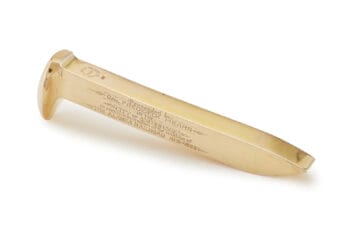
The Golden Spike used to symbolically finish construction of the Alaska Railroad in 2023 is seen in this undated photo. President Warren Harding hammered the spike in a ceremony in Nenana. (Photo provided by Anchorage Museum)

A glittering piece of Alaska history is returning to the state after it made its first appearance more than a century ago.

The “Golden Spike” used as the final connection that symbolically completed the Alaska Railroad is now back in Alaska hands, thanks to a successful bid at the auction house Christie’s, the Anchorage Museum and City of Nenana announced on Friday.

The spike was hammered by President Warren Harding at a ceremony in Nenana on July 15, 1923. The purchase price for the 24-karat gold piece, which is 5.5 inches long and weighs about a pound, was $201,600, and the sale closed on Friday, according to the listing on Christie’s website.

A variety of private donors supplied money for the purchase, the museum and city of Nenana said in their statement.

Now that it is returning to Alaska, the spike will be displayed in turn by the Anchorage Museum and the city of Nenana.

“We are thrilled to partner with Nenana to share this piece of history with the public,” Julie Decker, director and chief executive officer of the Anchorage Museum, said in the statement. “The Golden Spike is a great piece of storytelling about place and people.”

A schedule has yet to be set, said museum spokeswoman Janet Asaro.

The spike spent little time in Alaska, or in public view anywhere, after it was used in the ceremony.

The city of Anchorage, itself a product of the railroad’s construction, officially bestowed the Golden Spike to U.S. Army Col. Frederick Mears, one of the chief engineers overseeing the project. Anchorage at the time had been newly formed out of a railroad construction tent city named for its geographic location, Ship Creek, a waterway that flows into Cook Inlet.

Mears, in turn, lent the Golden Spike to Alaska’s territorial governor for use in the ceremony at Nenana.

The Christie’s listing includes an excerpt from the New York Times’ report on the event. It took Harding three times to drive the spike in correctly, as he missed completely on the first two tries, the Times reported.

After it was used in the Nenana ceremony, the spike was exhibited temporarily at a museum in Juneau before being returned to Mears. Much later, it was featured briefly in other Alaska exhibits, in Fairbanks in 1967 and Anchorage in 2001, according to the museum.

Harding was the first president to visit Alaska – and the only sitting president to ever drive a railroad spike, according to the museum. His expedition was a big event, with destinations that included the Resurrection Bay port city of Seward, Interior Alaska sites and Valdez.

While the Golden Spike is one legacy of that Alaska trip, there are others.

The historic Fairview Inn in Talkeetna is decorated with lights on the evening of March 9, 2024. The Fairview has a display of Harding memorabilia, and local legend has it that the former president was poisoned there during one of the last stops in his Alaska tour. (Photo by Yereth Rosen/Alaska Beacon)

The Kenai Peninsula’s Harding Icefield, the largest icefield located entirely in the United States, was named for the president after he visited Seward. The city is the southern terminus of the Alaska Railroad.

In the small town of Talkeetna, one of Harding’s last stops, there is a persistent local legend about the former president. He got a meal and a haircut at the Fairview Inn, but he died days later, after he returned to the Lower 48. According to the legend — which is unsubstantiated but grew out of contemporary accusations and remains a popular topic of conversation in Talkeetna — Harding’s wife slipped poison into the meal because she was fed up with the president’s persistent philandering.

The Fairview Inn, now on the National Register of Historic Places, has an extensive display of Harding memorabilia that was assembled by Cortni Ruth, a longtime bartender. The display includes images of the Golden Spike ceremony — plus a lot of documentation of Harding’s extramarital affairs.

If Florence Harding did kill her husband, local sentiment is that she was amply provoked, Ruth said on Friday. “Our theory is she poisoned him because he brought his mistress on the trip,” she said.

The U.S. Army apologized to Wrangell clans for the 1869 bombardment of a village. Not all of them accepted the apology.

Major General Hilbert apologizes to Wrangell Cooperative Association on Jan. 11, 2025 for bombarding Ḵaachx̱aana.áakʼw 155 years ago. (Colette Czarnecki/KSTK)

A large group of people greeted each other with morning chatter at the end of a Wrangell peninsula on Saturday, where the Taalkweidí clan once resided.

They were there to witness the U.S. Army apologize to the Wrangell Cooperative Association for bombarding the Tlingit village of Ḵaachx̱aana.áakʼw in 1869. The tribe lost at least five people, a totem pole and multiple houses. And for the past 155 years, the tribe has been waiting for this apology.

This was one of several different stops on Saturday’s walk to where Tlingit clans once lived. The last was where a Tlingit man, Shx’atoo, was hanged at Fort Wrangel. Before he turned himself in to stop the bombardment, he stopped at each clan’s location to say goodbye. The group retraced his last steps on this walk.

After visiting Taalkweidí and honoring the clan through a small ceremony, footsteps and chatter took over the walk towards the second stop, where the Teeyhíttaan clan lived.

“When he stopped here, he talked to the clan leader, whose name I now bear, Gashx,” Teeyhíttaan clan leader Aak’wtaatseen Mike Hoyt said. “He brought his hat out and he brought out other at.óow to stand before. That’s how I’m feeling today, that we would bring these things out for him if he were here, and that his spirit is here.”

At.óow are significant tribal artifacts.

Continuing the walk

Fifteen-year-old Vincent Cordova from Ketchikan was holding a peace pipe on the walk. It’s one of the recently repatriated at.óow. It features the Gunakadeit, a sea monster in Tlingit culture.

“I got told to hold the pipe because I am the clan leader’s oldest nephew,” Cordova said. “I’m proud of this and I’m happy to hold such an artifact.”

Gaalgé Kevin Calahan lights Naanyaa.aayí pipe that Vincent Cordova and Major General Hilbert hold on Jan. 11, 2025 in front of Shakes Island. (Colette Czarnecki/KSTK)

After a few more stops, the group ended up in front of Shakes Island, where the Naanyaa.aayí clan lived. Clan leader Gaalgé Kevin Calahan said there were six houses on Shakes Island.

“I have my nephew, Vince. This is a Naanyaa.aayí pipe that belonged to Chief shakes,” Calahan said. “We bring it out when we do our smoke ceremonies. I thought it would be appropriate if the General will hold it, we won’t smoke out of it, but I’ll light it.”

“The body remembers the wrongs that were done to my ancestors.”

The group visited Kiks.ádi territory and then headed towards Fort Wrangel, which is now the post office. Wrangellite Heidi Armstrong said her parents lived for this day.

“As a native child, I’m half native,” she said. “You know the wrongs that were done weren’t necessarily done to me, but the body remembers the wrongs that were done to my ancestors.”

She said there’s a picture from the 1940s in the Wrangell Museum that shows a similar walk along Front Street after they raised Chief Shakes house.

“It’s a historic walk,” Armstrong said. “I’ve always looked at that and thought, man, I wish I was part of that. Sorry. I’m getting choked up. I never dreamt that I’d be part of such a huge, I don’t know, maybe huge is the wrong word, but such a meaningful time.”

When the group reached the last stop, at the old Fort Wrangel, clan leader Hoyt said this is where the altercation happened. Where the U.S. Army launched bombs into the village. Where Shx’atoo turned himself in. Where he was hanged.

“I want you to imagine thinking back to where we started,” Hoyt said. “If you look that direction, you can see the trees. You can see the point. I want you to imagine paddling across and turning himself in over here.”

Hoyt said before Shx’atoo walked to the gallows to face his fate, he sang a song. He played the only recording, sung by William Tannery in the 1950s. Tannery was the primary storyteller who was key to passing the bombardment story to future generations.

It sounded lonely, just his voice.

Arthur Larsen (forefront) sings with others on walk honoring Tlingit clans of Ḵaachx̱aana.áakʼw on Jan. 11, 2025. (Colette Czarnecki/KSTK)
Tlingit tribal members gather to remember Shx’atoo before bombardment apology began on Jan. 11, 2025. (Colette Czarnecki/KSTK)

“This does not look like a conquered people to me.”

The group then walked to the Nolan Center, Wrangell’s civic center. Inside, there was a significant amount of historical at.óow in the front of the large room.

“It’s often said that we are a conquered people. This does not look like a conquered people to me,” Hoyt said. “This looks like a statement of who we are, a statement that goes back hundreds of years, thousands of years, and a statement that will continue to go forward accordingly.”

U.S. Army Major General Joseph Hilbert waited at the door to request permission to be on the tribe’s territory.

“Good afternoon. I’m Major General Joe Hilbert from the Commanding General 11th Airborne Division in the United States Army Alaska,” he said. “I live and work on the land of the Tlingit people. I request permission to enter the land the Shtaxʼhéen Ḵwáan.”

After accepting the request, the tribe sang a welcome song with a drum beat that filled the room.

Major General Hilbert of the U.S. Army requests permission to enter on tribal territory on Jan. 11, 2025. Wrangell Cooperative Association’s Tribal Administrator Esther Aaltséen Reese stands to the left. (Courtesy of James Edward Mills)

All of the clan leaders spoke in response to the Major General’s request, including Gaalgé Kevin Calahan with the Naanyaa.aayí clan.

“There really wasn’t a handbook out on how this happens,” Calahan said. “We’ve done plenty of Koo.éex’, plenty of feasts, we’re preparing to raise poles. This was a new thing. This is a great thing, but it was still brand new in new territory.”

He said the songs that they sing mean something big is happening.

“Some of the most beautiful songs are cry songs”

The tribe then sang a cry song, with a slow drum beat in the background.

“Some of the most beautiful songs are cry songs, but they’re songs you don’t hear because they’re so heavy,” Calahan said. “They serve a purpose.”

Some keynote speakers took turns speaking about how this event was historical, including U.S. Senator Lisa Murkowski.

“In order for us to move forward, the wrongs have to be addressed,” she said. “They have to be acknowledged, and we need that apology for us to move forward and to heal.”

She said the solemnity that the military presents is not casual and she hopes it’s recognized. She also honored the veterans in attendance.

“I’m grateful to those who have served,” Murkowski said. “Our treasured veterans, you have not always been treated with the dignity and the respect that should be afforded you.”

U.S. Alaska Senator Lisa Murkowski speaks during bombardment apology by the U.S. Army on why it’s necessary and long past due on Jan. 11, 2025. (Courtesy of James Edward Mills)

Later in the day, Major General Joseph Hilbert officially apologized to the clans. He assured everyone that the apology was written by human beings with hearts, even though it might sound formal.

“It is incredibly a heartfelt apology on behalf of the Department of the Army to acknowledge the 1869 bombardment of the Tlingit village of Ḵaachx̱aana.áakʼw by the United States Army,” he said. “And to offer an apology to the Tlingit people on behalf of the United States Army.”

He acknowledged that the U.S. Army’s bombardment on Ḵaachx̱aana.áakʼw resulted in death, suffering and generational trauma on the Tlingit people.

“I hope that today represents not an end, but a beginning,” Hilbert said. “A beginning of healing and a relationship between us going forward.”

Not every clan accepted the apology. The Taalk̲weidí, Khaach.ádi, Kayaashkeiditaan and Sik’nax̲.ádi accepted.

Three clans did not accept the apology

Aak’wtaatseen Mike Hoyt, with the Teeyhíttaan, did not. He said making peace is about rebuilding and restoring a relationship.

“I have heard your apology and I show as much respect as I can,” he said. “I really appreciate the words that you said in there that this is not the end, but a beginning, and to that extent, we can’t fully accept the apology so much as we see this as the beginning.”

Gaalgé Kevin Calahan who leads the Naanyaa.aayí clan said talking to others has deepened his understanding of the bombardment.

“I know it’s easy to sit back and think, ‘well, that happened so long ago, it didn’t affect you,’” he said. “I was like, ‘well, we’ve been asking about it every year since then.’ It affects us. It’s never left. You think about it every December.

Major General Hilbert said there needs to be continued communication to further establish the relationship between the Army and the Tlingit clans.

“I think where I was very much encouraged was it was an acknowledgement, and not a rejection, and a demonstration of a relationship going forward,” he said.

The other clans that did not accept the U.S. Army’s apology were the Kiks’adi and Naanyaa.aayí. In total, four clans accepted and three did not.

Jimmy Carter’s Alaska legacy, and how he got the name Nahóowoo

Angoon elders Matthew Fred, William Nelson, and Martha Nelson with President Jimmy Carter at a ceremony for the protection of Admiralty Island through the Alaska National Interest Lands Conservation Act. (Photo by Peter Metcalfe/Courtesy of Sealaska Heritage Institute)

A series of remembrances for former U.S. President Jimmy Carter began in Georgia on Saturday, culminating on Thursday with a national day of mourning. Carter, who died on Dec. 29 the age of 100, was known in Southeast Alaska as Nahóowoo — a name he was given when the Deisheetaan of Angoon adopted him sometime in the late 1970s.

Matthew Fred of the Daisheetan gave Carter his Lingít name. It belonged to Billy Jones, who witnessed the bombardment of Angoon by the U.S. Navy in 1882. Jones was only 13, but his account eventually became the basis for an apology the Navy secretary made to the village last October, 142 years after the bombardment.

Rosita Worl, president of the Sealaska Heritage Institute, says the Navy’s formal apology had its roots in President Carter’s efforts to bond with the people of Angoon.

“Although he was not able to do anything about their apology,” Worl said, “he was the first president, actually, that listened to their story.”

Protecting subsistence

Angoon is on Admiralty Island, or Kootznoowoo. The island’s Lingít name means Fortress of the Bear, a sacred place with the highest concentration of brown bears in the world.

In 1978, Carter used his authority under the 1906 Antiquities Act, a novel legislative tool, to designate Admiralty Island and other wilderness in Alaska as national monuments.

More protections were added when the president signed the Alaska National Interest Lands Conservation Act into law in 1980. ANILCA also doubled the size of Alaska’s national parks and refuges, classified more than 50 million acres as wilderness and created 25 wild and scenic rivers.

Conservationists hailed the legislation as one of Carter’s greatest achievements, while proponents of resource development said it locked up too much land.

Worl says Alaska Natives were caught in the middle. They wanted to develop their land but also protect it for subsistence. She says developers and conservationists both believed they had primacy over Alaska Natives, despite their long history of stewardship and ties to the land.

Jimmy Carter’s Lingít namesake, Nahóowoo, a name given to Billy Jones who witnessed the U.S. Navy’s bombardment of Angoon. Nahóowoo is on the left. His brother, Billy Johnson, is seated in the front, holding canoe paddles. Their sister Yíktusaan is on the far right. (Alaska State Library Historical Collections)

She said neither group understood the Lingít concept of Haa Aaní, which translates into “Our Land” but also incorporates core cultural values of reverence for the land, as well as the need to utilize it.

Worl says that’s a common theme in Alaska Native cultures that Carter appeared to understand, even though he seemed firmly planted in the conservationist’s camp.

“I believe that President Carter gained a deep appreciation and understanding of Lingít culture when he met with the Angoon Lingít traditional leaders,” Worl said. “I believe this meeting and ceremony influenced President Carter’s actions.”

The leaders, she says, were dressed in their finest regalia with crests of animals, birds and fish, which showed their close relationship to the environment and dependence on the land — a cultural experience for Carter that may have helped him recognize the need for ANILCA to address subsistence hunting and fishing rights.

“It’s not perfect,” Worl said, “but without it, we wouldn’t have had the protections we had.”

Worl says the subsistence policies outlined in ANILCA continue to be debated and litigated today, so it’s important for Alaska Natives to find new ways to protect their subsistence lifestyle.

“You have to work for your people”

Worl believes Carter’s most important legacy is the example he set as a leader, including his decades of service after his term as president.

“He cared for humanity. And he proved it by doing the work himself,” Worl said. “That’s a trait we admire.”

Worl said Carter saw leadership through the eyes of a servant, and to the Lingít, he exemplified their values.

“When a person becomes a clan leader down here, they go through a ceremony,” Worl said. “You become a leader. And then they’ll say, now you’re a worker for your people. You have to work for your people.”

Worl said Garfield George of the Deisheetaan will represent the Lingít at President Carter’s memorial service in Washington D.C. George also worked with the Navy on their apology to Angoon.

Site notifications
Update notification options
Subscribe to notifications