This is Tongass Voices, a series from KTOO sharing weekly perspectives from the homelands of the Áak’w Kwáan and beyond.
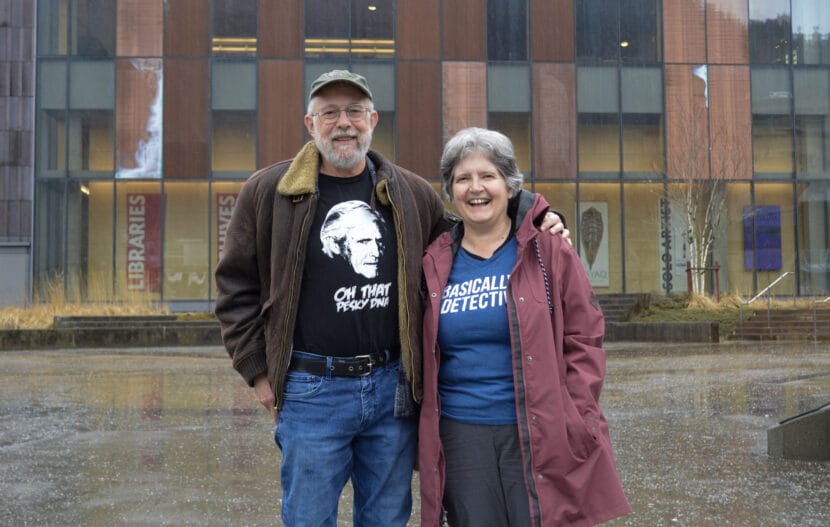
A retired couple in Juneau has picked up an interesting hobby — researching true crime stories in Southeast Alaska’s history. Betsy Longenbaugh and Ed Schoenfeld host walking tours and talks, and Longenbaugh has turned the research into two books, with another in progress.
Her first work of fiction, Death in the Underworld, is based on a crime committed in Douglas in 1916. And they have two upcoming presentations — called Death with Dessert — in April and May.
Betsy Longenbaugh: Our daughter, when we talked about Alaska’s first serial killer, made a cheesecake with a cereal crust. So she’s very deliberate about choosing, choosing the desserts and tailoring them to our presentation.
Ed Schoenfeld: We had a story about dismemberment and dismemberment, and she created a dismembered lemon meringue pie.
Betsy Longenbaugh: I’m Betsy Longenbaugh.
Ed Schoenfeld: I’m Ed Schoenfeld.
Betsy Longenbaugh: Well, both of us retired. We’ve been retired now for somewhere between six and seven years, and our passion after we retired, very unexpectedly, became looking into historic murders in not just Juneau, but some of the other communities in Southeast Alaska.
Ed Schoenfeld: And we call our effort True Crime Alaska, because everybody needs to be branded, right? And we research historic true crime. And it’s not just to do blood and guts, you know, like so much of the true crime reporting is these days, but we really like to talk about what’s going on in the community, and it really gives you a window into a community at a different point of time. I mean, Juneau in 1904 or, you know, Tenakee in the 1930s.
Betsy Longenbaugh: 1906, to be precise.
Ed Schoenfeld: And beyond that, it also just gives us a chance to talk about not only the particular cases, but how the justice system worked, how the community responded to times of crisis, which, in a small town, a murder generally, is a crisis.
And also to examine how the judicial system, the police, etc, responded to crimes against women and people of color, because obviously there was a lot of discrimination in those days.
Betsy Longenbaugh: But also how the media covered it. I mean, one of the things that have been interesting and frustrating is when we do our research, we know that there are Alaska Native women and men being killed. There’s very little coverage about them in the newspapers. There might be an account that it happened. But often it’s not much more than a name or two and maybe a charge.
In my second non fiction book, I just wrote a piece about a murder that happened in Petersburg, it was a horrible murder. It was a woman and child, and you would think it would have been a very sensational story that got a lot of coverage, but they were Chinese and their killer was Japanese, and they were all cannery workers. So there was actually very little coverage about the crime itself, even in Petersburg, where it happened.
Because we rely so heavily on newspapers as a resource for research, it’s upsetting and a little frustrating when the newspaper turns a blind eye to really these terrible things that are happening and we can’t get a handle on it.
We’re basically dealing with stories that don’t involve it, involve any live witnesses in all. But one case, the new book is going to have a story that happened in Sitka in the late 1950s and I actually was able to talk to two witnesses to that case, simply because I grew up in Sitka. So I was able to sort of track down these old timers, one of a former nurse who just turned 100 and was sharp as a tack and really helpful in the story.
So not having people who were there, having to rely on all third hand resources, so not having live witnesses, and then trying to figure out bits and pieces of clues. I had a story that I just wrote about a killing down in Ketchikan, and I thought I had a pretty good handle on it, until I contacted my source in Alcatraz. I have a guy I worked with named Gregory Schmidt, who works for the archives down in San Francisco, and he sends me these amazing resources from Alcatraz.
And when he sent that, I realized that most likely this man had not actually done the crime, based on what happened during his parole hearings and his behavior in prison, where he spent most of the rest of his life.
Finding those little bits and pieces, and sometimes big bits and pieces, is really the fun part. Again, it’s the puzzle, right? It’s figuring out.
Ed Schoenfeld: And sometimes we just have a feeling that there’s something missing that maybe we can find if we dig deeper. And it’s the same as when you’re reporting, you think you have the story, but you’ve done enough of this to think there’s something else going on here we should know about.
And sometimes we, pretty much, you know, decide not, not to include something in a book or presentation, because we’re just not sure. Usually we’re able to figure it out one way or the other.
Betsy Longenbaugh: We’ve been very clear about drawing the line at statehood, because when we initially did this work, not the writing, but the walking tours, we included some cases that Ed had covered as a reporter and that I was familiar with. And it became too traumatic, not just for us, but for the people who were hearing the stories.
I remember walking to her where we were talking about a contemporary murder was not, I don’t know, 25-30 years ago, but one of the people on the tour had taught the defendant in grade school. And another tour, we’d had somebody who’d served on the jury.
And I’m from a little town, you know? I’m from Sitka and I know how these things haunt communities. They really haunt communities. And we didn’t want to be participating in that haunting.
We wanted to be able to talk about stories where, as I like to put it, everybody would be dead anyway. Because it takes away that immediacy and the trauma, and I think the trauma and sadness of the murder, which are always just really heartbreaking, is balanced by telling more about their story and Ed likes to think of it as bringing names to the fore that have been long forgotten. The first book is Forgotten Murders. And it’s not just forgotten murders, in my mind, it’s forgotten victims.
Ed Schoenfeld: And the other way we kind of balance out this horrible stuff is we talk a lot about the history of the community and just of trends.
Betsy Longenbaugh: It’s actually the first fiction I’ve ever written. It’s based on a historic case that happened in Douglas in the early 1900s but I found that case very difficult to look into. It’s a very upsetting case in so many ways, and so when I fictionalized it, I found it, I was able to come up with a much more satisfying end.
And also explore some of the pieces of that story that we discovered when we were doing research on the original piece, which is that the victim was part of a sex trade operation that operated in Buenos Aires between the 1870s and World War Two. It was very well known, and their books about it, and this woman happened to have been part of that and was killed by her procurer, and who they were unable to convict.
So in my story, there’s a lot more twists and turns, but it’s sort of based generally around this historic crime.
Ed Schoenfeld: And there’s as much research that went into this, I think, just plus the imagination, and Betsy is a wonderful writer. But you know, if we wanted to find out, well, how much beer cost, because there’s bar scenes, not sure if we use that, but.
Betsy Longenbaugh: Well, I found out a lot about too about how federal marshals worked and coroner’s juries, which I’d been learning more about, but to write about those in a fictional piece was just different. So I really, really, really enjoyed writing it. It was just really super fun, because I was able to, I think, create some strong female characters.
So this the story, as it turns out, sort of centers around these very strong women who are trying to protect themselves from a ruthless killer who’s already killed one of their friends, and sort of how they protect themselves and the world of Juneau at the time of 1916.
You can find information about their talks and books at truecrimealaska.com.