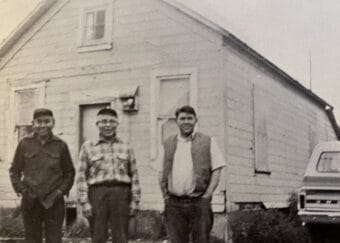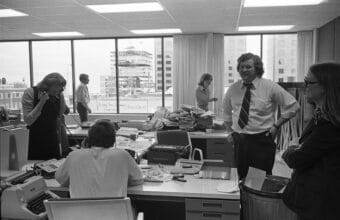
Old mission school and local residents, Kake, Alaska, 1975. (from ʼTomorrow is Growing Old: Stories of the Quakers in Alaskaʼ by Arthur O. Roberts/Used with permission)
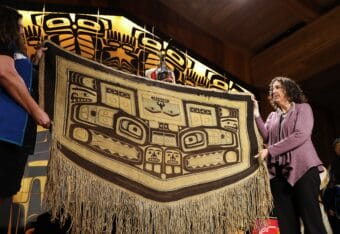
The Alaska Friends Conference is set to issue an apology in Kake on Friday for the harm caused to the community by a Quaker mission they ran at the turn of the 20th century. The missionaries were also teachers at a government-run day school that forced Lingít children to assimilate into white culture.
The Quakers’ apology was planned for Kake Day — a day to celebrate Kake’s survival and the community’s cultural revitalization work. It’s on Jan. 19 this year.
Along with the apology, they’re giving more than $92,000 dollars to the community to help build a healing and cultural center.
This isn’t the first apology from the Quakers. In 2022, they came to Juneau to apologize for the Douglas Island Friends Mission school. Jan Bronson is a member of the Alaska Friends Conference. In an interview before traveling to Kake, she said it’s important to do more than apologize.
“It’s not enough to say ‘we’re sorry.’ We’re committed to listening, learning, and helping heal the trauma that resulted,” she said.
Kake Tribal Council President Joel Jackson says missions and schools like the one in Kake traumatized generations of tribal members.
“What our people were experiencing because of the boarding school era being passed on to generations, even up to now,” Jackson said. “Being forced into these schools and forced not to speak their languages and carry out their customs and traditions and their language.”
Jackson wrestled with these consequences for decades, first as police chief, and now as council president.
“We had some unfortunate high numbers of suicide in our little community,” he said.
Suicide rates plummeted after Kake leaders established a camp for youth 35 years ago that taught traditional food harvesting and art forms like carving. But Jackson said Alaska Native people are still healing from the forced assimilation that schools like the one in Kake brought.
Jackson and other tribal leaders are designing the new center to treat addiction with traditional values and food practices like hunting and fishing.
“It’s very important that we can at least try to give people an option to start healing from intergenerational trauma,” he said.
Last summer, local Lingít activist Jamiann S’eitlin Hasselquist and two elders, Jim and Susan LaBelle traveled to a Quaker conference in Oregon to talk about the harm the schools caused.
After, the Quakers asked Jackson what they could do to help healing in Kake, and he said that $75,000 for this healing center would be a good start. A Quaker group in the Pacific Northwest pledged $75,000 right off the bat. Other Quaker communities contributed nearly $20,000 more.
Jackson, the council president, says the healing center Kake is building with that money will help restore a sense of belonging and cultural identity to those who need it.
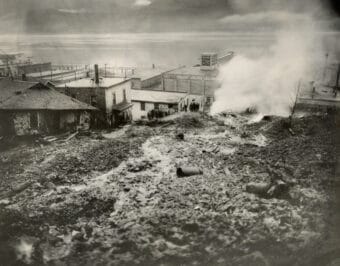
The 1936 landslide buried four buildings on South Franklin Street and killed 15 people, making it the deadliest natural disaster in Juneau’s history. To the left, plumes of smoke billow up from underground fires that broke out in a crushed apartment building. (International News Photos/Public domain)
Editor’s note: This story was originally written for the Nov. 22 anniversary of the 1936 landslide. We delayed publication after a deadly landslide struck Wrangell on Nov. 20.
Nearly a day after Juneau’s deadliest landslide, rescue crews had given up hope of finding any more survivors. But they kept working, shoveling muck from atop the 20-foot heap of debris that covered what is now South Franklin Street.
Plumes of steam and smoke billowed from under the jumble of mud, boulders and broken trees. Early that morning, an underground explosion in a buried apartment building had sparked fires that would burn for hours.
Cascades of water poured down Mount Roberts as people sloshed through flooded streets, calling out for loved ones.
A little voice cried out from somewhere beneath the mud. One of the rescuers, an AJ Mine employee named Ernest Mattielli, recognized it as the voice of 3-year-old Lorraine Vanali, the daughter of his friend Joe.
Rescue crews work to dig out Lorraine Vaneli. (Trevor Davis/Alaska State Library Historical Collection)
‘Everything went dark’
Nov. 22, 1936 was a quiet Sunday evening in Juneau. It was raining. It had been for weeks.
That night, Lorraine and her parents braved the downpour on their way to a dinner party. As they set out, Albert Shaw was at his grandfather’s house a few blocks away.
“We were reading, my brothers and I — well, I was probably looking at a picture book, at six years of age, ” Shaw said in an interview in November 2023. “All of the sudden, the lights go out — everything went dark.”
Shaw — who has lived in Juneau for all of his 94 years — is perhaps the only living person who remembers that night. But at the time, he didn’t know what was going on.
The 1936 slide path as seen upslope near Gastineau Avenue, November 1936. (Trevor Davis/Alaska State Library Historical Collection)
The lights flickered out at the Matson Boarding House, too, on what is now South Franklin Street. V.A. Babcock, a miner, was finishing up a bath when he heard a loud rumbling. The walls of his bedroom began to twist and tilt.
He covered himself and bolted for the front door only to see the building’s porch get swept away in an enormous flow of mud that roared down from Mount Roberts. He turned back and made a narrow escape by jumping out a window.
Nearly naked in the rain, he stood and watched as the boarding house careened down the hill.
On the street below, a Mrs. J. Wilson made her own narrow escape when “turning around she saw a great concrete building following her, which she described as a huge pile driver, just ready to strike.” Two men pulled her out of the way just in time, the Alaska Daily Empire reported.
Rescue crews work by the light of headlamps on the night of Sunday, Nov. 22, 1936. The slide knocked out power lines, casting much of the city into darkness. (Frederick K. Ordway/Alaska State Library Historical Collection)
Albert Persson and his family didn’t have the time to escape when their apartment on the third floor of the Nickovich Apartment Building started shaking.
“I knew it was a slide. There had been so many before,” Persson wrote in an account published by the International News Service.
He and his wife huddled around their two young children as plaster rained down on them. Then the ceiling and the walls collapsed.
“It was sort of a funny feeling,” Persson wrote. “Like being inside an egg when something smashed it.”
The entire Persson family was rescued alive from the wreckage.
The slide engulfed the Matson House, the Nickovich building and two other buildings. The great pile of debris — about 20 feet deep and 75 feet wide — came to a halt against the Juneau Cold Storage building, which stood across from the modern-day cruise ship terminal.
Along the way the slide took down telephone cables and power lines, throwing the city into darkness.
“The mighty cascade of dirt and rock roared down the mountainside on its mission of death, sweeping all before it,” the Empire wrote.
A blaze amid the landslide debris in the early morning hours on Nov. 23, 1936. (Photo by Trevor Davis/Alaska State Library Historical Collection)
Shaw’s father, a volunteer fireman, joined dozens of men who formed the rescue crews — city officials, police officers, U.S. Forest Service employees and sailors from the U.S. Coast Guard cutter Tallapoosa, which was docked in town.
“They put some of the miners to work, shoveling the muck, because that’s what it took,” Shaw said. “This took several days to get it cleaned up.”
Babcock was among them. He borrowed clothes from a friend and returned to the scene of his near-death. The crews set to work by the light of headlamps and headlights from cars and fire engines, which illuminated a gruesome scene. Live wires sparked fires, and heavy rain kept pouring down as rescue crews started digging.
The slide crushed four buildings and buried 23 people. (Trevor Davis/Alaska State Library Historical Collection)
Twenty-three people were caught in the slide. Some escaped with minor cuts and bruises, others with deeper wounds or broken bones. Gust Erickson, who lost his home, survived “slightly crushed” after his stove slid across the room and pinned him against the wall, the Empire reported.
His wife, Cora, was buried beneath the house’s toppling chimney. She was the first slide victim discovered that evening.
“Tragedy has struck the city,” read a column in the Empire the next morning. “The forces of nature with which we must always battle for existence have overwhelmed the puny human efforts for a moment.”
The front page of the Alaska Daily Empire reported the tragedy on the morning of Nov. 23, 1936. (Alaska State Library microfilm collection)
Fifteen funerals
Fifteen people died in the landslide. It was national news. The Associated Press, the New York Times and local papers from California to New England wrote stories about the destruction.
In the light of day on Monday, people found that other, non-fatal slides had come down across town, one on Glacier Highway and another in front of the Salmon Creek Bridge. The debris snarled traffic for days.
Men stand atop a pile of landslide debris against the Juneau Cold Storage Building on what is now called South Franklin Street. (Trevor Davis/Alaska State Library Historical Collection)
The threat of more slides continued in the unrelenting rain. Hillside homes along Franklin Street and Gastineau Avenue were almost completely abandoned.
It took the makeshift search and rescue crews hours to reach the first slide victims — most were buried deep. The more they dug, the higher the death toll rose.
“All the bodies were cut, bruised and discolored, as if hurled through a mighty grinder,” the Empire reported.
A wisp of a red dress led them to the body of Lucia Hoag, who had been attending a dinner party at the Nickovich Apartments with her family. Hours later, rescue crews discovered the bodies of her husband, James, and her fourteen-year-old son, Forrest.
Later that day, crews reached a gray-haired couple wearing pajamas. They were Hugo and Hilja Peterson, a couple who apparently had been crushed in their sleep.
A view of the landslide from South Franklin Street on Nov. 23, 1936. (Frederick K. Ordway/Alaska State Library Historical Collection)
It took five days to recover all of the victims. Most, it seemed, were killed instantly by the enormous force of the slide.
Local churches held 15 funerals that weekend. After the victims were laid to rest, the clean-up took weeks. Pickup trucks, dwarfed by the massive debris piles, lined up to carry the mud off to different parts of town, or to dump it in Gastineau Channel.
Men shovel mud from the slide into pick up trucks on South Franklin Street, Nov. 23, 1936. (Frederick K. Ordway/Alaska State Library Historical Collection)
The rain was unrelenting for the rest of the year. A week after the first slide, a much smaller slide came down, leading crews to pause their efforts for the winter.
They cleared the remaining debris in the spring, but the mark of the slide was prominent for decades — a wide gash in the hillside where one cabin, which had been narrowly missed by the mud flow, stood alone.
The scar of the 1936 landslide was prominent for decades after it happened. It can be seen in this undated photo of the Juneau Cold Storage Building, taken sometime between 1939 and 1959. (Alaska State Library Historical Collection)
“That cabin was still there, I want to say, into the 50s, maybe into the 60s,” Shaw said. “And for years, there was no basic development. There were areas along Franklin, South Franklin, where there were no buildings.”
Today, the street is fully redeveloped. The area where the Cold Storage Building stood is a vacant lot, but the stretch of South Franklin Street opposite that lot is the heart of Juneau’s tourist district. On any given summer day, hundreds or thousands of cruise ship visitors wander in and out of gift shops that line the street. Some of those gift shops have apartments upstairs.
Today, the path of the 1936 slide is largely grown over. (Clarisse Larson/KTOO)
‘Juneau is built against a hill’
“Juneau is built against a hill, not just a rolling land but a gigantic mountain of hard rock covered in shale and loose dirt,” wrote Juneau resident George L. Webb, in a December 1936 letter to his family. “The rainfall last month was over 25 inches, which is a great deal for any century.”
According to Sonia Nagorski, a professor of geology at the University of Alaska Southeast, Webb’s letter describes the basic ingredients that trigger a landslide — a heavy bout of rain on a steep slope covered in loose sediment.
“In Juneau, we’ve built up, you know, numerous houses right along the edge of these slopes,” Nagorski said.
In 1936, the stretch of South Franklin Street at the base of Mount Roberts was one of Juneau’s most densely populated neighborhoods. A remarkable amount of rain saturated the mountain slopes that November. More than two feet — 25.87 inches — fell in the course of the month.
“First one record is broken, then another, until finally all the records are broken,” the Daily Alaska Empire reported a week after the landslide. “Now the meteorologist has put away his record book.”
A clipping from the Alaska Daily Empire on Jan. 14. 1937 (Alaska State Library microfilm collection)
Southeast Alaska’s geology is well-suited for heavy rains. Most of the time, the soils can drain the water fast. But if the drenching passes a certain point, water pressure starts to build up under the soil, and the solid earth is transformed into a slurry of soil and water.
That can trigger a debris flow — the most common kind of destructive landslide in Southeast Alaska — where viscous earth mixes with boulders, trees and other debris as it flows rapidly down a slope.
Nearly four inches of rain fell in the 24 hours leading up to the 1936 slide.
“It’s those heavy rain events — on top of conditions that were already rainy for a while — that seem to be the most hazardous,” Nagorski said.
In Wrangell, the storm that led up to the fatal Nov. 20landslide dumped three inches of rain in 24 hours. More than one inch fell in just six hours before the slide.
And human-caused climate change is making heavy rain more common. Most of the heaviest, most prolonged rainfall in Southeast Alaska comes in tropical fronts known as atmospheric rivers, which are becoming more frequent.
Other deadly landslides in recent memory — the 2015 Kramer slide in Sitka and the 2020 Beach Road slide in Haines— happened during record rainfall events brought on by atmospheric rivers.
So as the region gets wetter, landslides may become more common, too. But they have always happened in Southeast Alaska, and in Juneau.
Today, South Franklin Street is lined with tourist shops, and a few apartment buildings. The open lot to the left is the place where the Juneau Cold Storage Building once stood. (Clarise Larson/KTOO)
In 1920, a debris flow came down on Gastineau Avenue, destroying 16 buildings including a boarding house, three homes and a dozen small cabins. It killed four people.
A clipping from the Alaska Daily Empire on Nov. 23., 1936 (Alaska State Library microfilm)
Another Gastineau Avenue slide destroyed a house in 1929.
And just weeks before the Nov. 22, 1936 slide, a debris flow came down Mount Roberts and across Gastineau Avenue, breaking through the back of the Alaska Hotel, damaging two houses and burying one woman, who ultimately survived.
A series of slides downtown
Some blamed those slides on the AJ Mine, which cleared trees and operated its mill on the slopes of Mount Roberts.
In 1920, the AJ Flume overflowed just before the deadly slide. But that overflow came on top of snowmelt and nearly 2 inches of heavy rain over 24 hours. Geologists would later say that overflow from the mine did not cause the slide by itself.
Gust Erickson and two other men who lost their wives and homes in the November 1936 slide filed lawsuits against AJ Mine, claiming that the company neglected to maintain the hillside. A deep crack in the ground beneath the flume was noted around the time of the slide. That may have contributed, but geologists would later determine that the slide began much further up the ridge.
And even after the mine closed in 1944, slides off Mount Roberts kept happening. In October 1952, three more slides came down across Gastineau Avenue and South Franklin Street after a rapid burst of heavy rain. They destroyed two houses, and they came down within — or extremely close to — the same paths as the 1920 and 1936 slides.
A view of the vacant lot where the Juneau Cold Storage Building once stood, taken from Gastineau Avenue. (Photo by Clarise Larson/KTOO)
Albert Shaw said he’s tracked landslides and avalanches in Juneau closely throughout his life, ever since he first saw the carnage on South Franklin Street in 1936.
“Stuff has come off the hillside repeatedly. Now, it’s apparently slowed down. But that gives you a false sense of security,” Shaw said.
Though Juneau hasn’t had a fatal slide since 1936, Shaw feels that’s just luck. He’s spoken out at city meetings on hazard mapping in recent months, urging the city to enforce stronger precautions for development in slide zones.
Nagorski, the geologist, said we can’t know when the next disastrous slide will happen.
“They don’t necessarily follow some regular temporal pattern, like a regular interval,” Nagorwski said. “It’s possible that a slope might not fail for the next several 100 years, or it might fail in the next atmospheric river.”
On the night of Nov. 22, 1936, this section of South Franklin Street was buried in a pile of debris 20 feet deep and 75 feet wide. (Clarise Larson/KTOO)
But the most likely locations for a major slide, she added, are known.
When a landslide happens, it changes the slope, the vegetation and the way water flows down a hillside. That can make the slope susceptible to more landslides. And when a slide comes down, the debris flow can exploit natural gullies that funnel it down the hill. Or it can tap into channels that were carved by slides that came before it.
“So the places around downtown — or anywhere in Juneau — that you would expect debris flow would be where they’ve happened before,” Nagorski said.
‘And the little spark of life went out’
For the men searching the rubble in 1936, the sound of Lorraine’s pleading voice felt too good to be true after nearly 48 hours of digging in the rain and mainly finding crushed bodies. Dozens of shocked and frantic rescue workers set to work digging her out.
“Faster, faster, flew the shovels,” wrote the Empire. “Hardened, calloused men who have often flirted with death were whipped into frenzied heights of energy as they heard that plaintive little voice call out ‘mother.’”
By this time, the body of Lorraine’s mother, Delia Vanali, had already been recovered. Her father Joe would be found dead a few days later.
It took rescue crews more than three hours to reach the toddler. She was huddled about 10 feet down in a small air pocket in the wreckage of the Nickovich apartment building — just a few hundred yards from where the downtown Juneau library stands today.
Workmen after the rescue of Lorraine Vanali on Nov. 24, 1936. (Frederick K. Ordway/Alaska State Library Historical Collection)
Lorraine was alive and responsive, but she’d been pinned face down for almost two days, and she was badly bruised. A wooden chest had fallen on top of her. Her left hand was crushed, stuck beneath a fallen beam. Her legs were blistered and burned from the underground fires.
She wore a jacket and a pair of ski pants that kept her warm from the November chill, and underneath, a pink silk dress and a string of gold beads she’d been dressed in for the dinner party. As Mattielli carried her out, Lorraine pushed her mop of curly brown hair away from her face, revealing wide brown eyes. She didn’t cry, the paper reported.
She was rushed to nearby St. Ann’s Hospital, where doctors tried to warm her up and tend to her wounds. But she died less than two hours later.
“The exposure and shock of being under the slide was more than was possible for the three-year-old to endure,” the Empire wrote. “And the little spark of life went out.”
The following Juneau residents died in the 1936 landslide
Forrest Beaudin, 14 years. A student at Juneau High school and the son of Lucia Hoag.
Pete Battello, 54. Owner of the North Transfer Company.
Cora Erickson, 64.
James Hoag, 40.
Lucia Hoag, 42.
Callie Lee, 38.
Lena Peterson, 48. A seamstress at Snow White Laundry in Juneau.
Hilja Peterson, 47. Store owner.
Hugo Peterson, 46. Long-time miner and carpenter for the Alaska Juneau Mine. Proprietor of the Peterson Boarding House
Pauline Lott (Latt), 55. A dressmaker.
Oscar Laito, 65. From Sitka.
Marie Mattson, 58. Proprietor of the Mattson Boarding House and wife of jeweler Fred Mattson.
Delia Vanali (Giovanele), age unknown.
Lorraine Vanali (Giovanele), 3.
Joe Vanali (Giovanele), 30. Electrician and maintenance man at the Gastineau Hotel.
Correction: This story has been updated with new information about Hugo Peterson’s occupation and about a building destroyed in the slide. Peterson was not a member of the Coast Guard. Malin Babcock, his granddaughter, reached out to say that Peterson was a carpenter and long-time employee of the Alaska Juneau Mine. She also told KTOO that the Peterson Building was a boarding house.
The last surviving person from Attu, Gregory Golodoff, passed away earlier this month at the age of 84. (Lisa Hupp/U.S. Fish And Wildlife Service)
Gregory Golodoff was sitting in a sod house when the soldiers arrived.
“We had heard machine-gun fire from this side, this side, you know. I forgot who it was told us they’re coming from this side, they’re coming from that,” Golodoff said in a 2018 interview — 75 years after the Battle of Attu.
The Japanese Imperial Army invaded the Unangax̂ village in 1942, where the three-year-old Golodoff lived with his family.
Golodoff was the last surviving person who was born and lived in Attu, the last island in the Aleutian Chain before reaching Russia.
His death on Nov. 17 marks the end of an era when there were still people alive who had lived in the now-lost village.
The Japanese army occupied the island for three months before taking all 42 Attu residents to Japan as prisoners of war.
The building in Otaru, Japan, where Golodoff and his family were first taken upon arriving in Japan, seen in 2017. (Rachel Mason/National Park Service)
Golodoff’s entire family was imprisoned in a dormitory in the port city of Otaru, about 500 miles north of Tokyo. The next three years were full of disease and malnourishment, straddling the brink of starvation.
“We would just get a bowl of rice a day or sometimes a salted herring,” Golodoff said.
He remembered the cooks taking pity on him and treating him like “a pet.”
The Oct. 3, 1945 issue of the Daily Alaska Empire newspaper reports that the surviving Attuan POWs have been released. (The Daily Alaska Empire)
“I was a cute little guy, I guess, because a Japanese cook scraped burned rice from the pot and would bring it to me,” he recalled.
People who knew Golodoff throughout his life have remarked at how little resentment he felt toward his captors. That empathy shows even in those early memories.
“Well, gosh, we were hungry, but so were the Japanese,” he said. “The Japanese were starving, too.”
Trying to forget
Only half of the Attuan POWs survived the experience. Golodoff lived through it, as did his mother, older brother, Nick, and his sister, Elizabeth. But many of their family members didn’t make it, including Golodoff’s father, who died of disease in Japan.
“We cremated all of them,” Golodoff said. “All the people that died in Japan.”
Those who did survive were released when the war ended, but couldn’t return home. Many homes had been destroyed, and the United States government judged it too difficult to relocate the freed POWs back to Attu.
Instead, the village was abandoned and the survivors moved to other communities. Golodoff and his family settled in Atka, an Unangax̂ village about 500 miles east of Attu.
Those who died in Japan were also brought to Atka to be laid to rest.
“They brought ‘em all back in three coffins,” Golodoff said. “All the ashes in three coffins and buried by the church in Atka.”
Golodoff spent most of his life in Atka. He practiced subsistence, hunted, fished and said he stayed too busy to think much about the war.
“I didn’t have time to wonder about anything, because most of the time we had to hunt for food, you know, go out and fish and stuff like that,” he said.
He joined the Army, was stationed in Germany, and then moved back to Atka. He ran the village store, and became the tribal president in the 1980s when Atka saw significant growth, including the construction of a new school and a subdivision about a mile from the old village.
In all those years after the war, Golodoff said the survivors didn’t want to talk about what happened. He didn’t even speak about it with his mother.
“She never told me anything. They don’t want to talk about anything like that. They’d rather forget it,” he said.
But a new generation of Attuan descendants are talking about it. Crystal Dushkin grew up in Atka, but her great-grandmother was from Attu.
“A lot of people refer to the Aleutian Campaign as the ‘Forgotten War,’” Dushkin said in a 2017 interview with KUCB. “But our people have never forgotten it. It’s never lapsed from our memory.”
Dushkin is one of the many people who work tirelessly to preserve Unangax̂ culture and the memory of Attu.
“That’s what I wish for the younger generation, as well,” she said. “To always hold on to what our ancestors taught us. To always remember them, and to make sure that they teach it to their children and grandchildren so that it’s never forgotten.”
Gregory Golodoff and his sister, Elizabeth Golodoff Kudrin, on Atka Island, sometime between 1946-1947. (Courtesy National Park Service, University Of Washington Press and Ethel Ross Oliver)
Then and now
People often compare the Aleutian Campaign to the attack on Pearl Harbor, but Pearl Harbor was an attack from the sky. The Battle of Attu, and a similar one on the Aleutian Island of Kiska, mark the only times the Japanese actually invaded the United States. The Aleutian Campaign was the first time foreign forces occupied American soil since the War of 1812.
In 2012, the National Parks Service held a meeting for all the Attuan descendants and survivors. Golodoff wanted to meet other descendants, but he also wanted to connect with other surviving POWs.
“I was going to see my peers,” he said. “Then I went there, I was disappointed. Nobody survived except us.”
There were only three survivors left. Greg, his brother Nick, and his sister Elizabeth Kudrin.
“I guess we just lived the longest. That’s all,” he said.
Nick Golodoff passed away two years after the reunion, leaving just Gregory and Elizabeth.
Gregory Golodoff passed away in Anchorage on Nov. 17 at the age of 84.
Golodoff was the very last person on Earth who was born and lived in Attu, a village lost to war — the last American citizen whose home was occupied by a foreign force. (Chrissy Roes/Aleutian Pribilof Islands Association, Inc.)
Ten days later, dozens of people came to St. Innocent Cathedral in Anchorage to pay their respects.
Moses Dirks is an Unangax̂ scholar and a friend of Golodoff from Atka. He said as a child, he looked up to Golodoff, who was a good role model in the community.
“He was always helpful, and he was always willing to help the people there in Atka for many years,” Dirks said.
Golodoff’s niece, Joanna Thompson, said she admired how her uncle would never show anger or resentment for what happened to him.
“Uncle Greg just turned it into something else,” she said. “He could have been one of the other children that passed. So he was lucky to be alive, and he just found joy in every day.”
Dimitri Philemonof, the CEO of the Aleutian Pribilof Islands Association, described Golodoff as a quiet and humble man.
Gregory Golodoff passed away in Anchorage on Nov. 17 at the age of 84. Ten days later, dozens of people came to St. Innocent Cathedral in Anchorage to pay their respects. (Courtesy Isabella Iparraguirre)
“Throughout his life, he has been a great leader,” he said. “I never saw him hate or anything of that sort. I think that says a lot for the Aleut people.”
Golodoff was the very last person on Earth who was born and lived in Attu, a village lost to war — the last American citizen whose home was occupied by a foreign force. But to Golodoff, those were just the facts of his life.
“It’s just something that happened. Things will happen. We’re all going to experience something,” he said. “We’re not really here. From dust we came, to the dust our bodies will return. So we don’t die, as far as I’m concerned. We don’t die. We might depart from our bodies, but that’s about it.”
Golodoff was buried at Anchorage Memorial Park Cemetery on Nov. 27.
Anchorage Daily News publisher Kay Fanning, left, and Howard Weaver, second from right, on May 3, 1976, when the ADN was awarded its first Pulitzer Prize. The newspaper’s office was then in downtown Anchorage. (Anchorage Daily News archive)
Former Anchorage Daily News editor Howard Weaver passed away last week from pancreatic cancer. He was 73 years old.
Born and raised in Anchorage, Weaver led the Daily News for 15 years, helping the paper transform from a scrappy underdog on the verge of bankruptcy to a two-time Pulitzer Prize-winner. The paper would later win anotherPulitzer after surviving yet another bankruptcy.
Homer-based writer Tom Kizzia worked with Weaver at the Daily News for more than a decade and wrote his obituary last week. Kizzia says he knew early on that Weaver was a high-caliber journalist.
Listen:
This interview has been lightly edited for length and clarity.
Tom Kizzia: You know, he was almost my age, but he seemed older. He seemed a lot wiser, and he felt like a national-caliber newsman here in Alaska. And so I was excited to meet him. But he was so kind and friendly that I didn’t feel at all intimidated once I started to visit with him. And he seemed very encouraging, he liked my writing, and so that was the beginning of that spell that he would cast on the people working for him, just by being himself, to just make you want to do your best work and proudly bring it to him and say, “Hey, see what I did?” and have him sort of pat you on the head. Not that he was at all condescending in that way. But we were eager to have him condescend to us. He was just so fun to work for.
Wesley Early: I know that the ’80s had a pretty big newspaper war between the Anchorage Daily News and the Anchorage Times. Can you talk about what went down there and what Howard’s role was?
Tom Kizzia: Oh, gee. Well that was such a saga. And, you know, that had happened in so many cities around the country, but most of the wars had died down. So this was kind of a late flareup in Alaska. And the Times was the old, conservative, establishment, prosperous newspaper, and the Anchorage Daily News had been the upstart paper started in the ’50s and was kind of the more liberal, just scrappier morning paper. It had almost died. There was a joint operating agreement where the Times was selling the ads for the Daily News, but only halfheartedly. And so the Daily News was fading away. And that was kind of what encouraged Howard to go off and start the Alaska Advocate and sort of prepare for the day in the late ’70s when the Daily News would fade away completely, and the Times would be the one paper. And so there would be a need for an alternative voice in Alaska.
Then when the McClatchy chain from Sacramento came in and bought the Daily News, suddenly there were resources. So that was when the Advocate folded and Howard and (company) moved over to the ADN. He became the top editor at the paper quite quickly. The Daily News had a bright product to sell to the community, and the community was changing. It was becoming more sophisticated, in that oil period, as a lot of people were moving up here.
He wanted us to go out and, you know, pick up the rocks and see what was underneath them. He wanted us to challenge the institutions and just do really good newspaper work. There was no sense of, “Oh, I better not do that or my boss might be upset.” It’d be more likely that the boss would be upset if you backed away from something that needed scrutiny. So, you know, he was just an inspiring leader through that period. He had this vision of the community newspaper as a tribal fire that the whole community could gather around and tell stories and share stories and develop a kind of common sense of who we are.
Wesley Early: I’m curious. What do you think made Howard such a great editor?
Tom Kizzia: Well, he was a great leader, you know. I mean, he had done it himself. He had won that Pulitzer, the investigative piece that he’d done on the Teamsters, and he was a good columnist. He had a good, pithy style. He understood good writing. But I think a lot of it was that he would attract creative people and then give them latitude to go out and do their best work, rather than being a kind of hands-on editor. When he sent me out to rural Alaska, he told me that if I was in a small village, I was supposed to be writing about life in rural Alaska, and if I found a good news story while I was in the villages, I was supposed to walk away and not cover it. That took a vision of, “Don’t think of this as a normal assignment where you’re trying to go out and cover a public hearing on an environmental impact statement. This is about real life.” And so he pointed me in a new direction and then let me go, and he did that with lots of reporters and photographers and others in lots of areas. So that’s why we all wanted to work and do our best work for him.
These two-foot kerosine lanterns, which could be seen from up to five miles away, marked the entry point to the Kasilof River in the 19th Century. (Hunter Morrison/KDLL)
Before the days of a reliable road system, much of the Kenai Peninsula could only be accessed via boat. A popular but challenging entry point from Cook Inlet is the Kasilof River, which has been used by mariners since the construction of the peninsula’s first salmon cannery in the late 1800s. With an increase in vessel traffic, the Coast Guard added two navigation beacons in the form of kerosene lanterns near the mouth of the river in 1929.
Light from the two-foot-tall lanterns could be seen up to five miles away. They operated seasonally, and were maintained by local citizen lamp lighters until they were replaced by electric beacons in 1962. They are believed to be the last oil-burning lanterns used for navigation purposes on the American coast.
“The river channel is pretty squirrelly, because Cook Inlet has so much sediment, and it has such huge tides that there’s no direct line from offshore into the mouth of the river,” said Catherine Cassidy, secretary of the Kasilof Regional Historical Association. “Even today, on charts, they said that local knowledge is very important for navigating into the river.”
After the lanterns were retired, the Coast Guard offered them to the Smithsonian Institution in Washington D.C. Kasilof Regional Historical Association President Brent Johnson orchestrated bringing the artifacts back home. He suspects they were never put on display at the institute.
“I thought ‘I’ll bet you they’re sitting in a backroom that nobody ever looks at at the Smithsonian, when they could be here in our museum where they belong,’” Johnson said.
Johnson, who now sits on the Kenai Peninsula Borough Assembly and serves as its president, says he remembers seeing the lanterns in use while duck hunting as a child. Cassidy says she was unaware of the existence of the lanterns, and was doubtful they could be located at the Smithsonian.
“They not only could locate them in their storage right away, they said they would be happy to have these lanterns back in Kasilof where they are meaningful to people,” Cassidy said. “They were really delighted to give them to us, it’s so cool.”
The Kasilof Historical Museum acquired the kerosene lanterns this fall and is working to create a display for the artifacts. Historical association members believe these lanterns are a symbol of the peninsula’s maritime history that is still relevant today.
“This is old history encapsulated in these lanterns,” Cassidy said. “It’s an ongoing part of our community to have access to this river.”
“History changes,” Johnson said. “One thing that is super important at one point in history becomes less important at another point. I think those navigational lights are still important because people are still using the Kasilof River.”
The Kasilof Historical Museum is located on Kalifornsky Beach Road in Kasilof, a half mile north of the Sterling Highway. The museum is open 1 to 4 p.m. every day Memorial Day through Labor Day. You can view the lanterns beginning this summer.
Lani Hotch passes a jar of chowder to pastor Al Giddings, who recently took over pastorship of Klukwan Church. (Lex Treinen/Chilkat Valley News)
In Klukwan, a village 20 miles northwest of Haines, a Presbyterian Church was just returned to the Chilkat Indian Village after a century of ownership under Presbytery USA.
KTOO’s Yvonne Krumrey spoke with Lex Treinen from the Chilkat Valley News about what this change means for Klukwan.
This transcript has been lightly edited for length and clarity.
Lex Treinen: It’s a place that people just went to, especially a few generations ago. It was just sort of standard that you went there. One church elder I spoke with, Lani Hotch, talked about her earliest memories and in life being going to the church with her grandmother. She described her grandmother’s blue polka-dotted dress and walking along the wooden boardwalks that used to serve as sidewalks in Klukwan. And so it seems to me that it’s a pretty important part of this small community.
Yvonne Krumrey: And in your story, you wrote about how some of the leaders in the church have been reckoning with the negative impacts that the church has caused in the community in the past. Can I ask what negative impacts were caused by the Presbyterian Church in the area?
Lex Treinen: Yeah, so it’s sort of an interesting question, because there is a Presbyterian Church presence in Haines that has what some consider to be a darker influence with the boarding school that was in Haines, the Haines House. And that school, like many other residential schools, took Alaska Native children from their homes from different areas around the state and brought them here to get a Western education.
In Klukwan, there wasn’t that explicit negative history. I asked some of the elders about that. And they said, interestingly, that in Klukwan itself, there never was sort of that animosity about what the church was doing there.
But it always did feel a little bit, I think, foreign for some of the people to have this outside influence of a denomination that was coming from outside. In that sense, there’s sort of this overarching, negative idea about some of the aspects of the church at least. And I think that was what Klukwan was trying to reckon with here, during this deed transfer.
Yvonne Krumrey: I know that some of the leadership in the church has been looking into reparative work for a while now. Can I ask what initiated that work? And who started looking into what could be done to kind of reconcile with the Presbyterian Church’s role in Southeast Alaska?
Lex Treinen: The person that got interested in it was a pastor who arrived in Klukwan in 2017. Her name is Jami Campbell. She served as pastor for a few years, and she said it was a little bit after she arrived that she became aware of an apology that Presbyterian USA — that’s a denomination within the Presbyterian Church — that those leaders made to the Alaska Federation of Natives conference in 2016.
In May of 2019, Pastor Campbell decided to give a sort of a local apology on behalf of the Klukwan church or the leadership of the Klukwan church. She sort of apologized generally. As I mentioned before, there weren’t specific abuses, per se in the Presbyterian Church in Klukwan. But she sort of spoke to the physical, sexual and emotional abuse that happened as a result of assimilation practices.
And it seemed like it was a pretty meaningful event in the church’s history. Campbell said that she had members of the community approach her years later and recite portions of that apology to her, even though they hadn’t been there at the time.
Yvonne Krumrey: And can I ask what’s now happened with the church?
Lex Treinen: All this sort of reckoning led to this idea of returning the property of the Presbyterian Church to the tribe of Klukwan, the whole area is owned by the tribe without one exception of the church. Pastor Campbell reached out to the Presbyterian leadership. And interestingly enough, the Presbyterian leadership was all on board. They didn’t even give it a second thought.
At the time, it wasn’t really a marked event. It was a time that there were still some COVID concerns. And so they decided not to hold a ceremony. But that changed this last year, and they finally decided to recognize it formally.
Yvonne Krumrey: What does it mean for it to be owned by the village now?
Lex Treinen: Pastor Campbell spoke of sort of how it was a ceremony of healing. She talked about how it just felt like a deep emotion of broken things being put back together. And it’s sort of interesting to compare her account of it to some of the other perceptions from other community members. Lani Hotch, who I mentioned earlier, one of the elders, when I spoke with her, the 2019 apology, she sort of talked about that, as something that she had actually already moved on from. Not to say that she can’t agree with it, but she thoumght it was something that was sort of already in the past. And here is what she had to say about that.
Lani Hotch: So do you just wait and suffer? Because so-and-so did me wrong and they never apologized? No, you gotta just let go of that and move on. It was great that there was an apology after the fact. But in my heart, I’ve already moved on.
Lex Treinen: So there were sort of some interesting feelings going on, from some of the church members, I think.
Close
Update notification options
Subscribe to notifications
Subscribe
Get notifications about news related to the topics you care about. You can unsubscribe anytime.