History

Restoration work begins on Anchorage’s oldest standing building


The church was built in Knik in 1875 and moved to Eklutna by 1895. (Shiri Segal/Alaska Public Media)

A small crowd gathered on a cool Friday morning at St. Nicholas Russian Orthodox Church in Eklutna, the oldest standing building in the Municipality of Anchorage. Bishop Alexei of Sitka and Alaska delivered a prayer in front of a large crane and several scissor lifts.

It’s the start of a project to restore the historic church, work funded through a federal grant. The building is a far cry from its heyday decades ago. Inside, layers of dust cover numerous religious icons that are more than a century old. The outside of the church needs work too, said Jobe Bernier, one of the architects working on the restoration project.

“It is rare to demo anything on a historic building, and especially a historic sacred building,” Bernier said. “We want to preserve every single thing we can, but in this case, it does have a head-height issue where people are hitting their head and has rotting logs.”

The first step in the restoration project is taking down the old bell tower.
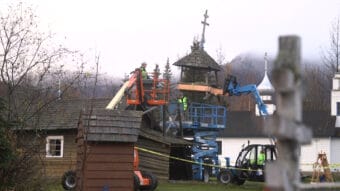
As the crowd looked on, construction workers on Friday carefully sawed the thin wooden beams holding up the tower. A crane then steadied it and brought it to the ground.

Bernier said the restoration project is still in its early stages and he’s not sure when it’ll actually finish, but the goal is to return the church to a usable form.

“It still is important that this is a tourist site and tourist destination and informative site,” Bernier said. “However, its primary function is sacred, and that’s important to all of us. Even those of us that are not Russian Orthodox.”

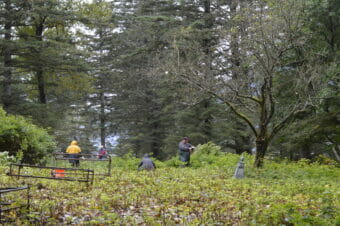
A crowd watches as the bell tower from the St. Nicholas Russian Orthodox Church is removed on Friday. (Shiri Segal/Alaska Public Media)

Watching the tower come down was an emotional experience for many at the site, including Charleen Shaginaw, great granddaughter of Eklutna Alex and granddaughter of Mike Alex. Eklutna was the last Dena’ina shaman of the village while Mike was the village’s last traditional chief. Shaginaw said she sees the restoration project as a new beginning.

“It was like a renewal. It wasn’t an ending,” Shaginaw said. “It was like the beginning of the next 50 or 70 years that this church is going to be serving our community and our tribal members.”

The overlap of the Russian Orthodox Church and the Dena’ina Athabascans who’ve long occupied the Eklutna area has a long history. Aaron Leggett, president of the Native Village of Eklutna, estimated that roughly half of his people’s population died between 1836 and 1839 due to an outbreak of smallpox.

“The Russian Orthodox Church was in charge of inoculating its followers,” Leggett said. “And so we started to see a new religion as part of, you know, our cosmology.”

While the church is the oldest standing building in Anchorage, it didn’t originate here. Leggett said the church was originally built in Knik around 1875, but it didn’t stay there for long.

“This location was reestablished in the late 19th century, when Knik became overrun with trappers and gold miners,” Leggett said. “It was literally the Wild West.”

Legett said the church was moved to Eklutna by around 1895.

There’s also a cemetery nearby. Walking around the cemetery is a different experience than walking through a traditional Russian burial area. While Russian Orthodox followers typically bury their dead, Leggett said, the Dena’ina had a spiritual practice of cremating their remains. So the two groups came to a compromise.

“We were afraid that the spirits would get confused,” Leggett said. “So we constructed the spirit houses and, traditionally, a person’s prized possessions would be put inside the house. Things that they would need in the afterlife, like a good pair of gloves, moccasins, a good knife, some food, that kind of thing.”

Leggett said the graveyard gets a lot more visitors than in years past, so the tribe has moved away from putting personal items in the small decorative spirit houses placed above the graves.

“You will still see, sometimes, little things of nominal value, put by the graves,” Leggett said. “For example, behind me, you can see Julie’s grave, her daughters always put a fresh bottle of Coca-Cola for her.”

Like Shaginaw, Leggett is a descendant of Eklutna Alex, a longtime caretaker of the church. He said his people aren’t as tied to the Russian Orthodox faith as they used to be.

“Most of the people of my grandmother’s generation, those born before World War II, were baptized Russian Orthodox,” Leggett said. “However, most people of my mom’s generation, and certainly my generation are not Russian Orthodox.”

Still, he described the St. Nicholas Orthodox church as a reflection of his tribe’s history and its heritage, and he’s hopeful the restoration project will ensure that history is preserved.

Researchers say Unangax̂ knowledge can help solve the mystery of Unalaska’s ancient bear bones

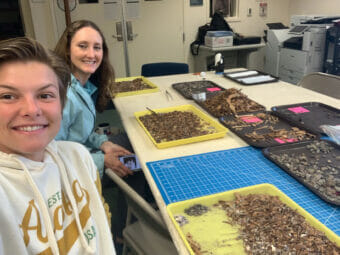
Lilly Parker and Kaylee Tatum at the Museum of the Aleutians helping sort fish, mammal, and bird remains from an archeological midden site in Unalaska. (Photo courtesy of Lilly Parker)

Archaeologists found brown and polar bear bones – some over 5,000 years old – at two dig sites on Unalaska and Amaknak Islands in the Aleutians during the early 2000s. Since then, the bones have puzzled scientists. There are no bears on either island today and no historical records of bears ever living there.
Lilly Parker and Kaylee Tatum, researchers from the University of Oklahoma, spent two weeks in Unalaska this summer. They shared their research findings with the community and asked for any information about bears that was passed down through generations. Tatum said Unangax̂ knowledge could help explain how the bones got there.

“Anything is helpful,” Tatum said. “Whether it’s a story that you heard around the campfire as a kid and you barely remember it … I still care. I still want to hear that.”

Kaylee Tatum at the University of Fairbanks Museum of the North, where her and Lilly Parker took photographs of brown bear and polar bear mandibles. (Photo courtesy of Lilly Parker)

According to carbon dating, the polar bear bones are about 5,500 years old and the brown bear bones are about 3,000 to 5,500 years old.

Parker said the bones were found at two different midden sites, which are historical dump sites used by Unangax̂ people thousands of years ago.

“They were just kind of in a jumble, in a mix of other remains,” Parker said. “There were around 23,000 animal bones found at the sites.”

Parker and Tatum spoke to many Unangax̂ elders about the mystery of the bear bones during their two-week stay in Unalaska.

While the elders were largely unsure of how the bones got there, one story suggested that people thousands of years ago may have transported bear meat by sea from the neighboring island of Unimak, which has a population of bears. Oral tradition has been passed down that says locals may have eaten bear when other food was scarce, such as during a particularly long and cold winter.

Parker and Tatum are planning to return to Unalaska next year to present follow-up scientific data. They will look for genetic clues, including a link between the bear bones found on Unalaska and Amaknak Islands and the bears on Unimak.

If they find a connection, it could solve the mystery of how the bear bones ended up on islands where bears were not previously known to live.

Volunteers hope for city support with cleaning up Douglas Island graveyards

Volunteers clear salmonberry bushes and other brush from graveyards on Douglas Island on Sept. 9, 2023. (Photo by Yvonne Krumrey/KTOO).

Over the whine of weed-whackers, about a dozen volunteers beat back bushes that covered old gravesites off 3rd St. on Douglas Island. Stone markers laid at all angles around gated-off gravesites.

Stefanie Bouma brought her two kids — Ori, 5, and Yadi, 2. Equipped with tiny rakes, they scooted leaves around the hillside. 

Bouma said her family started volunteering at the gravesites last summer because they want their kids to form a deeper relationship with the history and community around them.

“Every time we drive by, they always talk about the cemetery now,” she said. “Which I think, many people probably didn’t pay attention to it much before.”

For three years, this group of volunteers has been coming to the cemeteries to weed, clean gravestones and clear brush. First, they worked to clean up the Native cemetery, a plot of land where Alaska Native people were buried for several decades, starting in 1901. Now, they’ve started caring for the other cemeteries in the area, like the Asian cemetery and the old Douglas city cemetery that only allowed white people.

Now drivers can see the old headstones peeking out between trees on either side of the road, where they weren’t visible before. 

Volunteers wonder about help from the city

The volunteers say they can only do so much to fight the rainforest’s creep. Jamiann S’eiltin Hasselquist, who organizes the cleanups, said she has long wondered what the city could do to help. 

“All these volunteers coming together is just one more way to make things visible,” she said. “And maybe that could add a little bit of pressure to the City and Borough of Juneau to step up and start maintaining this area.”

Mike Kinville says he loves the community work that the clean up days have created, but thinks there are parts of the work — like sawing off long, hanging branches — that the city could take on. 

“For me, what would be perfect would be to see some sort of partnership,” he said.

Kinville was inspired by Bob Sam, a clan leader in Sitka who began restoring the Russian Orthodox Cemetery there about thirty years ago. Sam came to the Lawson Creek cemeteries in 1997 with Ed Kunz and Richard Dauenhauer and began cataloging the graves using information collected by Marie Olsen and others who researched the cemeteries in the 1990s.

Sam said it’s his life’s work to clean up cemeteries and advocate for the return of Alaska Native remains to their communities from boarding schools.

“There’s so much to learn from this work,” he said..

As volunteers begun unearthing old headstones, Kinville said Sam told them they have to be careful, and that’s something he wishes the city would help with.

“His recommendation is to wait until it can be done methodically, properly,” he said.

A confusing patchwork of land ownership

The city has long said that it’s not clear who owns the land the cemeteries are on.

Nearly 30 years ago, the City and Borough of Juneau conducted an inventory of historic gravesites that outlines a convoluted history of ownership, starting with a mining engineer named W.A. Sanders who owned the area. It says that Sanders verbally agreed to give the land to the city of Douglas — but refused to put that in writing. 

Now, the city’s parcel map says some of the land on the east side of the road is owned by “Douglas” and former Juneau Mayor Merril Sanford. But Sanford says he only owns the Order of the Eagle Cemetery, which he maintains. It’s fenced off from the rest of the graves. 

Meanwhile, the parcel map seems to show that the Catholic Church owns at least some of the land that the Native and Asian cemeteries are on. 

A representative of the Archdiocese of Anchorage and Juneau said that they are looking into that.

“The owners listed on the parcel viewer is what we really know,” said Deputy City Manager Robert Barr. 

Dozens of possible unmarked graves

Meanwhile, the cleanup job keeps getting bigger. Hasselquist’s team has uncovered dozens of other possible gravesites in the cemeteries — depressed rectangles in the land.

“The report that was done like 28 years ago only had five of the Native people recorded and three of the Asian people recorded,” Hasselquist said.

She said she’s since flagged over 70 possible unmarked gravesites in those two sites.

They found one buried headstone by accident last fall when a volunteer’s rake screeched against it.

“There was a piece of marble, white marble underneath the moss,” Kinville said. “And we dug it out and stood it up for the first time that headstone has been seen in I don’t know how long.”

A stuffed deer lies on the grave of a child on Sept. 9, 2023. Photo by Yvonne Krumrey/KTOO.

Across the road, Hasselquist shows the work they’ve done to make the city cemetery navigable again. She said that until recently, you couldn’t walk through it without chopping salmonberry bushes. Now, a low covering of deer heart leaves lays underfoot, and a toy fawn lies on one child’s grave. 

“There was a family — they knew they had an ancestor buried there, but they didn’t know where,” Kinville said. “They bring flowers every year, and the kids come and help clean up and they leave a stuffed animal there.”

Stories like these are why Kinville finds this work so valuable.

“To come across these people, these connections, these stories — it’s like a form of time travel for me and gives me a sense of connection to the community,” he said.

Back in the Catholic cemetery, Ori and Yadi took care with the century-old grave marker they were raking around. 

Their dad, Ephraim Froelich, said that he and Bouma want their children to grow up feeling invested in the communities around them.

“I think kids should be aware of what’s happening around them,” he said. “And we try to talk to our kids like adults, so they can be future responsible adults who aren’t sheltered from important topics.”

Topics like mortality, Froelich said, and the longstanding erasure of Indigenous culture in Juneau.

Editor’s note: This story has been edited to include previous restoration work done at Lawson Creek Cemeteries.

Presbyterian Church leaders visit Juneau to plan apology for 1962 church closure

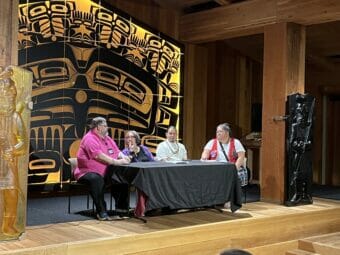
Tlingit and Haida President Chalyee Éesh Richard Peterson, Sealaska Heritage Institute President Kaaháni Rosita Worl, Lingít language professor X̱’unei Lance Twitchell and La Quen Náay Liz Medicine Crow on a panel about historic trauma on August 30, 2023. (Photo by Yvonne Krumrey/KTOO)

Southeast Alaska Native communities have worked for decades to undo the harms of colonialism. But Lingít language professor X̱’unei Lance Twitchell says that for too long, the organizations that caused that harm were conspicuously absent. 

“L’eiwtu Éesh Herman Davis once stood up at a gathering and said ‘Why is it just us? Where are the people who did this to us?’” he said. 

Now, some of those people are trying to join the effort. Presbyterian Church leaders came to Juneau this week to learn how exactly they ought to make an apology. The visit is part of a plan to formally apologize to the Lingít community for the 1962 closure of Memorial Presbyterian Church, which destroyed an important center for the Lingít community in downtown Juneau. 

Twitchell sat on a panel Wednesday at the Walter Soboleff building with Tlingit and Haida President Chalyee Éesh Richard Peterson and Sealaska Heritage Institute President Kaaháni Rosita Worl. La Quen Náay Liz Medicine Crow moderated as they spoke to church leaders about the harm religious organizations have done to Lingít communities through language suppression and violence at boarding schools. 

“Until about a few weeks ago, I’ve never stood up and talked about my trauma,” Peterson said. “Couldn’t do it. Now I feel like I have to as a leader, so people can understand and know what we all go through.”

Worl said that when she was putting together her presentation, she had flashbacks to when she was taken to boarding school as a child.

“I had been kidnapped from my home with my grandparents and brought to a Presbyterian mission, Haines House,” she said. “I am a strong woman, but last night, I will tell you I saw myself, I felt myself as a 6 year old that cried in my bed wondering, ‘Why was I taken from my family?'”

Twitchell said he can teach Lingít today because of the elders who held on to the language through all the violence at boarding schools.

“One time I was driving [Lingít elder Marge Dutson] home and she said ‘They tried everything, they tried to beat it out of me, they tried to scare it out of me, they tried to shame it out of me, but I held on to my language,’” he said. 

Jermaine Ross-Allam is the director of the Church’s new Center for Repair of Historical Harms. His job is to travel to places where the Presbyterian Church has created trauma and caused conflict, like Liberia. 

“The Center for Repair can’t tell Lingít people ‘This is what your reparation looks like,’” he said.

Ross-Allam said he noticed a lot of joy in the work that leaders like Twitchell have done to restore language and community, and that’s why he wants the Presbyterian Church to do this apology right. 

“For me, reparation is ultimately about reclaiming the material resources necessary to have more of that kind of joy,” Ross-Allam said.

Presbyterian Church USA has committed $1 million in reparations. They’re installing a memorial at the site of the former church on Oct. 7, and church leaders will read an apology Oct. 8.

From schooner to salmon tender, the Aleutian Express sails on 100 years of history

The Aleutian Express in Chignik after the 2015 salmon season. (Courtesy of John Clutter)

This summer, an unusual looking salmon tender is anchored in the Naknek-Kvichak District. The Aleutian Express is a historic, three–masted schooner that came sailing up from Washington State for the Bristol Bay sockeye season. With three masts and filled sails, this iconic vessel has been instrumental in many chapters of Alaskan history.

Owner John Clutter first laid eyes on the boat in Chignik waters in 1993. He’s captained the vessel across Alaska and the Pacific Northwest for the last eighteen years, and he says it’s become recognizable in many ports and across many generations.

So this guy was standing there looking up to the boat.” Clutter said. “He had a son with him about 10 years old, and he pointed up to the boat. He said, ‘That’s the coolest boat in Alaska. My dad told me that and his dad told him that.’”

The Aleutian Express was originally built in 1912 as a fire boat for the city of Portland, Oregon. There, the vessel started out under a different name: the David Campbell, in honor of the City’s late fire chief.

The keel was actually probably laid right about the time of the Titanic sinking,” he said. “And it was commissioned a year before that. But they actually started building in 1912 and it was fully operational then for the City of Portland sometime in late May that it actually got underway as a fireboat.”

Clutter says in 1912, the boat’s history started off with a bang.

The first operation, I guess they couldn’t get the boat out of gear and they crashed into the bridge. And I think that dent is still in the bow,” Clutter said.

A postcard depicting the original vessel, then named the David Campbell. (Courtesy of John Clutter)

Over the last hundred years, the ship has had many different names and lived many different lives. It’s been a fur trading boat in the Aleutian Islands, an oil tanker in WWII, a tow boat on the Columbia River, and a crabbing boat in the Bering Sea. Most recently, Clutter has captained the Aleutian Express as a salmon tender in Bristol Bay.

Since 2004, Clutter has retrofitted the 125 foot historic boat to bear resemblance to the ship’s rigging in the 1920s.

The boat, it had a couple of douglas fir masts where they cut them off to give them more of a tow boat look. And so it did have masts on it up until the early 1970s. And then I just decided to put the masts back but I made these out of galvanized pilings,” he said.

He says on long voyages, he’ll set a jib sail in addition to using the engines.

That jib alone would move the boat at three knots, just one big jib dragging the props. So it’s actually pretty efficient,” Clutter said. “And now that I have a mizzen boom built, I do believe it’ll make five to seven knots under the right conditions.”

He says sails not only help with speed, but cut down significantly on fuel use and carbon emissions. On one voyage from Alaska to Washington, Clutter calculated just how much.

I crossed the Gulf, took it down to Port Orchard, Washington and made it in a week and I pretty much ran on one of the engines and sails. And I figured I’d saved about 1500 gallons of fuel on that one week run,” he said.

Clutter says the challenges of owning and operating a historic vessel are extensive, but with his restorations, he hopes the Aleutian Express will be a working boat for generations to come.

It’s a great sea boat, I mean, this is an incredibly smooth ride. They just don’t build it like this anymore,” Clutter said. “I kind of see myself as a curator. With the work I’ve done in the last 18 years on this boat. It’s good for another 50.”

This season, the Aleutian Express is anchored at the Y on the Naknek River, working as a tender bringing loads of sockeye salmon from the water to Naknek’s docks. So keep your eyes peeled on the water this summer, for a 3-masted schooner coming around a bluff—a living piece of Alaskan history.

With Alaska’s maritime heritage at risk of being lost, program seeks to preserve it

The Alaska flag flies from the bow of a boat in one of Ketchikan, Alaska’s small-boat harbors on Monday, July 24, 2023. (James Brooks/Alaska Beacon)

With more coastline than all of the other states combined, Alaska has quite the maritime history. And for historians and museum leaders, it’s a challenge to preserve that history. A new federally funded grant program may make their jobs easier, by funding efforts to both preserve artifacts and educate the public.

Come Tuesday, the Alaska Maritime Heritage Preservation Program will be open to applicants for $327,500 aimed at helping retain and support maritime preservation and education projects. That’s the amount the National Park Service awarded to Alaska’s state government to distribute in grants to local programs.

With its 47,300 miles of coastline, the state of Alaska has an intricate relationship with the maritime world, making it a strong candidate for the national grant, according to Katie Ringsmuth, who serves as both the Alaska state historian and deputy state historic preservation officer.

“We really are the maritime north. We’re not just a state coastline. We connect the circumpolar north and the Pacific world. We have the power to tell that story for the rest of the country,” Ringsmuth said. “That would be why I think we made a good argument. The rest of the country needs us in helping them establish that history, that really important history.”


State Historian Katie Ringsmuth stands in her office with photos of Alaska maritime history. (Teigan Akagi/Alaska Beacon)

The State Historic Preservation Office formed a partnership with Alaska State Library, Archives and Museums, which allowed the state to increase the funding from the national grant. According to Ringsmuth, there are two grants to which those interested can apply: one focused on Alaska maritime heritage education and the other on Alaska maritime heritage preservation.

The education grant provides money to those who will share information with the public about maritime history or skills, whether that be through participatory programs, improving maritime exhibit spaces, teaching traditional maritime skills or other techniques.

On the other hand, the historic preservation grant gives money to projects that are documenting archeological history, research, the repair and rehabilitation of important maritime resources, and more.

The grants will provide money to Alaska-residing nonprofits, individuals, academic institutions, tribes, and others.

Museums work at preservation

Museums around the state are considering applying for the funding.

“It’s a great program–one of the few funding programs aimed specifically at preserving maritime history,” said Toby Sullivan, executive director of the Kodiak Maritime Museum.

He noted that Alaska’s long coastline makes it stand out when compared with other states.

“There’s a lot of history associated with that coastline and the oceans offshore from it, from the journeys of the Indigenous people who arrived in Alaska by sea thousands of years ago, to the early European exploration of coastal Alaska, to the modern fishing industry,” Sullivan said. “Preserving and understanding that history helps us to understand who we are in the present moment and gives us the perspective to see our possible place in the world of the future.”

The Kodiak Maritime Museum is just one of the many potential applicants for the program. The museum records oral histories, conducts historical research, surveys historically important waterfront sites and does other things to preserve maritime history, Sullivan said.

The Thelma C, a 1960s seine fishing boat restored by the Kodiak Maritime Museum, is seen on display in July 2021 in Kodiak. (Photo by James Brooks)

When it comes to what the museum plans on citing for its grant applications, Sullivan said that the museum has two projects in mind.

“First, finding a permanent building for the museum, which is the museum’s primary strategic goal, and helping to fund any refurbishment necessary to house the museum in that building. The second funding choice is to do a systematic historic survey and inventory of maritime history sites on Kodiak‘s waterfront,” Sullivan said.

Another potential applicant is the Sitka Maritime Heritage Society. Society Executive Director Keith Nyitray said of the opportunity: “It’s amazing!”

He said there are many different pieces of history that need preservation.

“I think it’s a shame when historic knowledge is lost, and providing that opportunity for younger people to learn about the history and skills and keep them moving forward is really important,” Nyitray said. “And it’s not just about how to fish, but it’s how it was done and why it was done, and those skills transcend time, but those skills are being lost.”

SMHS has done much to preserve Alaska’s maritime history. From boat-building and knot-tying classes to pub talks where historical themes and events are discussed, it’s all done without the walls of a museum. In fact, one of the SMHS’s biggest goals is to restore a boathouse to serve as their museum’s home.

“We’ve just spent hundreds of thousands of dollars into restoring this thing, we may apply for a fire suppression system, a sprinkler system, because what’s the sense in restoring it and then having it all burn down?” Nyitray said.

The Maritime Heritage Preservation Program application period opens on Aug. 1 and closes on Oct. 31.

Ringsmuth said it’s a significant opportunity.

“This is a program that we really hope will help Alaskans preserve not just the places that really matter to them, but their traditions and their lifeways,” Ringsmuth said. “We’re kind of treating this as a pilot program, and success will help leverage future grants. So that is really the intent is to try to create a more sustainable program so that we can continue to support coastal communities and the comprehensive history of Alaska.”

A webinar will be held on Sept. 21 with more information about the grant. For more information, concerning Alaska’s Maritime Heritage Preservation Grant or a link to the webinar, contact State Historian Katie Ringsmuth at katie.ringsmuth@alaska.gov.

This story originally appeared in the Alaska Beacon and is republished here with permission.

Site notifications
Update notification options
Subscribe to notifications