History

Curious Juneau: How big is the Coast Guard’s presence in Juneau?

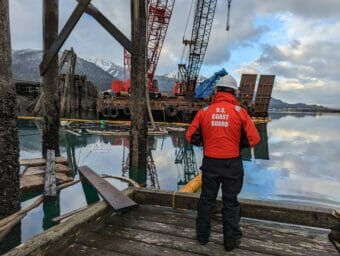
A Coast Guardsmen working on the recovery of the 81-year-old tugboat Tagish, which sank just south of Juneau’s cruise ship docks in December, 2022. (Courtesy of Coast Guard Sector Juneau)

At a Coast Guard change-of-command ceremony on Thursday, about 30 active-duty Coast Guardsmen gathered with some retirees, friends, and family under a tent at the Juneau docks. Young service members, wearing light blue uniforms and white caps, stood at attention while officers sent one officer off and welcomed another to town. 

Senior Chief Boatswain’s Mate Sean Crocker, the officer in charge for Station Juneau, said he didn’t want to come to Alaska when he was younger. But now he’s going to miss it. 

“It’s a little more bitter than sweet. And it’s not because I’m going to miss all the amazing fishing, hunting, boating,” he said. “For me, it’s going to be the people.”

The ceremony marked a passing of the torch from Crocker to Chief Boatswain’s Mate Nicholas Sedberry, who will now direct the 25-person Station Juneau. 

Capt. Darwin Jensen, commander of Sector Juneau, said that in Crocker’s two years of service, his unit conducted 90 search-and-rescue operations. Still, Crocker’s wife couldn’t make the ceremony. Their daughter graduated from kindergarten that morning. 

“Even more important,” Jensen said. 

Chief Boatswain’s Mate Nicholas Sedberry, Capt. Darwin Jensen and Senior Chief Boatswain’s Mate Sean Crocker at Coast Guard change-of-command ceremony on May 25, 2023 in Juneau. (Yvonne Krumrey/KTOO)

That’s how the Coast Guard is in Juneau – part of the community. 

“You don’t see a huge Coast Guard base down here. There’s Coast Guard here, there’s Coast Guard there,” said former Coast Guard captain Ed Page, who founded the Marine Exchange after he retired. “We’re more integrated in the community.”

While the Coast Guard is not as visible a presence in Juneau as some other Alaska military communities, it is large. A Curious Juneau reader wanted to know just how large — and how much the Coast Guard contributes to Juneau’s economy.

‘A major footprint’

Coast Guard members in Juneau might serve in the local unit — Station Juneau — or they might be involved or in regional or statewide management. Sector Juneau manages activities in Southeast, and District 17 runs the Coast Guard for all of Alaska. Both have their administrative offices in Juneau’s federal building.

Lt. Catherine Cavender works in waterways management for Sector Juneau. She says there are about 150 Coast Guard members in Juneau altogether and 270 throughout Southeast.

Like Page, she points to the lack of a base in Juneau, Coast Guard members live in houses and apartments all over town — they get their cars fixed, hair cut, and buy groceries at the same places everyone else does.

The Coast Guard’s headquarters inside the federal building in Juneau. (Photo by Jacob Resneck/CoastAlaska)

And they face the same challenges finding housing as the rest of the community.

“I lived in a hotel for four months before I was able to move into my rental,” Cavender said.

Meilani Schijvens of the research firm Rain Coast Data says that as of 2019, Coast Guard members had more than 400 dependents living in Juneau, too.

“It’s a major footprint. And then we also have people who work for the Coast Guard who are not active duty,” she said. “It does end up being a significant economic driver in the community.”
The Storis years

Damon Stuebner works at the state library. He made a documentary about the Coast Guard cutter Storis, which was based in Juneau in the 1940s and 50s.

He says that in the past, the Coast Guard’s presence was a lot more visible.

“If the ship had to leave for an emergency situation, the first officer of the ship — the executive officer — would call around to the Imperial and the Red Dog and say ‘Is my crew there? Get them out,’” he said. 

Coast Guard Cutter Storis
The Coast Guard Cutter Storis in Juneau in October 2006. (Creative Commons photo by Gillfoto)

Stuebner says the movie theater even used to have a red light that would start flashing to tell Coast Guardsmen to report for duty, right away.

The work was different then, too.

“When the Storis was based here in Juneau, she did a lot of the normal things as what you would expect from the Coast Guard to do,” Stuebner said. “But what they also did was what was known as the Bering Sea Patrol. This was a series of duties of transporting teachers to rural villages along the coast.”

Stuebner said the Coast Guard also delivered mail, groceries and supplies to coastal villages. 

“When statehood came around, then those duties dramatically shifted, and a lot of that burden went to the state,” he said.

Stuebner says that the Storis – which was stationed in Juneau from 1948 to 1957 before moving to Kodiak — even had a pitbull mascot named Red Dog — rumored to have been “acquired by suspicious means from the Red Dog Saloon.”

Red Dog, mascot of the Cutter Storis. (U.S. Coast Guard photo)

A Swiss Army knife

What does the Coast Guard do now? A lot of things, says Page.

The Coast Guard served in certain combat situations like Vietnam and Bahrain, said Page, but typically, those serving don’t face violence of that sort. 

“It’s a different type of service. It’s not just ‘Well, there’s a war, fight it.’ There’s a war all the time,” he said. “The war is in protecting the environment, the war is saving lives when the vessel sinks.”

Joe Geldhof, a maritime lawyer, said the Coast Guard rises to its many roles in Juneau.

U.S. Coast Guard and Hecla Greens Creek Mine crews deploy a boom April 3, 2019 to contain a fictitious heavy fuel oil spill at Hawk Inlet. (Photo courtesy of Coast Guard Sector Juneau)

“It’s kind of like a Swiss army knife — it’s got a lot of tools,” he said. “And they do extremely well.” 

Sector Juneau has a huge area of responsibility — from Dixon Entrance to Icy Bay. Geldhof says that between the size and the amount of work, it’s a lot for one group to take on. 

“I would say the Coast Guard is a reflection of all the disparate activities that they’re required by law to undertake,” he said. “Fisheries enforcement, drug interdiction at some point — you might conclude if you really study it, that they have too many tasks.”

They keep coming back 

Cavender has served one year in town so far, with two more to go. One of her favorite parts of being stationed here? Fishing. 

“I did catch a king salmon from the beach, which I’m very proud about,” she said.

It’s a new hobby that she started here. She says Juneau is a nice place to be stationed.

Coast Guard Station Juneau
Coast Guard Station Juneau on Sept. 22, 2015. (Photo by Jeremy Hsieh/KTOO)

“People definitely come back here for their last tour, or come back here and know that they want to retire here,” she said. “It’s really rare to see people retour so heavily in one spot.”

She said the town can feel like home to a lot of servicemembers, who integrate more into the community than they would elsewhere. 

Jensen, who commands Sector Juneau, says servicemembers look for opportunities to come back once they’ve been stationed here. He’s on his third tour in Juneau.


Curious Juneau

Are you curious about Juneau, its history, places and people? Or if you just like to ask questions, then ask away!

Filipino American History Month bill passes the Alaska Legislature

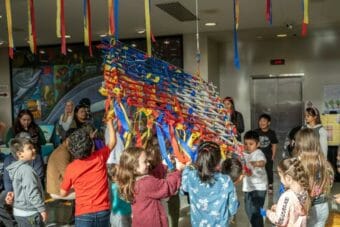
Children under and around a latticework of colored streamers
Children grab for goodies attached to a pabitin at Ketchikan’s Fil-Am Festival on Oct. 15. (Photo by Eric Stone/KRBD)

The Alaska Legislature passed HB 23 on Friday, establishing the month of October as Filipino American History Month in state statute.
Freshman Rep. Genevieve Mina, D-Anchorage, introduced the bill. She is Alaska’s second Filipino legislator after Rep. Thelma Buchholdt was elected 50 years ago, and HB 23 is Mina’s first bill.

“I just feel overwhelmingly proud because this bill wouldn’t have passed, not just without the support of the Legislature, but also without the decades and decades of advocacy and community work and just the existence that Filipinos have had in Alaska and in our nation,” Mina said on Friday after the bill passed. 

HB 23 has 43 co-sponsors — over half of the Legislature. Sen. Elvi Gray-Jackson, D-Anchorage, brought HB 23 to the Senate floor on Friday.

“From seasonal migrant cannery workers to health care workers and political leaders, Filipino Americans are a part of the fabric of Alaska’s diverse history,” Gray-Jackson said on the floor. “Unfortunately, the history of the Filipino community is not often told, which results in the erasure of both the history of this community and the people themselves.”

Rep. Genevieve Mina, her mother Evelyn Mina, and Lt. Gov. Nancy Dahlstrom pose for a photo after Rep. Mina’s oath of office. Mina chose her outfit, including a traditional Filipino shirt called a barong, beaded Philippine flag earrings and a necklace made by T’boli artisans to represent her Filipino heritage. (Photo courtesy of Genevieve Mina)

In 2019, two bills establishing February as Black History Month and November as Alaska Native Heritage Month were signed into law. Jackson says she sees HB 23 as an addition to these bills’ efforts to recognize the diverse cultures of Alaska in state statute.

Recalling the most rewarding moments she had when carrying the bill, Mina shared the time she spoke to Juneau’s Filipino Community Inc. for their biennial legislative reception earlier this year. 

“What I really was honored to experience after giving that speech was all of the love from people that I’ve never met before,” she said. “And that’s the type of representation that I hope this bill and enshrining Filipino American History Month in state statute will provide, because we’ve gone so long not seeing ourselves represented.”

The bill passed the Senate in a 19-0 vote, with Sen. Bert Stedman, R-Sitka, absent. The bill now goes to Gov. Mike Dunleavy to be signed into law.

Correction: This story has been updated to correct the spelling of Bert Stedman’s name.

Juneau musician Annie Bartholomew’s new album is a different kind of Alaska survival story

Annie Bartholomew records her “Sisters of White Chapel” album with other artists. (Photo by Rashah McChesney, courtesy of Annie Bartholomew)

Annie Bartholomew’s album, “Sisters of White Chapel,” started out as a song-writing project, then a musical — or a folk opera, as she calls it. In Juneau last summer, local actors and musicians took to stages wearing Victorian gowns and telling reimagined versions of real stories that real women lived over a hundred years ago.

Now she’s releasing the songs as an album.

It’s about the Klondike Gold Rush, from the perspective of the sex workers who worked in the mining towns. 

“I wanted to share how difficult those times were and how little power these women had, but also what they made of it,” Bartholomew said. “And how it is a survival story that you just don’t hear when you think of Jack London or ‘Into the Wild,’ you know?”

Finding nuance in an often whitewashed history

The idea for “Sisters of White Chapel” took root after Bartholomew toured the Red Onion Saloon in Skagway, a restaurant and museum that used to be a brothel. The tour was campy, but it stuck with her. 

“I was just a little bit haunted by the true stories that I heard and the artifacts that I saw,” Bartholomew said.

It shifted her perspective on what sex work meant at the time.

“A lot of the narratives I’ve been told about sex workers and prostitutes were wrong. These women came from all over. These women were smart,” Bartholomew said. “And I really wanted to use music to examine them, and share what I had learned.”

Bartholomew said that some in Southeast Alaska shy away from the brutal choices that these women faced, and that it’s often whitewashed or ignored in tales of the gold rush. 

In “Mountain Dove Song,” she sings:

“They think they can buy my silence / They think what can’t money buy / If they tried to sell me back my virtue / I wouldn’t waste a dollar thinking about the price”

“They are our history. And we’re living with the consequences today,” she said. “I think anywhere you see resource extraction communities, you get all of these other social ills, like man camps and missing and murdered Indigenous women.”

Bartholomew said she worked to balance the exploitation of sex workers with the fact that they had agency and their own wills. 

“My mom said ‘It can’t all have been bad times, Annie.’ And I think if you want to find the trauma and hurt and tragedy, it’s everywhere,” she said. “But they also had good times. And they also were entrepreneurs.”

And in her songwriting, she said it took some work to get at that nuance. 

I think it’s a lot harder to make people feel good in a song than it is to make them feel sad,” she said. “I feel like you have to balance the good and the bad. And it would just be so easy to make it a tragedy.” 

New and old songs

Each song on the album is original, except for one. “The Cuckoo” is rewritten from a traditional folk song. And one song found its inspiration in a miner’s poem from 1900 that was published in the Daily Klondike Nugget. 

“One of the things they did to entertain themselves was write poems and publish them anonymously in the paper,” Bartholomew said. “‘All For the Klondike’s Gold’ was a poem that I had read and kind of absorbed, and then just ended up reworking for this song.”

The song is the lament of a woman whose husband died on the Chilkoot Trail:

“He’s buried in the Yukon’s sand / beneath its angry wave / No headstone in that dismal land / does mark his lonely grave”

Bartholomew went back to the Red Onion to record a video of an early version of one of the songs. She said she finished writing the song while on the ferry to Skagway. 

“It was very magical to finish the song on Lynn Canal with the wind in my hair — and get to practice it as much as I could before having to put on a skirt and a corset and then go record it,” she said.

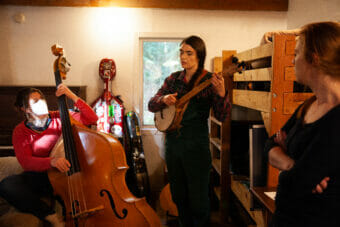
She recorded the album at a cabin at the Eagle River United Methodist camp with all Alaska artists. Bluegrass musicians Erin and Andrew Heist backed her up on various strings, Marian Call helped with vocals and Kat Moore contributed voice, piano and bass. 

“My producer Justin came in from Gustavus, and drove up everything needed to turn that spot into a full-fledged recording outfit,” Bartholomew said. “And we recorded it in like a week because we had to get out of the cabin because they had reservations.” 

The album officially comes out in June, but Kindred Post in Juneau will sell copies during a pre-release party in the store on Friday from 4:30 to 7 p.m. Bartholomew said she wanted the Alaskans who’ve been supporting her all these years to get a first listen. 

Listen to a special live rendition of “Mountain Dove Song” from the upcoming album, “Sisters of White Chapel,” recorded in the KTOO studio:

Annie Bartholomew is a former KTOO employee. She worked as an arts and culture producer until 2019.

What history’s hidden grandmother of climate science teaches us today

There are no lasting photos of Eunice Foote. Her experiments set the foundation for climate science. (Carlyn Iverson/NOAA Climate.gov)

Today, most climate science is done with satellites, sensors and complicated computer models. But it all started with two glass tubes.

“A woman, about 170 years ago, used a very simple experimental setup – two glass tubes, two thermometers, an air pump – and was able to demonstrate that if you add carbon dioxide to the atmosphere, you warm it up. It’s basic physics,” says Annarita Mariotti, a climate scientist and program director of Modeling, Analysis, Predictions, and Projections at the National Oceanographic and Atmospheric Administration.

Eunice Foote, the woman behind that glass tube experiment, has largely been left out of the history books. Until about 10 years ago, John Tyndall was seen as the grandfather of climate science for setting the foundation for the understanding of the greenhouse gas effect. But Foote’s experiment, done three years prior, showed that air with more “carbonic acid,” or carbon dioxide, both heated up faster and cooled down slower than regular air.

“She actually did some really important work before John Tyndall even got going. So why was there this grandmother of climate science that had essentially been written out of the history books?” asks Katharine Wilkinson, a climate scientist and the executive director of The All We Can Save Project. “Some of the frustration is that her story is still all too relevant today, that there are still far too many women doing really important work that either flies under the radar or gets shoved under the radar.”

Foote’s study was relatively straightforward. In a series of experiments, she took two glass containers full of air and would pump different gasses – including carbon dioxide and water vapor – into one of the containers. She would then leave those containers in the sun and monitor how quickly they heated up and cooled down in the shade.

Her work was presented in 1856, at the annual meeting of the American Association for the Advancement of Science. It was the first work done by a woman to be presented at the conference – though she did not give the presentation herself. Rather, it was done by physicist and first secretary of the Smithsonian, Joseph Henry.

But Foote didn’t just pioneer the field of climate science. Mariotti says, “She opened doors for women in science and in general broader representation in sciences … She did not have a Ph.D. and she did not have sophisticated experimental set up. And still she did it.”

Foote was a pioneer in more ways than one. She was the first woman in the United States to publish papers on physics; she also advocated for women’s rights outside of academia. Foote helped organize the Seneca Falls Convention, which launched the women’s suffrage movement in the U.S. “There was something sort of intersectional, perhaps, in her thinking in her life,” Wilkinson says. “If we are not bringing critical lenses to understand the root causes of the climate crisis, if we’re not bringing critical lenses to understanding the need to embed equality and justice in the solutions to the climate crisis, we’re not going to get to a good outcome … There’s early seeds of that in Eunice’s story as well.”

Listen to Short Wave on Spotify, Apple Podcasts and Google Podcasts.

This episode was produced by Liz Metzger, edited by Rebecca Ramirez and fact-checked by Anil Oza. The audio engineer was Robert Rodriguez.

Copyright 2023 NPR. To see more, visit https://www.npr.org.

New sign tells real Alaska ‘discovery’ story

Aaron Leggett, Chief, Native Village of Eklutna, and Beth Nordland, Exec. Dir. Anchorage Parks Foundation, speaking at the unveiling of a Dena’ina place names sign at the Capt. Cook monument at Resolution Park, Anchorage, AK March 22, 2023 (Photo by Joaqlin Estus/ICT).

A monument to Captain James Cook in downtown Anchorage hails him as “greatest explorer-navigator the world has ever known.” The plaque under the life-size statue of him highlights Cook’s travels, including Cook Inlet, where Anchorage is located.

The inlet was no discovery, though. For at least a thousand years, the region has been home to the Dena’ina Athabascan people.

The Eklutna Tribe, Anchorage Park Foundation and Anchorage Museum last week unveiled a Dena’ina place names sign near the Cook monument.

The new sign is due in part to the Black Lives Matter movement. In 2020, activists pushed for the removal of symbols of the slave trade, colonization and other injustices. Similar calls were made in Anchorage to have the Cook monument taken down.

Plaque at Captain Cook monument in Resolution Park in downtown Anchorage, Alaska, March 22, 2023 (Photo by Joaqlin Estus/ICT)

Anchorage then-Mayor Ethan Berkowitz said he would defer to the Eklutna tribe.

“I’m not really in favor of tearing down monuments in this case, but I want to use it as an opportunity to tell the complete story,” said Native Village of Eklutna President Aaron Leggett, Dena’ina Athabascan, speaking at the March 23 unveiling. He’s also senior curator of Alaska history and Indigenous culture for the Anchorage Museum.

“One of the ways of doing that was (using) this great vista that you can see here to highlight the Dena’ina names,” Leggett said. “So, what are the names that existed here when Captain Cook arrived at the end of May in 1778?”

“This gives you a Dena’ina view and shows that Cook didn’t discover these places, he simply documented them,” Leggett said.

The new sign reads, in part, “Before Captain Cook sailed into the inlet, the Dena’ina Indigenous inhabitants named all the features of the land you see in front of you. These names and stories reveal relationships with lands, waters, animals, and plants of the environment. They also convey oral traditions.”

Anchorage Parks Foundation Executive Director Beth Nordland said the new sign is part of a larger project.

She said the foundation has been working with Leggett and the Native Village of Eklutna “for some years now on Indigenous place names and the conversation about being able to add historic and cultural value interpretation in our parks and on our trails.” The new sign is one of a handful of similar projects at Anchorage parks.

“Today is a small victory, but a beautiful victory,” Nordland said. “And we want to keep going, making these small and large changes in our public spaces for Anchorage and Anchorage visitors to enjoy.”

Life-size statue of Capt. James Cook at Resolution Park in downtown Anchorage. March 22, 2023 (Photo by Joaqlin Estus/ICT)
Dena’ina Athabascan place names sign at the Capt. Cook monument in Resolution Park, Anchorage, Alaska, unveiled March 22, 2023 (Photo by Joaqlin Estus/ICT).

After his speech at the unveiling, Leggett added, “I think for our tribal members in particular, it’s important that our future generations know who they are and can be proud of who they are and can see themselves as part of this place because we have been here for well over 1,000 years.”

This story originally appeared in Indian Country Today and is republished here with permission.

Elizabeth Kudrin remembered as ‘great survivor’ of World War II

Elizabeth Golodoff Kudrin and her brother, Gregory Golodoff, photographed on Atka Island, sometime between 1946-1947, after they had begun to recover from the starvation they experienced during their stay in Japan, where they were housed as prisoners of war until 1945. Of the seven Golodoff children taken to Otaru, Hokkaido, three died from beriberi, a vitamin B deficiency caused by malnutrition, which leads to painful nerve damage and heart disease. (Photo Courtesy Of National Park Service, University Of Washington Press And Ethel Ross Oliver)

In the Russian Orthodox tradition, a week of memorial services concluded last month for Elizabeth Kudrin, a woman whose family says her legacy is that of a “great survivor.”

Kudrin died just a few days after her 82nd birthday. She was born on Attu, a tiny island in the far Western Aleutians in 1941 — the same year that Japanese planes bombed Pearl Harbor. In June of 1942, more than a thousand Japanese soldiers invaded Attu.

Elizabeth was just a baby, the youngest of seven children, when she and her parents, Olean and Lavrenti Golodoff, along with her family, were taken captive.

In September, the Golodoffs, and the rest of the islanders, were taken to Japan as prisoners of war.

About 40 arrived in Otaru on the northern island of Hokkaido, where they were housed in a big, shabby dormitory. About half of them died by the end of World War II, including Elizabeth’s father, two brothers and one sister.

Kudrin’s husband George says his wife’s passing marks the end of an era. He calls her “the matriarch of matriarchs, the last mom from Attu.”

Elizabeth and George Kudrin were a very close couple. In January this year, they celebrated 50 years of marriage. This photo was taken a few weeks before her death on Feb. 19. (Photo by Helena Schmitz)

Her death leaves only one survivor from Attu, her older brother Greg.

Although Kudrin and his wife were a close couple, he says she never talked about the war, partly because she was too young to remember what happened — and what memories she did have were too painful to dwell upon.

Elizabeth’s older brother, Nick Golodoff, described the hunger and starvation in his book, Attu Boy. He said the daily ration, near the end of the war, was only a quarter of a bowl of watered-down rice.

Rachel Mason, a National Park Service historian, says the timing of their evacuation from Attu, which came after the summer fishing season, turned out to be key to their survival.

“The Japanese told the Attuans to pack as much as they could of their subsistence foods, so they brought dried fish,” Mason said. “And that I think saved them, because at least until their fish rain out, they ate fairly well in Japan.”

Mason said Elizabeth’s mother did what she could to keep her children from starving.

“She was reduced to finding orange peels on the ground to feed her children,” she said.

Those who survived the war were not allowed to return home to Attu, which today remains uninhabited. The federal government resettled Elizabeth, her mother and three brothers in the neighboring island of Atka, where her husband George grew up. He remembers stories about how people were puzzled to hear mysterious sounds from this newly arrived four-year-old girl.

“She used to sing Japanese,” Kudrin said. “She used to go under the table and sing Japanese.”

But Kudrin says his wife had no memory of that.

Ray Hudson, a historian who has written extensively about the Aleutians, says the people of Attu are now lost to the footnotes of history, but what happened should not be forgotten.

“These were American citizens and subject to a very high death toll,” Hudson said. “So really, the capture of the Attu people in 1942 sealed the fate of Attu Island in many ways.”

Hudson says prior to the Japanese military invasion, a number of Aleutian villages had disappeared, but Attu was a thriving community.

“The villagers would trap fox, go fishing and made a good living,” Hudson said.

The women, he said, still made the tightly woven baskets that the Aleutians are famous for. But the war changed everything.

“People like Elizabeth are the victims of forces really beyond their control,” said Hudson, who said he was always impressed by her unfailing graciousness. “People like Elizabeth showed amazing courage and resoluteness to start over.”

Hudson said when Elizabeth was taken to Japan, she had to deal with people who didn’t speak her language, Unangam Tunuu. And when her family moved to Atka, she had to learn a new dialect.

“So there’s always this constant reinventing of yourself. And I think Elizabeth showed that resolve and a spirit of renewal that is really in the Unangax people.”

Elizabeth’s family says her life was full of hardships. She lost her first husband in a boating tragedy and outlived four of her five children.

“Anĝaĝinam iĝamanaa,” George Kudrin says in Unagam Tunuu. “She was a good person and she just loved you.

Elizabeth’s husband George says he marveled at Elizabeth’s ability to channel hardship into kindness and compassion for others.

Elizabeth Kudrin, her son Bill Dushkin and newborn grandson, Ivaan William Chalanax Dushkin. (Courtesy of Crystal Dushkin)

Her daughter-in-law, Crystal Dushkin, said she became a role model to young women in Atka.

“Seeing her example of strength and resilience, in all that she endured in her lifetime, was a real inspiration,” Dushkin said.

Dushkin believes she was also an important tie to the past, whose struggles have helped the younger generation understand the impacts of historical trauma, and how even today, the fallout from war continues.

Dushkin says she grew up hearing adults talk about the war.

“From a young age, I remember knowing that there had been a war, hearing about the war,” she said. “Everybody would always talk about before the war. That was kind of how stories started.”

She says some of these stories frightened her.

“Anytime I heard the plane flying overhead over our village, I would run inside the house, because I thought the plane was going to drop a bomb on our village, because that’s what I grew up hearing about — that planes dropped bombs,” Dushkin said.

Crystal and her husband, Bill Dushkin, love their life on Atka, but as today’s Russian fighter jets — and most recently, a Chinese spy balloon — have crossed into Alaskan air space, they say Elizabeth’s story serves as a reminder that far-flung places like Atka and Attu are still vulnerable, that they could once again be caught in the crossfire between nations. Attu is the only place on American soil that has been occupied by a foreign country since the War of 1812.

“It’s just amazing that it even happened back then, that one of our islands was taken over by a foreign country,” Dushkin said. “But yeah, it could happen here again. You never know.”

Elizabeth Kudrin gave her son, Bill Dushkin, a copy of When the Wind was a River on his 30th birthday. The cover photo of Elizabeth taken when she was a child prisoner of war, with the number 30 on her dress. It wasn’t until he was an adult that Dushkin learned he was adopted, and that Elizabeth was his mother. He says the photo helped him understand her decision.

Dushkin is Elizabeth’s son, whom she gave up for adoption. It’s a complicated story, one that he began to understand when she gave him a book for his 30th birthday — one that had her picture on the cover — the little girl, who would later become his mother, a prisoner of war, with the number 30 on the front of her dress

Elizabeth’s husband George has two words to sum up his wife’s life and legacy.

“Ayagam Kayutuu,” he says in Unangam Tunuu. “Strong woman.”

It was Elizabeth Kudrin’s strength and resilience that made her a part of Alaska history, which passed with her on Feb. 19 — a woman with a story that few Alaskans, and ever fewer Americans, know.

Editor’s note: Michael Livingston, an Unangan historian, contributed to this story. 

Site notifications
Update notification options
Subscribe to notifications