History

Meet Genevieve Mina, Alaska’s second Filipino legislator

Rep. Genevieve Mina is sworn-in as the second Filipino legislator since Thelma Buchholdt in almost 50 years. (Photo courtesy of Genevieve Mina)

In 1974, former Rep. Thelma Buchholdt, D-Anchorage, made history as the first Filipino to be elected to the Alaska Legislature. Now, almost 50 years later, Rep. Genevieve Mina, D-Anchorage, is making history as Alaska’s second.

Mina took office in January. She represents House District 19 in Anchorage, which covers the Airport Heights, Mountain View and Russian Jack neighborhoods. 

Like Buchholdt, who represented Spenard for 8 years, Mina has a strong connection to the Anchorage community. It’s where she was raised by her mother, an Ilonggo nurse, and her father, an Ilocano grape farmer and Alaskero who fell in love with the state.  

“There are so many people that I grew up with, that I went to school with, who have family in these neighborhoods who I would come over to hang out and watch TV, or have sleepovers, or do Dungeons and Dragons, or have tea parties,” she said.

Despite being elected at 26, Mina never thought she’d go into politics. She says she was shy and quiet as a kid, but she wanted to break out of her shell. At East High School, she began volunteering with school groups and realized her love for serving her community. 

While studying at the University of Alaska Anchorage, she was introduced to the debate team by a friend. It was a welcome break from her biology degree that quickly transformed into a passion that redirected her future plans. Then, the same friend who introduced her to the debate team asked Mina to help out on her first political campaign. 

“And I just got hooked from there,” Mina said.

Mina joined the Alaska Young Democrats and College Democrats, and was elected to be a delegate to the 2016 Democratic National Convention. She’s worked on numerous campaigns, interned in state and municipal political offices, and with policy firms in Alaska and Washington D.C. Her involvement in community groups expanded her interests in health care, public transit, economic empowerment and women’s rights. 

“The more I realized how much I love doing this type of work of talking with people, building relationships, making policies into reality and leading groups, the more I felt that it was a natural fit for me to eventually run one day, whenever the timing was right,” Mina said. 

Inheriting a passion for health care 

Mina grew up in a health care family, where she watched her loved ones care for others as a career.

Her mother, a nurse from Iloilo City in the Visayas region, was the first in her family to go to college. 

“My mom is a nurse. She’s the first nurse on her side of the family,” she said. “My brother became a nurse, my sister-in-law’s a nurse, my aunt is a caretaker. All of my immediate family works in the healthcare industry.”

Rep. Genevieve Mina stands next to her mother, Evelyn Mina, as she sits in her daughter’s seat on the Alaska Legislature’s House floor. (Photo courtesy of Genevieve Mina)

For almost 20 years, her family ran assisted living homes. The business, called the Genevieve Assisted Living Home, is named after her. 

“I grew up around more old people than people my own age,” Mina joked. 

When she was young, her father passed away by suicide. And after that, her mother lost Medicaid approval for their family business. When trying to appeal her case with the state, Mina said her mother felt she experienced barriers and discrimination. Eventually, her mother connected with other Filipino-American assisted living home administrators experiencing similar challenges from the state.

When she was still a preteen, Mina found herself supporting a burgeoning group of health care administrators in an attempt to sue the State of Alaska for shutting down Filipino-owned care homes without due process. She helped her mother document her handwritten recollection of interactions with the state, and she even designed the logo for the group.  

The group lost the case, but the experience shaped Mina’s love for health care policy. 

“It was really gratifying and fulfilling to be able to help someone understand what is going on, when they’re trying to deal with a very difficult system,” she said. “Health policy is truly an avenue where you are trying to work through the system to literally save lives, and I think that’s a beautiful thing.”

Learning who came before

In 2017, Mina interned with former Rep. Ivy Spohnholz at the Alaska Legislature.

“I was in the Capitol for the first time, being an intern. And I was just like, you know what, I wonder if there’s ever been a Filipino elected to the Alaska State Legislature?” she reflected. “And I looked it up, and I learned about Thelma Buchholdt.”

Before getting into politics, Buchholdt dedicated tireless hours to communities in Alaska. She was involved in Anchorage’s NAACP chapter, the Filipino Community of Anchorage and worked alongside rural Alaska communities to increase their access to health, education and social services.

She worked for years as a school teacher and first ran for the Anchorage school board in the 1960s. While she lost that first election by a small margin, she was elected to the Alaska House of Representatives in 1974 as one of the first Filipino-American women to be elected as a legislator in the U.S. 

Buchholdt spent her eight years in office passionately representing the concerns of her working class district in Anchorage. She served as vice-chair of the Finance Committee and chair of the Health & Social Services Committee, and her accomplishments include establishing the Alaska Commission on the Status of Women and the Asian Alaskan Cultural Center in Anchorage.

Even after leaving office, Buchholdt continued her mission for civil rights. She founded the Alaska chapter of the Filipino American National Historical Society, compiled a historical book about Filipinos in Alaska, and served 30 years on the Alaska State Advisory Committee for the Commission on Civil Rights. 

“I think that my mother was very aware of the lack of representation of Filipinos in the United States,” Buchholdt’s daughter, Titania Buchholdt, said. “And she took it very seriously as the amount of change she had the ability to create in her role.”

“I could see myself doing this work, because I saw Thelma doing it,” Mina said. “Learning about her history, learning about the work that she did, and the other parallels that I love, like that she was an ad hoc young Democrat.”

Reclaiming her Filipino identity

Buchholdt was born in Luzon, in the Philippines. She didn’t come to the U.S. until the 1950s for college.

Mina, on the other hand, was born in the U.S. in Alaska. But, growing up with family members that were all born in the Philippines, she says that when she was young she didn’t feel she was truly Filipino.

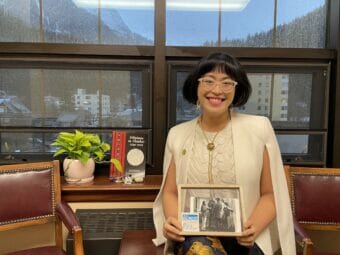
Rep. Genevieve Mina poses in her new office with a photo of former Rep. Thelma Buchholdt in January 2023. The photo was gifted to her by Christine Marasigan, a former legislative staffer who has mentored Mina around being a Filipina in politics. (Photo by Tasha Elizarde/KTOO)

“Between people who emigrated in their adult life with folks who were born here, it’s a huge cultural difference,” she said. “A big challenge that I have personally had is my family constantly speaking in a language that I don’t fully comprehend. That’s a very alienating feeling to have on a daily basis, where you don’t fully know what’s going on in your own home.”

Mina is now proud of her Filipino identity. It took an intentional effort exploring ways she could connect with her family – through food, learning her family’s language, attending Filipino community events and organizations and teaching herself that her differences didn’t make herself any less Filipino. 

Still, she emphasizes that her feelings of isolation aren’t abnormal in Filipino households, or in any home. As a public servant, she hopes to see other Filipinos feel included and take pride in who they are. She believes that talking through feelings of alienation, isolation, and depression is crucial to not only finding pride in our identities, but to supporting our mental health.

“Mental health is a huge issue in the Filipino community. I’ve been very open about how my dad died by suicide when I was very young,” she said. “There are ways to take pride in who you are. I own who I am, as someone who kind of knows Tagalog but not really, who didn’t grow up involved in the Filipino community, who wasn’t raised Catholic, but I’m just as Filipino as other folks from my community.”

Mina is known for putting together outfits that share the facets of her identity. On the day she was sworn in as a lawmaker, Mina wore a barong, a traditional Filipino blouse, gifted by her mom and jewelry made by T’boli artisans in the Philippines.

In her office in the Capitol, she has a framed photo of Thelma Buchholdt speaking to a group of taller male legislators. The photo was gifted to her by Christine Marasigan, a former legislative staffer and one of many accomplished Filipinos she credits with her journey into politics.

Mentors like Marasigan are why Mina introduced her first piece of legislation, HB23, which would establish October as Filipino American History Month in state statute. The bill will have its first committee hearing next week.

She hopes the bill will help the public recognize the complexities within the Filipino community while also challenging Alaskans to better understand the community’s history. 

“We have this assumption that Filipino-Americans work only in canneries, only in hospitality, only in health care. And when you think about these different Filipino groups, Ilocanos, Ilonggos, Tagalogs, Kapampangan, there’s a lot of complexity within our cultures,” she said. “And so I want to go deeper in that conversation and challenge the public. To learn more about who we are, why we came here, and why we take so much pride in being who we are.”

She hopes to see more Filipinos, and anyone else from an underrepresented community who doesn’t feel heard by the government, feel like they can be civically engaged.

“I just hope that I am able to live up to the work of (Buchholdt) and many other people who have come before me, to inspire others to to get involved and do the same after me,” she said.

Rep. Mina will be speaking at the Filipino Community Inc.’s installation of board officers ceremony and dinner on Saturday, Feb. 25 at 5 p.m. at Filipino Community Hall. The event is open to the public. 

Juneteenth and Indigenous Peoples Day are now Anchorage municipal holidays

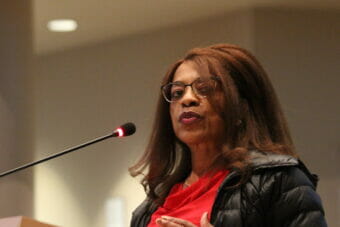
Celeste Hodge-Growden, president of the Alaska Black Caucus, speaks in favor of an Anchorage Assembly ordinance making Juneteenth and Indigenous Peoples’ Day city holidays on Feb. 21, 2023. (Wesley Early/Alaska Public Media)

Juneteenth and Indigenous Peoples Day are now municipal holidays in Anchorage.

That’s after the Anchorage Assembly voted Tuesday night to add the two holidays to the list of paid holidays for municipal employees. Initially, the ordinance would’ve also removed Seward’s Day from the municipal holidays list, but Mayor Dave Bronson amended the ordinance to keep it in.

The celebration of Juneteenth dates back to June 19, 1865, the day that the last slaves in the Confederacy were informed of their freedom following the Emancipation Proclamation. It’s often considered the oldest holiday among Black Americans, signifying the effective end of slavery in the United States.

Celeste Hodge-Growden, president of the nonprofit Alaska Black Caucus, said she hoped the city would follow the lead of the nation, where Juneteenth is a federal holiday, and the state, where a proposal to make it a state holiday is being considered.

“It’s more than giving employees a day off,” Hodge-Growden said. “It will give residents a day to think about the future that we want while remembering the inequities of the past. I’m elated the Assembly is considering this ordinance.”

Indigenous Peoples Day is a holiday commemorating Alaska Native and Native American history. Typically it’s held in lieu of Columbus Day. It’s been a state holiday since 2017. Anchorage resident Ayyu Qassataq, who’s Inupiaq, testified in support of both holidays.

“Recognizing Indigenous Peoples Day and Juneteenth Freedom Day are but one step in elevating public consciousness of the rich and sometimes unjust histories of the vibrant peoples whose stories deserve to be recognized and respected,” Qassatuq said by phone.

The ordinance was passed unanimously.

Juneau celebrates Elizabeth Peratrovich Day by advocating for civil rights

Jamiann S’eitlin Hasselquist touching the graves of Elizabeth and Roy Peratrovich. Feb. 16, 2023. (Photo by Katie Anastas/KTOO).

Most years, on Feb. 16 – Elizabeth Peratrovich Day — the Alaska Native Sisterhood celebrates the anniversary of the passing of Alaskaʼs Anti-Discrimination Act first by visiting the gravesite of its advocate, Ḵaax̱gal.aat Elizabeth Peratrovich. Then they encourage Alaska Native activists to continue her work. 

Jamainn Sʼeiltin Hasselquist, with the Alaska Native Sisterhood, went to Peratrovich and her husband’s graves a day earlier to shovel away the snow.

“We all have workplaces. We all can go into restaurants. We all can speak our language. And we’re all walking in the legacy of Elizabeth and her spirit. And so the intention today was to come together and let people speak,” Hasselquist said. 
Peratrovich is credited with being the force that turned the favor of the legislature toward passing the Anti-Discrimination Act by challenging Alaska Legislators who were against the bill.

“When a brave person is standing in front of a maybe not-so-brave senator and they call him to task — that’s what happened, so we’re proud of her,” said Alaska Native Brotherhood Glacier Valley President Peter Naoroz.

Later, at the Capitol steps, the Alaska Native Sisterhood led a rally meant to bring attention to those carrying out Peratrovichʼs legacy. 

“Some of you are holding signs, signs of important topics. But we don’t just see you as holding a sign,” Hasselquist said. “We see you moving in the spirit of Elizabeth. You are using your most powerful tools: your voice and your presence.”

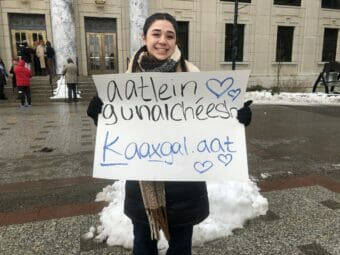
Shaash Kwan Raven Svenson’s sign said “Aatlein gunalchéesh, Ḵaax̱gal.aat,” and thatʼs what this holiday is about for her, appreciating Peratrovich’s dedication to Alaska Native rights.

Shaash Kwan Raven Svenson holding her sign at the Elizabeth Peratrovich Rally. Feb. 16, 2023. (Photo by Yvonne Krumrey/KTOO)

“Just being very grateful for the effects of that. All of that work was done for us today. And the freedoms that I get to enjoy because she’s stood up for it,” she said.

Svenson was there with the University of Southeast Alaska student group Wooch.een. Almería Alcantra was, too. Sheʼs been working in tribal advocacy since 2020. 

“I think far too often Indigenous people are left out of the picture, but we’re here and we’ve been here and we’re not going anywhere,” they said. 

The students said that Peratrovich inspires them in the work they do, like language revitalization efforts, advocacy for Alaska Native rights in legislation, and making room for Indigenous students in academia. 

Part of that legacy is advocating for civil rights now, the students said,  and the group held signs that supported bills like one financing mental health program funding in schools and another that would increase insurance coverage of contraceptives. The group advocated against a bill that limits school sports based on studentsʼ gender assigned at birth.

Bill that would make Juneteenth a state holiday receives first legislative hearing

Sen. Elvi Gray Jackson and her Chief of Staff Besse Odom speak at the Feb. 15, 2023 hearing for a bill that would make Juneteenth a state holiday. (KTOO/Gavel Alaska screenshot)

The Senate State Affairs Committee heard a bill Tuesday that would make Juneteenth a state holiday in Alaska.

Juneteenth is already a national holiday. It commemorates the day when enslaved people in Galveston learned from a Union soldier that they were free — more than two months after the end of the Civil War. The holiday is recognized nationally, and by 24 other states, on June 19.

Sen. Elvi Gray-Jackson, D-Anchorage, first introduced a similar bill in 2021, but it was referred to committee and didn’t advance. She introduced SB 22 at the start of this year’s session. 

At the hearing, she said that this holiday — and the history behind it — has been overlooked in the past.

“This moment in our nation’s history shows the urgent need for history to be more thoroughly understood,” Gray-Jackson said. “When we talk about America, we often think about high ideals like freedom and justice. By studying Juneteenth, we can better understand how these ideas have simply not been applied equally.”

Celeste Hodge Growden with the Alaska Black Caucus testified first on the bill. 

“Becoming a state holiday will not merely give employees a day off. It will give residents a day to think about the future that we want while remembering the inequities of the past,” she said.

Vikki Jo Kennedy of Juneau called in to say she supports the bill but was worried that public transportation wouldn’t run on the holiday.

“The majority of people who ride public transportation in our state alone, just ours, are people of color,” Kennedy said.

Gray-Jackson worked on making Martin Luther King Jr. Day a paid holiday in Anchorage in 1999 when she was an Assembly staff member. The first bill she sponsored as a state senator established February as Black History Month in Alaska and became law in 2019.

The dark origins of Valentine’s Day

A drawing depicts the death of St. Valentine — one of them, anyway. The Romans executed two men by that name on Feb. 14 of different years in the third century. (Hulton Archive/Getty Images)

Valentine’s Day is a time to celebrate romance and love and kissy-face fealty. But the origins of this festival of candy and cupids are actually dark, bloody — and a bit muddled.

Though no one has pinpointed the exact origin of the holiday, one place to start is ancient Rome.

The Romans’ celebrations were violent

From Feb. 13 to 15, the Romans celebrated the feast of Lupercalia. The men sacrificed a goat and a dog, then whipped women with the hides of the animals they had just slain.

The Roman romantics “were drunk. They were naked,” Noel Lenski, now a religious studies professor at Yale University, told NPR in 2011. Young women would line up for the men to hit them, Lenski said. They believed this would make them fertile.

The brutal fete included a matchmaking lottery in which young men drew the names of women from a jar. The couple would then be, um, coupled up for the duration of the festival — or longer, if the match was right.

The ancient Romans may also be responsible for the name of our modern day of love. Emperor Claudius II executed two men — both named Valentine — on Feb. 14 of different years in the third century. Their martyrdom was honored by the Catholic Church with the celebration of St. Valentine’s Day.

As the holiday spread, it evolved

Later, Pope Gelasius I muddled things in the fifth century by combining St. Valentine’s Day with Lupercalia to expel the pagan rituals. But the festival was more of a theatrical interpretation of what it had once been. Lenski added, “It was a little more of a drunken revel, but the Christians put clothes back on it. That didn’t stop it from being a day of fertility and love.”

Around the same time, the Normans celebrated Galatin’s Day. Galatin meant “lover of women.” That was likely confused with St. Valentine’s Day at some point, in part because they sound alike.

As the years went on, the holiday grew sweeter. Chaucer and Shakespeare romanticized it in their work, and it gained popularity throughout Britain and the rest of Europe. Handmade paper cards became the tokens du jour in the Middle Ages.

Eventually, the tradition made its way to the New World. The Industrial Revolution ushered in factory-made cards in the 19th century. And in 1913, Hallmark Cards of Kansas City, Mo., began mass-producing valentines. February has not been the same since.

How we celebrate now

Today, the holiday is big business. But that commercialization has spoiled the day for many. Helen Fisher, a sociologist at Rutgers University, said we have only ourselves to blame.

“This isn’t a command performance,” she said. “If people didn’t want to buy Hallmark cards, they would not be bought, and Hallmark would go out of business.”

And so the celebration of Valentine’s Day goes on, in varied ways. Many will break the bank buying jewelry and flowers for their beloveds. Some will celebrate in a SAD (that’s Singles Awareness Day) way, dining alone and bingeing on self-gifted chocolates — while others will find a way to make peace with singlehood in a society that wants everyone to partner up.

Copyright 2023 NPR. To see more, visit https://www.npr.org.

Metlakatla launches homegrown historical archive: ‘We have the right to know about our people’

A photo of the Duncan Memorial Church fire in 1949. (Photo courtesy of the Annette Island Reserve Historical Archive)

Alaska’s only reservation is fighting to reclaim how its story is told. Metlakatla residents hope that by filling the new Annette Island Reserve Historical Archive with pictures, videos and sounds, future generations will know where they came from — and the current generation will remember the past.

Right now, when someone writes about Metlakatla, they don’t always get to hear the story from the people who live there. Tribal Councilmember Keolani Booth said that’s because there’s not a central archive to store the tribe’s stories and memories.

“You know, when anyone writes about Metlakatla, or does anything … we’ve got one narrative — that’s from our narrative, and, and I think the fact that we don’t have that right now, it’s left up to interpretation by anyone who would want to write about Metlakatla,” Booth said.

Reggie Atkinson is a former Metlakatla mayor. He told KRBD there have been efforts to build archives in Metlakatla before, but they haven’t been digitized, and they aren’t organized.

“We do have a building right next to our council chambers and it’s (an) archive building,” he explained. “There’s archive boxes stacked in there, and actually, I don’t even know what’s in there. I went in there once.”

Atkinson said he’s heard that there are historical images of Metlakatla inside Duncan Church, and that relatives might have even more.

“There are people saying they have photos,” he said. “I know for a fact that a relative has eight millimeter movies from his father. His father was in the territorial guard unit here then.

The Metlakatla Indian Community contracted Caitlin Steinberg, a researcher from Wisconsin, to come to the island and help develop the Annette Island Reserve Historical Archive. When it’s finished, Steinberg said the archive will hold pictures, videos, and interviews with local elders and families.

“It’s been brewing for decades, it seems, in Metlakatla,” she said.

The effort will involve the whole community, largely led by youth: students will interview their parents, aunts, uncles and neighbors, learning more about their family’s history, as well as the history of Annette Island.

“So there was already this hunger for this place for anyone to just go find their stories of their family in the community,” she said. “And it was born from talking about all these different ideas and all these, you know, hopes and wishes for how organizing Metlakatla’s history could benefit the people.”

Once the interviews are completed, Steinberg says they’ll be filed away along with a questionnaire, created by residents.

Steinberg says there will be a little of everything in the archive — from stories about the founding of Metlakatla to the history of residential schools and what life was like in World War II.

“And it’s also going to be fishing, hunting, gathering, you know, it’s going to be things about stories about the old cannery and you know, when there would be coffee meet ups at the old cannery as well as the fishing culture down at the docks,” she said.

The archive will be contained in a room at Metlakatla High School, and anyone will be able to record an interview for the collection.

The work has already started taking shape. On a recent Friday afternoon, community elders gathered at Metlakatla High School for “coffee with elders.”

The recording is a little hard to hear, but resident Henry G. Smith spoke about the value of the archive in this clip from the event sent to KRBD.

In the clip, Smith said, “It’s a good thing for the kids to learn … the history of where thier parents, their grandparents, their great-grandparents came from, how Metlakatla came about. It’s good for them to know this stuff, to know the history of their ancestors.”

And Booth, the councilmember, hopes that knowledge will be preserved for future generations in Metlakatla.

As a councilmember, Booth said if he wanted to look back at something a past member had done, in most cases, he’s out of luck. He doesn’t want that to happen to future generations.

“And there are things that I’d love to speak to Henry Littlefield about, or Solomon Guthrie,” he said. “And they were councilmen, many, many years ago. And, you know, if they didn’t write it down, we don’t know. So I think it’s really going to help a lot in the continuity of serving the community, passing information, and, and preserving our culture.”

“You’ve got to know what you’ve done to move forward,” he added.

He hopes the archive will help preserve knowledge of times both good and bad, as well as traditional language.

It’s things that we need to know, and we feel we have the right to know about our people,” he said.

Booth says that Steinberg, the contracted archivist, plans to train a member of Metlakatla’s tribe to take over as lead historian, once the project is fully on its feet.

Site notifications
Update notification options
Subscribe to notifications