History

Alaska doctor, once the focus of outrage, reflects on past as abortion provider, with questions

A black-and-white photo of a woman in front of a large, concrete building
Dr. carolyn Brown sits outside her obstetric-gynecologic practice in Palmer with the Valley Hospital in the background. This photo was taken sometime in the mid-1980s. (Photo by Sally Mead)

This story is an adaptation of Episode 2 of the Alaska Beacon podcast, Private Right: Abortion in Alaska.

Written in large letters across a billboard displayed in the Alaska Right to Life booth at the 1981 State Fair in Palmer was this question: “Does your Doctor kill babies?” Underneath that question was a list of several names – including Dr. carolyn Brown.

This billboard along with things published in Alaska Right to Life’s newsletter — like calling Brown “baby-killer Brown” — were part of a libel lawsuit that would go on to reach the Alaska Supreme Court. She would lose the lawsuit, which touched on principles central to debates over free speech.

From the late 1970s to the late ’80s, Brown was a gynecologist and obstetrician in Palmer. She delivered thousands of babies, which she was known and praised for. She also performed abortions, which she was known and praised for — and vilified for. She remembers being told, “how bad it was, how evil it was that I was killing babies, and that God would get me for that and I would burn in hell and all the other stuff that people say to people.”

However, Brown herself has questions. As she reflects on her past as an abortion provider, she struggles with how to define the beginning of personhood. And she’s relieved she no longer has to decide when it’s OK to perform an abortion. But despite this uncertainty, she continues to support a right to an abortion.

A long interest in medicine

Brown was born in 1937 and raised in Hereford, Texas, about 50 miles southwest of Amarillo. Her parents divorced when she was around 9 and her mom left, so Brown and her brother went to live with their grandmother. She knew when she was 10 she wanted to be a doctor.

“I was working in a cotton patch and there were a whole bunch of other people working in that cotton patch and here I am this little kid with a 6-foot cotton sack that I’m pulling behind me and I decided I don’t think I want to do this all my life,” Brown said, adding that she isn’t sure why she chose to be a doctor at that time. “Maybe I’ve been to a movie. I didn’t have any books to read. My growing up and background was a little bit challenging, I will say. But I decided at that point that I really was interested in becoming a doctor.”

When she was introduced to a library at age 12, she read everything in the children’s part of the library.

“I read a lot of biographies and … I was just mesmerized with medicine. That really made more firm what I was going to do,” Brown said.

She took all the science classes that were possible for her to take in middle and high school, and went to college at Hardin-Simmons University in Abilene, Texas, where she majored in chemistry and biology, and graduated magna cum laude.

When it came to deciding what medical school to go to, Brown was sure of only one thing: “Whatever I have to do, I had to get out of Texas,” she said.

She didn’t want a big medical school and she didn’t want to go too far north, “Because I was too much of a hick. And I knew that. And I was poor as Job’s turkey,” Brown said.

Growing up, Brown did not think highly of herself.

But she got into all the medical schools in Texas at the time.  Still, she decided to go outside the state — to Bowman Grey School of Medicine in Winston-Salem, North Carolina.

Brown met her husband George Brown there, and the two doctors came to Alaska in 1965. They worked as public health doctors with the U.S. Public Health Service. They were based out of Anchorage but traveled all over the state. The two then went to Hawaii, where Brown did her first residency in public health and preventive medicine at the University of Hawaii. Afterward, they returned to Alaska.

Brown had a long list of jobs during that time, including working at the Anchorage Municipal Health Department. Brown was inundated with women who had a lot of health questions about women’s issues – questions Brown couldn’t always answer. So, she decided to go back to the University of Hawaii to do a second residency.

One of the boys

Throughout this whole time, Brown didn’t have any strong feelings about abortion. In fact, she didn’t really think about it at all during college, medical school, or her first residency. It wouldn’t come up until her second residency in obstetrics and gynecology.

It was 1975. The U.S. Supreme Court had decided on Roe v. Wade two years prior, ruling that the constitutional right to privacy includes the right to access an abortion.

The University of Hawaii wanted to teach all OB-GYN residents how to perform abortions.

“When I got there, I had a choice,” she said. “You were offered it. They suggested it. And if you didn’t want to do it, and there were some who, based on religious background, chose not to do it, then they were given other kinds of work. Grunt work, we call it.”

Brown said it was an excellent teaching program — but, as one of the first women to go through that program, she said it was also extremely misogynist. So Brown had to make a choice — was she going to be one of the boys and perform abortions, or would she go do grunt work?

She decided to be one of the boys. Even then, she still didn’t have an opinion about abortion.

“I didn’t have a decision about — What did I really think about it? I said, ‘OK,’ because I hadn’t really processed what that really meant,” Brown said.

Brown knew that she wouldn’t have an abortion. She had to ask herself: What am I doing? It weighed on her, but she didn’t have much time to dwell on it.

“Except once in a while I did think about it, and I went to church. And I did all of those things that I sort of grew up doing way back in the day. But I had to come to some peace with myself,” Brown said. “But I never could decide for myself that an egg and a sperm was a person because a person is a philosophical definition. A sperm and an egg when they come together, that’s tissue up to a certain point. And then you got the whole philosophical thing is when does the soul enter the sperm and the egg? I didn’t know and I still don’t know. But I’ve struggled with that for all of these many, many years.”

During Brown’s days at the clinic, she did 10 to 14 abortions a day.

Setting up a practice in Palmer

When she was done with her residency in Hawaii, she, her husband George Brown and their two kids returned to Alaska in 1978. The couple started Women and Children’s Health Associates, a nonprofit that operated an obstetric-gynecologic and pediatric practice in the Mat-Su Valley. Brown’s office was based in Palmer and her husband’s pediatric office in Wasilla.

Brown initially worked out of the Valley Hospital, though she didn’t have a proper office.

“But the hospital had a little front room, just off of the waiting room when you go into the hospital and it was maybe 16-by-16 square feet. And so we found a table with stirrups on it and a desk and a chair and a screen. And I didn’t have a secretary, I didn’t have an assistant, I had nothing, but the people started coming,” Brown said.

Brown had a very active OB-GYN practice. She eventually moved her office to its own building, just outside the hospital’s parking lot. She said she would work 100-hour weeks and she didn’t make payment a barrier.

“In those days, I gave stuff free. I did free C-sections, I took bear meat, I took salmon. You know, it was the old-fashioned way of doing whatever it is you had to do,” she said.

She also provided abortions. Brown saw all kinds of patients, including Medicaid recipients, and people from all over the state — like Fairbanks, the Aleutians, Kotzebue, Juneau, Utqiagvik — were referred to her.

“Literally every quadrant of the state and people would call the office or they would call whatever practitioner they knew, or from way out in the villages, they would contact the public health nurse,” Brown said.

At this time, Brown said there weren’t ultrasounds. She had to tell how far along someone was from doing a pelvic exam. It was up to her to determine if a woman was, for instance, eight weeks pregnant or 22 weeks.

In the late 1970s, doctors in Alaska could perform abortions up to 150 days, or about 21 and a half weeks. To provide an abortion beyond that, state regulation allowed doctors to use “reasonable judgment.” Brown said she stuck with the 150-day limit and was “worse than OCD on that sort of thing.” This meant she sometimes had to turn people away, like a woman who had traveled from Utqiagvik to Palmer.

“She got there and, bless her heart, when I did the exam… she was more – 150 days is 21 weeks and four days – and that was 22-weeker and I said, ‘I can’t do this. I can’t do this,’” Brown said.

By this time, Brown said performing abortions was as normal as any other OB-GYN medical procedure. Though she performed abortions up to 21 and a half weeks, Brown said more than 90% of the abortions she did were done in the first trimester – the first 13 weeks.

She estimates she did three to five abortions a week in the Valley Hospital, though there were peaks and dips. And she said she had a good safety record.

“I wasn’t having any bad events, any failures, any disasters. I was very, very, very conservative about what I did,” Brown said.

‘There goes the baby killer’

Brown and her family were part of the community. They went to the Presbyterian church. The two kids attended middle and high school in Palmer. It wasn’t a secret that Brown performed abortions. She said the board of her and George’s nonprofit was very supportive, but not everyone in the community was.

Throughout her time in Palmer, starting a couple months after they arrived, Brown recalled being harassed. She received hate mail and phone calls in the middle of the night. Air was let out of her tires. People against abortion rights went to her work place.

“When I would come to work, go in to make rounds, they would hiss and boo. That was still at a time when I had the little office in the hospital there. So they would come in and sit around and say whatever it is they had to say. And line up just like a march as it were,” Brown said.

She heard comments like, “There goes the baby killer. Is that the baby killer?”

“It was awful. It was really awful, but you have to carry on,” Brown said. “I’d come to work and get ready to go down to the other end of the hospital to do a C-section or to do whatever it was I was going to do. Well, it’s got to go on.”

She said that people’s behavior toward her was egregious and filled with vindictiveness. But she never felt unsafe. In the decades after she practiced in Palmer, several abortion doctors were murdered around the country, which led Brown to think that if she had been an abortion provider later, she might’ve been shot.

On the outside, Brown was calm and collected. But inside, she said she was a basket case. Most people didn’t know that, she said.

“Of course I had to be in charge in the operating room. I had to be in charge when a person was in labor, screaming their heads off or whatever. I got to the place where I could almost talk a woman through her delivery, just my soft voice and sitting there. And I knew that was happening and she knew that was happening. And I knew I was very good at that. But nobody knew what was going on inside. The fear of God Almighty, what if this woman dies? What if this baby dies? Oh, my God. All the horrible things that you could possibly think of, I went through them all a great deal of the time,” Brown said.

At the same time Brown was performing abortions and being called a baby killer, she was also delivering lots and lots of babies. And she was really good at it. “We never lost one,” she said.

There were also colleagues at the hospital who didn’t want to work with her.

Brown recalls a person who worked in the lab and refused to draw blood for abortion patients due to his religious objections. There were also nurses who wouldn’t work with Brown when she was providing abortions. “A few of the nurses, religious or otherwise, just simply could not help,” she said.

The lawsuit

In April 1981, Brown submitted her name to Gov. Jay Hammond for appointment to the Alaska State Medical Board. The board regulates the practice of medicine, including abortion procedures.

According to court documents, “The appointment process resulted in some confusion in the governor’s office.” A letter appointing Brown to the medical board dated in May was signed by Hammond’s signature machine. The letter wasn’t supposed to be sent until the governor actually gave his approval and it wasn’t sent; Brown never received this letter from the governor. But the governor’s press secretary announced Brown’s appointment and the lieutenant governor sent Brown a congratulatory letter. It was also reported in local newspapers.

In response, the Alaska Right to Life wrote about Brown in a June newsletter. It said: “Stop baby-killer Brown.” It called her “the Mat-Su Valley’s No. 1 Abortionist,” and instructed its readers to contact the governor to urge him not to appoint Brown to the Alaska State Medical Board.

The newsletter article said, “We cannot believe that Governor Hammond will bow to anti-life pressure to appoint an abortionist whose methods were so horrible as to cause a boycott by every nurse employed at Valley Hospital.”

Hammond eventually sent Brown a letter and apologized for the “erroneous announcement” of her appointment. He wrote that he had decided to follow his past practice of appointing a person recommended by the Alaska State Medical Association. According to court documents, the association had not recommended Brown because it thought that vacancies on the State Medical Board, which previously had been held by Anchorage doctors, should again be filled by Anchorage doctors.

In September 1981, Brown filed a lawsuit against Bill Moffatt, the primary author of the newsletter article, and Alaska Right to Life, alleging they had libeled her. In the lawsuit, Brown said that the defendants intimidated the governor and caused him to withdraw her appointment, resulting in damage to her professional reputation and career. Brown was joined by other doctors in the lawsuit.

The complaint also alleged defamation based on the state fair sign, what was written in the newsletter, and press conferences where they called Brown a “killer of babies.”

“It was very defamatory. That’s why I decided to sue them,” Brown said. “I was so horrified that somebody would say this about me because that wasn’t who I was.”

Sally Mead was horrified too. In September 1981, Mead was pregnant, and a patient of Brown’s. Mead lived in a two-story log cabin that she’d built in Bird Creek, which is south of Anchorage. Which means she’d drive past Anchorage in her hour-and-15-minute drive to Palmer for her appointments with Brown. That’s also where she delivered her baby, at the Valley Hospital.

It wasn’t an easy delivery, Mead said. It took around 12 hours and went through the night.

“And in the end, [Brown] said, ‘I think his head is bumping into your pelvic bone. So I know you didn’t really want to go into the O.R. But let’s just try and see if we can help him get out.’ So she takes me into the O.R. and of course I’m having contractions like crazy and been having them for hours,” Mead said. “she takes the forceps she puts them there, lowers the baby’s head down and – boink – out he comes. That’s all it took.”

In the moments after her son was born, as she was waiting for him to get cleaned and brought to her, Mead had a thought. She knew Brown performed abortions and she had seen the Right-to-Life display at the state fair. In her mind, Brown was being attacked. Mead had also heard about the lawsuit.

“And it was somewhere in that point of the delivery that I just had a flash. You know, this was something I could do to help. I could help to create a legal fund for her and support this effort.

Mead started the carolyn Brown Legal Fund (Brown’s legal first name begins with a lowercase “c”). At the time, Brown was paid $36,000 – just over 50% above the typical family income. Today, obstetricians on average make nearly 350% of typical incomes.

Mead made a pamphlet detailing Brown’s position, wrote letters, made phone calls and held gatherings to raise money, which she doesn’t recall as being that difficult.

“There was a large community, particularly of women but some men, who really felt this was an issue that needed to be spoken to. Because you know, we’d all go to the state fair, so we’d all see these exhibits from Right to Life,” she said.

Speech about abortion

But in that court case, Brown started to lose. In 1984, the Superior Court dismissed several of Brown’s claims against Right to Life, but not all of them. Bill Moffatt and Alaska Right to Life pushed for a summary judgment to end the rest of the case. The Superior Court denied the motion, setting up an appeal.

The matter eventually reached the Alaska Supreme Court in the case Moffatt v. Brown, which would have implications for not only Brown, but for free speech.

Besides the two parties and their lawyers, attorney John McKay was also involved in the case as a friend of the court. McKay has practiced law in Alaska since 1978, mainly representing news media. (A disclosure: The Alaska Beacon employs McKay when legal issues come up.)

McKay represented the Alaska Press Club in Moffatt v. Brown. McKay said the case could have affected the press’ ability to do its job.

“We wanted to basically take the position in the court that whatever way this came out, we wanted the court to be looking beyond the interest of Dr. Brown or the Right to Life. To say that this case, dealing with the standards in libel law, really probably affects us — the press in Alaska — really more than more than the parties in a sense; it’ll have a longer impact,” he said.

McKay said people saw Moffatt v. Brown as a case about abortion, “but I really think this is a case about talking about abortion. So it could be talking about any other issue too, but abortion was then and remains a really, you know, hot button issue. … And I think that the First Amendment and the same constitutional provision in the Alaska Constitution guarantees free speech, free press. And if you can’t talk freely about these things because you’re worried that people are going to sue you, then you’re going to be less likely to take on those important issues.”

What McKay wanted to ensure was a standard that made it clear that free speech and freedom of the press were protected.

The alleged statement of defamation the Alaska Supreme Court was looking at claimed that Brown’s abortion “methods were so horrible as to cause a boycott by every nurse employed at Valley Hospital.”

That statement was inaccurate. Some nurses wouldn’t work with Brown on abortions, but not all. However, Brown’s side also had to prove that the statement was made with “actual malice,” because according to the courts, Brown was a public figure.

“They said carolyn Brown submitted a letter to the governor asking to be put on the medical board. She put herself in that position of becoming a public figure for at least the limited purposes of dealing with … the abortion question and the issues that came up around whether she should be on the board or not,” McKay said.

In the 1964 U.S. Supreme Court case New York Times vs Sullivan, the court placed certain constitutional limitations on state defamation laws. To recover damages for libel, which is what Brown was suing for, a public figure must prove two things: first, that the statement was false, and second, that the false statement was made with “actual malice.”

Though Bill Moffatt’s assertion about “a boycott by every nurse at Valley Hospital” was not accurate, he said he did not know it was inaccurate, and the court agreed. Moffatt had gotten his information from Robert Ogden, the hospital administrator.

Robert Ogden testified in a deposition that “most, but not all, of the nurses on the nursing staff at Valley Hospital refused to participate in Dr. Brown’s second-trimester abortions.”

He described the situation as escalating gradually, that at first a number of nurses were willing to help and but as time went on, there became fewer and fewer that would help on second-trimester abortions.

Brown’s side was not able to successfully prove that Moffatt wrote the inaccurate statements with malice.

The Alaska Supreme Court sided with Moffatt and the Alaska Right to Life. The opinion again referred to the N.Y. Times case, which stressed a “national commitment to the principle that debate on public issues should be uninhibited, robust, and wide-open, and that it may well include vehement, caustic, and sometimes unpleasantly sharp attacks on government and public officials.”

John McKay said it was a good result from the perspective of the press. He explains what the judge wrote:

“This after all is not a case about whether abortion is acceptable or might be punished but about whether public speech about abortion was acceptable and could be punished,”

Learning to be at peace

In 1988, the Browns sold their Mat-Su practice, gave the profits to their nonprofit’s board and left Alaska for Vermont. There, carolyn Brown was an assistant professor of the OB-GYN department at the University of Vermont medical school, where she trained others to perform abortions.

The couple stayed in Vermont until 2001, when carolyn Brown was asked to be the assistant director for the Alaska Division of Public Health. They returned to Alaska, to Juneau this time. After about a year and a half, the new governor, Frank Murkowski, gave Brown the pink slip, so she moved on.

In 2004, George and Brown went to Kenya for two years to set up a program that cared for HIV patients. When they returned to Juneau, Brown worked at a number of clinics, but was winding down her medical career.

Now, she is very active in the League of Women Voters and AARP, and stays connected with what’s happening in the Capitol on issues like prison healthcare, suicide prevention and opioid abuse. She’s also a voracious reader.

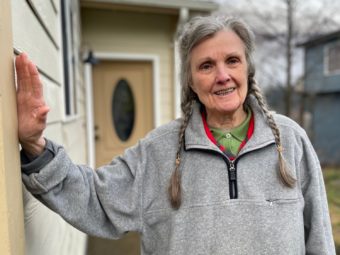
A portrait of an older woman standing outside a beige house
carolyn Brown stands outside her home in Juneau. (Photo by Lisa Phu/Alaska Beacon)

Brown said she is still learning to be at peace with what is.

“I went through a time of anger, rage, anger, vitriolic hate for the people who were the head honchos of the Alaska Right to Life. It took me a long time to get over that but I was only destroying myself by doing that, but the tincture of time does a lot of things for people,” she said.

These days, she reads a lot of philosophy and is interested in learning about different religions. One thing she doesn’t do is attend abortion-rights rallies.

“I remember when I first moved here in 2001 and we would have those rallies on Roe v. Wade day and I was asked to speak at them. I cannot do that, never could,” Brown said.

Brown said she went one year and just stood there. Brown is clear that she’s pro-abortion rights. But it’s not a simple topic to speak about.

“I don’t know. I still have to ask myself questions. What have I done? What is right? What is right? What is life? I know what life is and I know that this tissue here is human. That I know. Whether it’s a person – that’s my struggle. What’s the difference in humanity and personhood? Potential person? There’s so many unknown questions,” she said.

“I’m just glad that I don’t have to make those decisions anymore. That’s a gift to me for myself. It doesn’t mean I’m against abortions. I just don’t know what is a person. I don’t know. It’s complicated, isn’t it?” she said.

Ultimately, Brown said, abortion and what constitutes a life “is not black and white,” it’s not a yes or no question. Instead, it’s complicated and ever changing, and dependent on so many different factors – like a person’s background, spirituality, family history.

And that decision on what abortion is, what personhood is, is not for her to determine, Brown said. She doesn’t think it’s for the U.S. Supreme Court to determine either, or for all the other people who usually end up getting involved in these discussions and decisions. There’s no simple way to put it, she said; it’s just complex.

This story originally appeared in the Alaska Beacon and is republished here with permission.

On Walter Soboleff Day, panel reflects on church’s closure and the path forward

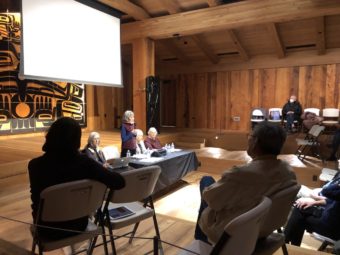
Lillian Petershoare speaks on panel about the closure of Memorial Presbyterian Church at Sealaska Heritage Institute in Juneau on Nov. 14, 2022. (Photo by Yvonne Krumrey/KTOO)

Monday was Walter Soboleff Day in Alaska. Soboleff, who lived to be 102, was a longtime advocate for Lingít people through his religious ministries and work to support Juneau’s youth. 
In honor of the day, Sealaska Heritage Institute hosted a panel discussion about the closure of the Memorial Presbyterian Church in Juneau, which Soboleff ran at the time. 

The national Presbyterian Church now recognizes its decision to close the church as a racist “act of spiritual abuse.” When the organization closed the church in 1963, it also gave the separate, white-led Northern Light church a loan of $200,000 for a new building.

Some of Soboleff’s children were at Monday’s panel discussion, along with former members of Memorial Presbyterian Church. Roy DeAsis attended the church with his mother when he was a teenager. 

“Various members of the church now in Juneau have expressed to me what’s been going on with this effort,” DeAsis said. “And sitting here, right now, this is pretty emotional for me.”

DeAsis joined the Navy and left Juneau the year the church closed. He said he has good memories about the church and Soboleff, and he was grateful now to learn more about what happened. 

“One of the things I remember about Walter, when he spoke to me years ago — but it was the last time since I’ve been away so long — is he said, ‘Roy, you remind me of a tree.’ And I’m so sorry that I didn’t ask him what he meant,” DeAsis said.

A black-and-white photo of a man in a suit and bowtie, sitting in front of a radio microphone
Rev. Walter Soboleff preparing to go on the radio. (Photo courtesy of the Presbyterian Historical Society)

During the panel discussion, members of Ḵunéix̱ Hídi Northern Light United Church committee — which was formed to research this closure and ask for an apology — told the story of Memorial’s closure and what they’ve done to repair that harm today. Myra Munson said the closure was an example of racism and its consequences, but telling the story could have a different kind of power.

“It can and has emboldened others to tell their story and shine a light on history that lives in the shadows of denial and pretends that the past is the past,” she said. “It can help those who suffered harm to recognize it for what it is and to begin to heal.”

Together, the Presbyterian Church USA, Northwest Coast Presbytery, and Ḵunéix̱ Hídi Northern Light United Church committed to pay nearly a million dollars in reparations for the harm and pain the closure caused. About a third of that amount comes from each. 

National church leadership says the reparation payments will be used to develop ministries in Native languages and Alaska Native leadership in the church. 

Former Alaska Gov. Bill Sheffield dies at age 94

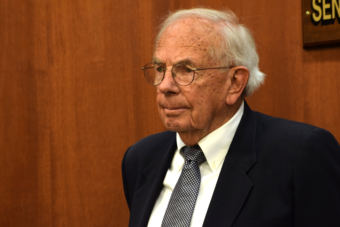
Former Gov. Bill Sheffield is introduced in the Alaska Senate, March 31, 2015. Sheffield led Alaska from 1982 to 1986 and is now vice-chair of the Alaska Railroad Corporation board. (Photo by Skip Gray/KTOO 360TV)

Former Alaska Gov. Bill Sheffield died Friday at his home in Anchorage after an extended illness. He was 94.

Sheffield, a Democrat, served a single term from 1982 to 1986 before a near-impeachment and the 1980s oil crash foiled his re-election chances.
During his term, he directed the spending of billions of dollars in oil revenue from the trans-Alaska pipeline, supported the opening of the Red Dog Mine near Kotzebue and the switch from four Alaska time zones to two.

Born in 1928 in Spokane, Washington, he served in the U.S. Army and became a salesman. Sent to Alaska, he arrived by steamship and railroad and remained, eventually founding a chain of 19 hotels. Later sold, they today operate under the Westmark name.

In 1982, he defeated Republican Tom Fink, Libertarian Dick Randolph and Joe Vogler, founder of the Alaskan Independence Party, to replace Jay Hammond and become the sixth governor and the fifth person to serve as governor. (Bill Egan served two non-sequential terms.)

Sheffield, who advocated the transfer of the Alaska Railroad from the federal government to the state, served on the railroad’s board of directors after leaving office and later became CEO of the state-owned corporation.

He served as director of the Port of Anchorage (now named the Port of Alaska) for a decade, retiring in 2012 at age 83.

He remained active in state politics until his death, supporting a variety of candidates and causes, including some Republicans and independent former Gov. Bill Walker.

Hands-on healing: Dugout canoe dedicated in Angoon on bombardment anniversary

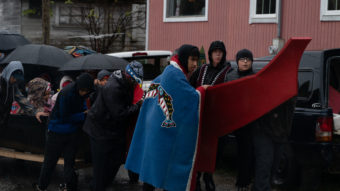
Shgein Kyle Johnson and classmates guide a canoe through Angoon. Oct. 26, 2022. (Photo by Andrés Javier Camacho/KTOO)

Angoon High School students surrounded Wayne Price as he helped them guide a canoe down Angoon’s roads to the waterfront. 

This dugout canoe, or yaakw, is special. It’s the first one built in Angoon in 140 years — that is, since Angoon was attacked and destroyed by U.S. military forces. Students who helped carve the canoe say the project helped them see their own resilience. 

In 1882, the U.S. Navy bombarded Angoon, burned their clan houses and food stores and destroyed their canoes — except for one that was away from the village. 

The people of Angoon — or Xutsnoowú Ḵwáan — were left for the winter with only one boat to fish and no shelter. It’s not known how many died as a result of this. But many of the families of those who survived are still in Angoon today. 

The U.S. Navy has never apologized.

The bombardment happened along the waterfront where Price and the students walked, their hands steadying the boat as they wheeled it along.

Shgein Kyle Johnson, who helped carve the yaakw with Price, led songs for the procession. He and five other students fasted for a day as they steamed the canoe open last month. That’s the process of painstakingly adding hot rocks to the boat and using trapped steam to expand the inside. It can be a make-or-break moment for canoes. 

“I am very, very proud of my teammates that helped me with the steaming process, and as a community just proud to finally have this new beginning,” Johnson said. 

This yaakw is Shaagaa Eesh Anthony Johnson’s second. He was in Hoonah when Price worked with students there to carve a dugout.

Anthony said it feels different, being six years older this time. 

“I was just putting wood on the fire then,” he said. “Now I’m one of the steamers taking out the rocks and stuff like that, and working on the canoe with Wayne.”

Price says the yaakw is seaworthy. 

“All of the dugouts that I’ve built are ready and able to meet each other on the water, and what a day that will be,” he said. 

Kyle’s mother, Kookeesh Tlaa Chenara Johnson, is a Lingít language teacher in the Chatham School District. She coordinated the youth who assisted in the yaakw carving. She says this history shows the resilience of the Xutsnoowú Ḵwáan.

“We’re still here, and our community is thriving,” she said. “And our students and our children are eager to learn and eager to carry on that part of our culture.”

Kyle says he’s hoping for more opportunities like this one.

“It’s a lot easier to learn about our culture and our traditional ways when it’s hands-on,” he said.

In the spring, the yaakw will be given a name and launched on the water for the first time — with Anthony, Kyle and several of their classmates aboard. 

Homer author Tom Kizzia named Alaska’s historian of the year

""
Tom Kizzia at Homer’s Pratt Museum in fall of 2021. (Photo courtesy of Jeremy Pataky/Porphyry Press)

A Homer local has been named 2022 historian of the year by the Alaska Historical Society.

Tom Kizzia is a journalist and author who came to the Kenai Peninsula nearly five decades ago. He spent three years with the Homer News in the late 1970s before moving to the Anchorage Daily News, where he worked for 25 years.

He’s written about everything from the history of the Kenaitze Indian Tribe to the failed effort to bring Jewish refugees to Alaska before WWII to the cowboys at the head of Kachemak Bay. He’s also the author of three books, including “The Wake of The Unseen Object,” “Pilgrim’s Wilderness” and, most recently, “Cold Mountain Path.”

Kizzia’s award, formally known as the James H. Ducker Historian of the Year Award, is named for longtime Alaska professor James Ducker, who served for 30 years as editor of the Alaska Historical Society’s journal, Alaska History.

KBBI’s Hope McKenney sat down with Kizzia on Tuesday to discuss his writing, his inspiration and what’s next.

Listen:

Tom Kizzia: One of the things that made Alaska really exciting to me, right out of college where I was kind of an American studies, history and American literature-type major, was that everything was so new and fresh, and all these big decisions were being made that had been made in other states. It seemed like if I was a reporter in another state, I would be in a pack of journalists trying to cover some incremental decisions. And up here, huge decisions were being made, and there were no other reporters around to write about it. So I really felt like it was a historical moment that I was writing about. And it was with a kind of sense of this sweep of history that I was watching — Native land claims and building the pipeline and creating all the national parks up here. All those things that were happening in the ‘70s when I got here. It was a really exciting time, creating the Permanent Fund, limited entry, huge decisions, and it felt like history was being shaped.

And so, you know, there’s that cliche about journalism, that it’s the first rough draft of history. I really felt like I was almost writing as a historian, or providing information to future historians. So I always had that interest. And then, over time, as I began to realize, even though it’s a new state, it has a rich and deep past, and I would find stories within that past to start telling. So as I looked around for good stories to tell, some of them were in the past. And those were the ones I enjoyed digging out and had the indulgence of the newspapers to let me do that.

Hope McKenney: So you just received the 2022 Historian of the Year Award from the Alaska Historical Society. Why did you receive this award? Tell me a little bit about “Cold Mountain Path,” and also your Alaska journalism that led to this moment?

Tom Kizzia: Well, you know, my previous book was the one about the Pilgrim family, “Pilgrim’s Wilderness.” And it was set in McCarthy, in the early years of this century. And I had included a couple of chapters about how we got to that point in McCarthy, kind of the ghost town decades, that made my first draft of that book, and my editor in New York thought that it was slowing down the momentum of the family story, which was kind of a page-turner. And so they had me boil that down to a page or two. So I pulled that information out, I kind of wanted to find a home for it. And when I read from those deleted chapters out in McCarthy, when I had a public reading, everyone wanted to know more. So I set out to do a second book just about those ghost town years. And that was the origin of the “Cold Mountain Path” project. And it got to be a bigger project than I expected. But it was, you know, a local history, but it was a locality that had all these sort of mythic overtones, and so I tried to get some of that in the book as well. And it’s just been really great.

You know, we just published it last year, it was published by Porphyry Press, which is an Alaska publisher, who was just getting started out there. And the reception has been great. And I think the book seemed to capture for people something about the old Alaska that’s passing in our own memory. And one of the reasons I was drawn to the story was because it was recent enough history that I could still interview people and sort of use my journalistic techniques to write about history. I didn’t have the secondary sources that one usually has, I was kind of digging it all up myself. That was great, great fun and a great challenge.

Hope McKenney: And I’d like hearing you talk a little bit about your work as a reporter. I mean, you’re such a figure in this state. Your journalism spans nearly five decades at this point. I mean, how does your work as a reporter, as a journalist, inform this historical writing?

Tom Kizzia: I don’t know. I think one way is that I had developed as a journalist a sense of storytelling, and trying to find stories that would have a kind of, you know, their own page turning drama, or at least stories that would carry you down the column inch of the newspaper page. And I wanted to then take that storytelling quality and apply it to the history. So kind of a narrative history as opposed to something that was sort of a dry collection of facts.

Hope McKenney: And so, you have nearly five decades of being a journalist in this state. You’ve written three books, you’ve now received the historian of the year award. What’s next for you?

Tom Kizzia: What does it all mean? I don’t know. I’ve got a lot of things I want to write. And so a lot of things that I still want to write and I’ll do the best I can to get those things done. But I don’t have any grand plan at this point. You know, I think when I came up here to work at the Homer News, I thought I was going to write the great American novel. And I don’t feel a great compulsion to attempt that at this point. But maybe I’ll surprise everybody or surprise myself and head in that direction.

Alaska volunteers want to know: What happened to the ‘Lost Alaskans’ sent to this Portland mental hospital?

A black and white illustration of a sanitarium campus
Morningside Hospital near Portland, Oregon, circa 1925. (morningsidehospital.com)

Before Alaska became a state, there were no formal services for treating people suffering from behavioral disorders or developmental disabilities, and mental illness was treated like a crime.

If an Alaskan was convicted of being “really and truly insane,” as it was known at the time, they were sent to an asylum in Portland, Oregon called Morningside Hospital, which opened in 1904 and operated into the ’60s.

At least 3,500 Alaskans went to Morningside, including a lot of Alaska Native people. Many of their families never saw them again. In some cases, similar to the federal government’s dark history of sending Native children to boarding schools, it’s unclear where they’re buried.

Much of what we do know about Morningside is thanks to a small group of volunteers working on The Lost Alaskans: The Morningside Hospital History Project. Among them is retired Alaska Superior Court Judge Niesje Steinkruger.

Steinkruger says some of the criteria for sending someone to Morningside would seem, well, crazy by today’s standards.

Listen:

The following transcript has been lightly edited for clarity.

Niesje Steinkruger: Things like suicidal, head injuries. A lot of head injuries. Drugs, drug addiction, mostly cocaine and heroin. Alcoholism, dementia, epilepsy. And after 1922, about a third of the patients were children, and so those were birth defects, disabilities by names that we now call Down syndrome and hydrocephalic. There were diagnoses of people unable to speak or unable to hear. Senility, or my own personal favorite, “senior exhaustion,” which I understand. Diagnosis of confused, delusional hallucinations. Paranoia. Lots of syphilis that, you know, then had entered the neurological system. And imbecile.

So those are the kind of diagnoses that we saw the most, with people going there. And of course, you’ve got to remember, we didn’t know anything about mental illness during those years. It really wasn’t until the ’50s, when we started getting more treatment ideas from Europe that things started to change.

Casey Grove: My understanding is, of course, back then, the treatment for these kinds of disabilities could be pretty rough, or they used things that we don’t use anymore like electro-shock therapy. And then some folks stayed there their entire lives and then died there. What happened to those folks that died there? Where were they buried? Do we even know?

Niesje Steinkruger: People died at Morningside. Lots of accidents or injuries. Certainly, people died based on treatment. And there was an autopsy room, actually at the hospital. A large number of autopsies were done, and we recently figured out that a lot of those were being, quote, “observed” by medical students from the University of Oregon, but they were probably using the patients as an anatomy class after they died.  You know, they didn’t have to get anybody’s permission.

And then they were sent to a mortuary, and they were buried in one of four cemeteries in Portland. Sometimes they’d wait till they had four or five and bury them all in one plot. We’ve found one area where there’s, it’s a ravine that’s gone back to its natural habitat, where there are probably 350 graves. They’re generally unmarked.

But of course, things have happened, like cemeteries have remapped and renumbered their plots. One cemetery, the records were flooded, and we don’t have them. None of the volunteers, we have never been able to find that the state kept a list of what Alaskans were sent to Morningside, no patient list. And so that’s how all of this got started, when we couldn’t find a list.

Casey Grove: Gotcha. Yeah. And I mean, there are similarities here with the boarding schools that a lot of Alaskan Native people were taken away to and never came home from. I guess, also similar to that, there are families here in Alaska that are trying to figure out what happened to their relatives that were sent to Morningside, right?

Niesje Steinkruger: Yes, yes. Many of the stories are, you know, “I remember my grandmother telling me that the federal marshals came and took this baby girl, and we don’t know whatever happened to her.” Or “my mother went to Morningside, and nobody knows what happened.” Or “my uncle got sent to Morningside, and we don’t know whatever happened to him.”

And that’s kind of what really got us started. And our real goal has been to identify who the patients are so that the family can know that, yes, this is where your family member went, and then what happened to them.

Site notifications
Update notification options
Subscribe to notifications