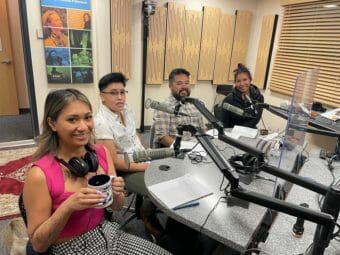
Tasha Elizarde, KTOO’s community reporting fellow, with interview guests Rachel Barril, Lionel Udippa, and Aims Villanueva-Alf on Juneau Afternoon Friday, Oct. 21, 2022, at the KTOO studio in Juneau. (Photo by Sheli DeLaney/KTOO)
October is Filipino American History Month. An event over the weekend in Juneau will celebrate Filipino food with several local chefs.
“So all of my memories, there’s always food associated with them,” said chef Rachel Barril. “Filipino food is the cornerstone of Filipino culture. It’s how we gather for family celebrations, funerals, that kind of thing.”
Barril works at In Bocca Al Lupo in Juneau, which is known for its wood fired pizza. But Barril makes sure there’s always a Filipino take.
“I take the traditional dishes and apply more modern techniques that I’ve learned. I like fermentation. Recently I learned to make miso out of peanuts and I used it in a kare kare dish. It’s like a peanut curry, usually served over oxtail,” she said.
October is the time to consider the contributions of Filipinos to U.S. history because the first Filipinos landed in what is now the United States in October of 1587.
“So, Filipinos have been in America for 435 years. And that’s 33 years before the pilgrims landed,” said chef Aims Villanueva-Alf, who owns Black Moon Coven in Juneau. “I never knew that.”
Villanueva-Alf is from Juneau, but the rich and long history of Filipinos in Alaska specifically is something she’s only recently started to embrace since moving back from the Lower 48.
“I don’t feel like fully let myself really nourish myself in my culture and my heritage until I was out of Juneau,” she said.
Lionel Udippa from Red Spruce and Abby Laforce Barnett from Zerelda’s Bistro will also be bringing food for the event hosted at the Filipino Community, Inc. hall downtown. And they’ll join in a panel discussion, followed by a screening of Ulam, a documentary about Filipino food, sponsored by Friends of the Juneau Public Libraries.
This story is part of KTOO’s participation in the America Amplified initiative to use community engagement to inform and strengthen our journalism. America Amplified is a public media initiative funded by the Corporation for Public Broadcasting.
America Amplified
KTOO is amplifying the voices of Filipinos in Alaska. We want to hear from you. What stories would you like to share or learn more about?
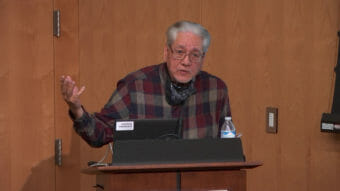
Oscar Peñaranda speaks at the Alaska State Museum on Oct. 7, 2022 (KTOO screenshot)
Canneries are a big part of Alaska’s history. Throughout the 20th century, waves of immigrants – primarily from the Philippines – came to work alongside Alaska Native people in the canneries.
The Mug Up exhibit at the Alaska State Museum in Juneau highlighted this history for the last six months.
The exhibit features lots of historic films and photos. There are black and white posed photos from the turn of the 20th century, and more candid photos taken by friends from the 1960s, 70s and 80s. Some panels explore the histories of the different labor movements that swept through Alaska’s canneries.
There’s even a recreation of a bunkhouse, with a door covered in names of the workers who slept there from the 1980s to 2009.
Next to it, a mess hall, with a hand-painted table, and a handwritten weekend menu. The backdrop is a photo of young women in hairnets smiling around a table, a few holding cigarettes.
Cannery workers gather on the Diamond NN Cannery dock for a “mug up” in ca. 1976. Mug Up or coffee break gave cannery workers a 15-minute reprieve from the monotony of slime line work and canning machines. (Photograph by Mike Rann)
Jackie Manning is the exhibit’s curator. Her favorite thing is a little cart used to serve coffee to workers during what was called Mug Up time. That’s where the exhibit gets its name.
“When I went up to Bristol Bay, and I saw that little Cushman cart – is what it’s called – and heard the stories about how diverse the canary crew was, and how important that mug up time was for camaraderie and everybody meeting and taking their breaks. And just all the different languages you’d hear on the docks,” she said.
Oscar Peñaranda moved from the Philippines to Canada and eventually to California before coming to Alaska to work in a Bristol Bay cannery in the 1960s. And he kept coming back. He worked 15 summer seasons in Alaska, before deciding to stay in San Francisco full-time.
Now, he’s a historian. He founded the San Francisco chapter of the Filipino American National Historical Society and wrote about his experiences as an Alaskero – the term for Filipinos who worked in Alaska’s canneries.
For Filipino American History Month, Peñaranda was in Juneau last week for the closing of the exhibit. He recognized some names and faces in the exhibit, like the Filipino union leaders who formed the Alaska Cannery Workers Association. They were murdered in 1981, and he said that’s when he stopped going to work in Alaska.
Peñaranda worked at the cannery for 14 years, even after he started teaching at San Francisco State University and James Logan High School in California.
He said he kept going back for the comradery.
“But the thing was, we didn’t feel like we had to get in touch between seasons,” he said. “Because we were gonna go the next season and catch up. That’s part of the reason why we kept going.”
Peñaranda’s language skills helped him to prosper at the cannery. He speaks four Filipino languages, as well as English, Spanish and some Italian.
“Language is how you see the world. You know two languages, you get two ways of seeing the world,” he said.
It allowed him to work as a sort of peacekeeper between different groups at the cannery.
The labor movements happening in the canneries paralleled his life in San Francisco in the winters. In 1968, he participated in strikes at San Francisco State University that led to the forming of the school’s College of Ethnic Studies.
Peñaranda went on to teach literature and Filipino language in high schools and colleges.
He’s now 78, and he’s thinking of returning to Bristol Bay next summer to work with an old friend. It would be the first time he will have worked at a cannery since he stopped over 40 years ago.
His friend is also in his late 70s and he operates the palletizer – the machine that puts all the cans into pallets to ship out.
Another reason Peñaranda said he kept going back to cannery work was the chance to be a new version of himself.
“When you go work in the canneries and go to Alaska, you can reinvent yourself – you’ll be a completely different you. You don’t like the way you are in San Francisco? Come to Alaska. Make your own reputation.”
So, a different Oscar Peñaranda may return next summer.
This story is part of KTOO’s participation in the America Amplified initiative to use community engagement to inform and strengthen our journalism. America Amplified is a public media initiative funded by the Corporation for Public Broadcasting.
America Amplified
KTOO is amplifying the voices of Filipinos in Alaska. We want to hear from you. What stories would you like to share or learn more about?
The Sealaska Cultural Values Pole represents all three Indigenous groups of what is now known as Southeast Alaska. It was dedicated at the Arts Campus opening during Celebration. June 8 2022, Juneau AK (Photo by Yvonne Krumrey, KTOO)
President Biden became the first president to officially recognize Indigenous Peoples’ Day in 2021, and did so again this year. It falls on the same day as Columbus Day, which was established by Italian American groups to celebrate their heritage and to acknowledge the mistreatment of the immigrant group in the U.S.
Indigenous Peoples’ Day is a time of reflection, recognition and celebration of the role Native people have played in U.S. history, as NPR has reported. One way to mark the day — and to learn about Indigenous history year-round — is to learn whose lands you live on.
Acknowledging an area’s original inhabitants and stewards is a valuable process, albeit a complex one, as the National Museum of the American Indian explains. The museum suggests reaching out to local Indigenous communities for guidance involving formal land acknowledgements, which can be offered at the start of public and private gatherings.
“Many places in the Americas have been home to different Native Nations over time, and many Indigenous people no longer live on lands to which they have ancestral ties,” the museum says. “Even so, Native Nations, communities, families, and individuals today sustain their sense of belonging to ancestral homelands and protect these connections through Indigenous languages, oral traditions, ceremonies, and other forms of cultural expression.”
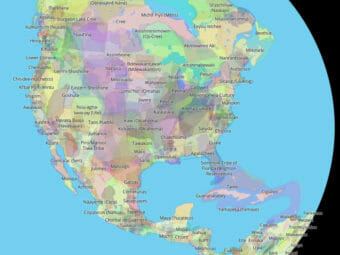
This map’s creators want it to convey more than borders
Users can click on labels across the Americas and around other parts of the globe — or type a specific city, state or zip code into the search box — to see which Indigenous tribes lived where. You can zoom in or out, as well as choose to apply “settler labels” to see how the map corresponds with contemporary state lines. Clicking on the name of each nation brings up links for related reading.
The map is available on the organization’s website and on iOS and Android mobile apps. Native Land Digital also publishes resources to go with the map, including a teacher’s guide and a territory acknowledgement generator.
The nonprofit says it aims to improve the relationship of people — both Indigenous and non-Indigenous — with the history and sacredness of the land around them. That involves “acknowledging and righting the wrongs of history.”
“We hope to inspire people to gain a better understanding of themselves, their ancestors, and the world they live in, so that we can all move forward into a better future,” it says.
The map itself is “more than a flat picture,” as the nonprofit explains, pointing out that land is sacred to everyone regardless of how consciously they appreciate it.
“In reality, we know that the land is not something to be exploited and ‘owned,’ but something to be honoured and treasured,” it says. “However, because of the complexities of history, the kind of mapping we undertake is an important exercise, insofar as it brings an awareness of the real lived history of Indigenous peoples and nations in a long era of colonialism.”
Mapping tribal lands comes with challenges
The nonprofit acknowledges the many logistical and ethical questions that come with mapping Indigenous territories. Those range from defining “Indigenous” across time and space to engaging with those communities so they can “represent themselves and their histories on their own terms.”
Native Land Digital aims to use at least two valid sources (including oral history, written documents or “maps sketched by people deemed to be reasonable authorities”) when updating the map, and says in cases of conflicting maps it generally errs on the side of being “more expansive.”
It cautions that the map does not represent definitive or legal boundaries of any Indigenous nations, and is a work in progress with many community contributions.
“We … encourage people to treat these maps as a starting point and to do their own research in engaging with communities and history themselves,” the group says.
The map has already made an impact
Native-Land.ca was created in 2015, and the organization was incorporated as a nonprofit in 2018. The group says it’s found over the years that its maps have made a direct impact on peoples’ lives.
That’s been true of Indigenous people, who have been glad to see their nation mapped or surprised to see how large their traditional territories look on a standard Western map, as well as non-Indigenous people who may be “for the first time, encountering the depth, breadth and complexity of Indigenous history on the land.”
“Some people may be made uncomfortable by the new information and history the map brings forth,” the nonprofit adds. “But we are secure in knowing that truth is the best teacher, and we hope to provide the best information we can to help people come to their own conclusions about themselves and their place in the modern world.”
Copyright 2022 NPR. To see more, visit https://www.npr.org.
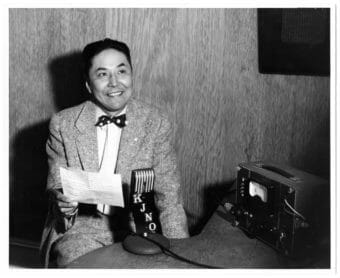
Rev. Walter Soboleff preparing to go on the radio. (Photo courtesy of the Presbyterian Historical Society)
This summer, the national branch of the Presbyterian Church issued a formal apology and committed to pay $1 million in reparations for closing a church in Juneau in the 1960s.
Longtime journalist Joaqlin Estus, Lingít, is a national correspondent for Indian Country Today. (Courtesy of Joaqlin Estus)
The Memorial Presbyterian Church had a Native congregation led by Pastor Walter Soboleff. Presbyterian church leaders have determined that closing the church was an act of racism.
Joaqlin Estus has a story about the apology in Indian Country Today. She spoke with KTOO’s Yvonne Krumrey.
Listen:
The following transcript has been lightly edited for clarity.
Yvonne Krumrey: Can you tell me the story of Memorial Presbyterian Church?
Joaqlin Estus: So, Memorial Presbyterian Church was heir to an earlier church that actually started in 1887. In Juneau, the town had two churches. They were segregated. There was a white church, and then the Native church and Walter Soboleff took over the Native church in 1940, I think it was. And by 1962, it was just the heart of the Juneau Indian Village. People thought of it as part of their extended family. And he had all kinds of events going on there all the time. And it was packed during holidays and very active all the time.
So then, the white church went to the National Presbytery and the Board of Missions, and said they wanted to build a new church and asked for a loan of $200,000. And, in part to accommodate them, no doubt, the National Presbyterian, the Board of Missions, shut down the Native church — and they did it without any explanation.
And very late in his life, people would ask Walter Soboleff what happened. He said, “I don’t know why they did it.” And I think he was just being polite because the reason they did it was because they were racist.
So a group at Northern Light Presbyterian Northern Light United Church formed a Native ministries committee, and they went to the National Presbytery, which is now called Presbyterian Church USA, and the Northwest Coast Presbytery and the Northern Light Church. And they asked for reparations. And the document that they used is called an overture. And basically they said that it was a racist decision, and it was very unfair, it was unjust, and it was very hurtful and painful to the people who belong to the Presbyterian Church, the Native Presbyterian Church.
So the Ḵunéix̱ Hídi Northern Light United Church — it’s been renamed. Ḵunéix̱ Hídi, it means “house of healing.” And that was kind of the first step in the reparations that the Presbyterian church made towards the Native ministries committee and the Native members of the Northern Light Church.
And then they voted in July to allocate about a million dollars for a huge range of programs and services, all aimed at language and cultural preservation, and support for Alaska Natives who want to go into the seminary to become ministers, and that kind of thing.
So they’re also going to contribute some money to establish a memorial at the site of the former church, which was situated across from the federal building, where the fire station is now.
So that’s what happened.
Yvonne Krumrey: You mentioned that the closure of Memorial was devastating for the community here in Juneau. Can you tell me more about that and what impact that had on the Lingít community here?
Joaqlin Estus: There was something going on there seven days a week, all hours of the day and night. And not all of it was church related. They also opened the doors to civic groups, and you know, for health clinics, they opened a children’s daycare. And this was back when the Juneau Indian Village was based all in the flats basically. And so it was a cohesive and kind of fairly extended neighborhood. And the church was right at the heart of it.
And so right after the church was closed, there were two devastating events. One was developers in Douglas burned down the Douglas Indian village there. They condemned the land, saying it was needed for development, and then burned the village.
And then the Juneau Indian village — most of it was knocked down for urban renewal. And so you had these two, you know, they were segregated communities, but within themselves, within the communities, there was a lot of cohesion and community. And those two acts of development and renewal were really hard.
I mean, they dispersed the Native community, basically, and the people I interviewed said it was shocking, and some never went back to church. They didn’t want to join Northern Light. They didn’t feel welcome there. And they either switched to another denomination or they quit going to church completely. So it was a huge spiritual loss for many people.
Yvonne Krumrey: You mentioned that the national branch of the church is issuing an apology as a part of this process. What does the apology say?
Joaqlin Estus: Well, let’s see, I can actually read the first couple of lines:
“The forced closure of this thriving multi-ethnic intercultural church was an egregious act of spiritual abuse, committed in alignment with the prevailing white racist treatment of Alaska Natives, statewide, and of Native Americans nationwide.”
And then the church goes on to say, to acknowledge that, that the closure, the justification for the closure “merely substituted assimilationist racism for the previous practice of segregationist racism.”
And then what they’re going to do is acknowledge, confess and apologize to the late Walter Soboleff and his surviving family members for the act of spiritual abuse committed by the Presbyterian Church’s decision to close the Native church.
The overture also calls for some soul searching on the part of the Presbyterian Church.
This is significant, because this is something that people wanted the Pope to do, when he visited Canada recently. The Presbyterian Church urges everyone to walk away from the Doctrine of Discovery, which is the idea that when a European nation discovers land uninhabited by Christians, it acquires rights to that land.
Native Americans and other people would like to see a more thorough repudiation of the of the idea behind the doctrine of discovery, which was basically the idea that was prevailing at the time was that Western Europeans were superior to the people who lived in these places, and therefore had the right to take over land and resources.
Yvonne Krumrey: I think that’s one thing that’s kind of interesting about this story is that it’s a church closure, that was the harm. While so many of it is focused on the church coming in and doing harm.
And I’m wondering if you have thoughts on that, or anything to say about the fact that the church came in, was a force of assimilation, but then was run by Walter Soboleff and became a community center and then was taken away, and how that impacted people?
Joaqlin Estus: I think the difference between what Walter Soboleff was doing and what mainstream Presbyterian boarding schools and churches were doing is that he spoke in both Lingít and English. He did give the message of God’s love and God’s mercy, and encouraged people to share his faith in the church and in God.
But my sense of things is that he was far from a negative force. I mean, people wanted to learn about this, and they wanted to belong to a church. Their earlier modes of spirituality had been destroyed. And people need that in their lives on some level. He provided it in a way that was more palatable and more accepting and more loving than in other churches. So I think there’s a big difference between what he did and what other churches did.
Yvonne Krumrey: When you look at Juneau after the closure of Memorial Church, and even up to today, what would you say the effects and the legacy of the closure are? And are we still living with those impacts today?
Joaqlin Estus: Well, I think combined with the destruction of the Douglas Indian village, and the Juneau Indian village, I think that the sense of cohesion and community that Alaska Natives felt in Juneau is not as strong as it used to be.
And I mean, it’s, it’s growing, and there is a community and there is cohesion. But it’s not to the extent that there was when the church was there, and when those two villages existed.
Yvonne Krumrey: Why did the overture and this whole process happen now, after nearly 60 years?
Joaqlin Estus: You know, I think it’s just part of the language and cultural revitalization that’s been going on for several years now. Some evidence of that is the land acknowledgments and more place names in the Lingít or Haida or Tsimshian language. There’s been a movement to reclaim what is ours. And this is part of that.
A woman from the Ho-Chunk Nation smiles as she touches the canoe. Wisconsin Historical Society maritime archaeologists recovered a 3,000-year-old dugout canoe from Lake Mendota in Madison, Wis., on Thursday. (Wisconsin Historical Society)
Tamara Thomsen was giving a scuba diving lesson in Wisconsin’s Lake Mendota when she noticed a piece of wood peeking out of the sand. Her student didn’t think much of it but Thomsen, who is a maritime archaeologist by trade, knew exactly what it was.
“This is not a joke. I found another dugout canoe,” she texted her boss.
The boat discovered in May was the second artifact Thomsen accidentally stumbled upon within the past year. In November 2021, Thomsen spotted a 1,200-year-old canoe while swimming in the same lake during her day off.
Archaeologists from the Wisconsin Historical Society — where Thomsen works — determined that the most recent find is even older — about 3,000 years old, the group announced on Thursday.
Thomsen said that when the radiocarbon dating results from came back, she wrote “1000 B.C.” on a Post-it note and stared in disbelief.
“It just makes you think about the people that were on this landscape where I live, and to imagine they were here hunting, gathering, fishing” she told NPR.
The canoe is about 14.5 feet long and carved from a single piece of white oak. It is believed to be the oldest canoe discovered in the Great Lakes region by roughly 1,000 years.
The two boats were located about 100 yards apart. Experts said the location and close proximity of the boats suggest that ancient villages may have once existed where Lake Mendota is located and the shoreline may have shifted over time.
Wisconsin Historical Society staff and volunteers remove the canoe from its transport trailer and carry it into the State Archive Preservation Facility in Madison. (Wisconsin Historical Society)
The 3,000-year-old canoe is believed to be the earliest direct evidence of water transportation used by native tribes from the Great Lakes region.
Members from the Ho-Chunk Nation and Bad River Tribe joined the Wisconsin Historical Society to recover the canoe last spring.
“The recovery of this canoe built by our ancestors gives further physical proof that Native people have occupied Teejop (Four Lakes) for millennia, that our ancestral lands are here and we had a developed society of transportation, trade and commerce,” Marlon WhiteEagle, the president of Ho-Chunk tribe, said in a statement on Thursday.
Both boats discovered by Thomsen will undergo a two-year preservation process.
Thomsen said archaeologists are planning to work with the Ho-Chunk Nation to conduct the first systemic search in Lake Mendota and possibly discover more canoes this coming winter.
Copyright 2022 NPR. To see more, visit https://www.npr.org.
Memorial Presbyterian church demolition. (Photo by Skip Gray)
In the 1950s and ‘60s, the “Native church” in Juneau was packed for holiday services. Seven days a week it housed civic and church-related gatherings.
The Memorial Presbyterian Church served a predominantly Lingít congregation, true to its 1887 roots in a town that practiced segregation in restaurants and movie theaters into the mid-1940s.
Then, to “end segregation,” the Alaska Presbytery and the Presbyterian Board of National Missions closed the thriving Native church in 1962.
Maxine Reichert, Lingít and Athabascan, recently told the Northern Light United Church congregation the closure meant the loss of the Juneau Indian Village’s support system, “the heart of the community,” just as it was undergoing even greater trauma. The Juneau Indian Village, and just across the bridge, the Douglas Indian Village were destroyed for 1960s-era urban renewal and development.
Now the Presbyterian Church USA, Northwest Coast Presbytery, and Ḵunéix̱ Hídi Northern Light United Church have committed to pay nearly a million dollars in reparations for the harm and pain the closure caused.
The amount is significant but what it will be used for is even more so. Most of it is to go to programs to promote healing, cultural preservation, and education.
We’ll get into that some more but first, let’s go back to 1940, when pastor Walter Soboleff, Lingít, held his first service in Memorial Presbyterian Church.
Only he, his wife, and one friend attended.
But he was brilliant at growing a congregation. Soboleff advertised in the newspaper and broadcast his sermons on the radio. He reached out with hundreds of letters of support and encouragement to acquaintances, parishioners, and prison inmates.
Rev. Walter Soboleff preparing to go on the radio (Photo courtesy of the Presbyterian Historical Society)
The church offered Bible study, choir practice, prayer groups, and teenage fireside chats. It was open for day care, Girl Scout meetings, and health checkups. It housed visiting basketball teams from surrounding predominantly Lingít, Haida, and Tsimpshian villages.
The church “was an extension of our family, our extended family,” Judy Franklet, Lingít, said in a 2019 interview.
Franklet remembered, “playing with friends down in the, we called it the basement, but that’s where they held the potlucks and other activities. And then we had coffee probably right after the worship service. And I remember Dr. Soboleff very clearly giving part of the service in English and in Lingít. That was very special to us… you love to hear your own language.”
Franklet also recalled the day when Soboleff told the congregation the church was closing.
“I just remember I was in a state of shock and when I look back, I’m sure he was hurting. His explanations were just very short,” Franklet said. “It was just like you were hit in the stomach. It was such a surprise.”
Last year, as the Native Ministries Committee of the church began discussing reparations, “I remember one moment in particular,” said Lillian Petershoare, Lingít. “We were talking about the closure of the Memorial church and I said to everyone, ‘You know, what really disturbs me here is that in our research, we have seen that the Presbytery and the national church leaders came to Memorial many times over the years. The women of the church sponsored tea for the regional and the national leader. They were not strangers. They knew this church. They knew the people in this church.’”
Memorial Presbyterian Church choir members at home of Tom and Connie Paddock after Christmas caroling in Juneau. The choir was treated to cookies, punch, smoked salmon, and crackers. December 24, 1962 (Photo courtesy of Maxine Richert)
She said it was inhumane of church leaders to abandon Soboleff to announce the closure alone.
“Why didn’t they come and have a beautiful ceremony to celebrate the wonderful work of the Memorial church and the Presbyterian church in the Juneau Indian Village? Its predecessor? Why wasn’t there all that circumstance? Why wasn’t there all that acknowledgement? Why wasn’t there that shared grieving?” Petershoare asked.
“If this had been a traditional Lingít setting, there would’ve been all of that protocol. And so there should have been.”
Petershoare said the national officials should have expressed the church’s deep roots in the community and its role in the life of the community. “We felt that profoundly.”
A former minister of Northern Light United Church, Phil Campbell, told filmmaker Laurence A. Goldin in a 2022 interview that as he met Native people, he learned time had not healed the wound of the church’s closure “even though it had been almost 50 years.”
“I did have one occasion to ask Dr. Soboleff about it. I was visiting with him a couple of months before his death as it turned out … as I began asking about this, I saw the pained look on his face. He was saddened and troubled by the question, and said in effect, ‘I don’t know why they closed it,’” Campbell said.
At the same time the Presbytery said it couldn’t afford to continue to subsidize the Native church, it loaned $200,000 to a White congregation to build a new church just a few blocks away from Memorial.
The Presbytery and Board of Missions advised the Native church members to join the new Northern Light Presbyterian Church. Less than half did. Most joined other denominations or drifted away from church altogether.
In the 1990s, a group of Indigenous members of Northern Light church formed a Native Ministries Committee. With Campbell’s help, in 2021 they wrote an “Overture,” (similar to a resolution) entitled “On Directing the Office of the General Assembly to Issue Apologies and Reparations for the Racist Closure of the Memorial Presbyterian Church, Juneau, Alaska.”
The Overture stated: “The forced closure of this thriving, multiethnic, intercultural church was an egregious act of spiritual abuse committed in alignment with the prevailing White racist treatment of Alaska Natives, statewide, and of Native Americans, nationwide.” It was distributed nationally to Presbyterian churches and discussed in regional and national gatherings of church leaders.
In Juneau, Memorial Presbyterian Church congregants leaving the church. n.d. (William Paul Jr. Collection via Ben Paul)
The Presbyterian Church USA adopted the Overture unanimously without amendment at its July General Assembly. In adopting it, the church acknowledges its justification for the closure ”merely substituted assimilationist racism for the previous practice of segregationist racism.”
The Overture includes a list of actions for reparations.
The church, with regional and national leaders present, will acknowledge, confess, and apologize to the late Walter Soboleff and his surviving family members “for the act of spiritual abuse committed by the Presbyterian Church’s decision of closure, which was sadly aligned with nationwide racism toward Alaska Natives, Native Americans, and other people of color.”
By adopting the Overture, the church committed to become engaged and accountable for “interactions with churches of primarily people of color congregations so that difficult decisions about support and funding are made in a spirit that recognizes the importance and contributions of these congregations to the Presbyterian Church (USA), which outweigh superficial considerations of their membership numbers or perceived lack of financial resources.”
The Overture also encourages Presbyterians nationwide to donate funds and to renew commitments to dismantle systemic racism and amplify the voices of people of color.
It urges all to continue to walk away from the doctrine of discovery, the idea that when a European nation “discovers” land uninhabited by Christians, it acquires rights to that land.
As one of the first steps in reparations, the church was renamed Ḵunéix̱ Hídi (people’s house of healing) Northern Light United Church.
Rev. Walter Soboleff ministering to a sick man, n.d. (Photo courtesy of the Presbyterian Historical Society).
As the successor and beneficiary of the Memorial Church’s closure, Ḵunéix̱ Hídi committed $350,000 for reparations, which will include the creation of art and remodeling of the Ḵunéix̱ Hídi church to be more welcoming to people of color and to reflect southeast Native cultures.
Money will go to scholarships and programs for revitalization of southeast Alaska Indigenous languages. Ḵunéix̱ Hídi will also gather oral histories and develop curriculum to teach the history of the Memorial Church.
Ḵunéix̱ Hídi will also pay for a “highly visible recognition” of the Memorial Church at its former location.
Reichert said additional money will go to “Tlingit, Haida, and Tsimpshian languages, (and) scholarships for students who want to go into the seminary to become ministers.” For these and other efforts, the church has committed nearly a million dollars.
The reparations were accepted by the local congregation, then at the regional and national levels. The commitments call for some soul searching, with the understanding that healing from racism is an ongoing process.
Ministries committee member Myra Munson said the history of racism, of slavery, of what happened to Indigenous people, and actions against LGBTQ people, “all of these things create a burden that maintains an “us and other” approach to the world and to each other in the community and at large nationally, and internationally. Every step we take that overcomes that or reduces it helps us all live in a healthier way and healthier place.”
Reichert said she was relieved when the General Assembly voted to accept the Overture. “It felt like Walter Soboleff and what he had been doing with Memorial Presbyterian church, he had been vindicated and, and I felt just really good about that.”
The Presbyterian church has a history of racism, perhaps most strongly exemplified in the boarding schools it ran to assimilate Indigenous children. The boarding school experience traumatized generations of Native children and led to the near loss of Indigenous cultures and languages.
However, Reichert said Indigenous people, “they have churches still existing, like in the Dakotas where they have a number of churches that are run by Native ministers. And a lot of them have not graduated from seminary and they have very little funding for those churches, but the Native people are still going to them and they still want that religion. But they want it in their own culture.” The reparations will help make that happen for Southeast Alaska Indigenous peoples.