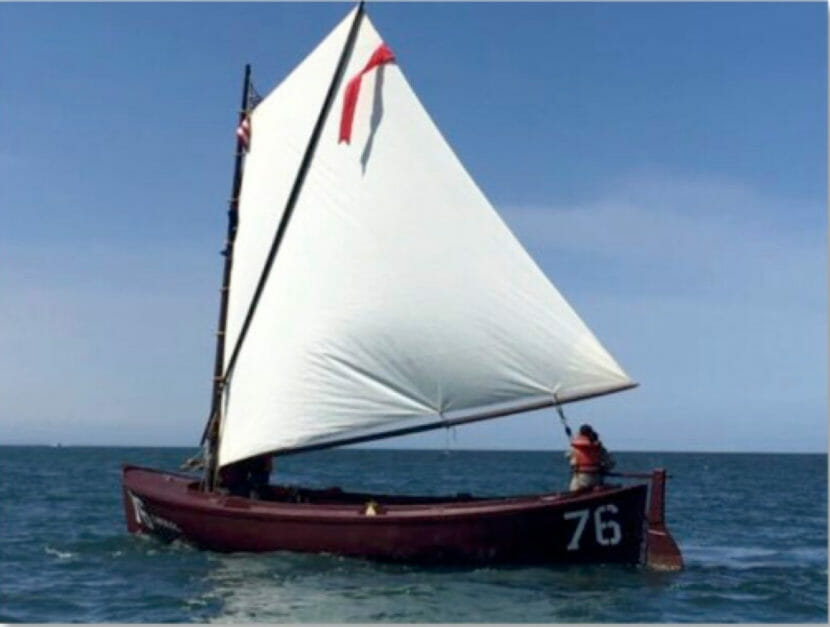
The Libby, McNeil & Libby No. 76. (Bristol Bay Heritage Land Trust photo)
For more than 60 years, sailboats dominated Bristol Bay’s commercial fishery. Motorized vessels were illegal. Then, in 1951, the federal government finally allowed motorized fishing vessels in Bristol Bay.
LaRece Egli, the director of the Bristol Bay Historical Society Museum in Naknek, says that made sailing obsolete almost immediately for the fishery.
“I think it’s literally down to 50 or 46 boats or something like that in 1954, and then they just disappear,” she said.
By 1952, powerboats outnumbered sailboats 4 to 1. In less than five years, every commercial vessel had a motor.
This year, local historians are bringing the sailing tradition back to the bay with a vessel named the Libby, McNeil & Libby No. 76. Tim Troll is the executive director of the Bristol Bay Heritage Land Trust and one of the sailing crew. They launched from Homer on July 5.
“We launched this morning at about 9 (a.m.),” Troll said. “It’s a beautiful, nice, sunny day with very calm weather.”
The sailboat has crossed the Cook Inlet, sailing toward Naknek.
“The boat is on its way,” he said. “It’s sailing nicely right now. We’ve got four guys aboard, and it just looks beautiful out there.”
Troll said in an email that they made it to their first stop, Williamsport, on Wednesday night. They carried the boat across the portage to Lake Iliamna and planned to reach Pedro Bay that evening.
The crew expected to visit Iliamna and Newhalen over the weekend and then head on to Kokhanok and Igiugig. It will visit Levlock on July 17 and the vessel is scheduled to arrive in Naknek on July 19.
Egli says the journey commemorates an iconic period in the fishery’s history.
“Those sails, sailing out on the horizon of our bay, are really visual icons, and they’re one of those grounding visual markers for both our canning industry, for the labor issues, independence of our fishermen, and also for our Indigenous story in our community,” she said.
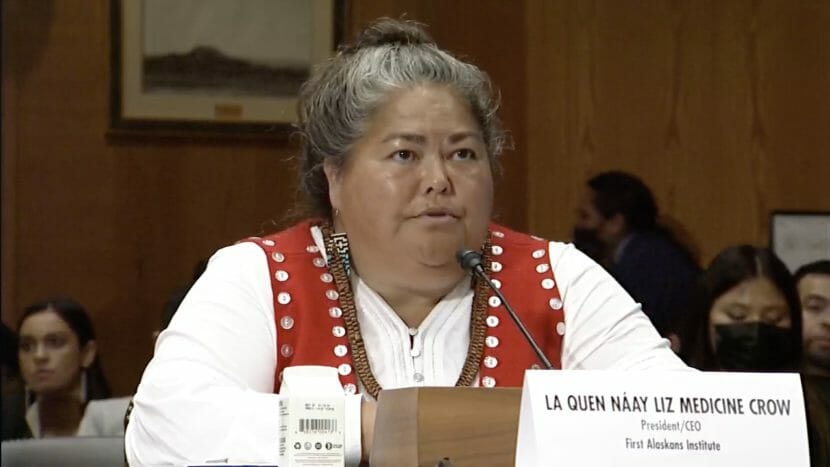
La Quen Náay Liz Medicine Crow, President of the First Alaskans Institute, at an oversight hearing Wednesday, June 22, on the first volume of the Federal Boarding School Initiative’s investigative report. (Screen capture from the United States Committee on Indian Affairs)
The U.S. Senate Committee on Indian Affairs held an oversight hearing Wednesday on the first volume of the Federal Boarding School Initiative’s investigative report. The report was released to the public in May. It detailed the initial findings of the Department of the Interior’s investigation into Indian boarding schools.
There were 408 residential schools across the United States created to assimilate Native American children with “systematic militarized and identity-alteration methodologies,” according to the report.
La Quen Náay Liz Medicine Crow, President of the First Alaskans Institute, testified at the hearing.
“I sit here before you as the granddaughter of a survivor. Her name was Mona Jackson. I wear her regalia here today because I wanted to bring her with me. And I wanted to become a vessel for her voice,” Medicine Crow said.
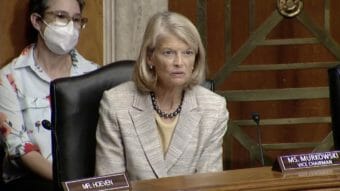
Sen. Lisa Murkowski at an oversight hearing Wednesday, June 22, on the first volume of the Federal Boarding School Initiative’s investigative report. (Screen capture from the United States Committee on Indian Affairs)
At the hearing, Sen. Lisa Murkowski asked Secretary of the Interior Deb Haaland about resources for those attempting to have loved ones’ remains repatriated back to Alaska.
She said the report highlights schools across 37 states, including 21 in Alaska.
“Twenty-one of those schools were located in Alaska. The sexual abuse, violence, malnutrition, solitary confinement, forced manual labor, untreated diseases, unreported deaths, and disappearances documented in this report, make it very, very difficult to read. And we know it just scratches the surface, unfortunately, of what actually happened,” Murkowski said.
The report included schools run or funded by the United States government and left out different programs run by religious organizations. There were thousands of other assimilation programs like orphanages and day schools, according to the report.
Murkowski asked Medicine Crow whether she thought the scope was too narrow.
“I do not think that we have an accurate number yet of the institutions that were in Alaska,” Medicine Crow said.
Medicine Crow pointed to the history of Alaska Native youth being sent out of state to boarding schools and to punitive asylums, like the Morningside Institute in the Lower 48.
“And so figuring out this entire kind of ecosystem of assimilative process is really critical. And I think that a very strict and narrow definition will limit our ability to really know the full story,” she said.
Sen. Elizabeth Warren, a Democrat from Massachusetts, proposed the Truth and Healing Commission on Indian Boarding Schools Policies Act in response to the committee’s work.
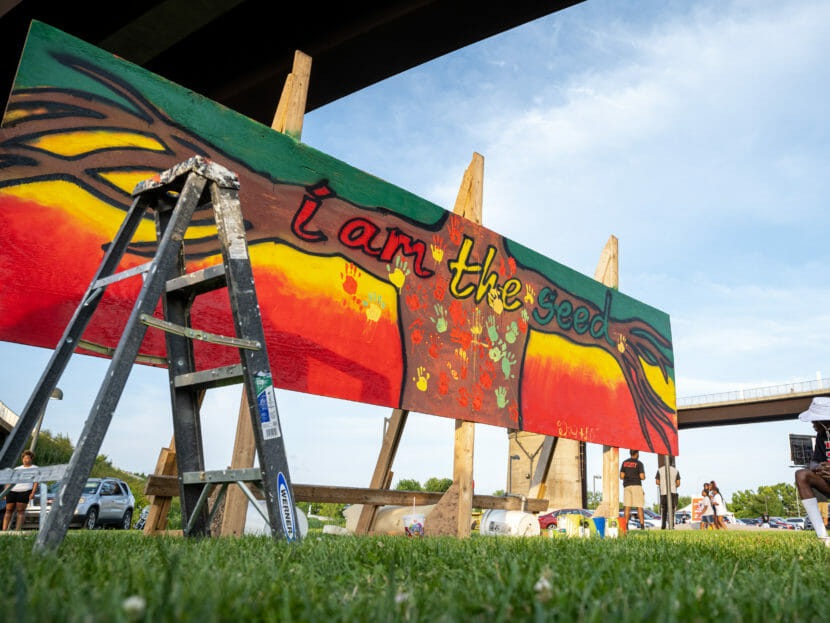
Juneteenth, or Emancipation Day, commemorates the end of slavery on June 19, 1865, in Galveston, Texas, in compliance with President Lincoln’s 1863 Emancipation Proclamation. Here, a young woman stands near a piece of art created during the Louisville Juneteenth Festival at the Big Four Lawn on June 19, 2021, in Louisville, Ky. (Photo by Jon Cherry/Getty Images)
Following its negative reaction on social media, Walmart pulled its special edition flavor of ice cream commemorating Juneteenth from shelves, with many critics calling out the retailer for capitalizing on the holiday for profit.
“There were several missteps with this. When you collectively look at all these missteps — the branding, the marketing, the visual rhetoric — you understand that there weren’t Black creatives in the room that had a voice at the table,” Christina Ferraz, founder and head consultant of marketing agency Thirty6five, told NPR.
“Juneteenth holiday marks a celebration of freedom and independence. However, we received feedback that a few items caused concern for some of our customers and we sincerely apologize,” the company said in its statement to NPR.
The Children’s Museum of Indianapolis apologized and removed its Juneteenth-themed watermelon salad from its food court menu ahead of its Juneteenth Jamboree celebration.
“As a museum, we apologize and acknowledge the negative impact that stereotypes have on Black communities. The salad has been removed from the menu,” the museum said in its statement. “We are currently reviewing how we may best convey these stories and traditions during this year’s Juneteenth celebration as well as making changes around how future food selections are made by our food service provider.”
But while companies are working continuously to remove their Juneteenth items off shelves, experts argue that companies that are selling and promoting Juneteenth-branded products are tone-deaf — claiming they are only profiting off Black suffering.
“When a corporation comes in, uses that further marketing march and then capitalizes off it and sells it, what we’re seeing is modern-day colonialism,” said Ferraz.
Experts say the true meaning of the commemoration can easily be lost through consumerism and widespread consumption.
The importance of Juneteenth and what it represents
Whether you call it Freedom Day, Emancipation Day or just simply Juneteenth, the annual commemoration is significant in U.S. history — marking our country’s second independence day.
“Juneteenth is a significant cultural resonance to the African American community, but also, of course, throughout much of the rest of the country,” said Ravi Perry, political science professor at Howard University.
On June 19, 1865, Maj. Gen. Gordon Granger — who had fought for the Union — arrived at Galveston, Texas, with nearly 2,000 troops to announce that the more than 250,000 enslaved Black people in the state were finally free.
Granger’s announcement came about two months after the ending of the Civil War and nearly three years after President Abraham Lincoln issued the Emancipation Proclamation.
During his visit, Granger issued General Order No. 3, informing the people of Texas that those who were enslaved were now free, according to the National Archives. Juneteenth gets its name by combining both “June” and “nineteenth,” the day that Granger arrived in Galveston with his announcement.
“The people of Texas are informed that, in accordance with a proclamation from the Executive of the United States, all slaves are free. This involves an absolute equality of personal rights and rights of property between former masters and slaves, and the connection heretofore existing between them becomes that between employer and hired labor,” the order reads, in part.
Major brands are still working to become more diverse
Over the course of the last two years, large brands and companies have become noticeably more inclusive. A number of major brands have featured more Black and other minorities in their ads and marketing materials as a way to take a stand against racism.
Last year, McDonald’s partnered with multi-platinum rapper Saweetie as the fast-food chain featured her “Saweetie Meal.”
Major brands and corporations are continuing to partner with Black and brown celebrities in an effort to maintain and expand their consumers of color.
“With the uprising and the advocacy and the demands after the murder of George Floyd, really there’s been a spotlight shining on the importance of highlighting and making space for Black people, specifically Black women,” Alfredo Del Cid, head of learning and development at consulting firm Collective, told NPR in 2021.
Copyright 2022 NPR. To see more, visit https://www.npr.org.
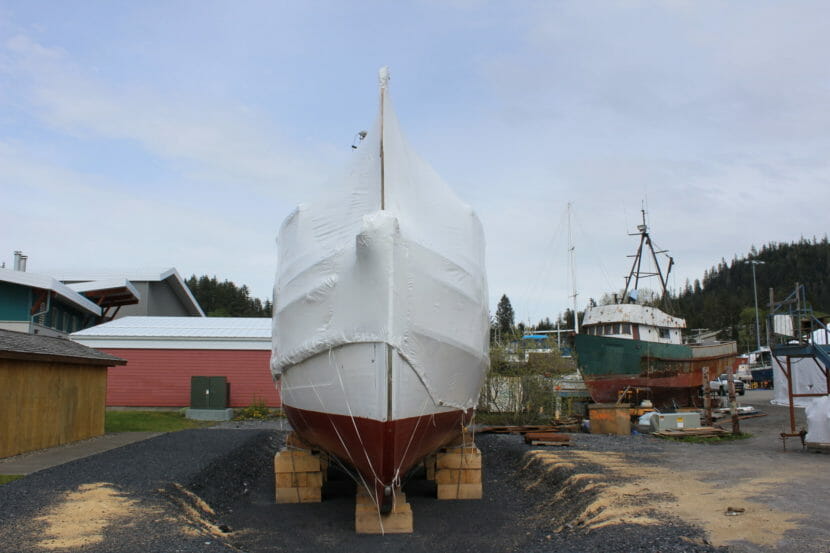
The wrapped-up Chugach outside Wrangell’s Nolan Center. (Photo by Sage Smiley/KSTK)
A boat on the national register of historic places will be on display in time for Wrangell’s Fourth of July celebrations.
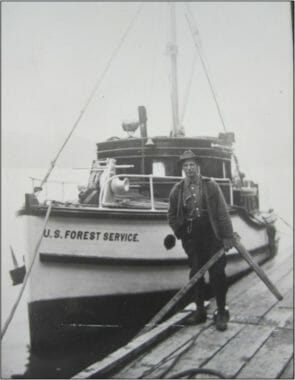
For the last few years, Wrangell’s local government and museum have been working with the U.S. Forest Service to preserve the M/V Chugach, which is the last remaining wooden ranger boat in Alaska.
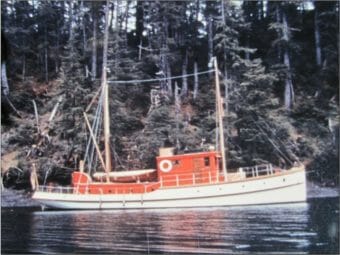
The 62-foot vessel was built in 1925 and spent decades patrolling the waters of what’s now known as the Tongass National Forest. It assisted federal officials with transportation, communication, record-keeping and search-and-rescue operations.
The M/V Chugach in the 1940s. (U.S. Forest Service photo)
Plans to build and develop a permanent display for the boat were put on the back burner by the COVID-19 pandemic. Wrangell District Ranger Clint Kolarich says that for now, the Chugach will be able to be viewed by residents but not boarded. Only contractors will be allowed on.
“It’s just much too difficult and quite dangerous, actually, to try to get folks up there,” Kolarich says. “But it’ll be neat to be able to see it completely unwrapped.”
Kolarich says that preliminary artists’ renderings of an interpretive exhibit for the Chugach are inspiring, but it’s a step of the process that hasn’t been funded yet. The Forest Service is looking for funding, but some of the burden also falls on the City and Borough of Wrangell, according to a Memorandum of Understanding between the agency and local government.
A Forest Ranger stands with the M/V Chugach in the 1920s. (U.S. Forest Service photo)
That means it could be a few years before the boat and accompanying exhibit are totally ready and open to visitors, Kolarich says.
“We’re talking about a permanent structure over [the boat], with wheelchair access and a viewing deck, and so it’s going to happen in phases over the next few years,” Kolarich says. “Unless someone listening wants to make a substantial donation to the City and Borough of Wrangell to preserve and showcase the last 100-year-old, all wood, Forest Service ranger boat.”
For now, Kolarich says the Chugach will be unwrapped and on display by June 26 at the latest and will remain unwrapped for at least a couple of weeks. People can see the Chugach next to former Alaska governor Frank Murkowski’s boat, on display outside the Nolan Center in downtown Wrangell.
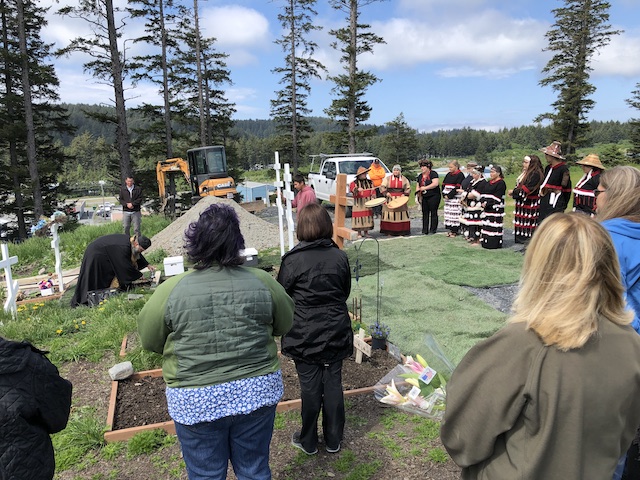
Community members gather for the burial of four Alutiiq individuals recently repatriated to Kodiak Island (Photo courtesy of Alutiiq Museum)
The remains of four members of the Alutiiq community came to their final resting places at a cemetery in Kodiak this week. Members of the Sun’aq Tribe and the Alutiiq Museum gathered at Kodiak’s City Cemetery for the burial on June 6. The graveside service was led by the local Russian Orthodox church.
April Counceller is the executive director at the Alutiiq Museum in Kodiak, which coordinated the reburial. She said the homecoming was long overdue.
“There’s a growing awareness that it is not fair or just to hold on to ancestral human remains,” she said.
Of the four individuals laid to rest, one was repatriated from a university collection, and two were returned by the Alaska State Museum. The fourth was found during construction on private land.
The Native American Graves Protection and Repatriation Act, or NAGPRA, which was passed in 1990, was meant to codify the process of returning cultural items — including human remains — from institutions that receive federal funding to the tribes they belong to. But Counceller said it’s been slow going.
The museum has identified the remains of more than 160 Native individuals that have yet to be repatriated to Kodiak — and there’s likely more they’re unaware of. The U.S. Department of the Interior announced last year it was considering changes to NAGPRA to expedite repatriations.
Counceller said the remains of the four buried recently in Kodiak were too old to be identified, but there’s a sense that they’re finally home.
“We consider any ancestral remains to be part of our family,” she said. “And for those individuals who were reburied, I can only think that they may now feel some peace.”
That’s a step in the right direction, according to Counceller, that likely won’t be the last.
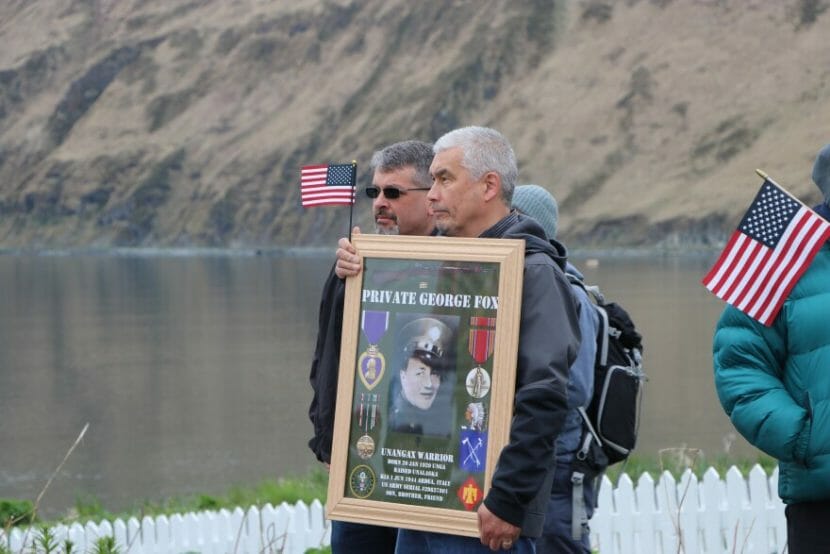
Jim Shaishnikoff holds an image of Fox outside of Unalaska’s Church of the Holy Ascension during the procession. (Kanesia McGlashan-Price/KUCB)
For nearly 80 years, a small American flag placed by an old friend was the only thing that stood above the tundra marking Pvt. George Fox’s plot in Unalaska’s cemetery.
That changed last week when the decorated veteran’s resting place was finally recognized.
Fox is the only known Unangax̂ soldier killed fighting in World War II, or in any war since. For decades, he was buried in an unmarked grave. This Memorial Day, he was finally honored with a gravestone in a long-awaited burial ceremony that drew crowds from across the state and Lower 48 to the remote Aleutian community.
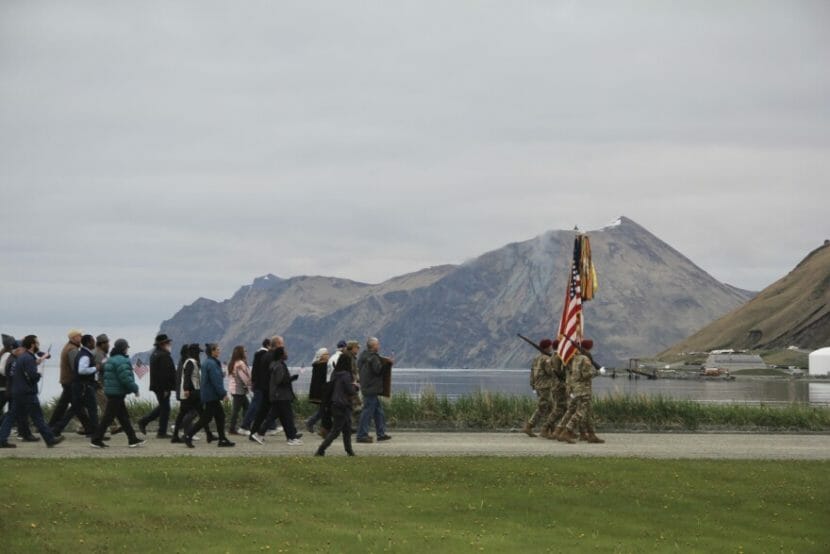
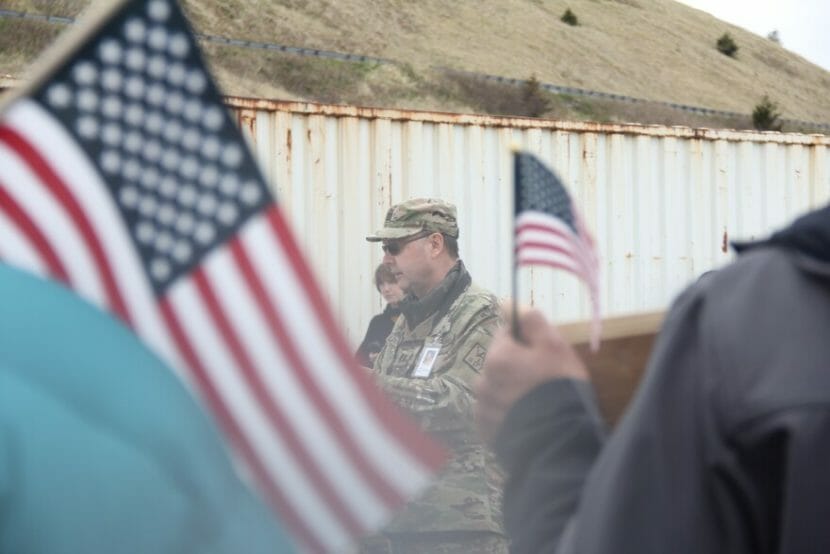
Officials unveiled an honorary gravestone during the ceremony, which included an Army color guard, a 21-gun salute and a speech from Fox’s former neighbor following a procession down Unalaska’s Front Beach.
Had it not been for the heavy Aleutian fog, members of Fox’s family and Sens Dan. Sullivan and Lisa Murkowski also would have flown in to speak in his honor. Representatives from the Aleutian Pribilof Islands Association, the Aleut Corporation and members of the VA Alaska Health Care System were in attendance.
During the ceremony, which included an Army Color Guard, a 21-gun salute and a speech from Fox’s former neighbor, officials unveiled an honorary gravestone, following a procession down Unalaska’s Front Beach. (Theo Greenly/KUCB)
Fox was born in 1920 on Unga Island, the largest of the Shumagin islands, about 250 miles northeast of Unalaska. Census data shows that he and his mother moved to Unalaska by 1929, and he joined the military when he was about 21 years old, according to Michael Livingston, who played an integral role in getting Fox’s gravestone ordered. Livingston works for the Aleutian Pribilof Islands Association and spent years uncovering lost details about Fox’s past.
Fox was killed fighting in Ardea, Italy, in 1944. About five years later, his remains were returned to Unalaska. Following a small ceremony, Livingston said he was buried in an unmarked grave next to his mother at the island’s cemetery. It took a lot of work and perseverance to confirm that his body was in Unalaska, he said.
While Sen. Sullivan tried but failed to make it to the special ceremony, Livingston said he played a key role in finally moving the process forward and ordering the grave marker last May.
Livingston and a few others have been researching and battling for years to get Fox his deserved recognition.
“It really is a decade in the making,” Livingston said. “A lot of people have been working on this to try to find out the information we needed to honor Pvt. George Fox. And a lot of people have been working to get the gravestone ordered. We’re just grateful for all the support.”
He said two locals recently discovered that in 1941, Fox signed a petition to incorporate Unalaska, also making him a founder of the Aleutian town.
Unangax̂ Elder Gertrude Svarny was Fox’s neighbor growing up. She said he was a friend to her older brother.
After Fox died in the war, Svarny would walk to his grave every Memorial Day and place a small American flag on the overgrown plot. This year, thanks to Livingston’s planning and outreach, her small flag was just one of several dozen that were brought by supporters from across the state who made the trek up the hill to his grave.
Micheal Livingston gives a speech during the procession. Livingston and a few others have been researching and battling for years to get Fox his deserved recognition. (Theo Greenly/KUCB)
Following a prayer and hymn from Unalaska’s Father Evon Bereskin, Svarny and Livingston pulled an American flag shroud from the stone, revealing the new marker to the locals and visitors gathered at the base of Mount Newhall.
In a speech following the unveiling, Svarny said that to fully understand what this recognition means, people need to know the region’s history.
“When I was 12 years old, my village survived the bombing of Unalaska Island by the Japanese,” Svarny said. “Shortly thereafter, we were forced to leave home.”
“We were dropped off in abandoned canneries, gold mines and logging camps in Southeast Alaska, stripped of our civil liberties,” she told the crowd. “And it changed our lives forever. Even as this was happening to us, our sons and daughters, our brothers, sisters were signing up to fight for the United States in the war.”
She said that spirit is in part why she and others survived the camps.
“This ceremony today symbolizes the recognition of the many Unangax̂ people who served in their country,” Svarny said. “If I could wish anything, I would wish that we would all teach our children to care deeply about the welfare of their friends and neighbors. We are nothing without the community around us.”
Fox’s marker is engraved with his own words: “Wish all love.” They come from a letter he wrote to his father just weeks before he died.
Livingston read that letter in Monday’s ceremony.
“‘I would sure like to be fishing,’” Livingston read. “‘This makes three seasons that I have missed fishing. We have transferred into infantry and are seeing some action. I’m getting along fine. Don’t worry about me. Write often, and I wish you all the love. Will write more later. Your son, George.’”
The gravestone also includes Fox’s name, his date of birth, his honors, including a Purple Heart, and his recognition as an “Unangax̂ warrior.”
Close
Update notification options
Subscribe to notifications
Subscribe
Get notifications about news related to the topics you care about. You can unsubscribe anytime.

9(MDEwMjQ0ODM1MDEzNDk4MTEzNjU3NTRhYg004))