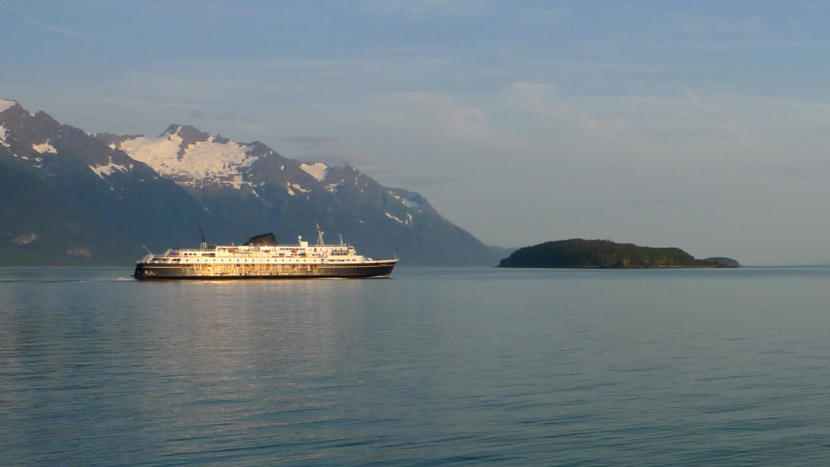
Alaska Marine Highway System ferry Malaspina plies the waters of Lynn Canal en route from Haines to Juneau in Southeast Alaska, August 15, 2012. (Photo by Kelli Burkinshaw/KTOO)
The state announced the $128,250 sale on Wednesday afternoon.
The first mainline ferry added to the Alaska Marine Highway fleet, the Malaspina has been moored since 2019 due to repair costs.
In a statement, M/V Malaspina President John Binkley said that “The AMHS has a proud and significant history, we want to preserve and highlight that for both visitors and Alaskans alike.”
M/V Malaspina LLC and the Ward Cove Group plan to use the retired ferry to bring attention to Ketchikan’s logging and maritime history, Binkley said.
According to the Alaska Department of Transportation, older ferries do not usually sell for large sums but “the state was interested in seeing the Malaspina reach a dignified end to her career on the sea, and this arrangement helps to preserve her legacy.”
The Malaspina is the fifth AMHS ship sold in the past 20 years. Alaskans can comment on its’s sale or share stories of the ship at the M/V Malaspina Engagement Hub.
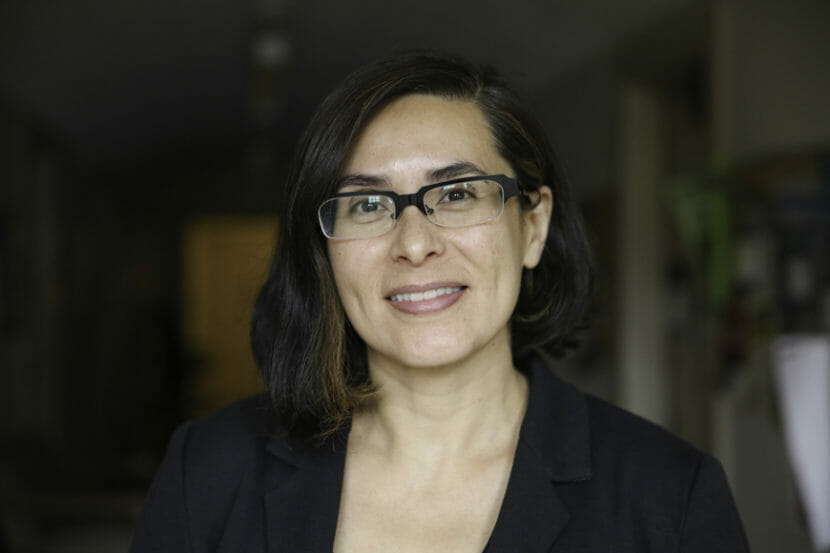
Juliana Hu Pegues, author of “Space-Time Colonialism: Alaska’s Indigenous and Asian Entanglements.” (Photo courtesy of Juliana Hu Pegues)
Juliana Hu Pegues is a professor at Cornell University. Last year, she released a book called “Space-Time Colonialism: Alaska’s Indigenous and Asian Entanglements.”
Inspired by her experiences growing up in Juneau and hearing the history of Juneau through her family, she began researching local legends of Asian residents more in-depth.
She told KTOO’s Yvonne Krumrey that the book’s intention is to interrogate what histories are told — or not told — about Alaska Native and Asian people in Juneau.
This interview has been edited for length and clarity.
The cover of “Space-Time Colonialism: Alaska’s Indigenous and Asian Entanglements” by Juliana Hu Pegues. (Image courtesy of Juliana Hu Pegues)
How did you enter this field of study?
I really wanted to try to look at different communities of color and linkages. And also think about race, gender and sexuality in conversation.
I kind of quickly realized I wanted to also have indigeneity be really central to what I was doing. I’m now a professor and I teach primarily in race, indigeneity, gender and sexuality. And I’m really wanting to look at Asian American histories, Asian American cultural action in relation to Indigenous peoples, lands and knowledges. So that’s really how I think of my work now.
What in your research on Juneau did you find to be the most surprising or, conversely, validating based on your experience growing up here?
Well, I started with stories that I knew, stories that I had heard growing up. That was a lot of the way that I found the specific kind of histories that I would look at, for my book. I think in terms of Juneau, I want to think primarily around China Joe.
I had always suspected that there was more to the story, even though there’s a lot of the story that is told over and over around China Joe. Often people said he was the only Chinese in Juneau and, realizing that he wasn’t the only Chinese, that there were other Chinese immigrants who had come in and out of the city, through the years in his life.
It became clear that I wanted to look at the 1883 lynching of three Lingít men and how we don’t know that part of the history, the way that we know China Joe’s story and the driving out [due to the Chinese Exclusion Act] that happens only three years after.
I call it a lynching, because it was vigilante violence. Two of the men were hanged and one man was shot. The white miners of the town, 60 to 70 white men, collectively pulled on the hanging rope to avoid individual responsibility. So I want us to think about that. This wasn’t random. It wasn’t bad apples. This was the functioning of the town. These are the foundational violences of the town and I want us to think about that, right?
And that was both surprising to learn about, and sort of unsurprising, and thinking about the long history of frontier towns and unfortunately, frontier violence.
China Joe is a figure in ‘Space-Time Colonialism.’ Who was he?
I look at China Joe in two ways. I look at him as a historical figure. He is a Chinese immigrant who’s important to Juneau’s founding history. He came to Alaska as part of the Gold Rush period, originally in the 1870s, in Cassiar, in Canada, and then he was in Juneau by 1881. And he establishes the city’s first bakery, and he remains in Juneau for the rest of his life until he passes away in 1917. So we know about him as a historical figure. That’s pretty important, right?
People who grew up in Juneau and spend time in Juneau or even some folks who come off the tour ships will be familiar with the folklore: that he, in the 1870s saved starving prospectors during a winter freeze in the Cassiar mining district, present-day British Columbia, and Tahltan-Athabaskan homelands. There were prospectors who were trying to wait out the season. And it was a particularly bad one. The last steamboat didn’t arrive with provisions and people were starving. And China Joe the baker baked and saved everybody, right? And in some ways, it’s a Loaves and Fishes story. With his flour, he fed everyone and he saved prospectors.
Then the second part of his story is that, in 1886, when Chinese miners were driven out of Juneau, the old-time sourdoughs, those who remembered him from the Cassiar, protect China Joe, and don’t allow him to be taken and driven out. As the law would have it, he’s the only Juneau Chinese who’s allowed to remain in Alaska’s gold country. Right? That’s the folklore. I look at China Joe both as a historical figure and a folkloric figure. And I want to reconsider both the person and the mythology.
What impact has the tourism landscape had on Asian people living in Juneau now?
I think this is really important when we talk about which stories get carried forward to tourists. It redeems white male heroics. This time, in the service of one lone Chinese baker, it somehow redeems the city. It somehow redeems the founding of a town.
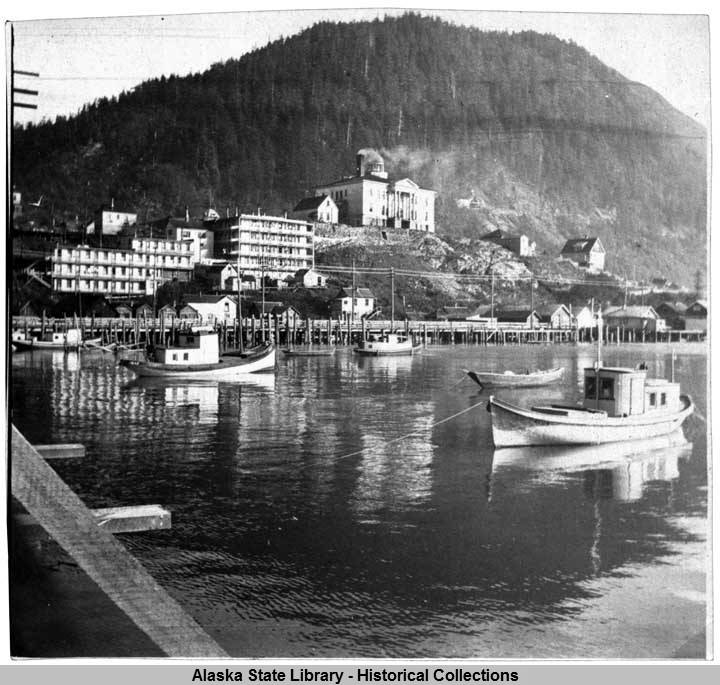
Telephone Hill in Juneau, circa 1920, as viewed from Gastineau Channel near Willoughby Avenue. Before a telephone company set up shop on the hill, it was known as Courthouse Hill. (Photo courtesy of Alaska State Library Place File, ASL-Juneau-Views-Areas-Willoughby-Ave-06)
On a sunny afternoon, Maureen Conerton was lounging in a camp chair with her husband outside the home they lease on Telephone Hill. A plaque on the door claims it’s Juneau’s oldest home, built in the early 1880s.
Telephone Hill is a rocky ridge that juts out toward Gastineau Channel in downtown Juneau. The massive State Office Building straddles it. The Telephone Hill name stuck after a telephone company set up shop there in the early 1900s.
Conerton said she’s lived on Telephone Hill since 1989, calling it “the last little piece of old-time, rural Juneau” in the downtown area. She reminisced about epic, Alaska Folk Festival afterparties that the neighborhood used to host.
“It was wild. We had to take everything off the walls, all — everything, mirrors, pictures, everything,” Conerton said. “Moved the furniture into this side room back there because there were so many people in the — and every room was a different band. You know, the dining room was the Celtic band.”
One year, the festival’s headliner played harmonica — in the pantry.
“The walk-in pantry!” she said. “It was just like, ‘Wow, this is so amazing.'”
Those afterparties are long gone. And, according to a 1984 agreement between the city and state, her home and six others on Telephone Hill are also supposed to be long gone. The state and city intended to build a new Capitol complex on the hill and presumably raze the homes in the process.
Conerton and her neighbors don’t own their homes; the state does. Back in 1984, the state spent $4.6 million purchasing them. Some of them were just taken through a process known as eminent domain. The city pitched in $2 million.
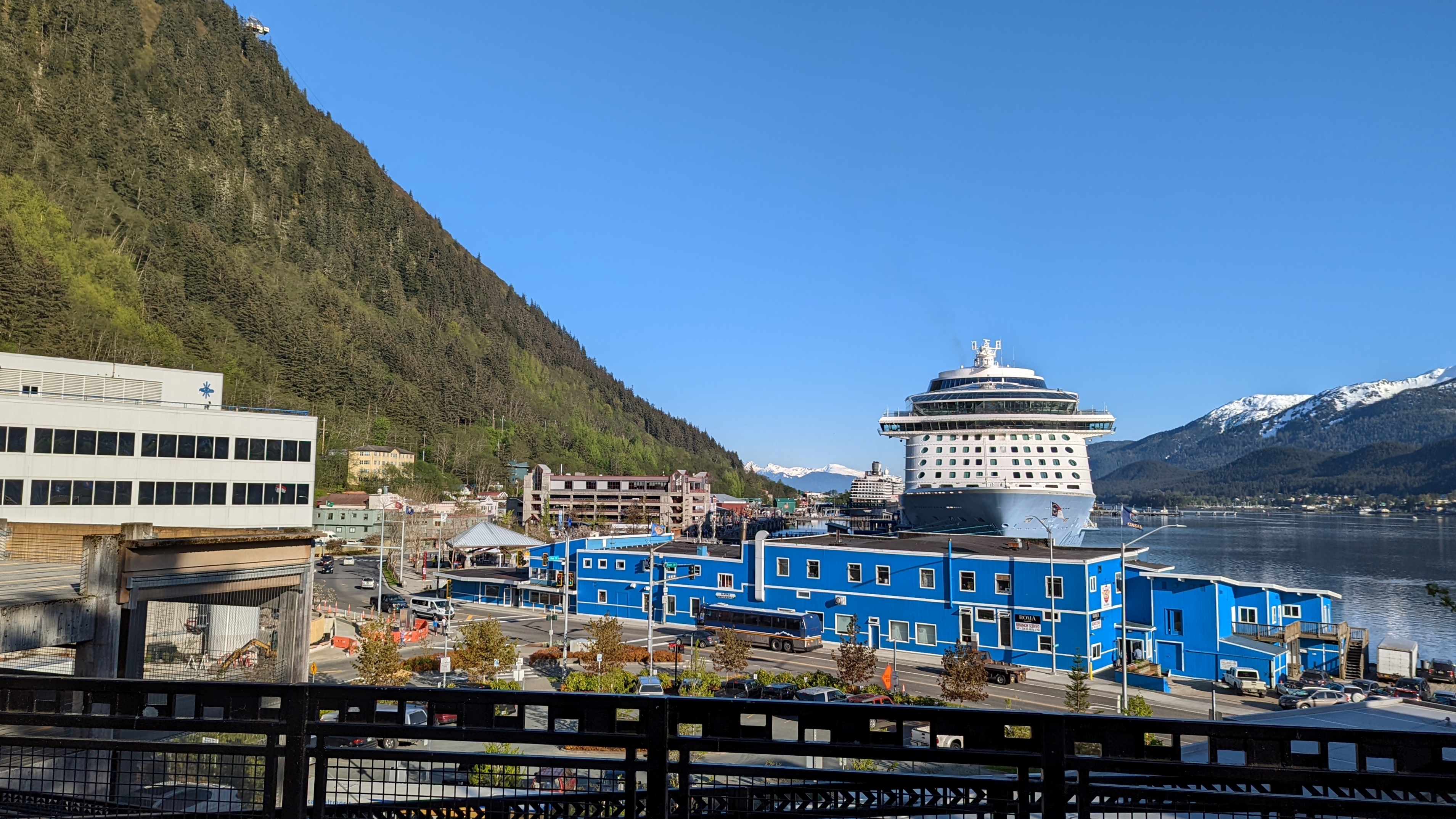
When the City and Borough of Juneau built the Downtown Transit Center, it also built a small park on top of Telephone Hill that features this view of downtown Juneau, as pictured on May 21, 2022. (Photo by Jeremy Hsieh/KTOO)
Telephone Hill is one of the most prominent natural features of the downtown area, which is part of why experts and locals back in the day thought it would be the ideal place to eventually build a new Capitol complex. That plan never came together, and the state became the landlord indefinitely for residents of the historic homes there.
The 1984 agreement says that if the state had not redeveloped Telephone Hill by 1994, it was supposed to compensate the city with cash and land. That also hasn’t happened.
Now there’s a renewed push for the state to transfer Telephone Hill to the city for redevelopment.
In a 2019 report, state officials flagged Telephone Hill as an asset it should consider selling. The city applied to get the land and settle the debt. It’s a slow process.
The city doesn’t have a concrete plan for Telephone Hill. But according to the city’s application, it intends to develop it “to support the Capitol campus, state government, and private development.”
“Since we just a few years back, put, oh, I think it was $37 million in seismic and other upgrades into the state Capitol building, it seems pretty clear that we’re not pursuing a new state Capitol building anywhere in the next generation or so,” Kiehl said.
The bill with Kiehl’s amendment is bound for the governor’s desk.
“I believe that this land transfer would have happened eventually. So I think this just cuts some time and some uncertainty out of the process,” Kiehl said.
Conerton said uncertainty is ingrained into life on Telephone Hill. Over the decades, it’s discouraged the residents from investing in significant repair projects. Things like roof replacements and fresh paint.
She said it feels like every time they’re ready to start working on something, there are new rumblings that they’ll finally be put out of their homes.
“Where they’ve said, you know, ‘This is the end. We’re going to do something,'” Conerton said. “And then they don’t. We’ve been lucky that way, because it’s a great place. And everybody, you know, we get along. It’s a real neighborhood.”
Ironically, the less-than-ideal condition of the homes is one reason the city and state say it’s ripe for redevelopment.
For now, city officials are waiting for the governor’s signature on the bill. After that, the Juneau Assembly will have some decisions to make about what to do with Telephone Hill.
An earlier version of this story was published with a historical photo taken from Telephone Hill. It’s been replaced with one of Telephone Hill.
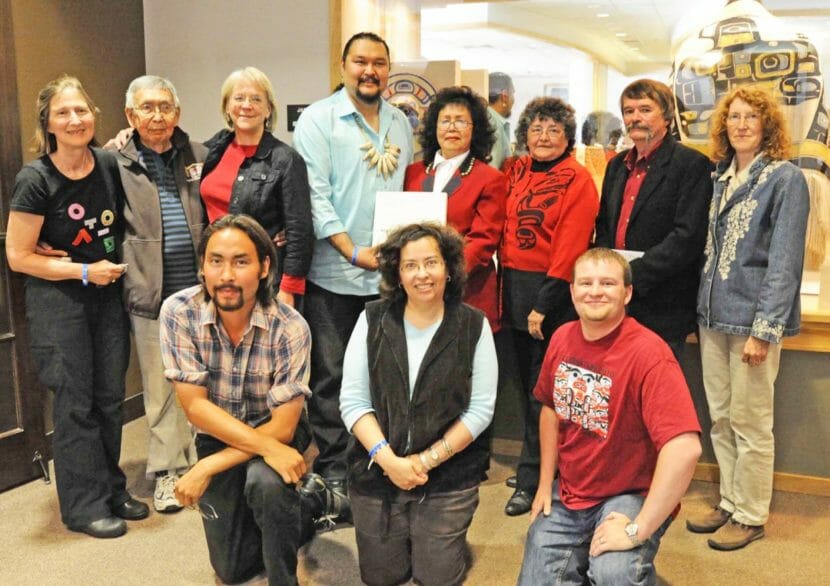
KTOO transferred the Southeast Native Radio tapes to Sealaska Heritage Institute in a ceremony in 2010. The show was produced by a team of volunteers, including Arlene Dangeli, Joaqlin Estus, Cy Peck Jr., Kathy Ruddy, Kim Metcalfe, Andy Hope III, Jayne Dangeli, Laurie Cropley Nix and Rhonda Mann. (Photo courtesy of Sealaska Heritage Institute)
Hundreds of hours of Southeast Native Radio broadcasts are now archived on the internet and available for anyone to listen to.
Southeast Native Radio was broadcast over KTOO in Juneau for 16 years, from 1985 to 2001. The volunteer-produced show played as current affairs at the time, but twenty-one years later it’s become a window into the lives of the people and events that shaped Native culture in the region over the last century.
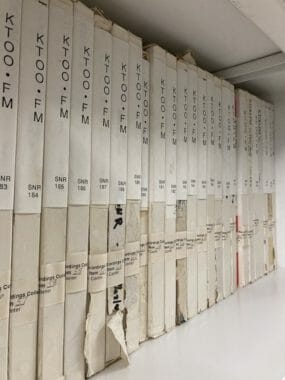
The Southeast Native Radio collection includes over 400 programs broadcast from 1985-2001. (Photo courtesy of Sealaska Heritage Institute)
The catalog of recordings is lengthy and populated with names that make it a who’s who of Southeast Native culture at the turn of the 21st century.
Nora Marks Dauenhauer, for example, was a leading Lingít language scholar and historian, as well as Alaska’s Poet Laureate. She died in 2017, but her words are now just a click away.
The Southeast Native Radio Recordings collection is available through the Sealaska Heritage Institute, which received the donated DAT tapes, reel-to-reels, and CDs from KTOO in 2010. In all, there are 400 recordings.
Even the most seemingly mundane shows are abuzz with history because the people represent a generational bridge to an even deeper past.
In one of the archived recordings, Roy Peratrovich, husband of Elizabeth Peratrovich, talks about the first of five times he was elected Grand President of the Alaska Native Brotherhood, when he lobbied to bring the Grand Camp to Klawock:
Peratrovich: When you’re young, you do a lot of foolish things…
Host: Was this 1929?
Peratrovich: No, 1939.
Host – 1939, okay.
Peratrovich: So I told the group that if we are going to build up this group, this ANB, we’re going to have to do it big. Pride is going to help us. Not knowing some screwball was going to nominate me for Grand President. So I got elected.
Peratrovich died in 1989, a year after that appearance on Southeast Native Radio.
And there’s basketball, which is a large thread in the cultural fabric of Southeast Alaska. One of the stars of the annual Gold Medal Tournament was Sitkan Herb Didrickson.
He told Southeast Native Radio that the Sitka team had to catch a ride on a seine boat each March for the trip to Juneau.
“As I started to put my gear up in the top bunk, I found this old man was laying up there already,” Didrickson says. “He kind of got on board a little early, and no one knew that he was there. So he was trying to stowaway, you know. So we figured, well, the old fellow wants to go and see some games, and we all couldn’t sleep at the same time.”
Didrickson to this day is considered one of the greatest players produced in Southeast Alaska, whose chances at a pro career were thwarted by WWII. Didrickson died in 2017.
Sealaska Heritage Institute refers to the archive as a “treasure trove,” and that’s not far off. The recordings include a 13-part series produced in 1986 on the history of the ANB. There are also a number of Lingít language segments with fluent speakers like Dauenhauer and Walter Soboleff conversing on a range of subjects.
Note: The Southeast Native Radio Recordings project was supported by a Digitizing Hidden Collections or Recordings at Risk grant from the Council on Library and Information Resources. The grant program is made possible by funding from The Andrew W. Mellon Foundation.
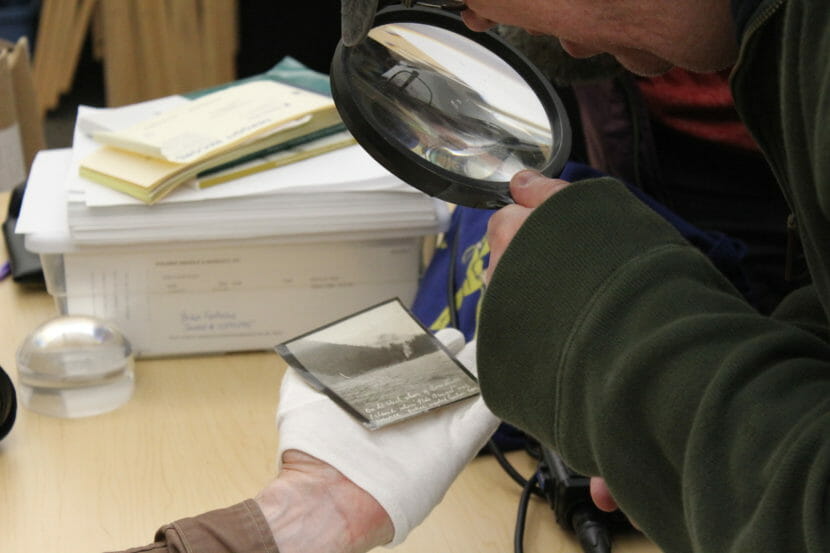
Researcher Shawn Dilles examines a photo of a site where the Star of Bengal may have wrecked. (Photo by Sage Smiley/KSTK)
A crew of researchers set out on a mission on May 6 to find the wreck of a cannery ship that sank in Southeast Alaska over 100 years ago. But the process of trying to find and identify a shipwreck involves a lot more than just looking in the water.
Thirty years ago, off the jagged cliff shores of Coronation Island in southern Southeast Alaska, Gig Decker and a couple of friends — working with their nonprofit the Southeast Preservation Divers — found an anchor chain about 70 feet underwater.
“When we first ran across the chain, it was obvious on the sounder that we had found it. I mean, it was very, very distinctive,” Decker said.
And it wasn’t just any anchor chain.
“I felt 89% sure that it was the chain from the Bengal,” he said.
The Star of Bengal was an iron-hulled, 270-foot cannery vessel that went down in a storm in 1908, killing over 100 people. Most of them were cannery workers from China, Japan and the Philippines.
“I went down and had a chance to go to the anchor and then follow the chain to the wreck. I was really happy to be able to be the first one – I thought – in 100 years that had seen it,” Decker says. “It was a huge thrill. I mean, I can only think of a couple of things in my life that really did it for me. And that was definitely one of them.”
Decker and the Southeast Preservation Divers had been searching for the wreck in the hopes of revisiting its history and registering it as a historic site. Decker says he became interested in shipwreck diving over the course of his 38 years as a commercial harvest diver.
“I had a chance to cover many, many miles of coastline,” Decker said. “ And ran into a variety of wrecks, from ancient wrecks to gillnetters and trollers and sport boats. The whole business of shipwrecks has always really fascinated me, you know, kind of a mysterious thing … shipwrecks kind of embody a tangible aspect of history, particularly if they are gravesites, which a lot of them are.”
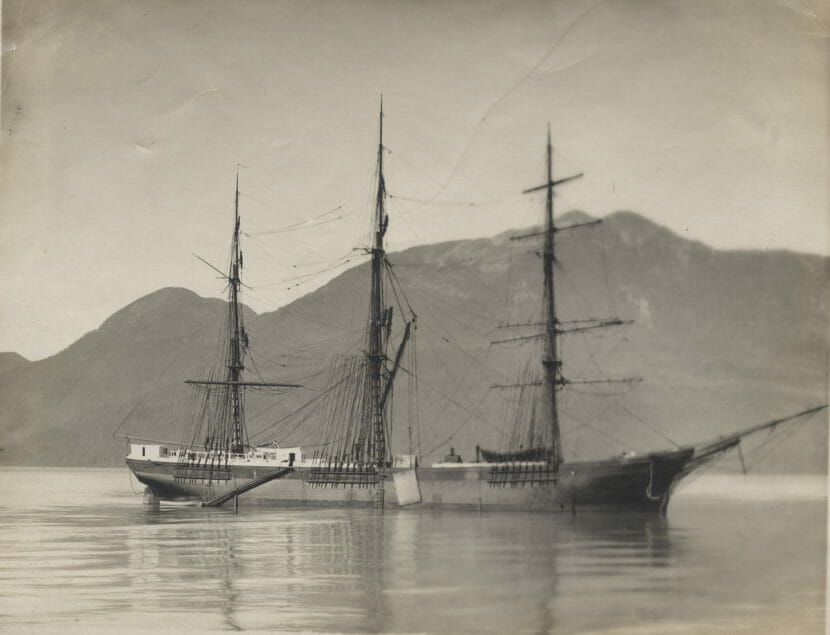
The Star of Bengal. (Photo courtesy of The Wrangell Museum)
Decker has spent decades researching the Star of Bengal wreck. And while he says he’s almost sure what he saw on the seabed was the Bengal, there’s quite a bit left to do before he can be certain.
“The next step I’ve always known is to get out there with a bottom mapping system to where we can do a 3D model of the wreck itself, the cove and the entry to it. And then most importantly, having a state-certified underwater archaeologist out there to claim that it was, in fact, the [Star of] Bengal,” Decker said. “After that, we can go on for a larger investigation of the wreck.”
That process started May 6, as an eight-person research crew set out from Wrangell aboard the Alaska Endeavour and headed for the site of the wreck. That includes Decker, marine archaeologist Jenya Anichenko, writer and visual artist Tessa Hulls, artist and musician Ray Troll, researcher Shawn Dilles, remote sensing specialist Sean Adams, and Endeavour owners Patsy Clark Urschel and Bill Urschel.
Part of their investigation aims to pinpoint where precisely the wreck is located. Decker dove what he believed to be the site more than 30 years ago, and didn’t have GPS mapping.
This time, they’re taking a more high-tech approach. Sean Adams is in charge of the expedition’s arsenal of sonar equipment, aerial drones, and a device known as a magnetometer, which senses iron — useful when looking for an iron ship.
“It’s the perfect target for the magnetometer,” Adams told the expedition crew on May 5.
Before leaving on their expedition, some of the team stopped by Wrangell’s museum to look at photos that seem to have been taken by the party sent to bury bodies after the Bengal went down in 1908.
The crew is using an instrument called a magnetometer. It is light enough to be mounted on a drone and flown in a grid to try and sense the location of a wreck like the Bengal. Adams says it’s typically used for detecting unexploded bombs or artillery shells buried under the ground. In this case, he’s hoping it could point the crew in the general direction of the wreck.
“You’re not going to get as detailed or a high definition targets and the smaller targets are not going to show up as well,” Adams said. “But it seems to be a very good magnetometer. This is kind of a new use for it — an experimental test.”
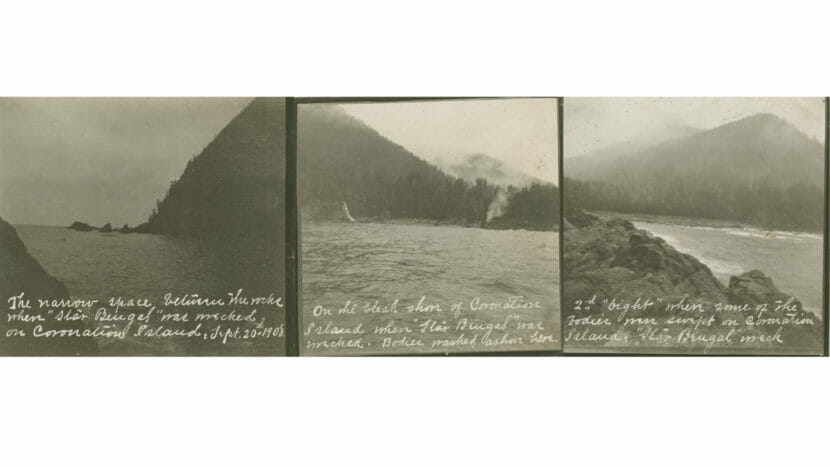
But the crew isn’t just relying on high-tech gadgets to locate the lost ship. They’re also turning to the historical record. Researcher Shawn Dilles says he’s looked all over the country for photos of the Star of Bengal and the site of its wreck like the ones in the collection of the Wrangell Museum, housed in the Nolan Center.
“I think the Nolan Center played a critical role in this,” Dilles said. “I’ve looked in archives all over the country and seen some of these photos, but not those two critical photos. We still don’t know exactly who took them and what day, but it’s a very reasonable guess, I think, to think it was a week after or so — within a week of the wreck and taken by the burial party.”
Three images seemingly show different sites, all said to be the site of the wreck of the Star of Bengal. (Photos courtesy of The Wrangell Museum)
The collection of tiny, square black and white photos with white cursive writing seems to indicate one of two coves along the southern coast of Coronation Island could be the site of the wreck.
“That’s what makes this a mystery is that we have two lines of evidence, and neither can be eliminated,” Dilles said while examining the photos in the Nolan Center office.
“It’s not about right and wrong,” he said.
For Decker, the commercial diver who thinks he found the Bengal three decades ago, the search is not just about finding a sunken ship. It’s about correcting the historical record.
“Those people, we can’t bring them back, but we can get the story straight that they didn’t die in the hold because they were hiding,” Decker said. “They were very courageous people to put themselves in the position they did. And they were murdered by cowardice.”
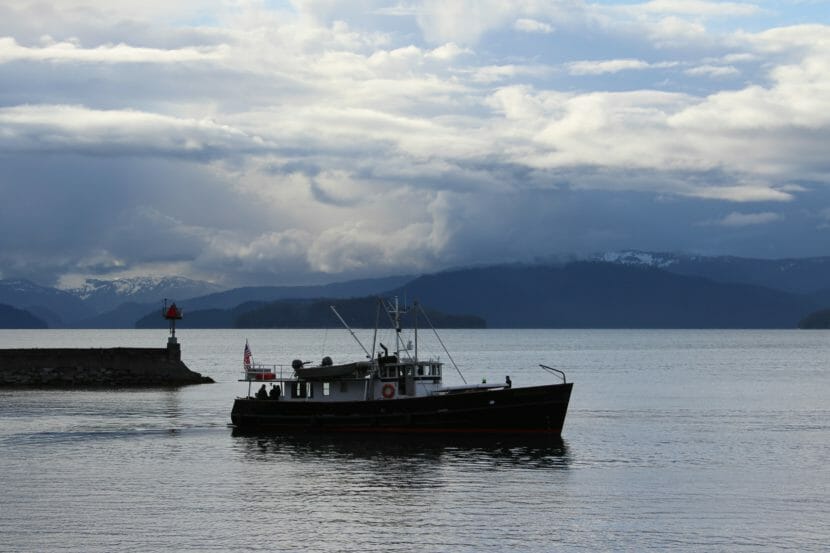
The Endeavour in the mouth of Wrangell’s Reliance Harbor. (Photo by Sage Smiley/KSTK)
An eight-person crew of scientists, artists and divers are trying to locate the site of one of the deadliest shipwrecks in Alaska history. Most of the victims were Asian cannery workers, and many of their names remain unknown. Expedition members say they hope to find the wreck and shine a light on how those workers bore the brunt of the tragedy.
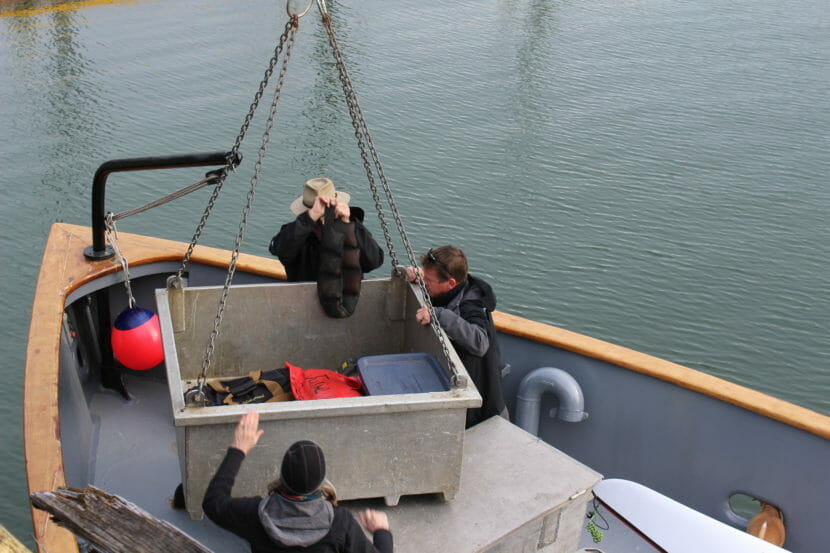
On a dramatic spring evening in Wrangell — black clouds and sharp shadows in the golden-hour sun — Alaska artist Ray Troll stood at Reliance Harbor, watching a gray metal box being lowered onto the deck of a 72-foot black-and-white ship.
“Those are oxygen tanks, I believe for scuba diving,” Troll said. “They’re very heavy.”
Troll is a part of an eight-person expedition searching for the wreck of the Star of Bengal, an iron-hulled Alaska Packers Association salmon-packing ship that went down in a storm in 1908 off the coast of Coronation Island in Southeast Alaska.
The group includes remote sensing specialist Sean Adams, marine archaeologist Jenya Anichenko, researcher Shawn Dilles, visual artist and writer Tessa Hulls, Wrangell commercial fisherman and diver Gig Decker and a boat dog named Bella. They’re all sailing on the Endeavour, a former U.S. Army boat built in 1956, owned by Patsy Urschel and her husband Bill.
“I think of this as a right brain-left brain, kind of a project,” Urschel said, “So it’s got the scientific aspects of it of discovery. But it has some cultural pieces too.”
For expedition captain Bill Urschel, the project stands out from other shipwreck explorations because of the story of the Star of Bengal.
“This is a special wreck because of the cultural significance,” he said. “It’s not just a ship that went down. It’s a social system that went down with it.”
All but one of the 111 cannery workers on board — from China, Japan and the Philippines — died when the Star of Bengal sank on September 20, 1908. Fifteen of the 36 white crew members died.
“I think that’s where that sense of injustice really kicked in for me,” said Tessa Hulls, a writer and visual artist who’s a member of the Endeavour crew looking for the wreck. For the last five years, she’s been working on a graphic novel exploring three generations of her family, from the communist takeover of Shanghai to the United States.
She says that for the white men who died aboard the Star of Bengal, there’s plenty of information — full names, ranks, even insurance payouts to spouses.
“Then you try and find any information about any of the Asian passengers and it’s always, ‘And about 100, Orientals, Asiatics, or word I’m not going to say’ — you know, they get so lumped together,” Hulls said.
The crew loads gear onto the Endeavor. (Photo by Sage Smiley/KSTK)
There are conflicting reports about how exactly the Star of Bengal went down in 1908 and what the ‘abandon ship’ looked like, but some first-hand accounts tell of the mates and masters of the vessel — all white — leaving the ship without freeing the cannery workers who were locked in the ship’s forward hold.
Hulls says the story of the wreck says a lot about the mistreatment of Asian workers in the U.S.
“It’s this incredible microcosm that tells us about a century of how Asian Americans were first coming to this country, and what the practices were with them being migrant workforces,” she said.
In all likelihood, Hulls says the Endeavour crew will never be able to find the names of all of the Asian cannery workers who were killed when the Star of Bengal went down.
“But I think telling the story of why we can’t find their names is the closest that we’re gonna get to justice on this,” Hulls said.
Marine archaeologist Jenya Anichenko says the crew hopes to locate and authenticate the wreck of the Star of Bengal and, if possible, bring back one or two small artifacts. She says she’s excited to be a part of a project of such great importance to the community of Wrangell, and one with historical significance.
“A lot of times in the case of shipwreck projects in Alaska, there is always a strong community source beginning and the group of enthusiastic individuals who care for the place and history,” Anichenko said. “And professional archaeologists, if they come into the picture, come as a secondary step.”
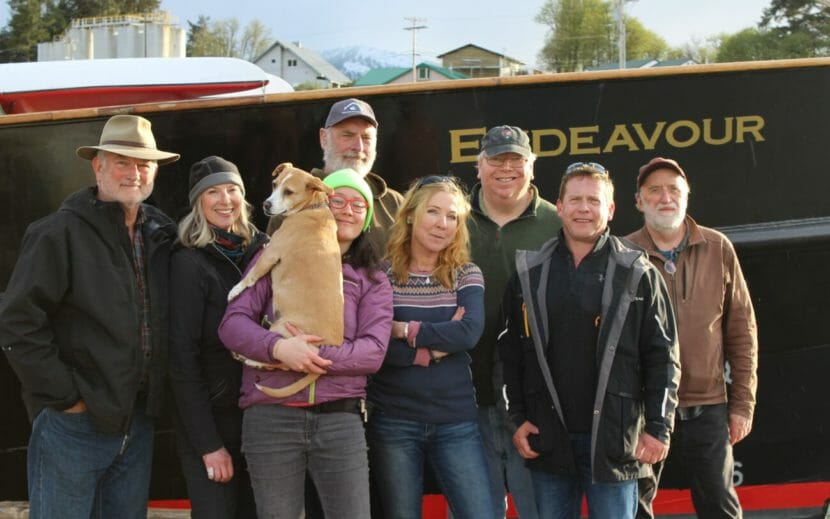
The expedition crew. From left: Bill Urschel, Patsy Urschel, Bella the dog, Tessa Hulls, Gig Decker (behind), Jenya Anichenko, Shawn Dilles (behind), Sean Adams, and Ray Troll. (Photo by Sage Smiley/KSTK)
In this case, the enthusiastic community connection is Gig Decker. He’s a Wrangell commercial fisherman and diver who believes he found the wreck of the Star of Bengal more than three decades ago and has been working ever since to research and pique interest in the story of the wreck.
“The ship was from Wrangell, they worked here, and they’re a part of my industry,” Decker said. “And I feel an obligation. So, that’s what was really important to me is just to get the story elevated to the level it should be.”
For Troll, who calls himself a “connector” and brought much of the 8-person crew together, the mission to find and authenticate the wreck is about respecting the humanity of the victims of the sinking, who have since become victims of history.
“There were certain people that were — their humanity was respected and others it was total disrespect,” Troll said. “I hope that what we’re doing here is maybe trying to bring that respect and to honor them in some way.”
The journey of the Endeavour and its eight-person crew started on May 6 at the old APA cannery site — about where Wrangell’s airport now stands. From there, it traces the 82 miles out to Coronation Island — the same route as the Star of Bengal, where they’ll spend a week documenting their efforts to find its wreck.
Close
Update notification options
Subscribe to notifications
Subscribe
Get notifications about news related to the topics you care about. You can unsubscribe anytime.