History

What is May Day? For the most part, the opposite of capitalism

Demonstrators wearing red and carrying pro-labor signs
May Day demonstrators march through downtown Los Angeles last year. Thousands of people took to the streets across the nation that May 1 in rallies calling for immigration reform, workers’ rights and police accountability. (Photo by Ringo H.W. Chiu/AP)

May Day, celebrated by workers across the globe as International Labor Day, falls on May 1.

But you’d be forgiven if that’s news to you. While the day traces its origins to an American laborers’ fight for a shorter work day, the U.S. does not officially recognize International Labor Day.

Like other countries that mark Labor Days on different dates, the U.S. and Canada celebrate their Labor Day in September.

U.S. resistance to celebrate International Labor Day — also called International Workers’ Day — in May stems from a resistance to emboldening worldwide working-class unity, historians say.

“The ruling class did not want to have a very active labor force connected internationally,” said Peter Linebaugh, author of The Incomplete, True, Authentic, and Wonderful History of May Day. “The principle of national patriotism was used against the principle of working-class unity or trade union unity.”

That hasn’t stopped American workers from commemorating the day, which in recent years has ranged from marching for labor rights to reading literature about Marxism.

“The meaning of that day keeps changing,” Linebaugh said.

Before we consider how May Day has evolved in the U.S., let’s dive into how it all began.

The traditional May Day is an ancient European export

If you instead associate May Day with baskets of flowers, dancing around maypoles, or simply, the start of summer, those May Day celebrations recall the holiday’s much earlier origins. Before May Day was adopted as a day to champion workers, its roots belonged to pagan tradition.

The springtime tradition was inherited from pagan tribes in Ireland and Scandinavia, said Linebaugh, borrowing ancient Roman practices celebrating the Earth’s flowering season. When the first Europeans came to North America and erected a maypole in Quincy, Mass., they imbibed copious amounts of beer and danced with the Indigenous people, he said.

“The Puritans of Boston put an end to it by military force,” Linebaugh said. “And yet this tradition of May Day as a time of dancing and play and pleasure persisted right into many parts of the U.S. today.”

At the end of the day, no matter your version of May Day, it remains a time meant to celebrate togetherness. Inevitably, history shows, that May Day comradery has been met with suppression.

May Day in America has bloody origins

May Day in America was born out of the 8-hour workday movement in 19th-century Chicago. At the time, as the capitalist system gained a foothold in industrial-era America, working-class conditions had worsened. A 16-hour shift wasn’t unusual for workers at the time.

Decades before the 8-hour work-day became the country’s norm, the organization now known as the American Federation of Labor set May 1, 1886, as the date that workers nationwide should go on strike to demand the 8-hour workday.

“The reason was that the decade before there had been terrible unemployment … and yet new technology had made the employer richer,” Bill Edelman, a professor of labor studies, previously recounted on Talk of the Nation.

The workers followed through. On that May date, anarchists and labor activists in Chicago began a multi-day strike in what became known as the Haymarket affair of 1886. By May 3, the protests turned violent when police — “which were basically the armed force of the capitalist masters,” according to historian Linebaugh — attacked workers demonstrating near the McCormick Reaper plant. The following day, a meeting held in the city’s Haymarket Square turned even bloodier. Again, the police intervened, said Linebaugh, triggering clashes that killed both officers and civilians.

A bomb exploded among police ranks in the melee, but historians say it’s unclear whether it was intended for the police or the crowd of civilians.

“There was a trial of eight men who were found guilty of conspiracy to murder,” Linebaugh said. “Even though no evidence was ever produced that any of them had any relationship to this bomb, and four of them were eventually hanged despite a worldwide campaign in England, Europe, Mexico to save their lives.”

Linebaugh points to the influential words of August Spies, one of the convicted men, who just before his execution cried out the famous words: “There will come a time when our silence will be more powerful than the voices you strangle today.”

His words “swept the globe,” Linebaugh said. “Throughout Latin America, throughout Europe and in North America, to many, the day became this holiday to celebrate working people.”

To honor the Chicago workers, the International Socialist Conference in 1889 named May Day a labor holiday, birthing what many nations now call International Workers’ Day.

But in the U.S., anti-communist attitudes during the Cold War, as well as opposition to working-class unity, led authorities to suppress May Day’s association with labor movements.

President Dwight D. Eisenhower instead declared May 1 “Law Day” — dedicated to the principles of government under law — and Labor Day is now celebrated in September.

It’s not just a “communist” holiday

Despite International Labor Day’s U.S. origins, said Linebaugh, many Americans, still view May Day as strictly a holiday enjoyed by “communist countries.”

In the former Soviet Union, May Day was an occasion to honor workers’ contributions with giant parades in Red Square, a tradition that has dwindled in the decades since — a fading remnant of the Bolshevik Revolution that’s lost its meaning in modern Russia.

“Some of the workers of Czarist Russia also celebrated May Day, but quickly within 10 years, say by the 1930s, it becomes [for] the Soviet Union a day to display military hardware, military weapons,” Linebaugh said.

As for Americans this year, he mused, “How it will be celebrated this day?”

“I’m not sure. I think it’ll be exciting to pay attention to see the ways in which its history is remembered.”

For a day that celebrates reform and revolution, political discussions and petitions, said Linebaugh, there’s something in it for everyone. Well, maybe not.

“There’s nothing in it for the capitalist class,” he said.

Copyright 2022 NPR. To see more, visit https://www.npr.org.

Arliss Sturgulewski paved the way for Alaska women in politics, friend says

Arliss Sturgulewski in 2017. (Eric Keto/Alaska’s Energy Desk)

Trailblazing Alaska politician Arliss Sturgulewski died on April 7 at the age of 94.

Sturgulewski got into politics in 1970s Anchorage, as she was raising a son after her husband died in a plane crash.

Sturgulewski went on to serve in the state Senate and, as a Republican, was the first woman to win a major political party’s gubernatorial primary election and run for governor.

Her longtime friend and fellow community organizer, Jane Angvik, says Sturgulewski paved the way for other women politicians, but it was her interest in improving all Alaskans’ lives that really drove her.

Listen:

The following transcript has been lightly edited for clarity.

Jane Angvik: She actually saw the influence that government has on people’s lives and wanted to make sure that the government public policy was actually to the benefit of the citizens. She believed that if you were involved, if you evaluated the issues, you could make good decisions. And even if you weren’t the head of a company, you could have the information and the ability to influence the direction of public policy.

Casey Grove: I wanted to ask you to describe her political career and kind of what happened.

Jane Angvik: Okay, what she did is she worked in local government, and then she was elected to the Alaska State Senate in 1978 and served in the Senate for 10 years. And in that time, the state of Alaska exploded in population, went from being almost broke to exploded in money as a result of the completion of the trans-Alaska pipeline and the beginnings of oil wealth that accrued to the state of Alaska. It went from a tiny budget to a several-hundred-million-dollar budget in one year. And then the next year, it was a billion dollar budget. So that’s where Arliss Sturgulewski shone. She was a bright voice for the public interest versus the private interest. And she was very strong and very capable of making sure that the public interest was going to be served by the appropriations made for capital improvements, by the appropriations made for community grants — that what we were going to be doing is making sure that they could be using those funds for the public interest.

She ran for governor in 1986 and in 1990. That was very unusual in Alaska. It was very unusual in America. And so at that time, they (thought), “Could a woman actually be the governor of Alaska?” And she was perpetually prepared to answer the question: “This woman is able to be the governor of Alaska. And this is why, and this is how.” But she continued her work on behalf of the community in a variety of ways. And so what I really want you to understand is, she had 60, 70 years of service to Alaska that never stopped. She was fully active her whole life.

Casey Grove: In general, what do you think is her lasting legacy on Alaska politics?

Jane Angvik: Arliss was an advocate of the people and of good government. What did she accomplish? She created an ethos, an ethic of community service as the principle for people to be able to do public service. She also absolutely broke trail for every woman who has ever followed her in seeking office in any way, from school board to governor. And she broke trail for all women who wanted to be able to stand on their own two feet and make sure that they had equal opportunities under the law.

Casey Grove: Just as a friend, what was she like?

Jane Angvik: She was a lot of fun. She was a lot of fun. It was joyful to have dinner with Arliss, at her home or our home. She had a wry sense of humor, and it was joyful to hear. She was devoted to her family and her grandsons as well as her son and daughter-in-law. And she was very engaged in a broad range of things. I mean, she supported the Girl Scouts, she supported the Boy Scouts, she supported… (everybody). So what I’d say about her is that she was fun, and she was joyful, and she was kind and she was smart. Oh, so smart. And she inspired generations of people to be willing to stand up and take a stand.

How Yup’ik dance returned to Napaskiak after a 70-year absence

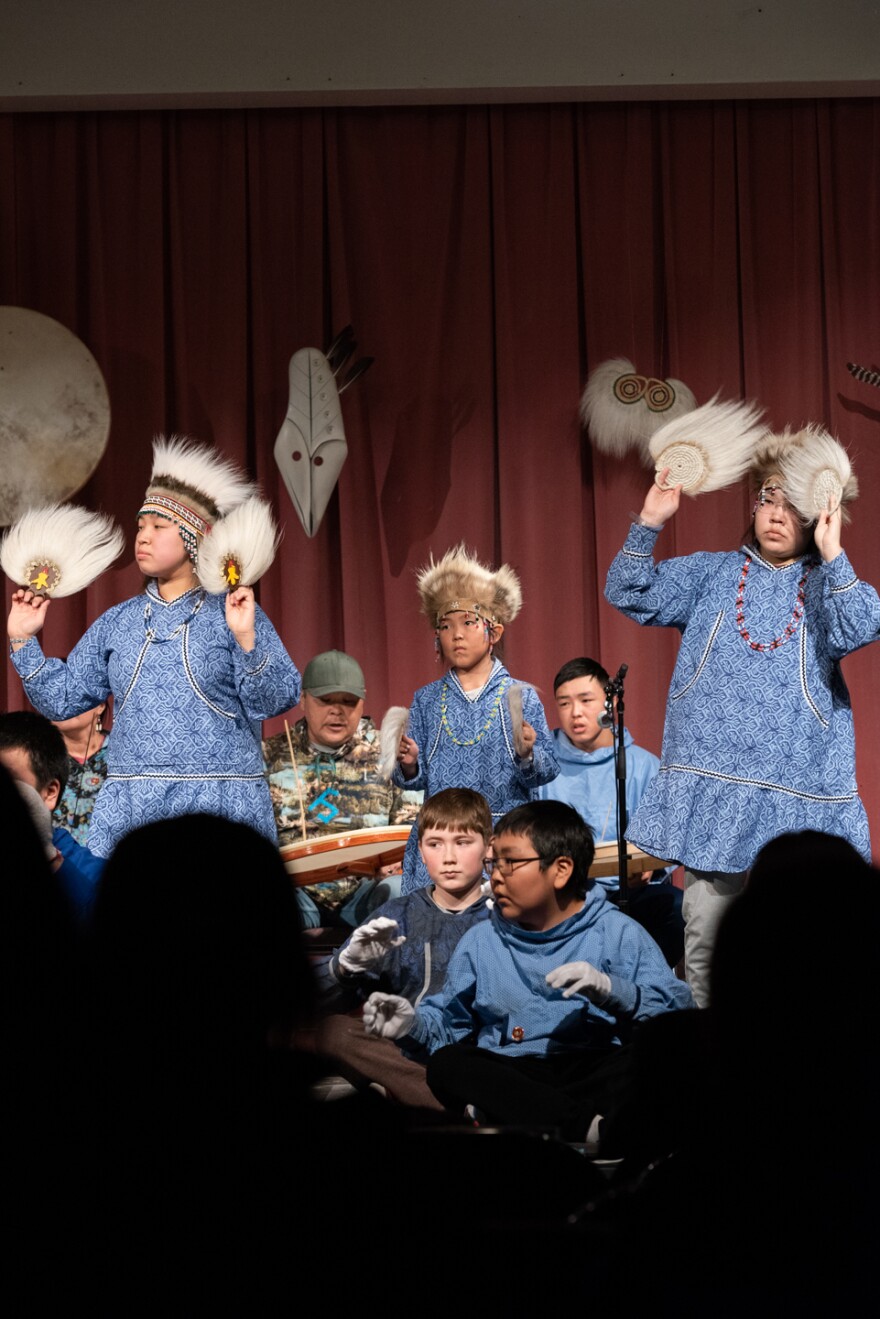
Napaskiak Dancers at Cama-i Dance on March 27, 2022. (Photo by Katie Basile/KYUK)

For many Yup’ik dance groups in the Yukon-Kuskokwim Delta, the pandemic limited their ability to gather together and perform traditional dance. Some groups are just beginning to dance together again after two years, but the village of Napaskiak remembers a longer period without the drums.

“It’s an old one. It’s about when the birds return, like the Canada goose, the crane, and then the famous crow or the raven,” said Julia Sipary, the leader of the Napaskiak Dance group, describing one of the village’s oldest songs.

It’s one of the few that remain from before the missionaries stopped yuraq in Napaskiak. That was in the 1930s. For 70 years, the drums fell silent.

Sipary was born during that time. She first saw Yup’ik dancing on television while watching a Native arts festival.

“And I wanted to start it too,” Sipary said. “I knew we were missing out.”

Her great-grandfather had been part of the last generation in the village to drum in the 1930s. She wanted to continue that tradition. When she was a young teacher at the Napaskiak school, she got her chance.

It was the year 2000. The principal asked Sipary if she would begin a dance group, but she couldn’t do it on her own. She and a group of others asked the two churches in the community, the Russian Orthodox Church and the Moravian Church, for approval first; they both said yes.

“It was surreal. Like we were able to breathe again,” Sipary said.

Sipary and another teacher, Rachael Nicolai, met with an elder who remembered Napaskiak’s dances. The elder’s name was Emma Clark. However, Clark did not want to be seen dancing.

“Tamani wani record-allraku Emma-m iirluni pilallruuq yugnun tangercecuumiinani aturpallrani wall’u yurallrani, aliingellrullilria-wa wall’u caperrsullruuuq akaarnun Napaskiarmi yuraayuirutellruata,” Sipary said speaking in Yugtun, describing how Clark taught the dances.

“So she requested a closet, and we’d be in the closet, and she would teach and record then,” Sipary said, choking up as she remembered Clark. “But I guess she felt scared or something. She didn’t want people to see her drumming, or singing and dancing.”

In all, Clark passed down six songs and dances to the community. A group from Bethel also came to Napaskiak and helped teach them to dance, sing, and drum again. Many people in Napaskiak were apprehensive about joining in after seven decades without the tradition. But, Sipary said, eventually that apprehension gave way to joy.

“Looking back, the people that were excited about it kind of spread throughout the community,” she said. “If they could do it, ‘Wow, and they’re so happy.’ They saw that, so they wanted to join,” said Sipary.

Napaskiak has been dancing now for over 20 years. Sipary has remained its main singer, drummer, and composer. It’s unusual for a woman to lead Yup’ik drumming. Sipary has also written most of the village’s songs. Many are inspired by watching her children. She’s written songs about hunting, playing basketball, and subsistence projects. One of the group’s favorite songs is about collecting punk fungus from birch trees.

The Napaskiak group consists of around 30 dancers. However, some members did not perform this Cama-i, and instead took advantage of the sunny day to go ice fishing. The group is multigenerational. Most of the members are students at the Napaskiak school where Sipary still works as a Yugtun and English teacher. She says that it’s important to pass the traditions to younger generations.

“If our kids aren’t dancing, if the kids aren’t singing, it will stop,” Sipary said.

Swastika marks escalation in spate of vandalism at Dzántik’i Héeni Middle School

Dzantik'i Heeni Middle School
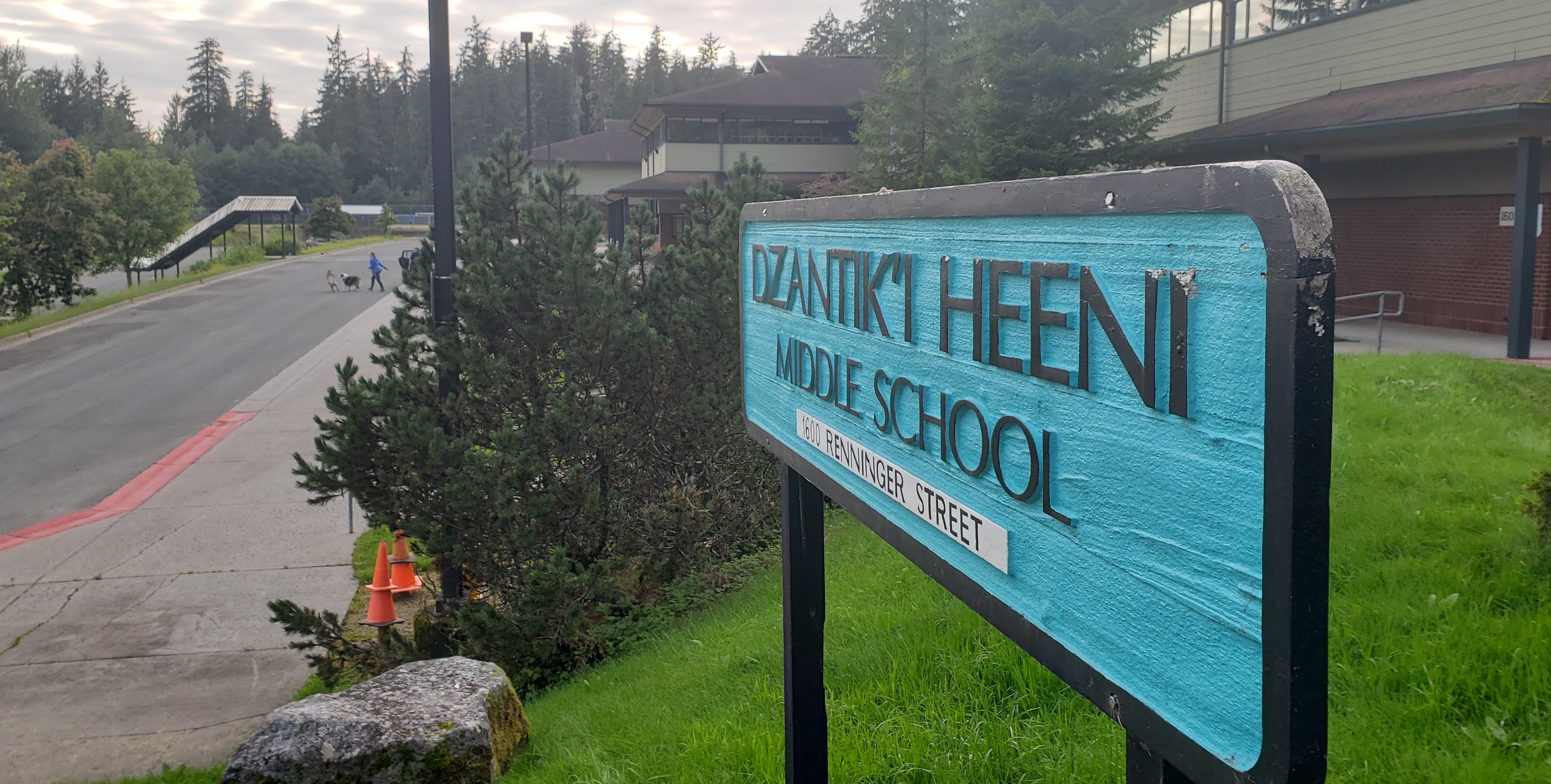
A woman walks a pair of dogs at Dzantik’i Heeni Middle School in Juneau on the evening of Aug. 11, 2020. “Dzántik’i Héeni” is a Tlingit place name for Gold Creek that means “river at the base of flounder hill.” (Photo by Jeremy Hsieh/KTOO)

Faculty at Dzántik’i Héeni Middle School in Juneau discovered a covered play area had been vandalized Tuesday morning. There were crude drawings, crude language, someone’s phone number — and a swastika.

Assistant Principal Laura Scholes said they’ve had a spate of vandalism at the school this year. She said the swastika feels like an escalation.

“It’s smiley faces, a couple of you know, sexually explicit kind of drawings, crude things, but not — not anything like this,” she said.

The swastika has had many meanings across many cultures in history. But for the last century or so, innocuous meanings have largely been displaced by associations with white supremacy and Nazi Germany’s mass murder of Jews and other minority groups.

Scholes said they painted over the vandalism immediately and, unlike past incidents, reported it to police.

Juneau police spokesman Lt. Krag Campbell said it’s being investigated. He said individual reports of vandalism are often logged to identify potential trends without much follow-up. But he said this case sticks out and will get more attention. In part because of the swastika, but also because the vandalism included references to a specific person and phone number, meaning this could be some kind of harassment.

Campbell wasn’t ready to call it a hate crime but didn’t rule it out either.

Scholes doesn’t think it got much exposure and for now, doesn’t intend to address it with her school community. She said that could change, depending on what the police find out.

After KTOO contacted the Anti-Defamation League for comment, the organization said it would reach out to Dzántik’i Héeni to offer support. Miri Cypers is the league’s regional director and she said that could include age-appropriate discussions about history, trauma and the Holocaust.

“We always do advise and try to work with K-12 schools to examine and reflect on the incident that happened and think about how they could make it a teachable moment for their students and their broader school community about how they hopefully want to commit to having a school where all students feel a sense of belonging and there aren’t, you know, hateful acts of vandalism or other hateful acts that happen,” she said.

Cypers said bias incidents are ticking up in schools, which she calls microcosms of our communities. She said exposing these incidents creates opportunities for growth and conversation.

Historians uncover Benny Benson’s Unangax̂ heritage nearly a century after he designed Alaska’s flag

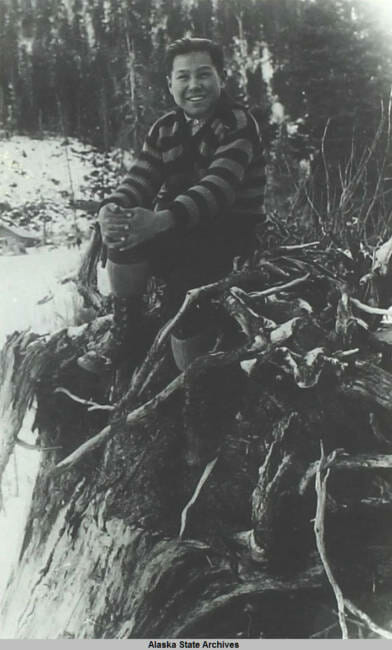
Benny Benson, designer of Alaska’s flag, in Seward circa 1927. A judge recently ordered the state to correct Benson’s birth certificate after historians found details about his age and cultural heritage. (Photo courtesy of Alaska State Archives, Juneau)

Historians announced Thursday that they’ve uncovered evidence that key details about the teenager who designed Alaska’s state flag have been wrong for more than a century.

Benny Benson, a Seward boarding school resident, won the state’s flag design contest in 1927. But he was a year older than previously thought, according to Michael iqyax̂ Livingston who works for the Aleutian Pribilof Islands Association’s community health services.

“I’ve been working for several years with several other family tree researchers focused on Benny Benson’s cultural heritage,” Livingston said. “And in the process of that research, we found what we believe were errors in his date of birth and his mother’s maiden name.”

He led a team of nearly 20 researchers and historians, who discovered that Benson was actually 14 years old when he designed the flag, not 13 as previously thought. They also uncovered illuminating details about Benson’s cultural heritage.

The team worked for more than five years examining Benson’s family tree, deciphering and translating historical records, interviewing family members and finally compiling all of that information to be submitted to the state.

“We started digging deeper and deeper, trying to figure out where his mother was born, where his grandparents were born, on his mother’s side, and where his great grandparents were born,” Livingston said. “And then we tried to corroborate as much information from as many different sources as we could.”

After reviewing the documents on Feb. 28 — 109 years after Benson was born — Anchorage Superior Court Judge Adolf Zeman ordered the State of Alaska to issue a corrected version of Benson’s birth certificate.

Benson was also thought to be Sugpiaq, or Alutiiq, likely because he moved to Kodiak Island as an adult. But Livington said new research shows that Benson’s mother was actually born and raised in Unalaska and that Benson was Unangax̂.

“Alaska Native cultural heritage is not determined by where we move to or where we pass away or where we’re buried,” he said. “It’s not even determined by where we’re born. For example, many Alaska Natives are born in Anchorage at the Alaska Native Medical Center. That doesn’t make those people Dena’ina.”

What’s important about Benson is where his ancestors were from, he said.

Benny’s mother, Tatiana, was born and raised in Unalaska,” Livingston said. “Benny’s grandparents were from Unalaska, so Benny is a member of the Qawalangin Tribe of Unalaska. His great grandparents were from Amlia Island, which is really close to Atka village. So Benny is a descendant of the Native Village of Atka.”

Benny Benson was born in Chignik — a small village on the peninsula, about halfway between Unalaska and Kodiak islands — in 1912.

His mother died when he was about two years old. His father sent him from Chignik to the Jesse Lee Home in Unalaska around 1916, after their family home was destroyed in a fire. And he moved to Seward when the Methodist boarding school was relocated there. That’s where he entered and won the contest to design the Alaska state flag in 1927.

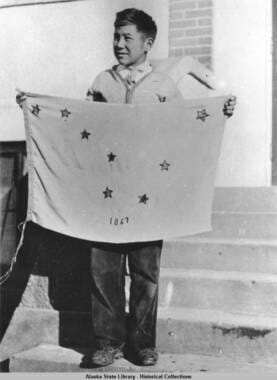
Benny Benson pictured at the Jesse Lee Home in Seward holding his design of the Alaska State flag, which features the North Star and the Big Dipper. (Photo courtesy of Alaska State Library, Historical Collections)

Benson received a $1,000 scholarship and a watch for his design, which features the North Star and the Big Dipper on a blue background. He eventually moved to Kodiak, where he worked as an airplane mechanic.

He died of a heart attack in 1972, at the age of 59.

Livingston said the corrections to Benson’s birth certificate and cultural heritage are important to properly honor his accomplishments.

“Benny was such an amazing role model for Alaska Natives,” he said. “And this was in the 1920s when racism was just blatant, in your face, against Alaska Natives. There were signs up that said, ‘No dogs allowed, no Natives allowed.’ And it was in that kind of environment that Benny won the Alaska flag contest.”

Some published information about Benson’s date of birth will have to be corrected, Livingston said. But he added that this is a great start for continuing research in preparation for the 100-year anniversary of the raising of the Alaska State flag, which is coming up in just five years.

Along with the official correction, Livingston and four other researchers have published an 81-page paper on Benson’s hidden Unangax̂ heritage.

Alaska House bill would start process to rename highway named after convicted war criminal

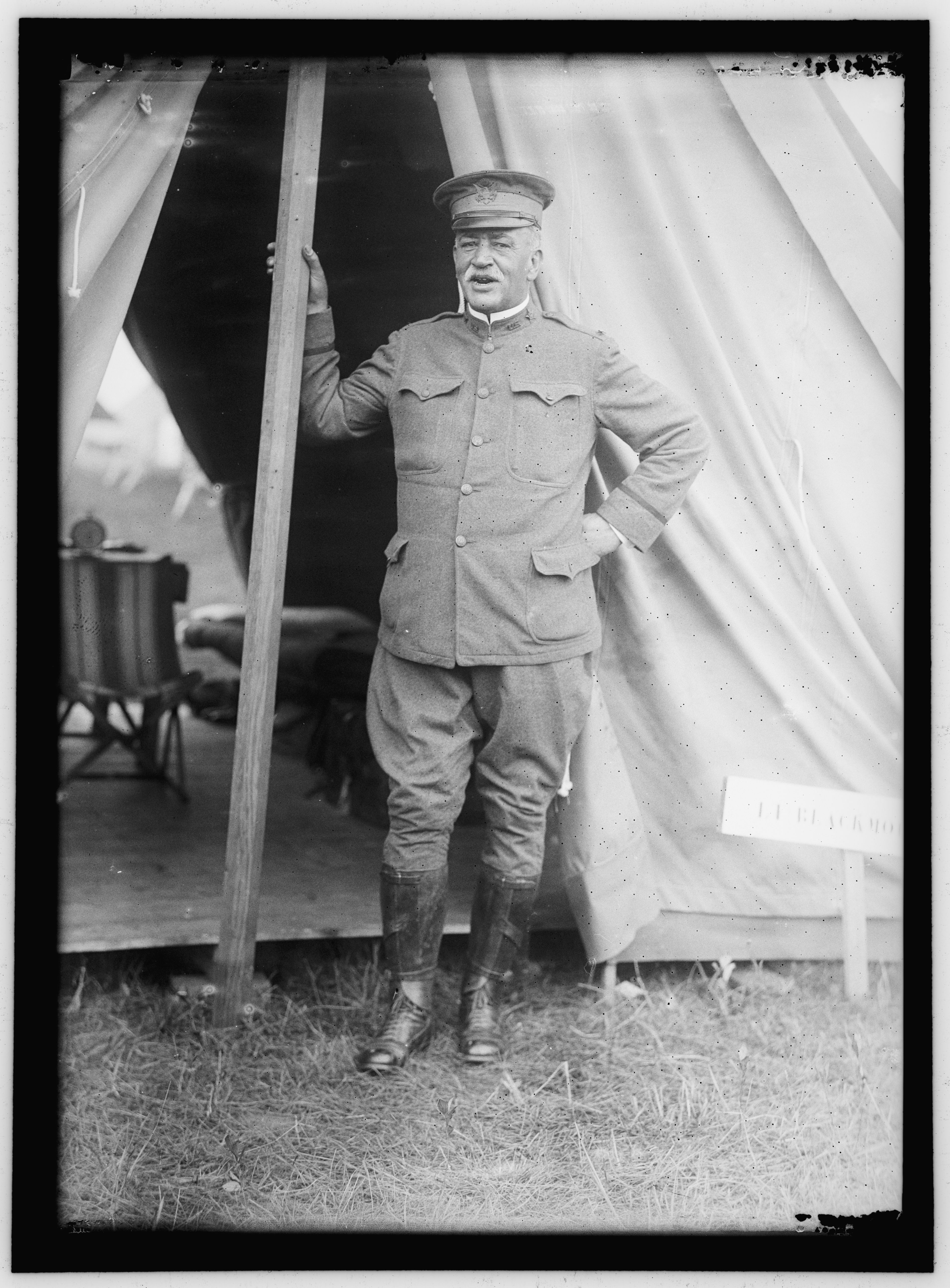
Edwin F. Glenn in 1916. (Photo from Harris & Ewing via the U.S. Library of Congress)

The Glenn Highway, which connects Anchorage to Glennallen, is named after Edwin Glenn, who oversaw U.S. Army expeditions in Alaska in 1898 and ’99. Glenn was convicted of committing war crimes in the Philippines the year after he left Alaska.

A bill working its way through the state Legislature would start the process of renaming the highway. But one House member is calling House Bill 352 a case of cancel culture.

Glenn was a career army officer. In the late 1800s he oversaw two expeditions in Alaska. Then he went to the Philippines, which at the time belonged to the United States — a trophy from the Spanish-American War. The Filipinos were fighting for their independence.

Anchorage historian David Reamer said that Glenn ordered soldiers to waterboard a Filipino man.

“When we say that he was a torturer, we say this because he admitted this,” Reamer said. “He admitted to doing these things. He admitted to ordering it. He admitted to overseeing it. He was there at times of torture. ”

Waterboarding simulates drowning and can cause lasting physical and psychological damage.

Soldiers who witnessed what happened talked about it after returning home, leading newspapers to report it. That led President Theodore Roosevelt and his secretary of war, Elihu Root, to order an investigation.

When Glenn was court-martialed, he admitted to what he did but denied it was torture. He was found guilty, paid a fine and was suspended from his command for one month.

Now Alaska lawmakers are considering a bill that would provide a process for renaming the Glenn Highway. It would require the state to consult with tribes, Alaska Native organizations and communities in the area to gather input on the new name.

Big Lake Republican Rep. Kevin McCabe opposed the bill at a March 1 House Transportation Committee meeting.

“This is cancel culture. I want that on the record,” McCabe said. “This is canceling somebody who when he did waterboard did not think it was torture. You make it sound like we’re pulling fingernails and that sort of thing. Waterboarding is accepted even today.”

That hasn’t been true, ever since former President Barack Obama prohibited government agencies from using waterboarding.

McCabe said Alaskans don’t know what Glenn did because they didn’t witness it.

“If I look at this bill, if you want to know the truth, this is a bill right here to besmirch the name of a guy that’s long dead,” he said. “Who cares? The guy is long gone. That’s all this bill does is besmirch his name.”

Joshua Albeza Branstetter is a member of AKAPIDA, the Alaskan Asian, Pacific Islander, Desi American association. He said changing the Glenn Highway’s name would recognize the role Filipino Americans have played in the state for 100 years.

“But for this highway to be named after someone who was, for lack of a better term, canceled by the U.S. military and by Teddy Roosevelt, who approved the findings in his case for his war crimes in a war that cost the lives of over 200,000 Filipinos,” he said. “That history has in turn been canceled from our school books.”

Lisa Wade is a member of the Chickaloon Native Village. The highway was informally named after the village, which it runs through, before being named for Glenn.

“This bill represents much more than a simple name change,” she said. “To me, it does not represent cancel culture. It represents an opportunity. It represents an opportunity to show respect and maybe even some reconciliation for past harms that were perpetrated against Alaska Native peoples during the time this highway was created, and even the harms to the other Filipino people as well.”

She said that area tribes generally don’t name things after people, but use the names of geographic features. She said that at the time the highway was built, her tribe suffered greatly.

“And history is not one-dimensional,” she said. “However, that history has long been told from one dimension and has resulted in the invisibility of the beautiful and unique Indigenous peoples at the glamorization of people like Edwin Glenn.”

State officials estimate renaming the highway would cost $2 million, to change the road signs and other things. But since the bill itself wouldn’t rename the road but just set up a process to do it, it wouldn’t cost the state anything if the Legislature passed it. That means the bill doesn’t have any cost listed on what’s known as a fiscal note.

For Anchorage Republican Rep. Tom McKay, that part doesn’t make sense.

“It said there’s a zero fiscal note, but we did rename it, there would be a fiscal note, because we’d have to pay for all the road signs to be changed, the maps would have to be changed.”

Anchorage Democratic Rep. Zack Fields introduced the bill.

“These tribal members have been in this corridor certainly a lot longer than I have and maybe we should seek their guidance about whether the Chickaloon Highway or the Katie John Highway or some other name might be the most appropriate,” Fields said.

The transportation committee hasn’t scheduled a vote on the bill yet.

Site notifications
Update notification options
Subscribe to notifications