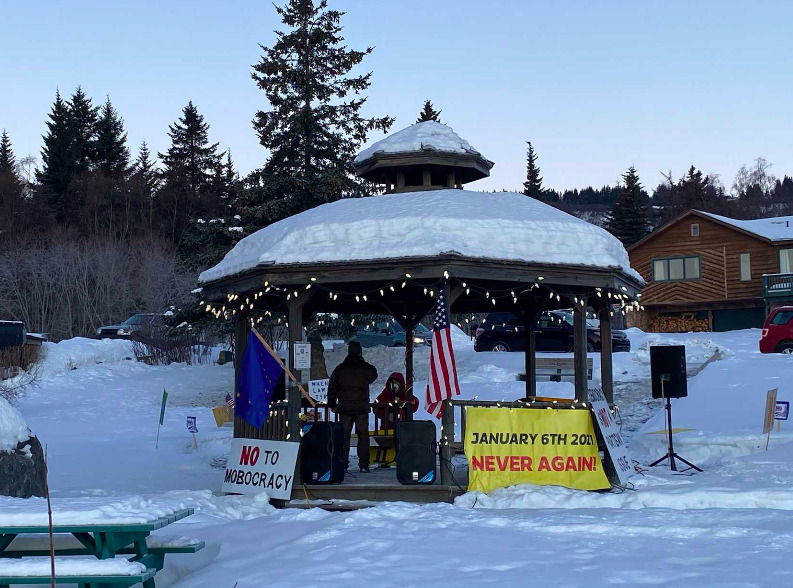
Professor Jeffrey Meyers spoke at a vigil in Homer Thursday morning on the one-year anniversary of the Jan. 6 riot at the U.S. Capitol. (Photo courtesy of Jeffrey Meyers)
One year ago, a mob of pro-Trump insurrectionists violently stormed the U.S. Capitol while lawmakers gathered to certify Joe Biden’s Electoral College victory.
On the other side of the country, Jeffrey Meyers was gearing up for the first day of the semester at Kenai Peninsula College. Meyers is an assistant professor of history and political science at KPC’s Homer campus.
When we talked to him on Jan. 6, 2021, Meyers said he was just starting to think about how to make sense of that day and contextualize it in his American history courses. Thursday, on the anniversary of the riot, he said it’s something he has thought a lot about in the year since.
Jeffrey Meyers: I watched quite a bit this morning, and I’ve been watching for the last year and reading and listening to people who were there — senators, congressmen, congresswomen. Why it happened, and we’re going to know more and more as things go on.
But mostly it just kind of it makes me sad. But hopefully we can move forward, find out what happened, hold people responsible for what happened and then move forward and get back on track.
Sabine Poux: When we spoke last year, we were talking about how an educator goes about teaching current events like what happened last Jan. 6 as they’re happening when the political climate is so volatile.
It’s been a year. How have you incorporated Jan. 6 into your curriculum?
Jeffrey Meyers: It was good timing for me in the sense that KPC taught a Civil War class starting in January. So students from around Alaska were able to take an American Civil War class through me.
And one of the first things that we did in class is we showed a picture of the gentleman who was running through the Capitol on Jan. 6 holding the Confederate flag.
And I’m sure a lot of people are familiar with that photo. And so we basically started the American Civil War class asking students from Alaska, you know, “What does this photo mean to you?” Or, “What do you see here?”
And there was about 15 or 16 students, and we were all on Zoom because of COVID. And I got everything from, “He’s breaking the law,” and that the Confederate flag is a sign of states that seceded from the Union illegally to “Well, actually, that’s just a symbol of states’ rights and it’s cultural, and there’s nothing too wrong with the flag itself.”
It was interesting that through these 15 or 16 students, you could see that even when you’re looking at the same photo at the same time discussing it, images and ideas and events mean different things to different people. So it has been fairly difficult in this time period to teach things like Jan. 6.
Sabine Poux: Where do you go from there as a professor? Like as an educator, how do you carry on that conversation?
Jeffrey Meyers: Well, that day it went on — “OK, that’s great. Now, let’s learn about what the flag is.”
And then so for the next four months, we discussed the reasons for the Civil War, what it meant to the country, why it occurred, could it have been stopped — things like that.
And so we went through some of the reasons why a human, a person, an American would be flying the Confederate flag through the Capitol. And so from that day forward, we tried to explain that photo a little better with historical outlooks.
Sabine Poux: You went to a Jan. 6 remembrance today. Can you talk about that?
Jeffrey Meyers: Sure. It was put on by the Homer Unitarian Universalists and it was a vigil. And it was a discussion of and a remembrance of what happened to year ago. And just kind of how we got here and what we can do to help heal and kind of move our democracy forward so that we don’t lose it.
And so my role in this was they asked me to give a speech. And I gave a short six, seven-minute — because it was like eight degrees outside — discussion on the historical comparisons between the time that Abraham Lincoln was first elected to his inauguration, which was from November to March, and kind of the similarities between when Joe Biden was elected to his inauguration.
And I kind of went through some of the similarities, in the sense that we have been through this before and we got out of it. And one of the things that Abraham Lincoln said at his inauguration was essentially that we’re friends, we’re not enemies. You know, we must not be enemies. And even though passions have strained us we have to come together.
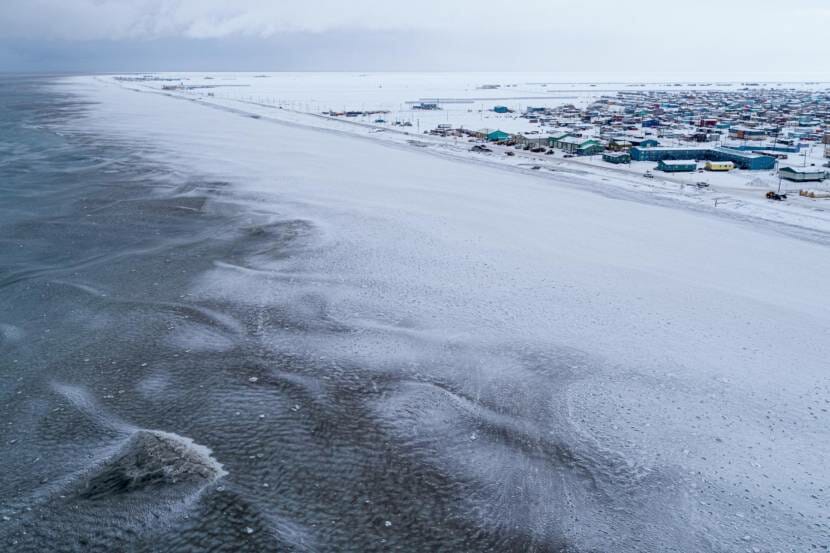
Waves churn newly-forming ice next to the shoreline in Utqiagvik on Nov. 1, 2021. (Loren Holmes/ADN)
The portfolio of Alaska’s largest corporation includes two oil refineries, a construction business and one of the North Slope’s few hotels.
At Arctic Slope Regional Corp.’s headquarters in Alaska’s northernmost community, Utqiaġvik, the richly decorated boardroom features a skin boat used for whaling that rests on the floor, encircled by the conference table.
Since its inception, ASRC has paid out more than $1 billion in dividends, with recent per-shareholder payments as high as $7,000 a year. Only people with Alaska Native heritage can own shares, with a few exceptions. And the shares cannot be sold, only issued directly by the corporation or passed from existing shareholders to their loved ones.
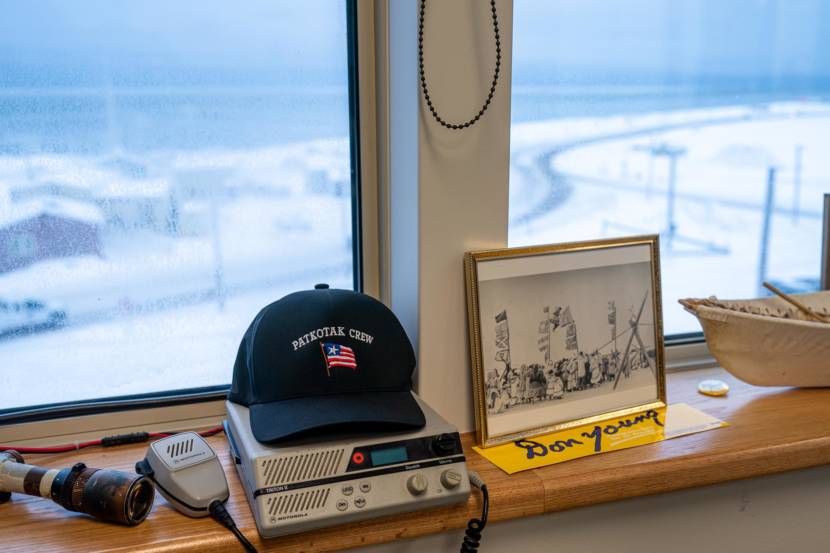
In Arctic Slope Regional Corporation chairman Crawford Patkotak’s office, whaling memorabilia sit alongside a bumper sticker for U.S. Congressman Don Young in a windowsill overlooking Utqiagvik on Nov. 2, 2021. (Loren Holmes/ADN)
This unique ownership structure was created by the U.S. Congress in a landmark land claims deal with Alaska Native leaders that turns 50 years old this month.
But while the deal helped create monetary wealth for ASRC’s 13,000 shareholders and those of dozens of other Alaska Native-owned corporations, it also came at a huge cost.
For all of ASRC’s assets, its shareholders still cannot claim title to their ancestral Iñupiat lands 25 miles from the corporation’s Utqiaġvik headquarters — or to any oil that might lie beneath them. That property now belongs to the U.S. government, which established the area as a naval oil reserve in the 1920s before later designating it the National Petroleum Reserve in Alaska.
To the east, Prudhoe Bay, one of North America’s largest oil fields, belongs to the state of Alaska, which receives royalty and tax revenue from the $35 million in crude piped off the North Slope every day. And nearly all of the Arctic National Wildlife Refuge is in federal hands, frustrating ASRC’s efforts to open it to oil development and provoking routine clashes over access and management with the Iñupiat residents of Kaktovik, the only village that lies within the refuge’s boundaries.
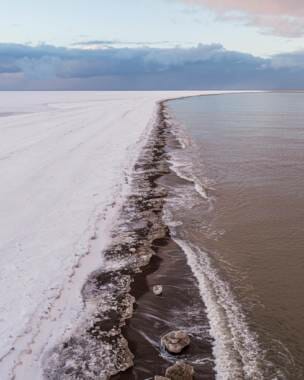
The Arctic Ocean meets the shore just east of Nuvuk, the northernmost point in the USA, on Nov. 1, 2021. Nuvuk is 9 miles northeast of Utqiaġvik, Alaska. Archaeological evidence indicates that the site was occupied about 1,500 years before the arrival of the first Europeans. (Loren Holmes/ADN)
That tension between monetary wealth and lost land is at the heart of the Alaska Native Claims Settlement Act, which President Richard Nixon signed into law in December 1971.
The legislation was, in effect, an experiment by a mostly white Congress pulled between two conflicting approaches to Indigenous people: self-determination, and assimilation and termination — the concept of ending the government’s obligations to Natives.
By creating more than 200 Native-owned corporations like ASRC and seeding them with 44 million acres of land and $1 billion, the legislation was one of the most progressive land deals ever struck between the U.S. government and Indigenous people.
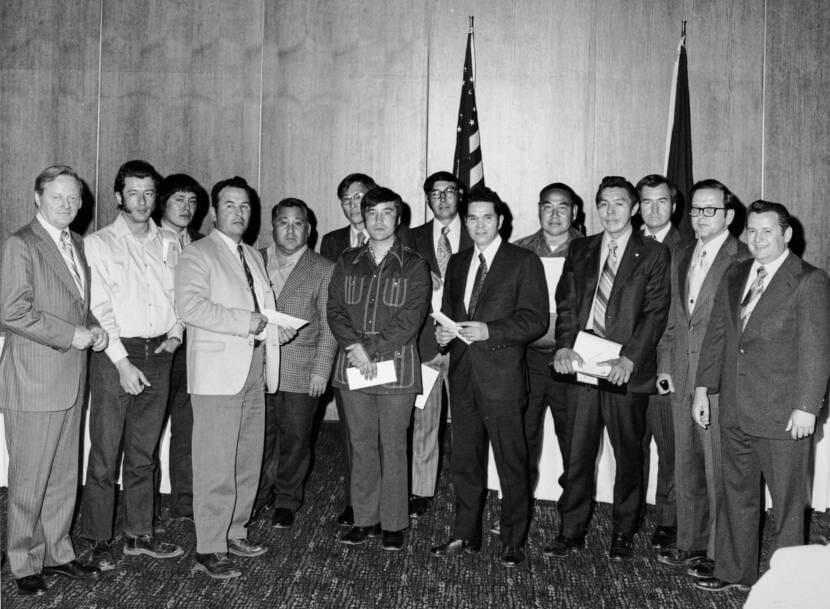
As a result of the passage of the Alaska Native Claims Settlement Act, monetary awards were made to Native regional corporations created by the Act on July 1, 1972 at the Anchorage Westward Hotel. Pictured L-R: Alaska Lt. Gov. Red Boucher, Mike Swetzof (Aleut League), Jack Wick (Koniag, Kodiak), Martin Olson (Bering Straits), George Miller (Cook Inlet Region), Joe Upicksoun (Arctic Slope), John Sackett (Doyon, Tanana Chiefs), Robert Marshall (Ahtna), Cecil Barnes (Chugach), Robert Newlin (NANA), Bob Willard (Sealaska), Morris Thompson (BIA area director), Sen. Ted Stevens and Don Wright (AFN president). (Dept. of Interior/Ted Stevens Foundation photo)
But by establishing for-profit corporations, Congress also pulled Alaska Natives into a Western, capitalist system and cut off access to lands that, for generations, sustained them through subsistence harvests of fish and game. The vast majority of Alaska lands — some 90% — were taken away from the state’s Native people.
“This capitalist system was imposed on us in a colonistic way: ‘Either you’re going to do it this way or you’re not going to do it at all. And you’re going to conform to this or you’re not going to do it at all,’” said Qaiyaan Harcharek, an avid subsistence harvester in Utqiaġvik. “It got us where we are today. But it’s a drop in the bucket for the Indigenous people of Alaska.”
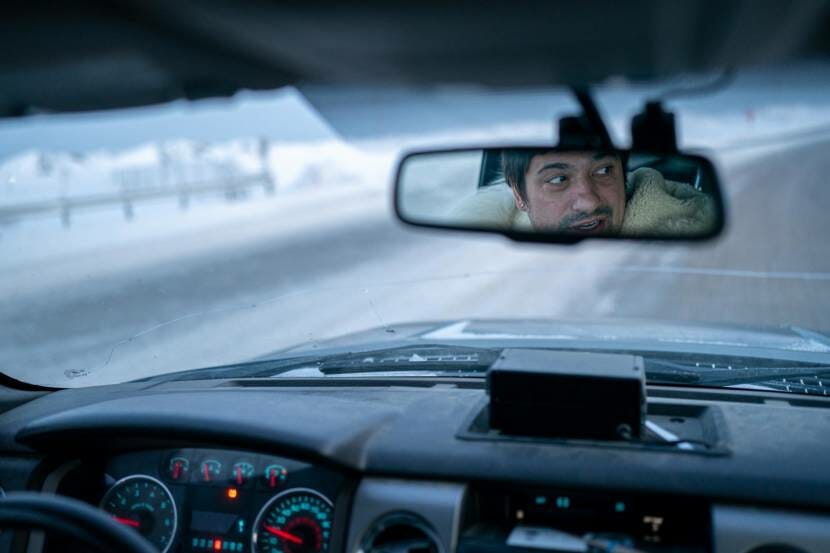
Qaiyaan Harcharek gives a driving tour of Utqiagvik on Nov. 2, 2021. “ANCSA got us what we have today,” he said. “It’s a drop in the bucket.” (Loren Holmes/ADN)
Hindsight
Today, with 50 years of hindsight, discussions about the settlement with Alaska Natives inside and outside the corporate world provoke complicated emotions — a reflection of the legislation’s wide-ranging impacts on Native and non-Native people in Alaska.
The North Slope, with its rich oil and gas resources, is a useful test case to examine the legislation’s huge cultural and economic stakes.
Utqiaġvik, the 5,000-person North Slope hub town, is almost unrecognizable from what it was in the 1960s, when a previous generation of Iñupiaq leaders first organized to stake their claim to their ancestral lands.
Elders still remember emptying honey buckets full of sewage and melting ice on Coleman stoves to wash up each morning.
In the years following ANCSA’s passage, oil money began pouring into the community and its surrounding villages, allowing them to invest in infrastructure envied by other regions of rural Alaska.
Now, a 3-mile underground “utilidor” moves water, wastewater and utility lines around town, and gas fields not far away supply heating fuel to local homes.
Fresh pineapples are $13.49 each at the Stuaqpak grocery store on Oct. 31, 2021 in Utqiagvik. (Loren Holmes/ADN)
Grocery stores sell hot food and fresh fruit and vegetables. And students, who once flew hundreds of miles even to reach middle school, can now attend Barrow High School and take classes from a tribal college, Ilisagvik. Iñupiaq is now taught at school — a stark change from a few decades ago, when government-run schools punished North Slope residents for speaking it.
“I got my hands whipped,” said Harry Brower, 63, the borough mayor.
The region’s modernization grew out of ANCSA’s passage in 1971 and the establishment of the North Slope Borough the following year. But the Iñupiat had to fight for both.
Statehood
The push toward a settlement lasted years, and it began as the state government started selecting pieces of its land entitlement granted by Congress under the 1958 Statehood Act. The state got to select 100 million acres, about one-fourth of the land in Alaska.
Some of the areas it chose caused conflicts with Native communities, whose members were encountering newly built cabins on their ancestral lands and greater competition from non-Native residents for fish and game.
Unlike in the Lower 48, Alaska tribes hadn’t been conquered in wars and they hadn’t signed treaties ceding their lands. So Alaska Native groups began filing land claims.
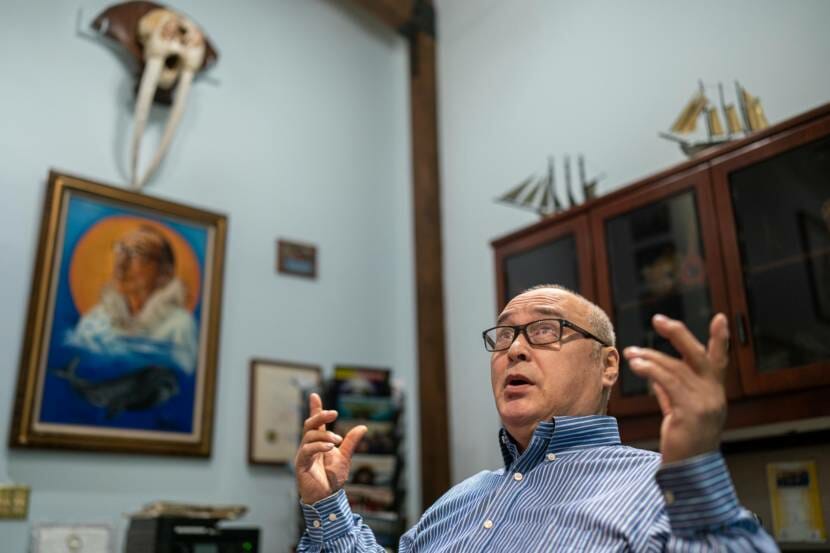
North Slope Borough mayor Harry Brower sits in his office on Nov. 3, 2021. Behind him is a painting of the first North Slope Borough mayor, Eben Hopson, Sr., as well as a walrus skull and Yankee whaling ships fashioned out of baleen. (Loren Holmes/ADN)
While the Native leaders largely enjoyed support from the state’s representatives in Congress during the land claims era, including Rep. Nick Begich and Sens. Ted Stevens and Mike Gravel, they also faced disinterest, opposition and blatant racism.
Oliver Leavitt, an ASRC board member and Iñupiaq elder who spent time working with Congress in the 1970s, described attitudes there in blunt terms: “To them, you were a f–king savage.”
“They just didn’t give a damn about you,” Leavitt, 78, said in an interview in ASRC’s Utqiaġvik offices. “They’d tell you to get the f–k out of their office.”
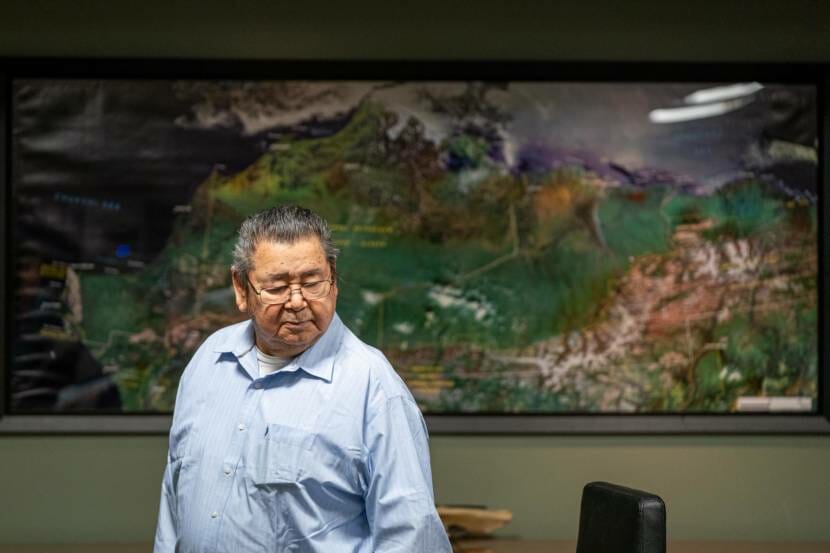
Arctic Slope Regional Corporation board member Oliver Leavitt stands in front of a map of the North Slope in the ASRC board room on Nov. 2, 2021 in Utqiagvik. Leavitt spent time working on Native claims issues with Congress in the 1970s. (Loren Holmes/ADN)
Oil
An event on the North Slope dramatically changed those political dynamics: The 1968 discovery of the Prudhoe Bay oil field.
The field contained billions of barrels of oil. But the Native land claims stalled construction of the trans-Alaska pipeline, which got congressional leaders’ attention.
“People really could care less about the Alaska Natives,” Ron Birch, who worked as chief of staff to Stevens during the land claims era, said in a recent interview. “But senators and congressmen out of Texas and Oklahoma and Louisiana cared a lot about big oil.”
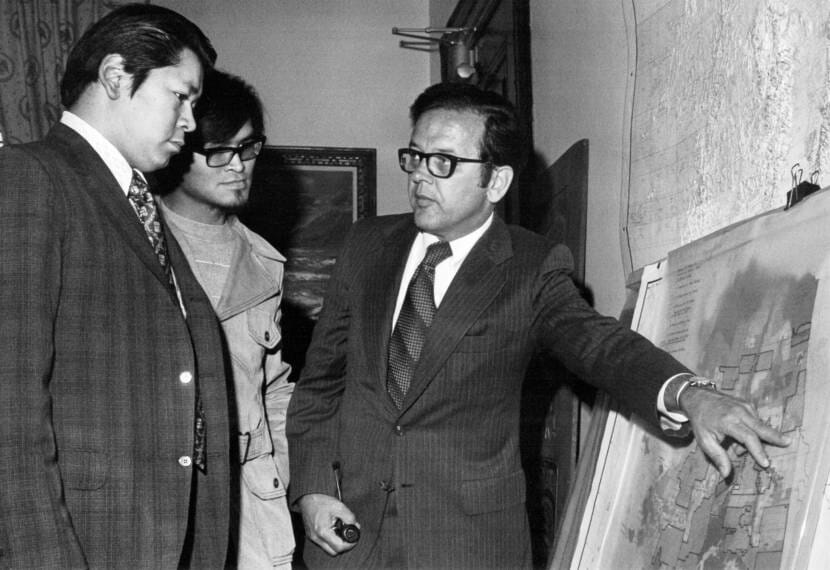
L-R, Oliver Leavitt and Mayor Jake Adams of Barrow visit Senator Ted Stevens in Washington D.C. on September 6, 1972, regarding ANCSA land selections for the Arctic Slope Region. (U.S. Senate/Ted Stevens Foundation photo)
Other dynamics converged to help overcome institutional opposition to the settlement.
One was a homegrown movement of Alaska Native leaders — activists and regional Native organizations from around the state who coalesced into the Alaska Federation of Natives.
The group, led by figures like Emil Notti, Don Wright, John Borbridge and Willie Hensley, included representatives from the North Slope to Western and Southeast Alaska. And it fought, said co-founder Hensley, with “two hands tied behind our back.”
At one point, AFN had $9 in the bank, and one man mortgaged his house to fund his participation in the movement, Hensley and other early AFN leaders recalled during October retrospectives hosted by the Alaska Historical Society. AFN ultimately secured loans from a tiny Alaska Native village that had made money from an oil and gas lease sale, and from a Washington tribal government.
“We didn’t have any lawyers, initially,” said Hensley, who wrote a key research paper on Natives’ legal standing for a 1966 university graduate course. “We didn’t have any money. We didn’t have any time.”
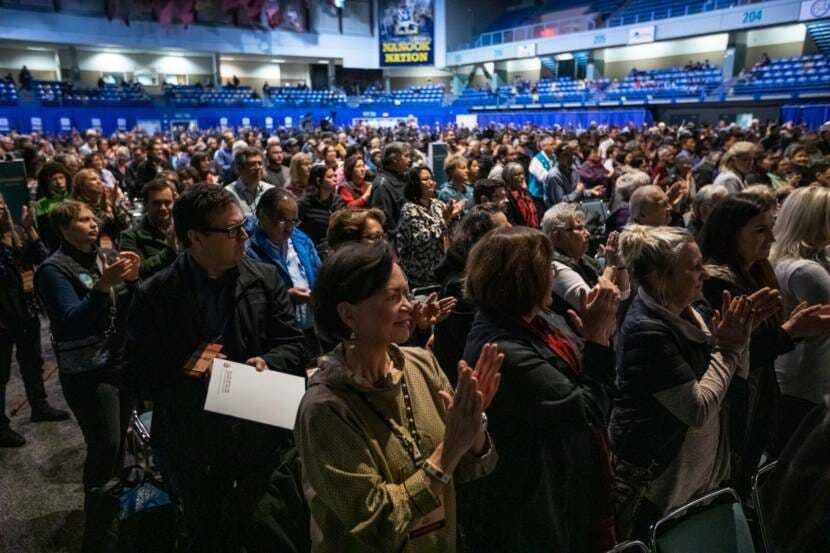
Alaska Federation of Natives delegates applaud during a presentation of the Shirley Demientieff award Thursday, Oct. 17, 2019 during the AFN convention at the Carlson Center in Fairbanks. (Loren Holmes/ADN)
Some in Alaska’s business and political establishments opposed transferring land to Native people, and AFN’s leaders said they faced death threats and hostile newspaper editorials. But Stevens, Gravel and Begich all helped push the legislation across the finish line in Washington, D.C.
Stevens, the Republican senator, was convinced that any Alaska lands that could be shifted out of federal ownership would end up benefiting the state, said Birch, his chief of staff at the time.
“Ted would explain tirelessly, ‘No, I’m taking the land away from the federal government and giving it to Alaskans,’” he said.
Gravel, Alaska’s other U.S. senator, was a Democrat who owed his election to the Alaska Native community, and he supported the legislation. Nixon’s White House and some of his top aides were also key allies and early supporters of a 40-million acre settlement, which gave political cover to Republican lawmakers who had previously opposed a deal with that much land.
“‘Tricky Dick,’ they called him. But as far as I’m concerned, he’s a hero,” Hensley said. “He’s the fellow who created self-determination.”
Natural gas flares at a processing facility just outside Utqiagvik on Nov. 2, 2021. The gas heats homes and is burned to provide electricity for the community. (Loren Holmes/ADN)
Settlement
The drawn-out political process that led to the settlement tested the bonds between the Native groups that came together to form AFN, and they forced the North Slope’s leaders, along with others, to make concessions.
A particularly difficult set of questions arose around how to divide up the money and land that Congress would set aside on a statewide basis. In the end, the lands were split up based on the North Slope’s preferred formula, which tied each region’s share to the size of their original land claim.
But other parts of the settlement were divided on a per capita basis, which the thinly settled North Slope vehemently opposed, saying the method benefited more populous Alaska Native groups at their expense. Another provision opposed by the North Slope that was included in the legislation required corporations to share 70% of their resource revenue — including from oil.
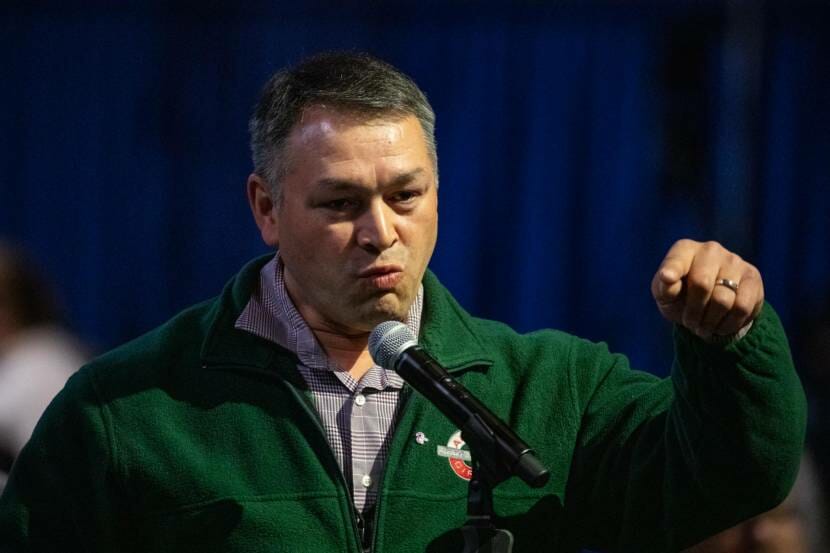
Arctic Slope Regional Corporation chairman Crawford Patkotak speaks in support of an amendment preserving access to natural resources during discussion of a resolution reinstating a climate action leadership task force and declaring a state of emergency on climate change, on Saturday, Oct. 19, 2019 during the Alaska Federation of Natives convention at the Carlson Center in Fairbanks. In December 2019, the ASRC board voted unanimously to leave AFN in order to focus on local concerns on the North Slope. (Loren Holmes/ADN)
North Slope leaders were some of the most strident in their arguments for the settlement, even withdrawing from AFN at one point, and their contemporaries said their positions helped move the negotiations’ center of gravity.
Among those early leaders was Charles “Etok” Edwardsen, who protested outside a 1969 Prudhoe Bay lease sale held by the state with signs that read: “2,000,000,000 Native land robbery” and “Eskimos own North Slope.”
Protestors handed out leaflets that said the lease sale was “perpetrating of economic genocide on a native minority,” and Edwardsen told reporters it represented “the rape of Alaska Natives.”
After the settlement’s passage through Congress, North Slope leaders wrote to Nixon asking him to veto the legislation. And when AFN convened to consider whether to recommend to Nixon that he sign the bill, the North Slope delegation voted no.
Its leader, Joe Upicksoun, delivered a scorching indictment in a speech.
“You can obviously see that I am hurt and frightened and perhaps bitter,” he said. “This hurt and fright and bitterness have been caused by the other Natives demanding more than their just share; by the state being dishonorable in grabbing whatever she could; by the Congress’ incompetence in not really understanding the problems and not trying to; by the oil companies stepping on us as if we were not people; by Western society moving in on us and brushing us aside.”
Hensley said other Native leaders felt similarly to Upicksoun, even as they voted to recommend that Nixon approve the settlement.
“You’d think there would have been celebration. But there wasn’t — we knew what we were giving up,” he said at the historical society’s recent retrospective. “The remarkable story is that people just didn’t sit back and cry about it all. They said, ‘What the heck, let’s get this thing together and let’s see what we can do with it.’”
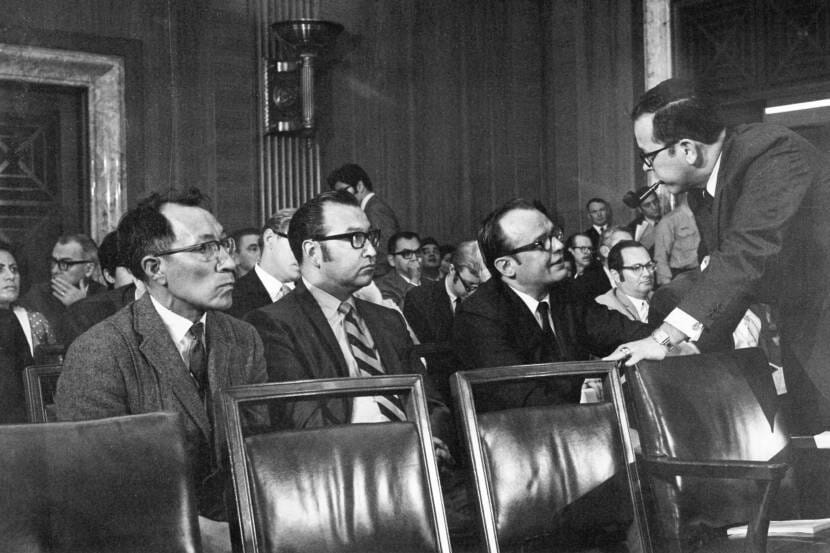
L to R: Eben Hopson of Barrow and Flore Lekanof of the Pribilof Islands listen as attorney Lester Miller, representing the Aleut League, and Sen. Ted Stevens confer during an ANCSA hearing in the Committee on Interior and Insular Affairs in Washington, D.C. on August 7, 1969. (U.S. Senate / Ted Stevens Foundation photo)
No ‘trail of tears’
The ink on the settlement wasn’t even dry before the Iñupiat began work to improve on the deal Congress made with them.
Eight months before Nixon signed ANCSA, the region’s leaders had submitted their petition to form the North Slope Borough, which at 89,000 square miles is roughly the size of Minnesota. After voters in the region approved it, the new government entity began levying taxes on infrastructure built by oil companies.
The borough now raises $400 million a year in property taxes — levying more than $100 million on ConocoPhillips alone.
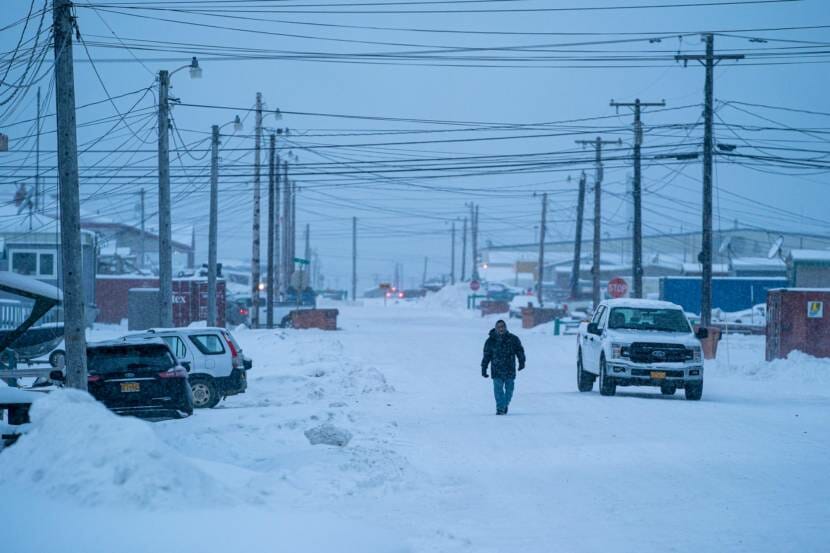
A person walks down a street in the Browerville neighborhood of Utqiagvik on Nov. 1, 2021. (Loren Holmes/ADN)
The money is invested in water and sewer lines, communications infrastructure and schools. It also pays for police and fire departments, a wildlife department that does bowhead whale research, and a search and rescue department with four aircraft, including a massive Sikorsky helicopter.
Major oil companies sued to block the borough’s formation, but they were unsuccessful.
“There’s always, for the longest time, been those sentiments of the old guard: Don’t give any land to the borough. Don’t give any lands to the Natives. Fighting tooth and nail because oil is at stake up here,” said Gordon Brower, the borough’s current planning director.
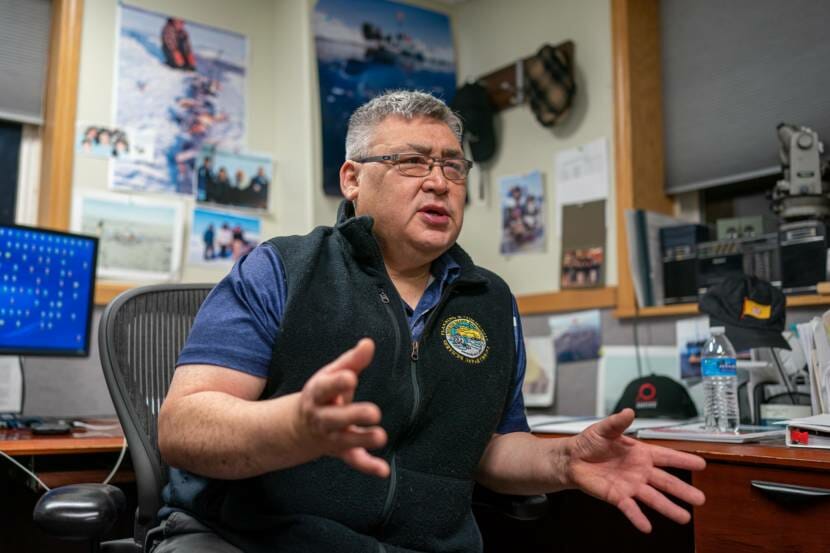
Gordon Brower, director of the North Slope Borough Planning & Community Services Department, talks with a reporter in his office on Nov. 2, 2021 in Utqiagvik. (Loren Holmes/ADN)
ASRC, meanwhile, got to work creating an array of subsidiaries, including a construction company and fuel distribution and tourism businesses.
It also began signing leases with oil companies for the land ANCSA granted it — and for a tract inside the Arctic National Wildlife Refuge that it obtained through a federal land exchange orchestrated during the Reagan administration. So far, ASRC’s leasing revenue from that area, which doesn’t have to be shared with other Native corporations, is likely at least $50 million, according to public documents.
ASRC has now been listed as Alaska’s top revenue-generating business for the past 27 years. It says it has 13,500 employees across the country and ranks among the top regional corporations in its yearly cash dividends, though the impact of the COVID-19 pandemic did force reductions.
Original ASRC shareholders received $7,000 in 2018 and 2019, and the company employed some 500 shareholders during that time. At least one regional Native corporation has paid out less in dividends over its entire, five-decade existence than ASRC has paid in a single year.
North Slope leaders say they’re keenly aware of their relative fortune, particularly when they compare themselves to Native people outside Alaska.
“Ain’t no trail of tears in Alaska,” said Josiah Patkotak, who represents the North Slope in the state House. “We got the best deal that a Native people has got. Ever.”
Patkotak’s father, Crawford, is board chair and executive vice president of stakeholder engagement at ASRC, which paid him $2 million last year. In an interview at the corporation’s Utqiaġvik office, Crawford used a poker analogy to describe how the Inupiat have fared since the settlement: starting with two deuces — a very tough hand.
“Look at the challenges we had to face. Look at what mountains we had to climb. Look at the valleys we’ve had to endure. And we’re still here,” he said. “We ain’t going anywhere.”
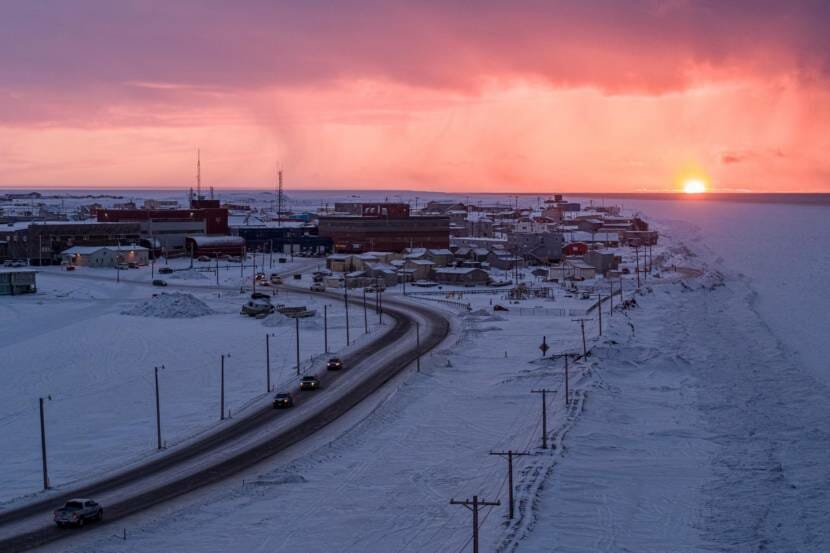
The sun sets behind Utqiagvik on Nov. 1, 2021. (Loren Holmes/ADN)
This story is part of a reporting collaboration between Alaska Public Media, Indian Country Today and the Anchorage Daily News on the 50th anniversary of the Alaska Native Claims Settlement Act. Funding for the ANCSA project was provided by the Alaska Center for Excellence in Journalism. Read more from the ANCSA project.
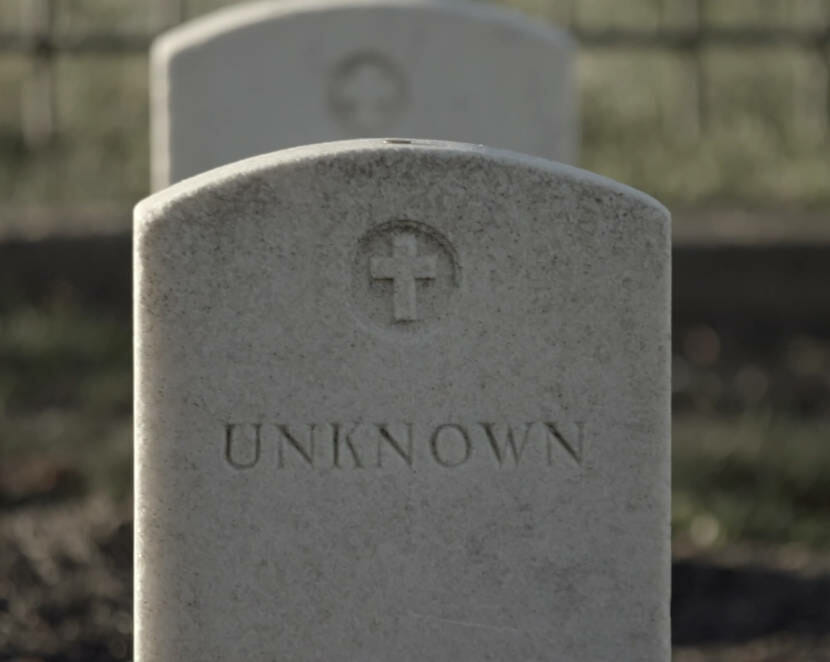
A gravestone at the Carlisle Indian School marking the grave of an unidentified Native child. (Production still from Al Jazeera’s “Fault Lines”)
The atrocities that occurred at Native American boarding schools in the United States will finally be investigated, at least in an official way, after U.S. Interior Department Secretary Deb Haaland announced the Federal Indian Boarding School Initiative earlier this year.
It’s a reckoning that Canada has faced more recently, including the discovery of hundreds of Indigenous children’s unmarked graves at residential schools.
A new half-hour documentary, “Buried Truths” on the Al Jazeera program “Fault Lines,” delves into that painful history in the U.S.
Kavitha Chekuru is senior producer of Fault Lines, which features the stories of two Alaska Native people, one who survived their time at a boarding school and one who didn’t.
Listen here:
The following transcript has been lightly edited for clarity.
Kavitha Chekuru: So in the documentary itself, we featured one survivor in particular, Jim LaBelle, who lives in Anchorage. But as part of the kind of research process of it, we did speak to other survivors. And even though they went to different schools and different years, there was a commonality, which was they were not allowed to speak their language, and they were subjected to pretty horrific abuse. But one of the things I think is important to remember is that, when people are learning about this boarding school policy, is that even though it started in the 19th Century, it continued for over a century. So it wasn’t that long ago, and there’s still survivors out there who were taken from their families.
Casey Grove: Like you said, Jim LaBelle was one of those that you spoke to, and he said a lot of things in that documentary that really drive home what was going on at these boarding schools. But there was one part of that documentary that really kind of just hit me: the way that he described the first night there at the boarding school. I thought I would play just that clip here quick.
Jim LaBelle [clip from documentary]: We got settled in for the night. That’s when some of them started to cry. It started off with little whimpers, little sniffles, but it caught on. All it took was for one little child to start crying, and then another one and another and another, to a point where the entire dorm room of little kids are just wailing into the night. And we all cried ourselves to sleep. Waking up the next day, our eyes were swollen shut, and the process was repeated over and over and over, until the middle of the school year, I don’t think any child cried anymore. Because no one’s gonna come and get me or hold me, tell them that they’re loved.
Kavitha Chekuru: Jim in particular, I think, he’s really amazing, because he’s willing to talk about, you know, what he went through. But talking about trauma is not something that is easy to do. And so we’re, in that sense, we’re really honored that he felt comfortable talking to us about that.
Casey Grove: Yeah, definitely. And, I wondered about why it was so common, I guess, and it seems to represent something, that there were graveyards around a lot of these schools? What ended up being unmarked or unnamed graves, right?
Kavitha Chekuru: So right now, following the discovery of the unmarked graves in Canada, earlier this year, the U.S. government announced that it would undertake their own investigation, looking into burial sites and how many children died. One of the only other times the government has done anything looking at the boarding schools was in the 1920s. And they released a report, and this government report didn’t mince words at all. They called the schools “grossly inadequate.” They said the children were malnourished, not properly fed, even at the best schools, the children’s health and diet was not good. And there was extreme overcrowding, so disease could just run free, in particular tuberculosis. They raised the issue of the fact that these children were having to do manual labor at the school. And, you know, ostensibly, that was under the guise of education, but it was actually really to keep the schools running. So yeah, the conditions were extremely harsh, and the idea that the government does not know and is only now undertaking an investigation to find out how many children died at these schools is really just, I don’t really have a word for it. It’s infuriating, to be honest, but it’s important that they’re doing this work now.
Casey Grove: Of the folks that have been doing research on this, some of them are relatives of people that went away to boarding schools, and one of them is Eleanor Hadden. She’s an Alaska Native woman who spent many years trying to figure out what happened to her great aunt, Mary Kininnook, who was taken to the Carlisle Indian School. What did Eleanor tell you about that journey, about her investigation and what she discovered?
Kavitha Chekuru: Yeah, so Eleanor’s great aunt went to Carlisle in 1903. And it was only in the 1960s that Eleanor’s mother learned about this aunt that she never knew. And she was the one that started this search. And so she spent decades trying to get this information. And I think one of the things that’s important to kind of take away from from this is that the information is just scattered, and that’s not uncommon. So that information about the students and what happened to them is kind of locked away, and you kind of have to work in pieces to get it, and that’s what Eleanor and her mother did. It’s just so much work that they did to try and find out what happened to this one child. And it’s something that the government is currently undertaking now as well.
Casey Grove: Yeah, you see it in this documentary where she has all these different documents that she’s had to find in all these different places out on the table. And it’s just, visually, you know, compelling how difficult it must have been to just get what today we would think of as pretty simple information about where somebody was or what happened to them. And, ultimately, what did she discover about what happened to Mary Kininnook?
Kavitha Chekuru: So she eventually discovered that Mary died in December of 1908. And when Eleanor first went to Carlisle, she went to the cemetery that’s there. And she looked for her name, and it wasn’t there. And so at Carlisle, they moved the cemetery, and in the process of that move, a lot of things seem to have gone awry, because there are over a dozen graves at Carlisle that are marked as “unknown.”
Casey Grove: Here’s Eleanor Hadden talking about that, about visiting Carlisle:
Eleanor Hadden [clip from documentary]: When I first went to Carlisle and went through all the names on the stones, I was overwhelmed with so many children. There was no Mary. Fourteen graves had markers “unknown” in the school cemetery. We figured she must be one of the unknowns. They moved the cemetery to where it is today, and the records were not good. They can’t keep track of children. That’s what I got my first anger about the people not knowing what we’ve gone through.
Casey Grove: So, Kavitha, what happens next? I mean, where do we go from here?
Kavitha Chekuru: I mean, it’s a good question. I think one of the things I took away from reporting on this was, you know, anytime friends or family would ask me what I was working on, I would tell them, and no one no one knew about this. And I think it’s just one of the reasons we call the documentary “Buried Truths” was not just, unfortunately, about the children who died at these schools, but the fact that this history itself is very buried. It’s been kind of pushed away and hidden. You know, I went to public school in Texas, and I never learned anything about federal policy toward tribes, let alone about the boarding school policy. And so I think this is infuriatingly common when it comes to U.S. history, but it’s one of the reasons that we really appreciate the interviewees talking, taking the time to film with us and open up to us about this, so that the stories are out there more and more, and hopefully with the Interior investigation, and maybe more people talking about it, unfortunately, in light of the discoveries in Canada, more people will start to recognize and learn about this dark chapter of U.S. history, but it’s a chapter nonetheless.
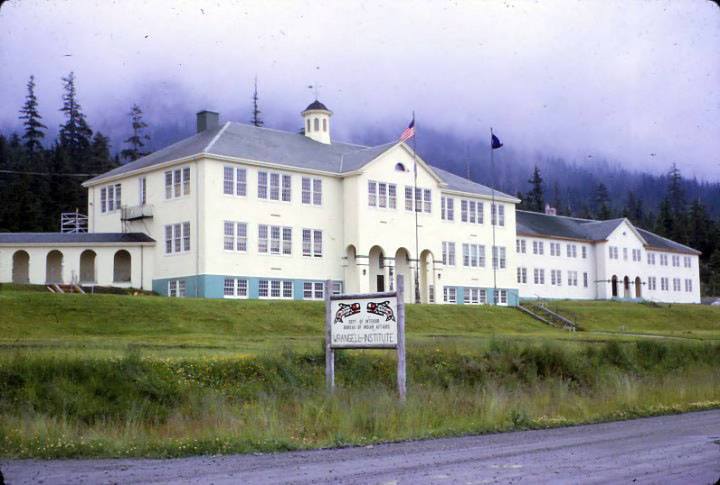
The Wrangell Institute. (National Archives/BIA Photo)
A government boarding school for Native children in Wrangell was one of the first of its kind in Alaska. Now, there are plans to redevelop the site of the former Bureau of Indian Affairs facility that was open for 43 years. But sensitivity toward the legacy of abuse and trauma and recent discoveries of graves at Canadian boarding schools have caused local officials to tread carefully before breaking ground.
But days later, news broke of a grisly discovery in Canada: the remains of more than 200 Native children were found on the grounds of a former residential school in British Columbia. In the following weeks, thousands more bodies would be discovered at the sites of former residential schools across Canada, shedding light on the country’s dark history of mistreatment of Indigenous peoples. Canada’s Truth and Reconciliation Commission has documented more than 6,000 Indigenous children’s deaths at Canadian residential schools, but estimates that 15-25,000 Indigenous children may have died at the schools.
Wrangell economic development director Carol Rushmore says the discovery in Canada brought the redevelopment process of the Institute property to a halt. That’s partly because the U.S. Army Corps of Engineers is taking a fresh look at former residential school sites in the United States: the former Wrangell Institute property among them.
“The permit was not issued because of the concerns of cultural resources, perhaps burials on the site,” Rushmore told KSTK in an interview.
“They’re looking through the old archives, and many of the records are in boxes, they’re not digitized, they’re having to go through them by hand,” Rushmore said. “There are issues with privacy act requirements in looking at some of these records, and they’re trying to do consultations with the different tribes, including the WCA, to identify their concerns and information concerning this record search.”
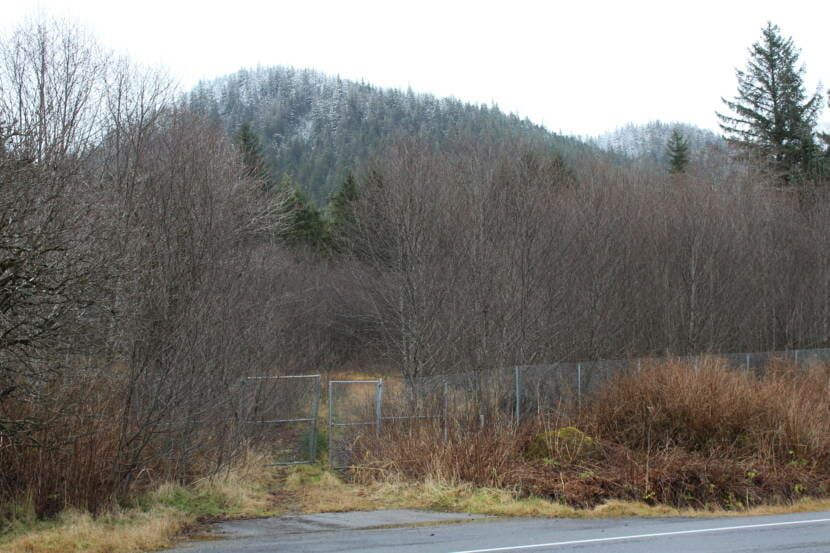
Present day, the former Institute property sits overgrown. (Photo by Sage Smiley/KSTK)
While the federal investigation is more records-based, the Army Corps of Engineers and State Office of Historic Preservation are looking to do an on-the-ground search in Wrangell.
“They both will have their own sort of requirements as to what the borough needs to do to make sure that there are no cultural resources on-site,” Rushmore said.
Cooperation with Wrangell’s tribal government is an integral part of the task.
“We’re just happy to be able to work with the city on something of such critical importance and a sad part of the history of our people,” said the tribal administrator for the Wrangell Cooperative Association Esther Reese, whose Lingít name is Ax̱seen. “So it’s very appropriate that the city is working with the tribe on it.”
Reese says the City and Borough of Wrangell has kept the tribe apprised of developments at the property. Earlier this year, the city was looking at possibly using ground-penetrating radar to survey the site.
“Because the ground is somewhat uneven, they were looking at bringing in dogs that would help with a search, because it sounded like the radar technology would be more difficult because of the topography,” Reese said.
In September, Rushmore reported to the borough assembly that the city was drafting a letter to tribal entities and Native corporations around the state, informing them of Wrangell’s development plans and asking for their input.
With that feedback, Reese says Wrangell’s tribe is starting work on the design for a memorial for Native children from all over the state who attended the Wrangell Institute.
“What the tribe is looking at is consultation with affected tribes and then the construction of a memorial gazebo honoring all the tribes that attended the Institute, then doing a healing ceremony,” Reese said.
Rushmore says at this point, the borough is still trying to contact tribes and figure out how to proceed with a ground search of the property, but nothing is set in stone yet.
Located at a Lingít site known as Keishangita.’aan, or Alder Top Village, the boarding school opened in 1932. It was not affiliated with a particular religious denomination, although federal records show Wrangell’s Catholic priest in the late 1930s took an interest in the school and incorporated it into his parish.
Reese says the site’s name, Keishangita.’aan, was rediscovered by a tribal citizen in University of Alaska Southeast professor Thomas Thornton’s book “Our Grandparents’ Names on the Land.”
“We let the city know that because we can’t rename something that already had been named by our ancestors,” Reese says, “So that was the name that the tribe brought forward to the city.”
The Wrangell Institute was one of about 20 residential schools for Alaska Natives that operated through the 20th century. Its enrollment peaked in the mid-1960s with just over 260 students from five to 15 years old.
So there’s a lot of work — and healing — to do before the property could be redeveloped. In part, that means federal and state surveys. Reese, the tribal administrator, says the borough should be putting out a proposal request for ground surveys soon, possibly with the help of federal funding.
The borough and tribe say they will also continue to collect feedback from tribes and Native organizations around the state whose children were sent to the Wrangell Institute, with the hopes of collecting comments and stories for a memorial that will speak to its history before the ground is repurposed for the future.
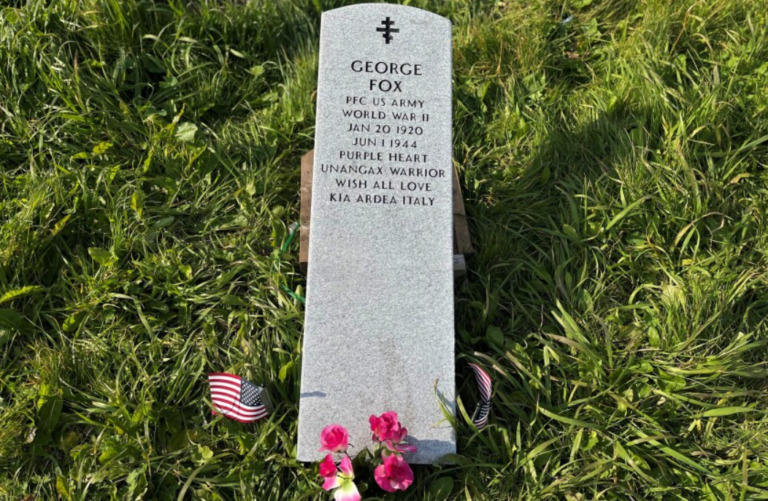
The grave marker for Army Pvt. George Fox, who was killed in action in World War II and has been buried in an unmarked grave for almost 80 years. (Photo by Maggie Nelson/KUCB)
Army Pvt. George Fox is the only known Unangax̂ soldier killed in action in World War II and any war since. He’s also been buried in an unmarked grave in Unalaska for over 70 years. Now, nearly a decade of work will culminate in a Memorial Day 2022 ceremony to recognize and honor him.
Michael Livingston is the cultural heritage specialist for the Aleutian Pribilof Islands Association and one of the people who has made Fox’s long-awaited commemoration happen.
“The procession will start in the parking lot of the Russian Orthodox Church and proceed down Bayview Drive to Memorial Park, where there will be some speeches,” Livingston said. “The gravestone will be placed at Pvt. George Fox’s gravesite next to his mother, Emma Fox.”
Fox was born in 1920 on Unga Island, the largest of the Shumagin islands, about 250 miles northeast of Unalaska. Census data shows that he and his mother moved to Unalaska by 1929, and he joined the military when he was about 21 years old, according to Livingston.
Fox was killed fighting in Ardea, Italy, in 1944. About five years later, his body was returned to Unalaska. After a small procession, he was buried next to his mother in an unmarked grave, Livingston said.
It took a lot of work to confirm that Fox was buried in Unalaska, Livingston said. That was just the start of the battle in getting Fox a proper gravestone.
“Request after request was ignored,” he said. “I’d fill out all the paperwork and send it in and expect a response. I’d wait weeks and months, and nothing would happen.”
Livingston said he provided over a dozen pages of evidence that Fox was an active U.S. Army soldier, but his appeals continually met resistance. That’s until he contacted Sen. Dan Sullivan.
“Sen. Sullivan’s office made it very clear that Pvt. George Fox was serving, he was killed in action and that the gravestone needed to be ordered,” he said.
The gravestone was finally ordered this summer, largely in thanks to Sullivan, Livingston said.
He said it was a huge relief to finally see the photos of the marker and know that it was awaiting placement at the Russian Orthodox Church in Unalaska.
“It was also a big relief to actually get the date pinned down,” Livingston said. “Memorial Day 2022 is an excellent date to honor Pvt. George Fox because that’s a national holiday.”
Livingston is glad to see progress being made for Fox, but he sees a big difference in how others — who are not people of color — are sometimes recognized with greater honor and more immediate attention.
“When you compare some of what occurred during World War II, or shortly after World War II, people who were white were highly honored,” Livingston said. “Their gravestones were ordered very quickly after their passing, even if their passing was not honorable, even if … people weren’t killed in action, which is one of the highest honors in the United States military.”
It’s also an honor in Unangax̂ culture to die in battle, according to Livingston.
“Back before Europeans arrived in the Aleutians in 1741, people who died in battle were elevated,” he said. “Songs were written about them so they wouldn’t be forgotten.”
For Livingston, this gravestone represents a fight for racial and social justice.
The marker is solid granite and nearly four feet tall. It includes Fox’s name, his date of birth, his honors — including a Purple Heart and his recognition as an “Unangax̂ warrior” — and at the bottom is a special engraving of Fox’s own words.
“We found a letter that he wrote from Anzio beach to his father in Unga,” Livingston said. “We were able to have engraved three words from that letter, and those words are: ‘wish all love’.”
Fox’s ceremony is scheduled for Memorial Day 2022 and is hosted by the Unga Tribal Council, Ounalashka Corporation, the Qawalangin Tribe of Unalaska, the Aleutian Pribilof Islands Association and the Aleut Corporation.
While the list of dignitaries for the event is growing, Livingston said it includes Unangax̂ Elder Gertrude Svarny, Sen. Dan Sullivan, members of the Unga Tribal Council and the Qawalangin Tribe, as well as Ounalashka Corporation shareholders.
Livingston said they are hoping to include a military color guard, a marching band as well as a 21-gun salute to honor Fox.
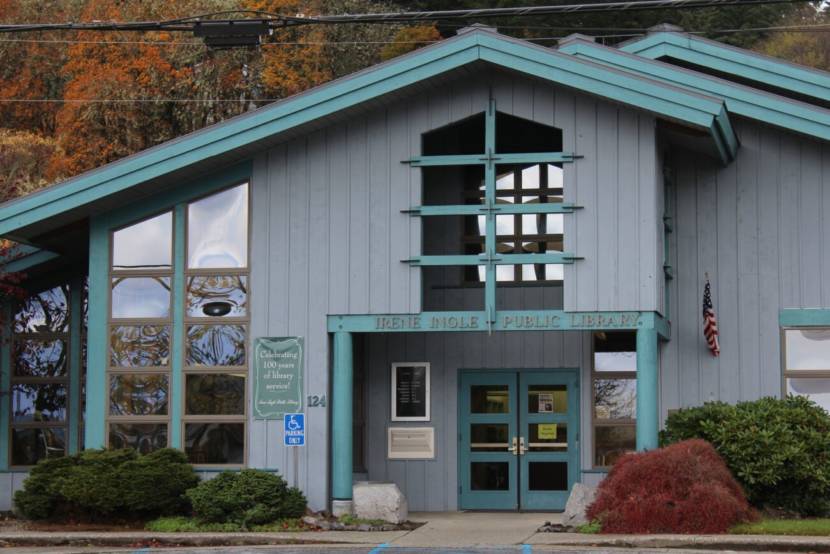
Wrangell’s Irene Ingle Public Library in October, 2021. (Sage Smiley/KSTK)
The Wrangell Public Library’s 100th birthday fell on Halloween. Generations of Wrangellites have enjoyed the services of the century-old institution.
Compared to its usual calm, quiet atmosphere, Wrangell’s Irene Ingle Public Library was buzzing with activity on the afternoon of Oct.28. A black and gold spiraling balloon arch framed tables with punch, coffee, and two cakes, both covered in black and orange frosting rosettes, and sporting “100”s.
“I feel honored to be a part of this library story here in Wrangell,” said assistant librarian Sarah Scambler, holding a piece of cake on a small, black and gold plate. Scambler says her mom used to work at the library, which brought her in often.
“I participated in the summer reading program growing up,” Scambler says, “And then I moved back, I had a young family, and we started coming to story time. Then when Lana retired, I applied for the job and was fortunate enough to get it.”
Scambler says she did a bit of research in the run-up to the 100th-anniversary party. She says it’s given her a unique perspective about what it took to get — and keep — a library in Wrangell.
Wrangell’s public library began as an idea put forward by the ladies’ Civic Improvement Club in 1913.
It took eight years for the idea to be realized, but there was wholehearted public support for the establishment of a library.
T.C. Havens, a local businessman, was among the Wrangellites who committed to buy a subscription to a magazine to fill out the library’s shelves. He also said he’d volunteer to paint, stain and varnish anything necessary in the library. Also, Havens wrote in a 1921 letter to the Wrangell Sentinel that “if it becomes absolutely and unavoidably necessary, I agree to go over to the library one day each week and make ardent love to the librarian in order to keep her on the job.”
The offer went unclaimed. With donations from Wrangell residents and the failing Perseverance Mine near Juneau, the library opened on Halloween of 1921. It started out as a room in the City Hall building, which is now the Senior Center. Local government donated the room, as well as heat and lights.
Its first librarian was Helen Hofstad, who presided over the 802-book collection — about one for each town resident at the time. It also had a subscription to nearly 40 periodicals. In its first month, the library issued 58 library cards, checked out 153 books, and seven magazines.
In 1929, Wrangell’s library was one of the first five libraries in Alaska to receive funding from the territorial government. While it started as a subscription model, the library quickly became one of the few free public libraries in Alaska. To raise money, the Friends of the Library held benefit dances and sold prepared dinners.
In the ensuing decades, the library also hit a number of rocky patches. It was moved to the old school building, which sat where the library gazebo now stands. Wrangell’s town council offered to help fund the librarian’s salary, then rescinded the funding three years later.
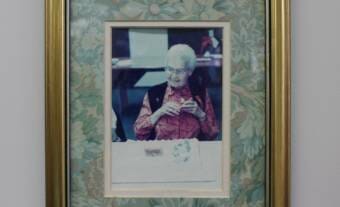
A picture of Irene Ingle hangs on the wall of the library.(Sage Smiley/KSTK)
When the namesake of the library — Irene Ingle — was hired as head librarian in 1951, the library didn’t have heat, running water or a bathroom.
In 1974, Wrangell sold more than $150,000 in bonds to fund a new public library facility, and in 1975, the library became a fully-funded city department.
When Irene Ingle retired in 1981, the library was renamed the Irene Ingle Public Library. There have only been two head librarians since: Kay Jabusch, who retired in 2015, and Margret Villarma, who is the city’s current head librarian.
Scambler — the assistant librarian — isn’t the only Wrangellite who’s got a multigenerational history at the library. Kristy Woodbury came to the library’s birthday party with her son, Stuart.
“It’s neat to have something so consistent,” Woodbury said. “I went here when I was little, and now I can bring my kids here.”
Along with Woodbury’s kids, Lilly Ellis is another kid who frequents the library.
“I don’t really like reading,” she says with a grin, “But for some reason, I really like the library and getting books.”
Ellis says her favorites are books that have “the old school mythical creatures.”
For Alice Rooney, who came to Wrangell in 1975, the library is a place she feels comfortable. It’s one of the first places she came to in town, she says, and the fact that it’s a century old speaks to its community value.
“I think it means that we really value what the library has to offer, and that is more than books,” Rooney said. “It’s been a gathering place. It’s been a community center. It’s opened our eyes to new technology, been a meeting place for different meetings, and all kinds of interests, more than just books.”
Irene Ingle has been quoted as saying that “a town can be no better than its school and library.”
In the 100 years since it began as a small reading room in City Hall, the library that bears her name has weathered its struggles, due in large part to the commitment of community members to keep it open.
Thanks to Bonnie Demerjian for her book, “A history of the Irene Ingle Public Library (Wrangell, Alaska) 1921-1986, which was an invaluable resource in writing this story. The book is a part of the Irene Ingle Public Library’s reference collection.
Close
Update notification options
Subscribe to notifications
Subscribe
Get notifications about news related to the topics you care about. You can unsubscribe anytime.

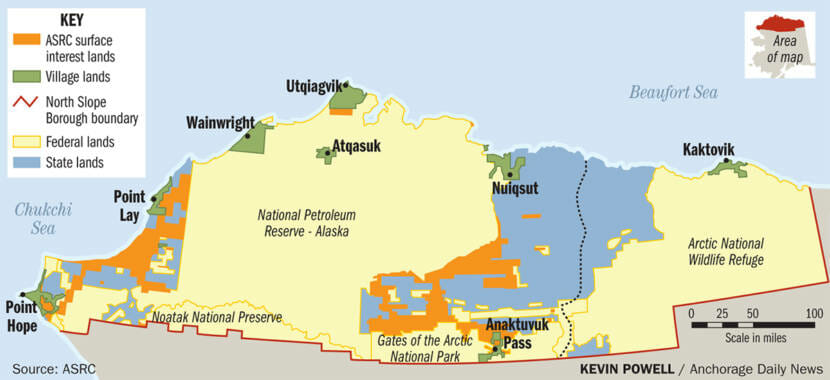 For all of ASRC’s assets, its shareholders still cannot claim title to their ancestral Iñupiat lands 25 miles from the corporation’s Utqiaġvik headquarters — or to any oil that might lie beneath them. That property now belongs to the U.S. government, which established the area as a naval oil reserve in the 1920s before later designating it the National Petroleum Reserve in Alaska.