History

Clem Tillion, Alaska’s original ‘fish czar,’ dies at 96

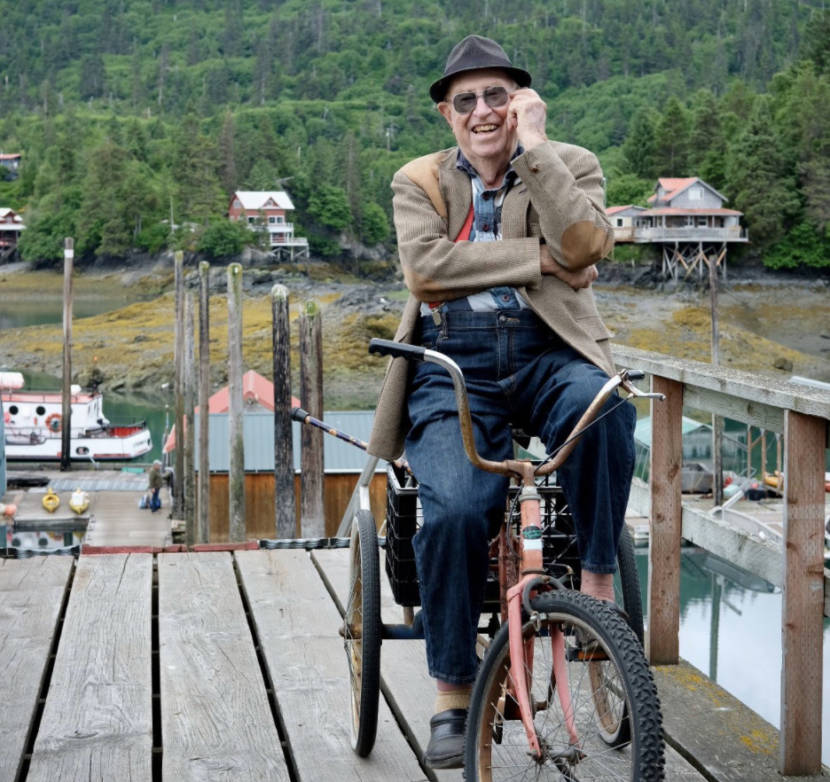
Clem Tillion in Halibut Cove in 2018. (Jason Sear)

Clem Tillion had a story for everyone, it seemed, and now everyone is telling Clem Tillion stories.

A towering figure in the worlds of Alaska fisheries and politics — and in the intersection between the two — Tillion, 96, died Wednesday morning at his home in Halibut Cove.

“Clem Tillion belongs to history now,” said Rick Halford, who served with Tillion in the state Legislature. “Almost 100 years of his own history and a lot of great contributions to the state of Alaska. He was an outstanding person and a great teacher.”

Tillion, in the words of one close friend, was Alaska’s original “fish czar.” He helped resettle Halibut Cove, played a role in the creation of the Permanent Fund and, into his 90s, remained active as a fisheries lobbyist and an uncompromising advocate for the Permanent Fund dividend.

And he was the only Alaska lawmaker to vote against repealing the state’s income tax in 1980 — a decision he defended for the rest of his life.

“He was a long-term thinker,” said Vince Tillion, one of Tillion’s two sons. “His fish politics were for the fish. His state politics were the long-term interest of the state.”

The only thing that slowed Clem Tillion down was a long ago back injury that interfered with the sensation and circulation in his feet.

His last foot injury, which led to complications that ultimately caused his death, came as he was using heavy equipment to work on a neighbor’s foundation over the summer, said Martha Cotten, one of Tillion’s two daughters.
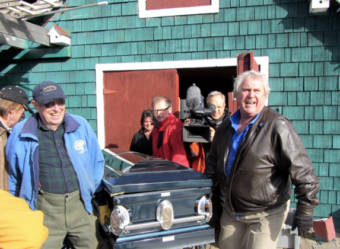
Tillion, left, and former state Sen. Mike Szymanski carry Tillion’s casket at Tillion’s “Dead or Alive” party in 2012. (Courtesy Mike Szymanski)

“But he was going to be doing those sorts of things ’til he died anyway,” she said.

Tillion’s casket had been waiting for him for a decade: He bought one after having a premonition that he would die in October of 2012. One of his friends, tired of hearing about Tillion’s impending demise, challenged him to a bet that would come due when Tillion expected to die.

“If you’re in that casket, I will pay for all the booze that people can drink at your going-away,” the friend, former state senator and fisheries lobbyist Mike Szymanski, said he told Tillion. “If you’re not in that goddamn casket, you’re paying for all the booze, but we’re still having a party.”

Tillion lost. The “Dead or Alive Party” was an alive party.

“I had just come back from fishing, got to go over, and here’s Clem, sitting on the dock with his casket full of beer,” said another longtime friend and Homer fisherman, Buck Laukitis. “He said, ‘Buck, better have a beer — I can’t get in there ’til it’s all gone.’”

Tillion was born in 1925 in Brooklyn, New York, where his father was an architect. He served in the South Pacific during World War II — a searing experience that he would breezily recount, in gruesome detail, into his old age.

He arrived in Alaska on a steamship and traveled to the shore of Kachemak Bay by train, raft and on foot before working his way around to Halibut Cove. The community was once home to thousands of people who worked in a herring fishery, but it was largely abandoned after fish stocks died off.

Tillion could still fish for halibut and cod, and he bought most of an island in the cove for $1,400. The money was secured from an Anchorage bank with a letter of recommendation from a seafood processor named Squeaky Anderson: “He’s a crazy kid but catches fish.”

Tillion married Diana, an artist who became known for painting with octopus ink, and the couple raised four children.

He entered the state House in 1963, just a few years after statehood, when a retiring lawmaker signed Tillion up to run without consulting with him.

Tillion served in the House and Senate for nearly 20 years. While there, he helped develop the state’s system to limit the number of permitted commercial salmon fishermen, in an effort to conserve declining stocks and keep fishing rights in Alaskans’ possession.
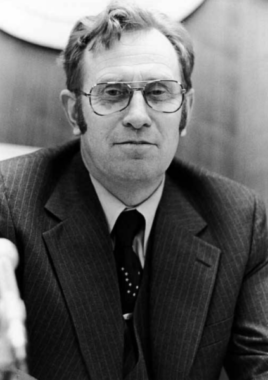
Clem Tillion as a state senator. (Alaska State Library)

Much later, as “fish czar” for Gov. Wally Hickel, he got behind a system that divided up harvests of halibut and black cod into individual catch shares for fisherman — a move aimed at eliminating frenzied, derby-style fisheries where boats faced pressure to operate in dangerous weather.

Even into his 90s, Tillion continued working on fisheries issues as a paid lobbyist for the regional Alaska Native corporation for the Aleutian Islands.

Tillion was also close with Jay Hammond, a bush pilot and fisherman who served with Tillion in the Legislature and then was elected governor.

The two worked together on the establishment of the Alaska Permanent Fund in the 1970s, which Tillion later described as the “probably the single best accomplishment completed by our state government since statehood.”

His advocacy around the fund and the dividend never stopped.

Tillion signed onto a 2016 lawsuit that unsuccessfully challenged a partial dividend veto by then-Gov. Bill Walker. And he continued writing opinion pieces and letters pushing Alaska leaders to put larger dividend payments and lower overall spending by the fund in the state Constitution. (Any resulting budget holes, he has said, could be filled by a reinstated income tax.)

A May 3 letter to the Legislature apologized for “nattering on,” cited a 1970 Harper’s Magazine story and told lawmakers that their political problems would “disappear like a plate of king crab legs at a legislative reception” if only they could agree to enshrine a “sensible” dividend payment in the Alaska Constitution.

Those positions, like many others Tillion took in his career, were geared toward preserving resources for future generations of Alaskans.

“I never thought of myself as anything but a temporary organism that was going to be here for a few years and pass on,” Tillion once told journalist Charles Wohlforth. “And the only thing that counted were my children, my grandchildren and my great-grandchildren.”

The policies Tillion fought for have not been universally embraced. One recent report published by the Nature Conservancy found that the limited entry permit program disadvantages Alaska Native and rural communities.

Tillion also could be pushy and a crafty and confounding opponent if you found yourself on the opposite side of an issue. A 1992 Anchorage Daily News profile referenced a bumper sticker that referred to Tillion as the “prince of darkness,” and featured a photo of him sitting on a bulldozer under the headline: “Get out of the way — be it for fisheries or for family, Clem Tillion does what he thinks is best.”

But Tillion was also effective and beloved by generations of fishermen, policymakers and family members who spent time with him.
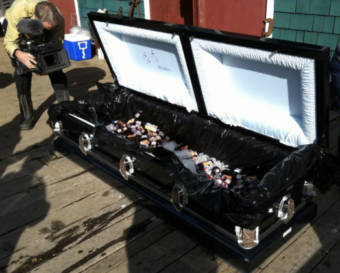
Tillion’s casket was filled with beer for his 2012 party. Now, it rests in a crypt on a hilltop above his home in Halibut Cove, where he lies beside his late wife, accompanied by pickled herring, cookies and a martini. (Courtesy Mike Szymanski)

“He could command the room, and everybody listened,” said Laukitis, who, like Tillion, served on a key fisheries policy making board called the North Pacific Fishery Management Council. “I’ve had dinner with him in restaurants, and he’s so loud that you get stares from all the way on the other side of the room. And some of his stories were not very politically correct, and some of them kind of made you cringe at times. But we’ve all heard them, and they make me smile now.”

Laukitis was one of Tillion’s close friends who got to see him in his final days.

Tillion had spent four days in the hospital for treatment of an infection in his foot. But visitors couldn’t see him there because of COVID-19 restrictions, so two of his children rolled him out of the hospital for a little party with friends, then rolled him back in for his next dose of antibiotics.

Ultimately, with his health failing, his family brought him back across Kachemak Bay to his expansive home in Halibut Cove. That’s where he died, said Martha Cotten, his daughter.

“In his room, with a picture of my mom, comfortably,” she said.

Cotten, her husband and her brother Vince spoke with a reporter late Wednesday from Tillion’s home, just before his casket was sealed in a hilltop crypt that also holds his late wife’s Diana’s coffin.

“It was a great loss,” Cotten said. “But not unexpected. We definitely all were crying for a couple of hours. But we’re bucking up.”

Inside the casket with Tillion: pickled herring, cookies, photos of his family and notes from Diana. And a martini.
Juneau poetry event spotlights forced displacement of Native people

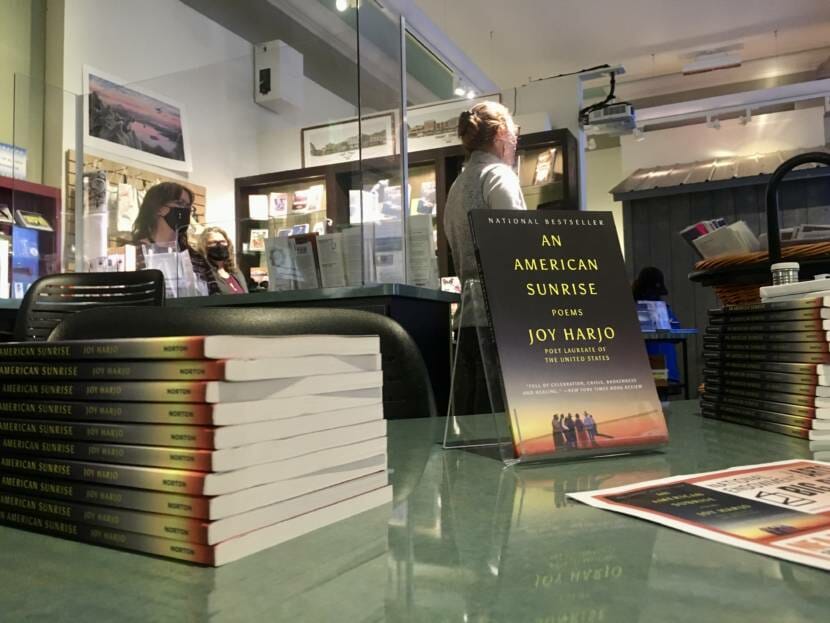
Free copies of “An American Sunrise” by Joy Harjo at the Juneau-Douglas City Museum (Sheli DeLaney/KTOO)

Juneau Public Libraries has selected “An American Sunrise” by Joy Harjo for its Big Read program — a kind of community-wide book club.

The launch event at the Juneau-Douglas City Museum featured samples of Harjo’s poetry read out loud and one of the last chances to view the “Echoes of War” exhibit about the internment camp at Funter Bay.

A storm raged outside but it didn’t stop determined, dripping patrons from tromping into the City Museum to celebrate the poetry of Joy Harjo, the first Native American U.S. poet laureate.

“I’ve read Joy Harjo before, I was really interested in her new book of poetry,” said Keira Koch, one of the first attendees to arrive at the event. “And I’ve never been to the City Museum because of COVID and the pandemic, so I thought this was a great way to get some Joy Harjo in but also visit a place I haven’t been.”

Because of the pandemic, the museum wanted to avoid gathering people inside to hear readings of Harjo’s poetry. Instead, they created a “soundscape” of her poems to play on a loop through the overhead speakers. The soundscape featured 22 recordings of poems from An American Sunrise, recited aloud by local writers, actors and artists.

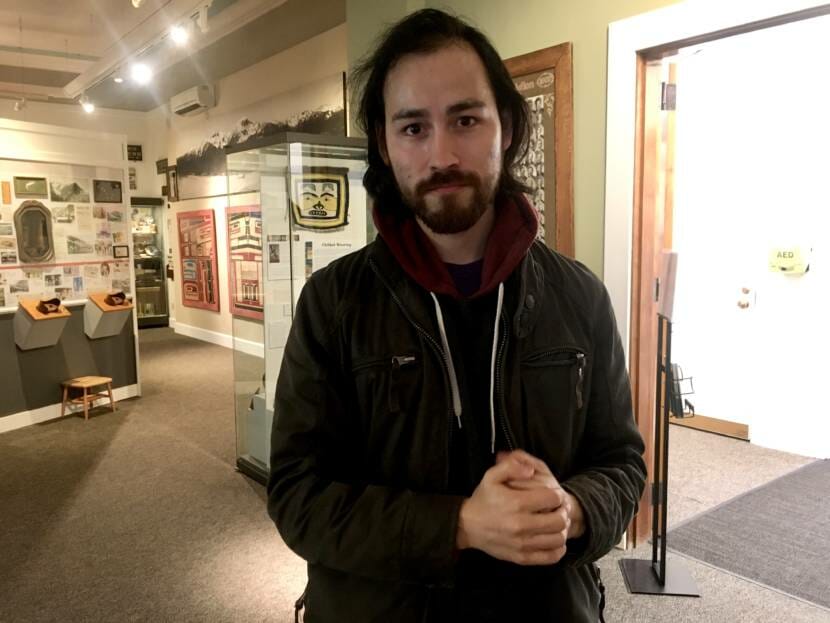
Jared Olin, an actor who recorded a Joy Harjo poem for the event’s soundscape (Sheli DeLaney/KTOO)

Jared Olin is an actor who is currently doing an artistic apprenticeship at Perseverance Theater. He recorded a reading of the poem “Beyond” in Harjo’s native language of Mvskoke (Muscogee).

“I took a course on her native language,” Olin said. “My native language is Denaakk’e and that’s of the Koyukon-Athabascan people, and we have the same pronunciations, we have the same sounds in our languages.”

The soundscape of “An American Sunrise” was not only a celebration of Harjo’s poetry, it was also meant to augment the exhibit “Echoes of War: Unangax̂ Internment During WWII,” now in its final days at the City Museum.

“Echoes of War” told the largely ignored story of Unangax̂ people who were forcibly removed from the Pribilof islands and held at Funter Bay in Southeast Alaska from 1942-44.

The poems and the exhibit both spotlight the history of forced displacement of Native people.

Jonas Lamb teaches English at the University of Alaska Southeast.

“I just caught the tail end of a poem that was speaking to these green hills, which reminded me of our rainy landscape here, thinking about how foreign that could have been to the Unangax̂ people who were displaced here or relocated here.” he observed.

Lamb joined the libraries’ effort in order to introduce his first-year students to Harjo’s poetry as well as the history of the Unangax̂ internment.

“Harjo’s work really explores this idea of just being dispossessed of your land and of your culture and of the place where you draw strength,” he added.

Free copies of “An American Sunrise” are available at all three locations of Juneau Public Libraries. The audiobook can be checked out on the libraries’ mobile app — it’s read by the author herself.

The last day to view the “Echoes of War” exhibit is Saturday, Oct. 16.

Now you can watch as the Museum of the North readies the ‘Into the Wild’ bus for display

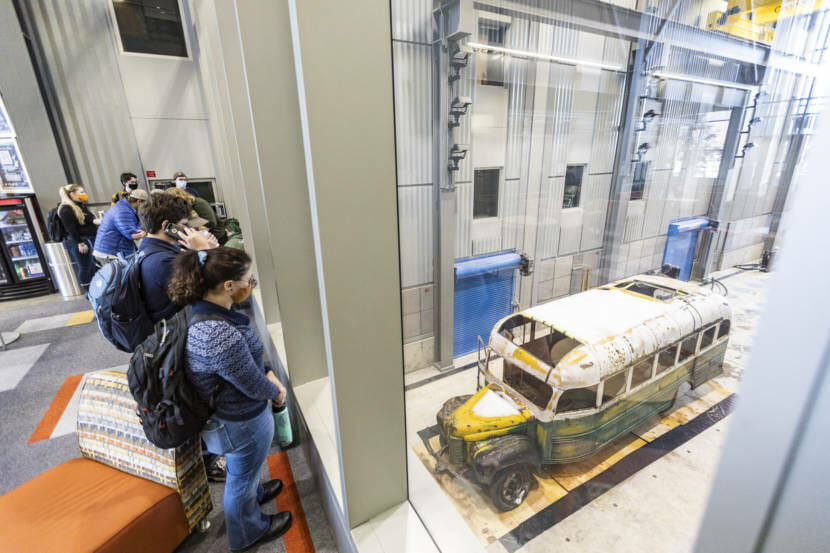
Students looking down on the Chris McCandless bus in a high-ceilinged vehicle bay
A group of students gather to observe Fairbanks Transit Bus 142 at the Engineering, Learning and Innovation Facility Wednesday, Oct. 6, 2021 at the Fairbanks campus. (JR Ancheta/UAF)

The University of Alaska Fairbanks has moved the “Into the Wild” bus to a UAF engineering building lab for repairs.

Originally dragged into the wilderness for a road-building camp along the Stampede Trail, the 1940’s Fairbanks public transit bus is where young adventurer Christopher McCandless lived and starved to death in 1992. His story was popularized by the book and movie, “Into the Wild.”

The state helicoptered the bus out of the wilderness in June 2020 to stop people from making a dangerous hike out to see it. Under an agreement with the state, the UAF Museum of the North plans to create an exhibit around the vehicle. But up until this week it remained in storage.

Chinook helicopter removing the 'Into the Wild' bus
An Army National Guard Chinook helicopter carries the dilapidated Fairbanks bus away from its former resting place near the Teklanika River, close to Denali National Park. (Alaska National Guard)

Senior Collections Manager Angela Linn, who is leading the bus project, says the UAF Engineering Building’s high bay lab is an ideal facility to begin preparing the bus for display.

“It’s dry, it’s warm, it’s safe there. It’s kind of the best possible solution on the campus for doing this next phase,” she said.

Linn says the bus project involves materials science as well as structural engineering, so it will provide learning opportunities for students.

“Understanding the structural elements of objects and how they degrade over time and what can we do to slow that degradation process down,” Linn said. “It’s a great educational opportunity.”

She says the first project is to thoroughly photograph and 3D-scan the bus for both documentation purposes and potential development of a virtual tour, which could have an “augmented reality component.”

“You could place yourself in the bus back on the Stampede Trail,” Linn said.

A team of about 25 people are helping guide the broader bus project. Linn says the future exhibit will be about the bus’s entire history, not just Christopher McCandless’s story.

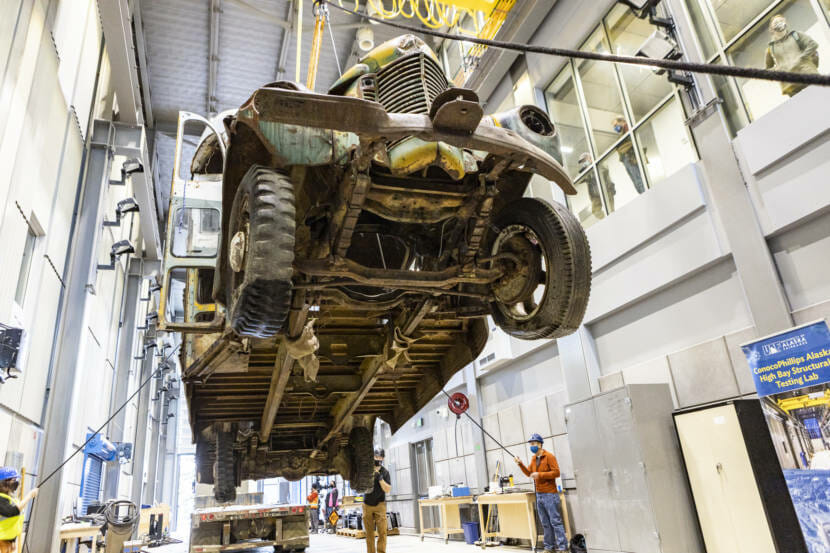
view of the underside of the McCandless bus as it's lowered into place indoors
Bus 142 is lowered at the Engineering, Learning and Innovation Facility’s high bay structural lab for preservation Wednesday, Oct. 6, 2021 at the Troth Yeddha’ campus. (JR Ancheta/UAF)

As far as readying the actual bus for eventual permanent outdoor exhibition, Linn the plan is to stabilize its condition and make it safe. The bus has rust holes, broken windows, and worse.

“There’s big holes in the ceiling and in the floor from when they helicoptered it out,” she said

Linn says a cost estimate for the project is still being developed.

“It’s gonna be a big number, though, for sure,” she said.

Linn says the museum plans to raise money for the bus repairs and exhibit development through a mix of sponsorships, crowd funding and grants.

In the meantime, the public can view the bus inside the UAF Engineering Building on weekdays from 8 a.m. to 8 p.m. through large windows overlooking the high bay lab. The museum says it also plans to install a webcam so the public can watch the conservation work online.

Petersburg group raises money for long-term upkeep of historic Southeast lighthouse

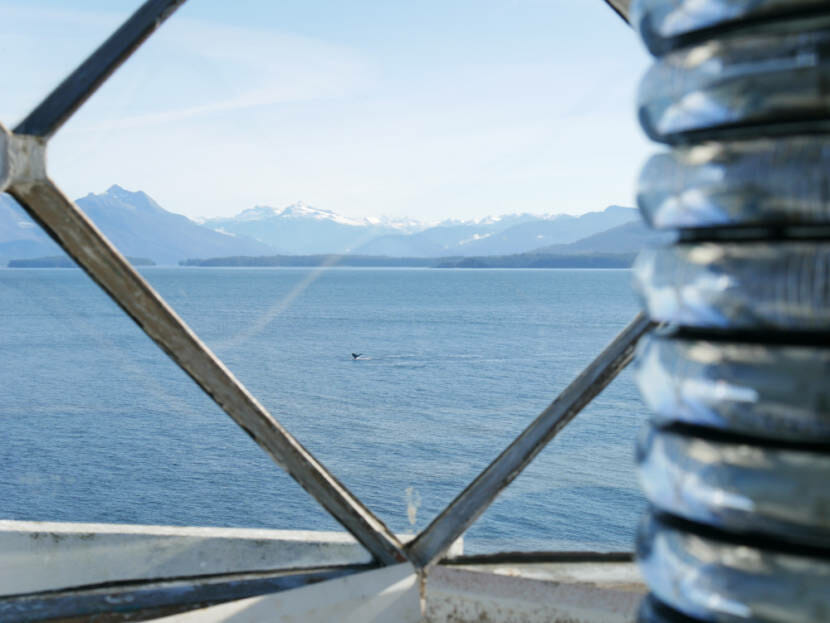
Humpback whales are a common sight from the light at Five Finger. (Joe Viechnicki/KFSK)

It’s a rare blue sky day in between autumn storms of mid-September at Five Finger Lighthouse. A little over 40 miles north of Petersburg, the light endures on a windswept, salt-sprayed rock on the inside passage where Stephen’s Passage meets Frederick Sound. Humpback whales feed offshore, fattening up for the long trip to Hawaii while sandhill cranes have already started their migration south.

Today those aren’t only sounds on the island.

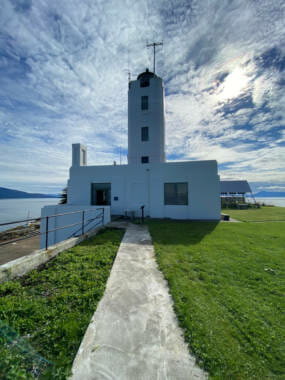
A side view of the historic 1935 building (Joe Viechnicki/KFSK)

A work party for the Five Finger Lighthouse Society tackles a list of projects, winterizing the building, draining pipes, putting away equipment and buttoning up windows and doors. Interpretive signs along the trails of the small island are stowed away until next year.

The society has assumed ownership and maintenance of the light. For years, a Juneau-based organization did that work. Now this group of Petersburg residents is putting more shingles on a new roof for the boathouse. The old one blew off last winter. They’re also getting a troublesome generator to run.

“It looks pretty good. The roof project still has a ways to go,” said Josef Quitslund, one of the volunteers. He’s been multiple times to the remote spot.

“Well it’s hard to get here,” Quitslund said. “I’ve only been here on calm days but the really cool thing about it is it’s right in the middle of everything. You know there’s so much life going on around here with whale swimming right along shore and seals and birds all over the place. It has its own unique little biosphere of critters out here.”

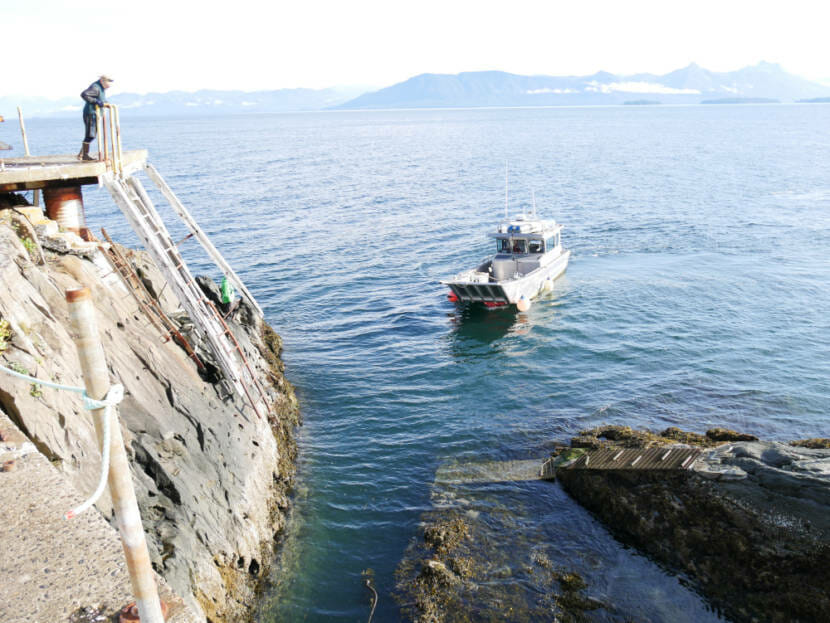
Besides being far from other places, the island is a difficult place to get ashore. Anchoring nearby is difficult. There are a few spots to tie boats up to the rock when the tides and waves cooperate. There’s a rusting ladder up steep rock and rock stairs to an access ramp.

A lighthouse society work party ties up for the day at Five Finger. (Joe Viechnicki/KFSK)

“You can see too there’s been efforts to be able to increase the safety as far as access,” said Eric Castro, a board member of the society. “That’s one of the major challenges that still exists really is accessing the island. So even though there are hundreds of people that pass by, that transit by this island, getting onto the island is one of the major obstacles.”

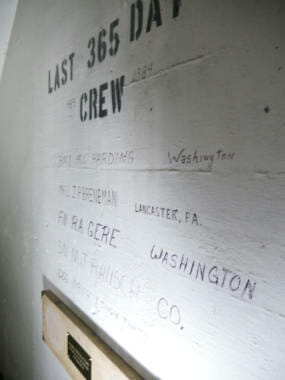
Names of the last Coast Guard crew to live at the light year-round. (Joe Viechnicki/KFSK)

The lighthouse building dates back to 1935, built in the art deco style. It replaced one completed in 1902 that burned to the ground in 1933. The light’s automated now. The last year-round Coast Guard crew to live there left their names in the basement of the building in 1984.

It’s peaceful out here between storms. But the evidence of the harsh conditions is everywhere. The salt air has rusted a horseshoe on the shop building nearly away. Inside the light itself someone’s built a system of indoor gutters to move the constant rain.

Board member Karen Dillman says there’s been a lighthouse keeper onsite for part of the past two summers, and the group has someone lined up for part of next year as well. She’s hoping a local fund raising effort will help the society land some grant money.

“I think that’s the main goal is really just tapping into some other grants too that really like catapult the whole process into a whole other realm, just because of the power situation, the solar polar, the access, those are big ticket items, if you want to have more people show up and use it as a retreat,” Dillman said.

Lighthouse keepers welcome visitors on passing boats while the structure is open, usually at least part of the time between May and September. The light has also housed whale research and even yoga sessions for cruise ship passengers.

Solar panels help power the light. (Joe Viechnicki/KFSK)

The owners hope it could be a destination again.

“You know you have to have the right person, right group of people who can come out here with the knowledge they might be left out here for a week or more at a time due to inclement weather and just the inability to be able to make it off the island. So it takes a certain kind of grit,” Castro said.

“Grit and flexibility, right?,” Dillman adds. “You don’t want to have a plane to catch tomorrow and come out here the day before or something because that could change,” she said.

Besides fixing things that break, the society has a list of things that would make the island more livable, like a new bank of batteries to store power from solar panels and a better access ramp.

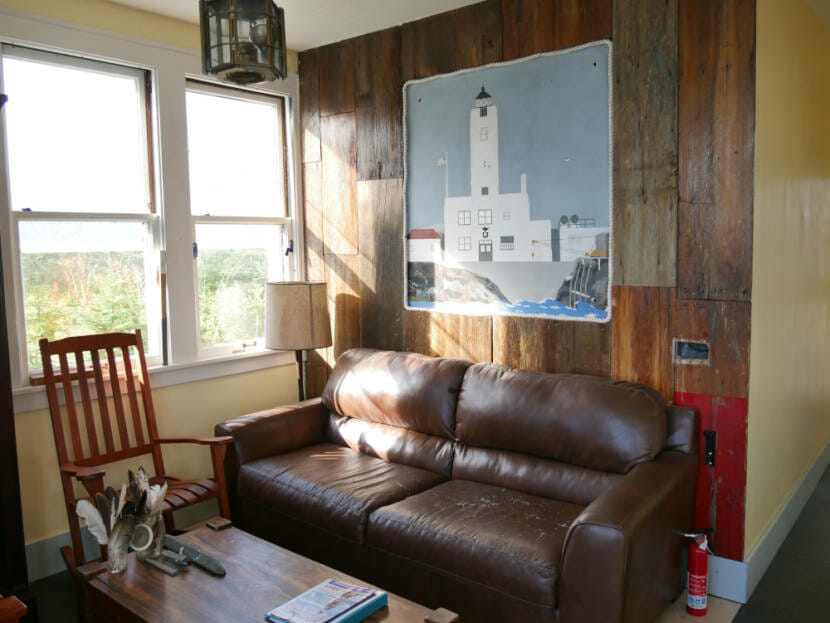
The living room with a painting of the light discovered during former renovations. (Joe Viechnicki/KFSK)

The society has solicited donations from artists and they have an online auction underway. The society has canceled its in-person auction because of COVID cases. The online auction now has a closing date of Oct. 31. The art works will be on display at the Clausen Museum Oct. 4-15.

Scholars say Holocaust symbol has no place in Anchorage mask debate

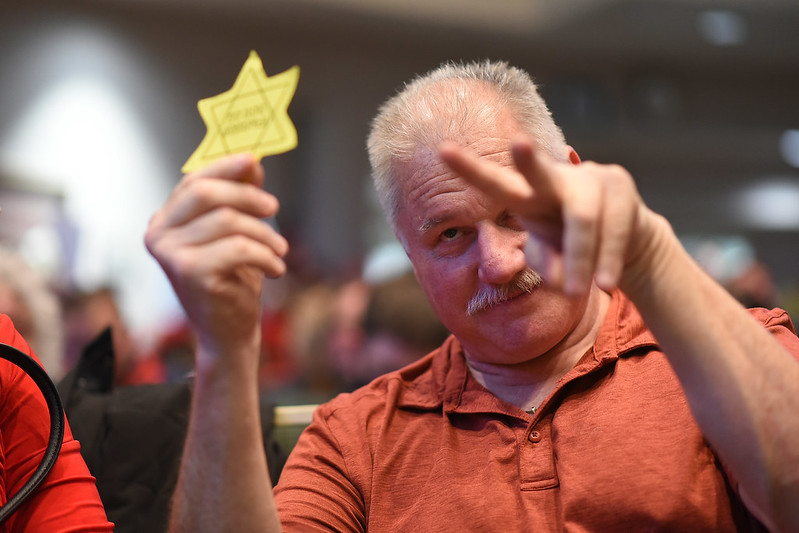
Skip Myers stared and pointed at Assembly member Forrest Dunbar after Dunbar objected to the use of the Star of David in a debate over a mask mandate. Myers says his gesture was not antisemitic but meant to emphasize that he wouldn’t comply with the mask mandate. (Creative Commons photo by Paxson Woelber/Alaska Landmine)

Jewish leaders and Holocaust scholars say it’s wrong for opponents of an Anchorage mask mandate to don yellow stars, an infamous symbol of Nazi oppression, to protest a public health measure.

Anchorage Mayor Dave Bronson later walked back his words, but at a contentious hearing Wednesday night, he defended the use of Holocaust imagery in the mask debate.

“We’ve referenced the Star of David quite a bit here tonight,” Bronson said at the meeting. “But there was a formal message that came out within Jewish culture about that, and the message was, ‘Never again.’ …. And I think us borrowing that from them is actually a credit to them.”

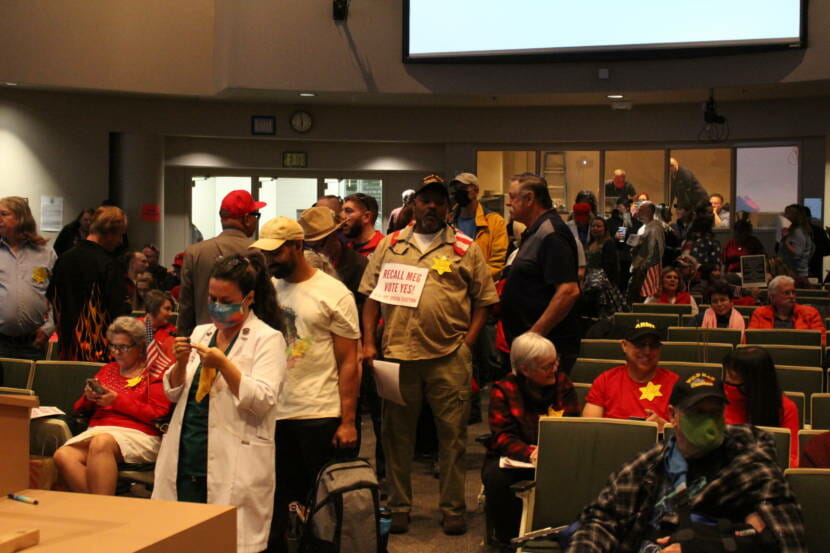
At the hearing, dozens of mandate opponents pinned yellow paper Stars of David to their chests. A protest message was printed on them, in a faux-Hebrew font.

The tactic is not unique to Anchorage. Periodically throughout the pandemic, COVID-19 skeptics and opponents of mask and vaccine mandates have sought to compare public health restrictions to Nazism.

Jonathan Sarna, a professor of American Jewish history at Brandeis University, said the Anchorage display was a horrible misuse of a badge that Nazis used to dehumanize and ultimately annihilate millions of Jews.

“I think that many of us find this analogy nothing short of appalling,” he said. “To conflate those who want to save lives with those who wanted to destroy lives is to willfully kind of turn the world upside down.”

The Holocaust is not a “gimmick” to be trotted out to advance a political agenda, said Rabbi Jonah Pesner, director of the Religious Action Center of Reform Judaism.

Members of the public packed the Anchorage Assembly chambers on Sept. 29, 2021. The Assembly is considering a mask mandate. (Wesley Early/Alaska Public Media)

“Donning a yellow star in opposition to a mask mandate meant to save lives is to defile the memories of those who were killed in the Holocaust and those who died during this pandemic,” Pesner said.

Rabbi Abraham Cooper from the Simon Wiesenthal Center embraces the need for vigorous debate around mask mandates and vaccine requirements. He’s lost family members to COVID-19, and one of his brothers had a serious reaction to the vaccine. But Cooper said it’s “just wrong” to exploit a symbol of Jewish suffering. He said it degrades the lessons of the Holocaust. And, he said, it doesn’t help mandate opponents make their case.

“It clouds the debate,” Cooper said. “It brings further emotion to a discussion and a debate that already has way too much emotion. It brings no clarity.”

Anchorage Assembly Member Forrest Dunbar, who is Jewish, explained to mandate opponents that the use of the star was offensive.

After that, Anchorage business owner Skip Myers locked eyes on Dunbar. Myers, sitting in the front row of the legislative chamber, held the star aloft with one hand. With his other, he repeatedly pointed two fingers at his own eyes and then at Dunbar. A political blog, Alaska Landmine, published a photo of Myers making the gesture. It went viral before the meeting was over.

Myers said Thursday he wasn’t taunting Dunbar. He said holding the star up was not meant to be antisemitic. He said he was intending to emphasize the words on it: “Do not comply.” He said Dunbar stared at him first and that his gesture was a response.

Mayor Bronson issued an apology Thursday for his comments defending the use of the yellow star imagery.

“I understand that we should not trivialize or compare what happened during the Holocaust to a mask mandate and I want to apologize for any perception that my statements support or compare what happened to the Jewish people in Nazi Germany,” he said, starting off a 400-word statement his office emailed to reporters.

Tribal and environmental advocates celebrate the first water flow down the Eklutna River in decades

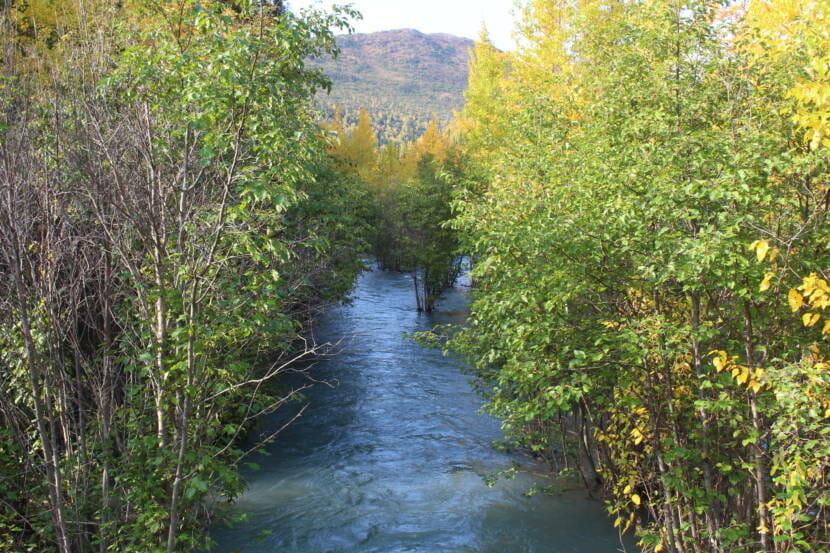
Water flows down the Eklutna River on Sep. 18, 2021. (Wesley Early/Alaska Public Media)

For more than 60 years, the Eklutna River north of Anchorage had been dammed up, stifling the salmon runs that fed generations of Dena’ina people in the area.

Before the damming, for hundreds of years, the area surrounding Eklutna Lake was populated by the Dena’ina people. Curtis McQueen says the inhabitants were originally more nomadic.

“They settled these lands here and never left because of the rich abundance of habitat in this area,” he said.

McQueen is the former CEO of Eklutna Inc., the tribe’s for-profit corporation.

“And the Eklutna River, which was a raging, massive river at the time, has – still has — all five species of salmon,” he said. “A lot of rivers don’t have all five species.”

McQueen is Tlingit but was formally adopted by the Eklutna people. In his time working with the tribe, he says he’d heard stories about how bountiful the river used to be.

“We lost an elder recently named Alberta Stephan,” McQueen said. “Alberta was our historian, and she would talk about when she was a little girl, down there at the mouth, where literally, they could walk across the back of salmon. And it was a massive stream, and there was no such things as mortgages and houses and cars. Everything they needed was right here.”

The fish were their main source of food. That was, until the construction of the lower river hydroelectric dam in the 1920s, which provided Anchorage with its first major source of power.

McQueen says it didn’t operate for long.

“The challenge was, when they built it in the canyon, it would fill up with silt really quick,” McQueen said. “And so they were constantly dredging it. And as Anchorage was growing, they needed more power, that became an issue.”

The lower dam became defunct in the 1950s when the federal government opted to build a larger dam project further up the river. But the lower dam continued to fill with sediment for decades, blocking off the river run.

Supporters of the Eklutna River restoration efforts gather for a group photo at the river campgrounds. (Wesley Early/Alaska Public Media)

That was until 2018 when, with the support of the Native Village of Eklutna and Eklutna Inc., the environmental non-profit Conservation Fund raised $7.5 million to demolish the lower dam. The entire process took about five years.

Earlier this month, tribal and environmental advocates witnessed the first water to flow down the river in decades.

“For the first time in 66 years, the thirsty Eklutna River is finally getting a drink of water,” Trout Unlimited project manager Eric Booton said as the crowd applauded.

Native Village of Eklutna Tribal President Aaron Leggett was part of the celebration. He says he’s grateful for the work that has been done so far to get the river flowing.

“Our ultimate goal is to restore the salmon runs that sustained us for many hundreds of years,” Leggett said.

There’s still more work to be done to make sure the river can support a salmon run. Eklutna Lake supplies 90% of Anchorage’s drinking water, so the water release needs to strike a balance.

(left to right) Eric Booton and Austin Williams (both with Trout Unlimited) and Curtis McQueen, former CEO of Eklutna Inc. (Wesley Early/Alaska Public Media)

Austin Williams is a legal and policy director with Trout Unlimited.

“The question here is how much water and what needs to be done to ensure that salmon returning to the Eklutna River can successfully spawn, rear and support a healthy fishery,” Williams said.

In the early 90s, the electric utilities agreed to help with studies to look at the impacts from the dams and how to protect and bolster the salmon runs in the Eklutna River. Booton with Trout Unlimited says those studies are ongoing.

“The study plans that they will do for two years in order to get the data necessary to come up with the mitigation outcomes,” Booton said. “At this point, they’re nearly wrapped up with the first year of collecting that data and there will be a second year in 2022 to also collect that information.”

While different groups continue to work on what’s next, McQueen with Eklutna Inc. says there’s still cause for celebration, and a flowing river to enjoy.

“I want to camp out here tonight. I’d sleep rock hard listening to this,” McQueen said. “Whether you’re on a beach or on a river, there’s nothing that relaxes a human mind more than hearing water moving. It’s amazing.”

Correction: An earlier version of this story misspelled Aaron Leggett’s last name.

Site notifications
Update notification options
Subscribe to notifications