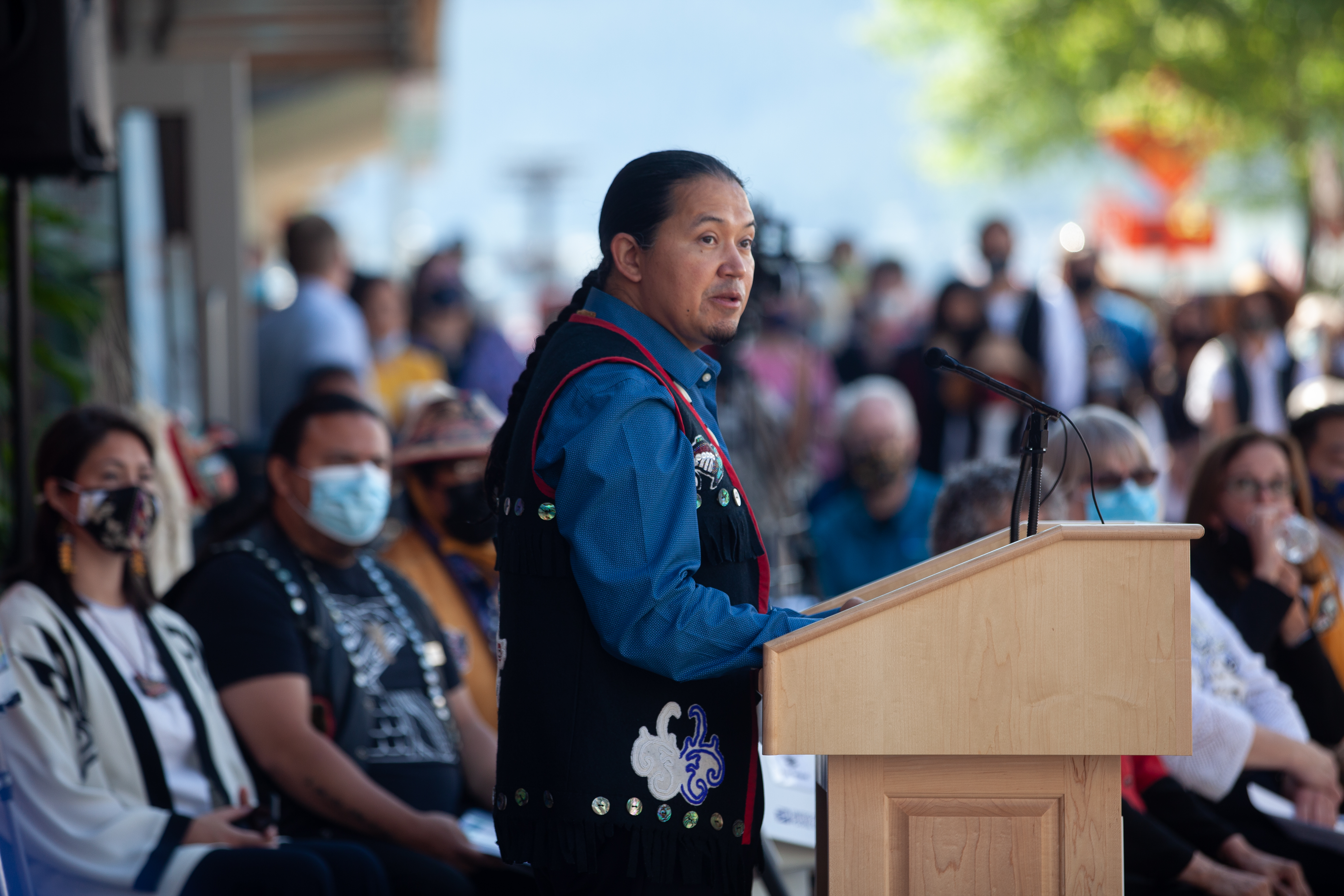
X̱’unei Lance Twitchell addresses a crowd of at least 200 people who showed up to celebrate the release of Rico Lanáat’ Worl’s new postage stamp on Friday, July 30, 2021, in Juneau, Alaska. (Photo by Rashah McChesney/KTOO)
There’s no title for the screenplay yet, but now X̱’unei Lance Twitchell has a fellowship from the Rasmuson Foundation to realize a longtime dream — to bring a true story to life, about how Native boarding schools systematically tried to kill indigenous languages.
Twitchell says this dark chapter in history has recently pushed into the mainstream consciousness, but he’s heard stories for years, from elders like the late Marge Dutson.
“They tried everything. They tried to beat it out of me. They tried to scare it out of me. They tried to shame it out of me. But they couldn’t get my language away from me,” he said she once told him.
She also shared a story about her first day of class at the Juneau Bureau of Indian Affairs school, when her teacher grabbed her by the hair, lifted her off the ground and shook her violently to punish her for speaking Lingít.
Twitchell said these stories of courage still inspire him today, but when he set out to record them years ago, a linguist — the late Michael Krauss, who worked to preserve a number of Alaska Native languages, some of which have disappeared — encouraged him to get elders to share them in Lingít, because it would better preserve the details of what they experienced.
That’s when he decided to tell the story — in Lingít — of two boys who ran away from their boarding school.
“Torture, abuse of all different kinds was going on in these places – and then to sort of have that from the perspectives of two young people, who are birth speakers of Lingít and who are there as siblings and can communicate with each other and make a decision to get out of that, I think it has a lot of potential power.”
The boys used their traditional knowledge to guide them home from Oregon. It’s a story he heard from several members of the same family, who have since passed, except for Florence Sheakley. Sheakley’s father, Willie Marks, is the boy who ran away from the school with his brother.
Twitchell says the springboard for the screenplay will be a high quality film of the elder telling her story in Lingít. Twitchell will receive $18,000 for his work and will share some of it with Sheakley.
He says it won’t be easy to write the script entirely in Lingít but the words of Marge Dutson remind him why it’s so important.
“Él i tóoch ulchéeshiḵ wáa sá eeshandéin yoo haa kaawashóo chʼu tle tlél ḵáa tuwáa ushgú haa yoo x̱ʼatángi,” he said. “And she said it’s impossible for you to feel how much we suffered when people didn’t want our language.”
Twitchell hopes a screenplay in Lingít can capture some of that feeling. He says subtitles can be used if the script is ever turned into a movie.
The Rasmuson Foundation also awarded two other Juneau Lingít artists project grants: poet Ishmael Hope and Sydney Akagi, a Lingít weaver and photographer, who will each receive $7,500.
A previous version of this story mentioned that Twitchell was working on a play. The project is a screenplay. The headline has been corrected.
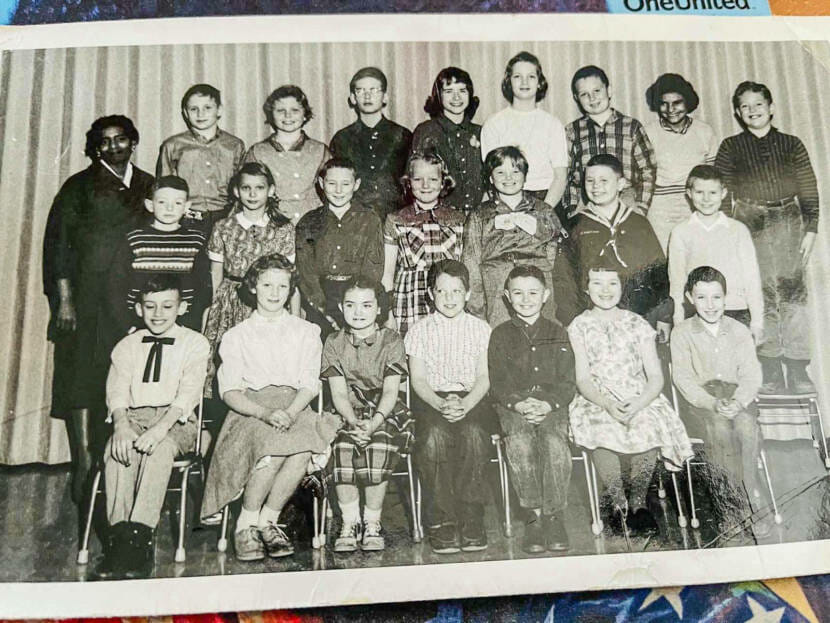
Etheldra Davis and her class at the old Government Hill School in 1960. (Photo courtesy of the Antoine family)
The Anchorage School Board voted unanimously Tuesday night to commemorate the district’s first Black teacher and principal by adding her name to her neighborhood‘s elementary school.
Etheldra Davis moved to Anchorage in 1959 from Los Angeles and was the first Black teacher hired on contract with the Anchorage School District. She later became principal of Fairview Elementary in 1969, another first for a Black educator. At the time, many Anchorage neighborhoods had restrictive covenants preventing Black and Alaska Native people from buying homes.
“We had segregation right here in Anchorage people aren’t really talking about,” said Andrea Antoine, Davis’ daughter.
Antoine said when her mother moved to Anchorage, the Fairview neighborhood was one of few places Black families could buy property.
“She was able to come to the Last Frontier, with dirt roads, because there were dirt roads in Fairview when we moved there,” Antoine said. “And to become the first Black teacher and principal, that’s saying something.”
Davis died in November from complications due to COVID-19. Shortly after, advocates in the Fairview neighborhood along with the Anchorage NAACP circulated a petition to name Fairview Elementary School after Davis to commemorate her legacy as a trailblazing educator.
For Antoine, she also sees her mother’s legacy in other Black education leaders in Anchorage like school board president Margo Bellamy.
“To see that manifest, that is her legacy,” Antoine said. “Progress in the community that she loved.”
Antoine said she hopes the name change and her mother’s story will inspire students to learn about other role models in their communities.
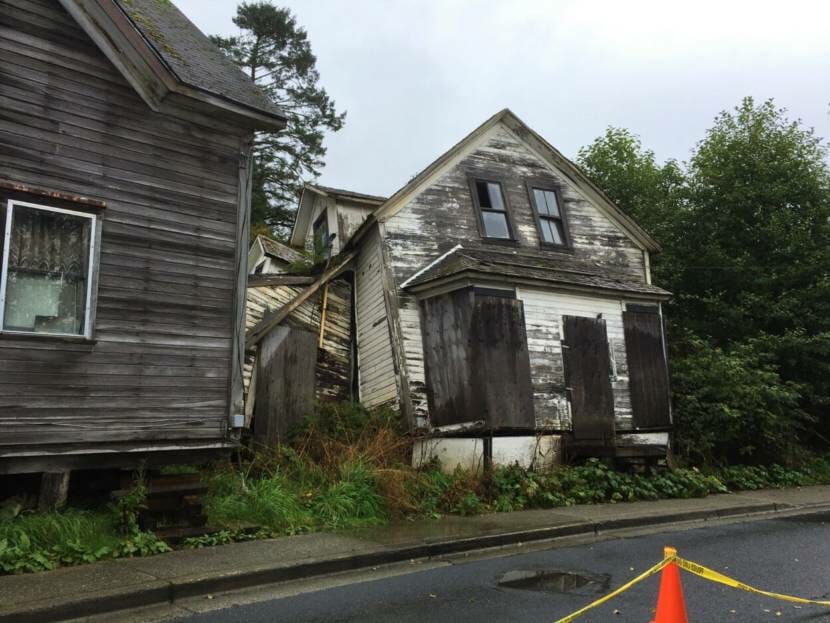
DaGinaa Hít, “The Far Out House,” was built by Kanóosgu Eesh Frank Kitka in the early 20th century. (Robert Woolsey/KCAW)
One of only nine remaining clan houses in Sitka is on the verge of collapse. The historic property is deeply rooted in Sitka’s clan traditions, and its passing is a significant milestone.
The century-old frame house is one of a pair that sit side-by-side in a historic district of Sitka, on Katlian Street. It was built in the early 20th century but was steeped in tradition even then.
“So this house was called DaGinaa Hít, and some people translate that as ‘The Far Out House,’’ said Roby Littlefield, chair of the Sitka Historic Preservation Commission and a Lingít language scholar. “But it comes from a very ancient Raven story about how Raven pulled the Salmon House to shore from the open ocean, and that’s how the salmon began to swim upstream.”
“So it is a Coho, or L’uknax.ádi House,” Littlefield continued. “And when the Yakutat people moved to Sitka in the 1800s, they brought their house with them in name, and when they built this house, it also became the newest DaGinaa Hít.”
The ownership of DaGinaa Hít is caught in a gray area between cultures. In western culture, ownership passes from parents to children. In Lingít culture, clan identity and ownership are matrilineal, and marriages are between members of different clans. So when a father dies and his property reverts to his children under western laws, that property also moves under the care of a different clan — which can lead to problems.
As complicated as this becomes, Littlefield says that it’s important to reflect on what the loss of DaGinaa Hít means.
“What it means to the community is that we’ve lost one more of our ancient structures that embodies the history of the Lingít people,” she said. “And the only reason we can recite this history in the 21st century is because that house is standing.”
DaGinaa Hít is slumping into the embankment behind it and looks like it could further collapse and slide into the roadway. Sitka police plan to keep the street closed indefinitely, until the city works out a stabilization plan with the owners — and that will be difficult on several levels.
The house may not be saved, and Littlefield says that should be acknowledged.
“This house had a spirit, and it’s passing away,” she said. “It’s leaving our world now.”
Littlefield says that in the Lingít worldview, DaGinaa Hít will remain alive only as long as people remember it.
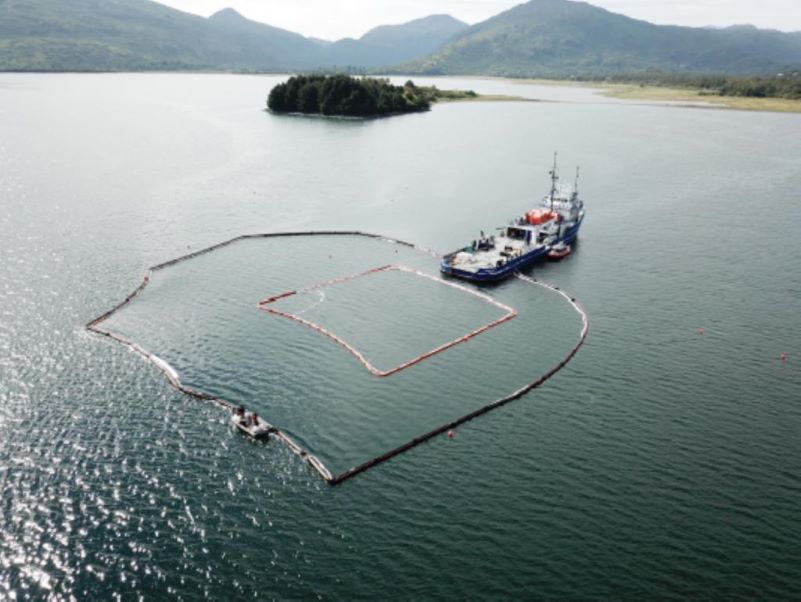
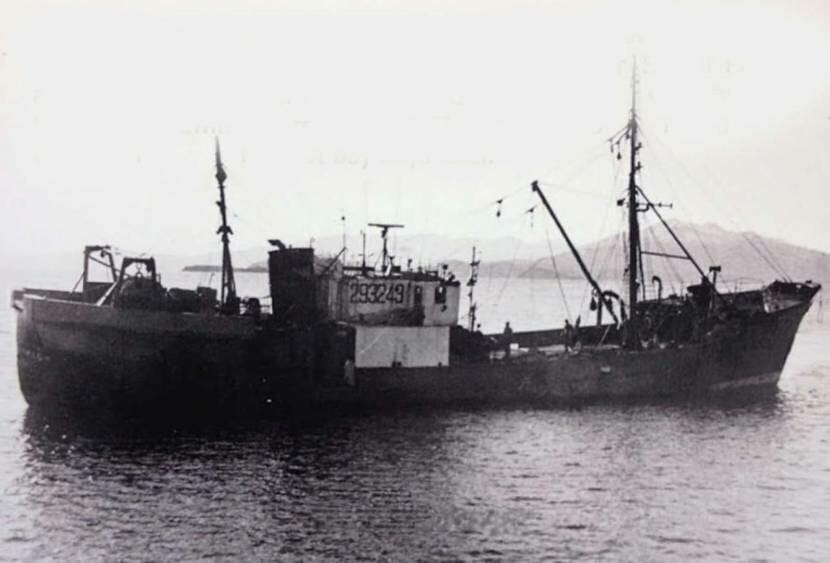
Responders put about 800-feet of boom around a sheen from the sunken ship in Kodiak’s Womens Bay on Aug. 14, 2021. (Photo courtesy of Global Diving and Salvage via Alaska DEC)
Efforts to contain pollution from a sunken scallop boat that sank off Kodiak Island more than 30 years ago have cost more than $3 million in less than a month. The wreckage of the Saint Patrick is a testament to one of Alaska’s deadliest fishing disasters, and it remains an environmental hazard today.
The Saint Patrick lay nearly forgotten at the bottom of Womens Bay until Aug. 3, when an alert passerby noticed an oily sheen on the water’s surface. Divers traced the leaks to several pinholes in the vessel’s hull, where the heads of rivets had corroded away over the past decades, state officials reported this week.
The state’s Spill Prevention and Response Division has been coordinating divers and boom deployment since oil sheens appeared in early August in Womens Bay. Responders say around 10,000 gallons of water mixed with petroleum have been removed.
“We’re making really good progress on removing fuels and this oily water from the vessel so that we can make sure that it doesn’t continue sheening,” Jade Gamble, who has been leading on-scene response, told CoastAlaska on Tuesday. “And we intend to get this vessel as clean as possible so that we don’t have to come back.”
Records are spotty on how the derelict Saint Patrick ended up on the seafloor. Officials only know it went down some time in 1989 after being moored nearby for several years.
“I’m not even for sure the date that it actually sunk,” she added.
But the story goes back several years earlier. And for many in Kodiak’s commercial fishing community, the vessel’s pollution has dragged up memories of one of Alaska’s most devastating fishing disasters, which claimed nine lives in 1981.
“It was a mismanaged boat to begin with,” recalled Bill Harrington, a retired commercial scallop fisherman in Kodiak. “You know that it was over 200 tons, so it’s supposed to have a licensed master mate and engineer. And then I know when it sank, the captain took the trip off and put this guy in charge that didn’t have a license.”
Owners paid out to survivors, victims in multi-million suit
Kodiak maritime attorney Jerry Markham represented one of the two survivors and several families of victims. He says just before the tragedy, the Coast Guard had let the 138-foot ship off with a verbal warning over the licensing issue.
But the owners ordered the Saint Patrick to fish for scallops anyway in late November.
“And the mate went out in a very serious storm and got side to the seas, and the boat rolled so far over that it took water into the air intakes and flooded the engine,” he said, “and that’s what caused the crew to panic.”
The fishing vessel Saint Patrick under tow in 1981 shortly after nine of the 11 crew perished after abandoning ship in rough weather. (Photo courtesy of Kodiak Maritime Museum via Alaska DEC)
The batteries had become waterlogged and someone in the crew became convinced they could explode. Which was unfounded. But that was the fear among the crew — most of whom had little experience on the water.
“They hired these kids out of Homer. A couple of them were under 20, as I recall, and they were for shuckers — that’s all their job was, was to shuck scallops. They didn’t know anything about maritime,” he said.
They were 13 miles offshore, when the order was given to abandon ship for a life raft. But it blew out of reach. Three of the crew members didn’t have survival suits, which in the frigid waters, gave them only minutes to live.
“The boys in survival suits, of course, they lasted 10 hours and watched each one of them slowly die until the last two got cast on different parts of the shore because they were separated,” he said.
Only two of the 11 crew survived after washing ashore on nearby Marmot Island. The disabled Saint Patrick rolled in the rough seas but never foundered.
“It’s just it’s such a tragedy because of the nature of the accident. If the boys that only stayed with the boat,” Marham said of the victims — eight of whom were men, one was a young woman.
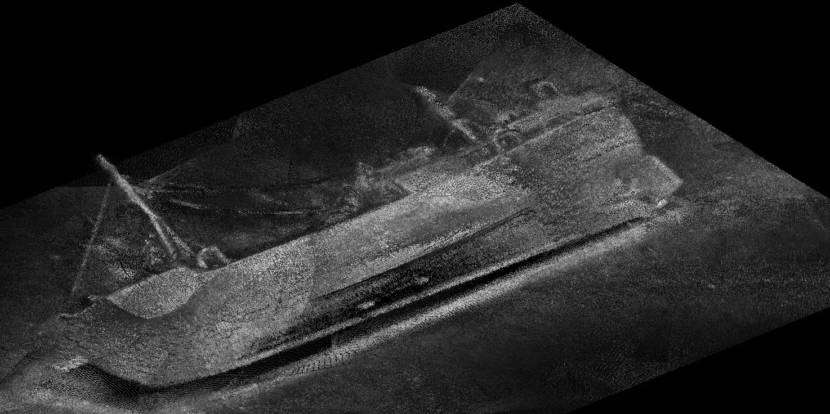
The ship was salvaged a few days later and towed back to Womens Bay, where it remains today in about 58 feet of water.
As legal battle moved onshore, fishing vessel left to rust
Markham spent the next decade in litigation against the four principal owners of the Saint Patrick’s holding company.
“The court found the corporation was a shell and what we call piercing the corporate veil and held them all responsible for the accident,” he said.
It went to federal appeals twice before the court awarded a final payout of nearly $8 million to the two survivors and the estates of nine crew members lost in 1981. That wasn’t until the late 1980s. And during all that time, the abandoned Saint Patrick sat in Womens Bay.
“I wasn’t really concerned with the vessel. We were just looking at the situation, collecting something for the people,” he said.
Apparently nobody was. And the 200-odd ton ship rusted on its moorings while legal battles were fought onshore in federal court.
“The salver, I don’t know if he ever got anything out of it. But for this boat that nobody wanted to touch because it was, quote, a ghost ship,” Markham added.
Bill Harrington, who fished scallops all through the 1980s, remembers the empty Saint Patrick as a fixture on Womens Bay. It was visible from the road until one day in 1989, it wasn’t.
“It was kind of a reminder of the disaster that happened,” Harrington said. “You know, any boat isn’t going to stay afloat if no one’s taking care of it. And no one was taking care of that one, either. So that’s probably why it sank.”
Coast Guard, harbor officials say circumstances of 1989 sinking unclear
Kodiak’s harbor officials say there are no records explaining exactly when or why the ship went down.
Multi-beam sonar image of the bow aspect of the sunken vessel F/V Saint Patrick on Aug. 17, 2021. (Photo by eTrac Inc. via Alaska DEC)
Harbormaster Mike Sarnowski says he’s been calling around looking for answers and reading articles online.
“And nobody really has any information,” he said Wednesday. “So it’s a difficult story to find, but we’ll keep on trying to see if we can figure out if somebody here knows what actually caused the sinking in 1989 and Women’s Bay.”
Meanwhile, first responders are moving into their second month trying to contain any pollution from the sunken ship. The Coast Guard has tapped into federal cleanup funds with about $3 million in public money spent so far.
Efforts to track down those who could be held liable have been fruitless, says Jade Gamble, the on-scene coordinator.
“Many of the businesses that owned or were involved with this vessel in the ’80s are now out of business. And so there’s not been a responsible party identified as of yet,” she said.
Jerry Markham, the maritime lawyer, says he thought the Saint Patrick was a tragedy from another era. But he’s still answering questions about it.
“It’s crazy that they’re still having these problems with it,” he said. “But modern times have changed. Like I said, they’re much more concerned about the pollution these days.”
The ghost ship that claimed nine souls still casts a shadow of sorts over the waters of Womens Bay.
Hundreds of feet of boom encircle the area to keep the oily waste from reaching the shoreline. But this wrecked scallop boat that sank more than 30 years ago still isn’t completely at rest.
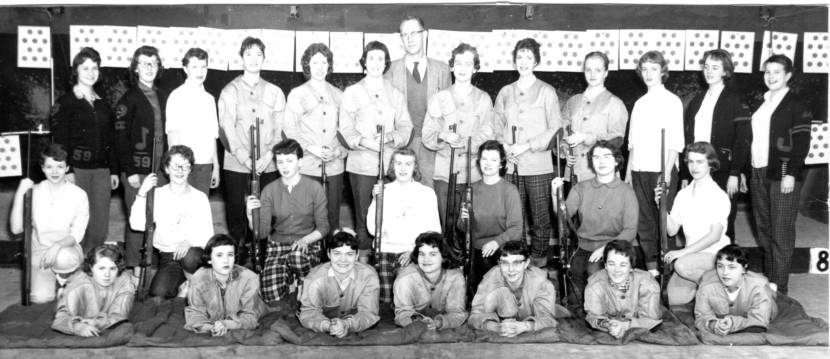
The 1958-1959 girls’ high school rifle club poses for a yearbook photo in the basement of Harborview. (Courtesy of Karleen Grummett)
As part of KTOO’s Curious Juneau project, a listener asked: “Was there really a gun range in the basement of Harborview Elementary School?”
The short answer is yes. It was there for decades, and there are plenty of people still around in Juneau who remember it.
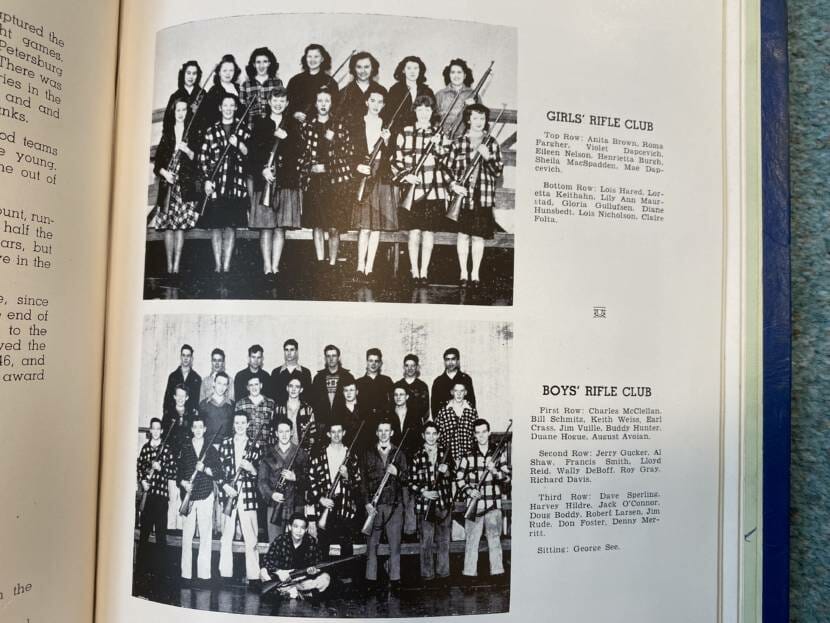
Flipping through decades of Juneau’s high school yearbooks, you’ll find some dated extracurriculars, like candy stripers and the Future Homemakers of America.
You’ll also find the rifle club, which was founded in 1934. Karleen Grummett is a former member.
“Rifle club was one of the more common groups to join in high school, and it sounded like fun to me,” she said. “They had both boys’ and girls’ rifle clubs, and they were both very well attended.”
Grummett participated in the club from 1958 until 1960, when she graduated from what was then Juneau High School (not yet Juneau-Douglas High School).
“It was just assumed that that’s where you went to learn how to shoot a rifle,” she said. “It was in the basement of the Harborview school.”
She joined the group hoping that if she could properly handle a gun, her father would take her hunting.
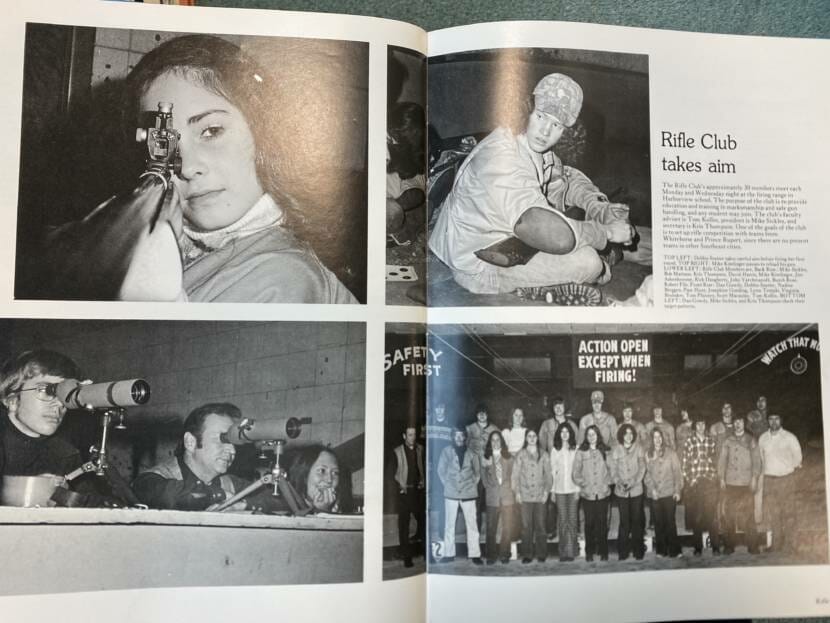
The 1974-1975 high school rifle club as pictured in the yearbook. (Bridget Dowd/ KTOO)
“That didn’t happen, but we still had a lot of fun,” Grummett said. “It was really noisy down there in that basement, with all the guns going off. I have nothing but fond memories of it.”
The girls would start in the prone position and work up to sitting, kneeling and standing.
“There were certain goals for each of those positions,” she said. “At the end of the year, you were awarded some brass bars that you put on a pin on your high school sweater.”
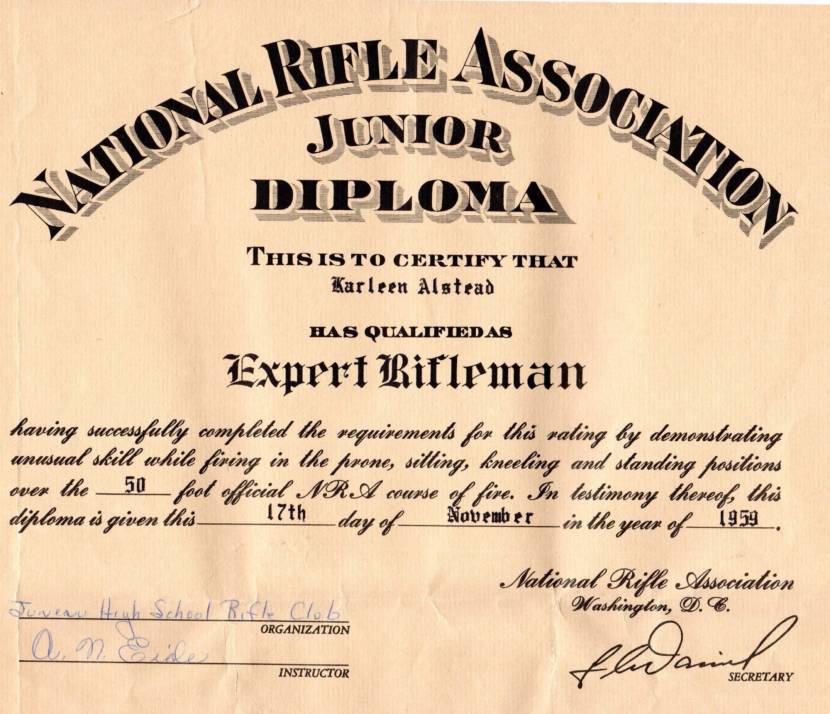
Club members could work their way up to “expert” or “distinguished” levels, and Grummett was proud to achieve the expert title.
Karleen Grummett (then Karleen Alstead) saved this certificate from her time in the Juneau High School rifle club in the late 1950s. (Courtesy of Karleen Grummett)
“But I was a little disappointed when I found out later that the way to get your ‘distinguished’ was to get special time at the gun range, and that wasn’t readily available to women at that time,” she said.
But the high school rifle club wasn’t the only organization to use the Harborview gun range. James Cartmill wasn’t yet 10 years old when he started taking gun safety classes through Territorial Sportsmen in the early 1970s.
“There was an open area down there [in the Harborview basement] right next to the rifle range that we would go in and play around until our names were called,” he said.
Courses were held for several weeks each year, and Cartmill’s family was heavily involved.
“My mom would be the one that would take down the names at the front door,” he said. “You would check in with her, and then they would have movies on shooting safety and hunting. My dad would run the movie projectors in the library area.”
At one point, Cartmill remembers there being about 50 kids involved in the program.
“There was, I believe, five different stations, and each one of the stations had a coach or an adult there to tell you how to use the gun, your breathing, your sight alignment, your trigger squeeze,” he said.
At the end of each day, the kids took their targets home to show off and later received certificates of completion. A few years later, in 1986, Ryan Scott took a hunter education class in the Harborview basement. Now he teaches the course through Alaska’s Department of Fish & Game, but a lot has changed since he first learned to shoot.
“Many of us, when we were older, especially in high school when we were able to drive, would hunt in the mornings before school started or in the afternoons as soon as it got done,” Scott said. “Certainly, I had shotguns in my vehicle because that’s what I was doing after school.”
The 1946-’47 high school rifle club as pictured in the yearbook. (Photo by Bridget Dowd/ KTOO)
Nowadays, taking a gun to school would land you in a lot of trouble. Debates over American gun laws heated up over the years as mass shootings became more frequent.
Scott said his courses aren’t just for hunters, and being familiar with a gun could help dispel some of the fear people associate with them.
“That does give an individual more comfort, just understanding what the firearm really is and what it will do,” Scott said. “And then also knowing, well, this is the type of ammunition. You know, it’s not a shotgun shell, it’s a cartridge, and this is a revolver, this is a semi-automatic pistol, things like that.”
Scott said that education could come in handy even if you don’t have a gun in your home because it’s not uncommon to come across one in someone else’s, especially in Alaska.
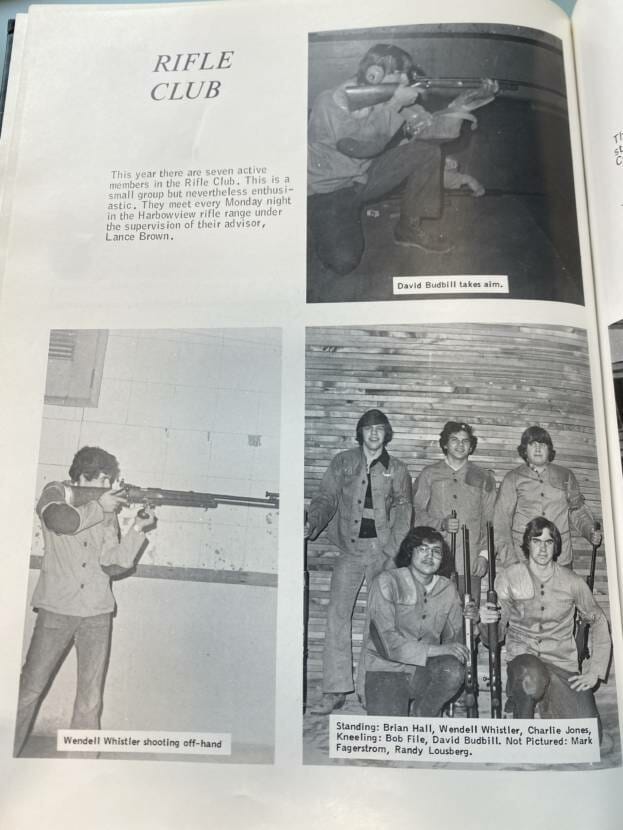
Continuing through those high school yearbooks, the number of rifle club members gets much smaller in the late ’70s, then the club disappears completely.
The 1976-1977 high school rifle club as pictured in the yearbook. The club practiced in the basement of Harborview. (Photo by Bridget Dowd/ KTOO)
As for the rifle range at Harborview, it’s long gone. The school was renovated in the early 2000s and didn’t include a range. Around that time, a new gun range was built in Montana Creek.
But for James Cartmill, when it comes to gun safety, some things haven’t changed. He and his two grown children still go hunting, employing the lessons he learned in Harborview’s basement more than 40 years ago.
“You know, it’s not a toy, it’s a weapon,” he said. “That’s something that I’ve instilled in my kids.”
Are you curious about Juneau, its history, places and people? Or if you just like to ask questions, then ask away!
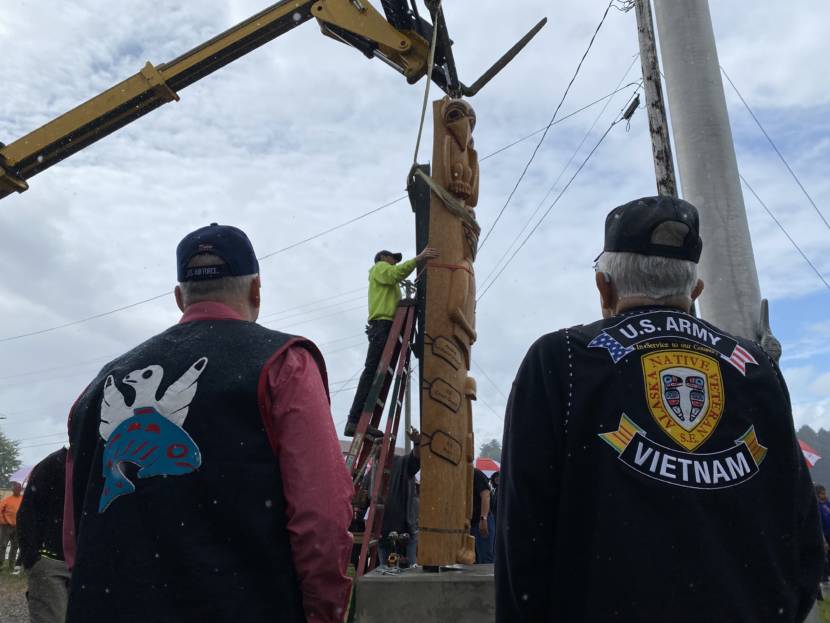
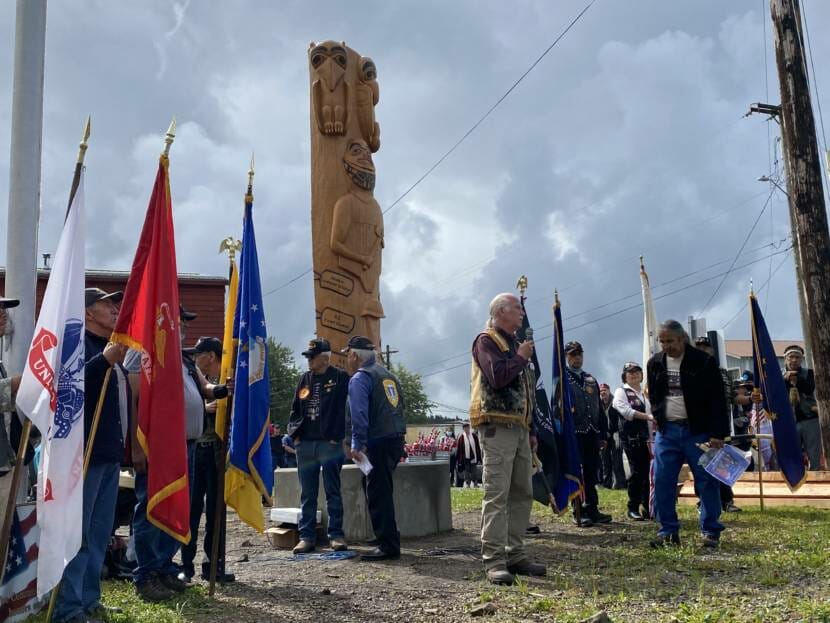
Veterans and their families came together for a totem pole raising ceremony in Hoonah on Saturday, July 24. (Photo by Bridget Dowd / KTOO).
A two-year project honoring Alaska’s veterans is finally complete. On an emotional weekend in Hoonah, service members and their families gathered to celebrate.
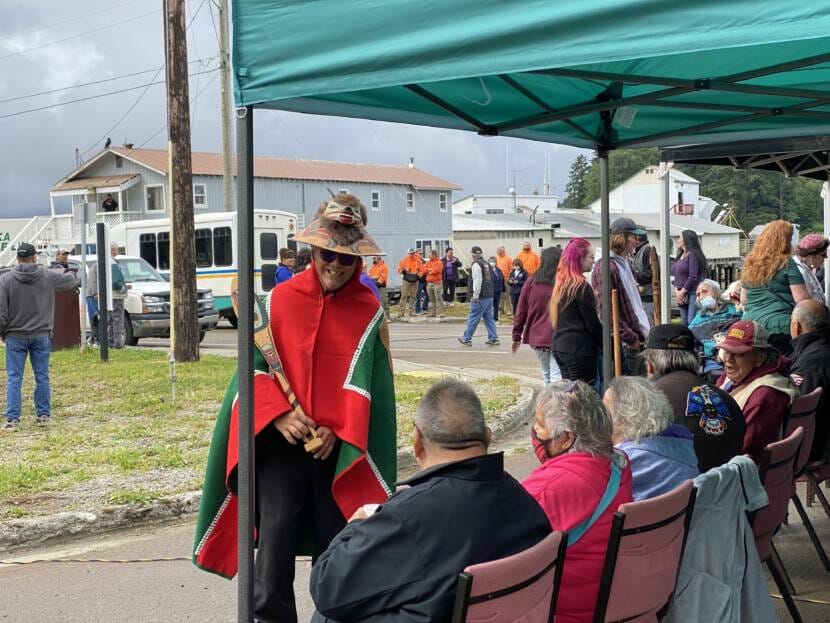
A few hundred people sat for five hours in the rain on Saturday to witness the raising of a totem pole honoring the community’s service men and women.
There are a lot of veterans in Hoonah. At least 10% of the population has served in the military — one of the highest numbers per capita in the country. Even before Alaska was a state, many Alaska Natives stepped up to fight for the United States.
Local artist Gordon Greenwald explains his totem pole design. (Photo by Bridget Dowd / KTOO).
Local artist Gordon Greenwald designed and carved the totem pole.
“All you men and women that have stepped forward, we have tried to honor you the best we could with our hands and our tools,” he said.
He’s not a veteran himself, but he wanted to pay tribute to those who’ve served.
“Gunalchéesh,” Greenwald said. “May our hands do you justice. Thank you.”
Veterans and their families came together for a totem pole raising ceremony in Hoonah on Saturday, July 24. (Photo by Bridget Dowd / KTOO).
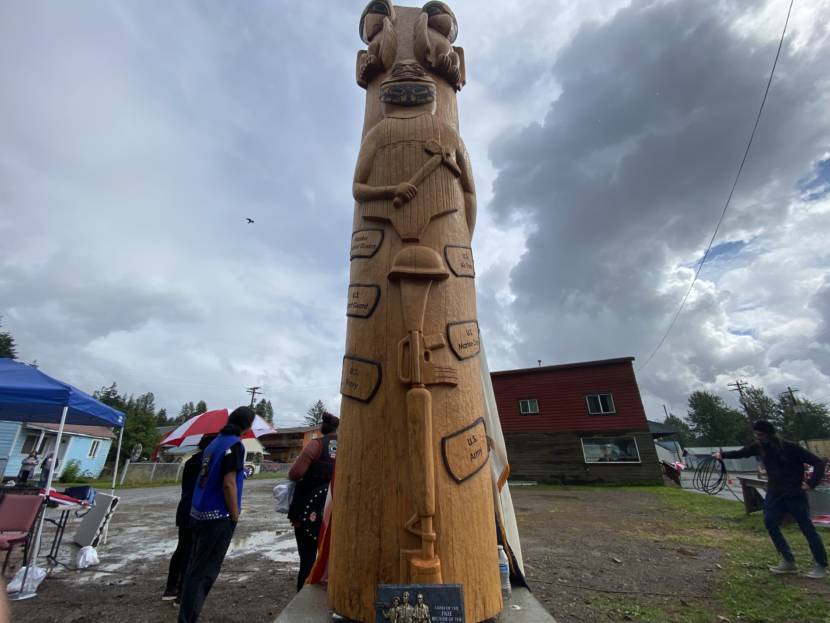
The base of the pole honors the fallen soldier. Moving upward, there are carvings of combat boots from Operation Desert Storm, a Vietnam-era M16 rifle and a World War II helmet.
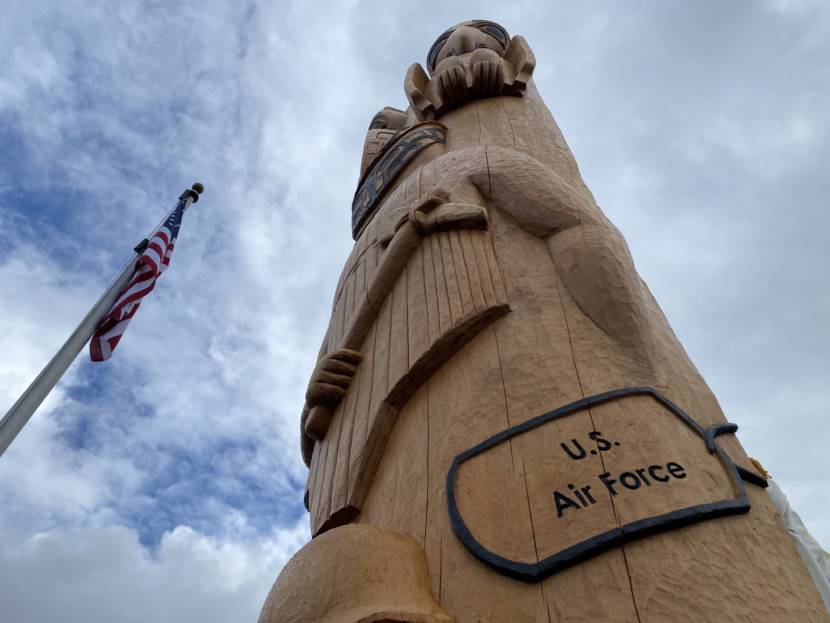
Toward the middle are carved dog tags representing each branch of the service, including the Alaska Territorial Guard, and a Tlingit warrior dressed in armor.
Toward the middle of the totem pole are carved dog tags representing each branch of the service, including the Alaska Territorial Guard, and a Tlingit warrior dressed in armor. (Photo by Bridget Dowd / KTOO).
“And on the top are the eagle and raven,” Greenwald said. “Now you notice that the eagle and raven are turned slightly back to back. It’s not the cold shoulder, but all you military veterans know ‘I’ve got your back, buddy.’”
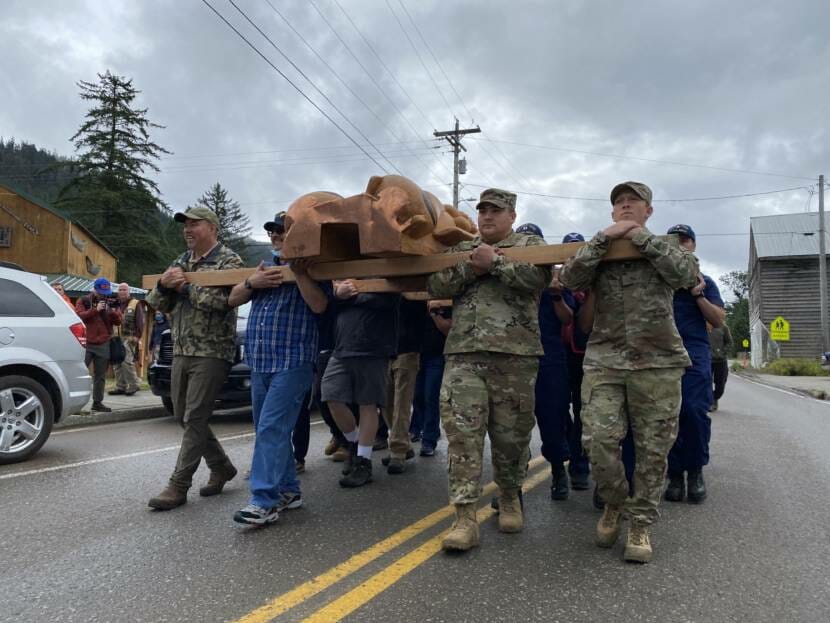
Veterans carry a totem pole to its permanent location in Hoonah. The pole was raised during a ceremony on Saturday July 24. (Photo by Bridget Dowd / KTOO).
Veteran commanders traveled from Sitka, Juneau and Kake to join those from Hoonah. William “Ozzie” Sheakley was the emcee.
“I’m the commander for Juneau Vets so they asked me to emcee over here since I’ve been doing it for a while,” Sheakley said. “The carvers finished last summer, but we weren’t ready to put it up because of the COVID. We wanted to put it up when it was mostly all clear.”
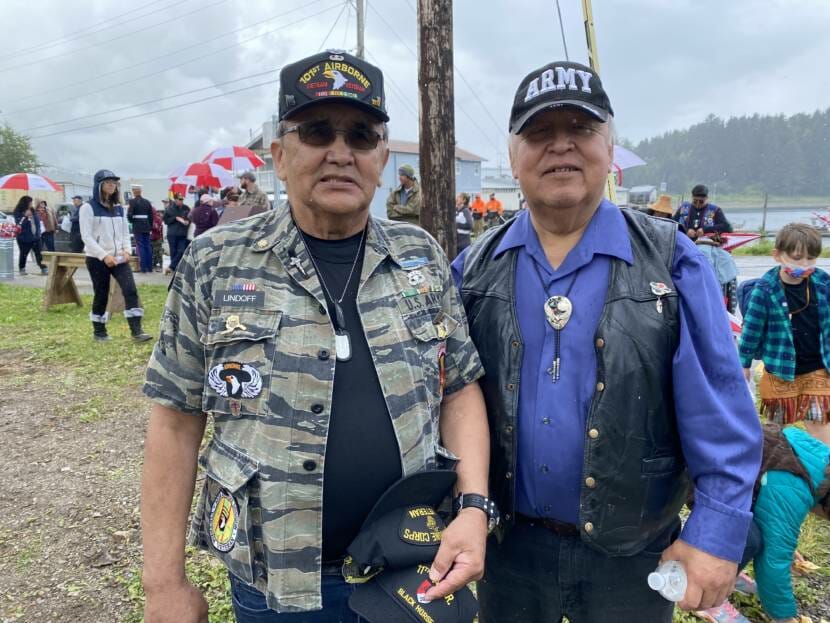
When there was a break in the ceremony for lunch, Sheakley caught up with Hoonah Veterans Commander James Lindoff Jr.
Veterans James Lindoff Jr. and William “Ozzie” Sheakley pose during a totem pole raising ceremony in Hoonah on Saturday, July 24. (Photo by Bridget Dowd / KTOO).
“We were up in Wasilla in ‘98,” Lindoff said. “They got a wall. I told my cousin — he’s passed on — but I told him, ‘We’ll get ours. We’ll get our own.’ Which we are.”
Lindoff was in Vietnam in 1967 and 1968.
He joked as it started to drizzle again.
“Here comes the rain,” he said. I’m gonna lose my curls now.”
And there was plenty of chanting, singing and dancing to be seen throughout the day; the rain not hindering anyone’s ability to appreciate the weight and joy of the occasion.
There are a lot of veterans in Hoonah. At least 10 percent of the population has served in the military — one of the highest numbers per capita in the country. (Photo by Bridget Dowd / KTOO).
The project is a collaboration between the City of Hoonah, the Huna Heritage Foundation, the Hoonah Veterans Committee and Hoonah clan representatives.
The land was donated by Korean War veteran Stanley “Steamie” Thompson who passed away in April. His wife Judy Thompson spoke on his behalf.
“Steamie was born and raised in Hoonah and he was very proud to be from Hoonah,” she said. “He was very proud of his heritage. He was very proud of his family and he was very proud to be a veteran and so that’s why he wanted to dedicate this land to the Huna Heritage Foundation.”
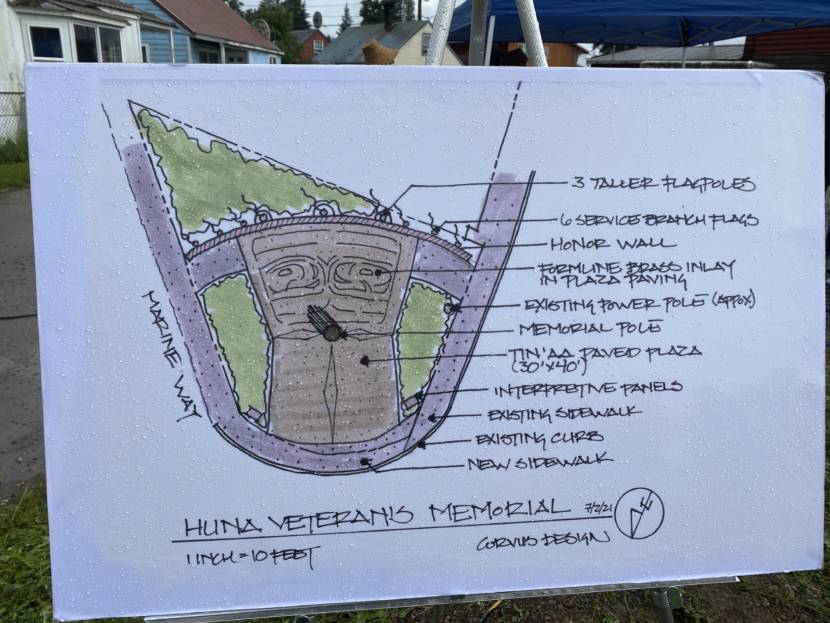
Huna Heritage Foundation Executive Director Amelia Wilson said the totem pole is just the first piece of what will eventually be Huna Veteran’s Memorial Park.
The new totem pole is just the first piece of what will eventually be Huna Veteran’s Memorial Park. (Photo by Bridget Dowd / KTOO).
“There will be a memorial wall honoring those Hoonah Veterans who have passed on and that will be behind the totem pole,” Wilson said. “Then there will be some concrete work in the shape of a Tin’aa, which is like a copper shield and it’ll have some brass inlays and then we’ll have some native plants that will be used for landscaping around it to kind of enclose the space in a natural way.”
Wilson added that it felt good to be able to gather for something positive because the few occasions they’d been able to get together recently were for funerals or the passing of loved ones.
“I think in our community and most other communities too, if you haven’t served yourself, somebody in your family or in your social network has served,” Wilson said. “So it’s really something that can unite us and it really showed at the event.”
Close
Update notification options
Subscribe to notifications
Subscribe
Get notifications about news related to the topics you care about. You can unsubscribe anytime.