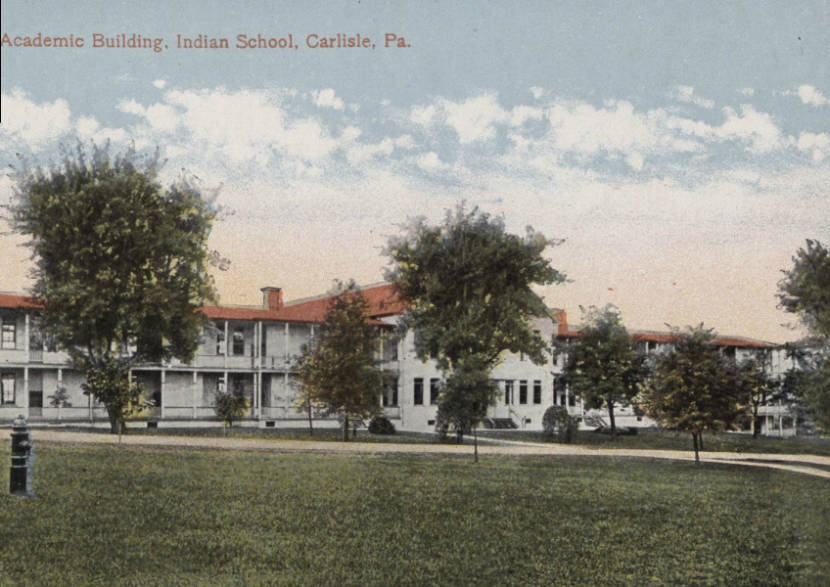
The caption on this artwork reads ‘Academic Building, Indian School, Carlisle, PA.’ (Public Domain image from National Archives and Records Administration)
The remains of an Alaska Native student buried more than 100 years ago at the Carlisle Indian Industrial School in Pennsylvania will return to Alaska.
Beginning June 19, the U.S Army started the process to return the remains of 10 Native students buried at the Carlisle school.
According to a U.S. Army news release, nine students are from the Rosebud Sioux Tribe and one student — Sophia Tetoff — is identified as an Alaskan Aleut.
Sophia entered the school on June 26, 1901, and died there May 6, 1906. According to WITF, a public radio station in Harrisburg, Pennsylvania — Sophia’s remains will be returned to Saint Paul Island, Alaska.
The Carlisle boarding school operated from 1879 to 1918. The site continues to be part of the U.S. Army War College.
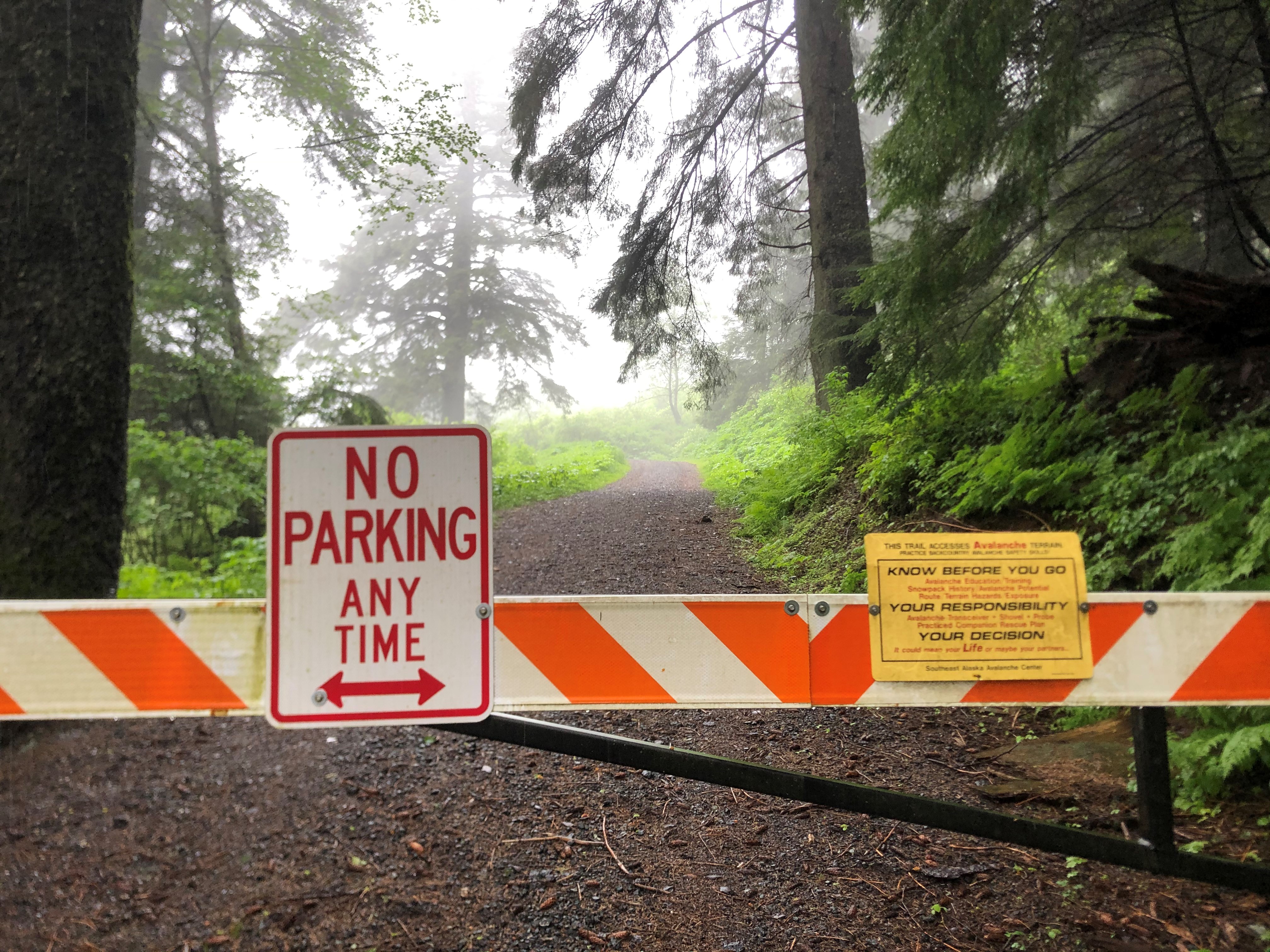
A sign at the end of Judy Lane in Juneau warning about the avalanche path on Mount Juneau. (Jennifer Pemberton/KTOO)
There’s not a great written record of urban avalanches in Juneau. There was a well documented big one in 1962, but most of what we know about destructive slides from before that comes from one lost photograph and stories from old-timers. There is, though, a vast library of climate data and avalanche records that goes back more than a thousand years — it’s inside the region’s trees.
On the side of Mount Juneau: Yadaa.at Kalé there’s a swath of the mountain that has been scoured year after year by avalanches. It’s called the Behrends path because it crosses over Behrends Avenue in a downtown subdivision. There are about two dozen houses there, which study after study has determined are in an unacceptably dangerous place.
The avalanche path itself doesn’t have trees, just a tangle of alder and other bright green spring bushes. But there are trees along its edge, and Erich Peitzsch with the U.S. Geological Survey is visiting from Montana to collect data from those trees.
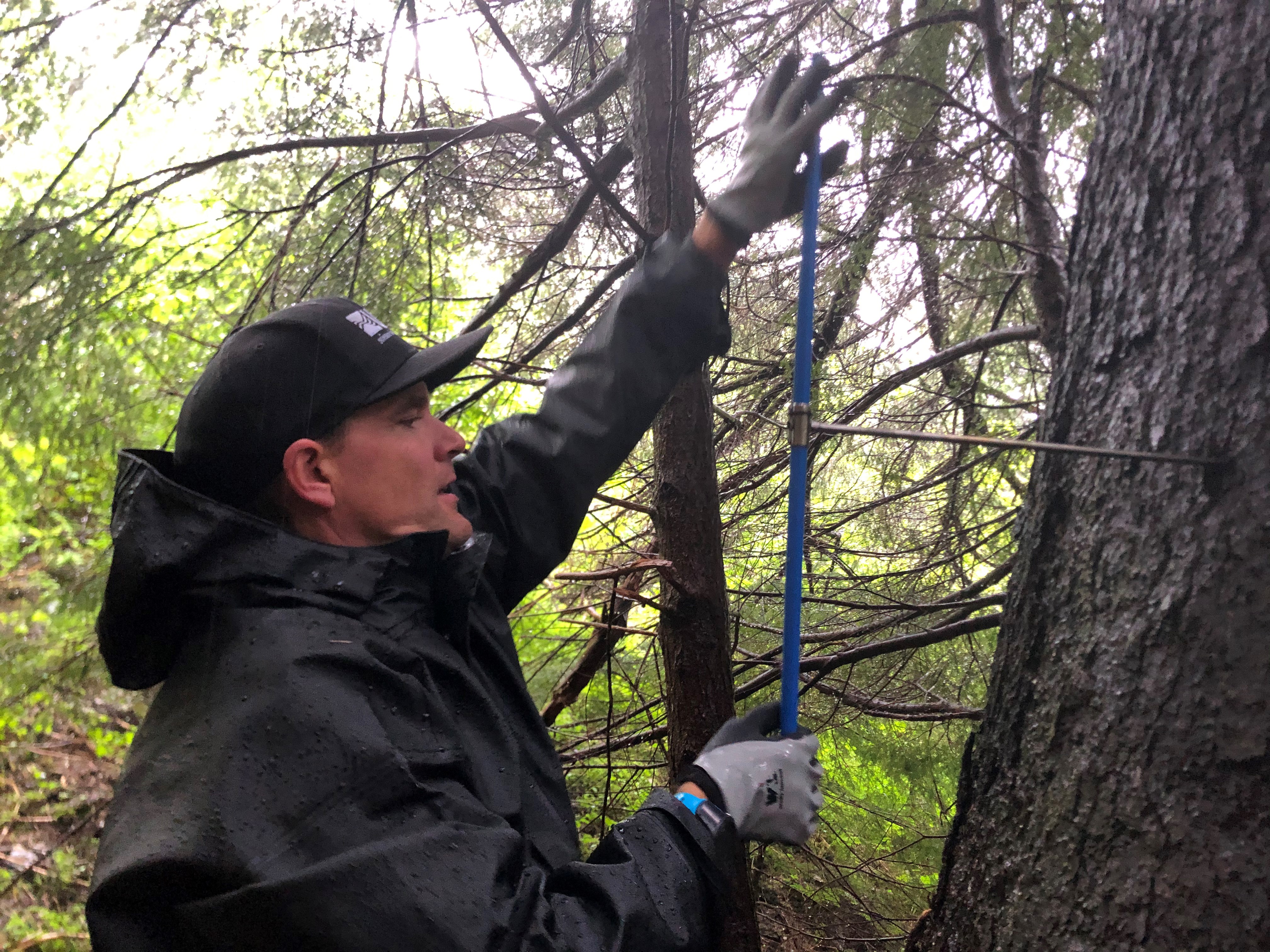
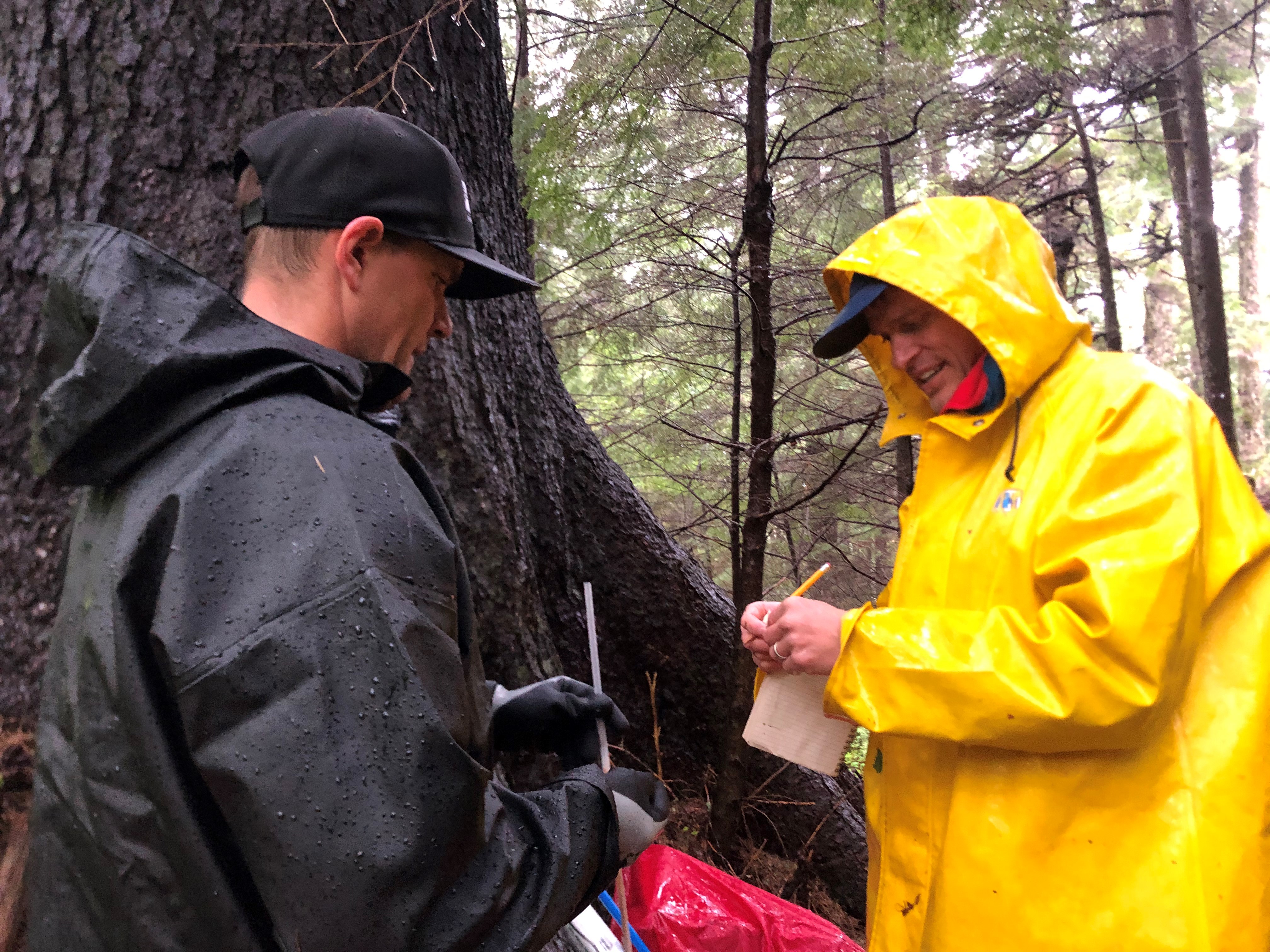
He drills into a big evergreen with a long, thin, corkscrew instrument called an increment borer, which he says doesn’t hurt the tree. It has a nice long handle for leverage, so it looks a little like he’s changing a tire on a giant Sitka spruce.
It’s not backbreaking work, but it’s hard. Peitzsch and his colleagues are going to sample at least 70 trees over three days. One of the grad student’s hands are all bandaged up from gnarly blisters he got cranking on the borer all day.
Erich Peitzsch uses an increment borer to take a tree ring core sample in the Behrends avalanche path on June 2, 2021. (Jennifer Pemberton/KTOO)
When the core comes out, it’s thinner than a pencil and about four times as long. The rings will have to be counted under a microscope in a lab. In addition to figuring out how old these trees are, Peitzsch and his team are also looking for telltale signs of avalanches.
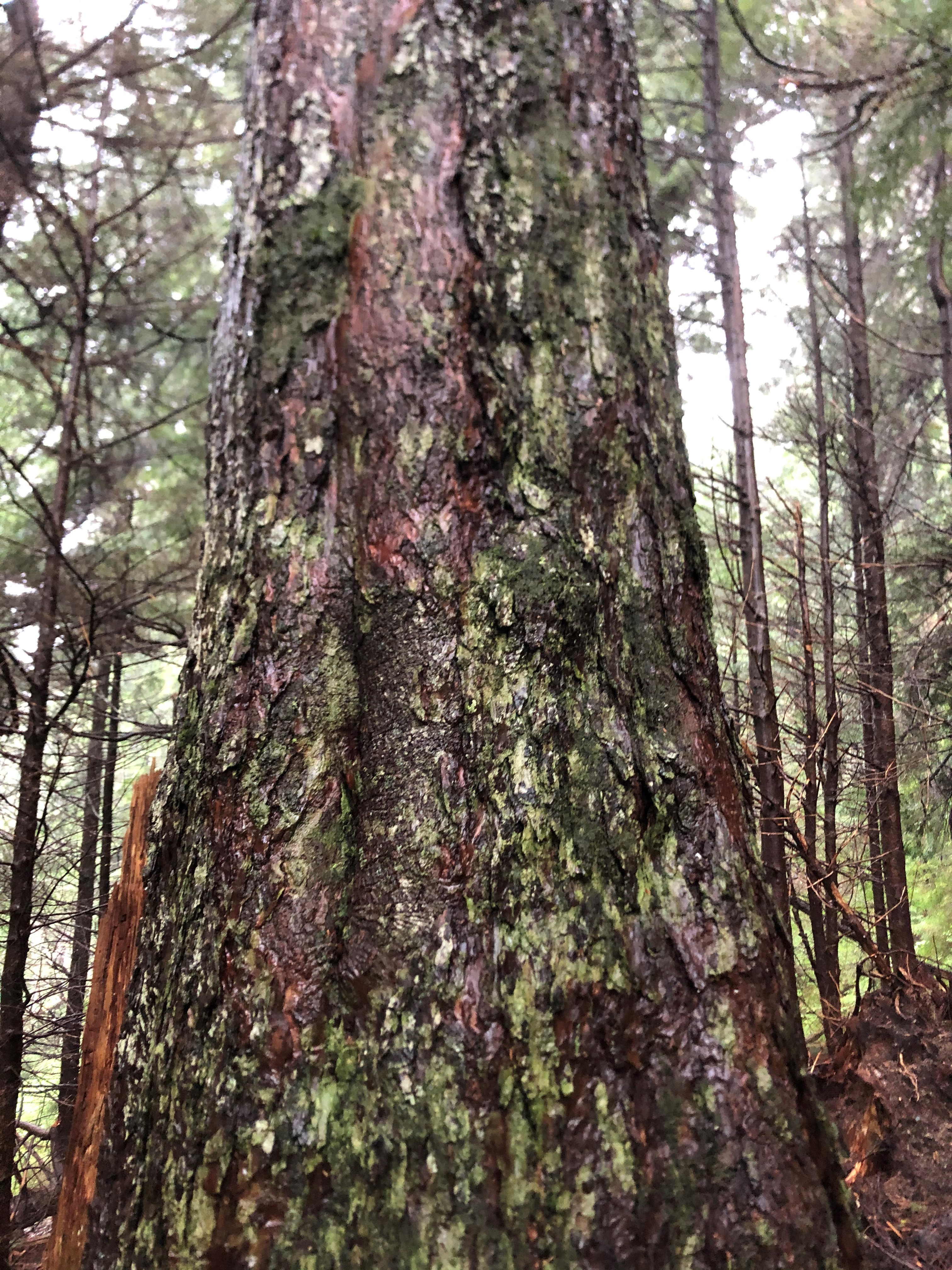
When an avalanche hits a tree but doesn’t knock it over and kill it, it can leave a scar on the uphill side — a place where the bark is gone, leaving a kind of bumpy ridge on an otherwise perfect column of tree trunk. Under the microscope it looks like a little black line on the tree ring for that year.
An avalanche has left a scar on this tree in the Behrends avalanche path on Mount Juneau — a place where the bark is gone and leaves a bumpy ridge. (Photo by Jennifer Pemberton/KTOO)
Juneau is unique in how much of the city is at risk from avalanches.
“In all the places I’ve worked and lived — in Colorado and other places, I’d never seen that many houses right at the bottom of a major path,” said Eran Hood, one of the local researchers from the University of Alaska Southeast.
Avalanche mitigation often takes the form of intentionally setting off small slides with explosives to sort of relieve the pressure for potential big ones, which is what Alaska’s Department of Transportation does along a stretch of highway that goes to Juneau’s Thane neighborhood.
“You close the road, you bomb it, the avalanche comes down, and you clean it up,” Hood said. “But that’s not an option here in the Behrends path.”
It’s way too dangerous to set off small avalanches above the Behrends neighborhood. The path is just too steep, and it’s too hard to control how much snow might come down. Houses could get hit, people could get hurt. You could evacuate the homes while you did it, but then you’d also have to close the main road that connects downtown Juneau to its only hospital.
So far these researchers have crunched the numbers for six different avalanche paths around Juneau, going back more than 500 years. They found that regionwide the median return rate for damaging avalanches was nine years.
A 2011 study estimated that an avalanche reaches the Behrends neighborhood every 15 years. And every 20-30 years, there’s a slide big enough to cause damage to those homes. But that’s a number based on data and models. In reality, Hood says, it’s been much longer than that since there was a big one here.
“There hasn’t been a big avalanche into town really in more than 50 years that’s done damage,” he said. “And so if you think about that, as a generational timescale, there are not a lot of people living here that are that worried about it, right?”
Eran Hood (right) gets a label ready for a tree ring core sample for Erich Peitzsch (left) in the Behrends avalanche path on June 2, 2021. (Jennifer Pemberton/KTOO)
Ten years ago, that study by some Swiss engineers recommended that the best way to reduce the risk of a dangerous avalanche in the Behrends neighborhood is for the city to buy out the houses in the danger zone and make sure no one lives at the bottom of that hill. It wasn’t the first time that had been recommended. But the city has never been willing or able to do that. And when the city asked residents in the path if they were interested in getting bought out, they received very little response.
So scientists and policy makers keep studying in finer and finer detail a risk that you can see plain as day from just about anywhere in town. And, on top of that, they’re trying to figure out what wetter, warmer weather might mean for these trees, this hillside and the people living down below.
Alaska’s Avalanche Capital
This story is part of a KTOO series about Juneau’s urban avalanche risk.
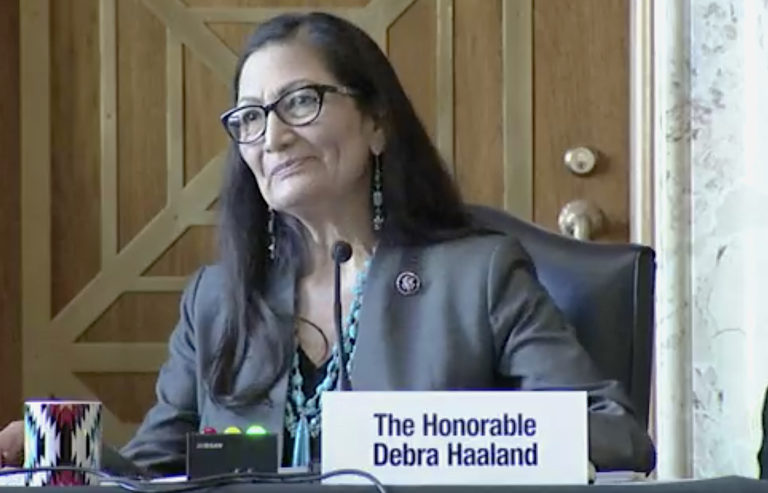
Deb Haaland had a confirmation hearing in the Senate Energy Committee Feb 23, 2021. (Screenshot from Senate Energy Committee video)
Interior Secretary Deb Haaland on Tuesday announced a new initiative to examine the loss of life and traumatic legacy of boarding schools run by the Bureau of Indian Affairs.
Haaland, a member of the Laguna Pueblo and the first Native American to serve as a U.S. cabinet secretary, described it as a national tragedy with personal impact.
“I come from ancestors who endured the horrors of Indian boarding school,” she said at the National Congress of American Indians’ midyear conference, where she announced the Federal Indian Boarding School Initiative.
“Assimilation policies carried out by the same department that I now lead,” she said, “the same agency that tried to eradicate our culture, our language, our spiritual practices and our people.”
Throughout much of the 19th and 20th centuries, Native American students were often forcibly removed from their families and their way of life. Some didn’t see their parents for years at a time. Haaland said the physical and spiritual suffering has harmed entire communities.
The new initiative will document boarding school policies and shed light on their lasting impact, said Haaland. It will also identify burial sites near the schools and try to name every deceased child sent to them.
The initiative is prompted by the discovery of 215 bodies in a mass grave in Kamloops, B.C., at the site of a former Canadian residential school. Haaland said she and her staffers wept when they heard of it.
“Each of those children is a missing family member, a person who was not able to live out their purpose because forced assimilation policies ended their lives too soon,” she said. “I thought of my own child, who carries this generational trauma with them. I thought of my grandmother, who told me about the pain and loneliness she endured when the trains took her away from her family to boarding school.”
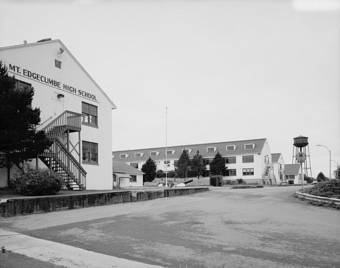
Mt. Edgecumbe School was operated by the BIA from 1947 until 1983. It’s now a state-run boarding high school with competitive admission. (Library of Congress)
In Alaska, the BIA operated three vocational boarding schools in the 1920s. Then in 1932, the agency established the Wrangell Institute in Wrangell and, in 1947, Mt. Edgecumbe School at Sitka. Thousands of Alaska Native students were also sent to BIA schools in Oregon and Oklahoma. Other Alaska boarding schools were operated by churches and later, the state.
Some former students say they had a choice of schools and report positive experiences. Many others tell of beatings and other dehumanizing practices.
Iñupiaq elder Jim Labelle Sr. was sent to the Wrangell Institute when he was 8. He said on “Talk of Alaska” Tuesday that all children had identification numbers written on their government-issued clothes and bedding.
“Children who had difficult names were often referred to only by their number, by many matrons,” he said. “And I can still remember years later children — as we were much older — talking about, ‘Gee, I thought my name was my number.’”
Secretary Haaland has ordered that a final report from the investigation of BIA boarding schools be issued by next April.
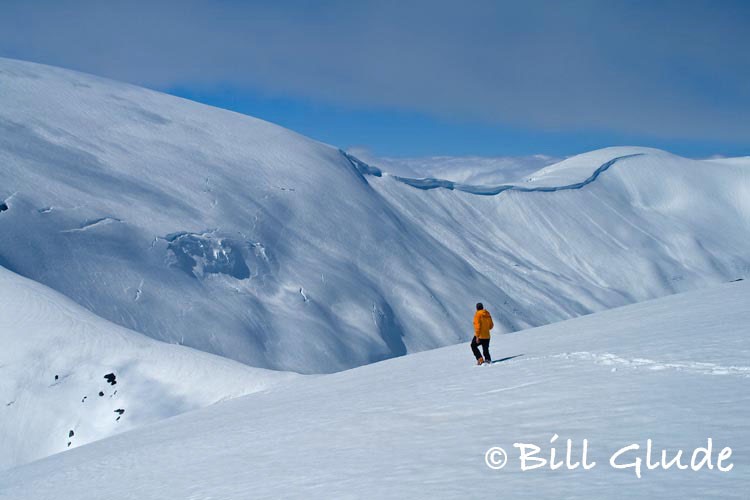
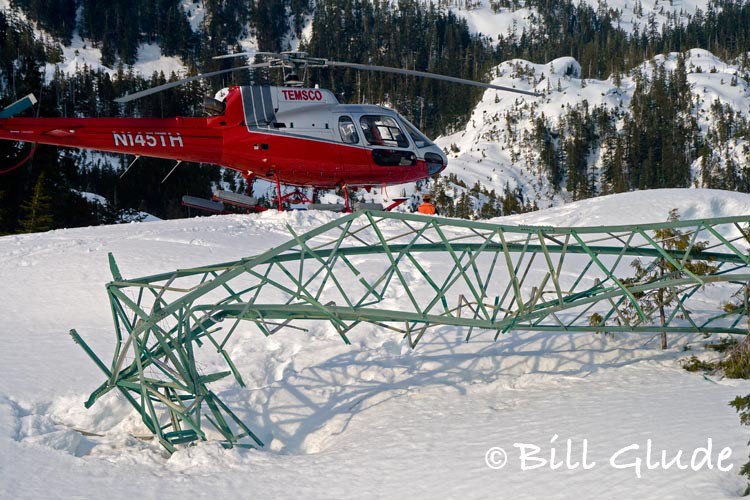
Signs of an avalanche above the transmission line from the Snettisham Hydroelectric Project. (Photo copyright Bill Glude, used with permission)
In the spring of 2008, Juneau residents were affected by a huge set of avalanches that wiped out towers for a power transmission line, severing the capital city’s connection to its biggest source of hydroelectricity, the Snettisham Hydroelectric Project.
Juneau-based avalanche forecaster Bill Glude says the avalanches on April 16, 2008, were the biggest he’s ever seen — at the absolute top of the scale for size and destruction.
“They did, in fact, gouge the landscape,” he said. “Not only did they remove forests, but they took a lot of the area right down to bedrock, just ripped all the soil out as well. It was pretty impressive. There was a lot of yellow cedar floating out in the arm, big chunks of snow and lots of trees.”
The slides damaged at least two towers and destroyed three others for the main transmission line that runs more than 40 miles to town. Juneau got cut off from its main source of cheap hydroelectric power.
A helicopter lands at the site of one of the destroyed towers for the transmission line from the Snettisham Hydroelectric Project. (Photo copyright Bill Glude, used with permission)
Alaska Electric Light & Power, Juneau’s electric utility, ran diesel generators to meet demand. Back then, the high price of diesel fuel meant the typical household suddenly faced electricity bills that jumped to five times what they were before.
Edward Thomas had just finished a term as president of the Central Council of Tlingit and Haida Indian Tribes of Alaska. He still remembers what tribal citizens were experiencing then, like a friend of his who was afraid of turning up the electric heat in his home.
“He had turned everything down too much. And pipes all froze under his kitchen, then flooded out his whole kitchen,” Thomas said. “And he’s handicapped. So, he had a real traumatic experience with all that stuff.”
People who relied on public assistance programs had to wait before their assistance actually matched their increased electricity costs.
“You’re basically behind by two months by the time the family can make up the difference for what they’re paying and the higher costs,” Thomas said.
He also remembers higher grocery costs and cuts in bus service. Thomas says his family focused on conserving electricity. They turned off unneeded lights, dialed down the electric heat and closed off unoccupied rooms. He says they also disconnected everything that still drew power when it was turned off.
Bruce Botelho was mayor of the City and Borough of Juneau at the time. He was focused on conserving energy in those weeks after the avalanche, too. He stopped using his clothes dryer.
“We got in the habit of draping laundry over banisters to dry out,” he said. “A practice that my wife still does on particularly larger items, sheets and the like.”
Botelho says repairs to the transmission line were expected to take several months, but the city wanted to provide fast relief for residents.
The city took a few quick steps, like suspending sales taxes on the extra surcharge for electricity bills. There were also loan programs for businesses and other relief grants for individuals and organizations.
Electricity powers the city’s wastewater treatment plants and the pumps that deliver freshwater around town. So Botelho says they tried encouraging water conservation, too.
“We estimated that the crisis was going to cost an additional $15,000 a day to maintain Juneau’s water system, with literally 140 miles of pipe,” he said.
As well as the damaged and destroyed towers, over a mile of cable from the transmission line itself was carried down the slope and buried in the snow. Bill Glude says that threatened to pull down even more towers.
“They came up with the thoroughly ingenious method of using a deer hunting rifle from the helicopter to shoot out the glass insulator bells to drop the cables,” he said. “They were able to drop all the cables, take the tension off the towers and save quite a few towers.”
Repairs were finished by June 1, 2008, which was nearly two months after the slides but much earlier than expected.
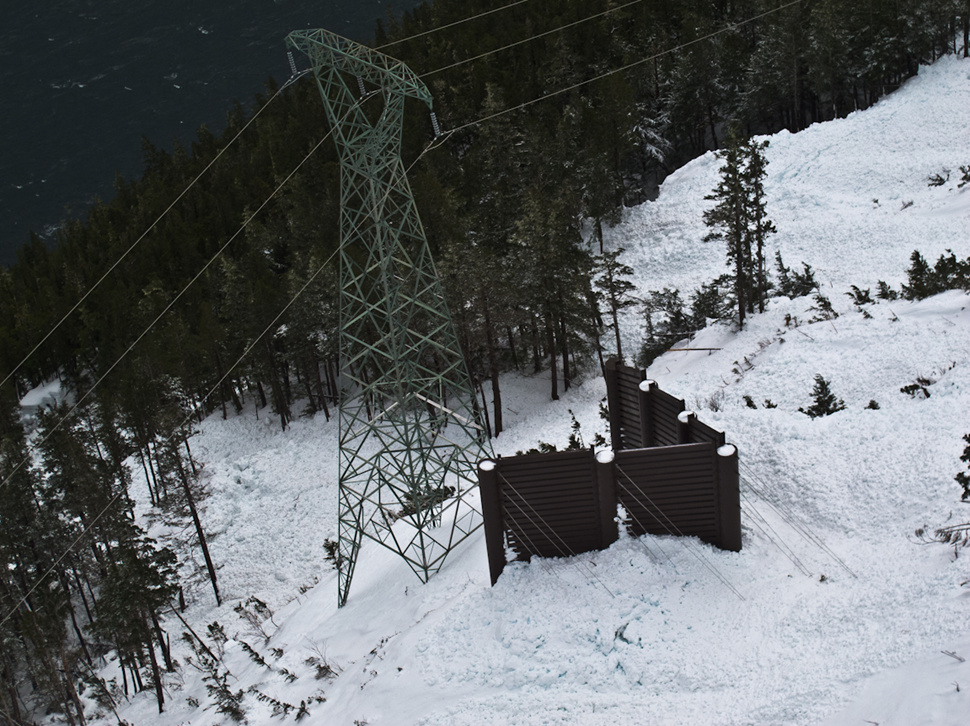
Transmission tower and avalanche diversion structure on the Snettisham transmission line. (Photo courtesy AEL&P)
Glude made several recommendations to the electric utility in the aftermath. Since then, 40-foot tall steel structures were built around some towers to divert snow away from them. And now there’s a state-of-the-art avalanche forecasting and control program.
Glude says the utility is much better equipped now to deal with any potential avalanche hazards along the transmission line.
“Yes, it’s pretty much a night and day difference,” he said.
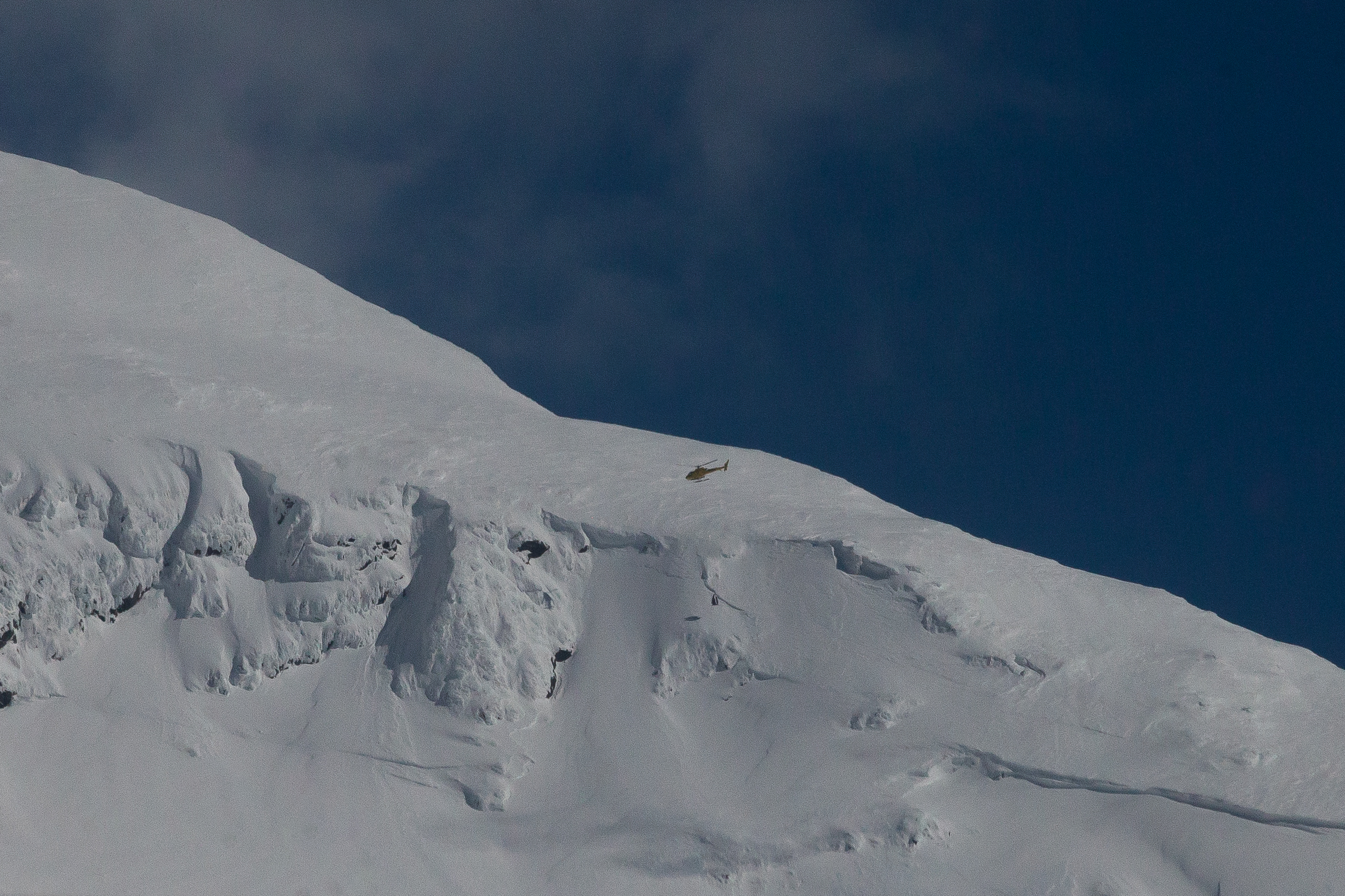
As part of the avalanche mitigation plan, helicopters hovering over the slopes above the power lines are a common winter sight. Since 2010, the utility has been using a device called a daisy bell that hangs down under the choppers and produces a controlled, targeted blast on the snow.
Avalanche control above Thane Road on March 18, 2021 in Juneau, Alaska. (Photo by Rashah McChesney/KTOO)
The city will never be completely safe. Just this winter, a controlled avalanche wiped out a section of those same transmission lines, close to downtown Juneau. Fortunately, the utility had already switched to a set of redundant back-up lines buried in the 1990s under that particular avalanche chute. So this time, residents didn’t even notice.
Alaska’s Avalanche Capital
This story is part of a KTOO series about Juneau’s urban avalanche risk.
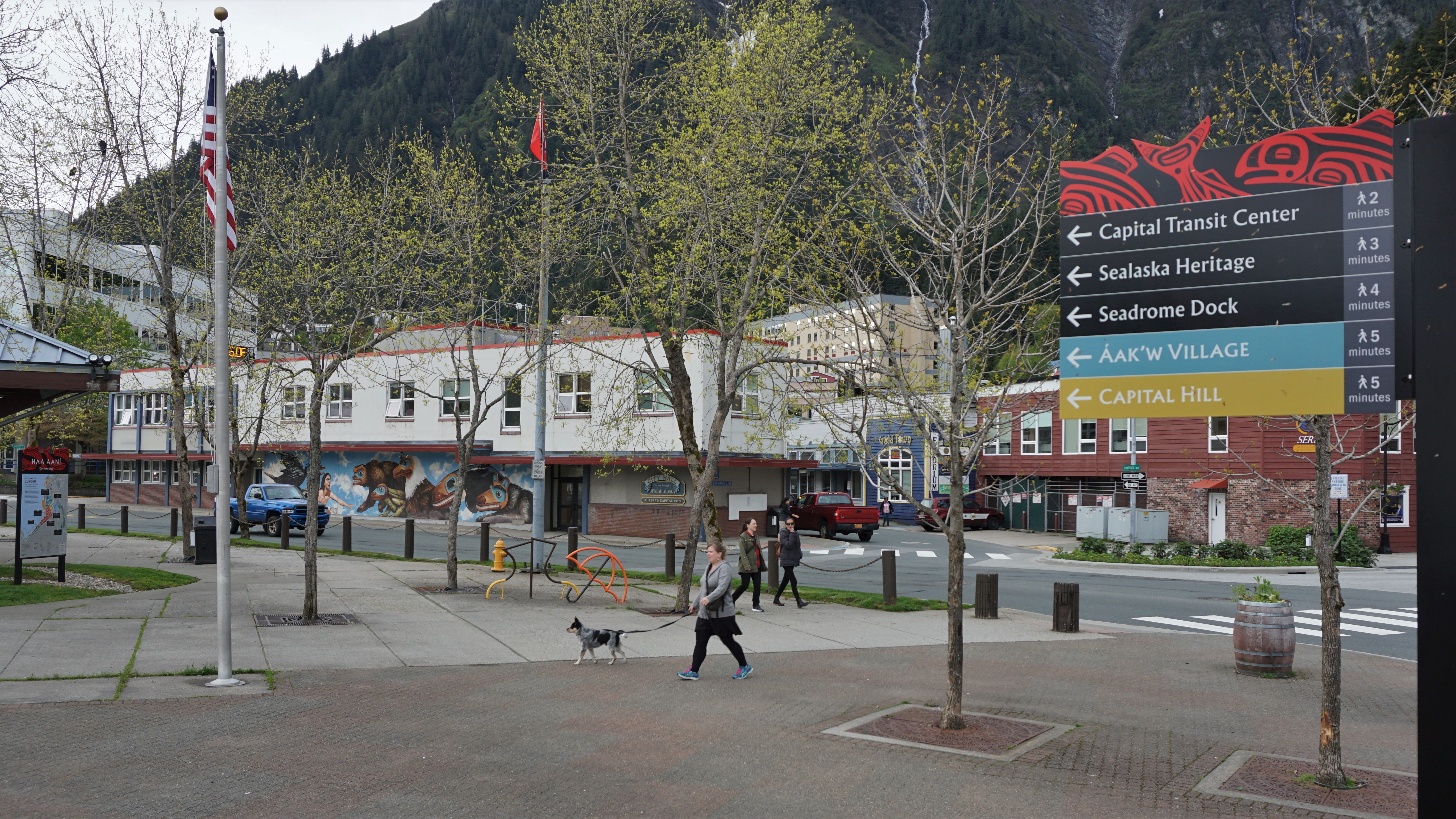
Pedestrians walk through Marine Park in downtown Juneau on June 1, 2021. The wayfinding signage, installed in 2020, incorporates Tlingit place names and voices through audio narratives. (Photo by Jeremy Hsieh/KTOO)
The Juneau Assembly started to include a land acknowledgment as part of its regular meetings in February and made it an official part of meetings in May.
Wayne Klusaa Áak’w Smallwood represents the Áak’w Kwáan Coalition Council. He says T’aaḵu Kwáan aren’t Native to the Juneau area and that they came from up the Taku River, in what is now Canada, to Juneau during the Gold Rush era.
“It’s just, CBJ shouldn’t be acknowledging anybody on our territory period, unless they acknowledge it correctly, which is Áak’w Kwáan,” he said.
Assembly member Christine Woll says the assembly made room for changes when it made the acknowledgment part of its regular meetings.
“We did receive a letter from the coalition, but we also received several other letters from others over the last few months, and so we’ve been evolving it as we go,” she said.
She says the assembly changed the language to mention the more inclusive “Tlingit people” instead of specific clans to make sure it’s honoring the intent of being respectful to the people who are Native to this land.
But for Smallwood, the change doesn’t go far enough.
“So I understand when it says you’re just going to acknowledge the Tlingit country, but there’s no tribe called the Tlingit tribe,” he said. “‘Tlingit’ the word itself means human.”
He also says it doesn’t resolve the issue of a totem pole at Savikko Park in Douglas, which also acknowledges the T’aaḵu Kwáan. The coalition sent a separate letter to the city about the totem pole.
Ben Ooskan Coronell who speaks for the T’aaḵu Kwáan says his clan is also a part of the Juneau’s past.
“What we’re missing out on is history,” he said. “When you deny it — our ancestors, our history — you’re denying that we exist.”
He says he’s not interested in disputes but wants to meet with the Áak’w Kwáan and the city about the land acknowledgment and the totem pole.
“I’m more interested in, what can we do to help develop this community,” he said. “And we’d be willing to compromise and meet with them to see what can we discuss.”
President Richard Chalyee Éesh Peterson of the Central Council Tlingit and Haida Indian Tribes of Alaska said in a statement that the council is glad the city is starting the long-overdue practice of a formal land acknowledgment.
But he says the council is not taking sides on the issue between Áak’w Kwáan and T’aaḵu Kwáan because it does not “involve [itself] in clan business.”
Editor’s note: This story has been updated to correct a typo.
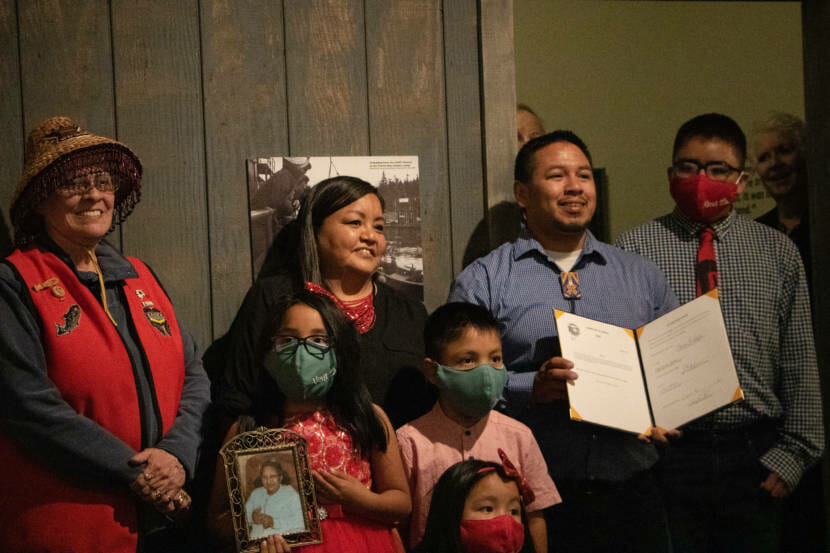
Martin Stepetin stands with his family holding House Bill 10. Alaska Gov. Mike Dunleavy signed the bill into law on June 8 at the Juneau-Douglas City Museum. (Photo by Lyndsey Brollini/KTOO)
Alaska Gov. Mike Dunleavy signed a bill into law protecting the Unangax̂ cemetery in Funter Bay on Tuesday at the Juneau-Douglas City Museum.
Martin Stepetin has been advocating to protect the Funter Bay cemetery since 2014.
“We’ve seen, so many times, all throughout our country, where our sacred grounds have been desecrated and disrespected and not cared for,” Stepetin said. “And that’s what this bill does. It protects it from happening, you know?”
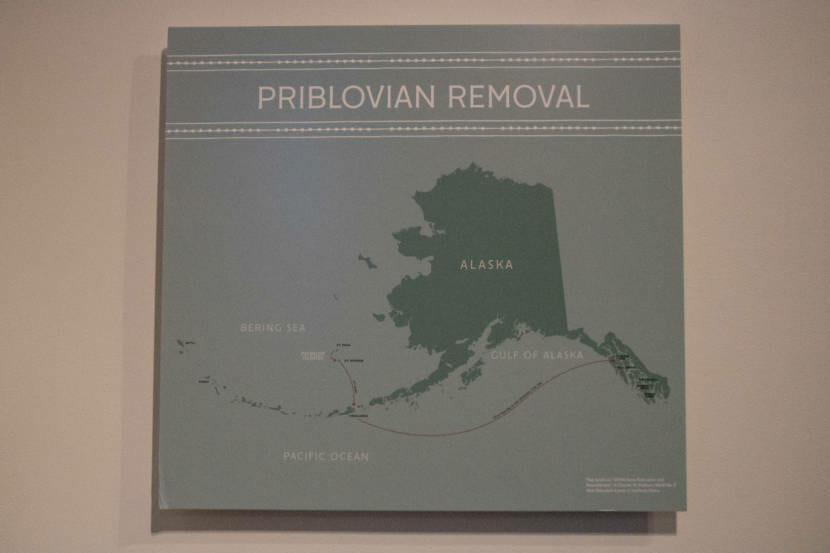
A graphic in the Juneau-Douglas City Museum showing the forced internment of Unangax̂ people from the Pribilof Islands to Southeast Alaska. The graphic is part of an exhibit at the museum – Echoes of War: Unangax̂ Internment During WWII – which runs through October 18, 2021. (Photo by Lyndsey Brollini/KTOO)
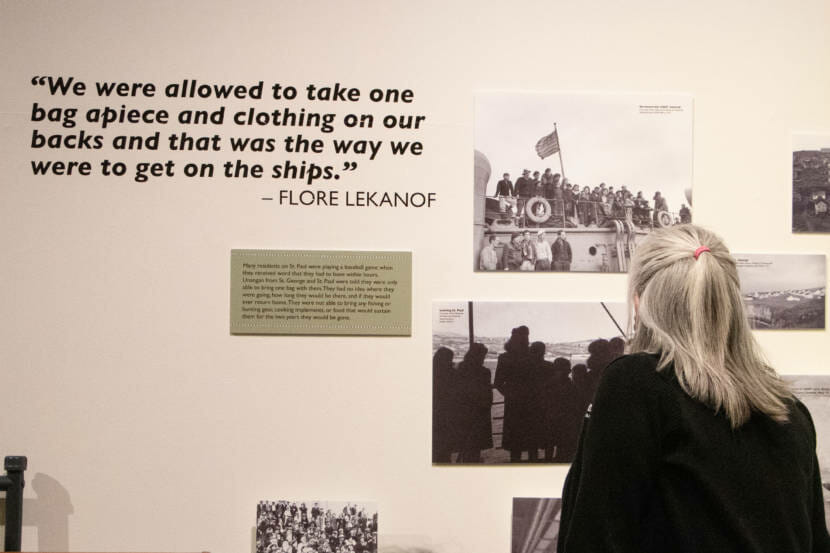
During World War II, the U.S. government forced Unangax̂ people to live in an internment camp in Funter Bay on Admiralty Island; 30-40 people died and are buried in a cemetery there.
The bill signed Tuesday adds the cemetery to the Funter Bay Marine Park. With the cemetery part of a state park, that land cannot be sold or developed, ensuring that the cemetery is protected.
In addition to lawmakers and other people already in Juneau, leaders from the Aleut Corporation and TDX Corporation, the village corporation of St. Paul, flew down to Juneau for the signing event.
For Constance Bergo, vice president of TDX Corporation, the feeling of the bill being signed was indescribable, in a good way. But it was also bittersweet.
“It’s sad because it took, the last time I guess the Elders that came down — there was four, five of them — they’re no longer with us. So it’s sad but it’s healing at the same time,” Bergo said.
Tara Bourdukofsky looks at the current exhibit on display at the Juneau-Douglas City Museum about the Unangax̂ internment in Southeast Alaska during World War II. (Photo by Lyndsey Brollini/KTOO)
To Tara Bourdukofsky, director of Aleut Corporation, the bill is educational for everyone.
“Probably a lot of people, even my own fellow Unangax̂, much in the way that many still don’t understand what happened in World War II, that the bill is probably even a little foreign to them and what it means because people are still learning about it. Even my own people,” Bourdukofsky said.
Even though the bill is now law, Bourdukofsky thinks it will require continual education for people to understand the effects of the World War II internment on the Unangax̂ people to this day.
Close
Update notification options
Subscribe to notifications
Subscribe
Get notifications about news related to the topics you care about. You can unsubscribe anytime.