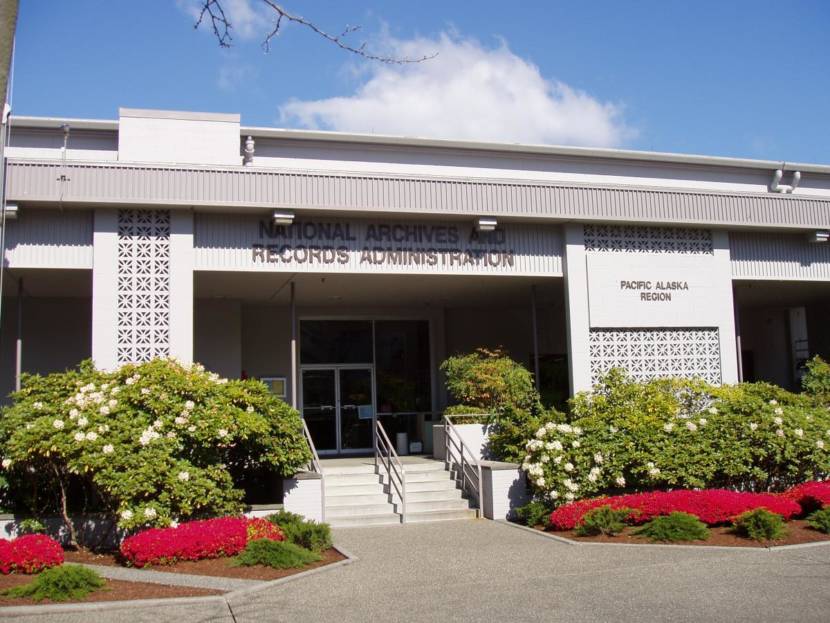
The National Archives and Records Administration facility in Seattle is earmarked for closure and to be sold in an effort to cut federal spending. The Office of Washington state’s Attorney General filed a motion to seek a preliminary injunction to block the sale. (Photo courtesy of the National Archives and Records Administration)
The Biden administration has cancelled the sale of a National Archives building in Seattle, citing a lack of tribal consultation.
Alaska Native and Pacific Northwest tribes opposed the sale when it was revealed during the Trump administration. They said the move would displace documents and artifacts important to their heritage. The plan was to rehome them in other Archives facilities in Missouri and California.
Acting Director of the Office of Management and Budget Shalanda Young wrote a letter Thursday saying that she’s withdrawing approval for the sale of the facility on Sand Point Way.
“The president’s January 26, 2021 Memorandum on Tribal Consultation ‘charges all executive departments and agencies with engaging in regular, meaningful, and robust consultation with tribal officials in the development of Federal policies that have tribal implications,’” she wrote. “But the process that led to the decision to approve the sale of the Federal Archives and Records Center is contrary to this administration’s tribal-consultation policy, and I am accordingly withdrawing OMB’s approval of the sale of that facility.”
The Alaska collection had already been displaced once. In 2014, the National Archives closed its Anchorage branch and moved almost everything to Seattle.
Rep. Deb Haaland, at podium, spoke at a rally in Washington, D.C. to oppose drilling in the Arctic National Wildlife Refuge in 2018, a few weeks before she was sworn in as a member of Congress. On March 15th, 2021, Haaland was confirmed as a Secretary of the United States Department of the Interior. (Liz Ruskin/Alaska Public Media)
Deb Haaland, a member of New Mexico’s Laguna Pueblo, has become the first Native American cabinet secretary in U.S. history.
The Senate voted 51-40 Monday to confirm the Democratic Congresswoman to lead the Interior Department, an agency that will play a crucial role in the Biden administration’s ambitious efforts to combat climate change and conserve nature.
Her confirmation is as symbolic as it is historic. For much of its history, the Department of the Interior has been used as a tool of oppression against America’s indigenous peoples. In addition to managing the country’s public lands, endangered species and natural resources, the agency is also responsible for the government-to-government relations between the U.S. and Native American tribes.
“Indian Country has shouted from the valleys, from the mountaintops that it’s time. It’s overdue,” Pueblo tribal member Stephine Poston told NPR after Haaland was nominated.
It’s not the first time Haaland has made history. In 2018, she became one of the first two Native American women elected to Congress. Her nomination by President Joe Biden to lead Interior was celebrated by tribal groups, environmental organizations and lawmakers who called the action long overdue. But it faced opposition from Republican lawmakers and industry groups who portrayed Haaland’s stance on various environmental issues as extreme.
“I’m deeply concerned with the Congresswoman’s support on several radical issues that will hurt Montana, our way of life, our jobs and rural America,” said Republican Sen. Steve Daines of Montana, who worked to block Haaland’s confirmation.
As a Congresswoman, Haaland was a frequent critic of the Trump administration’s deregulatory agenda and supported limits to fossil fuel development on public lands. She opposes hydraulic fracturing, or fracking. She was also one of the first lawmakers to support the Green New Deal, which calls for drastic action to address climate change and economic inequality.
Republican lawmakers grilled her over those stances during her confirmation hearing in an effort to portray her as a radical choice to manage the nation’s public lands, but Haaland struck a moderate tone, repeatedly saying that as Interior Secretary she would aim to accomplish Biden’s environmental goals — not her own.
Biden has not supported the Green New Deal or bans on fracking, and has taken a more balanced approach to fossil fuel development on public lands. He put a temporary pause on new oil and gas leases on federal lands while his administration reviews the broader federal leasing program.
“There’s no question that fossil energy does and will continue to play a major role in America for years to come,” Haaland said during her confirmation hearing, before adding that climate change must be addressed.
Haaland has called the climate crisis the “challenge of our lifetime,” and as Interior Secretary she’ll play a key role in the Biden administration’s efforts to address it. Biden has pledged to make America carbon neutral by 2050, an effort that would require massive changes to the industrial, transportation and electrical sectors.
The Interior Department manages roughly one-fifth of all the land in the U.S., as well as offshore holdings. The extraction and use of fossil fuels from those public lands accounts for about one-quarter of the country’s total greenhouse gas emissions.
“The Department has a role in harnessing the clean energy potential of our public lands to create jobs and new economic opportunities,” Haaland said during her confirmation hearing. “The president’s agenda demonstrates that America’s public lands can and should be engines for clean energy production.”
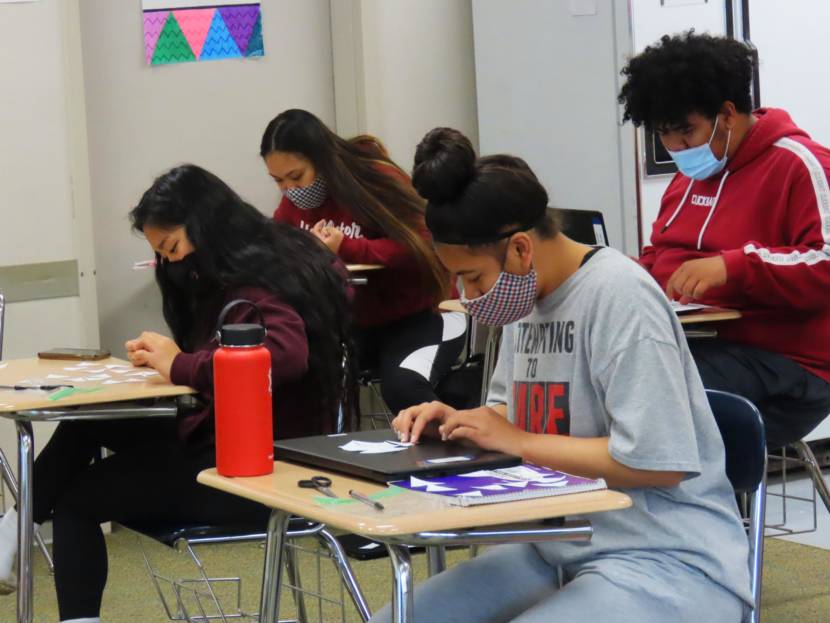
High school teacher Hannah Vowell said she consistently seeks out work and examples from diverse voices and authors, no matter what subject she is teaching — whether that be math, science, Spanish or photography. (Photo courtesy of Hannah Vowell)
February was Black History Month, a time when schools, libraries and organizations across the nation often pause to celebrate Black history and recognize the United States’ violent and unjust treatment of Black people.
But in Unalaska, many teachers didn’t do anything special in their classrooms last month because they are working to include Black history and perspectives in their lesson plans year-round.
“It’s kind of like we’re saying your history isn’t history, and your literature isn’t literature, and your art isn’t art unless it’s February — the shortest month of the year,” said fifth and sixth-grade teacher Greta Eustace. “And that just never seemed right to me.”
Eustace teaches language arts and social studies on the island, and while she acknowledges Black History Month with her students, she said she tries to consistently highlight work from Black Americans throughout the year.
According to Eustace, one month of recognition is not sufficient, but she said the month is necessary to help ensure that people acknowledge Black history and that teachers include Black voices in their curriculum.
“I just don’t think [Black History Month] should be a necessary thing and unfortunately, it is,” Eustace said.
Discussing Black history and racial inequality, as well as including diverse voices are all inherent parts of her classroom and teaching style, she added.
“It’s important to consider the fact that social justice belongs in every classroom and that cultural sensitivity in classrooms promotes connection and equity with students,” she said. “And you have to consider presenting the world from the perspective of your students and the perspective of underrepresented people, in addition to what we would call the classics.'”
Eustace calls this approach “decolonizing” her curriculum. By providing her students with diverse texts from diverse writers, she’s giving them the tools they need “to form an educated opinion of the world around them and not just regurgitate what they’ve been told over and over in their lives.”
High school English teacher Jacob Collins-Wilson echoed Eustace’s sentiments and agreed that Black history should be included year-round.
“Isolating it, I don’t think is the healthy way or the way that I want my classroom, or my life, or the world to be,” said Collins-Wilson. “Black history is not isolated to one month, or one subject, or one kind of conversation. I think it’s inherent in everything no matter what we’re reading or writing.”
Excluding Black history throughout the year and then highlighting it in his lessons in February feels like a “cop-out,” he said. Instead, Collins-Wilson makes sure to include essays, stories and ideas from people of diverse backgrounds from the beginning of the year.
“My whole teaching from the get go has been much more infused with women and people of color and a big focus on international writers as well,” he said. “Basically, to use English class as a way to explore not only language or writing but also identity and culture.”
The recent Black Lives Matter movement has helped facilitate more conversations with his students about racial injustice, police violence and Black history in general, he said. The movement and its social media presence have encouraged people — his students included — to think more diversely.
“As an English teacher, I love that because then we get to read such different stuff,” Collins-Wilson said. “And it’s harder for a student to say, ‘this is irrelevant.’ When, if we look at our nation right now, we’re having tons of conversations around race and identity and culture and language and equality and treatment and power dynamics. So it’s really important to talk about that and to read different perspectives that relate to those different topics.”
English and social studies teachers are not the only ones incorporating discussions about race dynamics and injustice into their classrooms. Hannah Vowell said she consistently seeks out work and examples from diverse voices and authors, no matter what subject she is teaching —whether that be math, science, Spanish or photography.
While she has included some specific lessons in both her Spanish and photography courses this year to celebrate Black History Month, Vowell said she considers it her general responsibility to make time in her classroom to address conversations about things like diversity and culture.
“I think it’s my job to lead discussions and provoke critical thinking about what’s happening in the world,” she said.
In a school district with a teaching staff that does not mirror the diversity of the student population, these teachers — who are all white — recognize that conversations about race and inequality can be very complicated.
While Eustace said she finds the lack of diversity in the teaching population on the island disappointing, she considers it her responsibility to provide kids with a diverse education that always includes Black voices and perspectives.
“The kids who need you the most are the ones who need an activist, ones who need people to fight for them to be represented and heard and seen in the world,” she said. “And if you’re not an activist, you’re not really helping the kids who are most in need.”
Since 1976, every U.S. president has officially designated the month of February as Black History Month. Other countries around the world, including Canada and the United Kingdom, also devote a month to celebrating Black history.
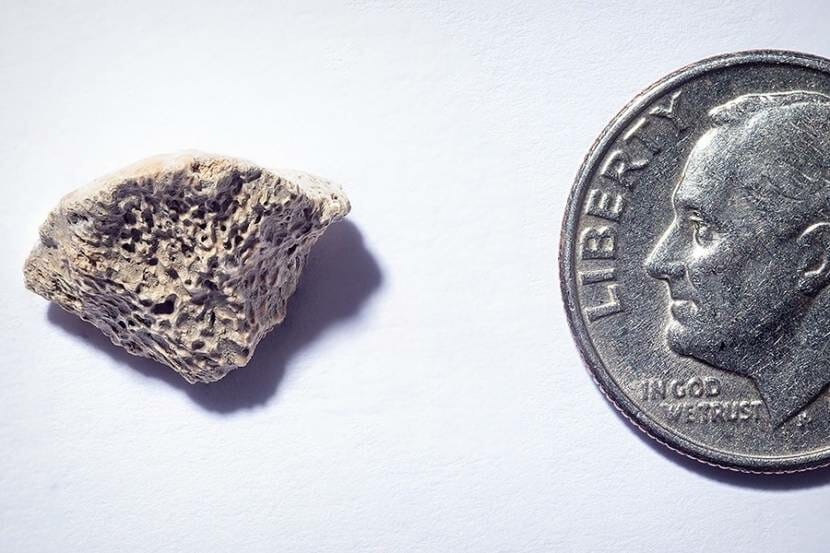
This bone was part of the femur of a dog that lived more than 10,000 years ago. (Courtesy of SUNY Buffalo/Douglas Levere)
A dime-sized fragment of dog bone — more than ten-thousand years old — has given researchers new clues about how domesticated dogs first made their way to the Americas.
Examining a pinto bean-sized bone fragment, the scientist thought she was analyzing an ancient bear bone.
“We have sort of a long standing project working on bear bones from these caves,” explained Charlotte Lindqvist. She’s an associate professor of biology at the State University of New York at Buffalo.
Caves dot the Alexander Archipelago in Southeast Alaska. The fragment of leg bone Lindqvist was examining came from a cave on the mainland just east of Wrangell Island. The cave is a marble tube, about the length of a standard swimming pool.
“This DNA, when we were looking at it and analyzing it, we realized: ‘This is not bear DNA,’” Lindqvist continued.
“That is among the oldest dog remains that we have from North America,” Lindqvist said. Ancient dog remains are a rare discovery on their own, but Lindqvist explains that the location is also part of what makes this identification so exciting.
To understand why, it helps to look back to the Ice Age — which ended about 10,000 years ago.
“During the Ice Age most of North America was completely covered in these two big ice sheets. So there was no contact north and south of the ice sheet,” said Lindqvist.
Basically, a band of ice across Canada and the northern United States prevented the people living in northern Beringia — including what is now Alaska — from moving south into what’s now the Lower 48.
Lindqvist continued: “There has been this long-standing hypothesis that as soon as these two ice sheets started melting, it opened up a sort of continental or inland corridor. If you have seen the Disney movie ‘Ice Age,’ that’s sort of what is displayed in that movie. But more and more, we’ve started to believe that the coast probably started melting earlier and became viable earlier than this inland corridor.”
And as the adage goes: “A dog is a man’s best friend.”
“Finding a dog on the coast can tell us a lot,” Lindqvist continued, “not just about dog migration and where dogs have been — but also humans, because dogs follow alongside humans.”
And human remains and tools from various points in ancient history have been found in the same cave off Wrangell Island.
The dog bone Lindqvist and her colleagues — Flavio Augusto da Silva Coelho, Stephanie Gill and Crystal Tomlin — analyzed was collected in the late 1990s by a now-retired earth science professor at the University of South Dakota named Timothy Heaton.
The 50,000-odd bones now reside in the collections of the Museum of the North in Fairbanks.
The piece of dog femur may be tiny, but Lindqvist says it could still yield a lot of information.
“For now,” she said, “we have just isolated the DNA from the mitochondria in this bone, and that is inherited from the mother. So it only tells us the maternal history of this dog. If we can, from this tiny little bone that we have left, get some nuclear DNA — DNA from the genome, we might be able to get deeper insights into the history of this particular dog and the history of new world dogs.”
Lindqvist says she hopes for other discoveries in the thousands of bones from Southeast caves that are left to analyze.
“I’m sure it’s not the last [exciting discovery],” she said, “and it will be exciting as we hopefully will find older remains as well.”
The cave off Wrangell Island has only been partially excavated. That’s because it is a heritage site, protected by federal law. Human remains from the site have been repatriated to Wrangell’s Tlingit tribe, the Wrangell Cooperative Association, under the Native American Graves Protection and Repatriation Act.
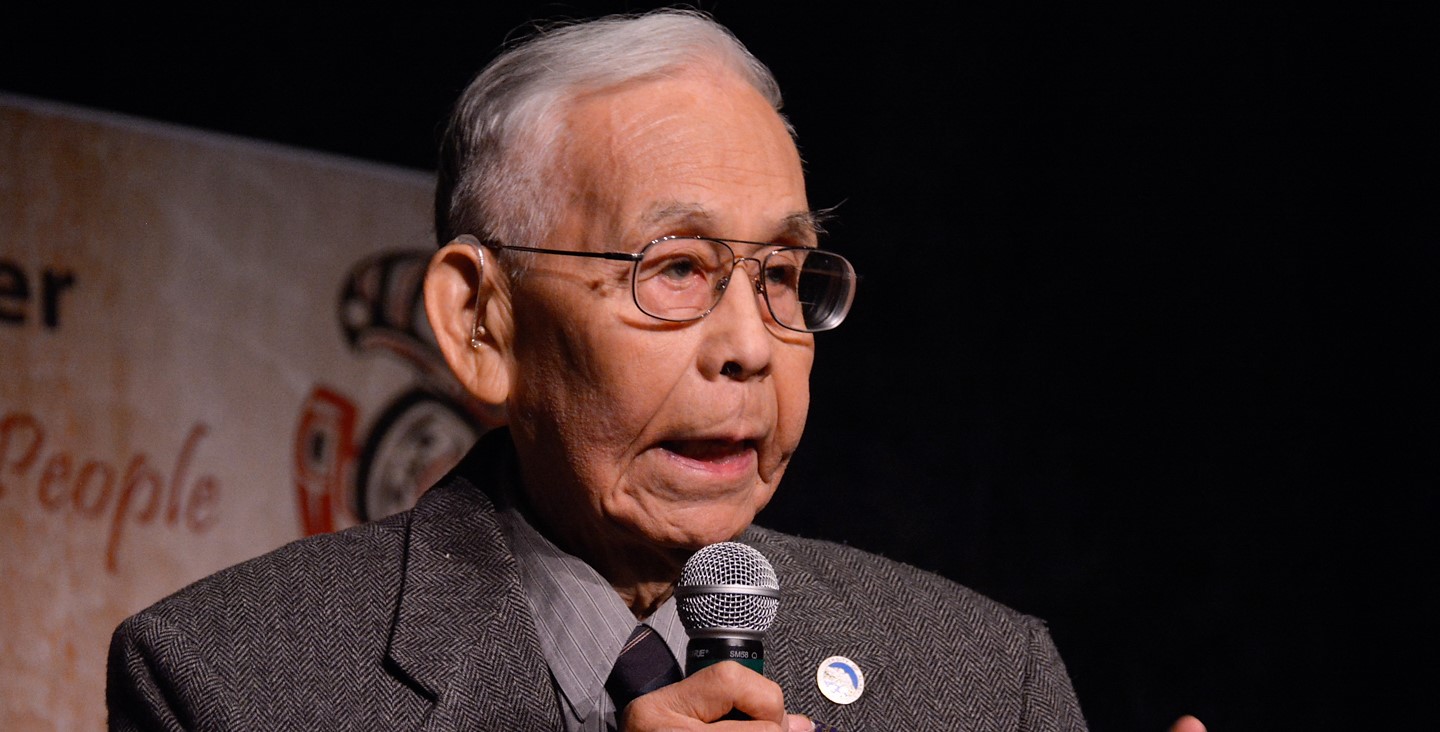
Longtime educator and coach Gil Truitt speaks after receiving the President’s Lifetime Achievement Award during an April 19 ceremony in Juneau. He and seven others were honored by the Central Council of Tlingit and Haida Indian Tribes of Alaska. (Photo by CCTHITA)
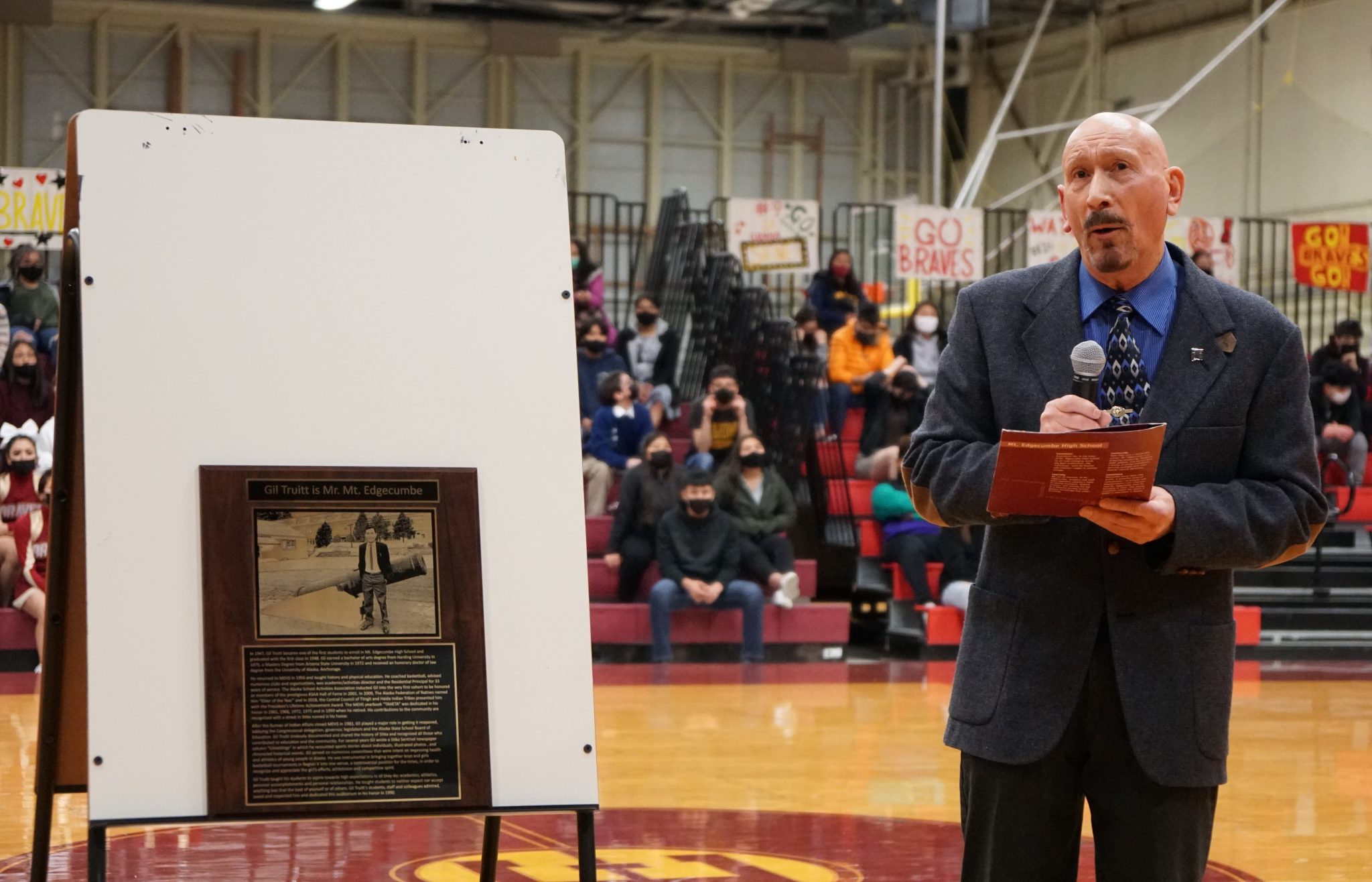
Mt. Edgecumbe High School celebrated Gil Truitt Day on Tuesday and honored the Tlingit elder and local historian with a plaque dedication and tribute. The holiday has been part of the school’s founders’ week celebrations for two years. It’s particularly poignant this year because it’s the first since the death of the former teacher and administrator last July.
When Bernie Gurule became principal at Mt. Edgecumbe High School, one of the first people he talked to was Gil Truitt.
“He emphasized to me that Mt. Edgecumbe High School is more than just a school, it’s more than just a boarding school. Mt. Edgecumbe High School is an institution. Mt. Edgecumbe High School is a family,” Gurule said. “He went on to say, ‘Mr. Gurule, many of our students come from hard lives and tough backgrounds. We will not lower our standards or expectations, and more importantly, Bernie, we will not allow anybody else to do so.”
For Truitt, supporting students like family meant holding them to high standards around self-discipline, academic achievement and personal conduct. It’s advice that Gurule said has shaped his approach as academic principal of the school. And it’s just one of Truitt’s many legacies. He spent 34 years working as a teacher, basketball coach and administrator at the school, but his influence extended long after he retired in 1990.
“His place at Mt. Edgecumbe High School and the significance of his place really can’t be overstated,” said Mt. Edgecumbe High School history teacher Dionne Brady-Howard.
Brady-Howard is a former student of Truitt’s and she remembers his lectures on sportsmanship, school pride and treating one another as family. They are conversations that she continues to have with her students to this day.
“We are kind of like their borrowed parents for their one to four years that they spend at Mt. Edgecumbe. And so those conversations are some of the most important education that actually happens,” Brady-Howard said.
Truitt was part of Mt. Edgecumbe High School’s first graduating class. Along with Brady-Howard’s grandmother, he was also instrumental in getting the legislature to reopen the boarding school after the Bureau of Indian Affairs closed it in 1983. Without him, the school may not exist today.
Mt. Edgecumbe High School Academic Principal Bernie Gurule pays tribute to Gil Truitt during a plaque dedication in the MEHS gymnasium on Tuesday evening. The plaque will hang in the entrance of the Gil Truitt Activities Center. (Photo by Erin McKinstry/KCAW)
But his legacy extends beyond Mt. Edgecumbe High School. He was also a local historian and shared his knowledge with the community in his Sitka Sentinel column “Gilnettings.” Through his research, he mapped nearly 300 residences of Sitka’s former “Indian Village” and helped the Sitka Tribe of Alaska acquire the land for the current Sheet’ká Ḵwáan Naa Kahídi community house, after discovering that the site of the former BIA school had to be used for Native education.
“He was actually the caretaker of a lot of knowledge about Sitka’s history, about Sitka’s history as far as Native families,” Brady-Howard said. “And you know which clan houses were where and belonging to whom and which families were connected with one another and how.”
Truitt grew up in Sitka’s Cottage settlement, a Native community that stood on Presbyterian mission land at the time. By the age of 15, he’d lost both of his parents. He also faced prejudice growing up in a highly segregated town.
“But my dad never lived his life as a victim,” his son Ken Truitt said. Truitt and his wife Shirley had three children. “In spite of the racial prejudice that he would’ve experienced growing up, he also would’ve at real critical moments in his life experienced extraordinary generosity and support from the non-Native community. “
After losing his mother, he was accepted at the BIA school in Wrangell but had no money to pay the fare to get there. A Sitka businessman stepped in to help. When he couldn’t afford tuition at Harding University in Arkansas, his basketball coach collected donations from Sitka organizations, Native and non-Native.
“I think he had this real sense of a debt to the entire community and a debt in not a bad way — but a debt that he was going to be committed to always working to make Sitka a better place,” he said.
Ken Truitt will always remember his father for his open affection, his subversive sense of humor and his love of sports — a love that he didn’t share but came to understand as he grew older.
“I asked him, I said, you know, ‘Dad, tell me what’s the big deal about sports?’ And he just said, ‘You know, when I was growing up, we weren’t able to play on the white teams and so we had our own teams and on the basketball courts,” Ken Truitt said. “Everybody knew what the rules were. And you had a chance to compete and you had a chance to win. And more often than not, we would win.”
Gil Truitt received countless awards throughout his lifetime, including an honorary doctorate of law from the University of Alaska Anchorage, a President’s Lifetime Achievement Award from the Central Council of Tlingit and Haida Indian Tribes of Alaska and multiple hall of fame inductions. He was a member of the Wooshkeetaan, or Shark, Clan of the Eagle Moiety.
The National Archives and Records Administration facility in Seattle is earmarked for closure and to be sold in an effort to cut federal spending. The Office of Washington state’s Attorney General filed a motion to seek a preliminary injunction to block the sale. (Photo courtesy of the National Archives and Records Administration)
A federal judge temporarily stopped the sale of a National Archives building in Seattle, Washington.
In a written order filed Tuesday morning, U.S. District Court Judge John C. Coughenour ordered a halt to the imminent sale of the National Archives building — and removal of an immense archival collection.
In a news release, Washington Attorney General Bob Ferguson said, “Today’s legal victory blocks the federal government’s unlawful plan to sell the Archives and scatter the DNA of our region thousands of miles away.”
In January 2020, a five-person panel identified the archives building in Seattle — and 11 other facilities — as excess properties and opportunities for the federal government to cut costs.
The archives building houses a collection that includes historical documents and records for 272 federally recognized tribes in Alaska, Idaho, Oregon and Washington.
A sale of the building could move the archive’s records as far away as Kansas City, Missouri and Riverside, California.
In January 2021, Washington state’s attorney general and 40 tribes, states and community organizations filed a motion to block the sale of the building.
The building also houses documents regarding the Chinese Exclusion Act and the Japanese internment camps of World War II.
It would be the second time that Alaska documents and records have been moved from a National Archives facility.
In 2014, a building in Anchorage was closed, and the materials transferred to Seattle.
Close
Update notification options
Subscribe to notifications
Subscribe
Get notifications about news related to the topics you care about. You can unsubscribe anytime.


9(MDEwMjQ0ODM1MDEzNDk4MTEzNjU3NTRhYg004))