History

Seward demolishes building where Alaska flag first flew, plans for memorial in its place

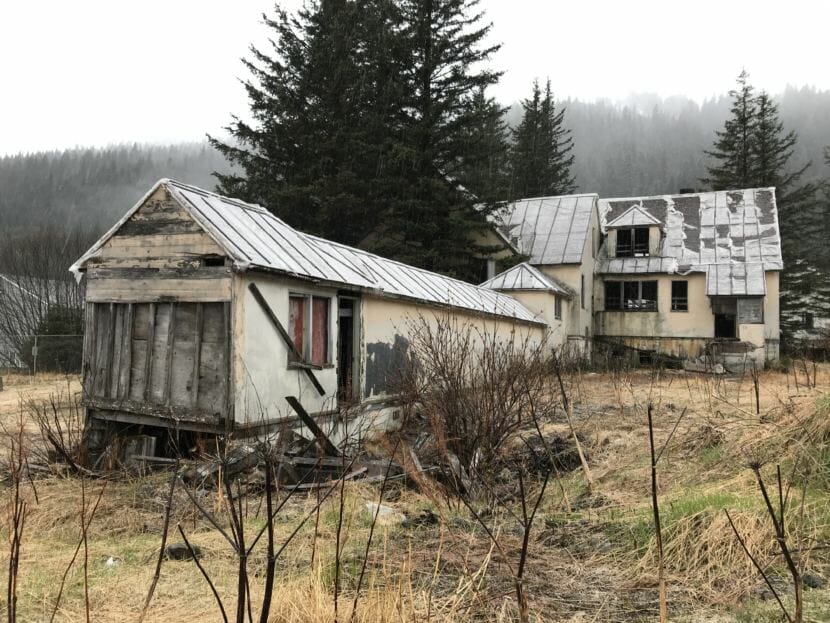
The Jesse Lee Home in Seward (Photo by Casey Grove/Alaska Public Media)

The historic Jesse Lee Home is mostly demolished. Now, the Seward property will be rezoned as a park, following a unanimous vote by the Seward City Council last week.

It’s the beginning of the end of a heated, years-long battle over the future of the abandoned historical building and the 2.66 acres on which it sits. Multiple attempts to keep it intact failed and the city began demolition in November.

The city plans on building a memorial on the property. To do so, it had to first rezone the land as a “park,” said community development director Jackie Wilde.

“My goal is that, come June, we’ve got grass planted, we’ve got an area to park and we are building a memorial,” she said.

It’s been a controversial process. For years, advocates fought hard to preserve the building. Others said its dilapidated exterior was a blight on the area.

From 1926 to 1964, the Jesse Lee Home was a residential school for children, many of whom were orphans or had parents with tuberculosis. It’s where Benny Benson lived when he designed the Alaska state flag, as a seventh-grader.

The home was abandoned when the 1964 earthquake damaged it beyond use.

The nonprofit Friends of the Jesse Lee Home took over the building more than a decade ago and worked with the state to turn it into a new school. But when the organization could not produce on its promises, the building was reverted back to city ownership.

The Friends’ final attempt to save the house was in September. The Kenai court gave them a week to raise half a million dollars, but they couldn’t do so by the deadline.

That effort did delay demolition, however, as did inclement winter weather. While most of the building is now gone, there are still parts of the foundation, stairs and a concrete boiler room left.

Wilde said the city hopes to have the demolition work done by the beginning of March. That will give them a sense of how much money they have left to build a memorial.

Dorene Lorenz, chair of the Friends of the Jesse Lee Home, said seeing the demolition was painful.

“What I did receive are a lot of really painful phone calls and hurtful letters from children of the Jesse Lee, expressing their anguish, their pain and their sadness with losing what to them was a sacred spot, a place of hope, a place of family and a place that was very meaningful to them,” she said.

Council member Sue McClure said she agrees with the sentiment that the home and its history must be memorialized. But like the other council members, she wants to see a new tribute.

“And so if we had lots of money, it would be wonderful to do some interactive, wonderful memorial, chronicling the history and experiences,” she said. “At this point, I’m not sure what we can do. But at least the rezone was the simple act of making it possible to do something.”

The city is currently using a $1.07 million grant from the state to demolish the building. It will use the funds leftover — an estimated $200,000 — to build whatever comes next.

It’s not certain what that will be. Wilde said the city can apply for grants to build other parts of a park or community center.

“I just want to see it be an area that we’re honoring everything that happened there and also providing a really great usable space, regardless if it’s a community center,” she said. “Those are all things that are allowed in a park.”

She said they’ve saved some parts of the building, like its arch windows, to hopefully repurpose in a park.

The city will solicit community feedback before coming up with a design for the new property. In a recent survey by the city, over half of 360 respondents agreed with turning the entire property into a park and memorial. Others said at least part of the property should be sold.

The city has to spend the funds appropriated by the state for a memorial by June 30, per the terms of the grant.

Progressive groups call for removal of Rep. Eastman and other Alaska lawmakers who challenged presidential election results

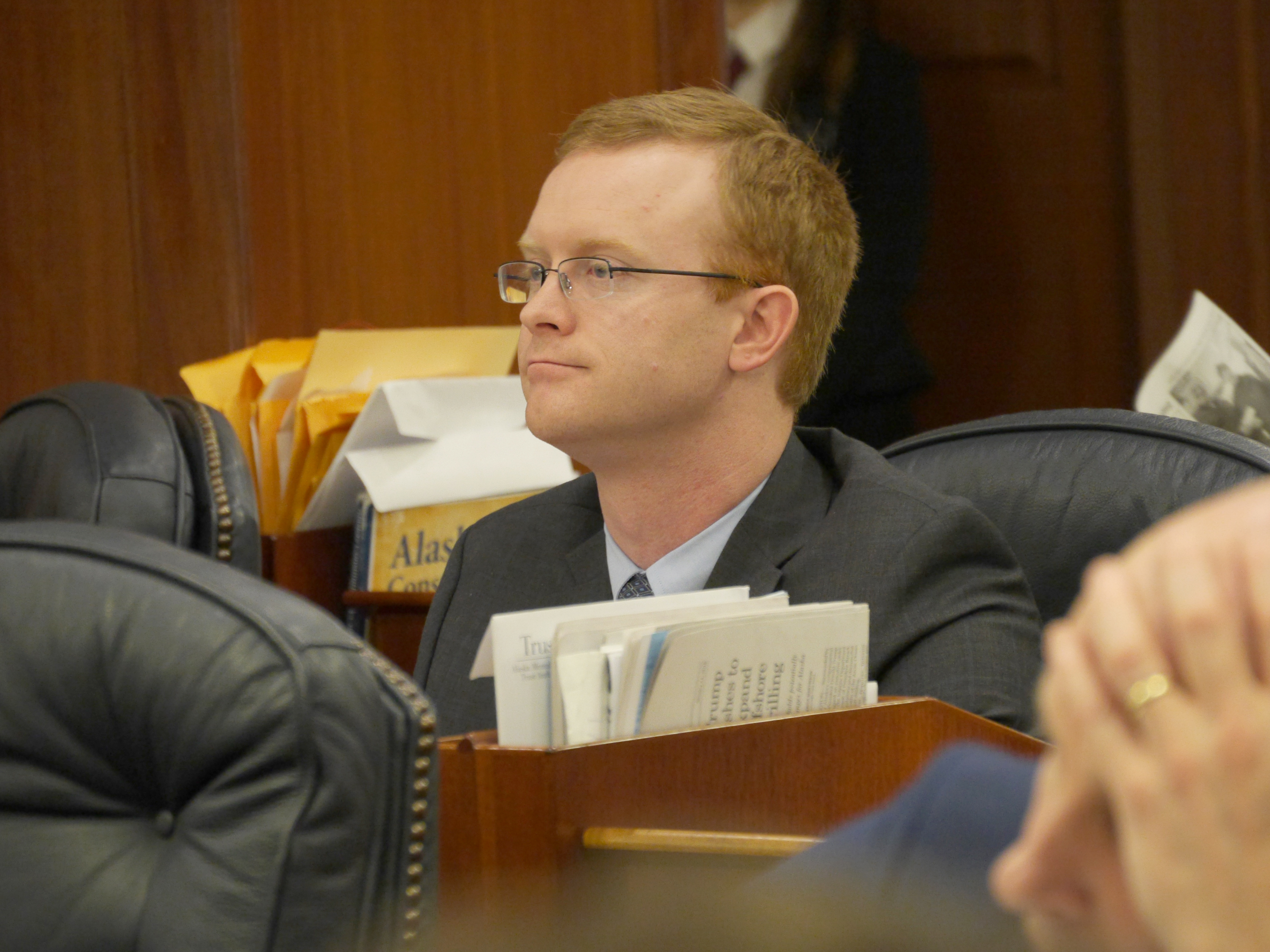
Rep. David Eastman listens to discussion on the House floor following a 31 to 6 vote to remove him from the Select Committee on Legislative Ethics on Jan. 31, 2018.
Rep. David Eastman. R-Wasilla, listens to discussion on the House floor following a 31 to 6 vote to remove him from the Select Committee on Legislative Ethics on Jan. 31, 2018. (Photo by Skip Gray/360 North)

State Rep. David Eastman is facing a torrent of criticism for participating in the Washington, D.C. rally Jan. 6th that led to the storming of the Capitol.

A coalition of nine progressive groups in Alaska are calling for the Wasilla Republican to resign or be removed from office, along with other legislators who they say used their official positions to try to overturn the national election results.

“Alaskan leaders who supported this insurrection must be held to account,” the groups, including the Alaska Center and regional political arm of Planned Parenthood, said in a joint statement last week. “Legislators who swore an oath to protect and defend the constitution in one breath, then seek to overthrow it in another breath have proven themselves unfit for duty, and unable to carry out the responsibilities of elected office.”

There’s no evidence Eastman was part of the mob that attacked the Capitol or that he broke any laws on Jan. 6th. In a brief phone interview early that afternoon, Eastman said he was leaving the rally by Metro and expected to be at the Capitol in a few minutes.

“I know there’s quite the fight at the national level and [it’s] important that Alaska be represented in that fight. And that Alaskans concerned on voter integrity have a voice,” he said. “I want to be part of that.”

In a later phone call, he said he did not witness any of the violence at the Capitol Building and was glad to have rallied with other peaceful demonstrators. In social media posts later, Eastman condemned the assault on the Capitol, and also blamed the violence on Antifa, which the FBI refutes.

Rep. David Eastman, left, at the Grant Memorial, about 200 yards from the West Terrace of the U.S. Capitol. He posted this to a public Facebook group called “Alaskans in Washington, DC for January 6, 2021” (Screen capture from Facebook)

It’s not clear how close Eastman got to the Capitol building. He didn’t return phone messages last week. One photo on social media shows him at the Grant Memorial. That’s across the lawn, about a city block from the Capitol’s West Terrace, where rioters grabbed metal pipes from a platform erected for the inauguration they hoped to prevent.

A decade ago, it might have been Eastman’s job to stop them. His resume says that, as a military officer in 2009, he was assigned to plan and preserve security for the inauguration of President Barack Obama.

On social media, dozens of Alaskans have called him a traitor. More than 2,500 people have signed a petition at change.org demanding he resign. Ivan Hodes of Eagle River is one of Eastman’s online critics.

“I just can’t get over the fact that a brother officer would engage in that kind of behavior,” Hodes said.

Eastman and Hodes overlapped as students at West Point. They served together as military police officers in Alaska.

Even if Eastman didn’t storm the Capitol, Hodes said he spread President Trump’s lie about the election being “stolen” in an attempt to keep Trump in power. Hodes said Trump’s lie animated the mob.

“As a state legislator he has a special responsibility not to do that kind of thing,” said Hodes. “He’s just in gross violation of the oath of office that he took as a legislator, not to mention the oath that all of us former officers swore when we were commissioned in the Army.”

State Sen. Tom Begich, an Anchorage Democrat, is a member of the Legislature’s Ethics Committee. Assuming Eastman didn’t invade the Capitol, Begich says he didn’t violate Alaska’s Ethics law.

“There’s nothing in the Ethics Law that would prohibit him participating in a protest,” said Begich. “And, you know, he has his first amendment right to do that.”

But Begich points to Eastman’s persistence in undermining faith in the national election, even after the Trump campaign lost dozens of legal challenges. Begich notes that the state House censured Eastman in 2017 – for claiming without evidence that women happily become pregnant so they can get a free trip to the city for an abortion. He says the Alaska House and Senate could consider censuring members who lie about the election.

“The narrative about the stolen election that they claim is all about trying to retain power in an undemocratic way,” he said. “I certainly would look at that.”

The nine groups that are calling on Eastman to resign or be expelled are The Alaska Center, Planned Parenthood Votes Northwest and Hawai’i, Alaska Black Caucus, Fairbanks Climate Action Coalition, Alaska Poor People’s Campaign, Alaska Public Interest Research Group, Alaska Community Action on Toxics, Native Movement and Enlaces.

They’re also calling out other Republican legislators who joined or supported a lawsuit challenging the presidential election. They are Reps. Sarah Vance, Ben Carpenter, George Rauscher and Colleen Sullivan-Leonard, as well as Sen. Lora Reinbold. None of them responded to an emailed interview request.

Coalition of Tribes and states seeks to block sale of National Archives building in Seattle

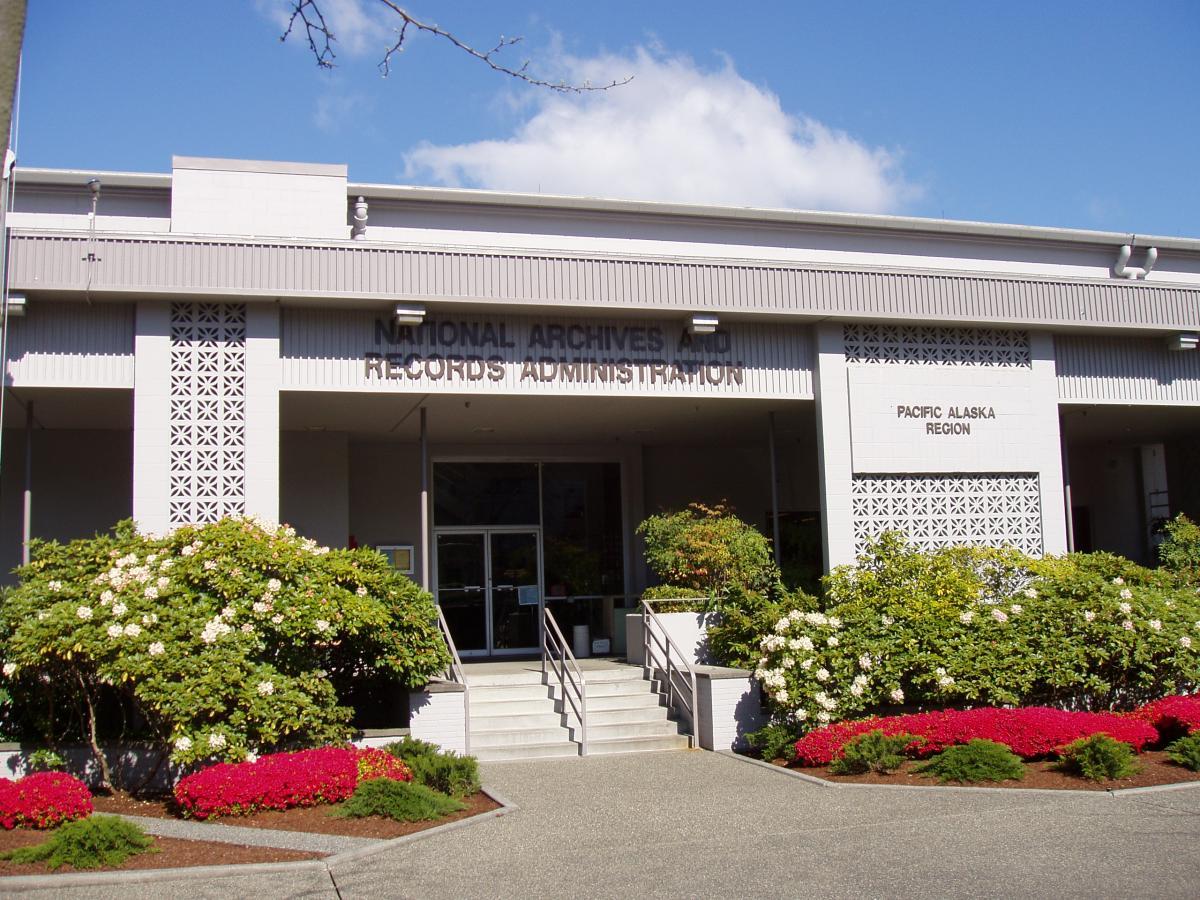
The National Archives and Records Administration facility in Seattle is earmarked for closure and to be sold in an effort to cut federal spending. Washington state’s Attorney General filed a motion to seek a preliminary injunction to block the sale. (Photo courtesy of the National Archives and Records Administration)

Washington state’s attorney general and a legal coalition of 40 Tribes, states and community organizations filed a motion Thursday to block the sale of the National Archives building in Seattle.

The facility houses an immense collection of historical documents and records, including records about Alaska and the Indigenous peoples of the area. The museum also contains documents related to the Chinese Exclusion Act and the Japanese internment camps of World War II.

Last January, a five-person panel earmarked the facility and 11 others for liquidation to help cut federal costs.

This is the second time the collection of Alaska archives and records has been moved in recent years. In 2014, these records were located at a National Archives facility in Anchorage, which closed. The current sale would split the collection between Missouri and California.

In a separate suit, Washington State’s Office of the Attorney General argues that the federal government failed to give Tribes and Tribal organizations prior notice of the sale and provided no consultation.

On this day in 1989, Redoubt eruption triggered seismic shift in Alaska volcano research

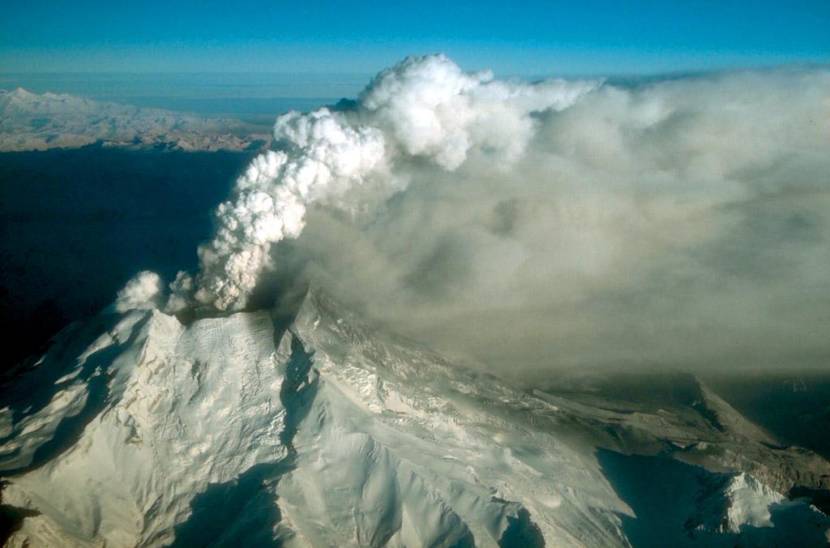
Redoubt on Dec. 18, 1989. (W.M. White/Alaska Volcano Observatory)

When an ominous mushroom cloud of ash erupted from Mount Redoubt 31 years ago on Dec. 14, 1989, it was anyone’s guess how long the eruption would last.

“The rule of thumb for looking at volcanoes like Redoubt is you typically look at how it’s erupted in the past and that often gives you good guidelines in the future,” said John Power, a research geophysicist at the Alaska Volcano Observatory.

Today, AVO uses an assemblage of sensors, receivers and satellites to monitor dozens of Alaska volcanoes, including Redoubt.

But in 1989, AVO was just one year old. When Redoubt’s first ashy belches began on Dec. 14, AVO had been watching Redoubt for about three months.

Power remembered catching wind of a set of foreboding, low-frequency volcanic earthquakes under Redoubt 23 hours before the eruption. That was AVO’s first hint of the six-month eruption that followed, sending layers of snow-like ash across Southcentral Alaska, grounding flights and temporarily halting a Cook Inlet oil operation.

One of the most dramatic effects of the eruption was when a cloud of ash cut off all four engines of a Boeing passenger airplane traveling from Amsterdam to Tokyo with 250 passengers. It dropped over two miles before the crew could restart the engines and land in Anchorage.

Henry Knackstedt, of Kenai, wasn’t in the air that day. But he did avoid flying his private plane for a while after that to avoid the disruptive effects of ash on his own engine.

“When it came here, we had a fair bit of snow on the ground,” he said. “And then we ended up with three-eighths of an inch, half-inch of ash, depending perhaps where you were. It looked like what I would imagine the moon to look like.”

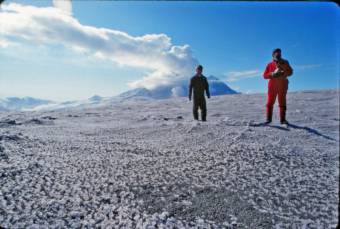
Game McGimsey of the Alaska Volcano Observatory and Willie Scott of the Cascades Volcano Observatory collect samples on ash-covered snow near Redoubt in April 1990, more than four months after the first eruption. (Steve Brantley/Alaska Volcano Observatory)

Come April, the snow melted faster because of the ash buried beneath it. Occasionally, there were muddy rains that had a corrosive effect on car paint.

“We were concerned about it because, periodically, you’d see plumes arise from the cone and you’d think, ‘Well, is this going to be a big one?’ And that went on for several months after the main eruption,” said John Williams, who was mayor of Kenai at the time.

Williams said he was preoccupied by concurrent efforts to clean up after the Exxon Valdez oil spill, which had happened several months prior. No shutdown orders or emergency proclamations in Kenai were necessary after the eruption.

No one had a better view of Redoubt than Mindee Morning. She looks at the volcano across the inlet from her home on the bluff along Kalifornsky Beach Road and remembered seeing beautiful pink shocks of light as the sun rose.

Her husband is an electrician and ran to the KSRM station to help when the power went out. But Morning wasn’t too worried.

“We were so casual about it,” she said. “My son and I just, because the lights went out, we just went back to bed.”

Spectators were awestruck by the eruption’s beauty. But the fallout over the next few months was more serious.

Eruptions prompted flight cancellations and delays at airports in Anchorage and Kenai. Experts worried ash would interfere with engines, as it had with the passenger jet, or cause damage to wings and windshields.

The ash was also bad for air quality, as Morning remembered.

“At that time I was a very active runner, running two times a day,” she said. “That came to a screeching halt. I was running in my basement.”

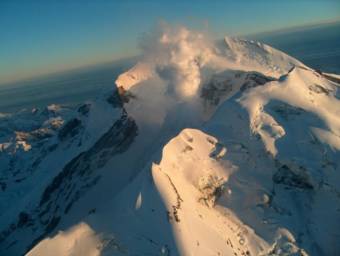
A recent shot of the west side of Mount Redoubt from Henry Knackstedt’s plane.
(Courtesy of Henry Knackstedt)

Mudflows reached the Drift River Oil Terminal, a tank farm for crude oil across Cook Inlet from Kenai, at the base of Redoubt. Williams, president of the Cook Inlet Regional Citizens Advisory Council, said he advocated closing that facility completely after the explosion, for fear mudslides could take down tanks full of oil.

All the while AVO, which had been created in response to earlier eruptions, was coming into its new role.

Redoubt erupts fairly often. Before 1989, it erupted in 1902 and 1966. Most recently, it went off in 2009.

But Power thinks the 1989 eruption brought home for many people how scary eruptions could be, in part because it nearly took down a passenger jet.

“I think, prior to that, the really invasive incidences of problems between jet aircraft and volcanic ash had occurred in Indonesia and very distanced areas,” he said. “And it hadn’t really been brought home that, ‘OK, this is an issue here for us, as well.’”

In response, AVO expanded. That included the creation of a worldwide network of volcanic ash advisory centers, which provide information on where and how ash travels after eruptions through weather services and aviation agencies. It also ramped up an effort to monitor eruptions along the Aleutian chain.

Technology has helped the observatory up its game. In 1989, it relayed information by fax machine and floppy disk. Now, notifications come in via cellphone. People who are interested in learning more about the observatory’s work can follow along on its Facebook page.

“I think we’re much better positioned at this point to anticipate eruptions with volcanos like Redoubt any many more throughout the state,” Power said.

Power said there’s currently nothing unusual happening at Redoubt. But in case of an eruption, he recommends a set of precautions that is very familiar in the age of COVID-19: avoid travel and stay inside, especially if you have respiratory problems.

Beloved historian and UAF professor Terrence Cole dies at 67

Terrence Cole in 2008 (Photo courtesy of UAF Arctic and Northern Studies)

Fairbanks historian Terrence Cole has died. Surrounded by family, Cole succumbed to cancer Saturday at his home in Fairbanks. Both scholarly and affable, Terrence Cole was a beloved and respected professor at the University of Alaska Fairbanks, where he taught for 30 years and penned key works about Alaska.

Terrence Cole and his identical twin brother Dermot were born 67 years ago and raised on a rural Pennsylvania farm. Their father, an engineer, believed in hard work and discipline and instilled those values in his six children, in sometimes unique ways, said Dermot in a 2018 interview with KUAC.

“He was a tough character in some ways, thought we weren’t tough enough, so after church on Sundays, we would have to box in the living room with a makeshift boxing ring,” he said.

The Coles also experienced tragedy when their mother died of breast cancer when the twins were nine years old.

“It was a traumatic event and it made it more so by the decision to never ever talk about it,” said Dermot.

But the twins said their father also believed in education, and all the children would eventually pursue college and professional careers. In fact, it was the oldest brother Pat’s search for a school that would draw several of the Coles north to Fairbanks and the University of Alaska.

“UAF was a good bargain, I think, as it is today, frankly. And you looked at the out-of-state tuition and what he could afford and you know hatched this plan coming up here, so we came up here,” said Terrence at the same 2018 interview.

Pat, Dermot and Terrence all drove to UAF and set down roots in the community. Pat would eventually become a city and borough administrator. Dermot pursued journalism, becoming a popular reporter and columnist for The Fairbanks Daily Newsminer.

And Terrence followed history. He received his doctorate at the University of Washington, even as he worked as an editor at Alaska Northwest Publishing. He says that dual experience influenced his approach to history.

“They wanted to do a book on Nome, and I thought, ‘Well, okay, I can do a dissertation on Nome,’ but I never told the publishing company I was doing my dissertation on Nome, and I never told the university I was also writing a book on Nome… the university would say, ‘well, it’s not serious enough.’ And the publisher would say, ‘well, it’s too serious,’” said Cole in the same 2018 interview.

Terrence returned to UAF in 1988 as a history professor. One of his students, Mary Ehrlander, also became an historian and eventually a colleague at the school. In a 2019 interview for the publication of The Big Wild Soul of Terrence Cole, a collection of writings by his students and colleagues, Ehrlander said his ability to write clearly and compellingly without jargon is a hallmark of his style.

“He really is a narrative historian and has always emphasized the story because, as he has said to our students, that is what differentiates humans from every other animal is that we tell stories,” she said.

Besides writing a series of books about notable Alaska institutions and personalities, Terrence served on the board of the University of Alaska Press. Nate Bauer directs the press. In an interview a month ago before Terrence died, he said Cole’s engaging style sometimes overshadowed his serious scholarship.

“He was a special series editor for our classic reprint series for a lot of years. And he brought just a remarkable amount of research about the history and the development of Alaska in the 19th and 20th centuries. None of his work as a scholar was lightweight,” he said.

Terrence’s lively, engaging style was also reflected in his teaching. Although he admitted it sometimes led to unexpected problems.

“Largely, I would set the classes up so that people didn’t know what I was going to do next. Now, this is sometimes a problem when you forget what you’re going to do next, which was sometimes what happened to me. I get so carried off in that bit of I was doing,” he said in the 2018 interview.

Nonetheless, he received awards for his teaching and contributions to history, along with his brother Dermot, who has also authored notable books.

Three years ago, Terrence was diagnosed with inoperable gastric cancer. Throughout his illness, he retained his humor and continued to work on his next book. On the occasion of his retirement at UAF two years ago, he found solace in the writing life.

“I heard an author one time who referred to his books … as his colleagues ,and when you make your contribution to the literature, that you’re in a conversation across the ages. I like the idea of being in the conversation with people even after you’re gone, when you have a longer frame of time reference because our lives are also short. That’s the best we can do is just put our little piece into the conversation,” he said.

Terrence has survived by his wife, Gay Salisbury and three children, Henry, Desmond and Elizabeth.

Alaska’s oldest WWII veteran prepares for her 104th Birthday

Hallie Dixon was the grand marshal of the 2019 Fourth of July parade in Anchorage. (courtesy of Naida McGee)

Alaska’s oldest World War II veteran, 103-year-old Hallie Dixon, decoded and encrypted messages for the Navy as a telegrapher during the war. And that wasn’t even her greatest adventure.

“My father heard the call to come to the Last Frontier to make his way as a young man out of the service, back in the days when Alaska was offering homestead land, especially for veterans,” said Niada McGee, Hallie’s daughter.

“And so he came as an aircraft mechanic and worked on Merrill Field, and she came and joined him in January of 1951, in a ground blizzard at 30 below zero with three little children and pregnant with number four. And she went on to raise 11 children in the far away isolation of Alaska.”

Eight years before Alaska became a state, Hallie and Paul Dixon settled in Anchorage. They also spent 14 years in St. Mary’s in the Yukon Delta, where Paul was the village corporation manager.

Hallie’s now living in an eldercare facility in Kenai, where she can see her daughter, Rita Lindow of Kenai, every day. Hallie’s health is deteriorating and she wasn’t up for speaking on the phone Wednesday.

McGee, who lives in Anchorage, said her mom enlisted when she was 25.

“She was working in downtown Detroit and in those days, on loudspeakers, throughout the city, they were making calls for young men and women to join the service and serve their country,” she said. “And she listened to the loudspeakers and decided to do it one day.”

Hallie was stationed in Sanford, Florida as a telegrapher. She was one of thousands of women who did so as part of the Navy WAVES, the woman’s branch of the U.S. Naval Reserve. Lindow said she was isolated in the barracks because she dealt with top-secret naval commands.

“And she did keep that top secret all the way through. We couldn’t get any of it out of her, even 10 years ago, what those messages were,” Lindow said.

Paul, who was Hallie’s boyfriend at the time, was deployed with the U.S. Army Air Corp in England. Lindow says he was a romantic.

“When he got to Gander, Newfoundland, he sent her a message on her teletype machine and he wrote, ‘I’ll see you at the light of the new moon.’ And her teletype machine was on the other side of her office,” she said. “And so one of the girls got the message and swooned of course and read the note to mom. Their relationship was quite captivating to everybody in the office.”Hallie Dixon was part of the Navy Women Accepted for Volunteer Emergency Service, or WAVES, during World War II.

Hallie and Paul married right before the war ended.

Shortly after statehood, Paul became the manager of all public airports in Alaska and frequently traveled to remote villages to negotiate contracts. So Hallie was often taking care of all 11 children by herself at their home off Delaney Park Strip.

“You had to be adventurous to make it through raising all those children in such an isolated place,” McGee said. “She got to speak to her own parents once a year when a telephone call would cost 40 or 50 dollars and last 10 minutes long. And writing letters. That was her communication with her family far, far away.”

Lindow said she still has her sense of adventure.

“Matter of fact, I just talked to my mom yesterday,” ehs said. “I could tell she was dreaming, I got up near and I said, ‘Mom? Want to go fishing?’ ‘Oh? Can we?’ At almost 104, you know?”

Most of the Dixon’s children still live in Alaska, along with a gaggle of grandchildren and great-children. Paul died in 2012.

Lindow said her mom doesn’t talk about the war much. But she has been publicly recognized for her service. She and other Alaska veterans took an honor flight in 2013 to Washington, D.C., where she saw the WWII monument and visited the National Cryptologic Museum in Maryland. In 2019, she was the grand marshall of the Fourth of July parade in Anchorage.

On her birthday in two weeks, Hallie will be 104.

Site notifications
Update notification options
Subscribe to notifications