History

What’s that reddish color on Wrangell’s petroglyphs?

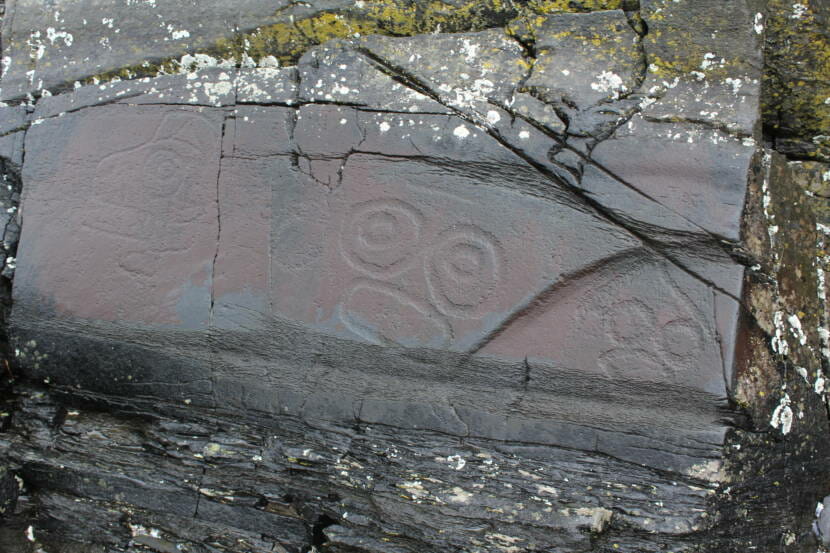
Wrangellites, scientists, and local police aren’t quite sure what’s coloring this set of petroglyphs on Wrangell’s Petroglyph Beach. (Sage Smiley/KSTK)

A beach on the northern tip of Wrangell Island is home to rock carvings estimated to be at least 8,000 years old — petroglyphs made by the ancestors of Wrangell’s Lingít people. Recently, one of the larger petroglyphs seemed to change color — and ignited some debate in town. Is it vandalism or naturally occurring?

Listen to this story:

While most of the carvings on Wrangell’s Petroglyph Beach are the weathered grey of boulders in a tidal zone, one of the largest intact rocks appears a deeply pigmented red-brown, especially when wet. A dinner-plate-sized animal figure with a fin adorns the left side of the rock face. Two similarly sized faces with round, wide eyes and open oval mouths are carved to its right — all stained.

“We always come down here for our dog walks, morning and evening. So I’ve gotten pretty familiar with all the petroglyphs. It’s fun looking at them in different light and whatnot,” said Wrangell resident Dan Trail.

“We,” is Trail and Dougie, his curly-haired black poodle-Portuguese water dog-mix.

“The other day when I was looking at it it was just like wow, somebody poured paint on this thing,” Trail said, explaining why he recently posted a photo on social media, alleging the burnt-sienna color was vandalism.

A fiery discussion ensued on Wrangell’s community Facebook group.

“I mean, I don’t care if it’s a different color,” Trail said. “Just the fact that it looks like paint.”
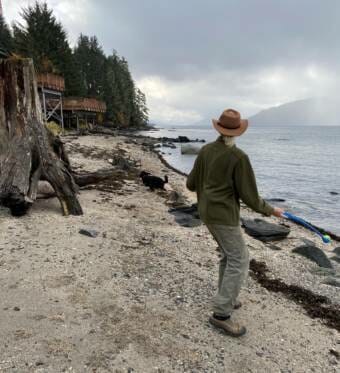
Dan Trail throws a tennis ball for his dog, Dougie at Petroglyph Beach. Trail posted about the coloring on the petroglyphs on Wrangell’s community board, sparking discussion about the source of the color.
(Sage Smiley/KSTK)

Trail said despite all the time he and Dougie spend down at Petroglyph Beach, he’d never noticed color like that on the carvings before. Plus, it was isolated to just the one large slab.

“I haven’t seen it on any of the other petroglyphs,” he said.

Wrangell police investigated. Police Chief Tom Radke said it was puzzling.

“We went out and looked at it and felt it and touched it and it doesn’t … It seems weird, don’t get me wrong, but it doesn’t seem like it’s paint like we know it as paint,” Radke said.

For one thing, the petroglyph is at least a hundred feet from the stairs down to the beach.

“Where the couple of them are — where the one is — I can’t imagine anybody bringing paint all the way out there,” Radke explained. “And number two, it’s been really rainy. I mean, not exactly painting weather.”

Ultimately, Radke said the police don’t think it was recent vandalism. More likely it’s tannins, a natural pigment that also gives the water around muskegs that coffee color.

Trail isn’t totally convinced: the discoloration is uneven.

“This is splotchy, you know,” he said, gesturing to the slab of rock. “It’s really obvious at the bottom end of the mouth there, there’s nothing and just now when we were looking at it, you can see this part was rubbed off there. And that would make sense because that’s the part that’s protruding, so if any logs or whatever rubbed up against it, it could rub that off.”

In the comments of Trail’s Facebook post, some Wrangellites said they believe the coloration has been around for years and posted pictures of a similar, red-brown color from 2014 and 2015.

Others say it could be vandals — but from decades past. Petroglyph Beach was made a state historic site in 2000 to protect the carvings of faces, animals, and spiral shapes. Janell Privett was on the Friends of the Wrangell Museum board at the time and recalls people messing with the 8,000-year-old petroglyphs. She said that prompted elders from Wrangell’s tribe and the Friends of the Museum to push for protections for the site.

“One of the biggest situations that happened was a tour group,” Privett recalled. “Photography, of course, has changed and changed and changed and there’s absolutely no reason for a good photographer to spray paint a petroglyph. And that has happened more than once. And the last one was a brown and another time a black.”

She thinks the color could be leftover paint from that tour group vandalism.

In a survey in the early 2000s, state archaeologists identified more than 40 ancient rock carvings on the Wrangell beach near the northern point of the island.

Tis Peterman said there used to be more. She’s a tribal citizen who said the Wrangell Cooperative Association had asked for assistance from the state to do a dig in the beach sand to catalog petroglyphs that could be buried by time, but “they turned us down flat.”

Years later, she said state Department of Natural Resources officials approached Wrangell’s tribe, soliciting help funding park improvements, which she said was frustrating, considering the lack of previous engagement.

The reddish color could also come from other wear and tear. Chalk, rice paper, and ferns were used to make rubbings of the petroglyphs for years. In fact, Wrangell’s tourism industry encouraged it as recently as the early 1990s.

KSTK sent photos of the petroglyph to chemists, geologists, and archaeologists at the University of Alaska Southeast. They’ve proposed a variety of possible natural causes for the coloring, including iron oxide or microscopic organisms. But they all agree — nothing can be determined by looking at photographs of the petroglyphs.

Biochemist Konrad Meister is an assistant professor of chemistry at UAS, based in Juneau. He said he thinks it could be some sort of bacteria.

“You might know from these very fascinating pictures from some of the national parks in the hot springs, there’s quite a lot of color variations,” Meister explained. “And so if you have microbes growing onto something, it can give it a set of those shades that you see in these images. But again, based on just this picture, it’s a bit tricky to be very conclusive about it.”

The only conclusive way to find out what’s coloring the petroglyph would be to take samples. If it’s biological, Meister said that could be as simple as bumping a culture plate up against the surface and seeing what grows.

“And that is probably the answer that the general public might be interested in,” Meister said. “But then you can go much further and say like, ‘Okay, what is actually causing the color change?’ and then we have to look into some of the chemical biochemical reactions and ‘Okay, where did it come from? Why is it only there seasonally?’”

Meister said this is a good time to be asking questions about changing color in the carvings.

“There’s a lot of research going into this because a lot of times, these color changes can just be color changes,” Meister said. “But you can also see that [change] in the deterioration of those petroglyphs. And that’s, that’s obviously something that we don’t want to happen, because they’re such amazing historical artifacts.”

Meister said he’d be interested in enlisting the help of a Wrangell UAS student, or even a science-minded high school student to look into what’s coloring Wrangell’s petroglyphs.

Whatever the color is, Peterman said Wrangell’s Petroglyph Beach is a rocky strip of refuge for her.

“I get a sense of peace out there,” Peterman said. “I feel a calmness, that no matter what, we’ve been a part of this land forever. And even though looking back over the years and how the natives have been treated, good and bad. We’ve always come from here.”

Being out among the petroglyphs makes her think about the thousands of years her ancestors have lived in the area.

“You go up there and you just are like, ‘Wow, this is really, proof that we live in harmony with the land and water,’” she said.

While the red tint on one of Wrangell’s petroglyphs remains a mystery, for now, the tide continues to pull and push against the ancient carvings.
First annual Filipino American Festival promotes community health, connections in Ketchikan

Ketchikan’s Plaza Mall was filled with chatter and music last Saturday as the first annual Filipino American Festival was in full swing. The event fell only two days before the anniversary of the first recorded arrival of Filipinos to the West Coast over four centuries ago.

October marks Filipino American History Month. One of the organizers of the first Filipino American Festival, Alma Parker, says it’s a time to celebrate the contributions of Filipinos throughout history within the United States — a history particularly that is rich in Southeast Alaska.

“Well, the Alaskeros were what’s what they call the Filipino cannery workers that could immigrate here due to the U.S. colonization. There was more freedom to come to the United States because they were considered U.S. nationals,” Parker said. “So there was an influx of workers to work in Southeast Alaska. I do know that. Ketchikan was the home to the first Filipino community club in the whole state of Alaska.”

The Filipino Community Club has records going back as early as 1938 at its original location on Stedman Street. Parker says she has fond memories of a later  Community Club, open during her childhood.

She recalls it serving as a space where Filipinos from the community could come together, practice dances, celebrate, and voice concerns with the local government. Today, the center is gone — the site is now a gravel lot next to Ketchikan’s American Legion post.

Nearly 10% of Ketchikan’s population has Filipino heritage — one of the highest concentrations in the state. Parker says she hopes the festival can help Filipinos connect with each other and build community by celebrating their heritage. The main event of the festival included a traditional stick dance, performed by the high school dance team.

Parker, with her new position at the Ketchikan Wellness Coalition, has started a project called “Sama Sama Tayo,” which she says, translates to “gather together.” It’s funded by a $300,000 health equity grant from the Robert Wood Johnson Foundation.

The aim is to improve the health of Ketchikan’s Filipino community. While it might not seem like a cultural heritage festival is immediately related to health care, Parker says it’s about building community — which she says helps Filipinos connect with the health care resources they need.

“As the health equity program coordinator, my goal is to improve access to health care and health care outcomes for Filipinos in the community and eventually to the underserved. So by having an event like this, it allows the opportunity to maybe, you know, connect with people and then to ask questions to say, you know, what are some of your challenges and obstacles,” Parker said.

In the Philippines, the months September through December are known as the “ber months” — when Filipinos celebrate Christmas. One of the most classic festivities is the parol, traditionally a lantern made out of bamboo. Parker has teamed up with the Ketchikan Area Arts and Humanities Council to share this custom with the community. A parol-making class will be held the second weekend of November where adults are welcome to come and learn more and participate in the Filipino tradition.

Juneau officials might rename this public space ‘Peratrovich Plaza’

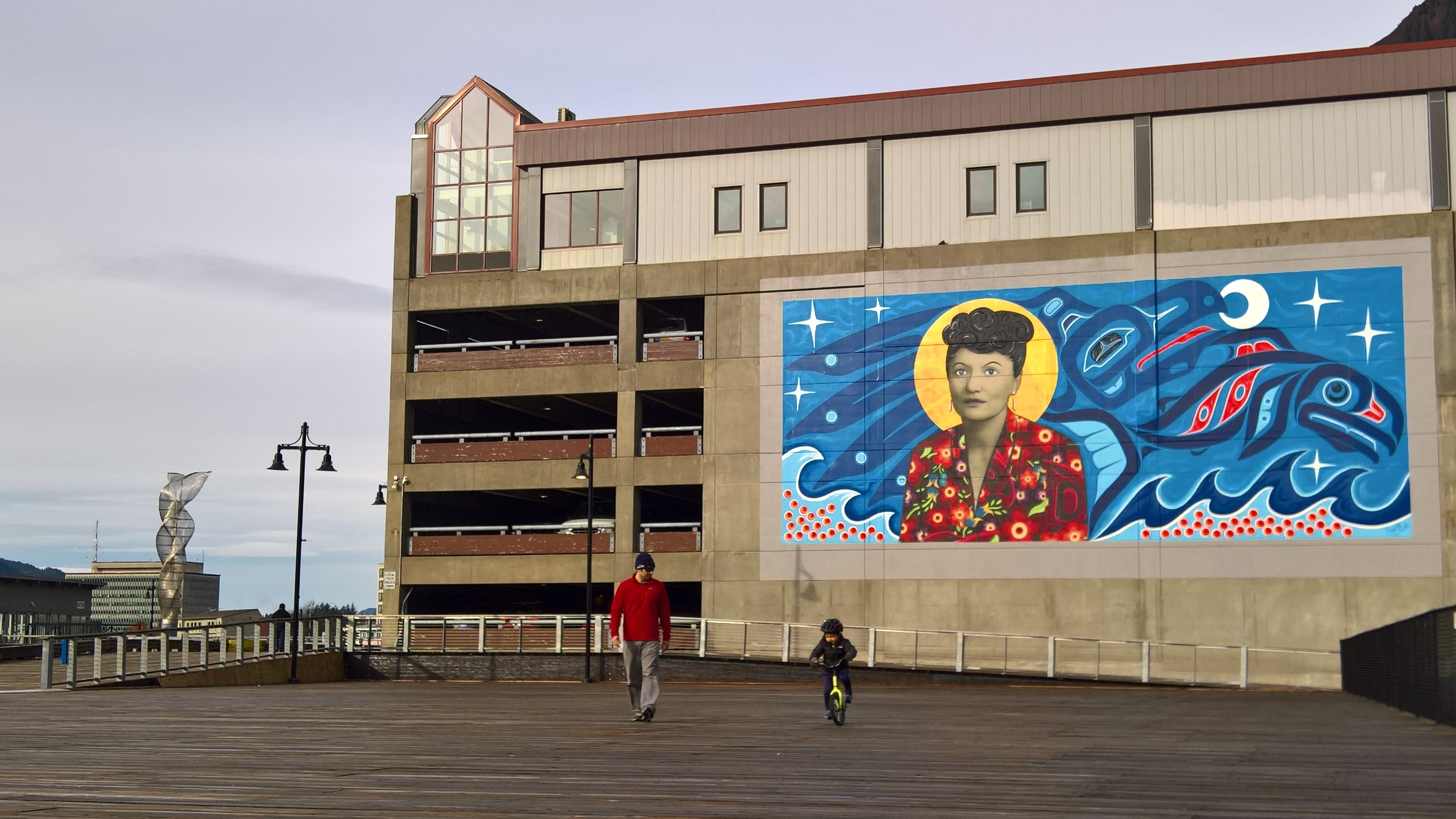
Erick Heimbigner keeps an eye on his son, 4-year-old Emmett Heimbigner, as he practices riding his bike at the Archipelago Lot along Juneau’s Seawalk on Oct. 21, 2021. Juneau Docks and Harbors officials want to rename the lot “Peratrovich Plaza” after the Alaska civil rights leader and the subject of the mural behind them. (Jeremy Hsieh/KTOO)

On Thursday, 4-year-old Emmett Heimbigner was doing some wobbly laps on a bike that recently got pedals.

“I am Emmett, and I’ve learned to ride a bike, and I haven’t done it by myself,” he said.

His dad was keeping an eye on him, and so was Alaska civil rights leader Elizabeth Peratrovich — in the giant, three-story mural behind him. Emmett didn’t recognize her, but the decked-over lot along Juneau’s Seawalk could soon be renamed for her: “Peratrovich Plaza.”

Right now, this prominent public space is called “Archipelago Lot 2A.” Few people know it.

Officials with Juneau Docks and Harbors think Peratrovich Plaza is a better name that fits with the new public art. It would also help teach throngs of cruise ship visitors a little about Alaska civil rights history.

The archipelago name seems to come from a boring legal description of the property. Kirby Day, who’s worked for the cruise industry in Juneau for decades, said it’s not well known.

“When you say ‘Archipelago Lot’ no one really knows what that is or what that means,” he told the Docks and Harbors Board on Wednesday.

That checked out with people walking by during the lunch hour on Thursday. Emmett’s dad, for example, didn’t know the archipelago name but knew Peratrovich.

Docks and Harbors officials want to rename the lot, both to fit with the new mural that was finished in September, and to help people get around the waterfront better.

“There’s a natural flow to naming it Peratrovich Plaza, given the mural’s existence there,” said board member Mark Ridgway. “And we’re talking about people who are just walking off of a boat. I’d like it better than, say, ‘the Norwegian Nook’ or ‘the Carnival Corner’ or ‘the P&O Outlook.’”

A board committee voted 7-1 on Wednesday to recommend the Juneau Assembly formally change the name.

Paul Grant voted no. He said he’s an “unreserved admirer” of Peratrovich but thinks she’s already well-known and recognized in Alaska. And he said the public ought to be more involved in picking a name. The board did get one letter about the name change, asking that it be named for miners or fishermen.

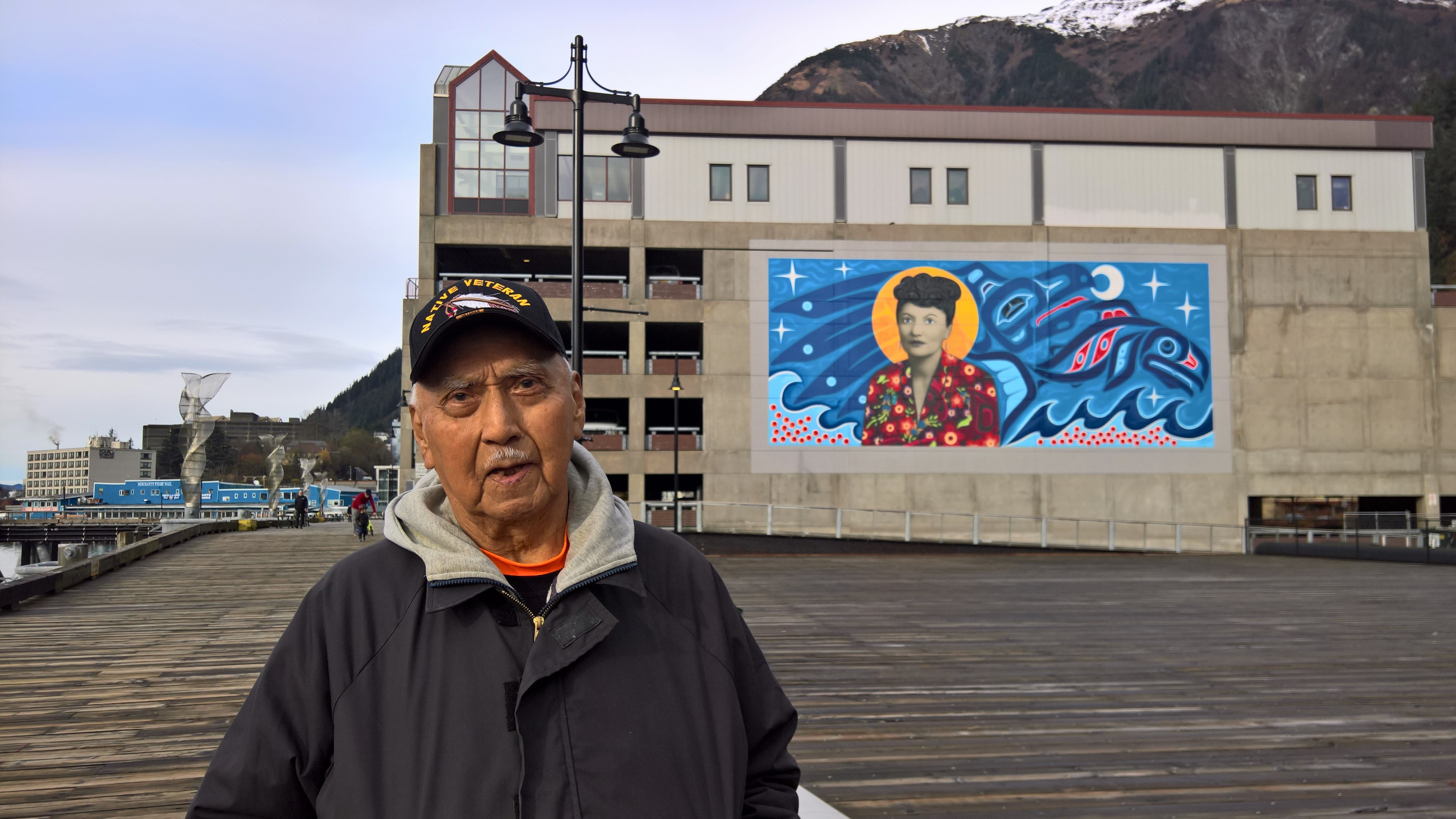
Ray Wilson was also walking the waterfront on Thursday. The Lingít elder has lived in Juneau most of his life and wears a hat that says “Native veteran.”

Ray Wilson poses for a photo on Juneau’s Seawalk on Oct. 21, 2021. Wilson, who is Lingít, says including Elizabeth Peratrovich, the Alaska civil rights leader that is the subject of the mural behind him, in Juneau history would be a big step toward recognizing Alaska Native people. (Jeremy Hsieh/KTOO)

“I think for a long time, the City of Juneau hasn’t recognized Native people,” Wilson said. “And haven’t given them enough credit for what they do and what they put into the pot, so to speak.”

Wilson also has a fuzzy memory that he might be a distant relative of Elizabeth Peratrovich.

“To include Peratrovich in Juneau history is a big step towards recognizing Native people,” Wilson said.

Before the recommendation goes to the Juneau Assembly, the Docks and Harbors Board has to vote on it at one more meeting.

Correction: An earlier version of this story misstated Ray Wilson’s age. The Lingít elder will turn 89 in December.

A movement to celebrate Reconciliation Day in place of Alaska Day continues to gain steam in Sitka

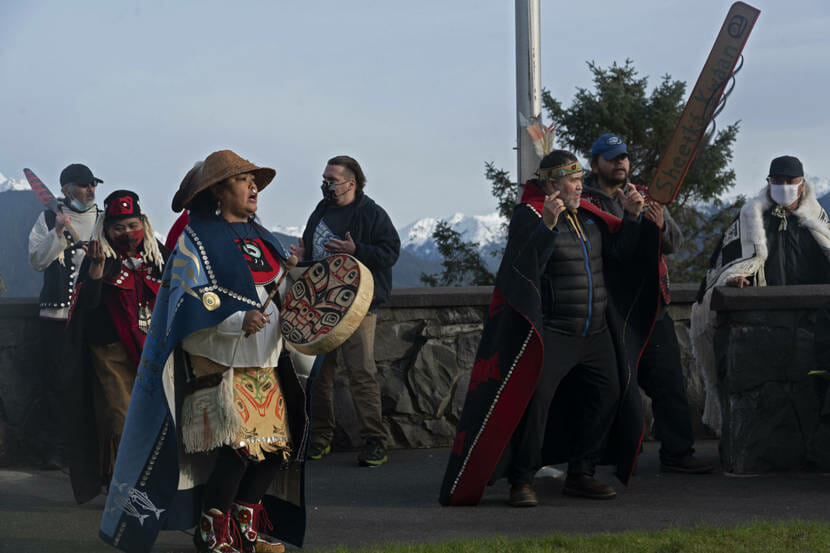
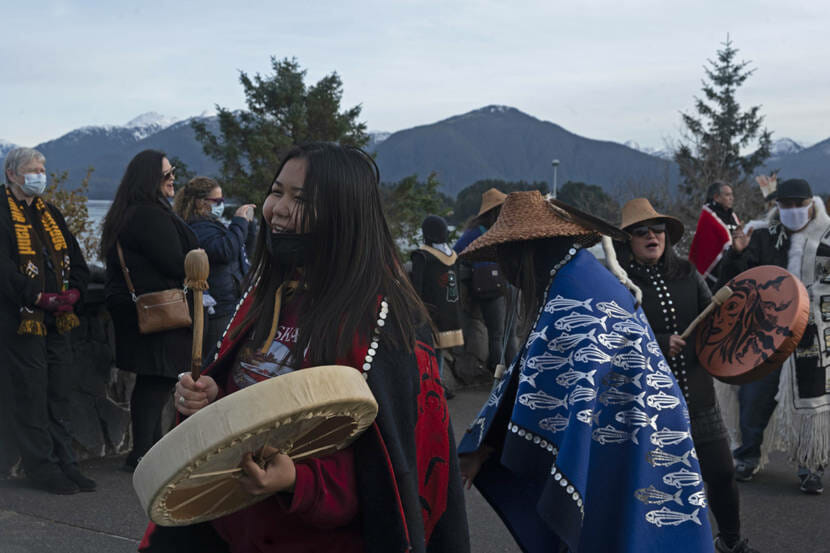
Dionne Brady-Howard drums and sings during a Reconciliation Day celebration on Sunday, Oct. 17. Members of the Eagle and Raven clans joined in song and dance at the gathering. (Tash Kimmell/KCAW)

Alaska Day is a state holiday recognizing the transfer of Alaska from Russia to the United States. A central event that caps off Sitka’s Alaska Day Festival celebrations most years is a reenactment of that transfer at the top of Castle Hill, or Noow Tlein.

For many, the Alaska Day celebrations and the transfer ceremony atop the hill commemorate the sale of stolen land from one colonial power to another and erase the violent history of colonialism in Sitka.

Noow Tlein was once the site of Lingít Kiks.ádi clan houses, which were later taken by the Russians and destroyed. In recent years, a movement to recognize Reconciliation Day in place of Alaska Day continues to gain steam.

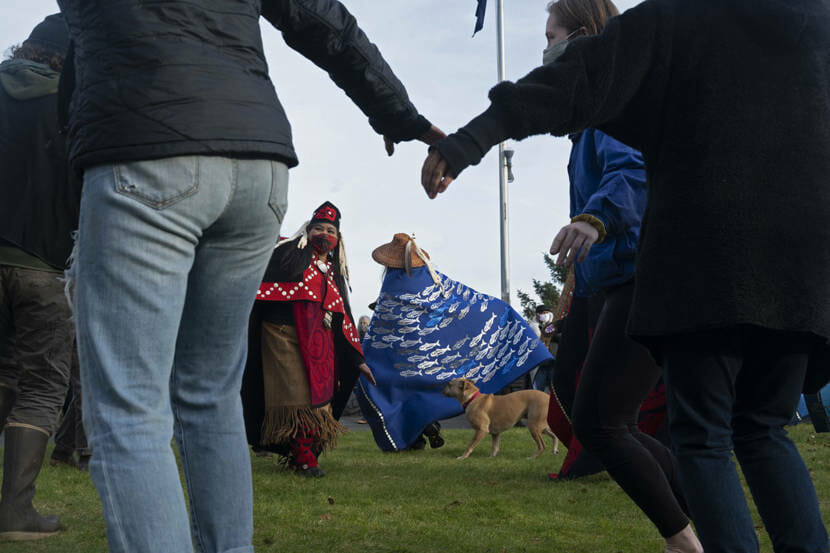
Tribal dancers invite onlookers to participate by imitating the walk of a Raven during a Reconciliation Day celebration Sunday, Oct. 17 in Sitka. (Tash Kimmell/KCAW)

On Sunday, a group of around 100 Sitkans led by Kiks.ádi clan members, gathered atop Noow Tlein to recognize Reconciliation Day. While the gathering emphasized celebration, the group did sing one mourning song.

On Monday, amid Alaska Day celebrations, a group of demonstrators organized by local activists and tribal citizen Louise Brady marched from Gaja Heen or Old Sitka to Noow Tlein.

Drummers and dancers celebrate Reconciliation Day on Sunday, Oct. 17, 2021 in Sitka with a traditional Lingít exit song and dance. (Tash Kimmell/KCAW)

The march was in commemoration of the “survival march” the Lingít people made across the island following the Battle of Sitka and their expulsion by the Russians from their ancestral home.

The group marched to the top of the hill in protest of the transfer ceremony reenactment holding signs about Reconciliation Day, while Brady lightly drummed. Brady says she hopes to see more respectful conversation about reconciliation in the future.

Episcopal Diocese of Alaska to investigate the history of church-run boarding schools for Indigenous children

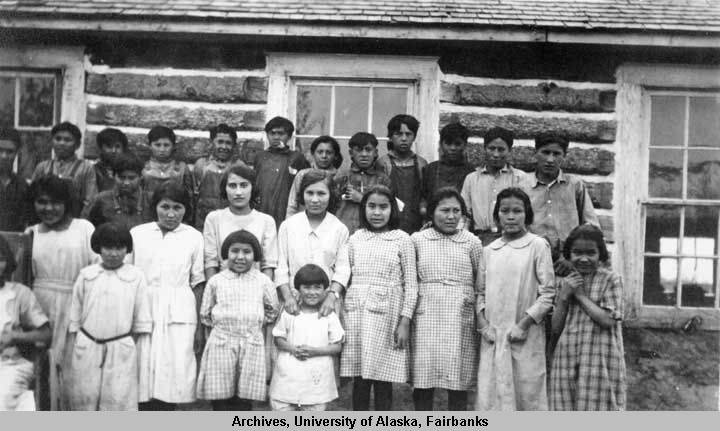
Boarding pupils of St. Mark’s Mission in Nenana in May 1924. It is from the Drane Family Collection, courtesy of the University of Alaska Fairbanks, APRCA (UAF-1991-46-782).

The Episcopal Diocese of Alaska says it will join a national effort to investigate the history of church-operated boarding schools for Indigenous children.

Episcopal Diocese of Alaska Bishop Mark Lattime said the action was prompted by the discovery this summer of unmarked graves where Indigenous children were buried at Canadian boarding schools run by churches.

“We recognize that it opened wounds that have been carried by so many of our Alaska Native brothers and sisters,” he said. “And the fact that the church was involved in this process is something that concerns us.”

The Episcopal Church was among those that ran boarding schools in Alaska and the Lower 48 in the 19th and 20th centuries.

Lattime said the Alaska church must look beyond its own account of history.

“The history that we’ve received is that those missions in schools were operated with care and respect for Indigenous culture and children. You know, we also have to recognize that history is written by one side of the story,” he said.

Lattime said the church in Alaska and nationally must “stand in the light of truth.”

“We might be able to say, ‘This wasn’t an issue in the Episcopal denomination.’ The fact is, if it happened in any church denomination, we, as a Christian body, I think are all responsible,” he said.

Lattime said the church is going through archival records and will work with Alaska Native organizations to hear from former boarding school students and their descendants.

The Episcopal Church hosted a national webinar on Indigenous’ Peoples Day about boarding schools, during which speakers described cultural genocide.

Pearl Chanar, who grew up in the Interior Athabascan village of Minto, recounted attending a boarding school hundreds of miles away.

“And what I remember most is that loneliness, missing my parents,” she said.

Pearl Chanar of Anchorage shares her story of attending a boarding school. (Episcopal News Service)

Chanar said she was denied expression of her culture.

“Not being able to speak my Native language, not being able to enjoy my traditional cultural activities such as my singing, dancing,” she said.

Chanar said she’s heard from other boarding school survivors who were abused. And she cautioned the Episcopal Church to be careful asking people about their experiences.

“That individual is going to tell you a story that happened 70 years ago,” she said. “It might have been traumatic for them. And if it was, then you’re asking them to repeat something that they’ve had buried for a very long time.”

Chanar noted that many boarding school survivors were subsequently lost to alcohol, drugs and suicide.

“And this is part of the truth of the Episcopal Church,” she said. “It’s a part of the history now. It’s not pleasant and it hurts.”

Chanar said the trauma experienced at boarding schools is passed to successive generations.

Bishop Lattime said the church is looking for Native guidance as it pursues “truth and reconciliation.”

“We need to be about listening and hearing and then following the lead of our Alaska Native people on the best way forward, and so really we’re just at the start of this process,” he said.

Lattime said Alaska Natives will be well represented in a state delegation which will attend a national Episcopal Church convention next summer in Baltimore, during which the boarding school issue will be a primary topic.

State flags lowered for former Alaska lawmaker Bill Hudson

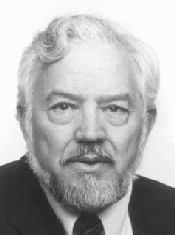
Former Alaska Representative Bill Hudson. Hudson died on Monday, Oct. 11, 2021. (Alaska State Legislature photo)

A longtime state lawmaker from Juneau died earlier this week.

Family and former colleagues say Bill Hudson died on Monday. Flags were at half staff across the state on Thursday in his honor.

Hudson was a Republican who represented Juneau’s Mendenhall Valley District from 1987 to 2003.

He was originally from Arizona, graduated from high school in Idaho and moved to Alaska in 1970. He lived in Dot Lake, Ketchikan, Cordova and Soldotna before moving to Juneau in 1974.

He served 21 years in the Coast Guard and was the director of the Alaska Seafood Marketing Institute, the commissioner of the state Department of Administration and director of the Alaska Marine Highway System.

Juneau’s legislative delegation remembered him on Thursday as a man who fought off attempts to move the state capital during his time as a legislator, as a fierce advocate for the Alaska Marine Highway System and as someone who helped secure funding for the former Glory Hall homeless shelter in downtown Juneau.

He was 88 years old.

Site notifications
Update notification options
Subscribe to notifications