History

After suspect’s arrest, Juneau woman is still hopeful her regalia will come home

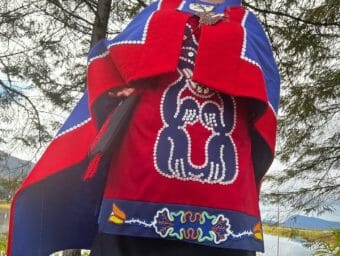
Neilga Koogéi Taija Revels’ stolen regalia. (Photo courtesy of Neilga Koogéi Taija Revels)

Neilga Koogéi Taija Revels lost a lot of her things when someone broke into her home last month, but the theft of her grandmotherʼs regalia was the most devastating.

Police arrested Juneau man Anthony Perry for the burglary this week, but the items are still missing. Revels says the regalia represents an important piece of Hoonah’s history — and some of the few things she had left from her grandmother.
Juneau Police Department Public Safety Manager Erann Kalwara said the investigation isnʼt over. 

“I would say there’s always hope,” she said. “They’re still following up on leads and still working through things.”

Revels said she feels hope, too. A lot of that comes from the support she’s received from investigators and the Juneau community as a whole.

“I’m just really humbled at the amount of caring and energy that folks have been putting into this,” Revels said. “And it does help me have hope and keep hope that the regalia will come home.”

Police also arrested Perry for a break-in at a local business in early December. He’s been charged with seven theft and burglary counts related to the break-ins and additional charges related to his arrest.

Perry is currently being held at Lemon Creek Correctional Center. 

A preliminary hearing is scheduled for Jan. 12.

‘Black Lives in Alaska’ highlights more than 150 years of African American history

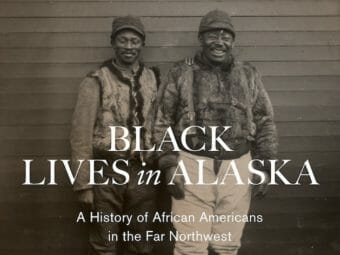
The cover of the book Black Lives in Alaska, showing two Black men dressed partly in furs.
“Black Lives in Alaska: A History of African Americans in the Far Northwest” is written by Ian Hartman and David Reamer. (Courtesy of the University of Washington Press)

Despite their small population, Black Alaskans have a history in the state that stretches back more than a century.
That history is the topic of a new book, “Black Lives in Alaska: A History of African Americans in the Far Northwest,” written by Ian Hartman and David Reamer.

Author and historian Hartman says while most of early Alaska history focuses on territorial days and the Klondike Gold Rush, Black people lived and worked in the region long before.

Listen:

The following transcript has been lightly edited for clarity.

Ian Hartman: You’re not really talking about Alaska really coming under U.S. control until the 1860s and 70s. But there is an Alaskan Black presence that predates even the treaty of purchase that I think people would be a little bit curious about. And that really has to do with the whaling industry. And so, if we think of the high era of North Pacific whaling in the 1840s, ’50s, and ’60s, and into the ’70s and ’80s even, the whaling crews would have been exceedingly diverse. And among the whalers would have included a pretty sizable population of Black whalemen.

Wesley Early: In recent years, one of the more storied pieces of Black Alaskan history has to do with the building of the Alaska Highway by Black soldiers in World War II. But your book highlights a lot of other contributions around that same time period, including during the Aleutian Islands campaign. Can you talk a little bit about those soldiers in Attu and Adak?

A black and white photo of two men using a bulldozer to build road through boreal forest.
Black soldiers were segregated and marginalized in the lead-up to World War II, but they proved their mettle with their work on the Alaska Highway. (U.S. Army/University of Alaska archives)

Ian Hartman: Yeah. So as you pointed out, oftentimes, we think about the Alaska-Canadian Highway having somewhat of a sizable Black troop presence to build that. But there is this other component, which would have been the Aleutian campaign. And so if we, even kind of shift our view, farther to the West, we see that Black troops were involved in that campaign, mostly in a logistical capacity. Remember, this is still very much so a segregated military. So the troops that were there were somewhat mistreated. They did not receive the same level of accommodations as their white counterparts. But nonetheless, they were really central in retaking the islands from the Japanese in 1942. And so they were involved in building runways and creating some of the infrastructure for the campaign.

Wesley Early: How do you think the post-war experience of Black Alaskans compared to black people living in the rest of the country?

Ian Hartman: What does make Alaska exceptional when we’re referring to the African American population is that, of course, the largest kind of visible minority population in Anchorage and through much of Alaska in the 20th century, of course, is the Alaska Native population. And then of course, you have an Asian American, Pacific Islander population. The Black population has kind of been in that mix in this broader pantheon of diversity. And so I think when you’re writing about Alaska’s Black population, it is different from say, writing about maybe Detroit or Chicago, or where I’m from in Pittsburgh, Pennsylvania, where the Black population is really the single largest minority population. And so I think, discussing Black history in Alaska, you have to kind of do so in correspondence with these other populations, as well.

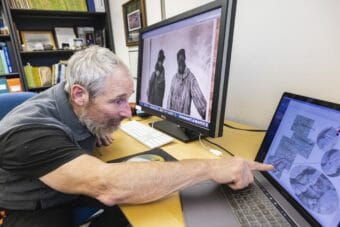
A man sitting by a microphone
University of Alaska History professor Ian Hartman. (Wesley Early/Alaska Public Media)

Wesley Early: As a non-Black person writing about Black history in Alaska, could you describe your process for making sure that your writings were reflective of those communities’ lived experiences?

Ian Hartman: When I started this project, it was really intended to be kind of a one-off, like a one chapter project. And it became quickly clear to me that it’s an incredibly rich history that really merited a far more extensive treatment. And so I think once I realized the depth of the history and the amount of people who contributed to it, it became… it kind of took on a new life. And at that point in time, I think your concern or your question becomes really important, which is how do you get community stakeholders involved? How can you bring elders into this to really share their story? And so I think the way that I’ve really tried to do that is to reach out to folks in the community to make sure that the history is, A: correct, but even more than that, that their voices are being included. And so I think oral history becomes very important to a project like this. Rather than just kind of going through newspapers and getting a sense of what was written about people, actually including the people who live that history in the book itself. And that’s been something that I’ve really taken away from this project. I think probably the most important part of it is almost that it’s collaborative and community based, rather than just kind of unidirectional about me going through archives or, you know, writing about experiences. But actually finding the folks who live this history who’ve contributed to the community and ensuring that their voices are represented.

Wesley Early: You talked a little bit about the sort of misconceptions around Alaska exceptionalism and the history that a lot of people commonly accept as Alaskan history. What do you think Alaskans would be most surprised about in your book?

Ian Hartman: Well, I, you know, I think it would be a combination of things. The first is that yes, there is this vibrant history of social mobilization and social movements here in Alaska. It’s also the case that Alaska has some of the same strains of racism and discrimination that one finds elsewhere. But again, I mean, people aren’t simply reactive. They’re community builders, right? And so it’s not simply the case that people are always kind of dealing with one wave of hostility or racism, but it’s instead that people are kind of proactively building community and building resistance. And so I think that that’s a really important piece of this that maybe isn’t always represented in Alaska’s history when we just look at say, the “great men” right? The legislative leaders, the folks who were responsible for the statehood movement. I think that there’s a whole other history of Alaska that is about the people and it’s about our diverse communities. And I think sometimes we forget how that diversity has really shaped our history.

In Juneau, Haa Tóoch Lichéesh solstice celebration offers a chance to heal

Solstice eve in Juneau, Alaska on Dec. 20, 2022 (Photo by Paige Sparks/KTOO)

Wednesday is the winter solstice, the shortest day of the year.

For some in Juneau, it’s an opportunity to work toward healing from the colonial legacy of the Christian holiday season. 

Haa Tóoch Lichéesh Coalition, a violence prevention organization, will celebrate the solstice Wednesday afternoon with a potluck, gift-making, singing and dancing at Generations Southeast. 

“It’s like a way to decolonize the holiday a little bit and get into spirituality, set intention and come together in community to do some traditional-based healing projects,” said organizer Jamiann S’eiltin Hasselquist.

She said that for Indigenous people, forced conversion to Christianity during the boarding school era has caused continued harm. A holiday that is not linked to Christianity creates space for healing.

Ati Nasiah, also with Haa Tóoch Lichéesh, said the solstice is a time to be intentional about the coming year. 

“We’re asking what those seasonal shifts have to teach us about how to live values-aligned lives, where we’re in reciprocal and healthy relationship with ourselves, with the land, and really working with the seasons in which we find ourselves,” she said.

Attendees can make cottonwood salves, rose rollers and medicinal tea for loved ones.

Juneau will see six hours and 23 minutes of sunlight on the solstice. On Thursday, Juneau will slowly start getting more and more daylight again.

Mislabeled photos, newly discovered at UAF, bolster 1910 Denali summit claim

A man points at a map and photos on a laptop.
Professor of geophysics Matthew Sturm points to the Sourdough expedition’s path in summiting Denali 1910 from studying newly found photographs located at the Elmber E. Rasmuson Library archives. (JR Ancheta/UAF-GI)

There’s new proof of the success of a pioneering ascent of Denali. Historic photographs from the 1910 Sourdough expedition were found this fall at the University of Alaska Fairbanks.

The black and white images provide hard copy evidence that Alaskans Pete Anderson, Billy Taylor, Charlie McGonagall and Tom Lloyd — known as the Sourdough expedition — got members to the top of Denali’s 19,400-foot North Peak in April 1910 — a feat that’s long been subject to skepticism.

“They went,” said UAF geophysics professer Matthew Sturm, who found the photos. “They did the climb, but they were not good about documenting it.” 

A black-and-white photo of two men in historic winter gear with snow goggles standing on a mountain.
In this photo, previously unpublished as far as is known, Charlie McGonagal, left, and Pete Anderson, two of the four-man Sourdough expedition that ascended Denali’s North Peak, are shown in a mislabeled photograph. (Photo from UAF Rasmuson Library archive)

Sturm says he came across the Sourdough expedition photos in October while doing research for an unrelated mountaineering book at the UAF Rasmuson Library archive. He says he was looking through a box of materials and found a folder with a label that included the words 1911 McKinley climb.

He said he “got a tingly sense that maybe something good could come of this,” even though the date on the folder was off by a year.

Museum of the North Director Pat Druckenmiller and Senior Collections Manager Angela Linn with the alpine stock used by Pete Anderson and Bill Taylor 1920 ascent. (JR Ancheta/UAF-GI)

Sturm says one of the photos in the folder shows two climbers he immediately recognized.

“I’m a bit of an amateur history buff for climbing in Alaska and the Yukon, and I thought — whoa, that’s Charlie McGonagall and Pete Anderson from the Sourdough climb,” he said.

Sturm says he worked with University of Alaska Fairbanks archive and Museum of the North staff to confirm the identities of the pictured Sourdough climbers, including Taylor and Anderson, who he says made it to the north peak’s summit.  He says he figured out where the photos were taken by comparing them with modern images of the mountain.

“We could place them quite high on the route,” he said. “The highest one is near around 16,000 — and we’d never been able to place them anywhere near that before — for marvelous sort of insight into an event that has been revered by some climbers and doubted by others for a hundred and ten years.”  

Sturm says the photos add to another piece of evidence that the Sourdough expedition climbed Denali’s North peak: a spruce flag pole the climbers set up a little below the summit, which members of the 1913 Hudson Stuck expedition reported seeing. They were the first to reach the top of Denali’s higher south peak.

A black-and-white panoramic photo of a climber in the distance, high on a ridge on Denali
A climber is seen in the distance at about 13,000 feet on what today is known as Karstens Ridge. Indentations to the left are believed to be from a 14-foot spruce flagpole. (Photo from UAF Rasmuson Library archive)

“I think it moves it from shadowy, maybe it did or didn’t happen, right into the mainstream,” he said. “It happened.”

Sturm says the Sourdough expedition photos were donated to the UAF archive in the 1980s by the daughter of an early 19 hundreds Fairbanks newspaper editor who was friends with Sourdough expedition climber Billy Taylor. 

This photograph, made at about 16,500 feet, looks down the 20,310-foot mountain. Matthew Sturm and colleague Philip Marshall used maps and digital software to pinpoint the locations where the photographs were made. This photo is mislabeled as March 1911. (Photo from UAF Rasmuson Library archive)

“She donated a lot stuff to the archives, and they logged it in, and it would have taken an expert to know what it was,” he said.

Sturm says it remains a mystery why the photos weren’t used by expedition members to prove their summit claim. Sturm plans to write an article for a mountaineering journal about the photos.

In new podcast, Juneau reporter digs into her family’s story of escaping the Khmer Rouge

Lisa Phu and Lan Phu in 2017. (Courtesy of Lisa Phu)

Lisa Phu has been a journalist in Alaska for years, covering local issues and statewide politics. Now she’s taking on her own family’s story, in a new podcast series called Before Me.

Her mother, Lan Phu, fled Cambodia during the Khmer Rouge regime in the 70s before coming to the United States. Lisa said there were a lot of parts of that story she didn’t know, and she’d been asking for years to interview her mother.

Now that two episodes of Before Me are out, she sat down with KTOO’s Yvonne Krumrey to talk about what it’s been like making the series. 

Listen:

The following transcript is of a shorter version of the interview than the recording above. It’s been edited for length and clarity.

Yvonne Krumrey: Is there anything that you wish people in Juneau and Alaska understood about the history of the Khmer Rouge?

Lisa Phu: Most people are familiar with the Vietnam War. So I think this is just a piece of our history that a lot of people just aren’t familiar with. So I think just like telling that story that’s been so important to my life and letting folks know this was going on at the same time. It’s just there was so much going on in that region. So yeah, I think it’s just a piece of history that people should know about.

Yvonne Krumrey: In the first episode, your mother tells you the story of how your older sister was killed. And she said something that really stuck with me, I’ll play it.

Lan Phu: It took me so long to be able to repeat the story.

Yvonne Krumrey: How did you feel asking her about these traumatic memories as part of this project?

Lisa Phu: I mean, I think on one hand, I wanted to know them. So like on a very basic level, I wanted a record of what happened in her life. It was important for me to know because I just never heard that story. 

I had asked my mom over years if I could interview her. And she said no. Like, she said no many times. And then I forget what year it was, like 2014 or 15. She got in a car accident. And she was fine. But it was just like, “Oh my gosh, we could lose anyone at any moment.” So I was like, “Mom, can I interview you, please?” And she finally said, yes. So, like, I felt okay, because she had obviously thought about it. And she was ready to share with me. 

Yvonne Krumrey: You said you’ve been working on the story for six years. Can you talk about why you wanted to do it and how it took to come to fruition? Like, how come six years?

Lisa Phu: So yeah, I had asked my mom after this car accident, Can I interview you? After many times, she finally said yes. And just feasibly, she came to visit me when my daughter was born. So that was just like, the longest time we were in the same location together. So just logistically, it made sense that I would interview her then. 

But as far as why I wanted to do it, I think in my mind growing up, I always assumed I would tell her story one day — or my family story. But yeah, so I interviewed her, just like the process of transcribing everything and like, writing everything just takes a super long time to do. Life gets in the way. But yeah, I mean, it just took a long, long time.

Yvonne Krumrey: You’ve been a reporter in Alaska for years. How has that experience prepared you for this project?

Lisa Phu: Um, I think it should have prepared me better. You know, I had been an audio reporter, a public radio reporter. And so I know how to, like, handle a mic and where to put it and stuff. But when I interviewed my mom, it was like, I can’t put this mic in her face. Like, there’s just no way I can do that because on one hand, I wanted to make her feel comfortable, but it was like, I couldn’t be the reporter with my mom. 

Yvonne Krumrey: Has hearing more about your mother’s story changed the way you see your work as a reporter at all?

Lisa Phu: You know, like, what I liked about this, doing this work is just like the in-depth nature to it. What’s been really interesting is that, I have also been doing another podcast called Private Right, which is a series about abortion and Alaska. And it’s really intense to like, kind of toggle between both of these stories.

You know, at the root of it, is like motherhood and I’m a mother. And I’m struggling just everyday with being a mom and being a reporter. And then telling my mom’s story, and then reporting on people having the choice or not to have the choice to be a parent. There’s just a lot of intersectionality to the work I’m doing with both podcasts. That makes me pause often, and I’m just like, “whoa.”

Listen: How American Indian family separation leaves impacts generations later

Illustration by NPR.

Every family has that one story that gets passed around the dinner table when company is over. Maybe it’s how a couple met, or a chance run-in with a beloved celebrity. For my family the chosen lore was the time my dad’s adopted mother, Cleo, met his birth parents.

The story goes that Cleo was working as a nurse in an emergency room in Salt Lake City when a young American Indian couple came in with a beautiful baby boy.

The man was tall and lanky with a big belt buckle – it had hunks of turquoise in it and was too big for his frame. His partner was short and more round, and in her arms was a newborn.

The couple told Cleo they loved the baby very much, but couldn’t keep him. They were the first from their tribes to go to college and they couldn’t afford a child. She gave them the name of her priest to help them figure things out.

They were just one passing couple in a long shift at work. She didn’t think much of it until a few weeks later. She got a call from the same priest saying her prayers had been answered and he had a baby boy for her to adopt.

When my dad got older and started searching for his birth parents he kept the image of the tall boy with the belt buckle and the short, round girl in his brain. He looked for years and years to find his parents – and with them his tribe – to no avail.

And for good reason: the students didn’t exist. Cleo made the whole story up, hoping to give her baby some sense of self in a very white landscape.

When my dad finally found his biological father in 2018, he wasn’t a tribal student from the University of Utah. His name was Phil Martinez and he didn’t even know he was Native American.

Now, at the dinner table, we tell the story of how two families with parallel lives found each other six decades later. And with that reunion came new questions on what shapes identity, and how generations of displacement of American Indians affects that identity.

Listen to this episode of Code Switch:

Copyright 2022 NPR. To see more, visit https://www.npr.org.
Site notifications
Update notification options
Subscribe to notifications