History

Curious Juneau: Why does Alaska’s Capitol building have a ground floor?

Alaska’s Capitol has a ground floor and a first floor. It’s relatively uncommon in American buildings. (Katie Anastas/KTOO)

When Americans walk into a multi-story building, they’d usually say they’re on the first floor. Not in the lobby of Alaska’s Capitol building.
“It has a very European feel to it,” tour guide Kirk Smith said on a recent morning tour. “Right now, you are not on the first floor, you are on the ground floor. And the reason for that is that, as a multi-agency federal building, it was required to have a post office in it.”

Kirk Smith leads a tour of Alaska’s Capitol building. (Katie Anastas/KTOO)

Smith said visitors often wonder why that is. KTOO listener Sylvan Robb asked us to find out for this installment of Curious Juneau.

The Capitol was built in 1931. That was before statehood, so it was built to serve as a federal and territorial building. The post office was on the second of six stories, but Juneau’s steep streets still made it possible to put entrances and loading docks on that floor — on the uphill side, on 5th and Seward Streets. So the architects called that the first floor and called the one below it the ground floor.

“In order to meet the post office’s requirements of having a first floor street entrance, they had to call this the ground floor,” Smith said in the lobby.

The doorway to Seward Street is still there, though the post office is long gone. When Alaska became a state in 1959, the building became the state Capitol. In the years that followed, the post office and other federal offices moved to the newly constructed Juneau Federal Building.

“There’s nothing of it left,” Smith said. “It would be nice if there was an antique post office box or a teller window or something, but there’s really nothing there. It just looks like a hallway. It’s too bad.”

This used to be the employee entrance to the post office. Now, it’s just another hallway in the Capitol. (Katie Anastas/KTOO)

One lingering sign of the building’s history, though, is its art deco style. 

“I like to refer to the architectural style that’s in use here as ‘early 20th century American post office,’” Smith said.

Like many other federal buildings and post offices built during that time, the Capitol was designed by the Treasury Department’s Office of the Supervising Architect.

That office’s designs have come in handy for local architect Wayne Jensen. He’s been involved in many projects at the Capitol over the years, including renovations of the House and Senate chambers and remodels of committee rooms. Most recently, he oversaw seismic upgrades throughout the building, which took years of work between legislative sessions.

That’s when Jensen saw one remnant of the old post office. 

“When we did the demolition, we found a door that was kind of closed into one of the walls,” he said. “I don’t remember if it said ‘post office’ on it, but that was the one thing we did find.”

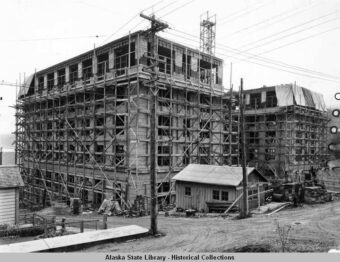
This 1930 photo shows a rear view of the Capitol under construction. (M272-2 Alaska State Library Manuscript Collection)

Jensen has studied the original architects’ ink-on-linen drawings. He said putting the post office on the first floor makes sense – that floor is bigger than the ground floor, and it has better street access.

“The ground floor isn’t as large as the other floors,” Jensen said. “It goes back into the mountain, back into the hill, so it’s truncated a little bit. Plus it has the boiler rooms and all those things that are not really occupiable spaces. But the first floor has access on the back side of the building and on Seward Street.”

According to the building’s original floor plans, the door to Seward Street was an employee entrance and the one to 5th Street was the public entrance. The post office lobby and work room took up the entire east wing of the first floor. Postal workers would sort the incoming mail in the workroom and feed it into post office boxes.

“I know stories from people who lived here in the ‘50s, ‘60s – they would go there every day to get their mail and it became a social area,” Jensen said.

This door, which goes out to Seward Street, was once the employee entrance to the post office. The steep street allows for a street entrance into the second story of the building. (Katie Anastas/KTOO)

Jensen said the history of the Capitol building is worth remembering. Before construction started, Congress only allocated enough money to pay for half of the block where the building stands today. Juneau residents raised the rest of the money and then gave the property to the federal government.

“The community got together and said, ‘Well, if the feds can’t do it, we can do it ourselves,’” Jensen said. “It’s very Juneauite. Over the years, we’ve done a lot to keep the Capitol here and support the Capitol, and that was one of the first efforts to do that.”

The post office may be a nearly-forgotten piece of the building’s history. But it’s why today’s visitors need to pay extra attention to what floor they’re on inside the Capitol.


Curious Juneau

Are you curious about Juneau, its history, places and people? Or if you just like to ask questions, then ask away!

Thousands attend first-ever Alaska filming of ‘Antiques Roadshow’

Shyanne Beatty is a volunteer appraiser for “Antiques Roadshow.” Beatty is Hän Gwich’in Athabascan and specializes in tribal arts. She is also the vice president of the Alaska Native Village Corporation Association. (May Lee/Alaska Public Media)

Local appraiser Shyanne Beatty stood behind a folding table under a tent at the Alaska Native Heritage Center in Anchorage on Tuesday discussing an attendee’s finely-detailed Indigenous footwear laid out on its wrapping.

The woman told her they were a gift from a friend.

“I’d say that you have a really nice friend,” Beatty said laughing.

Beatty was one of dozens of people appraising items at the filming of the PBS show “Antiques Roadshow.” It was the first time the popular show visited Alaska — and fans claimed tickets quickly. Nearly 2,500 people showed up throughout the day Tuesday with pieces to be evaluated, some wheeled in carts, others carried in their arms.
Beatty, who worked at the tribal arts booth, said some of her favorite items were a carved killer whale tooth from King Island, a seal gut doll and a Yup’ik basket adorned with goose feathers and feet.

She said she’s watched the show for years and was glad to be a part of it.

“It’s so validating, I think, for a lot of locals to have the ‘Antiques Roadshow’ to come to Alaska,” she said.

The longest line was consistently for the tribal arts booth. People brought everything from family heirlooms to garage sale finds.

Nicholas Lowry (left) and Kevin Zavian (right) pose with an “Antiques Roadshow” crew member on Tuesday. Lowry is the president of Swann Auction Galleries in New York City, specializing in vintage posters. Zavian is an appraiser specializing in jewelry. (May Lee/Alaska Public Media)

One guest named Brenda brought her grandfather’s teddy bear she thought could be worth something because it was from a valuable toy maker. Her bear looked beyond well-loved and was tattered and worn. While the bear did turn out to be genuine, she found out the overall-wearing bear was hiding a secret.

Apparently he’s Franken-bear. His head was decapitated and put on backwards. He’s just – he’s my sweetheart. So 1910. He’s old and well-loved. So that’s Teddy,” said Brenda.

“Antiques Roadshow” doesn’t allow the disclosure of last names to protect people with high-value items and to keep the upcoming show a surprise.

Other people brought things like musical instruments, paintings, furniture or jewelry.

They were bussed to the heritage center from Bartlett High School and then had to go through a process the show referred to as “triage.” Staff and volunteers ushered them to various locations depending on what they brought to get appraised. Everyone could bring up to two items.

Appraiser Amanda Everard learns more about a glass basket and the history behind it. (May Lee/Alaska Public Media)

Senior producer Sam Farrell said you never know what people will have in any given region.

“As someone once said, you know, you can see a Hawaiian bowl in Boston and a Boston chest in Hawaii,” he said.

Alaska is the last filming stop of five cities for the upcoming 28th season of “Antiques Roadshow.” For years, the added logistics to shoot in and travel to Alaska prevented the show from coming to the state, according to Farrell. This year, TOTE Maritime donated their shipping services, which allowed the show to get two semi-trucks’ worth of specialized gear to Anchorage.

The Anchorage filming will air as three episodes in the first half of 2024.The appraisers and producers will work together to determine which combinations of people and their objects will make the final cut. Only a very small percentage of the more than 2,000 attendees will be on air.

The episodes are expected to draw a big audience — the long-running “Antiques Roadshow” is the most-watched show on public television. Executive producer Marsha Bemko said she thinks its success stems from being smart reality television.

So I think that’s the ultimate secret sauce is that people like learning in a way that they don’t even notice, it feels like eating ice cream,” said Bemko.

Marsha Bemko, television producer of “Antiques Roadshow,” talks about her experience with the show and the stories she learned about the participants and their items. (May Lee/Alaska Public Media)

She has been the executive producer of “Antiques Roadshow” since 2003 and said that when you boil it down, the show tells people about what they own, appraises it and makes TV from it. It’s a simple formula, she said, but it’s not just about the items.

“Ultimately behind those things are people. And when you do this show like that over the years, you really get touched by people and the humanity of people and how we’re all the same,” she said. “We all care about the same things. And I like that.”

Editor’s note: Alaska Public Media is a PBS member station and broadcasts “Antiques Roadshow.”

Amateur historian wins national award for podcast on one of Alaska’s deadliest shipwrecks

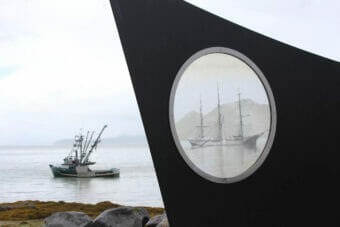
The Star of Bengal is remembered with an image at the Wrangell Mariners Memorial. (Sage Smiley/KSTK)

A podcast on Wrangell history has won a national award for its series on one of Alaska’s deadliest shipwrecks.

In late September of 1908, the iron-hulled Star of Bengal, battered by a storm, smashed against the rocks of Coronation Island in Southeast Alaska. The ship broke apart, killing 111 of the 138 people on board – most of them Chinese, Filipino and Japanese cannery workers.

“It’s so viscerally real to me,” said podcaster and amateur historian Ronan Rooney. “Those of us who live in Southeast Alaska, we know that coastline. We’ve all seen miles and miles of it just going around, and to imagine a ship of that size wrecking against the coastline is just extraordinary.”

The Star of Bengal’s captain survived the wreck and publicly blamed the captains of two tugboats that had been towing the ship. After months of federal investigation, nobody was ever held responsible.

Rooney started his podcast, Wrangell History Unlocked, early in the pandemic, as he found himself with a lot more time at home. He’s looked into all sorts of local history, including a five-part series on the wreck of the Star of Bengal.
“I intended for it to be kind of about an hour, when I set out,” Rooney said. “I wanted for people to hear a story about the Star of Bengal that was maybe something they hadn’t heard before. So I really went into: let’s get into different narratives and let’s pick apart who I think is embellishing or outright lying. Because that’s what I really like.”

Rooney says previous researchers and historians had thoroughly analyzed the federal investigation and how the Star of Bengal was battered by the storm. He wanted to do something different.

“I kind of feel like I brought for the very first time: Here is a reason why we should all take sides in this debate, we should say the captain and the survivors are totally wrong, and that the steamship captains were in the right the entire time,” Rooney said. “Making a case for why I think the captain of the Bengal and the survivors lied under oath about the chance of rescue, which was absolutely impossible. The morning that they sat at anchor, there was no way they could be rescued. They tried to destroy the steamship captains, who themselves were victims of the same storm.”

Star of Bengal (Courtesy of the Wrangell Museum)

Looking at what the survivors of the wreck told newspapers down the West Coast, Rooney found an evolving story.

“What drew me was the near-universal sort of conclusion for over 100 years from people who wrote about it was that there was really no way of knowing if the accusations about cowardice were true or not, it was always more like, ‘Well, we’ll never know,’” Rooney said, “And that really rubs me the wrong way. I just couldn’t accept that.”

Although Rooney’s podcast on the wreck contributes new perspectives to the event’s history, it’s not a complete record. The history is skewed to the captain and ship’s crew, who were mostly white — Rooney says there’s very little out there about the cannery workers, most of whom died in the wreck.

“What the story is severely lacking is the voices of the Chinese, Japanese and Filipino cannery workers,” Rooney said. “We don’t have their words to go by. So there’s always going to be a cloud of mystery that may never go away.”

Rooney isn’t a professional historian. Born and raised in Wrangell, he graduated Wrangell High in 2003. As a senior, he wrote a pamphlet on Wrangell.

“I wrote a booklet for the museum, which you can still buy down at the gift shop, it’s that little red book,” Rooney explains. “The fact that they still sell it is really a huge honor. That was me dipping my toe in this sort of, ‘Well, maybe this is something I like researching, and I do like to share with people.’”

Rooney now works in tech and lives down south with his family – wife Mary, daughter Rosemary and son Conan – on the Willamette River in Wilsonville, Oregon. He was born in Wrangell at the old hospital building.

“My father was a fisherman and mother was a social worker,” he said. “I went to St. Philip’s Episcopal Church, I had great exposure to Lingít culture, Haida culture, and all that you have access to and Wrangell even today, and I sort of took it for granted.”

But the early pandemic brought him back to looking at Wrangell’s history. The podcast is a sort of audio theater, with narration from Rooney, sound effects, and friends and family playing parts.

“I had my friends who did voices for the piece,” Rooney said. “I’d get people on the phone and have them record little lines here and there, and my mother is in this piece playing piano as well as talking to Bill Taylor. My wife plays piano and does the voice is Joan.”

Joan is Joan Lowell, the daughter of the Star of Bengal’s captain. She was a silent film actress and published a book about the wreck of the Star of Bengal in the late 1920s. Rooney’s wife voiced Joan in the final episode of Rooney’s series on the wreck.

“It’s campy, it’s weird,” Rooney said. “And it’s just a treasure to me. I listen to it from time to time, just because hearing it makes me laugh.”

But “The Rise and Fall of the Star of Bengal” is much more than its entertainment value.

Star of Bengal (Courtesy of the Wrangell Museum)

Katie Ringsmuth is the Alaska State Historian and deputy State Historic Preservation Officer for the state of Alaska. Ringsmuth’s office in Anchorage has been gathering information to potentially place the Star of Bengal shipwreck on the historic place register. It’s part of a broader push in recent years to investigate and recognize the importance of the wreck. She stumbled on the podcast while searching online.

“I was very interested in looking at that shipwreck as a potential national register nomination,” Ringsmuth explains, “And actually, just happenstance came across Ronan’s podcast while doing a quick search on Google to see what more was out there about the shipwreck, and was just really, really impressed with the amount of work Ronan had put into it.”

Ringsmuth says Rooney’s podcast series on the shipwreck is compelling for a number of reasons. It’s an important story about an underrepresented community, as well as an important story in Alaska maritime and cannery history.

“I thought that it was probably the best account of that event that I’ve ever read, or experienced,” Ringsmuth said.

So she decided to nominate the series for an American Association for State and Local History award.

“It’s not just something that is cool and connects people, but also offers an important contribution to the scholarship and our greater understanding of the historic record,” she said.

And the awards committee thought so too – Wrangell History Unlocked: The Rise and Fall of the Star of Bengal won an award of excellence from the American Association for State and Local History.

For Rooney, the recognition has him on Cloud 9.

“I felt like I wanted to ride that fire truck through town,” Rooney said, referencing the long tradition of winning sports teams in Wrangell parading through town on the fire engine. “It felt like a validation of this thing that I do as a hobby. As a passion project, it paid off.”

But he’s not resting on his laurels – Rooney is bursting with ideas for future series and episodes.

“Did you know that the very first woman to become mayor in Alaska was from Wrangell?” Rooney said. “It was 1946. And her name was Doris Barnes.”

He’s got other ideas, from telling the story of the corrupt officials overseeing Wrangell during the Cassiar Gold Rush in the 1870s to the founding of the former Bureau of Indian Affairs boarding school on the island, the Wrangell Institute.

“That’s the great thing about history,” he said. “Is that it’s always just there, you can always go tap into it, you can always go find the power in it. That it’s a long time ago doesn’t hurt. In fact, that can make it more meaningful.”

Rooney’s podcast will be formally presented with the award at the American Association for State and Local History awards conference in Boise, Idaho in September. Another Alaska history project focused on the former Diamond NN Cannery in Bristol Bay, will also be honored with an award.

Kodiak Filipino American Association brings back in-person celebration for Filipino Independence Day

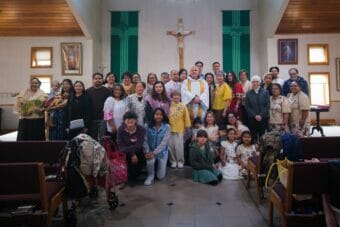
After Mass, community members and attendees gathered for a group photo in front of the altar, June 11, 2023. (Brian Venua/KMXT)

This week marks the 125th anniversary of the Philippines’ Declaration of Independence. That was when the island nation officially began a revolution from its colonizers.

Festivities take place across the country each year, and this year, celebrations even took place in Kodiak.

St. Mary’s Parish, Kodiak’s Catholic church, dedicated a Mass to the archipelago’s Filipino community on Sunday. After Mass, a celebration was held in the church’s community center across the parking lot.

Some helped serve food as they talked with friends, June 11, 2023. (Brian Venua/KMXT)

“The first time that the Philippine flag was raised was in Kawit, Cavite by the late president (and) general, Emilio Aguinaldo,” he said. “That’s the first time that we as the Filipino [sic], we are free from bondage, we are freed from slavery. ” This is one of the first events Kodiak Filipino American Association has had in a while. Mark Anthony Vizcocho is the association’s president. The United States didn’t officially recognize the Philippines until after World War II, but Vizcocho said most Filipinos recognize the original declaration from June 12,1898.

Some folks even wore traditional Filipino formal clothes for Sunday’s celebration in Kodiak.

Barong tagalogs are usually worn by men and look kind of like a western button up shirt. Filipinianas are usually worn by women and can look like a short jacket or similar to a shawl. Both are usually white or off-white and transparent, but worn with a similar color shirt or dress underneath. They’re traditionally made from pineapple fibers, and adorned with patterns near the collar and chest areas.

Vizcocho said he wants to hold more events like this to bring together the Filipino community and spread awareness about the association’s efforts.

“Let’s bring this back online so that everyone can see that we are here,” he said. “We are proud of who we are and we want to share that celebration with everybody in the community, so this is just a start on just giving back to the community.”

City Mayor Pat Branson also attended the celebration. The Kodiak City Council proclaimed June as Filipino Heritage Month at its meeting last week in honor of the independence day. She said it’s important to acknowledge the historic presence of Filipinos on the island and the impact they’ve had over the years.The small room was lined with tables filled with foods like pancit, a rice noodle dish with chicken and vegetables, and kaldereta which is like a stew. There were also desserts like puto, a steamed rice cake. The room was filled to the brim and attendees spoke both in English and Tagalog, the main dialect of the Philippines.

Four women, just outside the filled room, June 11, 2023. (Brian Venua/KMXT)

Vizcocho said they hope to host a basketball or volleyball tournament next year as well to get more young people involved. “(The) Filipino Community’s been here since the 1800s, a major part of our community, volunteering, working hard,” said Branson. “And celebrating – The FilAm Association knows how to celebrate with great food and laughter – you can hear that going on inside! So, it’s joyous day.”

“Anything that we try to do to get the youth involved,” he said. “That’s one of our main projects, towards the youth.”

The Kodiak Island Borough Assembly will also proclaim June as Filipino Heritage Month in their meeting on Thursday. Vizcocho says this past weekend’s festivities are just the beginning, and is already planning to host more events soon.

Researchers are searching underwater for more ancient evidence of Indigenous life near Prince of Wales Island

An aerial shot of Prince of Wales Island. (Photo courtesy KRBD)
An aerial shot of Prince of Wales Island. (KRBD photo)

A team of researchers have been combing the waters around Prince of Wales Island, looking for evidence that could shed more light on how long Indigenous people have lived on this land. An underwater robot has a key role.

After the discovery of an ancient fish trap last year, scientists were able to place Indigenous people near Prince of Wales Island around 11,000 years ago.

Now, more research is being done to see if they can push that time back even further.

Kelly Monteleone is a lead researcher with the crew. The crew includes people from the University of Calgary, Sealaska Heritage Institute and SUNFISH.

“We’re really hoping that we can find evidence going back, you know, thousands and thousands of years more — to get people on this continental shelf 16, maybe even 20,000 years ago,” Monteleone said.

She explained that the people who lived along that shelf tens of thousands of years ago are likely ancestors to modern-day residents.

We’re hoping to find caves,” Monteleone said. “And then we know that because of changing in sediments, we’re not necessarily going to find things on the surface in caves. So we’re trying to take a number of sediment samples.”

The samples will then be searched for something called microdebitage. It’s a big word for something that’s actually really small.

“So every time somebody sharpens or uses a stone tool, little, itsy-bitsy flakes come off — sometimes, you know, less than one millimeter in size,” Monteleone explained. “And we can find those in the sediment samples if people were using tools in the cave.”

That sediment will undergo a variety of tests.

“We’re also going to be analyzing the sediments for environmental factors,” she said. “And so we’ll radiocarbon date and we’re gonna get pollen and something called dinoflagellates cysts, which are little microscopic organisms that tell us about the waterfall at the time that sedimentation happened.”

But there’s one catch: the caves are now underwater. Monteleone said they would’ve been above water around 10,000 years ago, when sea levels were about 165 meters lower than what they are now.

So the team is using an underwater robot called SUNFISH. Kristof Richmond is the co-principal investigator involved on the robotics side of the project. He said the robot is going to explore areas that humans pointed out last year.

“And it does very precise mapping using sonar and cameras, and can actually navigate into caves autonomously,” he explained. “So it’s able to explore really complex underwater features and map them out. And so we’re using that tool to help us really identify with precision what kind of features we saw in this high level overview.”

The team also held public events with the robot over the weekend in Craig and Klawock.

“This is just, for us, a real exciting opportunity to demonstrate AI and autonomous functions, you know, to get to places where people can’t and learn lots about our environments, where we come from, and, you know, get into unexplored territory and just push the boundaries of human knowledge,” Richmond explained.

It will take another year or so to comb through what the team finds. But they hope it will lead to even more research about the history of people living in Southeast Alaska.

Complaint against Juneau Fred Meyer will be heard this fall by state human rights commission

A sign saying tribal IDs aren’t accepted for tobacco purchases at Fred Meyers in Juneau in 2020. (Photo courtesy of Jamiann S’eitlin Hasselquist)

The Alaska State Commission for Human Rights has scheduled a public hearing for a complaint regarding the use of tribal IDs at a Juneau grocery store. 

The issue relates to a 2020 incident when a sign posted at Juneau’s Fred Meyer stated that tribal IDs would not be accepted for tobacco sales. Another sign allegedly posted around the same time said customers would be required to show “valid identification when purchasing alcohol or tobacco.”

Jamiann S’eiltin Hasselquist filed the complaint after an elder called her and told her about the signs. 

“He was really shook up and said that it reminded him of those days when signs were posted,” Hasselquist said. 

She said the elder was referring to the period before Alaska passed the Anti-Discrimination Act of 1945, when Juneau businesses would post signs that said “No Natives allowed,” “No Dogs, No Natives” and “We cater to white trade only.”

City and Borough of Juneau Assemby member ‘Wáahlaal Gíidaak Barbara Blake said that tribal IDs should be valid for any purpose that any other government-issued identification can be used for. 

“People don’t understand that the tribes are a sovereign entity, that they actually have governing authority,” Blake said. “Their inherent authority predates the United States of America, predates the state of Alaska, or any Constitution for the state or for the United States of America.”

Fred Meyer staff eventually took the signs down.

A sign saying only “valid” IDs are accepted at Fred Meyer. This sign was allegedly posted around the same time as another sign that said tribal IDs weren’t accepted for tobacco purchases at Fred Meyer in Juneau in 2020. (Photo courtesy of Jamiann S’eiltin Hasselquist)

But Hasselquist said the store’s action caused harm to the community, so she submitted a complaint to the Alaska State Commission for Human Rights. She says she wants to make sure that Fred Meyer will offer education and training to make sure this won’t happen again. 

“They have to integrate civil rights and anti-discrimination into their policy to teach their employees that it is not okay to hang signs like that,” she said. “That it’s discrimination.” 

She wants that education to include Elizabeth Peratrovich and the history of Alaska’s own anti-discrimination movements. 

The Central Council of Tlingit and Haida issues IDs for tribal members. Their website lays out what the cards can be used for and gives advice for what people should do if their ID is rejected. 

The state Office of Administrative Hearings has scheduled the hearing for Oct. 9. Neither Fred Meyer nor its parent company, Kroger, responded to requests for comment.

Site notifications
Update notification options
Subscribe to notifications