History

Klukwan church returned to tribe after century of Presbyterian ownership

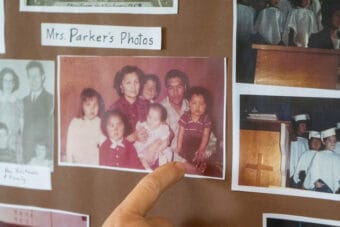
Lani Hotch points to photos on the Klukwan church wall of her family. (Lex Treinen/Chilkat Valley News)

On a recent Sunday, about a dozen parishioners sit on wooden pews at the Klukwan church listening to a sermon.

With a grand piano accompanying them, they sing along to “Count your blessings” and “These are the days of Elijah.” And, as they listen, a few parishioners sew animal hide.

On the surface, little has changed about the church services in years. The community staple — originally known as the Klukwan Presbyterian Church — has been holding regular Sunday services for nearly a century.

But one thing about the church has changed: its owner.

Last November, a national denomination of the Presbyterian Church transferred the deed to the Klukwan tribe, as part of the denomination’s effort to reconcile past abuses by clergy members and teachers against Alaska Native people.

Tribal and church leaders said it was an important step towards self-determination for the Chilkat Indian Village, the federally recognized tribe in Klukwan.

“It just kinda hits you dead center – the church is ours,” said Jones Hotch, a longtime church member and a member of the Klukwan tribal council.

The idea was first floated years ago under then-pastor Jami Campbell after she witnessed a statewide apology made by the Presbyterian Church at the Alaska Federation of Natives conference in 2016.

Campbell has since moved away from Klukwan but returned for the Oct. 8 ceremony.

“Being part of healing is a pretty amazing thing,” she said in a phone interview from Washington state, where she now lives. “They’ve gained some of their power back.”

Starting with an apology

Lani Hotch, another longtime church member and culture bearer in Klukwan, said some of her earliest memories are with the church. While she spent her early years in Haines, Hotch remembered coming to services with her grandmother, Jennie Warren, who wore a navy blue dress with white polka dots on Sundays. They walked over the wooden sidewalks to the wooden building, Warren in her black leather shoes with modest heels, keeping a strict eye on the rambunctious children.

Hotch said she loved the services and the connection it brought to her family and the history of the region. Her great grandfather James Katchkanuk had purchased the cast iron bell in 1903. She continued to attend church through adulthood.

Campbell said she quickly felt the importance of the church after she was recruited as pastor of Klukwan Church at the end of 2017. She served a brief volunteer stint cleaning the Jilkaat Kwaan Heritage Center earlier in the year and some church members asked if she would be interested in the pastorship. She decided to make the move with her partner in September of 2017.

Campbell tried to integrate into the community as quickly as she could, but the darker sides of the church’s history in Alaska gnawed at her. She remembered seeing a document at the Jilkaat Kwaan Heritage Center to prove they were no longer Indigenous. It required a signature from five non-Native Alaskans to prove they were “civilized.”

The Presbyterian Church was a major force in several regions in Alaska, including in the Chilkat Valley. The church was particularly active in missionary boarding schools, taking Alaska Native children away from their families to boarding school and prohibiting local languages as part of a “civilizing” mission. Among the most prominent Presbyterians was Rev. Sheldon Jackson, who established a system of boarding schools across the state.

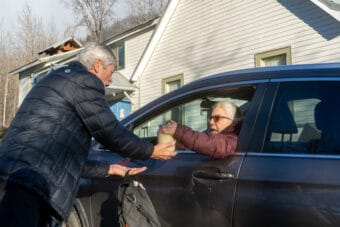
Lani Hotch passes a jar of chowder to pastor Al Giddings, who recently took over pastorship of Klukwan Church. (Lex Treinen photo/Chilkat Valley News)

Shortly after taking up the ministry in Klukwan, Campbell stumbled across a YouTube video of an apology from the Presbyterian USA denomination of the church for abuses at boarding schools in Alaska. The speech was delivered by Rev. Curtis Karns at the Alaska Federation of Natives conference in Fairbanks in 2016.

“To those individuals who were physically, sexually and emotionally abused as students of the Indian boarding schools in which the (Presbyterian Church USA) was involved, we offer you our most sincere apology. You did nothing wrong; you were and are the victims of evil acts that cannot under any circumstances be justified or excused,” Karns told the AFN convention, according to an Anchorage Daily News account at the time.

The discovery had a deep effect on Campbell, who decided the Klukwan church should make its own apology. In May of 2019, she gave a speech to the congregants at the Klukwan heritage center based on the Presbyterian USA apology from 2016.

“To those individuals who were physically, sexually, and emotionally abused and mistreated as a result of assimilation practices, we apologize,” Campbell told congregants.

The ceremony wasn’t publicized at the time.

“They decided they wanted it to be intimate,” said Campbell. “They decided not to inform local media at the time so it could be a personal, genuine moment.”

Jones Hotch remembers being moved by the speech.

“Pastor Jami was very real. I stood up and I said ‘I accept it.'” he said. “It was really something to hear and see in person.”

Campbell said she felt like it was a milestone for the church’s role in the community. She said she’s had people who weren’t even at the ceremony come up to her and recite portions of it word for word.

Still, she said there were members who weren’t supportive and who argued the church shouldn’t be apologizing for sharing the word of God.

Lani Hotch, a longtime church member and culture bearer, said it was bittersweet for her.

“It was great there was an apology after the fact, but in my heart, I had already moved on,” she said.

Hotch had completed a Klukwan Healing Robe, a Chilkat weaving project in 2001 that marked a focal point in throwing off cultural oppression and embracing Tlingit heritage for the community.

The text of Campbell’s apology to Klukwan still hangs on the wall of the church.

Words and deeds

Shortly after the apology, Campbell started hearing about a movement within the Presbyterian USA denomination of returning church lands to Indigenous peoples. She wondered if the church would be willing to do the same for Klukwan church.

The property where it sat, about halfway between the banks of the Chilkat River and the Haines Highway, was the sole piece of land still owned by non-tribal members in Klukwan. Campbell reached out to Presbyterian USA over email.

“Would you please consider gifting the Klukwan, Alaska church building to the Chilkat Tlingit people of Klukwan?” she wrote. “This transaction can easily be done by donating, gifting or selling for $1 to the Chilkat Indian Village.”

Within a week, she had a phone call.

“I didn’t even know there was a church there,” said Dean Strong, the clerk for the Northwest Presbytery at the time.

Strong combed through records Presbyterian USA kept in New York state to find the property. It was hardly a question of whether to return the property, Strong said.

“Once we found out about it, we were happy to have the Native American tribe own it. It was their property, their community center,” he said. “We’ve been trying to do this with all our churches on all our native properties and reservations.”

Getting it through the tribal council took a bit longer, but not for lack of support. Jones Hotch said there were minor technical issues and one of the tribal council members, Tony Strong, died.

“Just normal paperwork, I think the biggest problem was formatting the letter for the borough,” he said.

By 2022, the council had approved the transfer and the church became part of the tribal land.

Unfortunately, COVID concerns were still present in the village, and the tribe decided to delay a formal ceremony until Oct. 8 of this year.

The event was held at the church. Congregants brought local foods and heard speeches.

“Not too many empty seats that day,” said Pat Warren, a church elder. “There was fish and side dishes – it was a festive time.”

A series of people spoke about the meaning of the deed transfer, for the tribe and the church.

Campbell spoke as well, emphasizing that it allows the people of Klukwan to choose how they honor their faith.

Pastor Jami Campbell in October, 2023 with Kath Hotch (left) and Joann Elsie Spud (right). (Photo courtesy of Jami Campbell)

Klukwan tribal administrator Brian Willard and tribal council president Kim Strong spoke about the history of the church and the significance of the transfer.

“It was just very warm, very celebratory and very reflective and an excitement of moving forward,” said Al Giddings, who was also welcomed as the new pastor of the church during the ceremony.

Former pastor Campbell said it was a celebration “but not necessarily people jumping around hooping and hollering,” said Campbell. “It’s the kind of celebration of recognizing broken things coming back together.”

Campbell said making the trip back to see the culmination of years of effort was emotional.

“Being part of healing is a pretty amazing thing,” she said. “The village worked so hard for healing to sustain their culture and their way of life. Now the church isn’t standing in the way, it’s an ally for them.”

Church members like Lani Hotch echoed the sentiment.

“I think it’s made a difference to take ownership and to have that autonomy that we should have always had – it’s just natural,” she said.

Practically, there are small but significant differences. Hotch said the church can now choose which denomination to have preaching.

Right now, Giddings’ services are non-denominational. And, the tribe has been able to take over insurance and has paid for some repairs to the building.

Hotch pointed to a silver lining of history that despite the abuses by the church, many of the most influential Alaska Native leaders have come from it, including civil rights leader Elizabeth Peratrovich, influential pastor and elder Rev. Walter Soboleff, and William Paul, the first Alaska Native legislator.

Now that the Klukwan church is back in tribal hands, she said, the village will keep growing new leaders, and hopefully put the abuses behind.

Gregory Golodoff, the last surviving person from Attu, has died

Attu village was located in Chichagof Harbor before the Attuans were taken as prisoners during World War II and then forbidden to return home. (Photo by Zoe Sobel/KUCB)
The old village of Attu was in Chichagof Harbor. (Zoë  Sobel/KUCB)

The last surviving person from Attu, Gregory Golodoff, passed away earlier this month at the age of 84.

Golodoff was a young child in 1942 when the Japanese Imperial Army invaded his village in the western Aleutians. The Battle of Attu was the last major action of the Aleutian Islands campaign of World War II.
All 42 Attuans living in the village were taken to Japan as prisoners, including Golodoff. Only about half of them survived the experience.

Attu was abandoned after the war, and most of the returning Attuans settled in Atka, about 500 miles from their home.

Gregory Golodoff and his sister, Elizabeth Golodoff Kudrin , photographed on Atka Island, sometime between 1946-1947. (Courtesy Of National Park Service, University Of Washington Press and Ethel Ross Oliver)

Golodoff spent most of his life in Atka. He was the tribal president in the 1980s when Atka saw significant growth, including the building of a new subdivision and a new school.

His sister, Elizabeth Kudrin, passed away earlier this year. They were the last two living people who were born and lived in Attu.

Gregory Golodoff was living in Anchorage with his wife when he passed away on Nov. 17. His funeral service will take place at St. Innocent Russian Orthodox Cathedral in Anchorage on Monday, Nov. 27.

The Douglas ballpark was once named for a star Lingít athlete. Community members hope to restore his legacy

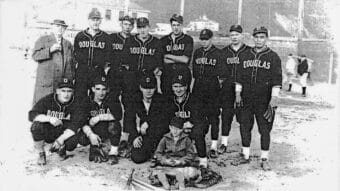
The Douglas Baseball Team in the 1930s, with Jimmy Manning standing at the far right. (Photo courtesy of the Gastineau Channel Historical Society)

Jimmy Manning was a standout player in Juneau’s vibrant baseball scene before World War II — and one of the few Lingít players in the league. A 1999 article in the Gastineau Heritage News described him as “possibly Juneau’s best homegrown player.” And his 1962 obituary in the Alaska Daily Empire, written by fellow ballplayer Erv Hagerup, called him the “Pride of Douglas.”

“Jimmy was a hero in my mind before I ever saw him,” Hagerup wrote. “Mainly because the older folks were always talking of his latest accomplishments in sports.”

Manning was so respected that, in 1963, the newly built baseball diamonds in Savikko Park were named the Jimmy Manning Memorial Ballpark. 

Photo of Jimmy Manning Memorial Ballpark, 1966. (Courtesy of the Juneau-Douglas City Museum, reference number JDCM 2016.05.066)

It’s not clear when or why that name was lost. But Lillian Petershoare, a tribal citizen of the Douglas Indian Association, says it would mean a lot to bring the old name back.

“Juneau, before anything else, is a Native community. And as such, our footprint needs to be very visible here,” she said. “And that’s beginning to happen.”

The pride of Douglas

Manning was born around the turn of the century — in 1903, according to one source. As a boy and a young adult, he quickly became a local star.

Signs that once stood in Savikko Park said he excelled at basketball. His obituary says he was a formidable track and field star at Douglas High School. But he was most celebrated as a baseball player. 

Manning’s heyday was in the Juneau City League in the 1920s and 30s. In the Gastineau Heritage News, Mac Metcalfe wrote that baseball in Juneau was then so popular that the 1928 season began with a parade, and Gov. George Parks threw the first pitch.

An excerpt from Jimmy Manning’s 1962 obituary in the Alaska Daily Empire, written by Erv Hagerup.

A preview of the 1925 baseball season in the Alaska Daily Empire called Manning “one of the best young players in the league.”

“The champions’ lineup was materially strengthened by his acquisition,” it read.

Hagerup wrote that Manning threw “a blindingly fast ball” with “deadly accuracy.” That he was the first Juneau player to hit three home runs in a single game. And that in a single weekend, Manning pitched three complete games in two days, winning them all and striking out 27 batters. 

Hagerup, who described Manning as “tall, athletically built, straight as an arrow — a gentleman at all times,” also wrote of how badly he wished he’d asked Manning about the early days. 

“I intend to ask Jimmy about the early day sports on the Channel, but I find that this is now impossible,” he wrote. “Within earshot of the ballparks on both sides of the channel where he had received the loud acclaim of thousands, he slipped away and has taken his story with him.”

Manning died at the age of 59 in 1962 and was buried in Evergreen Cemetery. His grave is on the cemetery’s map, but there’s no marker there today. 

“One by one they slip away and take their stories with them,” Hagerup wrote six decades ago. “We fill-in the details as best we can and the stories become partly fiction. Our neglect robs us of a rich story of factual history of this area.”

“A story that I can’t let go of”

Petershoare doesn’t want that to be so — and she sees a greater harm beyond the loss of factual history.

“When my mother was alive, she used to say, ‘It’s as if this community has forgotten its original people,’” Petershoare said. 

And for most of her life, Petershoare had never heard of Manning. A few years ago, she was speaking with Lingít elder Marie Olsen when Olsen mentioned him.

“It really intrigued me because she said that the ballfields in Douglas were named after him,” Petershoare said. “And so I thought, ‘Here’s a story that I can’t let go of.’” 

Frank Henry Kaash Katasse and Lillian Petershoare on KTOO’s Juneau Afternoon in 2018. (Photo by Scott Burton/KTOO).

There are three baseball diamonds in Savikko Park on Douglas, north of Sandy Beach. It’s where, in 1962, the city burned the T’aaḵu Kwáan village while most of the people who lived there were away fishing.

Manning died a few months later. Shortly after that, the city named the fields after him. He would have played many games nearby — Metcalfe wrote that during the city league days, Douglas had a ballfield “near Sandy Beach, just below the Native village.”

But sometime between then and now, signs that read “Jimmy Manning Memorial Ballpark” disappeared. Today, a larger sign denotes the whole area as Robert Savikko Park — Savikko was a former Douglas mayor and served on the Juneau assembly. The words “Anax̱ Yei Andagan Yé” are below that, in smaller letters, with no explanation. That’s the name of the village the city burned.

The sign and one of the ballfields at Robert Savikko Park on Nov. 17, 2023. (Anna Canny/KTOO)

When Petershoare first asked the city about the ballpark’s lost name in 2020, Colby Shibler, a Parks and Rec employee, told her that he’d seen some old signs in storage with Manning’s name on them.

“I said, ‘Oh, gosh, Colby, would you please go down the hall and take a picture of those signs?’” Petershoare said. 

They were old interpretive signs made in 1982, a little rusty and with some holes worn through the print. There were four of them, bearing sanitized histories of Douglas Island, Sandy Beach and the park itself. 

An interpretive sign, made in 1982, that once stood at Robert Savikko Park. Manning died in 1962, not — as the sign says — 1963. (Courtesy of Lillian Petershoare)

One presented short biographies of Manning and Savikko. 

“These ball playing fields are dedicated to the memory of Jimmy Manning,” that sign read, “who many believe to have been the best all-around athlete in this community’s history.”

The sign said a little about Manning’s parents and his playing career, and it said the ballfields were named after him on July 4, 1963. But there was a lot more the sign didn’t say.

“Nowhere is there a mention of his Lingít identity. And yet, we learned that Savikko was Finnish-Swedish,” Petershoare said. “This is such a continuation of the legacy of ripping away, you know, with the Douglas Indian village.”

That could change soon. The city is working with Douglas Indian Association to make the ballpark Manning’s again. City Manager Katie Koester says that during an October meeting, the two organizations decided that they want to do it right.

“We tried to get the signpost installed so that we could move quickly, even with the ground freezing,” she said. “And the consensus was more, let’s give this time and maybe use it to tell a story.”

Petershoare sees the effort as a chance to resurrect Manning’s legacy — and to help undo Juneau’s legacy of erasure. She thinks visible acknowledgments of Lingít people in Juneau’s history could matter for the future.

“I want our Alaska Native youth and all youth to read this signage and walk away from it with their shoulders pulled back,” she said. “Standing tall, feeling proud of Native history in this community.”

Inside the weird and delightful origins of the jungle gym, which just turned 100

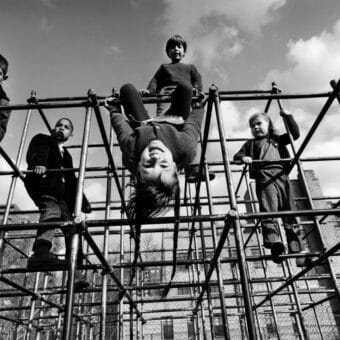
A jungle gym in the 1970s — a staple of playgrounds all across the U.S. (H. Armstrong Roberts/ClassicStock/Getty Images)

This story starts in the fourth dimension.

Or, more specifically, with a British mathematician who, in the late 1800s, was intrigued by the fourth dimension and how to teach disinterested children about it.

Charles Hinton wore a lot of hats. He wrote sci-fi stories before there was sci-fi — he called them “scientific romances.” At Princeton, where he worked for a time as mathematics instructor, he invented a baseball pitching machine powered by gunpowder. He also practiced polygamy, which was against both the mores and laws of his native England. And when he was convicted of bigamy in the 1880s, he was forced to move his young family to Japan where he found work teaching mathematics.

We will save all of that for the biopic, because for the purposes of this story, Hinton was the unintentional inspiration behind the jungle gym — the patent for which has just turned 100.

It turns out that the history of the jungle gym, and its sibling the monkey bars, is full of weird and delightful twists and sub-plots that take us from Japan to suburban Chicago and touch on child development theories and, yes, theoretical math.

Imagining dimensions — in bamboo

Hinton was a mathematician who explored the concept of the fourth dimension and how to represent it. His model of a tesseract as a way to represent the fourth dimension in geometrical space has since inspired a long lineage of science fiction writing and movies — from A Wrinkle in Time to Interstellar.

Yet it was while living in Japan that Hinton struggled to get his students to adequately wrestle with the concept of the fourth dimension.

Charles Howard Hinton
Studio of K. Yoshida in Kanazawa, Japan (Papers of Howard Everest Hinton, University of Bristol Archive)

“He said, you know, the reason these students can’t grasp the fourth dimension is because they were never exposed to the third dimension as children,” says Luke Fannin, a primatologist and Ph.D. candidate at Dartmouth College, who became obsessed with finding out where the term “monkey bars” came from (more on that later) and ended up becoming something of a Hinton family expert.

Hinton theorized that since we spend so much of our lives simply walking in straight lines, and not using all of the three-dimensional space around us, we have an even harder time making the mental leap to fourth dimension.

His solution was to train young children, namely his own kids, to internalize the third dimension. To pull this off, Hinton built his children a series of stacked bamboo cubes. He labeled the bamboo in all three directions, Fannin says: “Where the junctions would be, he would put X, Y, Z coordinates.” Then he attempted to turn these stacked cubes into a game. “He would say, ‘X2, Y4, Z3 — go! And all the kids would race each other towards the correct coordinate,'” says Fannin.

If that does not sound like a fun game to you, you are not alone. And those bamboo cubes never amounted to much. But years later, Hinton’s son Sebastian would recall how much fun it was to climb and swing on them.

“And he goes, ‘That’s what I remember. I don’t remember anything about the math, but I remember that it was so fun,'” says Fannin.

By now it was the early 1920s, and the junior Hinton had moved to Winnetka, Illinois where he worked as a patent lawyer. He dreamed of recreating the bamboo climbing structure of his youth — minus the not very fun math games — and he started describing his plans at a dinner party one night.

Winnetka at this time was a hotbed for progressive education. The village was taken with the educational philosophy of John Dewey, which called for “whole child education.” This meant not just teaching reading, writing and arithmetic, but also how to be healthy and active humans.

So, as Hinton was describing his dream climbing structure, the dinner party was stacked with educators, including the superintendent of the Winnetka City Schools, Carleton Washburne. Fannin says he imagines Washburne’s eyes widening before telling Hinton, “We need to build this in the schools!”

Soon after, Hinton began filing his early patents for the design, which he registered to something he called JungleGym Inc. And the rest, as they say, is history.

If that dinner party had taken place anywhere else in the world, this iconic piece of equipment may never have existed. Or, as Fannin says, “It only stays in Hinton’s backyard. It never becomes sort of the cultural mainstay that is now ubiquitous on most playgrounds.”

The difference between monkeys and apes

From the outside, there’s nothing remarkable about the old Victorian home at 411 Linden Street in Winnetka, Illinois, which these days serves as the headquarters for the town’s historical society.

Inside, the 30,000 artifacts range from typewriters to vacuum cleaners. But for visitors who walk through a small gate into the back yard, surrounded by 20-foot tall conifers, there’s a little bit of a hidden treasure, says Mary Treishman, the executive director of the Winnetka Historical Society.

“We currently don’t have a historical plaque on it,” she says. “We just have this laminated sign that says, ‘Please do not climb on this artifact. It’s not safe.'”

That artifact is a 100-year-old jungle gym — the first real version.

Hinton’s original jungle gym, pictured here in the 1930s at the Horace Mann School before it was moved to the Winnetka Historical Society. (Courtesy of Winnetka Historical Society)

To this day, kids sometimes still stumble across it, and Treishman has to politely tell them to stay off.

“I’ve seen adults come back here and really want to climb it because it reminds them of their childhood,” she says, adding that something about the classic bars really animates people. “The memories of this climbing structure are very deep. This is what everyone played on.”

Few things last 100 years. Children’s toys seem particularly fickle. Pet rocks, pogo sticks and scooters have all had full boom and bust cycles while the jungle gym — unflashy, workman-like, no fuss — keeps children coming back. Why is that?

It may be that the act of swinging and climbing in the jungle gym contains just enough risk, says Ellen Sandseter — a professor at the Department of Physical Education and Health at Norway’s Queen Maud University College, and an expert on risky play.

Sandseter says the jungle gym, and its sibling the monkey bars, offer a lot of challenging and also risky play, which is a good thing. She says it helps kids’ physical development — think motor skills — and their mental health, by building courage and self-confidence while reducing anxiety.

What’s more, unlike a lot of newer equipment that tells kids how it’s supposed to be used, Sandseter says the beauty of the jungle gym is in its simplicity.

“A monkey bar could be used in many different ways. And it, therefore, also affords creativity among children,” she says.

This all may help explain why the jungle gym has endured 100 years. But what about Fannin’s original question: how did the monkey bars get their name? Well, in the original 1923 patent for the jungle gym, Hinton seems to imagine children playing on it in language that has an ethereal quality of dreaming, of imagination:

“I have designed a climbing apparatus, so proportioned and constructed that it provides a kind of forest top through which a troop of children may play in a manner somewhat similar to that of a troop of monkeys through the treetops in a jungle.”

Hinton’s plans for the jungle gym, as outlined in his patent application. (United States Patent and Trademark Office, Sebastian Hinton.)

“There’s an illustration of it in the last patent he had approved. It basically is a jungle gym, and then adhered next to it is the ‘Accessory monkey runway,'” says Fannin. AKA, the monkey bars.

It’s worth remembering, Hinton was a patent lawyer, not a primatologist. And that behavior — swinging by your arms — is ape behavior, not what monkeys do. So should they be called ape bars?

“If you want to be pedantic about it,” says Fannin. “But I love the term monkey bars.”

Sadly, Sebastian Hinton never saw his invention get the U.S. Patent Office’s stamp of approval. He died in April of 1923, just six months before his patent was officially approved.

Much has changed since then: safety concerns have softened materials and rounded edges in playgrounds. But Hinton’s simple design that doesn’t dictate behavior, but facilitates it, has endured.

Perhaps it’s precisely because of this freedom that jungle gyms have afforded children the chance to dream for the last century. And maybe some of them will even dream about new dimensions.

Copyright 2023 NPR. To see more, visit https://www.npr.org.

After being uninhabited for years, downtown Juneau’s Elks Hall building is being demolished

The demolition of the former Elks Hall building in Juneau on Nov. 2, 2023. (Katie Anastas/KTOO)

A historic downtown Juneau building that hosted the first Alaska Territorial Legislature is being demolished. 

David McCasland, owner of Deckhand Dave’s outdoor food court in the adjacent lot, bought the former Elks Hall building this summer. He said Friday that he had hoped for a different outcome. 

“Just let them know that I tried. That was my main intention,” McCasland said. “The building was totaled, and it wasn’t saveable.” 

McCasland hired NorthWind Architects for the project. Shannon Crossley, an architect with the firm, is also on the city’s Historic Resources Advisory Committee. She said the building sat uninhabited for three years.

“The conditions in the building just got worse and worse,” she said. “Eventually, it turned from ‘How do we save this building?’ to ‘How do we try to try to maintain the façade in some way?’ And then that wasn’t feasible anymore. It was just a really sad story.”

Crossley said by the time the building changed hands, it was far too expensive to save any piece of it. 

McCasland had a personal connection to the building.

“I actually worked in it like 10 years ago,” he said. “And I remember being like, ‘Man, it’d be so awesome to own this building. This building is so sweet.’”

McCasland had been making offers on the building for years. Crossley said, in that time, the conditions worsened.

“Because they couldn’t agree on a price for that building, it just languished,” she said.

Erik Emert and Deborah Percy were the previous owners of the building, according to the Alaska Division of Corporations, Business and Professional Licensing. They could not be reached for comment Friday.

The building was built in 1908 and hosted the first Alaska Territorial Legislature in 1913. 

“And then the first thing that they voted on was to give women the right to vote,” Crossley said.

On the first floor was a Turkish bath and a bowling alley, and the second floor housed a ballroom. The third floor, where the Legislature met for the first time, was removed in the 1940s, and the outside was renovated to the stucco look it had until this week. More recently, it housed the Rockwell restaurant and bar downstairs.

Crossley said Juneau’s historic buildings hold the authenticity of the town. 

“And when we lose that historic fabric, it’s gone forever,” she said. “I would love to see more of a community investment in the historic buildings of Juneau.”

Crossley says public funding that supports preserving and using historic buildings would help prevent this fate for other historic buildings.

“There are many historic buildings in downtown Juneau that could be used for housing, that could be used for many things, but the property owners might not necessarily have the millions of dollars that it’s going to take to bring them back up,” she said.

McCasland isn’t certain of his plans for the lot. In the past he’s publicly talked about creating housing and restaurant space. He said he’s trying to figure out what’s possible financially. 

Anything he builds would have to meet the design standards of the Downtown Historic District. Basically, it can’t look too distinct from the rest of the street, Crossley said. 

That means it can’t be higher than 45 feet, and needs to have similar design elements to the buildings around it. 

‘Mana: The History We Inherit’ exhibit highlights Filipino history in Alaska

October is Filipino American History month, commemorating the arrival of the first Filipinos to modern-day California in 1587.

A new exhibit launched at the Anchorage Museum Saturday chronicles an oral history of Filipinos in the state. Mana is the Tagalog word for “inheritance” and the name of the project, founded by Shayne Nuesca, Tasha Elizarde and Joshua Albeza Branstetter.

Nuesca says the three of them had independently chronicled Filipino history, and the project took off when they came together to collaborate.

Listen:

The following interview has been edited for length and clarity.

Shayne Nuesca: We wanted to tell the stories of elders, Filipinos in Alaska, whose stories would otherwise go untold in mainstream forums. And so these are stories that were passed down orally. It’s how our stories are really told, from generation to generation, within our culture. We also had some elders who had passed away, and that motivated us to get this project going and to record the stories of the elders that we have still with us.

Wesley Early: Josh, the project covers a wide swath of the state. You’ve got Anchorage and Kodiak, and then up to Fairbanks and down to Juneau. Did you find that people were open to telling their stories? Did you find that there was maybe some hesitation?

Joshua Albeza Branstetter: There was hesitation at first. A lot of the elders hadn’t met us, they didn’t even know that I was Filipino American when we first reached out. A lot of these elders have had diverse, lengthy histories and stories that they’ve never shared with anyone. And a lot of that has to do with not feeling like they can share those stories. There’s a wonderful word that Shayne taught me just a few days ago. It’s “hiya”. So many Filipino words are entire essays, but it kind of takes this concept of this shame around like, don’t talk too much, don’t share too much. And our elders have the stories that they have felt like they couldn’t share. They didn’t have a platform to. They needed to trust us first. And once they did, we learned… I learned so much. So much about myself and our community.

WE: Tasha, all of you are Filipino. And while you all have backgrounds in various forms of media, be it filmmaking, writing, photography, journalism, I imagine there haven’t been a lot of big opportunities to do large projects about people who look like you. Did you find any additional pressure, any additional excitement about doing a project like this?

Tasha Elizarde: I was very excited, just because there’s not a lot of opportunities to be able to share the stories of our community, just in whatever spaces exists for media creation in Alaska. For example, there’s only one book on Filipinos in Alaska that’s ever been published, by Thelma Buchholdt. And that book is currently out of print. And so I think that says a lot about what kind of opportunities are available to be able to share the types of stories. She had written that book because at one point, she was just like, “Why do we have no archive?” And so we’re kind of repeating that question back and saying, “Why is there still, after so many years — that book was published, like I think 30 years ago — after so many years, we still don’t have an elaboration of that archive?” And so what we’re doing with Mana is creating a larger archive. Talking to people that exist here now, making these connections to even longer into the past. And that’s something that… it’s just not an opportunity that a lot of people go for. But we had to create that opportunity by ourselves. And that’s why I was so excited to be working with both Shayne and Josh is because we’re able to create an opportunity to share stories that are so important. You see people when we interview them, they’re just so excited to finally feel like they’re recognized and have relationships with young people that remind them we care about your stories, and other people will care about them too.

WE: Josh, you know, you got the opportunity to travel to a lot of parts of the state to meet different people and share their stories. Were there any that maybe surprised you, you learned something new or really resonated with you?

JAB: I would say one that really resonated with me was the story of Camila Cook. She is an elder here in Anchorage. And she would always call me “darling,” and I love that. But when I interviewed her she lit a cigarette and she put it in her mouth backwards, so the lit end in. And I said, “Lola, what are you doing?” And she’s like, “it’s just a thing, darling. We all did this when I was a kid, and so I still do it today.” And I think the specificity of our stories really creates a universality among our community. Because we already have the exhibit up and one of our team, she had never seen it and she went there yesterday. And she said she stopped at Camila’s, and when she saw that backwards cigarette before she’d even read the story, she said, “Josh, it sent me back 40 years, because I remember how all the kids would do that.”

WE: So Shayne, I think my last question is, what do you hope the goal of this project is? Do you see it as more of a resource for a wide audience to learn about their fellow Alaskans — their neighbors — or do you see it as a personal resource to help Filipino people learn about their own history?

SN: I definitely see it as both. So it is an avenue for the wider community to learn about our elders and the history of Filipinos, or a glimpse of the history of Filipinos in Alaska. But it’s also an opportunity now for Filipinos in Alaska to look within themselves, I hope, and to look at their families and open the door for those discussions about you know, the stories that came before them. For me, and I can’t speak for the rest of my team, this was a very healing project for me. I had immigrated here when I was six years old and had dealt with you know, the loss of my birth culture, in a sense straddling two different cultures. And so, hearing these elders speak about their experiences, and then correlating that with with mine as a child, it felt like those experiences were validated. And every emotion that I felt, all of the sort of hardships I had as a child, it felt like I was getting a hug from people that weren’t even in my family, and they were telling me they were validating my experience without even knowing.

“Mana: The History We Inherit” opened at the Anchorage Museum on Saturday, Oct. 27. The exhibit will run at the museum through January.

Editor’s note: Shayne Nuesca is a former KTOO employee and Tasha Elizarde currently works at KTOO. KTOO is not affiliated with the exhibit. 

Site notifications
Update notification options
Subscribe to notifications