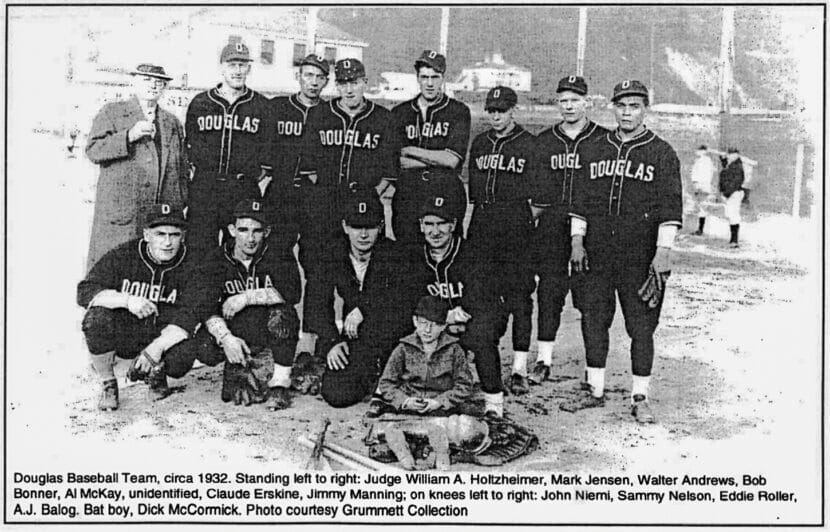
Jimmy Manning was a standout player in Juneau’s vibrant baseball scene before World War II — and one of the few Lingít players in the league. A 1999 article in the Gastineau Heritage News described him as “possibly Juneau’s best homegrown player.” And his 1962 obituary in the Alaska Daily Empire, written by fellow ballplayer Erv Hagerup, called him the “Pride of Douglas.”
“Jimmy was a hero in my mind before I ever saw him,” Hagerup wrote. “Mainly because the older folks were always talking of his latest accomplishments in sports.”
Manning was so respected that, in 1963, the newly built baseball diamonds in Savikko Park were named the Jimmy Manning Memorial Ballpark.
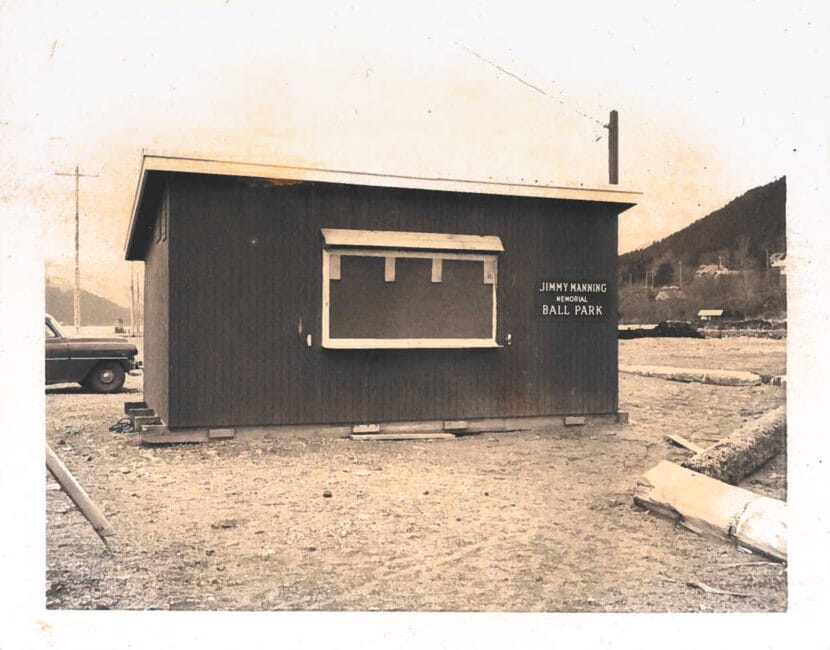
It’s not clear when or why that name was lost. But Lillian Petershoare, a tribal citizen of the Douglas Indian Association, says it would mean a lot to bring the old name back.
“Juneau, before anything else, is a Native community. And as such, our footprint needs to be very visible here,” she said. “And that’s beginning to happen.”
The pride of Douglas
Manning was born around the turn of the century — in 1903, according to one source. As a boy and a young adult, he quickly became a local star.
Signs that once stood in Savikko Park said he excelled at basketball. His obituary says he was a formidable track and field star at Douglas High School. But he was most celebrated as a baseball player.
Manning’s heyday was in the Juneau City League in the 1920s and 30s. In the Gastineau Heritage News, Mac Metcalfe wrote that baseball in Juneau was then so popular that the 1928 season began with a parade, and Gov. George Parks threw the first pitch.
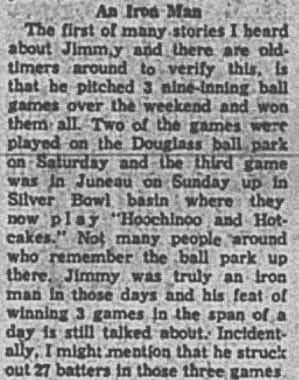
A preview of the 1925 baseball season in the Alaska Daily Empire called Manning “one of the best young players in the league.”
“The champions’ lineup was materially strengthened by his acquisition,” it read.
Hagerup wrote that Manning threw “a blindingly fast ball” with “deadly accuracy.” That he was the first Juneau player to hit three home runs in a single game. And that in a single weekend, Manning pitched three complete games in two days, winning them all and striking out 27 batters.
Hagerup, who described Manning as “tall, athletically built, straight as an arrow — a gentleman at all times,” also wrote of how badly he wished he’d asked Manning about the early days.
“I intend to ask Jimmy about the early day sports on the Channel, but I find that this is now impossible,” he wrote. “Within earshot of the ballparks on both sides of the channel where he had received the loud acclaim of thousands, he slipped away and has taken his story with him.”
Manning died at the age of 59 in 1962 and was buried in Evergreen Cemetery. His grave is on the cemetery’s map, but there’s no marker there today.
“One by one they slip away and take their stories with them,” Hagerup wrote six decades ago. “We fill-in the details as best we can and the stories become partly fiction. Our neglect robs us of a rich story of factual history of this area.”
“A story that I can’t let go of”
Petershoare doesn’t want that to be so — and she sees a greater harm beyond the loss of factual history.
“When my mother was alive, she used to say, ‘It’s as if this community has forgotten its original people,’” Petershoare said.
And for most of her life, Petershoare had never heard of Manning. A few years ago, she was speaking with Lingít elder Marie Olsen when Olsen mentioned him.
“It really intrigued me because she said that the ballfields in Douglas were named after him,” Petershoare said. “And so I thought, ‘Here’s a story that I can’t let go of.’”
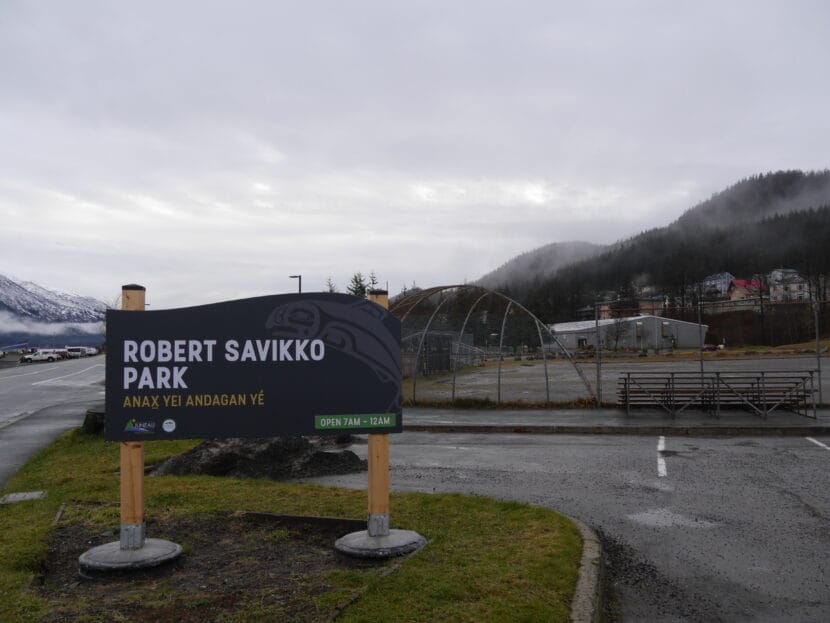
There are three baseball diamonds in Savikko Park on Douglas, north of Sandy Beach. It’s where, in 1962, the city burned the T’aaḵu Kwáan village while most of the people who lived there were away fishing.
Manning died a few months later. Shortly after that, the city named the fields after him. He would have played many games nearby — Metcalfe wrote that during the city league days, Douglas had a ballfield “near Sandy Beach, just below the Native village.”
But sometime between then and now, signs that read “Jimmy Manning Memorial Ballpark” disappeared. Today, a larger sign denotes the whole area as Robert Savikko Park — Savikko was a former Douglas mayor and served on the Juneau assembly. The words “Anax̱ Yei Andagan Yé” are below that, in smaller letters, with no explanation. That’s the name of the village the city burned.
When Petershoare first asked the city about the ballpark’s lost name in 2020, Colby Shibler, a Parks and Rec employee, told her that he’d seen some old signs in storage with Manning’s name on them.
“I said, ‘Oh, gosh, Colby, would you please go down the hall and take a picture of those signs?’” Petershoare said.
They were old interpretive signs made in 1982, a little rusty and with some holes worn through the print. There were four of them, bearing sanitized histories of Douglas Island, Sandy Beach and the park itself.
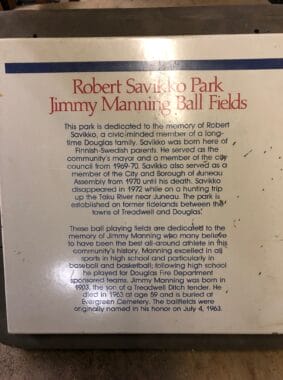
One presented short biographies of Manning and Savikko.
“These ball playing fields are dedicated to the memory of Jimmy Manning,” that sign read, “who many believe to have been the best all-around athlete in this community’s history.”
The sign said a little about Manning’s parents and his playing career, and it said the ballfields were named after him on July 4, 1963. But there was a lot more the sign didn’t say.
“Nowhere is there a mention of his Lingít identity. And yet, we learned that Savikko was Finnish-Swedish,” Petershoare said. “This is such a continuation of the legacy of ripping away, you know, with the Douglas Indian village.”
That could change soon. The city is working with Douglas Indian Association to make the ballpark Manning’s again. City Manager Katie Koester says that during an October meeting, the two organizations decided that they want to do it right.
“We tried to get the signpost installed so that we could move quickly, even with the ground freezing,” she said. “And the consensus was more, let’s give this time and maybe use it to tell a story.”
Petershoare sees the effort as a chance to resurrect Manning’s legacy — and to help undo Juneau’s legacy of erasure. She thinks visible acknowledgments of Lingít people in Juneau’s history could matter for the future.
“I want our Alaska Native youth and all youth to read this signage and walk away from it with their shoulders pulled back,” she said. “Standing tall, feeling proud of Native history in this community.”