KUCB is our partner station in Unalaska. KTOO collaborates with partners across the state to cover important news and to share stories with our audiences.
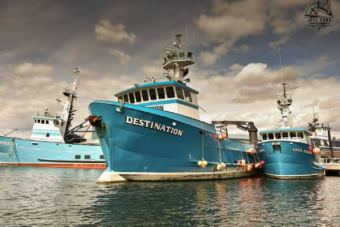
Six F/V Destination crew members died when their boat disappeared in February near St. George Island, marking the deadliest accident in more than a decade for the Bering Sea crab fleet. The Coast Guard is holding public hearings as part of its investigation into the Destination’s sinking. (Photo courtesy F/V Destination Memorial Fund)
Starting Monday, the U.S. Coast Guard is holding two weeks of public hearings as part of its investigation into the sinking of the F/V Destination.
All six crew members died when crab boat disappeared in February near St. George Island, marking the deadliest accident in more than a decade for the Bering Sea crab fleet.
The vessel’s wreckage was finally located last month, but investigators are still trying to determine why the Destination sank.
Coast Guard officials will interview witnesses about the state of the vessel as well as the human and weather factors that may have played a role in the sinking.
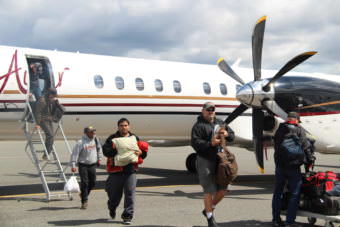
PenAir customers coming into Bristol Bay for the summer, deplaning one of the new Saab 2000s in King Salmon in June. (Photo by KDLG)
The largest air carrier in southwest Alaska has filed for bankruptcy protection.
“PenAir filed for reorganization under Chapter 11,” said CEO Danny Seybert on Monday. “There’s a number of reasons for this. I won’t go into all the reasons, but we’re going to reorganize the company.”
Seybert said the filing will not affect scheduled flights in Alaska, where the company serves eight communities: Unalaska, Cold Bay, King Salmon, Sand Point, Dillingham, St. Paul, St. George, and McGrath.
PenAir’s Boston flights won’t be affected either, but the airline is closing operations in Portland and Denver.
Seybert expanded to those markets in an effort to turn the regional carrier into a wider-ranging airline.
“That isn’t working out for us,” he said. “We have to reorganize and focus on what made us successful in the past, which is the state of Alaska.”
“There might be some equipment changes,” said Seybert. “You might see more 340s in the market versus the larger planes, but that hasn’t been decided yet.”
Since flying the 2000s, the company has announced a slew of mechanical cancellations and posted the worst reliability rates in its history.
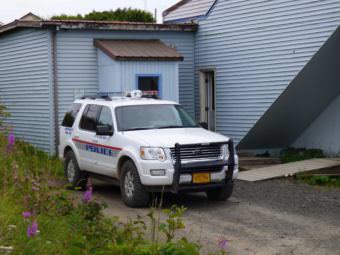
A police car sits unused in Sand Point. (Photo by Zoe Sobel/KUCB)
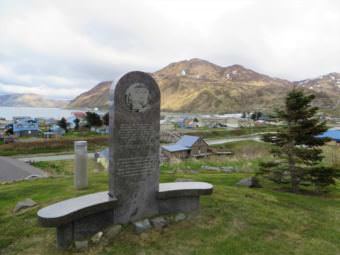
Sand Point faces a problem with its police force: It doesn’t have one any more.
In just three weeks, all its officers resigned.
City Administrator Andrew Varner said the first officer wanted to be closer to a spouse who is in the military. A week later, two more officers, a married couple, left because of a “family decision.”
Varner said that left Police Chief Roger Bacon — who was scheduled to vacation in Scotland — as the island’s only law enforcement.
“There was sort of a mutual understanding that if he left to go for a month-long journey — leaving the community with no law enforcement — that if he came back, he would not be an employee of the city,” Varner said. “Within a day or two, he had turned in his resignation.”
All Bacon had to say about his departure was, “If you don’t have anything nice to say, don’t say it.” and that he was headed to Scotland.
There is a contingency plan according to city officials. An Alaska State Trooper will be in town next week, and Sand Point is vetting an interim police chief.
Varner acknowledged losing the entire force in such a short time period might seem unimaginable to outsiders.
In Sand Point, struggling to hire and keep officers is the norm.
“Losing an officer in Sand Point, that’s certainly not new,” Varner said. “It’s certainly not new in rural Alaska either, especially in law enforcement. It’s kind of tough to keep officers around. Our department has basically been understaffed for years.”
After spending most of last year working to fill the now-vacant positions, Varner said not one of the officers worked on the force longer than six months.
Seeing every officer resign for family or travel illustrates Sand Point’s challenges as an isolated town of 1,000 residents, where round-trip tickets to Anchorage can cost more than $1,000. Varner said it’s difficult to provide enough compensation and flexibility to convince non-locals to stay.
“We’ll bite the bullet, metaphorically,” Varner said. “We haven’t hit desperation mode yet, but if we don’t have any officers or a new chief within a couple months, then I think we would worry.”
Before the resignations, Varner said police were focused on dealing with Alaska’s opioid crisis and managing the seasonal population increase due to commercial fishing.
The Robertson & Partners team flew up from Las Vegas to film on a bluebird day.
Things didn’t go as planned.
“All of a sudden they just lost communication with the drone,” Fitch said. “(The pilot was trying to) figure out what’s going on, frantically hitting the button that says return home, return home.”
The drone did not return. The team was worried.
The pilot wanted to prove he wasn’t at fault, so the drone’s insurance coverage would kick in.
None of them were exactly sure what happened.
“He was able to go back and look at the footage in slow motion, right toward the end,” Fitch said. “It just — you can see it: the yellow part of the eagle talon. And then — it’s gone.”
Fitch said they couldn’t believe it. Their footage was gone and their plans were ruined.
“After it happened, it was kind of like we all lost a member of the team,” Fitch said.
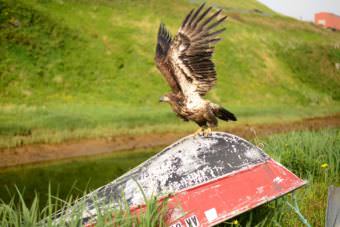
While eagle-drone interactions are unusual, they are not unheard of.
Police in France and the Netherlands have trained the raptors to snatch drones from the sky. Unalaska gets that service for free.
This time, it’s paying local dues. With the machine out of commission, a local drone pilot says the company turned to him for footage instead.
As for the future of drones in Unalaska? Fitch feels there’s a clear solution.
“They should be made to look different than birds of prey,” Fitch said.
Atka mackerel caught near Homer, Alaska. (Creative Commons photo by wikimedia.org.
Counting Atka mackerel became really important when Steller sea lions were declared endangered in 1997, according to National Marine Fisheries Service Biologist Suzanne McDermott.
“We learned that Atka mackerel are their main food item,” McDermott said. “That’s when we really started looking at them in relation to Steller sea lions.”
McDermott knows the mammals face competition for their food — commercial fishermen.
In 2016, Alaska fishermen caught and kept 55,000 metric tons of Atka mackerel and discarded another 532 tons as bycatch.
This summer, McDermott and her colleague David Bryan traversed the Aleutian Islands to answer a big question: are there enough fish to support both endangered Steller sea lions and commercial fishermen?
“The interest for us is to understand how much Atka mackerel is available to sea lions and how much Atka mackerel is available to the fishery, to make sure sea lions get enough prey,” McDermott said. “Especially in areas where they’re declining.”
Counting the mackerel is difficult.
Traditionally, fish abundance is measured by trawl net, but trawl nets are useless in the near-shore waters of sea-lion rookeries, McDermott said.
The scientists built a camera, which hangs underwater, close to the sea floor, and live streams mackerel footage through armored cables to their research vessel.
Unlike a trawl net, it can navigate around rocks, crags and coral.
Plus, the camera’s stereoscopic, side-by-side lenses means McDermott and Bryan can measure the length of each fish without catching them, which is invaluable.
“With the length, we can estimate the mackerel’s age. We can also estimate their weight,” Bryan said. “That’s helpful because then we can estimate biomass, which ties into food sources for sea lions.”
McDermott has been studying Atka mackerel for 20 years, but the camera gives her a new perspective.
“You start to relate to fish more as a beings with a brain,” McDermott said. “When they come up in a trawl, all you see is that particular fish in a net. You don’t understand where it lived and how it moved.”
The camera gives the scientists new understanding into fish behavior.
For example, they think sea lions rely on mackerel because the fish guard their eggs, making them a dependable meal.
The camera’s insights help the scientists build a more complete understanding of a resource that’s key to both sea lions and fishermen.
NOAA ship Fairweather captured this sonar image of the F/V Destination, where it rests on the sea floor near St. George Island. (Image courtesy National Oceanic and Atmospheric Administration)
Wreckage from the F/V Destination has been found off St. George Island.
The boat and its six crew members were fishing for snow crab when they disappeared Feb. 11.
The National Oceanic and Atmospheric Administration announced this morning that two of its research vessels have found and confirmed the location of the Destination.
The two ships used sound to map the sea floor near the crabber’s last known location.
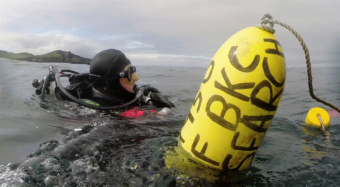
In May, a sweep by the Oscar Dyson narrowed the search, and on July 9, the Fairweather confirmed the presence of the Destination, nearly 250 feet underwater.
In a news release, the U.S. Coast Guard said later this month it will deploy the cutter Healy, a dive team and a remotely operated vehicle to analyze the wreckage.
The results of the search are part of the Coast Guard’s ongoing investigation into the disappearance of the Destination.
It’s considered the worst accident in the Bering Sea crab fleet for more than a decade.
Public hearings on the disappearance are scheduled for August 7-18 at the Henry M. Jackson Federal Building in Seattle.
Close
Update notification options
Subscribe to notifications
Subscribe
Get notifications about news related to the topics you care about. You can unsubscribe anytime.