KUCB - Unalaska

KUCB is our partner station in Unalaska. KTOO collaborates with partners across the state to cover important news and to share stories with our audiences.

Coast Guard medevacs man experiencing symptoms of appendicitis

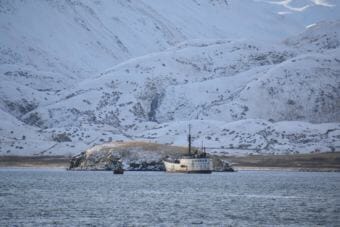
The U.S. Coast Guard medevaced a man Saturday off a bulk carrier 122 miles southwest of Adak.
According to a USCG news release, crewmembers of a Jayhawk helicopter were able to lift the man from the 652-foot-carrier and transfer him to a LifeMed aircrew in Adak.

The 27-year-old was suffering from symptoms of appendicitis. At the time, the vessel Snowy was in 29 mile per hour winds and 13 foot seas.

As recall effort gets underway, Unalaska’s mayor denies illegal dock negotiations

A group of Unalaskans is trying to recall Mayor Frank Kelty, center. To force a recall election, they must collect 168 signatures by Dec. 22. That number represents 25 percent of votes cast in the last regular mayoral election. (Photo by Berett Wilber/KUCB)

Unalaska’s mayor now is facing a recall effort following months of intense public criticism.

Frank Kelty has denied allegations that he interfered with the former city manager or forced his resignation.

But the recall petition isn’t centered on recent clashes at City Hall.

Instead, it accuses the mayor of backroom dealings regarding the city dock.

The petition charges Kelty with one count of misconduct: “Attempting to sole-source land use agreements for the Unalaska Marine Center positions 5-7.”

In other words, the mayor is accused of giving one company an unfair first crack at a preferential use agreement, rather than letting the city open a public bidding process as required by municipal code.

“Totally false,” Kelty said. “Everyone knows that the city manager handles negotiations on things like that.”

Recently, however, the trajectory of those negotiations has been unclear.

Since the city reopened a longstanding debate on priority dock usage, the city manager has resigned and half the City Council has been voted out of office.

The council also has revoked its own directive authorizing negotiations, after receiving legal advice from the city attorney, and the matter has not gone out to bid.

Kelty has been a vocal supporter of renewing Matson’s lapsed contract, and he admits to meeting with the private shipping company. But he said those meetings are part of an ongoing working relationship, not evidence of an illegal deal.

“Naturally, I would take a meeting with Matson, who is a major revenue producer for the city and provides jobs. (I) talk to them and hear their concerns,” Kelty said. “But I’ve been in no meetings when there were negotiations going on.”

KUCB has filed a public records request for the mayor’s emails regarding dock agreements. But Kelty said the recall effort is really about something else.

“I think it’s carryover from the Martinson issue,” he said.

Dave Martinson resigned as city manager in September, citing long-term tension with the council and mayor.

The Unalaskans leading the recall push acknowledge that is a factor.

“The public, in my opinion, has lost faith in the mayor in general,” said Ryan Burke, the petition’s primary contact. “All of this stemming, obviously, from the departure of Dave Martinson. His relationship with the mayor crumbled his wanting to stay here.”

Burke said he and nine co-sponsors are now circulating petitions around the island. They have until Dec. 22 to gather 168 signatures.

“We’re getting there,” he said. “We’re all collecting these signatures to hopefully bring this to a vote very soon.”

If they succeed, City Clerk Marjie Veeder will schedule a recall election no later than 75 days after signatures are verified. She said voters would be able to recall the mayor with a simple majority.

Unalaska police chief confirms investigation of city councilors

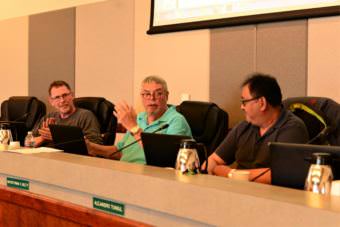
City Councilors Alejandro “Bong” Tungul, center, and Dave Gregory, right, acknowledged the investigation at the Oct. 24 meeting of the Unalaska City Council. Tungul said he’s received a warrant targeting his emails. (Photo by Berett Wilber/KUCB)

Members of the Unalaska City Council are under investigation.

Police Chief Mike Holman confirmed Tuesday to KUCB that the Unalaska Department of Public Safety is investigating current and potentially former city councilors.
Holman declined to comment on the scope of the inquiry. But at Tuesday’s City Council meeting, former councilor Yudelka Leclere connected it to the ongoing controversy surrounding Deputy Police Chief Jennifer Shockley.

“Today, I can stand here and look at you, Officer Shockley,” said Leclere, during public comments. “We never gave an order to fire you.”

Since August, the council has denied accusations that they pressured former city manager Dave Martinson to discipline Shockley for creating a survey asking Unalaskans to rate their satisfaction with each councilor.

When Martinson resigned last month, however, he cited long-term tension with the council that came to a head recently over a “personnel decision.” 

While it appears councilors are now under investigation for their roles in the power struggle, Councilor Dave Gregory said the extent of the probe is unclear.

“There’s an investigation of council members,” said Gregory. “Maybe it’s Roger (Rowland), maybe it’s me, maybe it’s Yudelka (Leclere), maybe it’s the other council members. We don’t know. We can’t get any information on it.”

Holman said the local Public Safety Department is “part” of the investigation, but he wouldn’t confirm whether other agencies are involved or comment on the timeline for completion.

The most specific information came from Councilor Alejandro “Bong” Tungul, who said an attorney has asked to review his emails.

“I’m being served a warrant on my computer, which I’m not happy about,” Tungul said.

A KUCB public information request for all August emails between the city manager, mayor and council was returned heavily redacted by the city attorney.

While the community awaits more information, the council has narrowly upheld a directive that could launch a counter-investigation.

At her last meeting in office, Leclere proposed hiring a third-party investigator to look into the matter.

Several current councilors argued the city should let the ongoing inquiry play out before taking any action. But others agreed an independent investigator is necessary, given the deputy police chief’s role in the incident.

“Since people who are in the Public Safety division are part of this, we need to get some outside assistance.” Councilor James Fitch said.

Councilors split 3-3 over the directive, leaving Mayor Frank Kelty to cast the tiebreaker vote.

He pushed the motion forward, authorizing the interim city manager and city attorney to explore the possibility of contracting for a separate investigation.

The City Council’s next meeting is Nov. 14.

Cruise ship cancellation a ‘significant loss’ to Unalaska businesses

The decision to dock Celebrity Millennium in Sitka may have cost Unalaska businesses about $100,000, the visitors bureau estimates. (Photo by Berett Wilber/KUCB)
The decision to dock the cruise ship Celebrity Millennium in Sitka may have cost Unalaska businesses about $100,000, the visitors bureau estimates. (Photo by Berett Wilber/KUCB)

A 2,000-passenger cruise ship was supposed to dock in Unalaska today, instead it decided to go to Sitka.

Although Unalaska is known as America’s top fishing port, tourism — in particular the cruise ship industry — is a growing source of revenue especially for small businesses and non-profits.

Locals say they’ve been left scrambling, trying to figure out how they will make up tens of thousands of dollars in lost revenue from the Celebrity Millennium’s canceled visit.

“It’s a big loss for that ship to not come here. It’s about $20,000 to $30,000 of lost revenue for us,” said Virginia Hatfield, executive director of the Museum of the Aleutians. “It’s important. This is what we use to put up exhibits, to buy merchandise for the store, and to pay salaries and health benefits for our staff.”

She estimates the money from the ships visit could have been used to create four or five small exhibits or one nicer traveling exhibit.

Hatfield doesn’t think it’s possible for the museum to make up the loss. It’s too significant.

“We already have what we hope to make from them built into our budget, so it’s just a loss,” she said.

The Museum of the Aleutians isn’t the only organization that was counting on increased traffic from the cruise ship.

Unalaska Port of Dutch Harbor Convention and Visitors Bureau executive director Carlin Enlow estimates that the Celebrity Millennium would have distributed $100,000 across museums, restaurants, and stores.

“It’s not going to happen and that’s a bummer,” Enlow said. “The biggest thing that I hopes come out of it is that people realize what these business and organizations do for these cruise ships and how (Unalaska comes) to rely on it.”

Even though the fishing industry is the bread and butter of Unalaska, Enlow says trans pacific sailings are increasing and with the Northwest Passage opening up to cruise ships, the city is likely to see even more boats in the future.

So what caused the cancellation of the Celebrity Millennium’s port call? A lack of available facilities.

“We did have some options that if they could delay for some hours, they could come in at that point,” said ports director Peggy McLaughlin. “I don’t think that worked with what they were trying to accomplish and ultimately they made a decision to change that port of call.”

With the city dock under construction, regular cargo operations, and requirements from the vessel, there was only so much McLaughlin could do. This incident raises a big question about Unalaska’s future.

“If the city believes that the cruise ship industry is something that we want to diversity towards, what is the infrastructure that the city is prepared to commit to that?” McLaughlin said.

With more cruise ships expected next year, McLaughlin thinks putting numbers to the revenue generated by the vessels and understanding the benefits the industry brings to local business and non-profits is important.

While Hatfield understands why the ship cancelled, she says cruise ship profits are vital to the museum and help fund services that grants won’t cover.

“The more we make from these cruise ships, the less we have to ask from the city to help us get by,” Hatfield said.

Three more cruise ships are scheduled to stop in Unalaska this fall. Enlow says she’s heard rumors that two of them may be considering cancelling their port calls, too. If that happens, she estimates that could be another $100,000 loss for small business and non-profits across the city.

St. Paul Island ramps up reindeer program to improve food security

Students at St. Paul’s reindeer camp butcher a female from the island’s herd. This summer, the tribal government organized the camp as part of its effort to develop a more robust reindeer management program. (Photo by Laura Kraegel/KUCB)

For the last century, reindeer have roamed St. Paul Island without much oversight.

But now, the tribal government is stepping up its management style to boost subsistence options and the local economy.

Fleshy red reindeer quarters are spread across the tables of St. Paul’s tavern. Surrounding them are eager pre-teens, wielding knives and wearing plastic gloves.

“I don’t think we can cut through this bone,” said one student. “It’s like that thick.”

“No! You don’t want to cut through the bone,” a teacher responds.

The kids are learning how to butcher a hind shank — how to feel along the bone with their fingertips, slice through the tendons, and free the best cut of meat.

“Do you want to cut the joint right there?” the teacher asks. “There you go. Nice!”

Instructors Lauren Divine and Erin Carr demonstrate how to process a hind shank at St. Paul’s reindeer camp. (Photo by Laura Kraegel/KUCB)

Lauren Divine is one of the instructors at “reindeer camp” — a first for the small island of 500 people.

“Just having a first shot at reindeer camp out here is a really big step for us,” said Divine, the co-director of the tribe’s Ecosystem Conservation Office.

Specifically, she said it’s a step toward an active management program for the island’s herd.

Even though reindeer have lived on St. Paul for about 100 years, she said the tribe hasn’t done much more than distribute hunting permits. That’s slowly beginning to change, because the community needs another consistent source of meat.

“Especially in light of other resources that are declining,” Divine said. “The struggle becomes greater every year.”

Tribal leaders have started investigating ways to develop reindeer as a robust option for subsistence.

They’re experimenting with different hunting seasons and harvest strategies, in addition to offering community education, like this camp.

“We’re at the starting line,” Divine said. “Whereas a lot of other places in Alaska are more developed or have these champions who have been around for a long time in the reindeer world, we’re building our knowledge base from the ground up.”

That’s clear from the dozen or so kids at camp. Most are pretty new to the animal, including 9-year-old Riley Melvidov.

“My dad only hunted (them) one time,” he said.

His family liked the meat. They liked having a stash of it in the freezer, too, alongside their fur seal and other more established subsistence foods.

“Yeah! I was into it,” he said.

Riley’s family isn’t the only one interested.

Tribal leaders say more and more people are picking up permits, heading out on the tundra, and taking a shot at reindeer hunting.

Eventually, that participation could translate into something more profitable.

“They have an opportunity to be able to sell the reindeer meat in the store,” said Erin Carr of the Reindeer Research Program at the University of Alaska Fairbanks.

Carr is partnering with the tribe to expand St. Paul’s economy — and freezer section — through commercial sales at the local grocery store.

It’ll take a while, but she says the program would let people support the island’s hunters while avoiding the astronomical prices of other meat.

Back at reindeer camp, the kids finish their butchering lesson and shed their bloody gloves.

They gather around the grill in silent excitement.

“You want to sear it on medium-high on both sides,” Divine said.

Finally, the reindeer is served up, the taste test begins — and the reviews are positive.

“Really good!” says one camper. “You want to try?”

St. Paul ramps up reindeer program to improve food security

Students at St. Paul’s reindeer camp butcher a female from the island’s herd. This summer, the tribal government organized the camp as part of its effort to develop a more robust reindeer management program.(Photo by Laura Kraegel / KUCB)

For the last century, reindeer have roamed St. Paul Island without much oversight. But now, the tribal government is stepping up its management style — to boost subsistence options and the local economy.

Fleshy red reindeer quarters are spread across the tables of St. Paul’s tavern. Surrounding them are eager preteens, wielding knives and wearing plastic gloves.

“I don’t think we can cut through this bone!” says one student, “It’s like that thick.”

“No! You don’t want to cut through the bone,” the instructor replies.

The kids are learning how to butcher a hind shank — how to feel along the bone with their fingertips, slice through the tendons and free the best cut of meat.

Lauren Divine is one of the instructors at “reindeer camp” — the first of its kind for the small island of 500 people.

“Just having a first shot at reindeer camp out here is a really big step for us,” she says.

Specifically, it’s a step towards an active management program for the island’s herd. Even though reindeer have lived on St. Paul for about 100 years, the tribe hasn’t done much more than distribute hunting permits. That’s slowly beginning to change — because the community needs another consistent source of meat.

“Especially in light of other resources that are declining,” Divine says. “The struggle becomes greater every year.”

Instructors Lauren Divine and Erin Carr demonstrate how to process a hind shank at St. Paul’s reindeer camp. (Photo by Laura Kraegel / KUCB)

So, tribal leaders have started investigating ways to develop reindeer as a robust option for subsistence. They’re experimenting with different hunting seasons and harvest strategies in addition to offering community education, like this camp.

“We’re at the starting line, whereas a lot of other places in Alaska are more developed or have these champions who have been around for a long time in the reindeer world,” Divine says. “We’re building our knowledge base from the ground up.”

That’s clear from the dozen or so kids at camp. Most are pretty new to the animal, including 9-year-old Riley Melvidov, who says his dad only hunted reindeer once. His family liked the meat, he says, and they liked having a stash of it in the freezer, alongside their fur seal and other more established subsistence foods.

Riley’s family isn’t the only one interested. Tribal leaders say more and more people are picking up permits, heading out on the tundra and taking a shot at reindeer hunting.

Eventually that participation could translate into something more profitable, according to Erin Carr, who works for the Reindeer Research Program at the University of Alaska Fairbanks.

“They have an opportunity to be able to sell the reindeer meat in the store,” she says.

She’s partnering with the tribe to expand St. Paul’s economy — and freezer section — through commercial sales at the local grocery store. It’ll take a while, but Carr says the program would let people support the island’s hunters while avoiding the astronomical prices of other meat.

Back at reindeer camp, the kids finish their butchering lesson and shed their bloody gloves. They gather around the grill in silent excitement, while their cuts of meat are seared on both sides.

Finally, the reindeer is served up, the taste test begins — and the reviews are positive.

“Really good!” says one student. “You want to try?”

Site notifications
Update notification options
Subscribe to notifications