KUCB is our partner station in Unalaska. KTOO collaborates with partners across the state to cover important news and to share stories with our audiences.

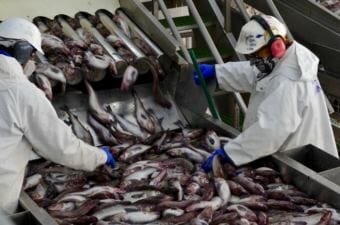
Workers inspect pollock offloaded at Unalaska’s UniSea processing plant. (Photo by Sarah Hansen/KUCB)
International seafood buyers are scheduled to visit Unalaska this month, but they don’t hail from a massive importer like China or Japan.
They’re coming from Ukraine — a once-modest market for Alaska fish that’s slowly reemerging after political upheaval and economic crisis.
In 2013, Ukraine spent $105 million on American seafood — a record for the Eastern European nation that loves hake, pollock and salmon roe.
But two years later, those imports had plummeted almost 70 percent as the Ukrainian government was overthrown and parts of its land occupied by Russia.
Today, the country’s political conflicts are ongoing, but inflation and income have stabilized enough that foreign fish is back on the menu.
“The Ukrainian market is a growing market for U.S. seafood exports, and therefore it makes sense for Alaska to be part of that presence,” said Jeremy Woodrow of the Alaska Seafood Marketing Institute.
Woodrow said the institute is organizing the Ukrainian visit to rebuild trade relationships that’ll hopefully pay off down the road.
“It’s definitely not as large as, say, Japan or China or maybe some other countries in Europe, but it is a growing market,” he said. “And it’s always good to have new customers and a growing demand for our products. It creates competition, and competition usually helps drive value.”
Woodrow said the six Ukrainian delegates represent companies that are eager to connect with Alaska seafood suppliers. They’ll tour processing plants and fishing boats in Unalaska before making stops in Juneau and Seattle.
“They’ll be interested in seeing some of the larger fisheries like pollock, as well as some of the groundfish fisheries, like halibut and cod,” he said. “And of course, it’s going to be salmon season when they’re here, so they’ll see how that operates across the state.”
While the delegates develop contacts in Alaska, Woodrow said Ukraine’s political landscape shouldn’t present any new obstacles.
He doesn’t expect anything like the new tariffs levied by China. And in fact, he said an ongoing Russian embargo on American food is only boosting interest in Alaska fish.
“We’ve actually seen some of that shift from Russia go to countries like Ukraine, who have similar customs and similar preferences in their diets,” he said. “That’s where we’ve seen some of our industry shift their focus, and that’s why it tends to be a growing market right now.”
The Ukrainian delegation will be in Unalaska on July 22-25, then head to Juneau and Seattle at the very end of the month.
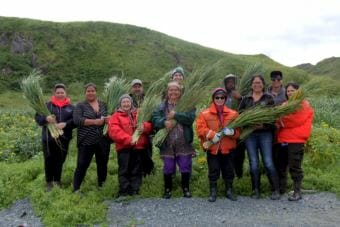
The descendants spent time gathering grass on Attu to be used in traditional baskets. (Photo by Zoë Sobel/KUCB)
Seventy-five years after Japan invaded the furthest tip of the Aleutian chain, Attuans are returning home.
In 1942, there were 44 people living on Attu Island, nearly all Alaska Natives. They were taken as captives to Japan, where half of them died. And after the war, the federal government forbade them from returning.
But in August, a group of 11 descendants finally visited their ancestral home for the first time.
Almost no one visits Attu Island.
The only way to get there is by boat.
It’s a long journey, as the island marks the westernmost point of the United States, and navigating the governmental red-tape that regulates Attu is a logistical nightmare.
But in the middle of a busy summer field season, the U.S. Fish and Wildlife Service made time for the R/V Tiglax to ferry descendants back to their ancestral home.
“I’m Crystal Dushkin from Atka, and I’m a descendent from Attu as well,” Dushkin said. “This was something I never ever expected to happen in my lifetime. To make it all the way there.”
Dushkin is the mayor of Atka, and she grew up steeped in Unangan culture.
Crystal Dushkin never imagined she’d get to set foot on Attu. (Photo by Zoë Sobel/KUCB)
She’s eager to see the old village site where her great grandmother, Mary Snigaroff (née Prokopeuff) lived.
Had World War II not happened, Dushkin could have grown up there too.
But in June of 1942, the Attuans’ lives were changed forever when Japanese soldiers landed on the island and captured all 44 residents. They were taken to Japan and held as prisoners of war.
In the 75 years since, National Parks Service anthropologist Rachel Mason said the stories of Attu haven’t been shared.
“The descendants of those people never even had a chance to to learn about the experience in Japan or about Attu village,” said Mason, as the boat made a pit stop at Kiska Island. “Their parents didn’t want to talk about the traumatic experience.”
The U.S. government didn’t allow the Attuans to return home after the war.
Mason said it was considered too inconvenient.
Many settled in Atka, but others never returned to the region.
A handful went to an orphanage, and some ended up in Pacific Northwest hospitals.
That includes Theresa Deal.
Raised by two white parents in Vancouver, Washington, she never really learned about her birth mother’s life on Attu or her captivity in Japan.
But Deal always got questions about her background.
“They think I’m Polynesian,” Deal said. “They think I’m Mexican. They think I’m all sorts of stuff and then I tell them, ‘No, I’m from the Aleutian Islands.’ Then you get the blank stare, so they get a lesson in geography when they meet me.”
Theresa Deal passes time on the Tiglax playing Sudoko. (Photo by Zoë Sobel/KUCB)
This is her first time in the Aleutians — her first time being close to the history of her mom’s family.
“I wish I knew more about the culture so I could tell my sons,” Deal said. “My sons know that they are Aleut, but they know less than I do.”
A stop in Atka gives Deal a glimpse of what her life could have been like had her mom, Marina Hodikoff, grown up there after the war.
From the second Deal steps on shore, Niigugim Tunuu — the western dialect of Unangam Tunuu — fills the air. A brief church service is held to bless the cross bound for Attu. And over at the school, she watches students perform traditional songs.
“It was really quite eye-opening to see the love that they have for their culture,” Deal said. “I wasn’t immersed enough. I didn’t get that. So I do wish that Marina would have been relocated to Atka. Then my life would be different.”
For the descendants, the days spent on the boat feel like a big family reunion. But after two days of travel, it’s time for the part of the trip that everyone is looking forward to.
“We’re here!” said Christine Kiehl. “We’re getting ready to land on Attu! It’s very exciting. If I could dance, I’d totally dance right now.”
The old site lies in a protected cove encircled by lush green mountains. The grasses grow long and wild, interspersed with purple and yellow flowers. But there’s no sign of the former village.
As they take in the land, the descendants find the foundation of the old Russian Orthodox church, plant the cross, and hold a ceremony to honor their ancestors and their lost community.
The old village of Attu was in Chichagof Harbor. (Photo by Zoë Sobel/KUCB)
From there, many gather grass for traditional baskets — and Kiehl heads to the shore.
“I’m bringing dirt back to my sisters,”Kiehl said. “They’re going to be able to touch Attu, too. Just not in the same manner I did.”
Kiehl was raised in Port Angeles, Washington. Her mom, Agnes Prossoff, was from Attu, but she died when Kiehl was 9 years old. Kiehl says she grew up without any exposure to the culture — no subsistence, no traditional dance or dress, nothing.
As she carries a plastic bag up the beach — filling it with sand, rocks, and other treasures of the past — Kiehl is joined by Deal. They start to unpack some of the complicated emotions this trip has brought up.
“Christine, what do you think about being back here?” asked Deal.
“It made me cry because this was where my mother was born,” Kiehl said. “She was denied her life here, which would’ve been so much better. A different quality than she got in Washington.”
Theresa Deal, left, and Christine Kiehl peruse the beach for treasures to remember Attu. (Photo by Zoë Sobel/KUCB)
“I agree,” Deal said. “The people who were born out here and got to stay out here — they have such a different culture. They’re very proud of their culture, whereas we just grew up as regular Americans.”
“It makes me angry because –” Kiehl said.
“Because our lives were also stolen,” Deal replied.
“Very stolen. It makes me angry,” Kiehl said. “And I don’t believe in racism or casting judgment. But it’s been really hard to not be angry at the Japanese for taking (my mother and the other Attuans). They were just here minding their own business and living their lives.”
“Did your mom teach you that anger at the Japanese or is it just you?” asked Deal.
“No, I think it’s me,” responded Kiehl. “If she did teach it to me, I was too young to remember. It’s just really hurtful, but I know that they were just doing their job.”
“My mom taught me that we have to feel empathy for the Japanese internment,” Deal said. “Because it was just wrong. You know, the Japanese internment was even more cruel than our parents as prisoners of war.”
Both of them agree that hate isn’t productive. Deal says she’s made a conscious choice not to hate the Japanese. Instead, she feels sad for them. And for Kiehl, she realizes that her mixed emotions stem from loss.
“There’s a million thoughts going through my mind because I’ve wanted to step foot on this island since my mother died,” Kiehl said. “I really feel that she died as a result of the war. She became an alcoholic and she was an anorexic and that ultimately took her life.”
But Kiehl says spending time with other Attuans is exhilarating. Because of this trip, she’s motivated to make her own regalia and bring grass back for her sister who weaves.
Deals says it’ll be hard to immerse herself in her culture, living outside of Alaska. But she’s hoping to return for a regional culture camp and learn more about her heritage.
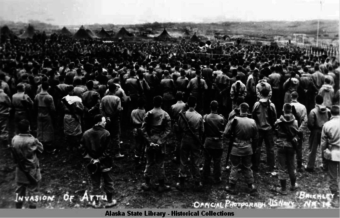
Because the Japanese had the advantage of time, the Americans attacked with quadruple the force — more than 12,000 soldiers. (Alaska State Library, Aleutian/Pribilof Project Collection, ASL-P233-V111)
Seventy-five years ago, Japan and the United States were locked in one of the bloodiest battles fought on American soil: the Battle of Attu.
Army veteran Allan Serroll served on Attu Island, which sits at the westernmost end of the Aleutian Islands — closer to Japan than Seattle.
Serroll is now 102. But he’s still haunted by the experience of staring down young men like himself.
“Some of the guys noticed that it was bothering me,” Serroll said. “They said, ‘Look, it’s kill or be killed. It’s your life you’re protecting.’ And they were right.”
In 1943, American troops were streaming into Alaska in preparation for one of the deadliest battles of World War II.
One year earlier, Japanese soldiers had bombed Dutch Harbor, seized Attu Island and took the Alaska Native people who lived there as prisoners of war.
It was the first time American soil had been invaded since the War of 1812.
Commanding officers told soldiers like Bob Brocklehurst of the 18th fighter squadron that the Japanese were looking to invade the Lower 48 by way of the Aleutian chain.
“They figured that if the Japanese had wanted to, they could’ve come up the Aleutians, taken Anchorage, and come down past Vancouver to Seattle, Washington,” Brocklehurst said.
But according to historian Jeff Dickrell, the Battle of Attu was really about reclaiming stolen land.
“There was a propaganda value in that,” Dickrell said. “Some of the higher-ranking people really wanted that. They wanted to be able to say the Japanese had been cleared from American soil.”
Because the Japanese had the advantage of time, the Americans attacked with quadruple the force — more than 12,000 soldiers.
A United News newsreel showed soldiers clambering onto small boats, motoring to shore and landing on Attu.
“The problem of supplying an expedition to take this vital subarctic outpost is tremendous,” read one 1943 newscaster. “But the Americans are well-trained for landings such as this, and they’re bringing everything they’ll need to hold Attu against any future attack.”
The Americans brought heavy equipment, but the lack of roads made it useless.
“It was strictly a foot job,” said former signal corps sergeant,
Serroll in an interview with the National Park Service. “You had to walk. You had to carry your equipment.”
The battle started on May 11, and it was supposed to last just a few days. But because of the conditions, it stretched to 19 days.
The Americans slowly advanced on the Japanese from Holtz Bay at the north and on Massacre Bay at the south, slogging their way through snowy tundra.
The Japanese were camped out high in the foggy mountains above the visibility line.
As the Americans sent scouts up into the hills, small skirmishes broke out when the two forces met.
American soldiers dig a tractor from the mud. (Alaska State Library, U.S. Army Signal Corps Photograph Collection, ASL-P175-050)
Many soldiers were young and inexperienced.
Some — like the 7th Motorized Division — had been training in the deserts of California for deployment in North Africa, so they’re weren’t expecting the brutal Aleutian weather — with constant raining or snowing. Serroll said the wind was the worst of all.
“You’d be walking along and all of a sudden, you’d be flat on your face,” Serroll said. “It was unbearable. If you wanted to plant a rifle, you just couldn’t do it.”
Attu veteran Joseph Sasser told the NPS that he didn’t have clothing suitable for the conditions.
“We did have rain suits, but that could prove a disadvantage to you,” Sasser said. “Because as you were walking and so forth, you would perspire. You didn’t get enough air, then you perspired. And then when you sat down to take a break, then you got cold.”
Sasser was luckier than other soldiers.
His clothes were wool, but some had only summer uniforms and they struggled with chills up in the mountains.
Poorly constructed leather boots that never dried also led to trench foot. Soldiers’ foot tissues died, leaving their extremities to blacken and decay.
On top of all that, Dickrell said the Americans had never gone head-to-head with the Japanese on land.
Every other battle had happened in the sky or at sea.
“When you fight on an island, there is nowhere to retreat,” Dickrell said. “It’s a battle to the end. We didn’t know how the Japanese would react to that.”
By the end of May, both sides were feeling the toll of the battle. Food and supplies were scarce.
The Japanese were down to 800 able-bodied men.
“We didn’t know if they would surrender once they were surrounded,” Dickrell said. “We didn’t know if they would fight to the end. The last thing we expected was a mass suicide.”
The Japanese soldiers followed the Bushido code, a samurai warrior ethic in which surrender was dishonorable. Every Japanese soldier who could walk assembled for a final Banzai charge, trying to catch the Americans off guard.
Sasser was part of that last stand on Engineer Hill.
“The Japanese just kept coming up the ravines and stacking on top of each other,” Sasser said. “Some, seeing that everything was futile, that there was nothing they could do, just took their hand grenades and pulled the pins. Blew their stomachs out completely.”
Serroll was there too. He ran over after hearing the commotion.
“When the Japs came at us running and screaming, they were ridiculous,” Serroll said. “They had grenades wrapped around their foreheads and around their chests. We lost quite a number of guys from the grenades.”
In total, 549 Americans died fighting. The Japanese casualties were catastrophic: 2,300 men died and just 28 soldiers were captured. Both Serroll and Sasser helped to bury the dead in mass graves.
But the real killer on Attu was the weather and disease. It took more American soldiers out of action than the Japanese.
An American solider look at a Japanese graveyard. (Alaska and Polar Regions Collections, Elmer E. Rasmuson Library, University of Alaska Fairbanks)
“After three weeks of costly fighting marking the first major American victory since Guadalcanal, Japan’s high-water mark advance was stopped dead,” read a Pathé News newscaster. “A turning tide proved a military milestone of the century.”
After a battle with so many unexpected losses, the U.S. stepped back and tried to learn from it.
Attu veterans were interviewed so that other soldiers could be better trained for cold conditions. Changes were also made to Army footwear, clothes, outdoor gear and food to prevent injuries.
While they were too late to save the lives and limbs of many Attu veterans, military officials credit the lessons learned with preventing casualties in the Italian campaign.
Many of those who fought in the cold and dodged the Japanese grenades came through the experience with more complicated feelings.
Looking back on the battle, Serroll said it was hard to wrap his mind around his own survival.
“When something good happened, I looked up and I said, ‘Thank you, God,’” Serroll said. “It made me feel good that the war with the Japanese was over and I survived it. But what about the poor guys who didn’t survive it? Japanese or American. It’s pure luck. What else can you say?”
Serroll remained stationed on Attu after the fighting ended. He spent time exploring the island, collecting samples of plants and filling a book with pressed flowers.
Now, 75 years later, he hasn’t forgotten the battle. Back then, it bothered him to shoot people, and he said that’s still true today.
“When you see people fall, it does something to you,” Serroll said. “I keep thinking that these people have wives and they have parents. How different are they from us? They’re just wearing a different uniform.”
Attu is uninhabited today.
The Attuans who survived imprisonment in Japan were never allowed to return home, and the only hint of the island’s wartime history is the abandoned equipment left to rust.
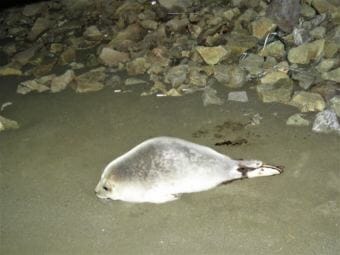
The first ringed seal was spotted last February near Kloosterboer at the Port of Dutch Harbor. (Photo courtesy Melissa Good/Alaska Sea Grant)
Unalaskans are used to spotting marine mammals around the island.
But lately, they’re not just seeing whales or otters.
Ringed seals — an Arctic species that typically lives far north of the ice-free Aleutian Islands — are showing up.
Now, scientists are monitoring the unusual visitors to find out why they’re near Unalaska.
When the first ringed seal popped up last winter, it seemed like a fluke.
But another appeared early this spring. And then, the number skyrocketed.
“Since we started tracking them in March, we have more than 50 reports,” said Melissa Good, Unalaska’s Sea Grant agent.
Good has been following the seal surge by fielding phone calls from community members and taking drives around the island.
“We first started seeing a couple, and it’s like, ‘That’s kind of weird, but OK,'” she said. “But when we started seeing 10 at a time, on one go-around, that was weird. That’s unusual.”
Ringed seals are ice seals that like to hunt in Arctic waters and haul out on sea ice.
Why are so many of them down in temperate ice-free Unalaska, lounging on docks and molting on breakwaters?
“One of my theories is that they’re looking for habitat,” Good said.
This winter, the Arctic ice pack was the second lowest on record, leaving seals with fewer places to rest, eat and have their pups.
That may have driven them to seek out new areas beyond their normal range, Good said.
“There’s plenty of food here, as long as they can adapt to a different hunting strategy,” she said. “They’re used to hunting under the ice and using that ice platform. They obviously don’t have that here, but maybe the breakwaters are serving that (purpose). Or they’re learning to hunt in these rocky reef areas.”
Good isn’t concerned about the sudden swell of ringed seals, for now, but she is curious.
“Are they going to stay here? How are they doing in general? The ones we’ve been seeing so far — I would say most of them are healthy individuals,” she said.
But Good has found two dead with high parasite counts, and others have patchy coats.
Good is asking Unalaskans to help keep an eye on the seals. She’s tracking sightings and collecting photographs in an effort to compile better data on their health and movements.
She’ll start a deeper analysis of their behavior with more information.
City Councilors Alejandro “Bong” Tungul, center, and Dave Gregory, right, acknowledged the investigation at the Oct. 24 meeting of the Unalaska City Council. “There’s an investigation of council members,” said Gregory. “Maybe it’s Roger [Rowland], maybe it’s me, maybe it’s Yudelka [Leclere], maybe it’s the other council members. We don’t know. We can’t get any information on it.” (Photo by Berett Wilber/KUCB)
State troopers have wrapped up a months-long investigation concerning at least one of Unalaska’s elected officials.
The case is now under review by the Alaska Office of Special Prosecutions, which will decide whether to pursue criminal charges.
But Unalaskans still know very little about what’s under scrutiny.
Troopers closed the investigation and compiled their findings late last week. Now, the Office of Special Prosecutions will decide what happens next.
“They can review it and make a determination on whether or not there’s anything there,” troopers spokeswoman Megan Peters said.
The handoff comes six months after local police confirmed the existence of the inquiry — and three months after the state took sole responsibility for it.
In that time, local officials have said only that some number of current or former members of the Unalaska City Council is under investigation.
Peters said the troopers have nothing more to add.
“I don’t have any information other than OSP has it for review,” she said.
The Office of Special Prosecutions handles criminal cases that fall outside the traditional wheelhouse of a District Attorney’s Office.
That includes things like cyber-crime and Medicaid fraud, according to Chief Assistant Attorney General Paul Miovas.
“In addition to that, we handle situations where there’s a public employee of some sort, or something where there’s a perceived conflict (of interest) with the D.A.,” Miovas said.
Unalaska cases are typically prosecuted by district attorneys based in Anchorage.
Miovas said his office will take the next month or two to review this special case and decide whether to file criminal charges.
“We try to use our discretion in a wise way so that we’re prosecuting the cases that really should be prosecuted, not just the cases that can be prosecuted,” he says.
And if Special Prosecutions decides not to move forward, will Unalaskans ever know what this was all about?
“You may never know the exact thought process,” Miovas said.
Depending on the case, Miovas said his office sometimes releases a public statement explaining their decision and sharing some details.
He said that often happens when they review officer-involved shootings, because community members want more transparency.
“And I understand that’s the same when we’re dealing with people who are in public office, especially in a smaller community,” says Miovas. “I’m not saying that’s something we would do in a situation like this. I’m just saying that’s a possibility.”
Like Troopers and city officials, Miovas declined to comment on the scope of the case.
The motor vessel Challenge Prelude is a 587-foot tanker. (Photo courtesy Hans Rosenkranz/MarineTraffic.com)
Updated
The U.S. Coast Guard has suspended its search for a man who reportedly fell overboard from an oil tanker traveling past the Aleutian Islands.
Petty Officer Lauren Dean says air crews spent 14 hours searching for the 22-year-old mariner, who went missing Sunday afternoon from the M/V Challenge Prelude.
“Due to the length of time, and with the extreme environment, the District 17 Command Center made the call to suspend the search,” Dean said.
Coast Guard responders covered almost 700 square miles in their search, which began south of Sand Point.
Dean says the tanker also retraced part of its own route in an effort to locate the man, whose name has not been released.
“Situations like this are never easy,” Dean said. “Our deepest condolences do go out to his family and friends. It is a tragedy.”
The Challenge Prelude was traveling from South Korea to Anchorage when the man went missing. Dean says it’s unclear why he fell overboard.
Original story
About 24 hours after he went missing from an oil tanker, the U.S. Coast Guard is deciding whether to continue its search for a man who reportedly fell overboard in Aleutian waters.
The master of the M/V Challenge Prelude noticed the 23-year-old mariner was missing Sunday afternoon when the vessel was 126 miles south of Sand Point.
The tanker turned around to search for the man, while Air Station Kodiak sent two aircrews to assist.
“The helicopter was able to do two flights and the C-130 flew for quite a long time along the vessel’s track line,” Lt. Brian Dykens said. “But we haven’t done any searches [on Monday], and the command center is planning the next course of action.”
Dykens said the Coast Guard will make a decision on the search Monday afternoon. There’s been no sign of the missing mariner, whose name hasn’t been released.
Close
Update notification options
Subscribe to notifications
Subscribe
Get notifications about news related to the topics you care about. You can unsubscribe anytime.