KUCB - Unalaska

KUCB is our partner station in Unalaska. KTOO collaborates with partners across the state to cover important news and to share stories with our audiences.

In the afterlife, Unalaska’s eagles find purpose at national repository

When bald eagles die in Unalaska, it’s the beginning of a long journey. Literally.

Many of them travel thousands of miles and find second lives in the Lower 48.
Damian Lopez-Plancarte is "the eagle guy" in Unalaska. He responds to calls for eagle assistance, and collects and ships dead eagles on to the National Repository. (Photo by Berett Wilber/KUCB)
Damian Lopez-Plancarte is “the eagle guy” in Unalaska. He responds to calls for eagle assistance, and collects and ships dead eagles on to the National Repository. (Photo by Berett Wilber/KUCB)

When Damian Lopez-Plancarte walks into the Wildlife Trooper office and opens the freezer, it looks like Thanksgiving.

The shelves are jammed full of turkey-shaped items wrapped in plastic.

But none of them are turkeys.

“Here we have one, two, three four, five dead eagles,” said Lopez Plancarte, counting each one.

When a raptor is found dead, he gets the call to remove the bird. He bags the carcass and stores it here, along with other freezer goods.

“That’s an ice cream sandwich,” he points out. “Keep ‘em in the same freezer.”

These eagles may have an unusual icy grave, but soon they’ll begin a journey that could take them more than 3000 miles across America. Why?

The Bald and Golden Eagle Protection Act of 1940 made it a federal crime for anyone to possess eagle parts — and the punishment is severe.

Get caught with even one feather, and you could receive a $200,000 fine, a yearlong prison sentence, or both.

The exception is for members of federally recognized tribes, many of whom use eagle feathers, talons and other parts in ceremonies or as spiritual objects.

But if taking, transporting and buying eagle parts is still illegal, then how are indigenous people supposed to get them?

The answer is the National Eagle Repository in Colorado.

Dead eagles from across the nation are shipped there, including those from Unalaska.

Sarah Metzer works at the repository. Her job includes delivering educational programs and sorting through two giant walk-in freezers full of eagle carcasses.

“Wanting to ensure that we protect the constitutionally protected right of religious freedom, our facility turns those eagles around,” Metzer said. “We’re able to distribute the parts and feathers to members of federally recognized Native American tribes.”

Last year, she says the repository received 2,700 eagles and filled nearly 4,000 orders, or more than seven eagles a day, and the rate keeps climbing.

“We’re looking at getting a third freezer,” Metzer said.

Most orders are from the Southwest, where the feathers are used for powwows and graduations, as well as gifts and headdresses.

“It’s a pretty special thing, knowing there’s a recipient on the other end,” Metzer said. “This eagle will live on, and its spirit will live on through that applicant.”

But the wait can be long and frustrating for those who feel the federal government shouldn’t be in charge of distributing ceremonial objects or regulating indigenous spirituality.

If you placed an order today, it would take six months to get a whole bald eagle. Half that for 20 loose feathers. A golden eagle takes more than two years.

That makes it tempting to pick feathers up off the beach. But now, indigenous people can do just that.

After decades of an informal policy to look the other way when Native Americans had non-repository feathers, the Justice Department issued a memo in 2012., which allows indigenous people to pick up and possess “culturally significant” eagle parts — even if they don’t come from the repository — as long as they don’t sell the parts or kill the eagles.

While the repository does fill orders from Alaska, chances are slim that Unalaska’s eagles will find themselves back on the island in the afterlife.

Responders have mitigated pollution threat of F/V Akutan, Coast Guard says

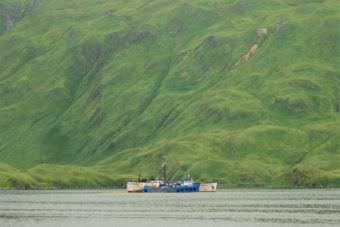
The F/V Akutan is still moored in Unalaska’s Captains Bay. (Photo by Berett Wilber/KUCB)

Officials have suspended their efforts aboard a disabled fishing vessel in Unalaska.

Coast Guard Petty Officer John-Paul Rios said responders have removed almost 16,000 gallons of oil and sludge from the F/V Akutan, which is moored in Captains Bay.
“The main thing we were trying to do was insure there was no major pollution incident,” Rios said. “At this time, we feel confident that we’ve mitigated any kind of imminent threat of pollution.”

Rios said it’s still unclear what will happen to the floating processor in the long term.

There are 130,000 pounds of frozen sockeye onboard, following the Akutan’s failed salmon season in Bristol Bay.

“As far as the ownership or who’s responsible from here on out, I don’t necessarily have the right answers for you,” Rios said.

While responders have scaled back their operations, Rios said they’re still on the island monitoring the situation and ready to intervene again, if necessary.

Scientists find new clue in Steller sea lion decline

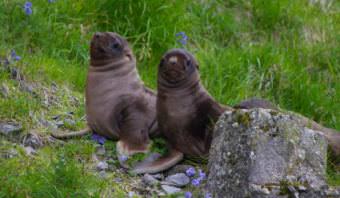
Sea lion pups rest on an Aleutian Beach. (Photo courtesy NOAA)

Scientists have finished another research season without solving the 40-year-old mystery of the Steller sea lion decline in the Aleutian Islands.

But this summer, a team from the National Oceanic and Atmospheric Administration may have found a new clue.
NOAA biologist Katie Sweeney is trying to solve the mystery of two sea lion stocks.

In the 1970s, the number of Aleutian Stellers crashed. Fifteen years ago, those on the eastern side of the Chain started recovering, albeit slowly. But those on the western side did not.

“We have field logs from biologists from the ’70s,” said Sweeney. “They talk about there being 13,000 sea lions on Attu at Cape Wrangell. We were just out there, and there were maybe 150.”

Why are western Stellers still declining? In its annual search for answers, NOAA sent Sweeney and her team to remote rookeries armed with a $25,000 drone.

After capturing a half-million images, the reason behind the decline is still unclear.

Sweeney said the drone data is some of the best NOAA has collected and it’s helping them to rule out some causes and come up with new theories for the population decrease.

Her team uses the pictures to track individual sea lions over decades, monitoring patterns of death and survival.

The data doesn’t indicate that more western sea lions are dying from disease, toxins, starvation or predation by orca whales. But they do illustrate something else: Birth rates are declining for western Stellers.

“Adult females aren’t having pups as often as they can,” she said. “They’re capable of having one pup per year, but we’re seeing them have one pup every other year, maybe.”

She isn’t sure why.

She said every bit of information is helpful, since the stakes are so high.

Western Stellers could go extinct in the next 50 years, and their decline is a warning for other fish and mammals that live in Aleutian waters.

“If you start seeing a problem with Steller sea lions, that’s an indication that something’s not entirely right with the ecosystem,” Sweeney said. “It’s kind of a canary in the coal mine.”

She’ll be back next summer to look for more clues that might explain low pup production.

Campers embrace culture at Unalaska’s Camp Adguyax

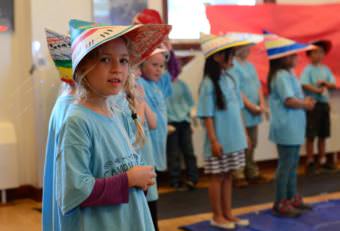
Students perform an Unangan folk tale on their last day of Camp Adguyax. (Photo by Berett Wilber/KUCB)

Campers huddle in the hallway of the Burma Road Chapel dressed as sea otter hunters.

The kids adjust their bentwood visors as community members file into rows of folding chairs.

“Am I missing any whiskers?” one girl asks.

“One of them broke,” says the boy next to her.

With costumes complete, they’re ready to perform an Unangan folk tale they’ve practiced all week at Camp Adguyax, about a greedy otter hunter who betrays the octopus that helps him.

The “whiskers” on their paper visors aren’t genuine sea lion, but imitation — beach grass, strung with beads.

Campers decorated their own bentwood hats based on traditional Unangan designs. (Photo by Berett Wilber/KUCB)

For five years, Sharon Livingston has organized “Camp A”, where first-, second- and third-graders immerse themselves in traditional stories, crafts and foods.

By encouraging kids to explore Unangan culture, she said they learn to see the value in cultures of all kinds.

“We believe that when you accept other people into your culture and teach them about it, they will learn how — at a very, very early age — to respect other cultures,” Livingston said. “That’s important in a town like ours, where we have every nationality you can think of.”

Campers draw draft clam rattle designs. (Photo by Berett Wilber/KUCB)
Campers draw draft clam rattle designs. (Photo by
Berett Wilber/KUCB)

While the folk tale didn’t have a happy ending for the greedy hunter — the final scene involved the kids screaming in terror and falling to the floor — Livingston said the tale encourages honesty and integrity toward your neighbors.

For the Unangax, that’s a meaningful lesson.

“The Unangan people have been here for so long,” she said. “We’ve been here for more than 10,000 years, and we’re not going anywhere.”

Diving for answers: Will blue king crab come back in the Pribilofs?

Jared Weems’ team dives near St. Paul Island. His two-year research project is focused on the overfished blue king crab population around the Pribilof Islands. (Photo courtesy Jared Weems).

In the Pribilof Islands, no one’s gotten an accurate count of blue king crab since the population crashed hard in the 1980s. This summer, a marine biologist is trying to change that, with the species’ first in-depth study in more than 30 years. His ultimate goal: Determine if blue crab can make a comeback — or if it’s gone for good.

It’s a foggy day on St. Paul Island and Jared Weems is itching for the weather to clear up. He wants to get out on the water and back to work.

“There’s so much life up here in the North Pacific,” he says, “Just amazing, spectacular diving.”

A juvenile blue king crab in Weems’ lab in Juneau. This summer, he’s tracking them in the wild by diving in St. Paul’s nearshore waters. (Photo courtesy Jared Weems).

Weems is a scientific diver and fisheries Ph.D. student at the University of Alaska Fairbanks. But this summer, whenever the weather’s good, he’s something like a diving detective.

His research has him combing the sea floor around St. Paul, searching for the elusive blue king crab. By diving in nearshore waters, deploying drop cameras and setting collector traps, he’s hoping to find the crab that sweeping trawl surveys tend to miss.

At this point Weems says it’s important to count as many as possible, because the species’ outlook seems pretty bleak.

“Blue crab has pretty much flat-lined right now in the Pribilof region,” he says.

But the population around St. Matthew Island, a few hundred miles north, had a similar collapse before rebounding enough to support a handful of commercial openings in recent years.

Is that a sign the Pribilof stock could also recover? Weems isn’t sure yet. He’ll have a better idea after he completes his population estimate — when he knows how many crab are in the water, how many are surviving to adulthood, and how much habitat they have to work with.

With that data, he says he’ll gauge if the blue crab population can rebuild naturally, if it needs some help from scientists or if there’s just not enough stock to rebuild.

Whatever the final answer may be, Weems says now is the time to take advantage of each clear day.

“This might be one of the last opportunities to really understand this stock before we have to move on or before it’s gone completely,” he says. “This should serve as a foundational study as to where blue king crab goes in the future.”

The preliminary results will be out in January with final data released in 2019.

Weems’ project is supported by The North Pacific Research Board, the Aleut Community of St. Paul Island, the Central Bering Sea Fishermen’s Association, the Bering Sea Fisheries Research Foundation, the National Oceanic and Atmospheric Association, the University of Alaska Fairbanks and the Alaska King Crab Research, Rehabilitation, and Biology Program.

After WWII internment apology, a new generation of Aleuts seek out history

A memorial overlooks downtown Unalaska. It's dedicated to the Unangax who were forcibly evacuated during World War II and the Aleutian villages that were never resettled.
A memorial overlooks downtown Unalaska. It’s dedicated to the Unangax who were forcibly evacuated during World War II and the Aleutian villages that were never resettled. (Photo by Laura Kraegel/KUCB)

Before a small crowd at the St. George community center, Wes Kuhns said the U.S. Fish and Wildlife Service was ready to take responsibility for its actions.

“I’m here to deliver a long overdue apology for the tragedies that befell the Aleut people on our watch,” said Kuhns, acting captain of a USFWS research vessel.

He was visiting St. George Island last month, to make amends in person for supervising the internment of the Unangan people during World War II 75 years ago.

In 1942, the agency removed St. George Islanders from their homes and sent them to internment camps, following the Japanese attack on Dutch Harbor. Almost 50 of them died from sickness and starvation.

“To the Aleut people interned at Funter Bay and their descendants, who continue to carry this burden, I am sorry,” Kuhns said.

Anthony Merculief, a 78-year-old survivor, received the apology.

Merculief was sent to Funter Bay as a toddler, so he doesn’t remember details from the three-year internment. But the experience stayed with him.

“It has an effect on you when you’re treated the way we were treated,” he said. “It never wears off.”

Merculief said he accepts the apology. To him, the most important thing is to continue healing and keep this history alive.

“The suffering we went through, how many people died because of the poor conditions … hopefully, it’ll never be repeated,” he said.

That’s why Merculief was glad his grandniece was at the apology ceremony. Leah Lekanof, 15, said the commemoration motivated her to learn more about what her people endured.

“When I get home, I’m going to ask my grandma about it more and my uncle,” she said.

For now, though, Lekanof said she’s happy to watch her Great Uncle Anthony receive an official letter of apology.

“I saw him smile so hard, in a way I haven’t seen in a long time,” she said.

Site notifications
Update notification options
Subscribe to notifications