KUCB is our partner station in Unalaska. KTOO collaborates with partners across the state to cover important news and to share stories with our audiences.
The trade group Alaska Bering Sea Crabbers coordinated with harvesters, processors and communities to ask Gov. Mike Dunleavy to request a federal disaster declaration, which the U.S. Secretary of Commerce approved in May 2023.
Relief money started going out earlier this year, first for community members and seafood processors, and now for captains and crewmembers. But Jamie Goen, the executive director of Alaska Bering Sea Crabbers, says fishermen should not have to wait years for relief.
“It needs to be within six months so that it’s useful for these families that are trying to make monthly payments,” Goen said. “Waiting four-to-six years to get your paycheck, that just doesn’t work for most families.”
Crab stocks have been recovering from the crashes a few years ago. The season that opened last month looks promising, but the rebound has been slow.
Dunleavy submitted another, separate disaster declaration for last season, which saw only minimal improvement from the previous year. But Goen says the goal isn’t more relief — it’s a stable fishery.
“We want to be fishing,” Goen said. “We don’t want to be asking for fisheries disasters.”
Eligible captains and crew have until the end of the year to apply for aid. Applications and information are available online.
Seafood harvesting jobs — which include commercial fishing but not processing jobs — dropped about 7.5% last year, about the same as the year before. That brings the industry’s harvesting jobs to their lowest count since records began in 2001.
The report’s author, Joshua Warren, says there are many reasons for the drop.
“There’s increased cost, competition in international markets, drop in prices,” he said. “A lot of different things can cause someone to choose to fish or not to fish.”
Warren says climate change is another major factor, bringing unpredictable runs and fishery closures for different species and regions of the state.
The report doesn’t reflect this year’s tariffs, but it does note that the U.S. has been losing ground in global seafood markets for years.
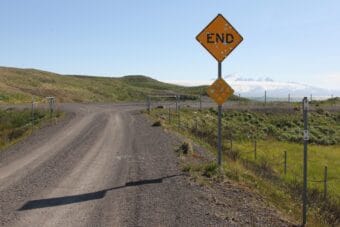
The end of the road leading out of King Cove. June 2024 (Theo Greenly/KSDP)
Department of the Interior Secretary Doug Burgum announced a land exchange agreement Thursday with King Cove’s Native corporation, making way for the controversial construction of what many consider to be a lifesaving stretch of road.

It’s not the first time an agreement like this has been approved for the road, which would connect two eastern Aleutian communities. But according to local leaders, there’s one important difference this time around.
“Having the land exchange agreement already signed, and the ownership of the land now a done deal, that’s never happened before, so that’s big,” said longtime King Cove City Administrator Gary Hennigh in a phone interview Thursday afternoon.
King Cove sits near the western tip of the Alaska Peninsula. It’s a small fishing community that is only accessible by air or water, weather permitting, and its short gravel airstrip is difficult to fly into.
But with the addition of about 11 miles of road, residents could access a neighboring all-weather airport in Cold Bay. King Cove community leaders have fought for that road for decades, arguing that it would provide lifesaving access to emergency medical care.
The problem, though, is that the road would pass through the Izembek National Wildlife Refuge. Environmental groups and several Alaska tribes have said that land shouldn’t be developed in order to protect wildlife.
In 2018, the Trump Administration approved a land swap, which was later revoked by the Biden administration. But Hennigh said this is the first time the land has actually switched hands.
Alaska’s congressional delegation celebrated the agreement at an Alaska Day ceremony Thursday in Washington D.C.
At a press conference after the event, Republican Sen. Lisa Murkowski said the property conveyance, including the patent and the deed to the land, would be recorded Thursday afternoon.
She applauded King Cove’s perseverance.
“They are weary,” Murkowski said. “They are tired of kind of this ‘up and down, and back and forth, and maybe or maybe not.’ They want the certainty that’s going to come with this very small connector road.”
Murkowski said the U.S. Fish and Wildlife Service is swapping 490 acres of federal land for the road. The King Cove Corp. — the local Alaska Native village corporation — will hand over acreage in return.
Some western Alaska tribes have opposed the road, saying it threatens important subsistence species. And federal biologists have acknowledged the road would impact the habitat of Pacific black brant and emperor geese.
Murkowski said she recognizes the significance of those resources and that requirements are in place to ensure the animal populations remain strong.
“Nobody’s talking about a multi-lane paved road, moving lots of big trucks back and forth,” she said. “It is still an 11-mile, one-lane gravel, non-commercial-use road.”
The congressional delegation said in a statement that the swap will ultimately “result in the net expansion of the Izembek refuge, clearly adding to its conservation and subsistence values. Under the agreement, Interior will receive or maintain roughly 14 times more land than it gives up.”
Hennigh said there’s still a lot to be done, with things like permitting, public commentary periods and funding to secure. After years of seeing progress toward a road fall back, he said he’s optimistic but cautious.
“We also are not so naive to think that there won’t be some lawsuits along the way,” he said.
Hennigh hopes to see construction begin by 2027.
The Alaska Desk’s Theo Greenly contributed reporting.
One of Nikolski’s five greenhouse domes in front of St. Nicholas Church in August 2025. (Theo Greenly/KUCB)
The Aleut Community Store is the only shop for the Bering Sea village of St. Paul’s 300 or so residents, so most people just call it “the store.”
You can get everything you need there, from produce and cereal to kitchen appliances and fishing supplies — even a Yamaha four-wheeler.
But in June, the barge that was supposed to bring groceries canceled its trip because of rough weather. Meanwhile the cloud ceiling remained too low for planes to land. When planes can’t land and deliveries don’t make it in, shelves go bare.
“Eggs were shorted, and then milk, too. Stuff like that,” said Ben Bourdukofsky, the store’s manager.
In all, 20,000 pounds of groceries got stuck in Anchorage for over a month. When the planes finally did arrive, a lot of that food had spoiled. The tribal government, which runs the store, estimates it had to throw away about a quarter of it.
The food shortage this summer was uncommon, but it wasn’t unheard of. The Pribilofs are some of the most remote communities in the nation, and freight can be logistically difficult, expensive and unreliable.
St. Paul’s 300 residents went without many major staples in June when travel disruptions led to a food shortage on the island, photographed here in September 2025. (Theo Greenly/KUCB)
In 2020, the Aleutian and Pribilof Islands Association partnered with the U.S. Department of Agriculture to survey community members across the region and assess their local food systems. They found that most residents rely on local stores, but that fresh, healthy options are often limited and expensive.
The survey also found that subsistence is the second most common source of food for families in the region.
In 2022, Gov. Mike Dunleavy created a food security task force to advise lawmakers on how to strengthen local production and distribution — most of what you find on grocery shelves throughout Alaska still comes in from the Lower 48.
The task force’s main recommendation was to establish a state Department of Agriculture, which it said would bolster private agriculture in the state and reduce Alaska’s reliance on imports. Farmers and agricultural groups backed the proposal, but lawmakers rejected it during this year’s legislative session, largely on procedural grounds.
A response to the pandemic
Nikolski is another island village, about 300 miles south of St. Paul. Roughly 20 to 30 people live in the village, which also has a single store. The community otherwise relies largely on subsistence.
Tribal Administrator Tanya Lestenkof says they have experienced situations similar to this summer’s food shortage in St. Paul, notably in 2007.
“Our weather was so bad that we didn’t see a plane for like, four months,” she said.
Nikolski’s subsistence practice revolves around salmon fishing and hunting the roughly 5,000 reindeer that live on the island.
“The only food that I had in the house was the reindeer that I had put up and the salmon, but I had dogs, so the dogs got all the salmon, and I ate all the reindeer. And now I can’t eat reindeer anymore,” Lestenkof said.
The community responded by building a geodesic dome for a community garden.
Lily Stamm is a project coordinator for the tribal government. She says the community ramped up their investment in greenhouses after the pandemic’s supply chain disruptions further exposed the community’s vulnerable food supply.
Lily Stamm is a project coordinator for the Native Village of Nikolski, the community’s tribal government. (Theo Greenly/KUCB)
“We realized we were going to have a much greater need for food security out here,” she said.
Today, they have five greenhouses, housing everything from community gardens to a sauna and a small pool.
Stamm says Nikolski has made food security and food sovereignty a community project.
“In this village, they’ve really prioritized it and started some really neat projects,” she said.
Subsistence is still critical to food security
But not all community investments in food security work out. In the Aleutians and Pribilofs, high winds and poor soil make growing things very difficult.
St. Paul has tried greenhouse projects, too — including a hydroponic grow center the community built on the ground floor underneath the Aleut Community Store. It ran for several years but eventually shut down.
Robert Melovidov, right, serves fur seal at a community cookout on Labor Day 2025. (Theo Greenly/KUCB)
Today, there aren’t any large-scale growing efforts on the island.
The shelves are full in St. Paul’s store now. But Bourdukofsky says this summer’s food shortage wasn’t the first time something like this happened, and it might not be the last. The challenges of isolation and weather aren’t going away
People in St. Paul also rely on fur seals for food. Richard Zacharof has helped organize that subsistence harvest for 40 years. He says they’d be lost without it.
“It puts food in the freezers for the winter months for people to enjoy their subsistence foods that we live on,” he said. “You know, it’s all part of our DNA.”
Fish and Game says survey results show increases in all sex and size groups of snow crab compared to last year. Large males remain at historic lows, but the population is showing signs of stabilization and recovery after the recent collapse. (Laura Kraegel/KUCB)
Bering Sea crabbers will see a boost in catch limits this season, after years of cancellations and small harvests due to low snow and king crab stocks.
The Alaska Department of Fish and Game announced Monday that it’s nearly doubling the harvest for the upcoming Bering Sea snow crab commercial fishing season from last year’s totals.
Fish and Game set the cap at 9.3 million pounds. That’s a low number compared to historic levels. In 1991, crabbers harvested more than 320 million pounds of snow crab.
The catch limit was set at 45 million pounds back in 2020, the year before the snow crab stock crashed. And the next year, the fishery closed for two seasons after more than 10 billion snow crabs disappeared from the region.
Fish and Game now says survey results show increases in all sex and size groups compared to last year. Large males remain at historic lows, but the population is showing signs of stabilization and recovery after the recent collapse.
Officials said a return to colder ocean conditions and increased numbers, especially in juvenile crab, are reasons to be optimistic.
And for the first time, a portion of the harvest will be reserved for a hybrid snow-tanner crab. Those are crabs that share some characteristics of both snow and tanner crabs, like eye color and tooth shape.
Regulators said recent surveys show an “unprecedented” amount of the hybrid crab. To incentivize harvest of them, Fish and Game designated about 11% of the total snow crab catch to the snow-tanner mix. According to officials, the fleet will be encouraged to harvest about a million pounds of the hybrids from the “hybrid grounds.”
Meanwhile, Fish and Game also boosted the Bristol Bay red king crab catch limit by about 16% from last year, with a total harvest of about 2.7 million pounds. Tanner crab harvests more than doubled for the western district of the Bering Sea but dropped by almost 40% for the eastern area.
All of those fisheries open Oct. 15. The lucrative Bristol Bay red king crab has the highest priority harvest, as that fishery closes shortly after the new year. Snow and tanner crab both close in the spring.
PenAir’s Saab 2000 airplane landed in Unalaska almost exactly six years ago, on Thursday, Oct. 17, 2019, overrunning the short runway and sliding into ballast rocks overhanging the harbor. (Courtesy of Megan Dean)
A Washington state jury awarded $16.9 million to the family of a man who died in a 2019 airplane crash on Unalaska’s runway.
After a six-week trial and about three days of deliberation at a Kent, Washington courthouse, jurors found Peninsula Aviation Services, Inc. liable for the death of David Oltman of Washington.
Miller, Weisbrod, Olesky, Attorneys at Law — the Texas-based firm representing Oltman — said the case marks the nation’s first fatal commercial airline crash trial in more than a quarter of a century.
PenAir’s Saab 2000 airplane with about 40 passengers, including 38-year-old Oltman landed in Unalaska almost exactly six years ago, overrunning the short runway and sliding into ballast rocks overhanging the harbor.
Shrapnel from a propeller flew into the cabin, fatally wounding Oltman. Nine others were injured. Oltman was traveling from his home in Wenatchee, Washington to Unalaska and purchased his flights through Alaska Airlines.
After a two-year investigation by the National Transportation Safety Board, investigators found faulty wiring, lax oversight by regulators and inexperienced crew to blame. Specifically, officials said the probable cause of the accident was bad wiring of an antiskid brake system that likely sent the plane over the runway, and happened during a previous overhaul.
According to the report, PenAir’s flight crew knew a significant tailwind was present at the time, and a landing in the opposite direction of the flight crew’s approach that day would have favored the wind pattern.
Now, a jury says the company that provided the overhaul and cross-wired the brakes is partially responsible for the incident, but PenAir is mostly at fault and owes the family for their negligence, according to the firm’s press release.
Close
Update notification options
Subscribe to notifications
Subscribe
Get notifications about news related to the topics you care about. You can unsubscribe anytime.