KUCB is our partner station in Unalaska. KTOO collaborates with partners across the state to cover important news and to share stories with our audiences.
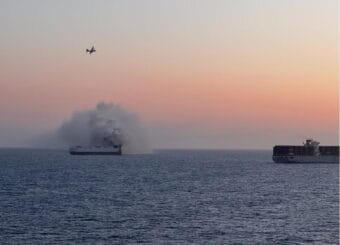
The 600-foot Morning Midas caught fire around June 3 near Adak Island. A United States Coast Guard cutter and aircraft crews responded to the fire, and all of the cargo ship’s crew members were evacuated safely. (Courtesy of U.S. Coast Guard)
A cargo ship that caught fire off the Western Aleutians sank Monday morning amid salvage operations in the North Pacific Ocean.
The 600-foot Morning Midas was carrying thousands of vehicles when it began to burn around June 3, near Adak Island. The fire burned for about two weeks before officials reported it was out.
According to the ship’s manager, Zodiac Maritime, the damaged vessel went down Monday morning after taking on water in heavy weather.
Earlier this month, Zodiac said a tug with long-distance towing capabilities was on its way to the ship, but the company didn’t say when the tug was coming or where they planned to tow it.
The Liberia-flagged ship was on its way to Mexico when the fire broke out. A United States Coast Guard cutter and aircraft crews responded to the fire, and all of the cargo ship’s crew members were evacuated safely.
The vessel was carrying 3,000 vehicles, about 800 of which were either partly or fully electric.
The Morning Midas was 360 nautical miles from shore in international waters when it sank. Zodiac Maritime said in a Tuesday morning statement that Resolve Marine — an international salvage and response company with a facility in Dutch Harbor — has two salvage tugs on location.
Zodiac representatives said because the ship was so far from land, there was no realistic way to save anything on board.
The salvage company will remain on site with pollution control equipment to monitor the situation. Another specialized pollution response vessel is also on the way.
“We remain in close coordination with Resolve Marine and the United States Coast Guard, and we extend our sincere thanks for their professionalism, swift response, and continued collaboration,” Zodiac Maritime said in a Tuesday statement.
Daren Herman, grandson of Alaska flag designer Benny Benson, was in the state for the first time to accept an honorary degree on his late grandfather’s behalf. (Photo by Adelyn Baxter/KTOO)
A special visitor touched down at Ted Stevens Anchorage International Airport on April 24. Daren Herman, grandson of Alaska flag designer Benny Benson, was in the state for the first time to accept an honorary degree on his late grandfather’s behalf. It had been almost a century since Benson’s unlikely win in a flag design contest for Alaska schoolchildren.
Herman descended the airport lobby escalator to a crowd cheering, singing the Alaska Flag Song, waving the iconic blue and gold starred banner, and performing traditional Unangax̂ dances. He knew there would be a reception, but not how big it would be.
Livingston showed Herman around Anchorage, bringing him to local landmarks, including those named after Benson. (Photo courtesy of Mike Livingston)
“I can’t even put words to it. I would have never dreamt anything like this,” he said. “This is just awesome, it’s crazy.”
Herman is from North Dakota, but has deep family roots in Alaska. His grandfather was the boy who overcame unlikely odds and prejudice to become the first and only known Native person to design an American state flag. Benson died in 1972 at age 59, and received an honorary doctorate in humane letters from Alaska Pacific University on April 26.
Mike Livingston, a regional historian whose work centers on overlooked Alaska Native stories in the Aleutians and beyond, served as Herman’s guide. He showed Herman around Anchorage, bringing him to local landmarks, including those named after Benson.
Livingston said Benson receiving an honorary doctorate is “pretty dang cool.”
“He really should have received it when he was still with us, but it’s never too late to correct wrongs,” he said.
Benson grew up in the Jesse Lee Home for Children, a boarding school in Unalaska that later moved to Seward. He experienced firsthand discrimination during the flag design contest when a panel of judges, some of whom were members of the Seward press, wrote offensive things about him based on his ethnicity. This lit a spark in him, and in the 1960s, he successfully advocated for his inclusion in the Kodiak Elks Lodge, opening the door for other Alaska Natives to join the Elks.
Livingston called Benson “a positive role model.”
“He was a brave young man who stayed in the contest and won the contest,” he said. “If it hadn’t been for Benny, we probably would have another boring state flag with a blue background and the state seal in the middle of it.”
At the commencement, around 120 graduates were recognized, including Benson.
Alaska Pacific University President Janelle Vanasse credited his contributions to the state.
“Today, we Alaskans are proud of our flag. Our state song echoes the words that young Benny submitted with his very design,” she said. “We have our flag because of Benny’s resolve.”
The room was packed with family and friends of the graduates, many of whom are Alaska Native. Herman walked onstage and accepted his grandfather’s doctorate to applause.
After the ceremony, Herman said as busy as it was, his first visit to Alaska was “awesome” and a learning experience.
“A lot of this stuff’s new to me, and it’s great to hear the story and be a part of it,” he said.
Peter Pan’s King Cove facility, pictured in June 2024, has been out of operation since January of that year. (Theo Greenly/KUCB)
Representatives from Oregon-based Pacific Seafood could be interested in buying the shuttered Peter Pan processing plant in King Cove, according to local officials from the Alaska Peninsula community.
At Thursday’s Aleutians East Borough Assembly meeting, King Cove Mayor Warren Wilson said that representatives from the seafood company had visited the plant the week before.
“They were very impressed with the plant, and they are moving forward with some talks on acquiring the facility,” he said during the public comment period, speaking as a community member. “So there is interest yet.”
Peter Pan ceased operating in King Cove in January of last year and was placed into a court-ordered receivership a few months later. After a legal dispute, the property was awarded to Peter Pan Chief Executive Rodger May. May has faced criticism over Peter Pan’s business practices, including failing to pay fishermen for the 2023 salmon season.
The plant was a major economic driver for the Alaska Peninsula community of about 800 residents. City Administrator Gary Hennigh said it generated about 70% of the city’s revenue.
“We’re not quite living on borrowed time yet, but we’re getting pretty darn close,” he said in an interview Tues.
Hennigh said he’s encouraged by the interest but cautioned that, even if there should be a deal for the plant, it is too late to restart operations for the upcoming salmon season, which opens early next month.
“Common sense just tells me it’s just not meant to happen for this summer salmon season,” he said.
Pacific Seafood has expanded in recent years. The family-owned company says it operates about 40 facilities across the U.S., Canada and Europe, including a former Trident plant in Kodiak that it acquired last year. The company did not respond to a request for comment.
Processors haven’t announced prices for the upcoming salmon season, but fishermen are expecting a higher payout for sockeye after several years that saw historic lows.
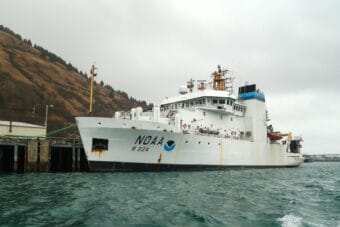
At a Commerce Committee hearing this month, Sen. Dan Sullivan pushed for Deputy Secretary of Commerce nominee Paul Dabbar to make sure a contract was signed so the Oscar Dyson — a research vessel from Kodiak — could perform important fish stock surveys. The Oscar Dyson sits at Kodiak’s Pier 2 on April 15, 2025. (Brian Venua/KMXT)
The U.S. Senate Committee on Commerce, Science and Transportation unanimously passed a seafood bill on April 30 to fight illegal fishing. The legislation would rely on efforts from the National Oceanic and Atmospheric Administration, which Sen. Dan Sullivan said is already struggling to complete key fisheries surveys.
Sullivan co-sponsored the Fighting Foreign Illegal Seafood Harvest, or FISH, Act with seven other senators, including Republican Sen. Lisa Murkowski. Sullivan said he hopes it will help fight unfair trade practices and give a boost to Alaska’s fishing industry.
Sullivan said the act takes aim at foreign illegal, unreported and unregulated, or IUU, fishing.
“It would blacklist foreign vessels and owners that have engaged in IUU fishing — it’s mostly Chinese,” Sullivan said. “And it would provide much more enforcement with regard to our Coast Guard’s ability to increase at-sea inspections.”
Any blacklisted vessels would be prohibited from accessing U.S. ports, traveling through U.S. territorial seas, except in accordance with customary international law, making deliveries in U.S. waters, or receiving services from American vessels.
According to Sullivan, the U.S. Coast Guard would largely be responsible for the enforcement of IUU fishing violations. Still, NOAA would be required to build and maintain the “blacklist” of vessels.
At a separate Commerce Committee hearing the following day, Sullivan pushed for the Deputy Secretary of Commerce nominee Paul Dabbar to give government signoff for key fisheries surveys. He told Dabbar that while the Biden Administration was given increased funding for NOAA, they missed out on the “blocking and tackling” of their job, failing to complete stock assessment surveys.
“You guys came in, ‘Hey, we’re not going to be like Biden,'” Sullivan told Dabbar at the confirmation hearing. “But you’re not — I’m getting really worried that you guys aren’t doing this either. When you don’t do stock assessment surveys, you know what happens? My fishermen can’t fish.”
He pushed Dabbar to make sure a contract was signed with the Oscar Dyson — a research vessel from Kodiak — so that it can head out to perform important fish stock surveys.
“I kind of was kicking him in the rear a little bit,” Sullivan told KUCB after attending the nomination hearing for Dabbar. “His staff was watching. And I’m saying, ‘Go do your job.'”
According to a spokesperson with Sullivan’s office, the Commerce Department approved the contract for the Oscar Dyson to undergo scheduled maintenance. They say it should ensure that future surveys are not delayed.
Sullivan said he told the Trump Administration that NOAA needs the staff and funding to complete those surveying tasks.
“The federal government has two responsibilities: one is to do the surveys and one is to make sure they have the regulatory approvals to open fisheries,” Sullivan said. “That’s not a lot to ask.”
However, it could be with proposed funding cuts to NOAA. And NOAA would play a major role in enacting Sullivan’s FISH Act.
But Sullivan said more funding doesn’t necessarily generate a more productive outcome.
“Even when you give a federal government, in this case, the Biden administration additional funding, that doesn’t mean they’re doing the blocking and tackling of what NOAA is supposed to do — and that is basic fish surveys, species surveys, data surveys — so our fishermen can go fish,” he said.
A large chunk of the Trump Administration’s proposed funding cuts would take aim at climate-dominated research and grant programs. That wouldn’t necessarily affect any stock assessments. However, the National Marine Fisheries Service — also referred to as NOAA Fisheries — is responsible for the management, conservation and protection of marine resources off the U.S. coast. They predict fish stock status, set catch limits and ensure compliance with fisheries regulations. NMFS is facing a possible cut of around 30% to its operational and personnel budget.
Similarly, climate-based research helps scientists and fisheries regulators make educated and sustainable decisions for Alaska’s fisheries.
Sullivan said while the key is to do the surveys, “We need to look at all components of the science, including what climate change has done with regard to our fisheries.”
He said the government has a duty to allow fishermen to fish, under any administration. And at the moment, he is focused on making sure legislation helps fight unfair foreign trade practices, like forced labor and threats to maritime security.
“What I’ve been trying to do is encourage this administration, the last administration, through executive action and through my legislation to go on offense, to protect our fishermen — fishing communities like Unalaska — and enable them to have stronger markets in America, stronger prices, and not to have to compete against fishing fleets that have practices that are unfair,” Sullivan said.
Among Alaska industry partners, though, there is a more pressing concern right now about how tariffs might directly affect things like dock prices. Sullivan didn’t have an answer for how the tariffs might hit the state’s fishing industry. He says the ultimate goal of the Trump Administration’s threat to increase tariffs is to see them reduced.
“They are undertaking trade negotiations to actually — that will hopefully have the end result of not retaliation, but lower tariffs across the board that will actually help our seafood industry,” Sullivan said.
A large amount of the state’s seafood is processed overseas. Sullivan said the majority of that should be protected from any retaliatory tariffs.
“For Alaskan seafood exporters, when they are catching fish and then that’s getting processed overseas, there’s an exclusion of 20% or more of a product from tariffs if 20% of the more that product is domestic and was sent overseas for processing,” he said.
While Sullivan’s Fish Act has been unanimously approved by the Commerce Committee, it will have to be heard on the House and Senate floors before heading to the President’s desk to be signed into law.
A crewmember on the fishing vessel Progress wraps up the 2025 pollock season in Unalaska. (Theo Greenly/KUCB)
The commercial fishing industry relies on the National Oceanic and Atmospheric Administration for everything from marine weather forecasts to fisheries data. But NOAA — which lost hundreds of employees in February when the Trump administration fired probationary staff — is in the administration’s crosshairs again, according to a preliminary budget proposal from the White House Office of Management and Budget.
The budget calls for slashing NOAA’s funding by more than 27% for fiscal year 2026. It also restructures the agency’s fisheries division, shifting key responsibilities to the U.S. Fish and Wildlife Service.
Frank Kelty, a fisheries consultant and former Unalaska mayor, said big changes like these could have major consequences for commercial fishing in Alaska.
“What are we going to do if we don’t have weather information?” he asked. “People are going to go out and get sunk.”
Kelty now serves as an advisor for the city of Unalaska, which operates the nation’s largest fishing port by volume. He said reliable stock assessments and real-time data are critical to managing sustainable harvests.
“We’re going to have a lack of information. And in the fisheries, timely information is critical,” he said.
The North Pacific Fishery Management Council is one of eight groups around the nation that manage federal fisheries and recommend catch limits. Those responsibilities are laid out in the Magnuson-Stevens Act, the bedrock of federal fisheries policy. The groups rely on NOAA data to fulfill their mission.
North Pacific Council Executive Director David Witherell warned that the council would struggle to operate under the proposed cuts.
“Cuts of this magnitude will have significant impacts on fisheries in the North Pacific,” he said.
Federal employees with NOAA’s fisheries division, he said, are responsible for opening and closing fisheries in-season, issuing permits, providing technical analysis, and conducting monitoring programs to ensure harvest limits are not exceeded.
He also warned that reductions in scientific surveys would make stock assessments and ecosystem monitoring less precise.
“Inadequate scientific surveys result in unnecessary reductions in sustainable yields,” he said. “Reduced surveys mean reduced confidence, which leads to lower catch limits.”
Vice Chair Bill Tweit echoed those concerns. He spoke in a personal capacity, as the council is expected to issue an official statement this week.
“The basic cause for concern is twofold. One is just loss of the science,” he said. “The other is the staff resources.”
Tweit and Witherell both said diluting NOAA’s mission would make it harder to attract and retain top-tier scientists, many of whom have already been under fire by the administration.
The council itself has already scaled back, according to Witherell. It has reduced staff, canceled travel and is holding meetings virtually. He warned that no viable private-sector alternatives exist to replace NOAA’s data collection and analysis.
U.S. Sen. Lisa Murkowski called the proposal “more than concerning,” but she emphasized that it was only a proposal and would still need to go through the budget process.
“I think it’s too early to say,” she said in an interview before the ComFish trade show in Kodiak. “Nobody really knows.”
U.S. Sen. Dan Sullivan echoed Murkowski.
“No final funding decisions have been made about NOAA cuts and reorganizing efforts,” Sullivan wrote in an email to Alaska Public Media. The email went on to say that Sullivan was “weighing in with the administration when such decisions would impact Alaska’s economy.”
The Trump administration can still change the numbers in the coming weeks before sending the proposed budget to Congress for review.
Alaska Public Media reporter Liz Ruskin contributed to this report.
The fishing fleet in Sand Point, seen here in June 2024, is among the state’s largest, local fleets. Although Sand Point doesn’t have its own king runs, fishermen intercept salmon that migrate through the region. (Theo Greenly/KUCB)
The Alaska Department of Fish and Game is imposing what it calls “unprecedented” conservation measures to address declines of Gulf of Alaska Chinook salmon — also known as king salmon — which is currently under review for listing under the federal Endangered Species Act.
The department said in a March 18 announcement that it will be restricting western Alaska king salmon fisheries, including in Kodiak, Chignik and Sand Point.
Matt Keyse, an area management biologist at Fish and Game’s Sand Point office, said the measures reflect a broader shift in strategy, and that it is unusual to restrict multiple fisheries based on broad concerns for Chinook salmon across the Gulf of Alaska.
“That is unprecedented,” Keyse said.
Sand Point — off the Alaska Peninsula — is in the middle of the management region known as Area M. Although it doesn’t have its own king runs, fishermen intercept salmon that migrate through the region. In recent years, Area M’s harvest levels have drawn criticism from stakeholders in Western Alaska, who argue the fishery reduces local salmon returns.
Keyse said genetic sampling shows much of the Chinook harvested in the South Peninsula fishery actually come from the Pacific Northwest. He noted the data comes from DNA sampling taken around a decade ago, but said new genetic sampling conducted over the next several salmon seasons will “provide us with a better understanding of the stocks that are harvested within this area.”
He added that the new management approach reflects a broader effort to distribute conservation burdens more evenly across the regions that encounter Gulf of Alaska Chinook.
Recent Chinook-related closures have also taken place elsewhere in the state. Last year, the fleet in the federally-managed Central Gulf pollock fishery, which is mostly based out of Kodiak, voluntarily ended its season when Chinook bycatch reached a specified threshold.
Keyse said the department is looking at ways to try to boost Chinook stocks throughout the gulf, and additional measures could affect other fisheries.
“Everyone that’s catching fish is going to bear a little bit of that burden,” he said.
Starting July 1, for instance, purse seiners on the Alaska Peninsula in the Area M region will have to release Chinook measuring 28 inches or longer. That restriction was in place last year as well. But the department is also imposing a new catch limit of 1,000 salmon during any 36-hour opener in a harvest area on the east side of Popof Island, where Sand Point is located.
The current, planned restrictions apply only to purse seiners and are limited to July, but Keyse said the management plan could evolve based on in-season harvest numbers.
Correction: An earlier version of this story included a quote that incorrectly stated it was unprecedented to manage a fishery based on data from fish not found locally. While such management is not new, the current measures are unprecedented because they restrict several fisheries based on concern for king salmon in the Gulf of Alaska.
Close
Update notification options
Subscribe to notifications
Subscribe
Get notifications about news related to the topics you care about. You can unsubscribe anytime.