KUCB - Unalaska

KUCB is our partner station in Unalaska. KTOO collaborates with partners across the state to cover important news and to share stories with our audiences.
St. Paul is working toward an Indigenous-led conservation plan

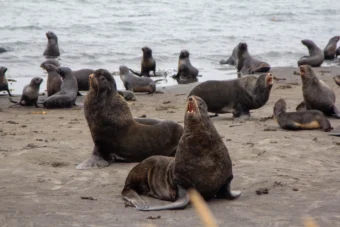
Northern fur seals at a haul-out on St. Paul Island in October, 2024. (Theo Greenly/KUHB)

Everyone around St. Paul knows Zinaida Melovidov as Grandma Zee. She grew up working in the community’s blubbering shop, back when the local economy revolved around the commercial fur seal harvest. Even then, she said, people worried about what would happen if the island’s seals, birds and other marine life disappeared.

“My mom and dad used to talk about this years ago,” she said. “I didn’t understand. Now I know. No more seals, no more food, no more birds.”

St. Paul Island, in the Bering Sea, is home to vast marine ecosystems that have supported the Unangax̂ community for generations. But the island’s most iconic species — the northern fur seal — has been in steep decline for decades.

“They’re all declining,” Melovidov said. “I remember rookeries used to be millions, thousands in every rookery around the island — all full of seals. Now it’s empty.”

With approximately 400 year-round residents, St. Paul bills itself as “the largest Aleut village.” (Theo Greenly/KUHB)

About half of the world’s northern fur seals breed in the Pribilofs. The population fell sharply when Russian fur traders set up an outpost in the Pribilofs in the late 1700s. And numbers kept falling in the twentieth century — the Pribilof Island population dropped by about 50% between the 1950s and 1998, prompting the National Oceanic and Atmospheric Administration to classify them as “depleted” under the Marine Mammal Protection Act.

But a recent push to protect St. Paul’s sea life met with strong resistance, especially from fishing interests. Now, St. Paul’s tribal government is moving forward with a new plan — one that prioritizes local and traditional knowledge in managing the island’s rich marine resources.

A push for a national marine sanctuary

St. Paul Island is 30 miles from the Eastern Bering Sea shelf. The surrounding waters are among the most productive marine environments globally, supporting dense populations of pollock, crab, and other marine species. In 2022, the community’s tribal government — the Aleut Community of St. Paul Island — announced plans to seek a federal designation as a national marine sanctuary to protect those resources. It would have been the first marine sanctuary in Alaska, giving the tribal government a seat at the table with state and federal resource managers.

A blue Arctic fox on the rocks above a St. Paul beach in November, 2024. (Theo Greenly/KUHB)

But the proposal faced significant pushback, prompting the tribe to change its approach. Commercial fishing groups were among the most vocal critics. Regional communities like Unalaska, whose economies rely heavily on fishing, also opposed the sanctuary. Even within St. Paul, some residents worried that the federal designation could jeopardize local fishing practices.

“People think, ‘Oh, federal and state governments would have the power, and they can regulate my fishing,’” said Destiny Bristol Kushin, who works with the tribe’s conservation office. “It’s more of, I call it a fear — a fear because fishing is a big part of our history, and you don’t really want to lose that.”

Tribal leaders repeatedly stated that the sanctuary would not curtail commercial fishing. Under the National Marine Sanctuary Act, fisheries management councils still would have had final authority over fishing regulations. But the assurances weren’t enough to calm critics.

Tribal Council President John Wayne Melovidov said the tribe ultimately decided in October to pause efforts to pursue the federal designation.

“We didn’t want to move forward with something that would be so controversial and potentially tear people apart instead of bring them together,” he said.

The proposed sanctuary will remain on NOAA’s nomination list, though tribal leaders said it is unlikely to go through without community support. NOAA expects to make a final decision within the next five years.

A new approach

Last fall, the tribe began holding listening events to hear from residents about how to protect the island’s ecosystems from threats such as climate change and overfishing. The eventual goal behind that work is designating the waters around St. Paul Island as an Indigenous marine stewardship area.

Kushin said the designation would allow the community to take control of its waters.

“It essentially gives the power to the people in the community,” she said. “And it gives us the opportunity to incorporate traditional knowledge into the decision making within this protected area.”

The tribal government says the stewardship area designation would give it greater authority to protect the region’s vast ecosystems and resources, including rich fishing grounds and habitat for the federally protected northern fur seal. (Theo Greenly/KUHB)

Indigenous marine stewardship areas are less common than government-declared protection areas, but their numbers are growing, following a global trend. California tribes created the first one in the U.S. in 2023. The designation lacks the legal framework and enforcement power of a national marine sanctuary, but it does emphasize local leadership while bringing in less federal and state oversight.

Tribal leaders have not firmed up details like what the boundaries and regulations would be. Melovidov said the tribe is still working with community members to develop a cohesive plan. And he said local participation will be key to its success.

“Nobody else is going to come in and save the day,” he said. “So, we feel the need to take it upon ourselves to do something about the downturn of the ecosystem in our backyard.”

A community’s fight to save Unangam Tunuu on St. Paul Island

Classes like this one are rare. Unangam Tunuu is taught in only a handful of classes in the public school system, and outside these sessions, the language is seldom spoken. The struggle on St. Paul mirrors trends across Alaska. A 2024 report from the Alaska Native Language Preservation and Advisory Council, a legislative council that advises the governor’s office, found that all of the state’s Indigenous languages are critically endangered, with some spoken by fewer than a dozen people. (Theo Greenly/KUCB)

In a classroom on St. Paul Island, Aquilina Lestenkof stands before a group of students, guiding them through an Unangam Tunuu language exercise. Her voice is steady and encouraging as she repeats a phrase, which the children repeat back. Some stumble over the syllables, but Lestenkof smiles.

“We focus on speaking, and it doesn’t matter if you mumble, fumble, fail fast, go ahead. Speak it,” she says. “Because putting it out there into this wonderful Unangax̂ universe is keeping it alive.”

Lestenkof runs the community’s language center on St. Paul, a remote island in the Bering Sea, where educators and elders are fighting to preserve Unangam Tunuu, the traditional language of the Unangax̂ people. Despite their efforts, the language faces a steep decline, with few fluent speakers left and even fewer opportunities to use it outside the classroom.

“We focus on speaking, and it doesn’t matter if you mumble, fumble, fail fast, go ahead. Speak it,” says Lestenkof, right. “Because putting it out there into this wonderful Unangax̂ universe is keeping it alive.” (Theo Greenly/KUCB)

Classes like this one are rare. Unangam Tunuu is taught in only a handful of classes in the public school system, and outside these sessions, the language is seldom spoken. The struggle on St. Paul mirrors trends across Alaska. A 2024 report from the Alaska Native Language Preservation and Advisory Council, a legislative council that advises the governor’s office, found that all of the state’s Indigenous languages are critically endangered, with some spoken by fewer than a dozen people.

Following the fur seal

The challenges facing Unangam Tunuu are rooted in a history of colonization. While Unangax̂ people historically traveled to St. Paul to hunt, they did not live on the remote Pribilof Islands. That changed when Russian settlers forced many Unangax̂ to relocate there as laborers during the fur trade.

The United States continued the practice after purchasing Alaska in 1867, designating the Pribilof Islanders as “wards of the state.” It wasn’t until 1983 that the U.S. government withdrew from the Pribilofs, allowing the community to regain independence.

Today, St. Paul celebrates its freedom with Aleut Independence Day, held each year on Oct. 28. The event brings the community together at the school gym, where residents cook, sing, and honor their heritage.

Zinaida Melovidov, known as Grandma Zee, is one of the few remaining fluent speakers in St. Paul. At this year’s celebration, she prepared “million dollar soup,” a dish made with corned beef that reflects the government’s compensation to the people of St. Paul.

“We call corned beef ‘million dollar’ because that was what the government gave to the people,” she said.

For Melovidov, the celebration is bittersweet. She remembers the injustices her people endured under colonial rule.

“It was sad,” she said. “Oh, I was so angry they treat our people like that.”

The loss of fluent speakers, many of whom are elders, has only deepened her frustration.

“All the people are gone that can speak, have a conversation, talk together. And these little kids, these younger ones, they don’t understand,” she said.

Melovidov says the only person left with whom she can really hold a conversation in Unangam Tunuu is her uncle, Gregory Fratis Sr., the oldest person on St. Paul at 83 years old.

Looking forward, glancing back

The state report emphasizes the importance of intergenerational learning, where elders pass their knowledge to younger generations. Events like Aleut Independence Day are aimed at fostering those connections.

With bellies full of fry bread and million dollar soup, attendees gathered in the gymnasium for closing ceremonies. Lestenkof addressed attendees over the school’s PA system.

“This is what we’re gonna do,” she said. “We’re going to say Malgaqan samtalix, and we’re going to walk a wonderful clockwise circle.”

“Malgaqan Samtalix” is an Unangax̂ song rooted in the idea of accepting the past.

“What has happened before has happened, and we must respect that,” said George Pletnikoff Jr., a young Unangam Tunuu instructor from Saint Paul who teaches alongside Lestenkof.

“We’re all here right now,” he added.

“Malgaqan Samtalix” is an Unangax̂ song rooted in the idea of accepting the past. “What has happened before has happened, and we must respect that,” said George Pletnikoff Jr., a young Unangam Tunuu instructor from Saint Paul. (Theo Greenly/KUCB)

While Alaska has made strides in incorporating Native languages into public education, programs remain limited. Most Indigenous students in Alaska’s public schools still lack access to Native language instruction.

Studies show that integrating cultural elements into language education can boost learners’ motivation and sense of ownership, a goal Lestenkof says is central to events like Aleut Independence Day.

“Something like today’s celebration, it’s strength building, and keeping our techniques and tools, and having the kids understand that it’s all in our hands,” she said.

The community forms a ring around the inside of the gymnasium, placing their hands on the shoulders of the person in front of them. Pletnikoff starts banging a drum, and the attendees chant, “Malgaqan Samtalix.” Everyone chants in unison and walks in a circle.

As Alaska schools close, one Aleutian village bucks the trend

Nikolski School students gather on couches as teacher Lynette Hall and teacher’s aide Tatyana Hillhouse review homework assignments at the end of the school day. (Sofia Stuart-Rasi/KUCB)

Nikolski’s one-room purple schoolhouse sits on the outskirts of the 30-person village, facing a vast, grassy valley. The western Aleutian village stretches along Umnak Island’s Nikolski Bay on the Bering Sea, with Okmok volcano on the horizon. Students come to school each morning by foot, bicycle or ATV — none of their houses are more than a couple of miles away.

One afternoon last September, the school’s 10 students — from kindergarten through 11th grade — sat listening on sofas as teacher Lynette Hall prepared them for the next day’s lessons. She asked them to take out their planners.

“Because you have homework today,” Hall said.

Some grumbled. A few cheered. These days, that’s a typical end-of-day scene. But for about a decade, it wasn’t.

In 2009, the Nikolski school closed its doors because enrollment had dropped below 10 students — the state’s minimum for funding. Many feared that could spell the end of yet another rural Alaska community. When schools close, families often leave.

Mike Hanley is the superintendent of the Aleutian Region School District. He says ensuring there are enough students to keep a school open is always on the radar of small Alaskan districts. Hanley says he focuses on building strong schools for residents to stay or draw family members back to the area.

“The best thing that we can do as a district is to continue to provide a good, positive education and work with families,” Hanley said. “So that the education is not separate from the community, that it’s seamless together.”

Schools closing across the state

Nikolski’s reopening counters a statewide trend. Over the past decade, 51 schools have closed in Alaska while only 32 have opened or reopened, according to the Alaska Department of Education and Early Development.

In 2015, the school in Cold Bay in the eastern Aleutians closed due to low student enrollment. In 2017, the school on St. George Island in the Pribilof closed. And in 2023, low enrollment forced the closure of the school on Adak Island, one of the region’s most remote communities.

Even in Anchorage, administrators are closing schools due to falling student numbers.

As schools close across the state, Hanley says that where families choose to live is changing, too.

“I don’t believe it’s a flaw in the educational model,” Hanley said. “It’s just a change in the way we live today — you know, a change in the world.”

‘Everybody here is involved’

The Nikolski school’s revival came through combined efforts of the Aleutian Region School District and the local tribal organization. It was possible in part because the families with children were still living there. When the school closed in 2009, most chose to homeschool or send their children to schools off-island.
Hall said when the island’s student numbers met state requirements again, parents approached the district about reopening.

“The parents in the community definitely are what brought it to life,” she said.

The tribe converted its community center into the schoolhouse — the village store is now where the old school used to be. They also secured housing for Hall, the teacher, who came from West Virginia.

Hall says the students’ mothers helped her understand her new students’ educational needs, and the community rallied behind the parents’ efforts.

“Everybody here is involved in making sure these students become the best they can be,” Hall said.

Tatyana Hillhouse, who works alongside Hall as a teacher’s aide, moved to Nikolski as a child and has lived on the island intermittently since then. Having seen the village both with and without its school, she says the reopening means more than just the return of formal education.

“I really hope that it stays for quite a while, because it’s nice seeing all the kids be all together,” she said.

The students now work together daily on projects, as Hall and Hillhouse guide them through assignments like exploring Nikolski’s biodiversity. And the school’s future looks promising. As these students graduate, younger ones are already waiting to take their place.

This story is part of CoastAlaska’s “Evolving Education” series. You can find other stories in the series online at kcaw.org.

‘Enough is enough’: King Cove officials hail Biden Administration backing for Izembek road

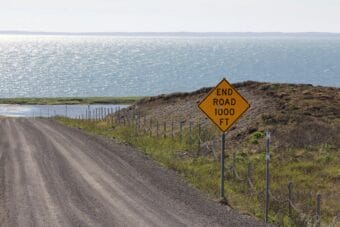
The road out of King Cove ends at the old hovercraft landing on the shore of Cold Bay, about 7 miles from the city of the same name. (Theo Greenly/KUCB)

A gravel road leads out of King Cove, a small fishing town near the tip of the Alaska Peninsula. The road passes a small airport and goes on for another 18 miles before ending at the shore of Cold Bay, a large inlet on the south side of the Alaska Peninsula.

King Cove’s mayor, Warren Wilson, helped build the road about 12 years ago. For now, it ends at a defunct hovercraft landing. You can see the city of Cold Bay from the landing, seven miles across the water.

“It’s just a skip and a hop,” he said. “That’s where we’d connect this last 11 miles of road.”

Those 11 miles are what it would take to connect the communities’ roads to each other. That would make it possible for King Cove residents to reach Cold Bay’s all-weather airport by land. Often, flying out of King Cove is impossible due to the weather.

For decades, King Cove’s roughly 800 residents have called for such a road — a link they say could save lives in emergencies. Neither city has a hospital, so residents rely on medical evacuations to reach Anchorage for urgent medical care.

The Biden administration last week endorsed the proposal, recommending a land exchange with King Cove’s Native corporation so the road can be built. But that road would go through a federally protected wilderness area. While residents argue it’s a matter of life and death, environmental advocates say the road could threaten vital wildlife habitat — and set a dangerous precedent.

Twenty deaths since 1980

draft environmental impact statement, released last week by the U.S. Fish and Wildlife Service and the Department of the Interior, supports a land exchange between the federal government and King Cove’s Native corporation to allow construction of a road through the Izembek National Wildlife Refuge. The administration’s endorsement does not actually approve the exchange, but it sets the stage for President-elect Donald Trump’s administration, which is expected to take up the issue in 2025. Trump supported a similar land swap in 2019 but the 9th U.S. Circuit Court of Appeals vacated the case after the feds pulled out of the agreement.

“We’ve been advocating for this road just to make travel possible,” Wilson said. “We’re stuck now. It’s not good for the community to be unable to travel for medical care, not to mention medevacs. That’s what hurts the most.”

Cold Bay’s all-weather airport, built by the military during World War II, has the fifth-longest runway in the state, capable of instrument landings. Flights there are only grounded about 10 days a year. On average, King Cove’s gravel airstrip is too socked in for flights to land more than 100 days a year.

Since 1980, at least 18 people have died in King Cove while waiting for medical transportation, according to Murkowski’s office.

‘Wilderness areas are all threatened’

Environmental groups have opposed the King Cove road for decades, arguing that a road through the Izembek National Wildlife Refuge would threaten critical habitat including Izembek Lagoon, one of the largest eelgrass beds on earth. It hosts hundreds of thousands of birds, like the Pacific black brant, a species of goose whose entire population relies on the refuge.

Brook Brisson, an attorney with Trustees for Alaska, an Anchorage-based environmental organization that went to court to stop the Trump-legacy land exchange, said the group is already taking steps to oppose the exchange.

“I am literally, today, actively reviewing the draft statement,” Brisson said. “I’m going to be working with our clients and our partners to raise concerns about the protection of those subsistence food resources and about the conservation lands and identifying legal concerns with the program, and we will be submitting comments on the draft statement in the coming month.”

While the group says Izembek is important, their larger concern is the precedent it could set.

“Wilderness areas are all threatened by a land exchange for a road in Izembek” Brisson said. “There is a precedential concern here.”

U.S. Sen. Lisa Murkowski, who has long championed the road, thinks it can be built while still protecting the environment. In a Wednesday statement, she praised Biden’s support for the exchange, saying it was the only way to “truly protect the people of King Cove.”

Brisson recognizes King Cove’s challenges but hopes the community will find another solution to cross the bay.

“We have heard the concerns from the community of King Cove, and we understand them. We support transportation solutions, and we think there are viable marine options that have been studied and funded so that the people in King Cove can get the access to the health care and the emergency services that they need,” Brisson said.

At the hovercraft landing site, a yellow road sign, pocked with bullet holes, says “END.” The hovercraft stopped running in 2013, when King Cove officials concluded that the weather was too rough to operate it consistently.

“It only took a couple years to figure out it wasn’t going to work,” Wilson said.

They’ve tried other solutions, like plane charters and ferries, but Wilson said all of those solutions failed due to high costs and the region’s relentless weather. The municipality, Native corporation, and tribal government are all steadfast that a road is the only viable option.

“We’re stopped from going across a refuge because of an environmentalist crowd that has a lot of money, and they could stop a project like this. But in America, you’re supposed to be able to save lives,” Wilson said. “It’s for the safety and well-being of the public traveling for emergencies and medical travel.”

“Too many deaths have happened trying to transit out of King Cove,” Wilson added. “Enough is enough.”

Despite the opposition, the Biden administration’s decision marks a major step forward for King Cove’s decades-long push. A public comment period for the exchange opened Nov. 15 and lasts until Dec. 30. People who wish to comment on the proposed land exchange can do so on the Fish and Wildlife Service’s website.

Environmental group seeks limits on Alaska trawling

The American Triumph — a 285-foot factory trawler with an onboard processing plant — sits in the Port of Dutch Harbor. (Hope McKenney/KUCB)

The international advocacy organization Oceana is pushing for the North Pacific Fishery Management Council to take action on trawling. The nonprofit released a statement Oct. 7 calling on the council to limit trawling in the Bering Sea and Alaska fisheries, saying it is a threat to sensitive seafloor habitats.

Trawling involves dragging a large fishing net behind a boat to collect fish. It’s big business: the trawl fishery targeting Alaska pollock in the Bering Sea is the largest fishery in the nation. Critics say trawl gear used in the Gulf of Alaska and Bering Sea makes contact with the seafloor, damaging marine ecosystems.

Ben Enticknap, a scientist and campaign director for Oceana, expressed concerns about the practice, saying trawling “risks damaging sensitive habitats.” He called on the council to impose measures to ensure the gear stays off the bottom.

Another hot-button issue in the trawl fishery is bycatch, which is when non-target species like salmon are unintentionally caught and often discarded. Pollock trawlers operating in the Gulf of Alaska recently caught more than their annual bycatch limit of Chinook salmon — over 2,000 fish.

Oceana has also taken legal action, filing a lawsuit against federal fishery managers for “failing to protect Alaska’s seafloor habitats.” The lawsuit argues that fishery management plans in the region have not fully considered the best available science or implemented adequate conservation measures.

Fishing groups and coastal communities have pushed back against many criticisms of the trawl fishery. Industry representatives argue that calls for tighter restrictions are unnecessary and could place undue burdens on the fishing sector. The Groundfish Forum, a trade group representing 17 catcher-processor vessels, says the criticisms are often based on misperceptions.

Stephanie Madsen, executive director of the At-Sea Processors Association, warns that recent legislative proposals aimed at curbing trawling would introduce “unworkable and burdensome new federal mandates.”

The North Pacific Fishery Management Council will take up the bycatch issue at its February 2025 meeting in Anchorage.

Judge approves former Peter Pan Seafoods co-owner’s bid for company assets

King Cove in August 2023. (Theo Greenly/KUCB)

A Washington state judge approved a deal on Thursday giving the assets of Peter Pan Seafoods to the company’s former co-owner Rodger May, a decision that follows months of controversy over the seafood processing company, which ceased operations this year.

May placed the winning bid for the company’s assets at auction last month, but the sale wasn’t approved until Thursday’s hearing, when King County Judge Steven Olsen signed the motion to approve the $37.3 million sale, which includes processing plants in Dillingham, King Cove and Port Moller.

“I really haven’t heard anybody say that the receiver failed to comply with that order approving the sale,” Olsen said.

Peter Pan Seafood Company was placed into a court-ordered receivership back in April at the request of Wells Fargo, which pointed to more than $60 million in debt owed by the Alaskan processing company. A receivership is a process similar to bankruptcy, but intended to protect a company’s lender. Both Wells Fargo and the court-appointed receiver, the Los Angeles-based Stapleton Group, supported the deal proposed by May.

However, more than 90 Alaska fishermen in August signed a letter that opposed selling Peter Pan’s assets back to May, saying that May had broken the fishing community’s trust by not paying fishermen.

“Mr. Rodger May and co-owners have done irreparable harm to the many people and their families that make their living from the commercial fisheries on the Alaska Peninsula,” they wrote. “There are still many fishermen that have not been paid for fish they delivered as well as vendors and tenders not being paid for goods and services provided.”

It’s unclear how the sale will affect King Cove, which relied on the processing facility as its main economic driver until it closed in January.

May acquired Peter Pan back in 2020 with the backing of California-based RRG Capital Management and McKinley Capital Management, which used funds from the Alaska Permanent Fund Corporation’s in-state investment program.

May attended the meeting on Zoom but did not speak during the hearing. May also did not respond to a request for comment from KUCB.

Site notifications
Update notification options
Subscribe to notifications