KUCB is our partner station in Unalaska. KTOO collaborates with partners across the state to cover important news and to share stories with our audiences.
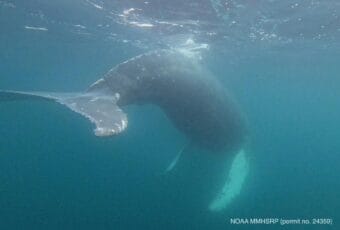
The entangled whale was first reported on Monday evening in Iliuliuk Bay. (Sofia Stuart-Rasi/KUCB)
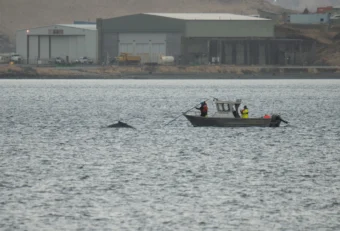
A humpback whale is now free in Unalaska after being tied up for at least four days. The entangled whale was first reported on Monday evening in Iliuliuk Bay.
Officials from the National Oceanic and Atmospheric Administration and the Alaska Department of Fish and Game were able to free the whale Friday morning. The team included Ed Lyman, a large whale entanglement response coordinator from Hawaii, and Sadie Wright, a biologist from Juneau. They both flew into Dutch Harbor Thursday morning and worked on detangling the whale until late Thursday afternoon. They resumed work the following morning at sunrise and freed the whale around 10 a.m. The whale swam out of the bay and into the Bering Sea.
Julie Fair, a spokesperson for NOAA, said additional information about the rescue will be provided later.
During the entanglement process, U.S. Coast Guard personnel were present on a nearby boat, and officials used a drone during the operation.
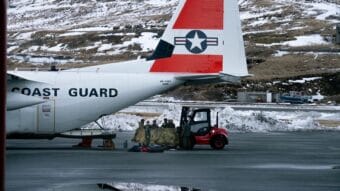
Military personnel at the Tom Madsen Airport in Unalaska load what appears to be a balloon onto a U.S. Coast Guard C-130 transport on March 2, 2024. (Sofia Stuart-Rasi/KUCB)
Commercial fishermen off the coast of Alaska found what the U.S. Department of Defense is calling a “large balloon with payload” and delivered it to the U.S. Coast Guard in Dutch Harbor.
Officials haven’t confirmed when the balloon was found but reporters with KUCB saw a bundle of parachute-like material being loaded onto a Coast Guard C-130 airplane on Saturday. The balloon was sent to Joint Base Elmendorf-Richardson in Anchorage for further investigation.
In a statement, U.S. Sen. Lisa Murkowski referred to the balloon as an “item of national interest.”
The incident comes about a year after a large balloon, which U.S. officials said was launched from China for intelligence-gathering purposes, passed over Alaska and Montana before being shot down by an Air Force fighter jet off South Carolina. That discovery prompted heightened concerns about air-defense tracking of unidentified balloons and several shootdowns of similar objects.
According to the Department of Defense, the latest balloon was caught in the nets of an unnamed American fishing vessel. The Coast Guard asked the fishermen to store the materiel on board until docking in Dutch Harbor.
Multiple agencies will analyze the object to learn more about its origin and purpose.
“We do not know why the balloon was in the waters off the coast of Alaska nor are we going to characterize it at this time,” wrote Department of Defense spokesperson Sue Gough in an email.
The FBI and Alaska National Guard were also involved in the recovery.
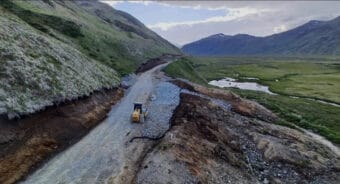
The Makushin Geothermal Project began building a corridor to the site of the proposed power plant in 2021. (Courtesy Of Ounalashka Corp./Chena Power LLC)
The City of Unalaska is pulling out of the Makushin geothermal project after the city council on Tuesday rejected new terms requested by the company building the project. The project’s goal was to harness energy from an active volcano to power the community, which has relied on diesel since World War II.
It was the fourth time that the joint venture between the Ounalashka Corp. and Chena Power, called OCCP, asked to amend its terms for the roughly $200 million project. This time they wanted to raise the rate they would charge the city for electricity.
City Manager Bil Homka said in a memo last week that he encouraged city council not to agree to the rate hike and to let the power purchase agreement expire.
While council members all voiced general support for the project, the consensus was that they had lost confidence that the project would be completed on a reasonable timeline.
“I’ve been in full support of this and I want to see this thing go through, but at the same time, we’ve done more than enough,” said Councilmember Alejandro “Bong” Tungul. “We’ve done three resolution amendments to extend it, and I still don’t see anything that will get it moved forward.”
Representatives of the project pushed back against some of the claims made in the council packet, including that the project would be unable to secure funding.
“We acknowledge the frustration that all parties have and are experiencing due to the project delivery timelines,” said Program Manager Dave Mathhews in a memo to city council. “OCCP does have financing and is proceeding with project development.”
Local resident Travis Swangel was among several community members who spoke out in favor of the geothermal project. He called the project “one of the most important and pivotal projects in the community’s history” and urged the city to be patient.
Councilmember Shari Coleman made a request to the city to allow a six-month extension for the geothermal project to find funding, but she was unable to find support and the motion was denied, effectively ending the city’s participation in the project.
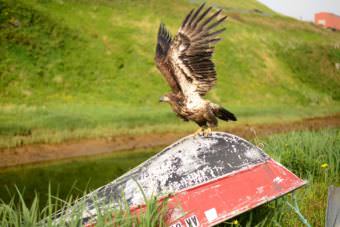
A bald eagle takes off near Unalaska Bay. (Berett Wilber/KUCB)
A viral TikTok video posted on Jan. 20 brought Unalaska eagles to screens across the world. It was produced by Eryn Whittern, who moved to Unalaska in April of last year.
“When my husband first told me about it, I was like, ‘Unalaska? What are you talking about?’” Whittern said. “That’s pretty much what everyone’s reaction is on TikTok, too, because it sounds so weird.”
“Weird” is one way of putting it. Unalaska is an industrial town on an island wedged between the Pacific Ocean and the Bering Sea. It runs on diesel power and the might of the fishing industry. When it isn’t being pummeled by wind and rain, its natural beauty is nothing short of breathtaking. In the summer, wildflowers dot the island’s emerald-green hills and, during migratory months, whales breach in the safety of its bays.
It’s only fair that influencers might want to plant their flags here and make adventure content. But Whittern’s online presence is decidedly modest. She posts videos from her hikes and usually doesn’t “break the internet,” so to speak. That changed when she uploaded something originally meant for friends and family.
Last month, Whittern posted a TikTok video that has since racked up millions of views. It’s not of a dazzling vista or of wildlife running free in the Aleutian tundra. It takes place at the Unalaska City Landfill — and readers should know that it does contain some astonished profanity.
“I was going to the dump with my trash, and there were a ton of eagles there,” Whittern said. “There’s always a bunch, but there was an exceptional amount that day.”
The video opens with a dirty bald eagle, milling around by itself. Then Whittern pans to another eagle. And another. One flaps across the shot and a new tableau is revealed: the interior of the landfill baler building, with a whole flock of eagles perched atop a trash pile. Whittern pans to a walkway near the ceiling, its railing lined with over a dozen birds.
Comments poured in from all over the world. Many viewers had no idea Unalaska existed until they saw Whittern’s post. One skeptic, however, didn’t think the video was filmed in Alaska at all.
“A person commented that I’m not really from Alaska,” Whittern said. “I’m just faking it to get clout. The reasoning was that in the video, we didn’t have any snow.”
As for future posts, Whittern’s plans remain unclear. She said some of the comments she got on the viral video made her apprehensive to post again. But there are still things she wants to capture that would be hard to find anywhere else.
“Now I have all these followers and I’m like, ‘Should I post something?’,” Whittern said. “Even when I was driving here, there were a couple of eagles sitting on the light posts, and they had their wings out — they’re drying their wings. I was like, ‘I bet you people haven’t seen that before.’”
Regardless of what Whittern does next, one thing is certain: there will be no shortage of Unalaska oddities waiting for their moment in the spotlight.
The last surviving person from Attu, Gregory Golodoff, passed away earlier this month at the age of 84. (Lisa Hupp/U.S. Fish And Wildlife Service)
Gregory Golodoff was sitting in a sod house when the soldiers arrived.
“We had heard machine-gun fire from this side, this side, you know. I forgot who it was told us they’re coming from this side, they’re coming from that,” Golodoff said in a 2018 interview — 75 years after the Battle of Attu.
The Japanese Imperial Army invaded the Unangax̂ village in 1942, where the three-year-old Golodoff lived with his family.
Golodoff was the last surviving person who was born and lived in Attu, the last island in the Aleutian Chain before reaching Russia.
His death on Nov. 17 marks the end of an era when there were still people alive who had lived in the now-lost village.
The Japanese army occupied the island for three months before taking all 42 Attu residents to Japan as prisoners of war.
The building in Otaru, Japan, where Golodoff and his family were first taken upon arriving in Japan, seen in 2017. (Rachel Mason/National Park Service)
Golodoff’s entire family was imprisoned in a dormitory in the port city of Otaru, about 500 miles north of Tokyo. The next three years were full of disease and malnourishment, straddling the brink of starvation.
“We would just get a bowl of rice a day or sometimes a salted herring,” Golodoff said.
He remembered the cooks taking pity on him and treating him like “a pet.”
The Oct. 3, 1945 issue of the Daily Alaska Empire newspaper reports that the surviving Attuan POWs have been released. (The Daily Alaska Empire)
“I was a cute little guy, I guess, because a Japanese cook scraped burned rice from the pot and would bring it to me,” he recalled.
People who knew Golodoff throughout his life have remarked at how little resentment he felt toward his captors. That empathy shows even in those early memories.
“Well, gosh, we were hungry, but so were the Japanese,” he said. “The Japanese were starving, too.”
Trying to forget
Only half of the Attuan POWs survived the experience. Golodoff lived through it, as did his mother, older brother, Nick, and his sister, Elizabeth. But many of their family members didn’t make it, including Golodoff’s father, who died of disease in Japan.
“We cremated all of them,” Golodoff said. “All the people that died in Japan.”
Those who did survive were released when the war ended, but couldn’t return home. Many homes had been destroyed, and the United States government judged it too difficult to relocate the freed POWs back to Attu.
Instead, the village was abandoned and the survivors moved to other communities. Golodoff and his family settled in Atka, an Unangax̂ village about 500 miles east of Attu.
Those who died in Japan were also brought to Atka to be laid to rest.
“They brought ‘em all back in three coffins,” Golodoff said. “All the ashes in three coffins and buried by the church in Atka.”
Golodoff spent most of his life in Atka. He practiced subsistence, hunted, fished and said he stayed too busy to think much about the war.
“I didn’t have time to wonder about anything, because most of the time we had to hunt for food, you know, go out and fish and stuff like that,” he said.
He joined the Army, was stationed in Germany, and then moved back to Atka. He ran the village store, and became the tribal president in the 1980s when Atka saw significant growth, including the construction of a new school and a subdivision about a mile from the old village.
In all those years after the war, Golodoff said the survivors didn’t want to talk about what happened. He didn’t even speak about it with his mother.
“She never told me anything. They don’t want to talk about anything like that. They’d rather forget it,” he said.
But a new generation of Attuan descendants are talking about it. Crystal Dushkin grew up in Atka, but her great-grandmother was from Attu.
“A lot of people refer to the Aleutian Campaign as the ‘Forgotten War,’” Dushkin said in a 2017 interview with KUCB. “But our people have never forgotten it. It’s never lapsed from our memory.”
Dushkin is one of the many people who work tirelessly to preserve Unangax̂ culture and the memory of Attu.
“That’s what I wish for the younger generation, as well,” she said. “To always hold on to what our ancestors taught us. To always remember them, and to make sure that they teach it to their children and grandchildren so that it’s never forgotten.”
Gregory Golodoff and his sister, Elizabeth Golodoff Kudrin, on Atka Island, sometime between 1946-1947. (Courtesy National Park Service, University Of Washington Press and Ethel Ross Oliver)
Then and now
People often compare the Aleutian Campaign to the attack on Pearl Harbor, but Pearl Harbor was an attack from the sky. The Battle of Attu, and a similar one on the Aleutian Island of Kiska, mark the only times the Japanese actually invaded the United States. The Aleutian Campaign was the first time foreign forces occupied American soil since the War of 1812.
In 2012, the National Parks Service held a meeting for all the Attuan descendants and survivors. Golodoff wanted to meet other descendants, but he also wanted to connect with other surviving POWs.
“I was going to see my peers,” he said. “Then I went there, I was disappointed. Nobody survived except us.”
There were only three survivors left. Greg, his brother Nick, and his sister Elizabeth Kudrin.
“I guess we just lived the longest. That’s all,” he said.
Nick Golodoff passed away two years after the reunion, leaving just Gregory and Elizabeth.
Gregory Golodoff passed away in Anchorage on Nov. 17 at the age of 84.
Golodoff was the very last person on Earth who was born and lived in Attu, a village lost to war — the last American citizen whose home was occupied by a foreign force. (Chrissy Roes/Aleutian Pribilof Islands Association, Inc.)
Ten days later, dozens of people came to St. Innocent Cathedral in Anchorage to pay their respects.
Moses Dirks is an Unangax̂ scholar and a friend of Golodoff from Atka. He said as a child, he looked up to Golodoff, who was a good role model in the community.
“He was always helpful, and he was always willing to help the people there in Atka for many years,” Dirks said.
Golodoff’s niece, Joanna Thompson, said she admired how her uncle would never show anger or resentment for what happened to him.
“Uncle Greg just turned it into something else,” she said. “He could have been one of the other children that passed. So he was lucky to be alive, and he just found joy in every day.”
Dimitri Philemonof, the CEO of the Aleutian Pribilof Islands Association, described Golodoff as a quiet and humble man.
Gregory Golodoff passed away in Anchorage on Nov. 17 at the age of 84. Ten days later, dozens of people came to St. Innocent Cathedral in Anchorage to pay their respects. (Courtesy Isabella Iparraguirre)
“Throughout his life, he has been a great leader,” he said. “I never saw him hate or anything of that sort. I think that says a lot for the Aleut people.”
Golodoff was the very last person on Earth who was born and lived in Attu, a village lost to war — the last American citizen whose home was occupied by a foreign force. But to Golodoff, those were just the facts of his life.
“It’s just something that happened. Things will happen. We’re all going to experience something,” he said. “We’re not really here. From dust we came, to the dust our bodies will return. So we don’t die, as far as I’m concerned. We don’t die. We might depart from our bodies, but that’s about it.”
Golodoff was buried at Anchorage Memorial Park Cemetery on Nov. 27.
The old village of Attu was in Chichagof Harbor. (Zoë Sobel/KUCB)
The last surviving person from Attu, Gregory Golodoff, passed away earlier this month at the age of 84.
Golodoff was a young child in 1942 when the Japanese Imperial Army invaded his village in the western Aleutians. The Battle of Attu was the last major action of the Aleutian Islands campaign of World War II.
All 42 Attuans living in the village were taken to Japan as prisoners, including Golodoff. Only about half of them survived the experience.
Attu was abandoned after the war, and most of the returning Attuans settled in Atka, about 500 miles from their home.
Gregory Golodoff and his sister, Elizabeth Golodoff Kudrin , photographed on Atka Island, sometime between 1946-1947. (Courtesy Of National Park Service, University Of Washington Press and Ethel Ross Oliver)
Golodoff spent most of his life in Atka. He was the tribal president in the 1980s when Atka saw significant growth, including the building of a new subdivision and a new school.
His sister, Elizabeth Kudrin, passed away earlier this year. They were the last two living people who were born and lived in Attu.
Gregory Golodoff was living in Anchorage with his wife when he passed away on Nov. 17. His funeral service will take place at St. Innocent Russian Orthodox Cathedral in Anchorage on Monday, Nov. 27.
Close
Update notification options
Subscribe to notifications
Subscribe
Get notifications about news related to the topics you care about. You can unsubscribe anytime.