KUCB - Unalaska

KUCB is our partner station in Unalaska. KTOO collaborates with partners across the state to cover important news and to share stories with our audiences.
Warming seas helped cause Alaska’s snow crab crash, scientists say

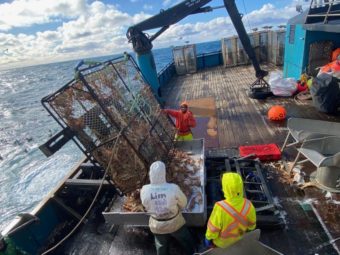
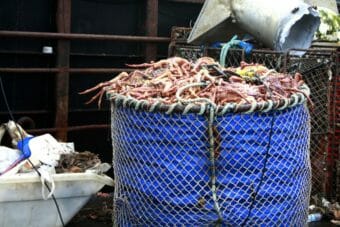
Three men emptying a crab pot on a fishing boat
Crew from the Silver Spray empty snow crab pots while fishing in the Bering Sea. (Courtesy of Bill Prout)

When scientists estimated that more than 10 billion snow crab had disappeared from the Eastern Bering Sea between 2018 and 2021, industry stakeholders and fisheries scientists had several ideas about where they’d gone.

Some thought bycatch, disease, cannibalism, or crab fishing, while others believed it could be predation from other sea animals like Pacific cod.

But now, scientists say they’ve distinguished the most likely cause for the disappearance. The culprit is a marine heatwave between 2018 and 2019, according to a new study authored by a group of scientists with the National Oceanic and Atmospheric Administration.

Mike Litzow is a co-author of the study and the director for NOAA’s Kodiak lab. He said starvation mediated by increased temperatures caused the collapse.

“Really the crab were not able to get the food they needed,” Litzow said. “They were just outstripping the resources that were available to them.” 

According to Litzow and his fellow researchers, the crab faced a number of compounding factors: First, higher temperatures meant increased metabolism so they needed more food; on top of that, there was less space for the crab to forage that food; and finally, the crab were just smaller than usual.

Researchers took data from the many possible hypotheses for the disappearance and they examined it alongside the data they have on the collapse. They examined possible mortality from a range of sources, including directed fishing from the snow crab industry as well as bitter crab syndrome — a fatal disease among crustaceans caused by parasites — and trawl bycatch.

The take-home message is really that none of those other proposed mechanisms explains the collapse with the data we have,” Litzow said.

He said it’s tough to know what the collapse from increased ocean temperatures could mean for other species, but it’s safe to say we’ll probably see more marine heatwaves like this, and they’re likely to be bigger and more frequent, as the world continues warming.

As we’re seeing these big surprising collapses, there is a general awareness that we have to build: we’re going to see more of those,” he said. “We need systems that can be resilient to those really outsized, surprising events.”

More carbon dioxide in the atmosphere means warmer temperatures, Litzow said, which is bad news for the cold-loving snow crab. And more greenhouse gasses also mean more acidic oceans, which can also be dangerous for some crab.

Carbon dioxide that we release through fossil fuels is also taken up by the oceans and has the effect of reducing the pH of the ocean — it makes it more acidic,” Litzow explained. “Because crab use calcium carbonate in their exoskeleton, they’re vulnerable to that acidification because calcium carbonate dissolves more and more easily as pH goes down.”

The good news — at least for snow crab — is they’re not as sensitive to ocean acidification as other species.

“In our lab in Kodiak, we’ve run a bunch of different studies over the years looking at different crab species in different ages — life history stages — in terms of how vulnerable they are to acidification,” he said. “And the good news is it looks like snow crab are one of the more resilient species — like we don’t see a strong effect for snow crab the way we do for red king crab or the way we do for Tanner crab.”

Alaska’s snow crab fishery has been closed since 2022, when regulators declared the population overfished.
The snow crab crash in combination with a two-year closure of Bristol Bay red king crab was a devastating blow to Alaska’s lucrative crab fishery, and it left some harvesters and coastal communities, such as St. Paul Island, looking for other sources of income.

Late last year, the Secretary of Commerce announced a disaster declaration for both fisheries to assist communities affected by the closures. That funding has historically taken years to reach fishermen and communities. Some Bering Sea harvesters are still waiting on disaster relief from 2019 requests.

While the bigger picture is still pretty grim — crab have been declining in Alaska since about the early 80s — Litzow said there’s still lots of cold water in Alaska’s seas and with it, hope for the spindly crustaceans.

“Snow crab have bounced all over the place,” he said. “Historically, there have been ups and downs — there have been previous overfished declarations. And we’re certainly hopeful as we see small crab showing up in the survey in 2022 and 2023.”

But, Litzow said, the rebound could take some time.

“If conditions stay reasonable for the next, say, four years, we should expect this crab to grow up to the size where they can start to support the fishery,” he said.

The snow crab crash really blindsided Alaska’s industry, and more similar surprises are likely on their way, according to Litzow. He said the more dependent a community or fishermen are on a single fishery, the more vulnerable they will be.

While diversification may be one of the most productive solutions to these kinds of startling crashes, Litzow said it’s also likely one of the most challenging.

“We have this management system where everyone has access — it’s allocated in a certain way, or everyone has gear, vessels that’s really specialized for just this particular kind of fishery,” he said. “And then when those surprises and those disruptions come along, it’s hard in practice for people to have a backup.”

Like other research, Litzow said this study isn’t the final answer, but he said it is an important step.

“It really does a great job of framing out our expectations,” he said. “We should not expect that the crab were just gone somewhere else, down on the Slope, or up in Russia, or anything like that. I think this study really makes it clear that they died, and gives us our best explanation for why that happened.”

Military responds after hunter finds large artillery shell in Izembek National Wildlife Refuge

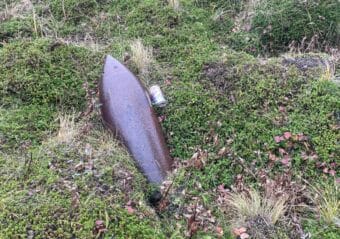
The shell was approximately 12 inches in diameter and four feet long (soda can for reference). Powell said that particular type of round was first manufactured in 1943, during WWII but could have been built anytime up to the 1990s. (Courtesy Of Harold “Hap” Kremer)

A group of explosives experts from Joint Base Elmendorf–Richardson traveled to Cold Bay, near the western end of the Alaska Peninsula, on Oct. 30 in response to a local hunter’s report of what appeared to be a large unexploded artillery shell. The ordnance was found in the middle of the federally protected Izembek National Wildlife Refuge, a key habitat for many migratory birds and other wildlife.

U.S. Air Force Staff Sgt. Tyrone Powell, the explosives ordnance disposal team leader for the mission, confirmed the hunter did find an unexploded military round.

“It’s big artillery,” Powell said. “When we pulled it out of the ground, it weighed probably six or 700 pounds. It took four of us to pull it out.”

The shell was about 12 inches in diameter and four feet long. Powell said that particular type of round was first manufactured in 1943, during WWII but could have been built anytime up to the 1990s.
“What was interesting about the round, it was actually split open, so there was no more explosive on the inside. It had to have been underneath the ground for a pretty long time for that to happen,” Powell said.

Courtesy Of Harold “Hap” Kremer

Photographs of the munition show that the surrounding area has several large divots in the tundra, which point to former military operations — the U.S. military built a base in the area during the 1940s.

“It looks like it used to be a demolition area for old ordnance,” Powell said. “What we think it was, was one of these old pieces of ordnance … got kicked out of where it was getting blown up. Those sorts of things get buried in the soil, and eventually, they work their way to the surface.”

The military team used explosives to dispose of the munition where it was found — in the middle of the 315,000 acre refuge, which contains one of the world’s largest eelgrass beds.

Noise pollution can have a negative effect on wildlife. But representatives from the refuge said they monitored the birds on nearby lakes before the detonation and that they were still there afterward with little reaction.

Izembek is a crucial habitat for a quarter million migratory birds. That includes the Pacific black brant, a rare type of goose whose entire population stops in the refuge at exactly this time of year during its fall migration.

The refuge said the detonation occurred away from the majority of migrating waterfowl and was not near the eelgrass beds where the brants feed.

Conservation group plans to sue federal government over deaths of orcas in trawl nets

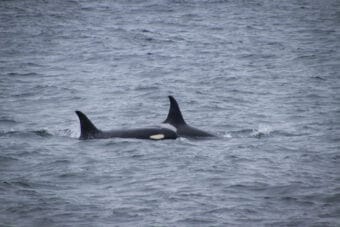
Orcas spotted in the Bering Sea in August 2023. (Courtesy Dustin Unignax̂ Newman)

The Center for Biological Diversity is preparing to sue the federal government for allegedly failing to protect killer whales from trawlers in the Bering Sea.

The trawl fleet in the Bering Sea and Aleutian Islands has come under fire in recent weeks. The backlash follows a report from the National Oceanic and Atmospheric Administration that said 10 orcas were hauled up in trawl nets over the last year, nine of which died.
The conservation group said in a Monday statement that NOAA Fisheries must uphold its duty to protect the killer whales, which are protected by the Marine Mammal Protection Act.

The national conservation group said the trawlers are catching lots of non-targeted species, or bycatch, in defiance of conservation laws.

It’s not a new issue for orcas to get caught up in fishing gear, but the recent numbers are a jump up from previous years. The trawl fishery association Groundfish Forum said their boats have reported a recent uptick in orca encounters. Climate change may play a role in the increased sightings, as many ocean species adapt to new conditions.

The conservation group announced they would file a lawsuit if NOAA Fisheries did not adequately address the allegations within 60 days.

Lucrative Bristol Bay red king crab fishery to reopen after 2-year closure

Red king crab from the Bristol Bay fishery. (KUCB file photo)

The Alaska Department of Fish and Game has reopened the Bristol Bay red king crab fishery, following a two-year closure.

The department announced Friday morning that the lucrative crab fishery will open Oct. 15, following analysis of survey data by the North Pacific Fishery Management Council.

The fishery closed in 2021 for the first time in more than 25 years due to low abundance. But this season, fishermen will have a total of more than 2.1 million pounds to catch — that includes both Individual Fishing Quota and Community Development Quota. In 2020, the total allowable catch was nearly 2.7 million pounds.

According to fisheries officials, summer trawl survey data shows higher numbers of mature females within the population. And while male and female crab are still at historic lows, the fishery is not at or approaching an “overfished” status.

Fish and Game said that the total estimated amounts of both mature and reproductive females are above thresholds required to open the fishery.

Red kings are the largest commercially harvested crab and are mainly caught in Bristol Bay. According to the National Oceanic and Atmospheric Administration, the Bristol Bay stock is considered the second largest king crab population in the world.

Fish and Game also announced Friday morning that the Bering Sea snow crab fishery will remain closed for a second year. Snow crab — or opilio crab — was declared “overfished” in 2021, and regulators closed the fishery the next year, not long after state surveys showed record highs for snow crab recruitment. The drastic drop came as a surprise to many in the industry. Some theories suggest climate change is to blame.

There will be a western and eastern Bering Sea tanner crab season this year. That will also open on Oct. 15. The state has allotted a total of more than 1.3 million pounds to the western district of tanner crab — or bairdi — and 760,000 pounds to the eastern. The western allotment is up more than 50% from last year’s total allowable catch, while eastern tanner TAC has dropped nearly 35% from last year.

The Bristol Bay red king crab fishery opens Oct. 15 at noon and closes Jan. 15.

Researchers say Unangax̂ knowledge can help solve the mystery of Unalaska’s ancient bear bones

Lilly Parker and Kaylee Tatum at the Museum of the Aleutians helping sort fish, mammal, and bird remains from an archeological midden site in Unalaska. (Photo courtesy of Lilly Parker)

Archaeologists found brown and polar bear bones – some over 5,000 years old – at two dig sites on Unalaska and Amaknak Islands in the Aleutians during the early 2000s. Since then, the bones have puzzled scientists. There are no bears on either island today and no historical records of bears ever living there.

Lilly Parker and Kaylee Tatum, researchers from the University of Oklahoma, spent two weeks in Unalaska this summer. They shared their research findings with the community and asked for any information about bears that was passed down through generations. Tatum said Unangax̂ knowledge could help explain how the bones got there.

“Anything is helpful,” Tatum said. “Whether it’s a story that you heard around the campfire as a kid and you barely remember it … I still care. I still want to hear that.”

Kaylee Tatum at the University of Fairbanks Museum of the North, where her and Lilly Parker took photographs of brown bear and polar bear mandibles. (Photo courtesy of Lilly Parker)

According to carbon dating, the polar bear bones are about 5,500 years old and the brown bear bones are about 3,000 to 5,500 years old.

Parker said the bones were found at two different midden sites, which are historical dump sites used by Unangax̂ people thousands of years ago.

“They were just kind of in a jumble, in a mix of other remains,” Parker said. “There were around 23,000 animal bones found at the sites.”

Parker and Tatum spoke to many Unangax̂ elders about the mystery of the bear bones during their two-week stay in Unalaska.

While the elders were largely unsure of how the bones got there, one story suggested that people thousands of years ago may have transported bear meat by sea from the neighboring island of Unimak, which has a population of bears. Oral tradition has been passed down that says locals may have eaten bear when other food was scarce, such as during a particularly long and cold winter.

Parker and Tatum are planning to return to Unalaska next year to present follow-up scientific data. They will look for genetic clues, including a link between the bear bones found on Unalaska and Amaknak Islands and the bears on Unimak.

If they find a connection, it could solve the mystery of how the bear bones ended up on islands where bears were not previously known to live.

EPA fines largest at-sea Alaska pollock processor nearly $1M for Clean Water Act violations

An American Seafoods Company vessel in the Port of Dutch Harbor in June 2020. (Hope McKenney/KUCB)

The U.S. Environmental Protection Agency has fined one of Alaska’s biggest fishing companies nearly $1 million for Clean Water Act violations.

American Seafoods Company is the world’s largest at-sea processor of Alaska pollock and holds the largest allocation of wild Pacific hake. The company operates a fleet of seven vessels in the North Pacific Ocean and Bering Sea.

The EPA cited the company and the owners of its vessels for hundreds of violations along the Oregon and Washington coasts, including discharging waste in a protected area, failure to monitor discharges and reporting inaccurate information in required annual reports, according to a Thursday statement.

“Discharge of seafood processing waste in prohibited areas and within the 100-meter depth contour of Washington and Oregon exacerbates already existing low-oxygen conditions which negatively impact most fishes, crabs and other marine life,” the EPA said.

An American Seafoods spokesperson said the company was notified of the allegations in March. Since then, he said the company has provided all documentation to the EPA, and that it’s assigned additional staff and updated its processes to ensure reporting is “complete, accurate and timely.”

The EPA found that American Seafoods and the owners of its vessels had noticeably more severe and much higher number of violations than other Oregon and Washington offshore fish processors during a compliance check of the industry. The vessels are the American Dynasty, American Triumph, Northern Eagle, Northern Jaeger and Ocean Rover.

The EPA is requiring American Seafoods to conduct “corporate-wide, systemic improvements” to ensure compliance with its permits, and requires they pay $999,000 in penalties.

“In amassing hundreds of violations from illegal discharges to sloppy and even non-existent record-keeping American Seafoods Company demonstrated a clear disregard for the fragile and valuable resources that sustain its business,” said Ed Kowalski, director of EPA’s Enforcement and Compliance Assurance Division in Seattle. “When issuing a permit, EPA confers to the permit holder the responsibility to protect our nation’s resources. We expect the company-wide, systematic overhaul of its operations will re-focus American Seafoods Company on the true value of its permit, the importance of tracking compliance with the permit, and the resources that permit entrusts it with protecting.”

When asked about the company’s Alaska operations, an EPA spokesperson did not say whether or not the agency is currently bringing any enforcement actions against them.

In August, a crew member on an American Seafoods factory trawler died at sea near Unalaska/Dutch Harbor, likely from an ammonia leak on board.

Site notifications
Update notification options
Subscribe to notifications