KUCB is our partner station in Unalaska. KTOO collaborates with partners across the state to cover important news and to share stories with our audiences.
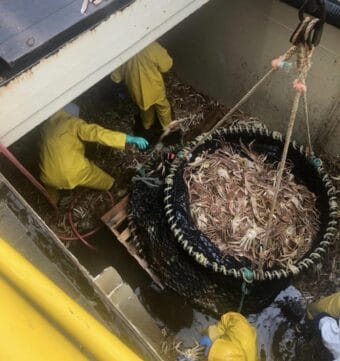
Fishermen load Alaska snow crab in the hold of a crabbing vessel. (Courtesy Tacho)
The Alaska Department of Fish and Game announced Friday afternoon that Bering Sea fishermen will be allowed to harvest a total of about 4.7 million pounds of opilio, also known as snow crab, for the first time in two years.
According to Fish and Game, estimates of total mature male biomass are above the threshold required to open the fishery.
The announcement comes as a surprise to many fishermen, after roughly 10 billion snow crabs disappeared from the Bering Sea over a span of four years, prompting Fish and Game to close the fishery in 2022. Recently, scientists have learned that the disappearance was likely due to ecological shifts, and there’s been little hope within the industry that stocks would recover anytime soon.
Still, the National Marine Fisheries Service and Fish and Game have analyzed the results from this year’s bottom trawl survey and agree that the volume of male crabs is at a safe limit for fishing. Fish and Game’s decision to open the fishery is based on the recommendation of the North Pacific Fishery Management Council, which met Friday morning to determine sustainable harvest limits for Alaska’s big three crab stocks.
Fish and Game has set the total allowable catch, or TAC, for snow crab at 4.72 million pounds, including Individual Fishermen’s Quota and Community Development Quota. The last time the fishery was open, harvesters were allotted 5.6 million pounds, although the year before they had a harvest of 40.5 million pounds.
The department also opened the Bristol Bay red king crab fishery, which closed for two years in 2021 and reopened last year. Fishermen will have 2.3 million pounds to catch this year, just above last year’s humble but welcome harvest.
Both the red king crab fishery and snow crab open Oct. 15.
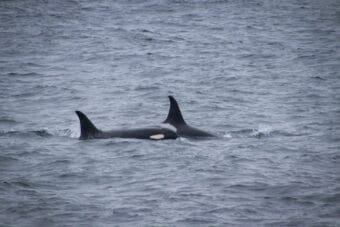
Orcas spotted in the Bering Sea in August 2023. (Courtesy Dustin Unignax̂ Newman)
Black cod fishermen in the Bering Sea have reported an increase in orcas taking their catch off their fishing lines in recent years. Orca depredation isn’t just a costly headache for fishermen — it can be dangerous for orcas, too.
Jeb Morrow has been long-lining for black cod around Alaska for most of his life. The process includes baiting hundreds or even thousands of hooks to catch oily fish on the ocean floor. When he started fishing in the 1990s, he heard stories from elders about orcas regularly stealing their catch, but he said it was only within the last few years that it became a reality for him.
“I can tell you without question these orcas are geniuses,” Morrow said. “They just adapt and conquer at a level that is like nothing we’ve ever seen.”
The problem is so bad that Morrow has decided to skip fishing for black cod this year. He said it’s not worth the hassle. Morrow and his crew have to be careful to protect their catch. For instance, they have someone whose only job is to look out for killer whales with binoculars in the wheelhouse. Once an orca is spotted, the crew immediately cuts and anchors the line, leaving the area as quickly as possible.
“Because you don’t want to be known as a boat that feeds the whales,” Morrow said. “If they establish you as a boat that will feed them, you’re (expletive) for life.”
Morrow said orcas are so intelligent that they’ll follow the boat for the rest of the season. And once the opportunity strikes, the orcas will continuously approach the vessel and take caught fish.
Asia Beder, a biologist with the Alaska Department of Fish and Game in Dutch Harbor, has seen the behavior herself and said stories of orca depredation in the Bering Sea have increased in the last few years.
“Seeing it in person, I was shocked at how quickly they found us, how smart and fast they were at pulling the fish off,” Beder said.
As a management biologist, Beder finds this behavior puzzling. She said that when orcas are around a fishing boat, it doesn’t always mean they are trying to steal the harvest — they also like to play with gear. However, when fishermen aren’t catching fish, it could mean there are orcas around quietly taking caught fish.
Beder said it’s challenging to manage the amount of black cod in the fishery when fishermen can’t accurately count how many they’ve caught, knowing that the orcas are also a factor. So, in the state survey, she said fishermen have a box to check if they saw orcas around while fishing.
“I feel both sides of the equation,” said Beder. “I feel for the orcas, and I also feel for the fishermen.”
Federal agencies also manage the black cod fishery in the Bering Sea.
Suzie Teerlink, a marine mammal specialist with NOAA, said orcas are starting to show new feeding behaviors around large trawler nets. They’re trying to steal fish caught in nets that are typically being hauled back. Scientists aren’t sure why orcas are doing this, but it’s dangerous for them because it increases their chances of getting caught in the net and dying.
Depredation can also be pod-specific. Killer whales are cultural learners — the elders teach the young survival skills particular to their hunting area. They’re also opportunistic.
“They’re looking for calories that aren’t difficult to get,” Teerlink said, “using as little energy as possible to get as much energy, calorie gain as possible.”
Teerlink said orcas have been following fishing boats for food for ages. Orca depredation isn’t just a Bering Sea problem; it also affects fishermen in other parts of the world. She emphasized that fishermen try to avoid orcas. For instance, many black cod fishermen are transitioning to pot gear to prevent the fish from being stolen off the hooks.
“When it comes to killer whale depredation, they’ve [fishermen] been innovating ways to reduce this since the onset and have already come about with lots of different tools and ideas,” Teerlink said.
Morrow believes it’s only a matter of time before the orcas can outsmart the latest fishing gear. For example, a few years ago, fishermen created a new kind of pot called the slinky pot, which worked for only a couple of seasons.
“It was like the answer to all our problems fishing black cod in the Bering Sea,” Morrow said. “And then the orcas figured it out, like in two years, they had it figured out, and they were shredding our pots, and it was done.”
Even if the orcas can’t get the fish out of the pots, Morrow said they’ll smash onto it, so the fish aren’t good anymore. So fishermen are trying heavier, more durable pots — but only time will tell if they’ll work.
As for Morrow’s black cod fishing future, he’s not optimistic.
“If it’s just me versus the whales, they’re gonna win every time out there,” Morrow said.
So, Morrow said he might invest more time and money in other fisheries.
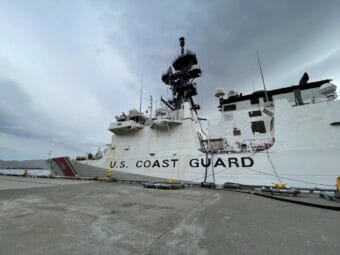
The foreign vessels spotted July 6 and 7 were following international law, and told Coast Guard personnel they were practicing “freedom of navigation operations.”
Coast Guard spokesman Lt. Cmdr. Michael Salerno said encounters with groups of Chinese vessels have been an annual occurrence in the Bering Sea since 2021, and Chinese naval ships have been spotted in the area since 2017. He said he didn’t have information about encounters with Chinese vessels prior to that.
In 2021, the Coast Guard spotted four warships in the region. About a year later, the Coast Guard cutter Kimball stumbled upon Chinese and Russian military vessels traveling together near Kiska Island. Then in 2023, U.S. Navy warships were dispatched to the Aleutians, after 11 Chinese and Russian military vessels were found operating in the region.
The latest four ships were in international waters inside the U.S. Exclusive Economic Zone, an area up to about 200 nautical miles offshore, where the U.S. has jurisdiction over natural resources.
The crew of the Kimball detected three of the latest ships 124 miles north of Amchitka Pass in the Aleutian Islands. Crew on an HC-130J airplane found another ship northeast of Atka Island.
None of the ships broke any international rules or norms. Still, the 418-foot Kimball contacted the Chinese vessels to ensure there were no disruptions to Alaska’s coastline or national interests. The Kimball continued monitoring the ships until they entered the North Pacific Ocean, south of the Aleutians.
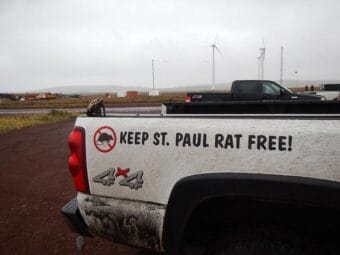
For more than two decades, the Pribilof Islands have implemented a rat prevention program to keep the island rat-free. (John Ryan/KUCB)
It may sound silly to outsiders, but for the remote Pribilof Island of St. Paul, a possible rat sighting could be a big deal.
The community of about 300 residents has worked for decades to be rodent-free. Officials with the island’s tribal government have said the invasive species would devastate local seabirds and permanently change the wildlife populations.
According to a Facebook post from the Aleut Community of St. Paul Island Tribal Government, a rat was potentially spotted last Wednesday. The tribal government’s Ecosystem Conservation Office is working to confirm the sighting using trail cameras at the city fourplex where the unconfirmed sighting was reported.
In 2018, local and federal officials spent almost a year trying to eradicate a rogue rat on the island. They believed the rodent likely snuck in on a boat.
Millions of seabirds descend each year on the rocky oasis near the middle of the Bering Sea. It’s one of the few places that has successfully protected its rich natural habitat and wildlife from invasive rodents.
According to Lauren Divine, the director of the tribal government’s conservation office, there have been no signs of a rat and the sighting is still unconfirmed. She said their staff immediately put out traps and trail cams, and are working with the U.S. Fish and Wildlife Service’s Maritime Refuge staff to place additional materials like black lights, which they will use to detect feces.
Traps are baited with peanut butter, and staff is monitoring daily for any signs of the rat. Signs include things like droppings, chew marks and shredded fibers or debris.
The tribal government asks locals to keep all food and waste properly stored or disposed of. If you spot a rat or evidence of one, or if you’d like to have traps placed around your home, call the conservation office at 907-615-5306.
Peter Pan Seafood Co., the state-backed processing company that has faced dire financial troubles recently, announced Friday it was ceasing operations.
“We’re saddened to share that Peter Pan Seafoods will be halting operations at its processing plants, leading to the discontinuation of both summer and winter production cycles for the foreseeable future,” the company said in a Facebook post Friday night.
The company has faced mounting troubles, including legal claims from fishermen of back-owed payments for unpaid seafood deliveries.
Silver Bay Seafoods recently announced it would acquire Peter Pan’s Valdez facility, as well as operate Peter Pan’s facilities in Dillingham and Port Moller during the 2024 salmon season. It never specified, however, if the King Cove plant would be included.
“This is so sad because I (worked up in King Cove) from ‘96 through last summer,” one commenter posted. “I have good memories from King Cove and the plant, have my kids in the school for a few years.”
King Cove, a community of around 800 residents, relies on the processing facility as its main economic engine. The city already faced hardship when Peter Pan opted last minute not to open for winter’s “A” season, forcing local fishing boats to scramble for new facilities where they could deliver their catch.
“Thanks for waiting until the last possible minute before you told the community of King Cove,” another person commented. “Wouldn’t even tell the fishing fleet of King Cove face to face what was happening, we all have to find out on Facebook.”
Experts say the whale looked good and that it was swimming normally. Once it got further out, it picked up some speed and took a nice deep dive. (From NOAA)
On April 1, a young humpback whale was found tied up in what was likely fishing line and anchored down in a busy area in Iliuliuk Bay. Four days later, a group of whale entanglement experts carefully cut the line wrapped around the humpback’s mouth and tail.
Ed Lyman, an entanglement response coordinator for the Hawaiian Islands Humpback Whale National Marine Sanctuary, thinks the whale was a two-year-old male who got hogtied while feeding in the area.
“(He) gets the line wrapped up in the mouth, panics, and twirls up,” Lyman said. “Suddenly, he’s got it on his tail as well — between the mouth and tail.”
It is unclear what type of fishing gear weighed down the 30-foot whale, but it gave enough slack for him to come up for air.
Lyman said the rescue process takes time. He has participated in 120 whale entanglements and said even though entanglements can be life-threatening for whales, they are not an immediate threat. He said whales are large animals, and disentangling can be deadly if not done carefully.
“So they have time on their side; we have time on our side,” Lyman said. “I’ve never been involved in entanglement where the animals died in a day or two.”
It’s unclear what type of fishing gear was weighing down the 30-foot whale, but it did give enough slack for the humpback to come up for air. (From NOAA)
The Alaska Department of Fish and Game in Dutch Harbor received a call about the entangled whale from locals who noticed that the humpback was breathing and unable to move freely.
It was then reported to marine traffic in the area. The U.S. Coast Guard in Alaska and the nonprofit organization Marine Exchange of Alaska posted a digital map displaying the entangled humpback, warning vessels entering the harbor to avoid the hazard.
Asia Beder, the state’s assistant area management biologist for Dutch Harbor, appreciated the patience shown by the community of Unalaska. She says it played a vital role in the successful rescue of the humpback whale.
“I know this was a very emotional story and event for the community,” she said. “By giving us reports, keeping the distance, and allowing us time, I think that created this into a success story.”
Local ADFG staff received expert advice on capturing footage of the whale entanglement using a camera attached to a pole. They said it helped whale experts determine specialized tools required for the rescue operation.
Sadie Wright, a large-whale entanglement response coordinator for the National Oceanic and Atmospheric Administration, is based in Juneau and has participated in 15 whale entanglements. She said whales can sometimes free themselves from entanglements. However, based on the photos and reports collected from the Unalaska community, it was clear that this whale needed help.
“It was a life-threatening entanglement, and we determined it needed an advanced response,” she said. “So reporting is essential.”
The Alaska Department of Fish and Game’s Ethan Nichols captained the primary vessel involved in freeing an entangled humpback whale in Unalaska’s Iliuliuk Bay on April 5, 2024. (Sofia Stuart-Rasi/KUCB)
The actual rescue took two days. On a boat, local Fish and Game biologists and visiting whale experts gathered data from specialized tools. They floated around the whale and sometimes over it. The team used a large pole with a hook knife at the end of it, and a camera attached, so they could see in real time where the knife was cutting the rope underwater.
“We knew which line we wanted to cut first, and then second, to try to encourage the rope to then come off by itself to slide off the animal,” Wright said, “which eventually happened.”
Lyman said the whale cooperated during the rescue and even seemed curious at times.
“It would almost rise up a little bit more and lean over a little bit,” he said. “Like, ‘What are you guys doing? Why are you here?’ You know, that kind of thing.”
After the whale was cut loose, the team followed it out of the bay and into the Bering Sea. They said the whale looked good and was swimming normally. Once it got further out, it picked up some speed and took a nice deep dive. Lyman said there’s a good chance the humpback will be fine.
“You know, I would almost bet on it, and I’m not a betting man,” he said.
The whale rescue team recommends not putting unnecessary objects in the water and reducing the use of floating lines to prevent whale entanglements.
The young humpback whale is currently identifiable with a string-like mark on its dorsal fin, which the team thinks is from when the whale was trying to break free from the gear.
Close
Update notification options
Subscribe to notifications
Subscribe
Get notifications about news related to the topics you care about. You can unsubscribe anytime.