KUCB - Unalaska

KUCB is our partner station in Unalaska. KTOO collaborates with partners across the state to cover important news and to share stories with our audiences.
Seafood industry urges US to ease trade tensions

The At-Sea Processors Association represents most of the catcher-processor vessels in the Bering Sea pollock sector, including the Northern Hawk, seen here in Unalaska’s Port of Dutch Harbor in February 2025. (Theo Greenly/KUCB)

Two of Alaska’s leading seafood trade groups are urging the federal government to back off aggressive trade policies, warning that new tariffs could trigger international retaliation and deepen the state’s seafood industry crisis.

The At-Sea Processors Association and the Pacific Seafood Processors Association sent a letter on March 11 to the U.S. trade representative, a cabinet-level official in the Trump administration, which said the industry is already under pressure from foreign tariffs and what they call unfair competition from overseas producers.

The groups argue that new tariffs imposed by the U.S. could prompt the European Union or nations like China or Japan to strike back, which could further strain Alaska seafood exports.

At-Sea Processors Association CEO Matt Tinning said in an interview that retaliatory tariffs could jeopardize the industry, which relies heavily on trade.

“We really do live and die by fair access to those export markets,” he said.

The trade group represents most of the large catcher-processor vessels that fish pollock in the Bering Sea — a major segment of the state’s commercial seafood industry.

Tinning said U.S. producers face mounting challenges from Russian seafood, which has flooded global markets in recent years.

“We face unfair competition in global markets,” he said. “Unfair competition from low-cost producers who aren’t held to appropriate labor and environmental standards. In the seafood space, the worst offender is Russia.”

While the Biden administration closed a loophole that allowed Russian fish into the U.S., American producers still struggle to compete overseas.

Existing tariffs are part of that struggle. During the 2018 trade war with China, China imposed varying degrees of tariffs on American seafood, reaching as high as 35%. The tax stabilized at 30% until this month, when China announced an additional 10% in response to the new tariffs Trump announced March 4.

The European Union, one of Alaska’s biggest export markets, also continues to levy tariffs from the previous trade conflict, even as its own products enter the U.S. duty-free.

The At-Sea Processors Association said it isn’t necessarily opposed to reciprocal tariffs, but warned that Alaska’s seafood sector is particularly vulnerable. About two-thirds of the state’s seafood production is exported, and processors fear any retaliation could further erode their competitiveness.

The groups also raised concerns about European labeling rules, which allow pollock caught and processed in Russia or China to be sold as “Alaska pollock.” While technically a species name, U.S. producers argue the label misleads consumers and damages the brand identity of wild Alaska seafood.

In their letter, the groups said the combination of foreign tariffs, labeling confusion and global overproduction has left the industry in a fragile position. If retaliatory tariffs target U.S. seafood, they warned it could “bring about an end to the economic lifeblood we provide to rural communities across Alaska.”

Federal fisheries employees in Alaska have been reinstated, but most are not allowed to work

The NOAA ship Okeanos Explorer visits Dutch Harbor in August 2023 while on a trip to map the ocean floor. (Andy Lusk/KUCB)

Employees who were fired last month from the agency that oversees federal fisheries in Alaska were reinstated on Monday morning. That came in response to a federal judge’s ruling that the Trump administration’s mass layoffs of thousands of workers were unlawful.
Most of the probationary employees fired from the National Oceanic and Atmospheric Administration have been reinstated. But most have been put on “non-duty” status, which prevents them from actually returning to work.

“They have basically placed us in a paid status, but we’re not returning to work necessarily,” said Rebecca Howard, one of 13 employees at NOAA’s Alaska Fisheries Science Center who were fired last month. She received an email Monday morning saying that she had been reinstated.

In Alaska, the agencies that were hit by the layoffs also include the National Park Service and U.S. Forest Service.

But two separate rulings came down Thursday that called the across-the-board firings unlawful. In one of them, U.S. District Judge James Bredar of Maryland ordered the reinstatement of probationary employees at 18 federal departments, including the Department of Commerce, which oversees NOAA. The decision places a temporary stay on the terminations.

The department complied, but some within NOAA say communication has been lacking.

“My supervisor wasn’t informed. I had to inform her, as was the case for everybody up the chain at the Alaska Fisheries Science Center,” Howard said. “I don’t think that anyone was told when these would be coming out.”

The U.S. Office of Personnel Management, which directs human resources within the federal government, lays out protocols for layoffs that are due to things like budget cuts or agency restructuring. Employees terminated under these circumstances receive protections, including priority for reemployment, severance pay or retirement benefits.

But last month’s mass terminations cited poor performance, essentially stripping those employees’ protections. And the reinstatement notices tell employees that the Department of Commerce “may revert your prior termination” if the department prevails in the Marland litigation.

“It’s kind of harsh because it basically tells us that they may retroactively fire us later if they win in this court case,” Howard said.

The temporary order expires March 31, and a hearing is scheduled March 26.

Unalaska museum eyes possible drop in revenue as tourists bail amid tense foreign relations

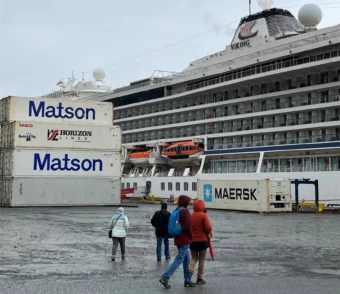
Unalaska’s 2025 cruise ship season is from May till October. (Laura Kraegel/KUCB)

Some international visitors are halting their summer travel to Unalaska as political tensions between countries rise. The Museum of the Aleutians has already received cancellations from international visitors, months before the cruise season begins in May.
Two cruise guests cited “the evolving political situation” between their home countries and the U.S. as reasons for their on-island tour cancellations.

From May to September, many international cruise ships make port calls in Unalaska, allowing visitors to explore the island before they sail off to their next destination.

The Museum of the Aleutians has a gift shop and offers historical tours to those visitors. That can be a significant business for the museum, according to Director Virginia Hatfield.

“The cruise ship season is really important for us,” she said. “Each cruise ship brings in about $5,000 minimum, almost, with admissions and what they purchase. But it depends on the cruise ship.”

Hatfield said the smaller cruise ships generate around $2,000.

“We make $2,000 the whole month of January, right? So having that in one day is amazing,” she said.

Hatfield said many of the cruise ship visitors are foreign tourists. She worries about the organization’s financial survival if there’s a drop in international tourism on the island.

“If they decide that they need to make a point about how the rest of the world is being impacted by American policies and in tariffs, that’s going to be a big impact to our earned revenue,” Hatfield said. “And I don’t know how we’ll make that one up.”

According to the Unalaska Visitors Bureau, the amount of cruises stopping in Unalaska is growing. In 2008, just five cruise ships visited the island. Prior to the COVID-19 pandemic, those numbers had been steadily increasing. This summer, the island expects 19 port calls from cruise ships – 16 of which are international.

But not all local organizations are currently worried about international tourism declining on the island.

Katherine McGlashan, executive director of the Unalaska Visitors Bureau, wrote in an email to KUCB that the tourism trend so far has been positive. She said she’s “feeling confident it will be another good season for UVB.”

Meanwhile, museum staff are waiting to see if cancellations continue to increase as the cruise season approaches.

King Cove applauds Trump’s order to build Izembek road

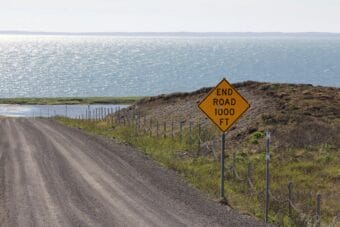
The road out of King Cove ends at the old hovercraft landing on the shore of Cold Bay, about 7 miles from the city of the same name. (Theo Greenly/KUCB)

Boosting Alaska’s energy sector was a priority among President Donald Trump’s executive orders on his first day back in office. The list of projects he supported included opening drilling in the Arctic National Wildlife Refuge and reinstating support for the Ambler Road. But one item seemed out of place among the energy projects: a road from King Cove to Cold Bay’s all-weather airport.

The proposed road has long been a point of contention. King Cove, a remote fishing community on the Alaska Peninsula, can only be reached by air or water. But the community’s harsh weather and short gravel airstrip mean it’s often impossible to fly in or out.

Residents argue that an 11-mile road through the Izembek National Wildlife Refuge — linking them to Cold Bay’s longer, all-weather runway — would save lives by ensuring access to Anchorage’s medical services.

“It was a little bit of a surprise, but a pleasant surprise,” said King Cove City Administrator Gary Hennigh, reacting to the executive order. “He has it somewhere in his brain, or with his people, that there’s something about a road in rural Alaska that the right thing to do is to build it, and you got a bunch of environmentalists jumping up and down that don’t like it, and that’s probably all the more reason why President Trump says, ‘Let’s do it.’”

For decades, conservationists have fought the road, arguing it would set a dangerous precedent by undermining conservation laws. The road would require a land swap between the federal government and King Cove’s Native corporation. King Cove would give up land adjacent to the refuge in exchange for the land required for the road.

Opponents see a dangerous precedent

Rob Rosenfeld, a consultant for dozens of tribes opposing the project, says allowing the land swap would weaken the Alaska National Interest Lands Conservation Act, a landmark law that has protected Alaska’s wildlands for more than 40 years.

“This means that all refuge lands, all ANILCA lands, all designated wilderness and even national park lands are vulnerable to the whims of changing administrations,” Rosenfeld said.

A road has never been built through conservation lands under ANILCA, and land exchanges typically require congressional approval.

Ian Dooley is an attorney with Earthjustice, a nonprofit group that represents some of the opposition. He, too, says the King Cove road could open the door to similar projects across the state.

“This would be the first land exchange under ANILCA that allows for divesting protected lands out of a conservation system unit for the purpose of putting a road through it,” Dooley said. “That has never happened before.”

Statewide subsistence concerns

King Cove residents say the road is crucial for more than just medical access. Dean Gould, president of the King Cove Corporation, says many residents in the largely Unangax̂ community struggle to reach their hunting and fishing areas without it, making subsistence difficult.

“We just can’t get there,” Gould said. “If the road to Cold Bay was there, we’d be able to use them a lot more often.”

But protecting subsistence is also at the heart of the opposition. Dozens of western Alaska tribes have filed formal resolutions opposing project, arguing that it threatens Pacific black brant and emperor geese, both key subsistence species.

But protecting subsistence is also at the heart of the opposition. A coalition of 78 western Alaska tribes has filed a lawsuit to stop the project, arguing that it threatens Pacific black brant and emperor geese, both key subsistence species.

The U.S. Fish and Wildlife Service’s 2013 environmental impact statement concluded that constructing a road through the refuge likely would cause significant impacts on the brant and emperor geese.

Dooley represents the Native Village of Hooper Bay in the Yukon-Kuskokwim Delta, which has taken a leading role in the fight. The Izembek refuge supports one of the largest eelgrass beds in the country, a critical habitat for the geese.

“Nearly the entire globe’s population of these two species of birds rely on both Izembek and the Yukon-Kuskokwim Delta for different parts of their life cycles,” Dooley said. “Disrupting these species in Izembek can have population-level effects that extend to the Y-K Delta as well.”

That could create significant challenges for subsistence communities like Hooper Bay, which are already dealing with the decline of salmon populations.

Edgar Tall Sr., the tribal chief of the Native Village of Hooper Bay, says most people there rely on subsistence species like the brant and emperor geese.

“We can save those, you know, during the winter, where we can freeze them and then eat them while we’re trying to look for other things to survive,” he said.

Despite the opposition, King Cove residents remain hopeful the project will move forward. Gould, the president of the Native corporation, noted that even former President Joe Biden’s administration endorsed the road near the end of his term.

“Seems like we’re more on a positive note, but we’ve been there before too,” he said. “One second you’re smiling, and the next one you’re holding your breath.”

The decision now rests with the Department of the Interior, as King Cove officials await word on the next steps.

Correction: An earlier version of this story said that a group of Alaska Native tribes filed a lawsuit to stop the road. The tribes passed formal resolutions against it.

Bering Sea snow crab season kicks off for first time in 3 years

Three men emptying a crab pot on a fishing boat
Crew from the Silver Spray empty snow crab pots while fishing in the Bering Sea. (Courtesy of Bill Prout)

Earlier this month, commercial snow crabs started hitting Unalaska’s docks again for the first time in nearly three years.

The Bering Sea snow crab fishery reopened in mid-October, after billions of the crab disappeared and the fishery was shut down in October 2022. This season’s first catch was delivered on Jan. 15. Opilio, or snow crab, is generally fished in the new year and into the early spring. The season runs through May.

Alaska Department of Fish and Game area management biologist Ethan Nichols said nine vessels are actively participating in the Bering Sea commercial fishery.

“The fleet is just getting started, for the most part,” Nichols said. “Fishing so far — the reports from the grounds — there seems to be good numbers of nice, new shell, large snow crab on the far northern portions of the grounds.”

Nichols said right now the number of keepers per pot, also known as CPUE or catch per unit effort, is somewhat low coming in at 134, but that will increase as the season progresses.

“That’s only coming from a handful of our first deliveries, and that includes some prospecting by vessels early on in the season,” he said. “So far, the highest CPUEs are being seen on the northern portion of the grounds. And as vessels get more dialed in on those hot spots or those productive areas of fishing, they’ll be coming with full loads of crab that are more reflective of the hot spots on the grounds.”

Fishermen were allotted about 4.72 million pounds of snow crab this season. That’s pretty low compared to historic catch limits. About 17% of that had been harvested as of Friday morning.

Normally, some of that harvest would be processed in St. Paul. But this year, everything is coming to Unalaska because Trident didn’t open their plant to process crab on the Pribilof Island, which is the only processor in the northern region.

Nichols said it sounds like processing the extra crab in Unalaska is going smoothly. He said it’s made some of their work at Fish and Game a little easier too.

“It’s just made our sampling a little bit more streamlined, just really in terms of travel logistics this time of year, not having to battle getting in and out of the Pribilofs with weather and flight availability and all that,” Nichols said.

He said he expects to see a total of about 15 vessels participate in this year’s fishery. Four vessels have already finished up and checked out of the fishery. Fish ticket prices are coming in at around $3 per pound, according to Nichols.

Meanwhile, eight vessels are registered for the Western Bering Sea Tanner crab fishery. Less than 10% of that total harvest has been caught so far. Nichols said they expect more vessels to start targeting bairdi, or Tanner crab, as they finish up with snow crab. Harvesters have until the end of March to catch the Tanner crabs.

And the Pacific cod pot fishery in state waters opened up Tuesday for boats 58 feet and under. Nichols said he expects about 20 vessels to kick that off. They have a harvest level of roughly 44 million pounds, which is just about the same as last year’s catch limit.

Unalaska jostled by magnitude 5.6 earthquake Sunday

Nearby volcanoes Makushin and Okmok are unlikely to be affected by the quake, an expert said. (Alaska Earthquake Center)

magnitude 5.6 earthquake struck about 58 miles southwest of Unalaska Sunday afternoon. While many locals felt the event, including in Nikolski and Akutan, experts said there was no threat of a tsunami or cause for further concern.

Alaska Volcano Observatory geophysicist John Power said the quake, which hit at 1:39 p.m., isn’t a likely precursor to another seismic event. Power noted that the quake was quite deep. The Alaska Earthquake Center currently estimates the event’s depth at 24.1 miles. Deep earthquakes don’t usually bring a lot of aftershocks, Power said.

“We see earthquakes like this very, very frequently in the Aleutian chain,” he said. “This one’s pretty big, but not unusually big.”

Initial calculations on magnitude, location and depth are subject to change as researchers refine their data.

Power noted that nearby volcanoes Makushin and Okmok are unlikely to be affected by the quake.

To report any seismic activity you felt, head to the United States Geological Survey website. For more information on earthquake preparedness, visit the Alaska Earthquake Center’s website.

Site notifications
Update notification options
Subscribe to notifications