KUCB - Unalaska

KUCB is our partner station in Unalaska. KTOO collaborates with partners across the state to cover important news and to share stories with our audiences.
Activists urge reforms after Bering Sea trawlers hauled up 9 dead orcas this year

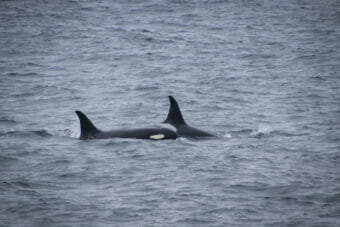
Orcas spotted in the Bering Sea in August 2023. (Courtesy Of Dustin Unignax̂ Newman)

Federal officials are looking into the deaths of nine orcas that were hauled up by groundfish trawlers in Bering Sea and Aleutian Islands fisheries this year, and conservation groups say more needs to be done to prevent such deaths.

According to NOAA Fisheries, a tenth whale was released alive, but the nine other orcas incidentally caught in trawl nets weren’t so lucky.

“NOAA Fisheries is analyzing collected data to determine the cause of injury or death and determine which stocks these whales belong to through a review of genetic information,” said Julie Fair, public affairs officer with the federal agency’s Alaska office, reading from a statement published Thursday. She declined to be interviewed, except to read the statement aloud.

Killer whales are protected under the Marine Mammal Protection Act, which requires boat owners or operators to report the deaths and injuries of the mammals during commercial fishing and survey operations.

Fair said NOAA Fisheries monitors bycatch of protected species to determine whether the animals were dead before being caught or were killed or seriously injured by commercial gear.

The vessels involved in these incidents weren’t named, but Fair said the boats involved were all required to carry two federal observers on board.

This isn’t the first time killer whales have been caught in trawl gear off Alaska, but the numbers seem to have spiked this year.

“Nine, ten killer whales is too many,” said Shari Tarantino, head of the Seattle-based advocacy group Orca Conservancy, which advocates for the endangered Southern Resident killer whale population that roams from California to Southeast Alaska. “And if it’s just this year, something needs to be done in the future to mitigate these atrocities, frankly.”

Chris Woodley, head of the Groundfish Forum — the Seattle-based association that represents Bering Sea trawlers — declined to be interviewed, providing a written statement to KUCB instead. In it, he said that vessels are experimenting with gear modifications that may prevent whales from entering trawl nets, and that the Amendment 80 trawl boats voluntarily stopped fishing on Sept. 9, with more than three months left in the season, because of the orca bycatch.

Fishing boat encounters that harmed or killed orcas in Alaskan waters were rare until recently, according to the statement, first reported by the Anchorage Daily News. NOAA reported just seven killer whale mortalities or serious injuries resulting from fishing gear entanglement between 2014 and 2020.
“In 2023, our captains have reported an increase in the number of killer whales present near our vessels, where they appear to be feeding in front of the nets while fishing,” the statement reads in part. “This new behavior has not been previously documented and marine mammal scientists are not sure why this change has occurred.”

Tarantino said it’s important to protect orcas for future generations.

“We’re not saying stop trawling, even though I think trawling is unbelievably devastating to the ocean animals and the beings that live there,” she said. “But to continue taking this bycatch is just insane. It’s destroying our future, in my opinion. You know, if the ocean goes, we go.”

Biologist Deborah Giles, the science and research director for the Washington-based nonprofit Wild Orca, said she wasn’t surprised when she heard about the nine orca deaths.

“I was glad that [NOAA was] finally recognizing it publicly,” she said. “Of course, my cynical brain wonders how often this is happening when it was not reported — or at least not released publicly. I’m very glad that this is going to be investigated.”

Giles said the industry needs to figure out a safe way to keep animals from interacting with fishing vessels and reduce bycatch of non-targeted species.

“We’d ask NOAA to come up with some new protocols for ensuring that this doesn’t happen again in the future,” she said. “NOAA is responsible for marine mammals, like killer whales, and they’re also responsible for making sure that the fisheries are not jeopardizing non-targeted species. And especially in the trawl industry, bycatch is massive. And it’s unsustainable. Initially, what we need to know is what are they doing about this? What steps are going to be taken to minimize this?”

Activists with the “Stop Factory Trawler Bycatch” campaign planned to hold a protest Thursday outside the annual meeting of Genuine Alaska Pollock Producers at Seattle’s Four Seasons Hotel.

“Nothing I have seen yet clearly states which trawl vessels were involved,” anti-bycatch activist David Bayes said in a text message.

Genuine Alaska Pollock Producers did not immediately respond to a request for information Wednesday afternoon.

In a written statement, NOAA spokesperson Julie Fair said the agency is working quickly to evaluate the orca-harming incidents and will share findings as soon as possible.

Russian military conducts exercises in Bering Sea

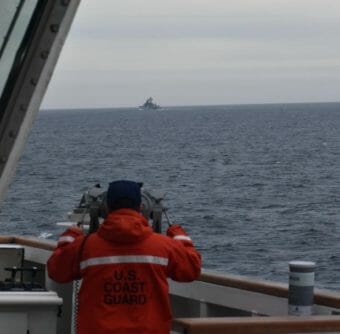
A Coast Guardsman aboard the cutter Kimball monitors a vessel from a group of Chinese and Russian warships in late September 2022. (Courtesy U.S. Coast Guard)

The Russian military is running naval exercises in the Bering Sea this month, and the U.S. Coast Guard is keeping watch.

The Coast Guard cutter Kimball is patrolling an area along the U.S./Russia Maritime Boundary Line as Russian vessels perform various tactical exercises.

On Friday, the Russians launched a missile approximately 600 miles northwest of Dutch Harbor.
The Department of Defense released a warning advising mariners of Russian missile operations in the Bering Sea, including within the U.S exclusive economic zone south of St. Lawrence Island, until Sept. 24. (From U.S. Coast Guard)

Rear Adm. Megan Dean, a representative from the Coast Guard, said in a statement the exercises are lawful, but said the Coast Guard “will continue to ensure there are no disruptions to U.S. interests or commerce in the maritime environment around Alaska.”

The U.S. Department of Defense issued a warning for the area that will remain in effect through Sunday.

Mount Shishaldin simmers down after explosive eruption

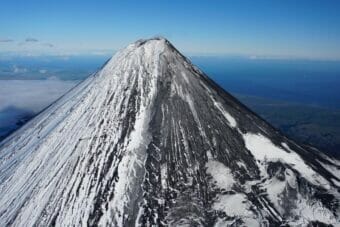
Shishaldin is the highest peak in the Aleutian chain, rising 9,373 feet, and is located near the center of Unimak Island, about 20 miles from the small fishing community of False Pass. (David Fee/Courtesy of Alaska Volcano Observatory

Mount Shishaldin has simmered down after a Friday eruption sent an ash cloud across the eastern Aleutians, prompting the Alaska Volcano Observatory to raise the aviation color code to red.

This was the stratovolcano’s latest eruption in a summer of increased activity.

Shishaldin is the highest peak in the Aleutian chain, rising 9,373 feet. It’s near the center of Unimak Island, about 20 miles from the small fishing community of False Pass.

The observatory said things slowed down quickly after Friday’s eruption and activity has returned to pre-eruptive levels.

Alaska Volcano Observatory reports ‘explosive eruption’ at Mt. Shishaldin

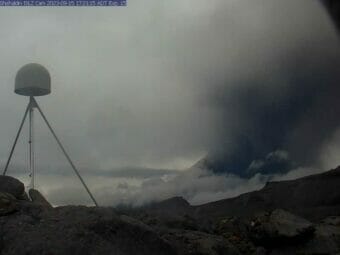
Ash emissions from Shishaldin Volcano captured on an Alaska Volcano Observatory webcam on Sept. 15, 2023. (Courtesy of AVO/USGS)

Mount Shishaldin in the eastern Aleutians is erupting, marking the latest event in a summer of increased activity at the volcano. The Alaska Volcano Observatory said “an explosive eruption” began shortly after 5 p.m. Friday.

“Ash is currently being produced and is drifting to the east below the cloud deck,” the volcano watch group reported.

The stratovolcano is near the center of Unimak Island, about 20 miles from False Pass, a fishing community with around 350 residents.

The National Weather Service issued a statement Friday evening warning of possible “trace ashfall” in False Pass, King Cove and Cold Bay.

Intermittent eruptions at Shishaldin have been disrupting air travel since July, one of which spewed ash as high as 40,000 feet.

The current aviation color code has been raised to red.

Crew member on Alaska factory trawler dies after possible ammonia exposure

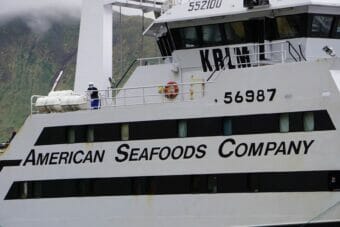
The Northern Eagle docked in Unalaska/Dutch Harbor in July 2020. (Hope McKenney/KUCB)

A crew member on an American Seafoods factory trawler died at sea last week, likely from an ammonia leak on board.

U.S. Coast Guard Petty Officer Second Class John Highwater said they received a satellite call from the Northern Eagle at about 4 a.m. Friday.

“One of their crew members was found unresponsive in one of their engineering spaces,” Highwater said. “They believe there was an ammonia leak somewhere in the vessel that caused the person to fall unconscious.”

Jeremy Baum, the Alaska Wildlife Trooper stationed in Unalaska/Dutch Harbor, identified the crew member as First Engineer David Kuma from Ghana, in West Africa.

Forty-three-year-old Kuma was found unresponsive just after 12 a.m. that morning, according to Highwater.

The nearly 350-foot vessel was already en route to Unalaska/Dutch Harbor when they made the call to the Coast Guard. Highwater said it would have taken Coast Guard crew longer to reach the vessel than for the trawler to head to port.

Unalaska’s Fire Chief Ben Knowles said the Northern Eagle reached Unalaska around 5 a.m. the next day — roughly 24 hours after the distress call. From there, the case was turned over to local responders.

“The fire department, along with NOAA, the U.S. Coast Guard Marine Safety Detachment and the Alaska State Troopers boarded the vessel around 6 a.m., once they were all tied up, and began the investigation into the incident,” said Knowles.

He said Kuma was pronounced dead prior to arriving at port. The Unalaska Fire Department assisted troopers with their investigation, provided decontamination and offered grief counseling for the vessel, according to Knowles.

“We were able to hold some listening sessions and just kind of make sure that the crew members were able to have someone to talk to,” he said.

American Seafoods brought Kuma’s family to the island, according to Knowles.

“We are here to offer our services to them,” he said. “And we’re hoping that they can find some healing in this process.”

The Coast Guard, troopers and NOAA Enforcement are investigating the incident.

Kuma’s body was sent off island to the State Medical Examiner’s Office on Tuesday for an autopsy, according to Wildlife Trooper Baum.

American Seafoods declined a request for comment.

After 200 years, a traditional Unangax̂ boat is making a comeback

The latest official launch happened at Sand Point Culture Camp, on July 24. That day, Ethan Petticrew, one of the teachers at camp, sat in the boat’s stern and called the strokes, while others chanted in Unangam Tunuu and beat drums. (Theo Greenly/KUCB)

Dozens of people packed Sand Point’s harbor on July 24. Some crowded the small dock while others sat along a wall overlooking the water.

They were there to watch a group of a dozen people board a long, wooden-framed boat. It was open, like a canoe, but this was a niĝilax̂, a traditional Unangax̂ boat, made from a wooden frame and wrapped in animal skins.

The community built this niĝilax̂ in the spring, but they’ve been waiting for the launch for much longer — it had been 200 years in the making.

During the Russian fur trade, the Russians took notice of our ancestors’ ability to move mass amounts, to move villages, to move their cargo, and ultimately to escape the Russians during the fur trade,” said Amy Mack, one of many people who helped organize the niĝilax̂ build.

She explained to the crowd that their ancestors used the boat like a cargo ship, and that worried the colonizers. They were able to move entire villages and warriors with ease with this one boat.

To ensure that our ancestors were completely at the disposal of the Russians, sadly, all the niĝilax̂ were destroyed,” Mack said.

But this summer, the niĝilax̂ has returned. Four communities have built them this year, after studying historical documents, sketches, and artifacts to learn how they were made – one in Sand Point, one in Atka, one in Anchorage, and one in a town in Northern California, where many Unangax̂ people were relocated during the Russian days. Three of the communities have since launched the traditional Unangax̂ boat that hasn’t been seen since the 1800s.

The latest official launch happened at Sand Point Culture Camp, on July 24. That day, Ethan Petticrew, one of the teachers at camp, sat in the boat’s stern and called the strokes, while others chanted in Unangam Tunuu and beat drums.

The group paddled out into the bay and circled Range Island, a small, rocky outcrop about a mile from the dock.

The crew pulled back up to the dock about an hour after pushing off, where Unangax̂ dancers from Atka and Sand Point, greeted the crew with traditional fanfare.

“This is such a moving experience, I’m going to cry,” said Petticrew. “People haven’t done this since the 1800s. This is such a spiritual moment, I feel so connected to my great grandparents. I feel like I’m paddling with my great grandparents.”

Many people suggested names for the nigilax̂ but, ultimately, Amy Mack said the choice was obvious.

Unangam Anĝii, which translates to “Unangax̂ Spirit.”

“We chose that name because we are Unangan people, and we want that spirit of our ancestors to come back,” Mack said.

After the paddle, the niĝilax̂ was hoisted onto the dock and stored at the tribal office. But the Aleutians won’t have to wait another 200 years for the next boat: already, a fifth niĝilax̂ is being built and will be water-ready soon in Unalaska.

Site notifications
Update notification options
Subscribe to notifications