KUCB - Unalaska

KUCB is our partner station in Unalaska. KTOO collaborates with partners across the state to cover important news and to share stories with our audiences.
Navy warships dispatched to Aleutians after Chinese, Russian military spotted in region

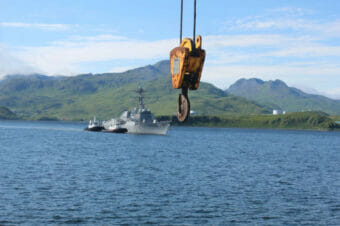
Several U.S. Navy warships docked in Unalaska last week, after 11 Chinese and Russian military ships were found operating in the region. (Andy Lusk/KUCB)

Navy warships were dispatched to the Aleutians last week after 11 Chinese and Russian military ships were found operating in the region.

The exact location of the foreign ships was not disclosed, but a military spokesperson from the U.S. Northern Command said the foreign patrol ships remained in international waters and were not considered a threat.
Still, U.S. Sens. Lisa Murkowski and Dan Sullivan issued a statement Saturday saying the incident shows why the military should expand its presence in Alaska to protect U.S. interests.

“This is a stark reminder of Alaska’s proximity to both China and Russia, as well as the essential role our state plays in our national defense and territorial sovereignty,” Murkowski said.

Her office offered additional assurances to Aleutian communities.

“Because this is a military operation, we are limited with what we can say,” said Joe Plesha, a spokesperson with Murkowski’s office. He assured Unalaskans the senator was “taking this incursion very seriously.”

China has sent naval ships to the Bering Sea off Alaska’s shores before, in what U.S. analysts often say is a provocative gesture. The first-known incident was in 2015, coinciding with then-President Barack Obama’s visit to Alaska.

In August of 2021, the U.S. Coast Guard encountered a flotilla of Chinese warships 46 miles off the Aleutian Islands. And the following year, on a routine patrol, a Coast Guard cutter found a group of Russian and Chinese warships traveling together through the Bering Sea.

Sen. Sullivan said in the statement he was glad to see a tougher response to these warships, which “sends a strong message to Xi Jinping and Putin that the United States will not hesitate to protect and defend our vital national interests in Alaska.”

Unalaska’s city and tribal officials have been weighing the island’s ability to host a larger U.S. military presence. Community leaders are promoting Dutch Harbor as a key port in the nation’s Arctic plan, as melting ice opens shipping lanes and allows for more foreign military transits.

Trident’s new processing plant in Unalaska will be the largest in North America

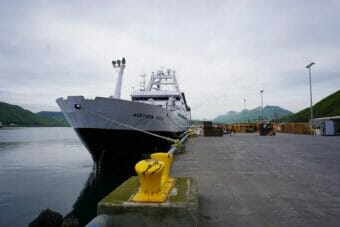
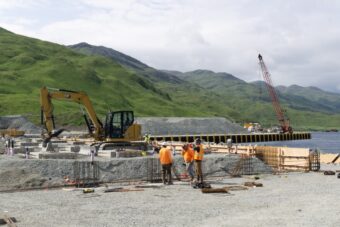
Trident Seafoods is constructing a state-of-the-art facility to process fish in Unalaska. Representatives say they expect to be online in 2027. (Hope McKenny/KUCB)

Trident Seafoods has begun building the first bunkhouses at its to-be processing plant in Unalaska’s Captains Bay, progressing on a timeline the seafood titan says would make it operational by 2027.

The Aleutian Islands and Bering Sea region is home to some of the world’s most productive fishing grounds. It’s where most Alaska pollock comes from, the whitefish found in fish sticks and McDonald’s Filet-O-Fish sandwiches worldwide. And a lot of that fish is processed at the giant Trident Seafoods plant in Akutan.

But aging infrastructure and decades of wear prompted the seafood company to plan a new facility.
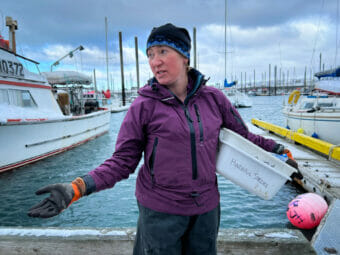
“Status quo in Akutan isn’t an option,” said Stefanie Moreland, a spokesperson for the company. “We can’t be operating a plant and making the kinds of changes and improvements that we need to within the facility that we’re running currently in Akutan.”

The company began a feasibility study in 2017 to explore ways to upgrade its Akutan plant. They tested things like building designs and energy efficiencies, but ultimately, representatives from the company said a complete rebuild was the only reasonable option.

Trident began constructing a dock on Captains Bay in Unalaska in spring 2022, after its subsidiary, LFS, acquired a tidelands lease from the City of Unalaska.

“We started in ‘22 [with] rock removal, rock crushing, getting kind of a building site ready,” said Jarred Brand, the site manager for the project. “We built over 1,500 feet of sheet pile dock, and we needed to let that settle for a year.”

Now, they are grading the site, working on a fendering system, and building the first bunkhouse.

While the company didn’t specify the size of the new plant, Brand said it would be at least as large as the Akutan plant, currently the largest processing facility in North America.

“We’re not getting any smaller,” Brand said.

Brand said the new plant will focus on automation, renewable energy, and on 100% protein capture — that is, being so efficient that not a scrap of fish is left to pump out to sea.

“In our industry, there’s a lot of waste that goes out the outfall pipes,” Brand said. “So we’ve been working on this process for quite some time, knowing that the future is 100% capture and putting it into a sellable product.”

Integrating the new plant into the city’s existing infrastructure poses a whole other set of variables.

Unalaska City Manager Bil Homka said considerations like power generation, plumbing and road access all pose serious challenges.

“We have diced this thing like a Rubik’s Cube, except it’s almost like a Rubik’s rectangle, just to kind of make it stranger,” Homka said. “You see all the parts … you twist one here, you twist one there and see how it works.”

The City of Unalaska is the community’s primary electricity provider, but the diesel power station doesn’t produce enough energy to power the new plant.

“Our existing power house only has room for one more generator,” Homka said. “And it’s only a maximum output of [about] four and a half megawatts, so we’d still be short.”

Many seafood processors provide their own energy, often through a combination of diesel and fish oil, but Trident says it wants to avoid power production.

The seafood company is hopeful about another potential energy source in the works: the Makushin Geothermal Project.

The community has been trying to tap nearby Makushin Volcano for geothermal energy since at least the 1980s. After decades of false starts, a contractor is currently working on the project — nothing is guaranteed, but Homka said the timing could dovetail with the new seafood facility.

“Wonderful if it all syncs up timing-wise between when Trident will be online and when geothermal will be ready,” Homka said. “Timing is of an amazing essence.”

The Trident crew is currently building bunkhouses and the geothermal crew is building an access road. Both projects are slated to come online in 2027.

Unalaska readies to deploy traps for invasive European green crabs

In much of the state, scientists have had their eyes on the crab for years. In communities around Kachemak Bay, they’ve been setting traps for about two decades. (Hope McKenney/KBBI)

Unalaska is preparing to start monitoring for European green crabs. That’s after the invasive species was first found in Alaska last July.

The crabs could cause a big problem. They destroy habitat and outcompete native species.
Biologists with the Alaska Department of Fish and Game say the monitoring program is crucial in the nation’s largest fishing port. They’re preparing to deploy traps later this summer.

“We don’t have any reason to believe that European green crab are here or established in the region, but we’re also not currently doing any monitoring,” said Ethan Nichols, the assistant area manager for shellfish with ADF&G in Dutch Harbor. “With European green crab steadily moving up the West Coast, through British Columbia, and into southern Southeast Alaska as of last year, I think it’s important that we start monitoring here in the Port of Dutch Harbor, given the amount of international ship traffic that we have.”

Twenty green crabs laid out in rows on a table, with a bucket full of green crabs next to them
European green crabs collected from Metlakatla’s Tamgas Harbor last fall. The crabs were trapped in shrimp pots. (Photo courtesy of Dustin Winter).

In much of the state, scientists have had their eyes on the species for years. In communities around Kachemak Bay and Prince William Sound, they’ve been setting traps for about two decades.

Tammy Davis is the invasive species program coordinator with the Department of Fish and Game in Juneau. She says European green crabs — which are native to coastal Europe and North Africa, and were introduced to the Atlantic coast through ballast water in the early 1800s — are so concerning, because although they’re small, they’re incredibly aggressive.

They reduce eelgrass (important nursery habitat for juvenile fish) and populations of clams, oysters, mollusks and other invertebrates that live on or in the seafloor. They can also prey on juvenile native crabs, like Dungeness — something that could impact Aleutian Island fisheries down the line, if their habitats overlap.

“Green crab are considered one of the top 100 invasive species globally,” Davis said.

Like anywhere else, Davis said, they would have impacts on the nearshore environment, putting organisms that rely on that intertidal and subtidal habitat at risk.

“They behave differently in different environments,” she said. “There’s, of course, some sort of general parameters of temperature triggers for reproduction, and tolerance for temperatures and so forth. But they’re very hardy organisms, and we don’t know what the potential impacts are in an environment like Dutch Harbor at this point.”

Davis said biologists are concerned the species could be introduced into Dutch Harbor through ballast water discharge, or by currents carrying larvae out the Aleutian Chain.

She said they hope to identify coastal areas with high-value commercial, recreational and subsistence harvests and use intensive trapping as a way to monitor and control green crab populations as they start to spread across the state.

Setting traps also helps them understand what species use these areas and are at risk of green crab predation, according to Davis.

“Whatever ends up in our traps also uses this part of the nearshore. Those are the species that are at risk from green crab,” she said.

Davis said although it’s not likely they’ll be able to get rid of green crabs if they establish themselves in the Aleutians, early detection is crucial.

“You’re keeping the population of green crab low enough that the negative impact they have on the native species and the native habitat is not greater than the native species can handle,” she said.

ADF&G plans to launch the monitoring program in the Port of Dutch Harbor this summer. Five traps are on their way to the island now.

If you find what you think might be a European green crab, you can call ADF&G’s invasive species hotline at 1-877-INVASIV or visit their website.

Crab pots ‘absolutely stuffed’ as Bering Sea Dungeness fishery breaks records

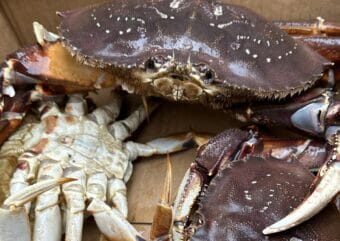
Dungeness crab that were caught in the Bering Sea by a local Unalaska fisherman. (Sofia Stuart-Rasi/KUCB)

While many Bering Sea crab populations are in freefall, Dungeness crab is breaking records in regions that hardly used to see them.

The North Peninsula District in the eastern Bering Sea opened as a commercial Dungeness fishery in the early ‘90s. In those early days, it was common for just one or two boats to fish there — many seasons, there were none.

The numbers increased modestly over the ensuing decades — but that growth has recently become exponential.

“The pots that we’re seeing coming out of this fishery are absolutely stuffed with crab,” said Ethan Nichols, who works for the Alaska Department of Fish and Game. “Like, you don’t even know how many crabs can fit in a pot.”

Nichols is Fish and Game’s assistant area manager for groundfish and shellfish in Dutch Harbor. He said the fishery boomed last year and became the largest Dungeness crab fishery in Alaska — bringing in 35% of the state’s total Dungeness landings.

So why are populations of this one particular species increasing, while red king crab and snow crab are decreasing?

The answer may be the same for both questions: climate change.

“We think it’s likely that the recent warming conditions in the Bering Sea are creating conditions more favorable for Dungeness crab,” Nichols said.

The same warming trend that is likely pushing king crab farther north could be bringing Dungeness crab to the eastern Bering Sea. But Nichols said the trend is too new to have any definitive answer.

“I’m hoping that as we have more years of consistent harvest in the fishery, we’ll have a better idea of the full distribution of crab in the area,” he said. “And if this is just a fluke for a couple of seasons, or if this can be a more consistently large Dungeness fishery.”

What is certain is that crabbers have taken notice. Last year, the fleet harvested 3 million pounds of Dungeness crab, breaking the highest record in the district.

That boom has some people concerned. In January, an Unalaska fisherman introduced an emergency proposal to ADF&G, warning that the sudden increase in vessel participation could lead to over-harvesting.

“The person who put this in was worried about some really big boats coming out from down south with like 3,000 pots apiece,” Nichols said.

In response, the department set a Dungeness pot limit — the first time they had ever done so in the district. The regulation limits pots to 500 or 750 per vessel, depending on how many boats have registered. This year, it’s 500.

The department said this season is starting slower than last year, with around 33,000 pounds of Dungeness crab caught since opening May 1.

The fishery will remain open until October 18, or until pot limits are met.

Deepwater mapping reveals gas seeps in Aleutian Trench

Deepwater mapping reveals gas seeps in Aleutian Trench. (Ellis Berry)

The Okeanos Explorer docked in Unalaska last month after finishing its first of six expeditions mapping out the deep seafloor around the Aleutian Islands. It was almost June, and the weather was starting to calm down from the winter season — making it safer for research boats to head out to the Bering Sea.

Sam Cuellar is with the National Oceanic and Atmospheric Administration and works as the expedition coordinator on the 224-foot research vessel. While on the Okeanos Explorer in May, Cuellar and his crew discovered three seeps bubbling gas through the seafloor in the Aleutian Trench.

According to NOAA, the discovery is crucial because these gas seeps can create unique surrounding habitats and provide potential sources of alternative energy and biopharmaceuticals. But to Cuellar and his crew, it was just another day at work.

“You’re in that kind of routine,” he said. “It’s not exciting because it’s not important — it’s just part of your job. And it’s really cool to note, but you just keep going on with your job and keep looking for more.”

According to Cuellar, finding these gas seeps wasn’t a total surprise. That’s because there’s research from the U.S. Geological Survey that predicts where gas seeps could be in Alaskan waters. And now, with more advanced machinery, there can be more advanced data collection from the seafloor.

“Now that you’re seeing the different technologies catch up with being able to more properly and economically extract resources from the deep seafloor,” said Cuellar. “We need to better understand [resources] for protection, but also to understand what kind of resources are here.”

Alaska’s waters are predominantly unexplored. Cuellar said it’s partially due to the state’s remoteness from the rest of the country and the environmental difficulties that come with being so far north.

But, he said, retracting ice sheets make areas more accessible than ever before.

“And so, there’s a renewed push by the U.S. government to better understand what is in those types of waters now that they’re accessible,” Cuellar said.

The Okeanos Explorer is out at sea until mid-October, mapping the deep waters around the Aleutian Islands, in the Aleutian Trench, and in the Gulf of Alaska. You can track the ship live online on NOAA’s website and the collected data will be accessible to the public during and after expeditions.

Army Corps to begin cleanup efforts at World War II fort in Unalaska Bay

Fort Learnard, a former World War II military outpost, housed anti-aircraft and anti-ship artillery at Eider Point, on the western side of Unalaska Bay. (U.S. Army Corps of Engineers Photo)

The Army Corps of Engineers is preparing to clean up Fort Learnard, a former World War II military outpost in Unalaska Bay.

The fort housed anti-aircraft and anti-ship artillery at Eider Point, on the western side of the bay.

The site was decommissioned after the war, and the artillery and munitions were exploded to dispose of them. But according to the corps, the explosion was not done in a controlled way.

“Fragments, and sometimes whole pieces of ammunition, were kicked out of the explosion,” said Ellen McDermott, who works with an engineering firm contracted for the cleanup. At a public meeting held in April, she said more than 200 munitions have been found in the area around Fort Learnard, most recently in 2016.

“The frequency with which items are found at the site suggests that there are a fair number of projectiles still out there, and we don’t know where they are,” McDermott said.

The corps plans to visit the site later in May for a preliminary survey, and the actual cleanup is slated for 2024.

Site notifications
Update notification options
Subscribe to notifications