KUCB - Unalaska

KUCB is our partner station in Unalaska. KTOO collaborates with partners across the state to cover important news and to share stories with our audiences.
Unalaska settles suits claiming hostile work environment for police

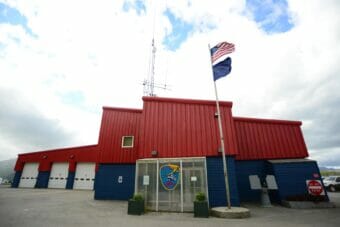
The City of Unalaska’s Department of Public Safety headquarters. (Berett Wilber/KUCB)

The City of Unalaska agreed to pay $765,000 to settle four separate lawsuits against its police department, all brought by former Unalaska Department of Public Safety employees who say they were either wrongfully fired or forced to quit due to harassment and bullying within the department.
The suits — brought by then-Sergeant John Merrion, and officers Ann Sotelo, Anthony Recco and Lisa Robinson — describe a dysfunctional department, full of “workplace hostility and retaliation, a tolerance for officer misconduct, and even physical confrontation,” according to one of the complaints filed at Unalaska Superior Court.

Northern Justice Project, LLC, an Anchorage-based law firm that focuses on civil rights cases, represented all four plaintiffs, although the cases were filed separately.

One case describes a young police officer who became “the latest in a long line of officers who have been significantly mistreated” by the department, and whose complaints were ignored by then-police chief Jay King. The four cases brought against the police department were filed between October 2020 and May 2022, all during King’s tenure as chief.

King resigned from the department in December, a month after the city settled the cases. King was named throughout the suits, which accused him of ignoring complaints of harassment and overlooking misconduct.

One complaint accuses King of acting aggressively towards officers, and of threatening an officer when she discovered King was using office supplies for his personal business.

King did not respond to several requests for comment.

The City of Unalaska, in its response to the complaint, denied the accusations against the department.

Two of the lawsuits focus some of their complaints on Officer Theresa Ah-Siu, who has been with the department since 2014, and one on Sergeant Kevin Wood, who joined the department in 2009 as an officer and became sergeant in 2017. Both are current Department of Public Safety employees.

Recco alleges Ah-Siu “subjected him to a sustained campaign of hostility … and verbal abuse.” Another called Wood “unhinged and violent.”

Wood denied all of the accusations in an interview, saying the lawsuits were “frivolous” and made in “bad faith.” KUCB was unable to reach Ah-Siu for comment.

The public safety department has had high turnover in recent years, not uncommon in Alaska law enforcement agencies where recruitment can be challenging. And the police department is not alone — the city is struggling to fill posts across many departments, and 26 city positions remained unfilled as of Jan. 10, including a permanent city manager and a finance director.

Still, the city’s public safety department has been marked by high turnover for years. Unalaska spent more than two years on a nationwide search for a chief before hiring King, who previously spent 25 years with the Montgomery, Alabama police department before taking the job in Unalaska in 2020.

King was active in the Unalaska community and sat on the board of several nonprofit and community groups, including Unalaskans Against Sexual Assault & Family Violence.

The City of Unalaska says it has enlisted an outside investigator to conduct an independent review of the allegations. The investigator’s report will be presented to the Unalaska City Council in a closed session at an upcoming council meeting.

NOAA denies emergency request to close red king crab savings areas

""
The red king crab savings area was established in 1996 and is permanently closed to bottom trawling, but it remains open to midwater — or pelagic — trawlers, pot fishing and longlining. (Bri Dwyer/Alaska Bering Sea Crabbers)

The National Oceanic and Atmospheric Administration has denied an emergency request Friday to close crucial habitat for Bristol Bay red king crab to all types of commercial fishing.

That comes after Alaska Bering Sea Crabbers petitioned in late September for a closure of the red king crab savings areas to protect the species during a time of historically low stocks.

The nonprofit, which represents independent crab harvesters, requested that the grounds be closed to all fishing gears from Jan. 1, 2023 through the end of June.

The Bristol Bay red king crab fishery has been closed to fishing for two years due to low population. Biologists have seen declines in recruitment and stocks for more than a decade. It’s not abundantly clear what is causing the crash, but some theories suggest climate change and warming ocean conditions may be in part to blame.
The savings area was established in 1996 and is permanently closed to bottom trawling, but it remains open to midwater — or pelagic — trawlers, pot fishing and longlining. Bottom trawling is allowed, however, in a small section within the savings area — known as the savings subarea — when Bristol Bay red king crab is not open to directed fishing.

Jamie Goen is the executive director of Alaska Bering Sea Crabbers. In a letter addressed to the North Pacific Fishery Management Council in December, she argued that pelagic trawling — or midwater trawling — has similar impacts to the sea floor as bottom trawling. She urged council members to consider closing the king crab savings areas for roughly 180 days of the year, when crab stocks are most vulnerable.

While the council said that the closure “could provide habitat benefits through reduced bottom contact by trawl gear and potentially reduce Bristol Bay red king crab mortality,” they argue those effects are uncertain and rely on assumptions that the closure would move fleets into areas with lesser impact to crab stocks. The council also said a provided analysis shows that the closure could negatively affect other species, like salmon and halibut.

Ultimately, despite Goen’s and about 25 other comments, the agency chose not to recommend the proposed emergency action.

And on Jan. 20, NOAA Fisheries announced that they had denied the petition and would not close the savings areas. Their reasoning: the emergency regulations wouldn’t address the low stocks or declining trends of mature female crab. They said taking emergency action and changing the rulemaking process isn’t worth it.

According to Alaska Bering Sea Crabbers, harvesters are “dismayed and deeply disappointed that NOAA Fisheries denied protections for dwindling crab stocks on the same day they opened pollock fisheries with increased harvest limits.”

The council is considering alternatives to the emergency action, including implementing an annual closure of the savings area and subareas to all commercial groundfish fishing gears through a normal rulemaking process — that would not include non-pelagic trawling.

NOAA is working to facilitate quick relief funding for various fishery disasters, including the most recent king crab and Bering Sea snow crab closures.

Historically, that kind of funding has taken years to reach the hands of fishermen.

Gov. Mike Dunleavy estimated a loss of more than $287 million to the red king crab and Bering Sea snow crab fisheries over the last two years.

Bering Sea crab crash jeopardizes St. Paul Island’s emergency medical services

St. Paul in 2015 (Ian Dickson/KTOO)

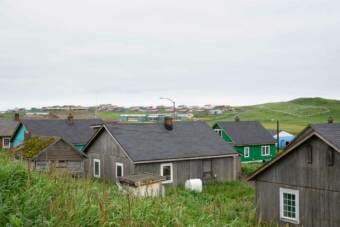
The collapse of the Bering Sea crab fisheries has put St. Paul Island at risk of losing some of its essential services.

The city’s economy is about 90% dependent on the harvest of snow crab, which closed for the first time in the fishery’s history in October. Without Bering Sea snow crab or Bristol Bay red king crab — which has been closed since 2021 — the City of St. Paul is estimating a roughly $2.7 million hit.
In light of those anticipated losses, St. Paul’s city government declared a cultural, economic and social emergency in late October following the fishery closures, and subsequently implemented budgetary cuts, hiring freezes and other measures.

Now, the Pribilof Island community faces the loss of its emergency medical services.

The community of about 350 people has one emergency medical technician — who is currently off island. And according to City Manager Phil Zavadil, there is only enough funding to employ them through the rest of the month. After that, the remote community will have to rely on local volunteers.

“Essentially, if something were to happen, we’ll go grab somebody in the ambulance and take them to the clinic, and that’s pretty much the extent of what can be done,” Zavadil said. 

He said that’s not ideal, but “with 60% of tax revenue gone, with no crab season, you have to make those tough choices.”

The city hires EMTs rather than relying on volunteers through the police force, which they had done previously, until the entire force resigned in late 2021, citing a vaccination requirement for city workers. It costs about $160,000 a year for the EMT contract, according to Zavadil.

He said there are emergency trauma technicians on the island, but they don’t have the extensive training of an EMT, who is certified by the state to perform various lifesaving procedures.

Zavadil estimates that the city has a budget deficit of roughly $900,000, and he said city officials are working to avoid overspending now, which could eventually lead to mass layoffs and bankruptcy later on.

We’re in a difficult spot,” he said. “As I talk to our staff and others, I have to caution them of overspending because we don’t know how long the crab crash is gonna last.”

The city is relying on donations to keep its medical services. The Aleut Community of St. Paul Island and the Central Bering Sea Fishermen’s Association have donated enough money to keep the city’s contracted emergency medical services through the end of January.

Bering Sea cod fisherman fights for better catch price amid slow fishing seasons

""
Rather than head out right away to the fishing grounds and set their gear like they usually do on the New Year, nearly 30 boats dropped their anchors or docked up in port, waiting on better news. (Maggie Nelson/KUCB)

What was once the bread and butter for many Bering Sea and Aleutian Islands fishermen now rests like a distant memory among Alaska’s commercial fishing industry.

The Bristol Bay red king crab fishery has been closed for two years, and along with it, Bering Sea snow crab have abruptly disappeared, causing another complete closure.

Together, the fisheries generally bring in millions of dollars to the fleet and the coastal Alaska communities that rely on them. Since 2021, when king crab closed and snow crab saw a huge decline in harvest numbers, fishermen have taken an estimated $287.7 million hit.

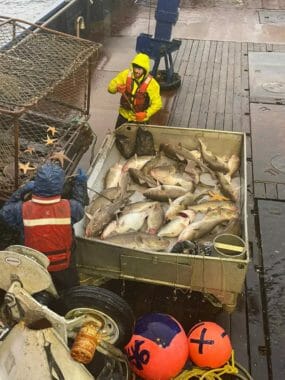
Without those fisheries and without that revenue, more and more boats are relying on other work like fishing for cod and small amounts of bairdi crab or summer tendering gigs just to make ends meet.

So when a group of Bering Sea fishermen recently heard they’d be getting paid less than they hoped for cod this winter season, they figured they couldn’t afford to just sit by. But that’s exactly what they did. When the season opened, they didn’t go out to fish — and it worked.

A fisherman stands by a cod pot that's mostly full of fish.
Fishermen on the F/V Confidence haul cod pots in the Bering Sea. (Courtesy Tacho/F/V Confidence)

Rather than head out right away to the fishing grounds and set their gear like they usually do on the New Year, nearly 30 boats dropped their anchors or docked up in port, waiting on better news.

“Trident posted a substantially low price for cod this season, but no other processors would post anything,” said Chris Studeman, captain and co-owner of the 104-foot fishing vessel Kevleen K. “And they all expected us to just go fishing with the good faith that they’ll make it right in the end. And you can’t really run an operation with the hope that somebody will make it right in the end.”

Studeman got on his phone and struck up a conversation with other fishermen in the cod fleet. Ultimately, about 26 boats joined Studeman and his crew in the informal strike. There’s likely somewhere around 40 to 50 boats total that are fishing federal cod this season. That includes both the above and below 60-foot sectors.

Studeman said he didn’t go in planning anything specific, but just wanted to gather some fisherman and talk. However, they soon organized and decided they wanted a better idea of what most of the canneries would offer them for their catch before they started dropping their gear.

“We never really put a name or a label on it,” Studeman said. “We were just trying to make sure we got the price to come out before we all went fishing. 40 cents wasn’t going to work.”

40 cents a pound was what the fleet heard Trident would pay for cod, but hadn’t received word from most other processors on price. That’s not unusual, though. Fishermen often head out to catch cod before they know for sure how much they’ll be making per pound.

Studeman — who’s been fishing in the Aleutians for about two decades — said that’s just how it goes.

“The cannery has kind of always held all the power because they put out a price and everybody goes fishing, and the only way we can stop that is to get together as a group, as a whole,” he said.

This New Year, that worked. Studeman said he hopes both the small and larger sectors of the fleet can continue to work together to advocate for one another and work with the processors.

“Because we’re able to get the small boats and the big boats both to be on the same page, I hope in the future that we can get organized the first week of December and then be talking with the processors before we even attempt to come up,” he said. “And hopefully we can have a price that everybody can agree on before we even leave our homes.”

Cod flopping in the bottom of a cod pot
The boats stood down for just about three days. By Jan. 4, they’d gotten word from most processors on prices. (Courtesy Tacho/F/V Confidence)

The boats stood down for about three days. By Jan. 4, they’d gotten word from most processors on prices.

Ultimately, Studeman said they posted a price of about 45 cents per pound across the board. That’s less than last year, but in the current climate and with increased costs for fuel, parts and labor, the five-cent jump up from the original 40 cents makes a difference.

“Pretty much all the crab fisheries that we’ve been fishing with this boat are gone,” he said. “We don’t have a lot left on the table. We got cod fish and some bairdi to go catch this year, and then salmon tendering… so everything’s pretty tight for all of us.”

A lot affects the price for cod, including changes at the processing level. And processors are also seeing increased operating costs. Tom Enlow, President and CEO of UniSea — a fish and crab processing plant in Unalaska — said the price for an entry-level processor has gone up 14% since last year.

“The market’s not the same as it was a year ago,” Enlow said. “So if we pay fishermen the price that we paid a year ago, we’re going to lose money.”

Still, Enlow said he understands where the harvesters are coming from. If he were in their Xtratuf boots, he said he’d probably do the same. And ultimately, he’s glad the company could come to an agreement with the fleet.

“It’s just a little bit of us revisiting our calculations and making sure that we can pay the harvesters with what they’d like to get paid, and still make money,” Enlow said.

UniSea is offering 46 cents per pound. And like most other processors, they also give volume incentives to their harvesters. So as the fishermen deliver more product, the price they get for that fish goes up.

As for harvest amounts, boats larger than 60 feet have 5,168 metric tons of cod to catch for the 2023 “A” season. The smaller boats have less than half that, with 2,413 metric tons. That doesn’t include the reallocation the under-60 fleet will get from the jig gear sector.

Those harvest numbers have been on a downward trend for the past several years.

Aleutian project reaches milestone as first Unalaska residents get high-speed internet

Spools of orange fiberoptic cable by a road in Unalaska.
The company announced Thursday that its island-wide launch of high-speed internet will be rolled out in a “phased approach” and won’t likely happen until mid-January. (Image courtesy of GCI)

GCI connected its first Unalaska residential customers to its fastest two-gig internet speeds this week. And while some Unalaskans now have access to that fiber connection, most community members will have to wait until the new year before logging on.

That timeframe is a little later than the telecommunications company had hoped — GCI had been planning for a launch by the end of the year. But for the majority of the island, that service is still weeks away. The company announced Thursday that its island-wide launch of high-speed internet will be rolled out in a “phased approach” and won’t likely happen until mid-January.

The announcement comes less than one month after the fiberoptic cable was damaged, likely by a ship’s anchor. It was repaired shortly after, and the company remained optimistic about its anticipated end-of-year launch date.

GCI’s AU-Aleutians Fiber project — an undersea cable running from Kodiak to Unalaska promising high-speed broadband connection across the Aleutian chain — is more than two years in the making.

According to a spokesperson with the company, there should be unlimited capacity, better even than what some urban areas like Anchorage get. Unalaskans can expect two-gigabit speeds, which is about two-thousand times faster than what locals have now.

As the company finishes launching service to the island, it will continue connecting communities along the Aleutian Chain and Alaska Peninsula, including Akutan, Sand Point, King Cove, Chignik Bay and Larsen Bay. Those communities are expected to come online within the next two years.

Roads and buildings closed as heavy rains trigger flood warning in Unalaska

The National Weather Service warning tells residents to expect six inches of rain in the next 36-48 hours, with the possibility of more flooding and mudslides. (Lauren Adams KUCB)

Several roads and public buildings are closed after a flood warning was issued amid heavy rains in Unalaska.

The National Weather Service said Tuesday between 3 to 3.5 inches of rain had already fallen in the last 24 hours and that up to 5.5 inches were possible.

Mechele Hester is the senior weather supervisor at the airport in Dutch Harbor. She says the one-day total precipitation — 3.76 inches as of 10 a.m. Tuesday — ranks among the top-10 on record.

“It’s unusual for sure. To have this many days and, looking at the forecast, for it to be continuing on? It’s definitely unusual,” Hester said.

While much of the state is experiencing sub-zero temperatures, Unalaska is unseasonably warm, with mercury levels hovering in the mid-40s over the past week. Two high pressure systems are squeezing warm air from the Pacific Ocean northwards over parts of the Aleutians, funneling warm air across parts of the chain.

Heavy fog has the airport socked in — Hester said only two planes have made it in over the past six days.

The City of Unalaska issued a travel advisory Tuesday morning. Ballyhoo Road and Summer Bay Road are closed, and the advisory warns residents to drive only when necessary. The roads crew has also removed manhole covers to help with drainage.

The warning tells residents to expect six inches of rain in the next 36-48 hours, with the possibility of more flooding and mudslides.

The flood warning remains in effect until midday Friday.

Site notifications
Update notification options
Subscribe to notifications