KUCB - Unalaska

KUCB is our partner station in Unalaska. KTOO collaborates with partners across the state to cover important news and to share stories with our audiences.
Commercial Tanner crab fishery opens in Eastern Aleutians for the first time in 5 years

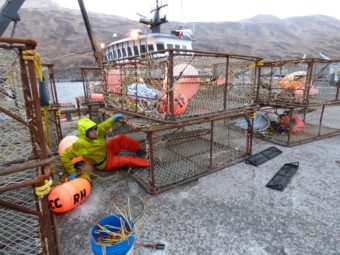
An Unalaska fisherman prepares for tanner crab season. (Photo by KUCB)

There will be a Tanner crab season in the Eastern Aleutians for the first time in five years, according to the Alaska Department of Fish and Game.

And while that’s great news for the fishery, only one section of the district will open — Makushin/Skan Bay, on the western side of Unalaska Island.

The other two sections — Unalaska/Kalekta Bay and Akutan — will remain closed.

Each year the Alaska Department of Fish and Game conducts a bottom trawl survey for Tanner crab in the Eastern Aleutian District. They can only open a commercial Tanner crab fishery when the abundance of mature male Tanner crab meets or exceeds stock size thresholds.

And even though the Akutan Sections and Unalaska/Kalekta Bay Sections didn’t reach those thresholds, Makushin/Skan Bay did for the first time since 2018.

Ethan Nichols is the assistant area management biologist for shellfish at the Dutch Harbor Fish and Game office. And he said the opening is a good sign.

“We’re pretty excited about the fishery and Makushin this year, because we’re seeing more legal crab than we’ve seen in quite a few years. And we feel that this year’s removal is pretty conservative,” Nichols said.

That removal refers to the general harvest level — how much crab people can catch.

The level this year is 49,000 pounds, which is the second largest there’s been since the Makushin section of the fishery was established in 2004.

The fishery opens on Jan. 15, 2023 at noon.

Another Aleutian volcano is showing signs of unrest

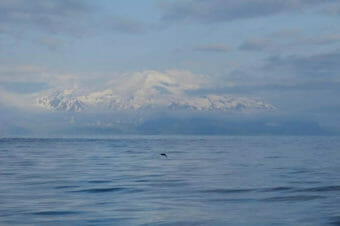
A snowy volcano, partly obscured by clouds, seen from across calm seas.
The east flank of Takawangha on June 10, 2021. (Loewen, M. /Alaska Volcano Observatory/U.S. Geological Survey)

Four Aleutian volcanoes have been under elevated alert levels for about a year. Now they’ve been joined by a fifth.
The new one is Takawangha, which rises 4,753 feet out of the Bering Sea in the far western Aleutians.

The Alaska Volcano Observatory put Takawangha on its watch list when a swarm of earthquakes with magnitudes between two and three intensified around the volcano.

John Lyons, a research geophysicist at AVO, said swarms often point to volcanic activity.

“That typically indicates that there’s been magma or volcanic fluid there,” Lyons said. “A swarm of earthquakes can often precede activity at the surface, including an eruption.”

The swarm began on Nov. 18, prompting the Alaska Volcano Observatory to move the volcano’s aviation color code to yellow, which means it’s showing elevated levels of activity but not erupting.

Active lava fountaining at Great Sitkin volcano on Aug. 5, 2021. (courtesy of Peggy Kruse)

The other four volcanoes are Great Sitkin, Cleveland, Pavlof and Semisopochnoi. Most have been moving in and out of the yellow and orange advisory levels. “Orange” means that an eruption is likely or already happening, but it’s not creating major hazards.

Five volcanoes rumbling at the same time might sound like a lot, but Lyons said it’s not uncommon for the state.

“There’s so many active volcanoes in Alaska, having five that have an elevated color code isn’t really extraordinary,” Lyons said.

Takawangha is about 55 miles west of Adak and could threaten the city of around 200 people should it erupt, but Lyons said the current advisory level is no cause for concern.

“The potential hazard to people in Adak is very low right now. And because the volcano is so well monitored, and because the Alaska Volcano Observatory is keeping an eye on it, there will be signs and we will catch those signs and put out timely notices if there’s any change in activity,” he said.

As of Monday, the swarm was still continuing at Takawangha and the color code remained at yellow.

Unalaskans hope new regional airline means better local air service

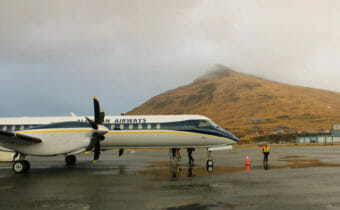
A turbo prop on the ground at the airport in Unalaska, with Mount Ballyhoo in the background.
Aleutian Airways’ inaugural flight marked the first commercial flight on a Saab 2000 to Unalaska since 2019. (Photo by Maggie Nelson/KUCB)

New regional airline Aleutian Airways touched down at Unalaska’s Tom Madsen Airport on Nov. 16., and with it arrived the hope of more stable and affordable air service to the remote Aleutian Island.

The roughly 15 passengers on board Aleutian Airways’ inaugural flight from Anchorage were greeted by a few dozen cheering Unalaskans, including local officials from the city and school district.

“It’s nice to see change,” said local Karley Parker. “And it’s a very welcome change. I’m glad that we have options. It’s much needed here in Unalaska, for competition and rates and just getting people off the island.”

Parker was one of the passengers on the fully booked return flight back to Anchorage. She’s lived in Unalaska most of her life and said she’s excited to have airfare options in general, but also to be able to catch a shorter flight.

The new regional carrier, which is operated by Sterling Airways, flies to Unalaska Mondays through Fridays on its Saab 2000 aircraft, which is a high-speed turboprop plane that holds around 50 passengers.

Previously, Ravn Alaska was the only airline offering regularly scheduled flights between Unalaska and Anchorage. Ravn flies smaller and slightly slower DeHavilland Dash 8 planes, which were used in place of the Saab after the same kind of aircraft — a Saab 2000 — crashed at the end of the runway during a commercial PenAir flight, killing one passenger in 2019.
Aleutian Airways’ Wednesday flight was the first time since that crash that a Saab 2000 had flown commercially to the island. A National Transportation and Safety Board investigation revealed that bad wiring, lax oversight and poor judgment were all factors in the fatal crash, which sparked a hailstorm of unreliable and expensive air service to and from the island.

Previously, Alaska Airlines flew jets from the Ted Stevens International Airport in Anchorage. But in 2004, the mainline carrier pulled its fleet from Unalaska due to weather cancellations and safety concerns over the island’s short, 4,500 foot runway. PenAir continued to service the island under an agreement with Alaska Airlines until the 2019 crash. But since Alaska Airlines stopped flying to Unalaska, there has been just one airline providing regularly scheduled service at any one time. And at certain points following the crash, Unalaska has been left without any commercial flights.

Unalaska, which is about 800 air miles from Anchorage and home to the nation’s largest fishing port by volume, has a year-round population of about 4,500 residents. But during peak fishing seasons, that number doubles. The region, while remote, is an industrial hub for the fishing industry and sees significant foot traffic from both locals coming and going for work and vacation, as well as the thousands of industry workers arriving for seasonal employment.

Flights on the new airline will cost about the same as other options. A one-way ticket off the island on Aleutian Airways and Ravn costs a minimum of about $650 but is usually closer to $750. And if you want a refundable ticket, it’ll be nearly $950, which is more than a seat on the average charter. Those skyrocketing airfare costs have local officials worrying about the future of the remote but vital fishing town.

But with Aleutian Airways’ entrance onto the regional market, some Unalaskans hope there is improvement on the horizon. For Denise Rankin, president of the Ounalashka Corporation, it’s a breath of fresh air to see the new regional airline’s puffin logo hanging above Unalaska’s check-in counter.

She said she came to the inaugural landing to show support for the new airline and say hello to some of the folks flying in.

“I think it brings some hope to community members that eventually the prices might come down to where they can travel more and bring some stability back. I hope,” Rankin said.

Rankin grew up on the island and until recently, she said she hadn’t left in about four years.

“Having a larger flight that can carry your bags with you is really important,” she said. “And I’m hoping that it will bring down some of the flight prices. But airfare was one of the main reasons we weren’t traveling. It was really expensive.”

Unalaska’s former Mayor and a contractor for the new carrier, Frank Kelty, was one of the first folks to deboard the plane and walk into the Tom Madsen Airport, as Rankin and dozens of others greeted them.

“We’re going to have dependable fast service to Unalaska,” Kelty said. “This morning, we made it in two hours flat, left at 7:30 and got here at 9:30. We’re going to do our best to provide a great service and we look forward to working with the community.”

He was joined by Aleutian Airways CEO Wayne Heller, who shared in the excitement about the inaugural flight.

“I couldn’t be happier,” Heller said. “I’m grinning from ear to ear.”

But the overall feeling of enthusiasm and hope that many felt about the flight doesn’t ensure lower airfare costs. Currently, Aleutian Airways’ prices are nearly identical to what Ravn Alaska offers. And Heller said he’s not sure what prices will look like going forward.

“Everything has gotten more expensive in the last couple of years,” Heller said. “Planes, employees, fuel — a myriad of different things that go into running an airline are a lot more costly than they once were. There’s a level that you have to get to in order to be able to provide service. So a lot will depend on what our load factors are in and out of Dutch Harbor. And we’ll adjust from there.”

As for the question that is likely on many local’s minds: will the new airline allow travelers to use their Alaska Airlines miles to buy Aleutian Airways flights? Heller said maybe… eventually.

It’s something on our long term plans,” he said.

The company plans to increase service and begin offering weekend flights starting Dec. 26 to help accommodate the influx of industry workers coming to the island for the upcoming winter fishing season.

The Aleutian Islands could become a hub for zero-emissions shipping

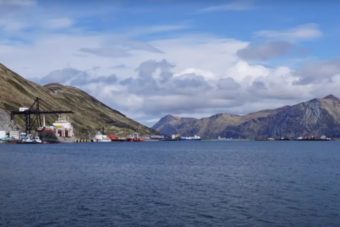
The International Port of Dutch Harbor presents the perfect fuel stop for hydrogen-powered container ships making the trip from Shanghai to Long Beach. (Hope McKenney/KUCB)

It started with a question: Is it possible for the large container ships traveling from China to the United States to make the trip using renewable fuel sources?

The international shipping industry largely runs on petroleum. The sector emits about a billion tons of carbon dioxide and other greenhouse gasses annually, according to a study published by the United Nations.

So a group of researchers at an independent nonprofit, the International Council on Clean Transportation, are looking into what it would take to transition petroleum-run ships into using zero-emission fuels.

What they found could put the Aleutian Islands right at the center of it all.

ICCT researcher Elise Georgeff has been investigating hydrogen as a potential replacement fuel. First, her team calculated how many ships could cross the Pacific Ocean using the existing hydrogen technology.

“About 43% [of existing ships] could be powered by using hydrogen fuel cells,” Georgeff said.

Fuel cells are similar to batteries, but instead of holding a charge from another source, they create a charge from fuel they store.

Georgeff found that almost half of the ships traveling from China to California could make the same trip with hydrogen fuel cells. As for the other half, the ICCT team determined that those ships would need to make a pit stop along the way to refuel.

“About 99% of the ships that couldn’t make the Pacific route before, if they just added one refueling stop — think a little gas stop on the way — they could attain the route,” Georgeff said.

This would essentially create a zero-emission shipping lane, or what many industry experts refer to as a “green corridor.”

Unalaska and Adak islands in the Aleutians are in perfect locations to become pit stops in a trans-Pacific green corridor. Most of the international ships crossing from west to east follow the same path, and those two communities are right in the middle: about halfway through one of the world’s busiest shipping lanes.

“Because of their strategic location, they could be a first player in this green corridor that’s already been talked about, between China and the United States,” Georgeff said.

Establishing a green corridor could yield significant economic benefits for Adak and Unalaska. The ICCT study estimates a market of more than $1 billion a year, if the Aleutians become a full-fledged hydrogen hub.

The United Nations has called for global leaders to work towards decarbonization of maritime shipping. And the Biden Administration has pledged to work with the U.N. to develop hydrogen and renewable energies in the American shipping industry.

The 2022 United Nations Climate Change Conference takes place next month in Egypt, when global leaders are expected to discuss global greenhouse emission standards for the maritime shipping sector.

Nationwide labor shortage hits Alaska tugboats

A tugboat in Unalaska
The 105-foot Millennium Star tractor tug services the petroleum and fishing industries. Like on many boats in the industry, crew members have been increasingly hard to come by. (Photo by Theo Greenly/KUCB)

The labor shortage hitting the nation is particularly pronounced in Alaska, where the rate of unfilled positions is about twice the national average, according to the state’s labor data.

Health care, food service and hospitality are among the hardest-hit industries.

And in the Aleutian community of Unalaska, you can see it playing out with tugboat mariners.

Chris Iszler is the captain of the Millennium Star, a 105-foot tractor tug that services the petroleum and fishing industries. He’s also the regional manager for Centerline Logistics, a marine transportation company that owns the tug.

Iszler said he started as a cook 27 years ago and worked his way up.

“Now I’m the captain and regional general manager of the operation here,” he said.

Stories like Iszler’s are pretty typical in the transportation industry. But right now, the industry is having a tough time attracting applicants for those entry-level jobs. Iszler says they’ve had one opening for more than four months, and they’ve only had a few applicants.

An entry-level cook can earn $80,000 working about six months out of the year, and the job doesn’t require a college degree. Still, many of those positions remain unfilled.

“We’ve been running without a cook on here for the last two trips,” Iszler said. “It’s not normal.”

Kimberly Cartagena works for Centerline, which owns the tugboat. They’re among the top three petroleum transportation companies in the United States, with operations on the east and west coasts, the Gulf of Mexico, Hawaii, Puerto Rico and the Panama Canal. She says her company is feeling the pinch.

“No matter how many places we posted in, no matter how many places we go to recruit from, there just aren’t people applying for tugboat jobs,” she said.

That lack of applicants means a lack of crew, which can have deep consequences for the industry. It creates the risk of boats having to stay put.

“If you don’t have enough crew members, then the vessel can’t move,” Cartagena said.

And that can ripple out to different industries. A stuck barge could result in grocery stores with empty shelves. Or cruise ships that can’t get fuel.

Although Cartagena said it hasn’t yet come to that for her company, Centerline crewmembers are forced to work more hours, longer shifts and to run skeleton crews.

“While we have a shortage in people applying for the positions, we definitely have our long-term employees who have been here for so long and are helping us get through,” said Cartagena.

A recent study from the U.S. Chamber of Commerce suggests that the so-called Great Resignation has been more of a great reshuffle. That’s because most of the people who have left jobs are getting re-hired somewhere else.

Cartagena has noticed that trend. The tugboat lifestyle can be challenging, especially for people with families. Mariners sleep on the boat, so that takes them away from their relationships on shore. She says many workers have left to take jobs where they can be closer to their families.

Millenium Star Captain Chris Iszler — who is based in Dutch Harbor — told this work-around story about an ex-crewmember who took a job in Hawaii.

“They’re so short on employees that they had to pull him on his off time from the Hawaii run and bring him up here to Dutch to fill in, so they’d have a full crew,” Iszler said. “So this is during his days off … and he’s out here in Alaska instead of being home with his family.”

People can enter the industry with relatively little experience. Someone fresh out of high school can earn their Merchant Mariner Credential and start off on a career track. And that kind of accessibility has the Millennium Star crew getting creative.

“We’ve started going through our friends. Like, ‘Hey man, do you want a freaking job?’” Iszler laughed.

And sometimes it pays off. He said the captain of another boat liked the work ethic of the person doing a bathroom remodel on his vessel, so he offered him a job.

“We’re going through the hiring process with him now,” Iszler said.

Coast Guard captain describes encounter with Chinese, Russian warships off Alaska

U.S. Coast Guard Capt. Thomas D’Arcy aboard his command, the cutter Kimball, during an Unalaska port call. The Kimball encountered several Chinese and Russian warships off Alaska in late September. (Maggie Nelson/KUCB)

The U.S. Coast Guard cutter Kimball calls Honolulu home, but recently it’s seen a lot of action in the Aleutians.

Just last month while on a routine patrol, the vessel encountered a group of seven Russian and Chinese warships traveling together through the Bering Sea. The Kimball’s commander, Capt. Thomas C. D’Arcy, recalled the encounter during a port call in Unalaska last weekend.

“We tracked them from about Kiska Island and then down through the pass,” D’Arcy said, pointing at a map of the Bering Sea. “So I’m assuming that they came up into the Bowers Ridge area and then moved in formation.”

The path the ships took was similar to that of a group of Chinese vessels that the Coast Guard tracked and followed in the region just about a year ago, according to D’Arcy.

The Kimball — which carries about 120 crew members, defensive weapons and a helicopter — came within about a mile of the group and made radio contact with them. Crew members on the foreign warships responded, but never declared who was coordinating the formation, he said.

While the group didn’t break any rules or give reason for direct contact, D’Arcy said the Kimball accompanied the ships until they passed into the Pacific side of the Aleutian Islands, where they split up.

He said they encountered the warships in the Bering Sea, in the U.S. Exclusive Economic Zone — an area up to 200 nautical miles offshore, where the U.S. has jurisdiction over natural resources. The formation never entered U.S. territorial seas.

A Coast Guardsman aboard the cutter Kimball monitors a vessel from a group of Chinese and Russian warships in late September 2022. (Courtesy U.S. Coast Guard)

NATO officials have warned of a strategic Arctic partnership between Russia and China that challenges the organization’s values and interests. For D’Arcy, Russia’s persistence to militarize and develop a presence in the Arctic is concerning. But, he said part of the Coast Guard’s duty is to ensure that the U.S. sovereign interests are protected and to spend more time in the region.

The most important piece for the Coast Guard is to make sure that we’re there and that we’re observing what’s happening, whether it’s a foreign vessel that’s coming up to do research or another naval vessel from a different country that’s operating in that area, especially if it’s anywhere near our interested waters,” D’Arcy said.

On Saturday, the crew of the 418-foot vessel welcomed more than 100 guests for tours, while docked up at Unalaska’s spit.

D’Arcy said he was excited to host the community, especially after about two years of limited interaction with locals due to the COVID-19 pandemic.

“It’s great to have the crew interact with the local community,” D’Arcy said. “The Coast Guard’s presence has been here since like the 1880s. We’ve been part of Unalaska. We’re not always the same ship or the same crew, but I think being able to demystify what we’re doing here was one of the goals that we had for this visit.”

Unalaska residents tour the U.S. Coast Guard cutter Kimball during an October 2022 port call. (Courtesy U.S. Coast Guard)

About half of the visitors that boarded the ship throughout the day on Saturday were school-aged kids, he said.

“We had stations out where they could try on gear, ask questions of our specialists — whether that was our cooks or maritime law enforcement specialists,” D’Arcy said. “We had our unmanned aerial surveillance aircraft out.”

D’Arcy said the event is meant to show Unalaskans that the Coast Guard cares about their well being and safety, but it’s also a great chance for the crew to get to know the island community.

Unalaska residents tour the U.S. Coast Guard cutter Kimball during an October 2022 port call. (Courtesy U.S. Coast Guard)

“When we say, ‘Hey, we want to do open tours,’ we have more volunteers than needed,” he said. “Everyone was like, ‘Come on, can I wear (my fancy uniform)?’ … They’re eager to show what they do. And it makes me proud.”

Unalaska residents tour the U.S. Coast Guard cutter Kimball during an October 2022 port call. (Courtesy U.S. Coast Guard)

This is D’Arcy’s second trip to Unalaska, and it’s the Kimball’s second deployment to the state. Right now, the ship is about two months into its roughly three-month station in the area.

D’Arcy didn’t comment on the strategic implications of the foreign warships the Kimball encountered last month. But he said the cutter is staged for just about anything and will continue monitoring the area for foreign military activity.

“Kimball will be ready and respond,” he said. “But if there is no foreign presence and no threat there, no adversarial strategic competitor operating in our waters, then we shift to the next tasking and priority.”

For now, the Kimball will continue patrolling near Unalaska in the Bering Sea region and into the Arctic.

As the fall weather builds and fishing seasons begin picking up, D’Arcy said the crew is preparing for weather-related accidents and enforcement of fishing regulations.

Site notifications
Update notification options
Subscribe to notifications