KUCB is our partner station in Unalaska. KTOO collaborates with partners across the state to cover important news and to share stories with our audiences.
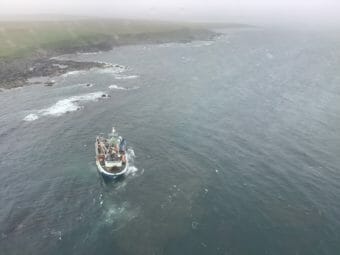
The 98-foot Pacific Sounder hailed a MAYDAY call at 10:43 Friday morning, but the crew waited three hours before they were rescued. Eventually, the Good Samaritan boat, the Polar Sea, arrived and found the crew unharmed. (U.S. Coast Guard photo)
A 98-foot fishing boat ran aground in the Eastern Aleutians on June 17 will be scuttled.
Four people were on board the F/V Pacific Sounder when it got stuck along the western shore of Unimak Island, between Unalaska and the Alaska Peninsula.
The Pacific Sounder hailed a mayday call at 10:43 Friday morning, but the crew waited three hours before they were rescued. Eventually a good Samaritan boat, the Polar Sea, arrived and found the crew unharmed.
“They were still on the boat when they ran aground,” said Nate Littlejohn, a spokesperson for the U.S. Coast Guard. “By the time the Polar Sea arrived on scene, they were wearing their survival suits.”
Littlejohn says the boat owner has hired Resolve Marine, a salvage and wreck removal company out of Dutch Harbor, to recover the boat. The first thing they will do is make sure the diesel on board doesn’t spill into the ocean. And there’s a lot of it: 21,000 gallons, to be exact.
“We sent out a Coast Guard helicopter crew Saturday who did not observe any pollution,” Littlejohn said. “That’s not to say there hasn’t been any diesel that has escaped, but we don’t know of any at this time.”
Resolve said the Pacific Sounder is too stuck for them to be able to tow it. Instead, they’ll have to scuttle it. In other words, they’ll sink it, and Littlejohn said he doesn’t know how long that will take.
“It cannot be understated how complex this operation is,” Littlejohn said, “and to make a prediction about how long it’s going to take is just not a good idea. It’s just very unpredictable how long it’ll take based on the weather.”
No reason has been given for what caused the boat to run aground. The Coast Guard is investigating.
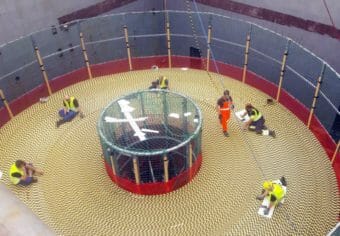
Crews carefully coiled more than 800 miles of subsea fiber into two tanks that were built on the M/V Vertom Thea in Germany. (Photo courtesy of John Edge/GCI)
Nearly 2,000 tons of subsea fiber has begun the journey from Europe to Alaska and its eventual home on the ocean floor along the Aleutian Chain.
The fiber — which is the foundation of GCI’s 800-mile Aleutians Fiber Project — would close the digital divide and bring high speed internet to homes in some of the most remote communities in the nation, including Unalaska.
In a statement, GCI said the construction and delivery of the specialized fiber is a major project milestone amid global production and supply chain issues.
“Subsea fiber, like what will be used in GCI’s AU-Aleutians Fiber Project, isn’t something that’s just sitting in a warehouse, waiting to be loaded onto a plane for its next deployment, and it’s not something you can buy from your local electronics store,” said Rebecca Markley, GCI’s principal portfolio program manager.
“It takes a highly specialized facility to build hundreds of miles of armored, sealed fiber specifically designed and made to order for large-scale infrastructure projects,” Markley added. “There aren’t many companies in the world capable of meeting the material needs of a project like AU-Aleutians — and even if they can, it doesn’t happen overnight.”
Because there are so few companies that can build the fiber needed for the project, GCI contracted with a cable producer in Germany late last year.
More than 3.7 million pounds of subsea fiber – with segments up to 230 miles long – has now been loaded onto a cargo ship and is traveling the 12,000 miles to Unalaska, according to the company.
It will make its way through the English Channel, across the Atlantic Ocean, through the Panama Canal, and up the Pacific coast to British Columbia where it will then be loaded onto two cable installation vessels and complete its journey across the Gulf of Alaska to Unalaska.
The Aleutians Fiber Project will run from Kodiak along the south side of the Alaska Peninsula and the Aleutians.
The project is scheduled to deliver service to the communities of Unalaska and Akutan by the end of this year, Sand Point and King Cove by the end of 2023, and Chignik Bay and Larsen Bay in late 2024.
“While some GCI projects have required us to practically move mountains, the AU-Aleutians Fiber Project has practically required us to part the proverbial seas,” said GCI Rural Affairs Director Jen Nelson. “The logistics of making a project like this possible are complex, but the end result of delivering transformational levels of connectivity to the Aleutians makes every foot of fiber and years of work worth it.”
The project is expected to cost $58 million. GCI was awarded a $25 million grant from the U.S. Department of Agriculture in support of the project in late 2020.
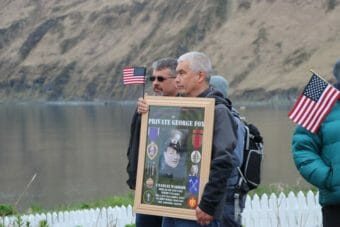
Jim Shaishnikoff holds an image of Fox outside of Unalaska’s Church of the Holy Ascension during the procession. (Kanesia McGlashan-Price/KUCB)
For nearly 80 years, a small American flag placed by an old friend was the only thing that stood above the tundra marking Pvt. George Fox’s plot in Unalaska’s cemetery.
That changed last week when the decorated veteran’s resting place was finally recognized.
Fox is the only known Unangax̂ soldier killed fighting in World War II, or in any war since. For decades, he was buried in an unmarked grave. This Memorial Day, he was finally honored with a gravestone in a long-awaited burial ceremony that drew crowds from across the state and Lower 48 to the remote Aleutian community.

Officials unveiled an honorary gravestone during the ceremony, which included an Army color guard, a 21-gun salute and a speech from Fox’s former neighbor following a procession down Unalaska’s Front Beach.
Had it not been for the heavy Aleutian fog, members of Fox’s family and Sens Dan. Sullivan and Lisa Murkowski also would have flown in to speak in his honor. Representatives from the Aleutian Pribilof Islands Association, the Aleut Corporation and members of the VA Alaska Health Care System were in attendance.
During the ceremony, which included an Army Color Guard, a 21-gun salute and a speech from Fox’s former neighbor, officials unveiled an honorary gravestone, following a procession down Unalaska’s Front Beach. (Theo Greenly/KUCB)
Fox was born in 1920 on Unga Island, the largest of the Shumagin islands, about 250 miles northeast of Unalaska. Census data shows that he and his mother moved to Unalaska by 1929, and he joined the military when he was about 21 years old, according to Michael Livingston, who played an integral role in getting Fox’s gravestone ordered. Livingston works for the Aleutian Pribilof Islands Association and spent years uncovering lost details about Fox’s past.
Fox was killed fighting in Ardea, Italy, in 1944. About five years later, his remains were returned to Unalaska. Following a small ceremony, Livingston said he was buried in an unmarked grave next to his mother at the island’s cemetery. It took a lot of work and perseverance to confirm that his body was in Unalaska, he said.
While Sen. Sullivan tried but failed to make it to the special ceremony, Livingston said he played a key role in finally moving the process forward and ordering the grave marker last May.
Livingston and a few others have been researching and battling for years to get Fox his deserved recognition.
“It really is a decade in the making,” Livingston said. “A lot of people have been working on this to try to find out the information we needed to honor Pvt. George Fox. And a lot of people have been working to get the gravestone ordered. We’re just grateful for all the support.”
He said two locals recently discovered that in 1941, Fox signed a petition to incorporate Unalaska, also making him a founder of the Aleutian town.
Unangax̂ Elder Gertrude Svarny was Fox’s neighbor growing up. She said he was a friend to her older brother.
After Fox died in the war, Svarny would walk to his grave every Memorial Day and place a small American flag on the overgrown plot. This year, thanks to Livingston’s planning and outreach, her small flag was just one of several dozen that were brought by supporters from across the state who made the trek up the hill to his grave.
Micheal Livingston gives a speech during the procession. Livingston and a few others have been researching and battling for years to get Fox his deserved recognition. (Theo Greenly/KUCB)
Following a prayer and hymn from Unalaska’s Father Evon Bereskin, Svarny and Livingston pulled an American flag shroud from the stone, revealing the new marker to the locals and visitors gathered at the base of Mount Newhall.
In a speech following the unveiling, Svarny said that to fully understand what this recognition means, people need to know the region’s history.
“When I was 12 years old, my village survived the bombing of Unalaska Island by the Japanese,” Svarny said. “Shortly thereafter, we were forced to leave home.”
“We were dropped off in abandoned canneries, gold mines and logging camps in Southeast Alaska, stripped of our civil liberties,” she told the crowd. “And it changed our lives forever. Even as this was happening to us, our sons and daughters, our brothers, sisters were signing up to fight for the United States in the war.”
She said that spirit is in part why she and others survived the camps.
“This ceremony today symbolizes the recognition of the many Unangax̂ people who served in their country,” Svarny said. “If I could wish anything, I would wish that we would all teach our children to care deeply about the welfare of their friends and neighbors. We are nothing without the community around us.”
Fox’s marker is engraved with his own words: “Wish all love.” They come from a letter he wrote to his father just weeks before he died.
Livingston read that letter in Monday’s ceremony.
“‘I would sure like to be fishing,’” Livingston read. “‘This makes three seasons that I have missed fishing. We have transferred into infantry and are seeing some action. I’m getting along fine. Don’t worry about me. Write often, and I wish you all the love. Will write more later. Your son, George.’”
The gravestone also includes Fox’s name, his date of birth, his honors, including a Purple Heart, and his recognition as an “Unangax̂ warrior.”
Joshua John Rukovishnikoff, 2, died in December. His sister, Jaylene Philemonoff, started a petition to bring his body home. (Photo courtesy of Jaylene Philemonoff)
A 2-year-old allegedly killed by his foster parents has been laid to rest on St. Paul Island. The child, Joshua John Rukovishnikoff, was buried on top of his mother’s grave during a memorial service Saturday.
Jeremy Philemonoff is from the Pribilof community of about 350 people and used to be married to the toddler’s mother, Nadesda “Lynnette” Rukovishnikoff, who was killed in September 2021.
Philemonoff said they laid John to rest right on top of her casket and placed a small cross in front of hers.
“When you’re born, the doctor usually puts the baby on the chest of the mother,” he said. “And that’s kind of what we were doing. It’s just kind of a beautiful ending to such a tragic death.”
Jaylene worked for months getting 6,000 signatures from across the globe on the petition that brought him home, according to her father. (Photo courtesy of Jeremy Philemonoff)
Several community members gathered for the memorial service at the St. Peter and Paul Russian Orthodox Church. There was a wake after the burial.
In mid-December, while in the care of his foster parents, John was medevaced to a hospital in Anchorage where he died of a serious head injury, according to a report from the Alaska State Troopers. His foster parents now face felony murder charges in his death.
His mother was killed just months before him. Joshua Rukovishnikoff — her husband at the time and John’s father — faces charges for her murder.
John had family in Anchorage and on the island. His half-sister, 17-year-old Jaylene Philemonoff, said she planned for him to be returned to St. Paul to be buried. But John’s paternal aunt had power of attorney. That side of the family had pushed for him to be buried in Anchorage, where he died.
Jaylene and her brother are enrolled citizens of the Aleut Community of St. Paul Island tribal government. The court said the tribe has inherent jurisdiction in this case.
That also means Philemonoff finally got to bring her brother home.
“At the end of the day, he’s with my mom now,” Jaylene said. “I guess that’s all that really matters.”
Jaylene worked for months getting 6,000 signatures from across the globe on the petition that helped bring John home, according to her father.
After all that work, she’s still somber, but glad that John was returned to their mother.
“I still don’t really know how I feel about it all because I did all this work and he’s still not here,” she said. “He’s still gone. So I’m very numb, but I know I did the right thing.”
A memorial service was also held in January at the Saint Tikhon Orthodox Church in Anchorage.
John’s death is still under investigation. His father’s next court hearing in the death of his mother is set for July.
House Bill 41 would allow certain nonprofits to pursue mariculture enhancement or restoration projects for species of shellfish — like abalone, razor clams, sea cucumbers and king crab. (Photo by Celeste Leroux/Alaska Sea Grant)
The Alaska House of Representatives agreed last week to changes made to a mariculture enhancement bill that would allow shellfish to be grown in hatcheries, moving it one step closer to becoming law.
House Bill 41 would allow certain nonprofits to pursue mariculture enhancement or restoration projects for species of shellfish — like abalone, razor clams, sea cucumbers and king crab. It would be the first time in Alaska’s history that people could raise animals like crab in hatcheries and release them into the wild to support commercial fisheries.
Independent Rep. Dan Ortiz sponsored the bill, which was presented in February last year.
“HB 41 plays a key role in the building blocks to make mariculture a growing and significant part of the overall Alaska fisheries portfolio,” Ortiz said.
The bill outlines safety standards and a framework for the Alaska Department of Fish and Game to manage projects for growing shellfish and keeping stocks healthy.
Ortiz said it’s just one piece of the puzzle for bolstering Alaska’s fishing industry.
“There’s lots of other things that have already happened and need to continue to happen in order to make that dream of perhaps an added billion-dollar-a-year industry to an already $5 billion, $6 billion-a-year industry.”
Right now, the capital budget has about $5 million for new mariculture projects. An important next step is the state expanding that number, he said.
“One thing that I’d like to see before the session ends is to see if we can get that number closer to the $25 million requested,” Ortiz said.
Now that HB 41 has passed the Legislature, it moves to Gov. Dunleavy’s desk for signing.
On nice weekends, F/V Raven Bay captain and owner Dustan Dickerson takes about three local teens on a short trip just a few miles from town for a behind-the-scenes look at the life of Unalaska’s small boat fishermen. (Photo by Maggie Nelson/KUCB)
It was still dark at Unalaska’s Robert Storrs Small Boat Harbor, just before 5 a.m. on a fair spring morning. Normally, Dustan Dickerson and his three-man crew would be warming up the engine of the 54-foot Raven Bay by now so they could head out a few miles to haul and set cod pots, eat, sleep and repeat for a couple days before returning home.
But on this mid-March morning, the crew was joined by three sleepy-eyed greenhorns: Corynn Lekanoff, Kaidon Parker and Anatoly Fomin.
The three local teens were headed out for a day trip to get a glimpse into the life of Unalaska’s small boat fishermen. The trip is part of an outreach program led and started earlier this year by Dickerson, captain and owner of the Raven Bay. It’s meant to provide local youth with the chance to get on a boat and see what fishing is all about.
Kaidon Parker, 14, had just started his spring break that morning. Despite the heavy bags under his eyes, he was eager to set sail.
“I’m not [sick] yet,” Parker said when asked if he gets seasick out on the open ocean. “On ‘Deadliest Catch’ when the waves are hitting the boat and they’re all like falling over and stuff — I thought that would be kinda fun.”
Deckhands on the F/V Raven Bay. “There’s a beauty to it,” said 20-year-old local deckhand Scott Lorenzen. “It’s just fun to be able to go out there and experience the raw Aleutian wilderness.” (Maggie Nelson/KUCB)
Unfortunately for Kaidon — while there was no “Deadliest Catch” galley drama, cranky captains or climactic 50-foot waves — he learned the hard way that he does in fact get seasick.
But that lesson was, in part, what he came for — a chance to test the waters and learn more about fishing in the Aleutians.
“Last summer, I actually asked [Dickerson] if he could take me and some friends out, and he told us that we should invest in a little boat and a tote and a jigging machine for fish,” Kaidon said. “But we couldn’t do that. We didn’t have any money.”
Ultimately, Parker got a better deal: a free trip to the fishing grounds and a behind-the-scenes look at how a local fishing veteran runs his boat.
Dickerson owns and operates the Raven Bay and has been working in Unalaska’s fishing industry since the late ‘80s when he came to the island. He bought his first boat, the Katie Jean, in ‘93.
“I was 25 years old in Corvallis, Oregon visiting a friend,” Dickerson said. “And this guy from Alaska came over and started telling these incredible stories. And I thought, ‘I’ve got to go there.’ And so I bought a plane ticket to Dutch Harbor and never left.”
The three local teens watch seagulls trail the boat, as the crew waits to haul another string of pots. Pictured left to right: Corynn Lekanoff, Kaidon Parker and Anatoly Fomin. (Photo by Maggie Nelson/KUCB)
Since then, Dickerson has seen the industry ebb and flow and watched the small boat fisheries and once-young fishermen evolve and start to grow old. Dickerson said things like a lack of local boats along with the aging community have led to a shortage of younger Unalaska fishermen today.
Rather than sit back and watch the fishery dwindle, he got some help from the Unalaska Native Fishermen’s Association’s youth program and took things into his own hands.
“If we can’t find deckhands, then we need to mentor them,” he said. “We need to make them ourselves and that means we need to get them involved.”
On nice weekends, Dickerson takes about three local teens along for a short trip just a few miles from town. He shows them how a commercial fishing vessel runs. UNFA is helping fund the program by paying for things like crew licenses and survival suits for Dickerson’s extra passengers.
Dickerson, who is a UNFA board member, said working with the organization to revitalize the local fishery is not only important for his generation of fishermen and boat owners, but also for younger folks. It’s not as easy for fishermen to get a foot in the door as it once was, he said.
“It’s important to preserve opportunities for people that are just getting started, otherwise we will have a big problem,” he said. “Otherwise there won’t be any more small boats because once I retire unless I pass this boat along, how is somebody in the community gonna get started?”
Dickerson owns and operates the Raven Bay and has been working in Unalaska’s fishing industry since the late ‘80s, when he came to the island. He bought his first boat, the Katie Jean, in ‘93. (Photo by Maggie Nelson/KUCB)
Dickerson’s story is one that he said is less feasible now. He entered the fishing industry first through processing, then went to longlining, bought his first boat and finally got into pot fishing in the under 60-foot fleet, which locally he said saw major growth around the early 2000s.
He said, prior to that, it was easier for a local to buy a skiff and get a jigging machine, then jump to longlining and eventually buy an entry-level boat. Now, Dickerson said it’s much harder to jump from jigging on a skiff to owning and operating a smaller boat like the Raven Bay, or even just long-lining in a skiff. A big part of that, he said, is the combination of how cod is allocated and the growing number of larger boats in the under 60-foot fishery.
Part of the solution lies in the hands of fisheries boards and councils who determine how the catch is allocated, but it’s also about exposure, he said. Cue the youth outreach program.
Since the program started, Dickerson said they’ve taken a total of three trips, and they’ve got teens on standby now, waiting for their turn to hop on board.
“What it’s doing is creating a labor pool that we really need in the industry,” he said. “Kids that have been exposed to commercial fishing are far more likely to get into the industry than having graduated from high school without ever being on a boat.”
While the program may be fulfilling a more complex purpose, Dickerson modestly describes it as a simple way of facilitating an already existing interest in local fisheries. It’s as basic as bringing curious youth, like Parker, along for a quick trip out to the fishing grounds.
The idea for all of it came about organically, he said.
“It hadn’t occurred to me a year ago to hire somebody that was just out of high school,” Dickerson said. “I normally like to have experienced people on the boat, but we were missing a guy and Scotty Lorenzen’s name came up.”
Fish on the F/V Raven Bay. (Photo by Maggie Nelson/KUCB)
Eventually, Lorenzen hopped on board. He started out as the bait guy and now, just a year later he’s switching out with his deck boss, working the hydraulics. Along the way, Dickerson said 20-year-old Lorenzen recruited some friends, including local Alex Schliebe.
“It was just a breath of fresh air to work with young people,” Dickerson said. “It was a good way to re-observe my surroundings through fresh eyes.”
For the hesitant, sleepy and seasick teens, the most effective part of the recent trip in March was the example the young fishermen set on deck.
Eighth-grader Corynn Lekanoff watched the fishermen from a window in the galley, leaning over the sink to get a closer look at the sorting table.
“When you cut gills on fish, normally, you rip them out, but they have like a thingy,” Lekanoff said, making a stabbing motion with her hand.
Lekanoff said she does subsistence fishing, but this was her first time getting to see the commercial side. She said she came to see how things work, but she isn’t sure if she’ll pursue a career in commercial fishing.
From left to right: Alex Schliebe, Kaidon Parker, Scott Lorenzen, Anatoly Fomin, Kevin Herron, Dustan Dickerson and Corynn Lekanoff. (Photo by Maggie Nelson/KUCB)
As the sun rose, the three fishermen worked in rhythm on deck. One would throw the hook, another ran the hydros, the third would count the fish and coil the line. They all worked together, cracking jokes, baiting the pots and launching them back into the sea, hoping to find more cod in the next haul.
“There’s a beauty to it,” said local deckhand Scott Lorenzen. “It’s just fun to be able to go out there and experience the raw Aleutian wilderness and to be able to have that life that a lot of people would really appreciate to live.”
Lorenzen grew up in Unalaska and recently joined the UNFA board. He said growing up around the island’s famed fishing industry initially piqued his interest. And now that he’s a part of it, he said he wants to advocate for other young fishermen.
“It’s really a dying industry, especially the small boat fleet,” Lorenzen said. “This boat and just a couple others are pretty much the last of the small boats really that are out fishing near town and come home just about every night. It would just be nice to help my captain out with what he’s trying to do and repopulate the small boat fleet.”
According to Dickerson, as long as there’s youth on the island interested in fishing, he plans to keep taking them out.
“We’re gonna continue this program until I retire,” Dickerson said. “It’s just too convenient to be fishing, you know, 10 miles out of town and not take people out to expose them to this.”
Close
Update notification options
Subscribe to notifications
Subscribe
Get notifications about news related to the topics you care about. You can unsubscribe anytime.