KUCB - Unalaska

KUCB is our partner station in Unalaska. KTOO collaborates with partners across the state to cover important news and to share stories with our audiences.
Alaska businesses have until April 15 to apply for 2nd round of pandemic relief grants

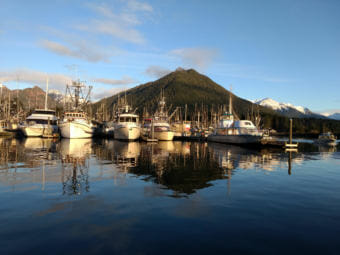
Sitka fishing vessels in harbor on Jan. 18, 2018. (Photo by Jacob Resneck/KTOO)
Sitka fishing vessels in harbor on Jan. 18, 2018. Commercial fisherman who own and operate their own boats may be eligible for the second round of the state’s pandemic relief program for businesses, Southwest Alaska Municipal Conference director Shirley Marquardt said. (Photo by Jacob Resneck/KTOO)

Alaska businesses hurt by the COVID-19 pandemic have until April 15 to apply for tens of millions of dollars from a second round of federal pandemic relief funding.

But that’s only if they didn’t get money during the state’s first series of American Rescue Plan Act grants.

Even if business owners applied and were turned down during that first round of the Alaska ARPA Business Relief Program, they can still give this second round a shot, said Shirley Marquardt, executive director for the Southwest Alaska Municipal Conference.

“If you applied, but you did not get any funding, for whatever reason … you can go back and you can apply again here on round two,” Marquardt said. “And I would really strongly urge people to do that.”

To be eligible, applicants have to show they’ve lost at least half or more of their gross revenue from 2019 to 2020 due to the pandemic.

The state Legislature originally allocated $90 million from the Covid State and Local Fiscal Recovery Funds, which is a part of Alaska’s ARPA funding, to go toward the tourism and business relief grant program. Of that original amount, there’s about $34 million dollars left in the state’s ARPA pot.

Unlike the CARES program, this grant isn’t first-come, first-serve, and all approved applicants will get funding, according to Marquardt.

You might not get all of the funding you asked for,” she said. “It completely depends on the number of complete, full applications that they’ve received and reviewed by the cutoff date.”

With about a week left to apply, Marquardt said there’s still plenty of money to go around.

“They have not had anywhere near the applications turned in as they did on the first round last year, where there were tens of thousands,” she said. “Right now, it’s in the very low hundreds.”

Marquardt said the pandemic affected Southwest Alaska differently than the rest of the state. Even within the region, she said the economic effects varied.

For example, in Kodiak, she said there are more businesses that rely on tourism and were devastated by the lack of visitors. In Unalaska, the effects were more localized to the fishing industry.

“We’re not visitor-based,” Marquardt said. “And we don’t have a university system that supports us. We don’t have a hospital system that supports us, like Kodiak does. We have fishing. So the impacts to the communities were more so for the processors and the harvesters.”

Only one Unalaska small-boat fisherman applied for the first round of funding, according to Marquardt. She said that was a missed opportunity for the community.

“Any commercial fisherman who owns and operates his own boat, or hers, is completely eligible,” she said. “You just have to be able to show your tax documents that go, ‘Yeah, this is what happened to me in 2020. I lost 50% of my revenue.’”

Businesses who received money through other programs, like the PPP or through tribal funding, are still eligible for this round of ARPA funding, Marquardt said. And if they qualify, businesses can use their money however they want.

She said there’s no reason not to apply if you’re an Alaska business owner who lost at least half of your revenue and didn’t get funding in that first round.

It’s either a yes or no,” she said. “And if it’s a yes, it comes in the form of a check — a very large check — that you can then use to pay off debts.”

Applications are due by 5 p.m. on April 15. Find more information on the State of Alaska’s website, and more resources at SWAMC.org.

Unalaska tribe gets federal money for geothermal project to source energy from active volcano

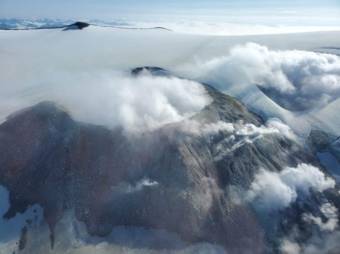
The 6,000-foot Makushin volcano’s molten magma could provide a fuel source for the Unalaska, a city of 4,500 people. (Photo by Givey Kochanowski/U.S. Department Of Energy)

For decades, green energy proponents have been trying to harness geothermal energy from an active volcano on Unalaska Island. And although there have been hurdles trying to bring geothermal energy to Unalaska, the clean energy source is one step closer to fruition.
The 6,000-foot Makushin volcano last erupted in the 1990s and its molten magma could provide a fuel source for the Aleutian community.

The Qawalangin Tribe of Unalaska has received more than $2 million in federal dollars to go towards the Makushin Geothermal Project to harness a local source to power the island’s community and industry. It’s part of the $1.5 trillion spending bill that President Biden signed on March 15.

Unalaska is a city of around 4,500 people that’s host to several large fish processing plants and the Port of Dutch Harbor. The city has relied exclusively on diesel to power the electrical grid since World War II but has sought new power sources for decades.

The power project is being led by Ounalashka Corp./Chena Power, LLC, a joint partnership between Unalaska’s Native village corporation and a Fairbanks-based private energy firm.

Although the Qawalangin Tribe is not a partner with OCCP, the tribe’s chief executive Chris Price says they are helping out and providing funding.

“We came up with this proposal to Congress to support the geothermal project and we were able to secure $2.5 million to go towards geothermal diversification, education programs, and to support the Makushin Geothermal Project,” Price said.

The city currently uses around 3 million gallons of diesel per year, according to Richard Owen, the city’s powerhouse supervisor.

The city signed an agreement to purchase about $16 million of electrical energy per year from OCCP in 2020 to replace its reliance on diesel. That amount would increase each year.

Unalaska City Manager Erin Reinders has said the city’s ratepayers would likely be paying slightly more initially, but the cost would go down over time, especially if industrial customers — like seafood processors — get on board with purchasing geothermal produced electricity.

The three main processors in Unalaska largely provide their own power by burning diesel generators and have not agreed to any purchase arrangement with the city, but Unisea wrote a letter of interest for the project — at least in principle.

Tribal President Harriet Berikoff said she is optimistic the fish plants would see the writing on the wall and get on board with locally produced energy that would bring rates down.

“I hope our electricity becomes cheaper, and everybody else kind of joins in together,” Berikoff said. “We’ve been [talking for years and years], but I’m sure the canneries and the other businesses will eventually join and support us.”

Originally, the geothermal project was expected to be completed by the summer of 2024.

But OCCP has needed several extensions. The most recent was in February; now the project is expected to be complete in 2027.

The City of Unalaska, the Qawalangin Tribe, and the Ounalashka Corp. all say they are working together more closely to capitalize on an agreement they signed to move forward united on some of the community’s key infrastructure projects.

And Berikoff said that will help pave the way for the future.

“Well, I’m hoping that, as a team, we can all work together and make it work,” Berikoff said. “I’m sure it’s gonna work, with the rest of us trying to do the best for the community here.”

Representatives from OCCP did not respond to several requests for comment.

Coast Guard cutter Alex Haley medevacs its 2nd patient in 4 days

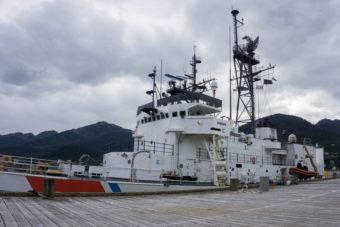
The Cutter Alex Haley in port at Coast Guard Station Juneau. (Photo by Jeremy Hsieh/KTOO)

The U.S. Coast Guard medevaced a man from a fish processing boat north of Cold Bay Monday.

The 62-year-old man was hoisted from the 254-foot Phoenix after he experienced stroke-like symptoms, according to a USCG news release. Officials at the command center in Juneau received the initial medevac request shortly before 11 a.m. Monday morning.
The vessel was about 50 miles north of Cold Bay Monday afternoon when the Alex Haley sent its MH-65 Dolphin helicopter crew to rescue the sick man. He was flown to Cold Bay, where he was put in the care of an ambulance crew.

Winds were gusting up to 40 mph and seas were at a height of 10 feet during the hoist, the statement said.

Master Chief Petty Officer Christopher Cole said this week has been busy for the cutter and its aircrew.

“They had two medevacs in four days and were essential in getting these individuals to a higher level of care,” he said in a statement.

USCG officials didn’t elaborate on the man’s condition.

Federal appeals court reverses decision that blocked King Cove road

""
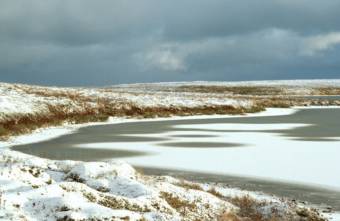
The Izembek National Wildlife Refuge sits at the tip of the Alaska Peninsula, in the Aleutians East Borough. There are more than 200 species of wildlife in the refuge. The proposed road would pass through the refuge, providing the roughly 1,000 residents of King Cove access to the airport in Cold Bay. (U.S. Fish and Wildlife photo)

A federal appeals court last week reversed a decision that had impeded construction of a road through the Izembek National Wildlife Refuge.

The proposed road would stretch 11 miles through the wildlife refuge on the Alaska Peninsula, connecting the communities of King Cove and Cold Bay.

The project has been held up in the courts since 2020, when a judge blocked a land exchange necessary for the road’s construction.

But the court decided last Wednesday to reverse that judge’s decision that prevented the swap between King Cove’s Native corporation and the federal government.

Supporters of the road say it will save lives. The small airport in King Cove is closed due to weather around 100 days a year, on average. Advocates say connecting King Cove to the much larger airport in Cold Bay would make emergency medical care more accessible for residents of the small community in the Aleutians East Borough.

Several environmentalist groups have filed lawsuits to stop the road. They say the road would tear through delicate ecosystems that protect wildlife.

Randi Spicak, the public lands director at the Center for Biological Diversity, called the ruling “devastating” and said that it “sacrifices a globally important wetland that’s vital to millions of migrating birds, fish and caribou.”

Sen. Lisa Murkowski applauded the court’s decision. In a statement, she urged the Biden administration and Interior Secretary Deb Haaland “to do the right thing and join our fight to secure a short, gravel, one-lane, life-saving road for King Cove.”

Interior Secretary Deb Haaland hasn’t taken an official position on the project. She says she is making plans to visit the two Alaska communities. She had initially planned to visit in summer 2021, but postponed due to concerns over the COVID-19 pandemic.

The Aleutians have a rat problem. Scientists are trying to solve it.

A "no rats" sticker on the gas cap cover of a white vehicle
A U.S. Fish and Wildlife vehicle on Adak Island promoting rat eradication. (Photo by Jennifer Pemberton/KTOO)

For millions of years, birds lived nearly predator-free on the Aleutian Islands. The volcanic archipelago stretches westward for 1,200 miles from the Alaska Peninsula, dotting a border between the North Pacific Ocean and Bering Sea. Hundreds of bird species thrived here.

Then came the rats.

When a Japanese boat sank in the Western Aleutians around 1780, stowaway rats jumped ship and made it to one of the islands, wreaking havoc on the ecosystem.

The rodents proliferated during World War II, when American Navy ships traveled along the chain, expanding the rats’ domain.

“The rats are like an oil spill that keeps on spilling year after year,” said Steve Delehanty, the refuge manager for the Alaska Maritime National Wildlife Refuge. “We would never allow an oil spill to go on for decades or centuries, nor should we allow rats to be a forever-presence on these islands.”

Rats bring a list of challenges to the islands. One: They’re a threat to birds.

The federal refuge that Delehanty manages consists of nearly five million acres of land and thousands of islands, where more seabirds breed than all of the rest of the United States and Canada combined.

But those birds are in trouble. Massive seabird die-offs in recent years have conservationists scrambling for solutions. And while there are many reasons for the decline in bird populations — rising ocean temperatures, algal blooms, and changing food sources — rats certainly play a role.

“You can have a colony that contains thousands, or hundreds of thousands, or sometimes even millions of birds,” he said. “Sadly, rats can just absolutely devastate bird populations. Seabirds, but also waterfowl and songbirds, and really the whole ecosystem.”

A couple years ago, Delehanty met with representatives from a wide range of groups, including the U.S. Department of Agriculture and the Aleutian Pribilof Islands Association, to figure out a plan to manage the Aleutians’ rat problem.

And they arrived at a fairly straightforward solution: kill the rats. All of them.

“That group collectively developed a vision of a rat-free Aleutian Islands someday, recognizing that that’s really an aspiration,” Delehanty said. “There’s no current plan to eliminate rats from every single Aleutian island. But wouldn’t that be a wonderful thing to achieve in the coming decades?”

Already, federal agencies and conservancy groups have taken steps to at least have fewer rats.

Back in 2008, before the group decided to end the rats’ Aleutian vacation once and for all, a team of scientists traveled to Hawadax Island, formerly known as Rat Island. They dropped poison pellets out of a helicopter all over the island. And they killed the entire rat population on that island.

Unfortunately, that’s not all they killed.

“We killed a considerable number of bald eagles,” Delehanty said. “They’re not out there consuming the bait, but what they are doing is consuming a rat that died that consumed the bait. Or consuming a gull, perhaps … and you can end up with this second or third order of killing that you don’t want to have happen.”

But the bird populations rebounded and thrived. A 2021 study published in Scientific Reports found that killing the rats led the island to rebound to its natural state. And now, Hawadax is touted as a success story for ecosystem recovery.

To be clear, the recent seabird die-offs have nothing to do with the Hawadax rat extermination. The rats were the main threat to birds on that island, and eradicating them is what led the ecosystem on that island to rebound.

Still, Delehanty and the team want to minimize collateral damage as much as possible. In August, around half a dozen scientists are planning to visit Great Sitkin Island in the Western Aleutians. Their plan is to put a small number of nonpoisonous pellets in strategic locations around the island. They’ll deposit the pellets by hand, then study how the pellets interact with the ecosystem.

“They are taking the same style of grain pellet that someday would include rat poison. But this year they’re using it without any rat poison in it, just to see how it breaks down in the environment,” Delehanty said. “Does a fish eat it? Does it last in the stream for hours, or days, or weeks? That sort of thing we want to learn.”

Delehanty said they’ll report their findings to see how feasible it will really be to eradicate rats from the Aleutians. He expects to complete the study by winter 2023.

Historians uncover Benny Benson’s Unangax̂ heritage nearly a century after he designed Alaska’s flag

Benny Benson, designer of Alaska’s flag, in Seward circa 1927. A judge recently ordered the state to correct Benson’s birth certificate after historians found details about his age and cultural heritage. (Photo courtesy of Alaska State Archives, Juneau)

Historians announced Thursday that they’ve uncovered evidence that key details about the teenager who designed Alaska’s state flag have been wrong for more than a century.

Benny Benson, a Seward boarding school resident, won the state’s flag design contest in 1927. But he was a year older than previously thought, according to Michael iqyax̂ Livingston who works for the Aleutian Pribilof Islands Association’s community health services.

“I’ve been working for several years with several other family tree researchers focused on Benny Benson’s cultural heritage,” Livingston said. “And in the process of that research, we found what we believe were errors in his date of birth and his mother’s maiden name.”

He led a team of nearly 20 researchers and historians, who discovered that Benson was actually 14 years old when he designed the flag, not 13 as previously thought. They also uncovered illuminating details about Benson’s cultural heritage.

The team worked for more than five years examining Benson’s family tree, deciphering and translating historical records, interviewing family members and finally compiling all of that information to be submitted to the state.

“We started digging deeper and deeper, trying to figure out where his mother was born, where his grandparents were born, on his mother’s side, and where his great grandparents were born,” Livingston said. “And then we tried to corroborate as much information from as many different sources as we could.”

After reviewing the documents on Feb. 28 — 109 years after Benson was born — Anchorage Superior Court Judge Adolf Zeman ordered the State of Alaska to issue a corrected version of Benson’s birth certificate.

Benson was also thought to be Sugpiaq, or Alutiiq, likely because he moved to Kodiak Island as an adult. But Livington said new research shows that Benson’s mother was actually born and raised in Unalaska and that Benson was Unangax̂.

“Alaska Native cultural heritage is not determined by where we move to or where we pass away or where we’re buried,” he said. “It’s not even determined by where we’re born. For example, many Alaska Natives are born in Anchorage at the Alaska Native Medical Center. That doesn’t make those people Dena’ina.”

What’s important about Benson is where his ancestors were from, he said.

Benny’s mother, Tatiana, was born and raised in Unalaska,” Livingston said. “Benny’s grandparents were from Unalaska, so Benny is a member of the Qawalangin Tribe of Unalaska. His great grandparents were from Amlia Island, which is really close to Atka village. So Benny is a descendant of the Native Village of Atka.”

Benny Benson was born in Chignik — a small village on the peninsula, about halfway between Unalaska and Kodiak islands — in 1912.

His mother died when he was about two years old. His father sent him from Chignik to the Jesse Lee Home in Unalaska around 1916, after their family home was destroyed in a fire. And he moved to Seward when the Methodist boarding school was relocated there. That’s where he entered and won the contest to design the Alaska state flag in 1927.

Benny Benson pictured at the Jesse Lee Home in Seward holding his design of the Alaska State flag, which features the North Star and the Big Dipper. (Photo courtesy of Alaska State Library, Historical Collections)

Benson received a $1,000 scholarship and a watch for his design, which features the North Star and the Big Dipper on a blue background. He eventually moved to Kodiak, where he worked as an airplane mechanic.

He died of a heart attack in 1972, at the age of 59.

Livingston said the corrections to Benson’s birth certificate and cultural heritage are important to properly honor his accomplishments.

“Benny was such an amazing role model for Alaska Natives,” he said. “And this was in the 1920s when racism was just blatant, in your face, against Alaska Natives. There were signs up that said, ‘No dogs allowed, no Natives allowed.’ And it was in that kind of environment that Benny won the Alaska flag contest.”

Some published information about Benson’s date of birth will have to be corrected, Livingston said. But he added that this is a great start for continuing research in preparation for the 100-year anniversary of the raising of the Alaska State flag, which is coming up in just five years.

Along with the official correction, Livingston and four other researchers have published an 81-page paper on Benson’s hidden Unangax̂ heritage.

Site notifications
Update notification options
Subscribe to notifications