KUCB is our partner station in Unalaska. KTOO collaborates with partners across the state to cover important news and to share stories with our audiences.
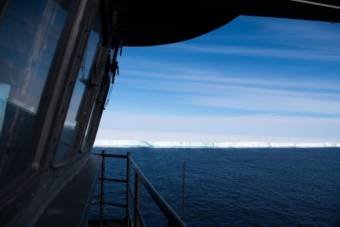
Shown is the edge of the ice shelf in the southernmost navigable water from the crows nest of U.S. Coast Guard Cutter Polar Star on Feb. 17, 2022. (Photo by Petty Officer 3rd Class Diolanda Caballero/U.S. Coast Guard)
The nation’s only heavy icebreaker reached the southernmost navigable waters on the planet last month, setting a new world record.
Melting of the Ross Ice Shelf meant the Polar Star could sail into newly navigable waters. The shelf is a huge frozen block about the size of France. In some areas, it can be nearly 2,500 ft. thick.
The nearly 400-foot U.S. Coast Guard icebreaker reached a position of 78 degrees, 44 minutes, 1.32 seconds south latitude off the coast of Antarctica. That’s about 500 yards from the edge of the Ross Ice Shelf, beating out the current Guinness world record holder for the southernmost point reached by a ship, according to a Coast Guard statement.
Almost 25 years ago to the day, the Polar Star’s sister ship, the Polar Sea, set the previous record.
During Polar Star’s transit, it surveyed nearly 400 nautical miles of the ice shelf, providing information that can be used by other ships in the future.
“The crew of Polar Star is proud to follow in the footsteps of legendary Antarctic explorers,” said Capt. Bill Woityra, commanding officer of Polar Star, in a statement. “We carry on that legacy of exploration, reaching new places, and expanding human understanding of our planet.”
This mission marks the Polar Star’s first return to Antarctica since the start of the COVID-19 pandemic.
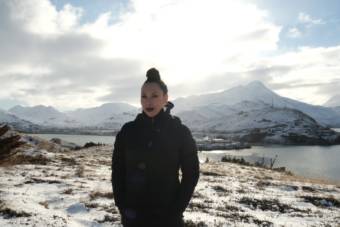
Haliehana Alaĝum Ayagaa Stepetin is an Unangax̂ artist, scholar and subsistence fisher from Achan-Ingiiga, or Akutan. She’s co-teaching the language class with her mentor, Unangam Tunuu expert Moses Qagidax̂ Dirks. (Photo by Kanesia McGlashan-Price/KUCB)
Since September, the University of Alaska Anchorage has been offering regular Unangam Tunuu classes, and it’s the first time in over twenty years that the language classes have been taught at the university level.
At the helm of the course is Haliehana Alaĝum Ayagaa Stepetin, an Unangax̂ artist, scholar and subsistence fisher from Achan-Ingiiga, or Akutan. For the last nine years, she’s been studying the language, which is native to the Aleutian and Pribilof Islands region, with her mentor and Unangam Tunuu expert Moses Qagidax̂ Dirks. Together, the two are co-teaching these classes.
In the beginner course, Stepetin and Dirks cover the Unangax̂ alphabet, common greetings, kinship terms and personal introductions.
“Ting Alaĝum Ayagaa akuq,” Stepetin gives her introduction in Unangam Tunuu. “Qigiiĝum Unangaa akuq. Akutanam asxuu Achan-ingiigam ilagaan angix̂takuq. Qiigiĝum tanangin kugaan angix̂takuq. Iluulum tanadgusii ilan anĝaĝizaq. Dena’inam tanangin ilan anĝaĝinaq. Adang Thomas Stepetin asax̂tanax̂. Akutanam ilagaan angix̂tanax̂. Anang Annette Senger asax̂takux̂. Iluulum tanadgusii ilan anĝaĝizax̂ ama Wiyot tanangin kugaan angix̂takux̂.”
In her introduction, Stepetin gives a brief family history and explains where her parents are from — an exchange well known in the Native community. At the end of the 15-week course, her students will give a similar introduction in Unangam Tunuu as their final presentation.
Stepetin said this project was inspired by her experience traveling across Indigenous homelands and witnessing this exchange everywhere. She wanted to hear more Unangam Tunuu being spoken in the world, she said.
“I’m in a Native American Studies PhD program, so almost everyone is Native,” Stepetin said. “We all introduce ourselves, and I was like, ‘it would be really great if people were doing this, not just at the Aleut Villages Conferences, but everywhere that Unangax̂ people are in the world.’”
Sharing traditional introductions in a classroom setting has become more common in recent years, but the origin of the greetings dates back to nearly six decades ago, according to Stepetin.
“The history of these Alaska Native introductions started with the Alaska Native solidarity movements in the ’60s and ’70s,” she said.
This period was one of the first times various tribes from around the state gathered in large numbers. After Alaska became a state in the late 1950s, there was an imminent threat of land loss for Indigenous peoples. This threat prompted the creation of the Alaska Federation of Natives, the largest Native organization in the state.
“And they didn’t know who they were,” Stepetin said. “And so they would say, ‘I’m so-and-so, my mom and my dad are so-and-so, and we’re from here.’”
Outlining familial ties through introductions is important among Native people because it’s a way to relate to each other, she said.
“And because a bunch of people at the time had known each other, especially through being removed to boarding schools or different residential schools,” she said. “They would be like ‘oh, yeah, I know your mom,’ or, ‘I know your dad. I’ve heard of that village. So-and-so, who I went to school with is from there.’”
This course — and the collaboration among Stepetin, Dirks and supporting organizations like the Aleutian Pribilof Islands Association — marks a big step toward Unangax̂ language revitalization.
The course culminated in a presentation where students were able to introduce family members, describe their favorite hobbies and talk about geographic roots — all in Unangam Tunuu. Stepetin said that all 23 students from the fall semester successfully completed this final project.
Stepetin hopes to teach level two Unangam Tunuu in the future. That course would likely cover conversations relevant to life on Unangam Tanangin — or Unangax̂ lands — such as weather and subsistence.
St. Paul in 2015. Ravn Alaska and Food Bank of Alaska work together to provide food for elders in the village. Ravn covers the freight costs for about 18-25 boxes of food each month. (Photo courtesy Ian Dickson)
Ravn Alaska has partnered with the Food Bank of Alaska to help provide meals to elders on St. Paul Island.
Andronik Hanson is the food bank coordinator for the Aleut Community of St. Paul Island — the local tribal government. He said shipping costs for food can get expensive on an island in the middle of the Bering Sea.
“The big thing they’re doing is donating freight to get the boxes,” Hanson said.
Ravn covers the freight costs for about 18-25 boxes of food per month, which has totaled more than 1,400 pounds since the program started in November, according to a Ravn press release.
The monthly deliveries are part of an effort to combat food insecurity in the region, said Rob McKinney, chief executive of the regional airline.
“We’re the primary carrier that serves that island,” McKinney said. “So we feel like we have a special obligation to make sure that we take care of that community.”
Ravn has covered freight costs for more than 600 meals to the island over the past few months.
McKinney said the deliveries to St. Paul will continue monthly and are the beginning of a larger project.
“Once we know what the needs are and what our capabilities are, we definitely want to look at other communities where we can expand that partnership,” he said.
The company is looking to add another De Havilland Dash 8 plane and increase its cargo capacity to supply more communities in rural Alaska with meals in the future, according to McKinney.
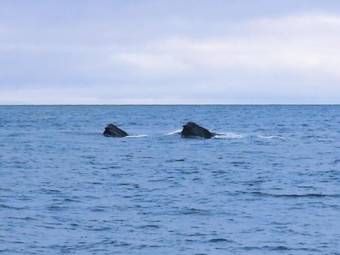
Two North Pacific right whales photographed near Unimak Pass on Feb. 8, 2022. (Photo courtesy of Josh Trosvig/FV Cerulean)
Josh Trosvig is the captain of the Cerulean, a 58-foot boat currently fishing for cod in the Bering Sea, about 80 miles northeast of Unalaska.
On a sunny day earlier this month, while he was waiting for the tide to change, he said he spotted something that looked like a large tote bobbing on the surface of the water, about 300 feet from his boat.
It turned out to be a group of whales.
But not just any whales.
“I’ve seen a lot of whales — thousands, tens of thousands in my 35 years of fishing out here,” Trosvig said. “But this was unique. I’ve never seen whales feed like that.”
Trosvig didn’t know it at the time, but the whales he was watching were North Pacific right whales. They’re critically endangered. And scientists say Trosvig is likely the first person to take photos and video of the whales feeding in the Bering Sea in the winter.
It took emailing between a few scientists until the whales were identified, because the sight is so unusual. Trosvig’s footage and other photos from fishermen prompted officials to call on fishing boats to exercise caution in the area.
Also, scientists say the images could help fill in some mysteries about the very small whale population.
“To my knowledge, this is the first sighting of North Pacific right whales in winter in the Bering Sea,” said NOAA Fisheries scientist Jessica Crance. “We have acoustic detections, or sound recordings, of whale calls during January, but no actual sightings from this time of year.”
Rolling along the water’s surface ‘like bulldozers‘
As Trosvig stood on his boat, looking out at the water, he said the whales moved almost “like bulldozers.”
They’d pop their heads up and roll along the water’s surface for minutes at a time — feeding behavior he’s never witnessed before.
At first, he said, he thought they might be bowhead whales feeding on marine invertebrates, based on their color and size. But he wasn’t sure. So he took out his phone and recorded them. Then he sent the video to an assistant area management biologist with the Alaska Department of Fish and Game in Unalaska/Dutch Harbor.
“I firmly believe that knowledge is power, especially when it comes to the oceans,” Trosvig said. “We know more about the universe outside our solar system than we do about the depths of our own ocean. And for proper fisheries management and ecological management of the ocean, it’s critical for all of us to work together.”
Asia Beder manages groundfish fisheries in the Bering Sea-Aleutian Islands region. When she got the video from Trosvig last Tuesday, she dug through her marine mammal identification books, trying to identify the dark whales with white bumps on their heads and jawlines called callosities.
But she said she wasn’t completely sure what species they were. So she forwarded the video to NOAA fisheries for help.
“The simple email of, ‘Can you ID this?’ which I’ve seen many times for fish and crab and other animals, turned into a big thing,” said Beder.
The video of the whales then made its way to Crance, who helped solve the mystery. She’s a Seattle-based research biologist with the Marine Mammal lab at the Alaska Fisheries Science Center, part of NOAA Fisheries. She said she helped identify the whales in the video as North Pacific right whales.
Beder, in Unalaska, was shocked.
“I don’t know anything about right whales, to be honest,” she said. “I know they exist, and I knew the population was low. But I didn’t realize how low, and so these sightings are really important.”
Eastern stock whale population falls from thousands to about 30
There are three different types of right whales: the North Atlantic, the Southern and the North Pacific. And the North Pacific right whales are split into two stocks: the eatern and the western.
“The western right whale is over in Japanese and Russian waters,” Crance said. “They number somewhere in the low hundreds, maybe 300 to 500 animals. The eastern stock is critically endangered.”
Scientists estimate there are only about 30 animals left in the eastern stock. That’s because the large baleen whales became the target of whaling in the 1800s. According to NOAA, the right whale got its name because it was the right whale to hunt — it moved slowly and would float after being killed.
“It’s estimated that anywhere between 25,000 and 35,000 animals were taken in just a few decades,” Crance said. “So that brought the population to maybe around the high hundreds of animals. But then in the 1960s, the Soviets began hunting right whales illegally and took over 700 additional whales. That decimated the population and brought it down to what we think are their current numbers of roughly 30 animals.”
Crance — who has been studying right whales for more than a decade — said the eastern stock feeds in the southeastern Bering Sea during the summer months. But because there are so few of them to track, it’s still unknown where they go the rest of the year.
“Prior to this, we assumed that they all migrated south, much like every other large whale population,” said Crance.
Because of Trosvig’s video, researchers are now thinking some of the whales may stay in the Bering Sea through the winter.
Crance said that because they know so little about the eastern stock — including even how long they live — every single sighting increases their knowledge considerably.
That knowledge helps them continue to monitor and study the right whale population, she said.
Tracking whales by the white bumps on their heads
NOAA has a catalog of whales they’ve seen before, with corresponding numbers or names, Crance said. And they’re able to track specific whales based on their callosities.
But Trosvig’s video and photos are too far away to confirm if they’ve seen the whales before.
“There’s no way to know if these are known individuals or are new to us,” Crance said.
There are a few known right whales that have been spotted in the Bering Sea in the past. But they were observed in the spring and summer.
For instance, Phoenix, a juvenile right whale, was spotted in the Bering Sea in 2017 — the first juvenile to be seen there in more than a dozen years. He was viewed as a sign of hope that the population might recover, said Crance.
Notchy was named for the notch on its flukes, and is the first and only North Pacific right whale to have been matched to both a high and low latitude area, according to Crance. Notchy was photographed in April of 1996 in Hawaii and, four months later, in the Bering Sea in Alaska. Notchy has made at least one migration, according to Crance, and is the only documented migration they have for this population.
Crance said Tuesday that NOAA hasn’t received any new images of the whales spotted by Trosvig in the past week or so.
But NOAA Fisheries and the U.S. Coast Guard are urging boaters to be careful in the area of Unimak Pass so they don’t harm the whales if they’re still nearby. The area is a major transit zone for ships — not just in and out of Dutch Harbor, but also to the rest of the world.
“Because they’re so critically endangered, every animal is crucial to the health of this population,” said Crance.
Also, Crance said, she hopes fishermen will continue to document the whales when they see them and send photos and videos to Fish and Game or NOAA.
“Every sighting that we get helps put one more piece of the puzzle together to try and understand the migration and movement patterns of these animals,” she said.
Nicole Misarti (left) and Caroline Funk traveled to Unalaska in the summer of 2021 to collect bone fragments from Steller sea lions, northern fur seals and Pacific cod. They scanned the bones for mercury levels to answer whether spikes in certain areas of the Aleutian Islands were caused by human activity. (Photo by Theo Greenly/KUCB)
Researchers looking into the decline of Steller sea lions over the last decade noticed that the concentration of mercury levels in lion pups was increasing in some parts of the Aleutian Islands — but they didn’t know why.
Now, a group of scientists from around the nation are working to solve that mystery with a research project called Aleutian Mercury Dynamics.
The project’s goal is to create a timeline to see mercury levels in the Aleutian Islands over the last few thousand years.
“We are looking at how mercury is present in the marine food web over thousands of years, to better understand implications for today,” said Caroline Funk, an archeologist from the University of Buffalo in New York.
Funk traveled to Unalaska in the summer of 2021 with another scientist from the project, Nicole Misarti from the University of Alaska Fairbanks. Together, they collected tiny fragments of bone from Steller sea lions, northern fur seals and Pacific cod to bring to Fairbanks and scan for mercury.
Animal remains from midden sites across the Aleutian chain reveal mercury levels as far back as 4,000 years ago. (Photo by Theo Greenly/KUCB)
The Museum of the Aleutians in Unalaska has the remains from midden sites — mounds of refuse from ancient villages — across the region, some dating back more than 4,000 years.
The bone fragments come from Unangax̂ villages across the Aleutian chain. This can be a culturally sensitive topic, so the researchers are working closely with the museum, as well as Unangax̂ tribes and corporations across the region.
Mercury can spike for natural reasons. Two prime causes are volcanic eruptions and the melting Arctic. When a volcano erupts, it releases mercury into the atmosphere. Additionally, permafrost stores mercury, so the element is released as the permafrost thaws.
But human activity can also release mercury into the atmosphere. Industrial activities, like burning fuel, release mercury as well.
The mercury research project aims to see if there were spikes in mercury across the region in pre-industrial times. That would help answer the question of whether this is solely a human-caused problem, or if it predates human activity.
“Is it coming from factories down south or in Asia that’s being blown over and dropping here?” Misarti said. “If we look 4,000 years in the past, and we have times…when there are spikes in mercury that are as much or bigger than the mercury we’re finding now, then we know this isn’t completely a human problem.”
Nicole Misarti from Aleutian Mercury Dynamics saws off a small fragment of marine mammal bone to bring to her lab at the University of Alaska Fairbanks. (Photo by Theo Greenly/KUCB)
Bones can be a window to the past. They can tell you what an animal was eating and where it was eating it. Misarti said they can extract reproductive hormones, stress hormones, and ancient DNA. And they can tell how much mercury was in the environment when the animal was alive.
After collecting tiny bits of bone fragments — about two grams of each animal — Funk and Misarti traveled to their lab in Fairbanks, where the team began analyzing the bones for mercury.
“It appears that we do have some changes through time over the last 4,000 years,” Misarti said. “From there, we’re looking at what those patterns might mean.”
They don’t have a lot of the answers they’re hoping to find yet. This is the beginning of a long, complicated process, and researchers expect to go through hundreds of samples over the next few years.
Photo of Popof Island, Alaska taken in 1905. It’s considered to be the state’s first codfish shore station. (University Of Washington Libraries/Freshwater And Marine Image Bank)
The Pacific cod fishery may have started about ten years earlier than originally thought, at least on a small-scale level, according to a recent peer-reviewed study published in the Journal of Anthropological Research.
Currently, Pacific cod landings bring in over $100 million each year, and a majority of that comes from Alaska. But it hasn’t always been that way. For a long time, Atlantic cod is what most Americans ate.
In the mid 1800s, before the Pacific cod commercial fishery was thought to begin, Atlantic cod was sent thousands of miles — from ports like Boston or New York, across the Isthmus of Panama or even around Cape Horn in Chile — all the way to San Francisco, where it helped feed the hordes of people moving to the city during the California Gold Rush of 1849.
During the first year of the gold rush, the population of San Francisco sky-rocketed. People were hungry and rapidly exploiting local food sources, said Cyler Conrad, a co-author of the study.
A caudal vertebra from an Atlantic cod found at Thompson’s Cove pictured on the left, and a Pacific cod caudal vertebra from a contemporary comparative collection. (Photo courtesy Of Cyler Conrad)
Newspaper excerpts show massive amounts of Pacific cod being delivered to San Francisco around 1863, when the fishery is considered to officially have taken off. One account from the Daily Alta California in September of that year depicts a delivery of 15 tons of Alaska cod by famed Captain Matthew Turner, considered by many to be a “pioneer” of the Pacific cod commercial fishery. The study suggests that that cargo radically changed the San Francisco Pacific cod market.
But there are also older records that show smaller deliveries of Pacific cod — some dating as far back as 1853, according to Conrad.
An 1857 article in the San Joaquin Republican suggests that Washington state’s cod fishery could pose competition to that of Cape Cod.
“People were aware of those fish populations,” Conrad said. “There were clearly fisher people, likely fishermen, that were traveling to the northwest coast, traveling to Alaska, and they were already fishing cod 10 years prior to the establishment of this large-scale fishery.”
Evidence of a small-scale Pacific cod fishery is important, in part, because it’s likely there’s more Pacific cod bones out there, Conrad said. And now there’s new questions to be asked about how that cod got there and whether it’s from the Atlantic or Pacific ocean.
And it just so happens that one scientist on the team figured out a pretty efficient way to distinguish between Atlantic and Pacific cod, Conrad said.
“He took a detailed look at the caudal vertebrae from each of [the] comparative specimens … and found this sort of notch in this feature that seems to identify Pacific versus Atlantic cod,” Conrad said. “And that all came from the work focused in this study.”
The pieces of cod vertebrae they used were found during a regulatory archeological dig of a building in downtown San Francisco about 10 years ago. It was led by Kale Bruner, another co-author of the study and also a researcher who now spends some of their time working for Unalaska’s Museum of the Aleutians.
Bruner and the team pulled random samples as contractors gutted and renovated the hundred-year-old building, which sat above a former Gold Rush site known as Thompson’s Cove.
“It was chock full of historic artifacts,” Bruner said. “The fact that we uncovered like a handful of cod bones in there — I happened to pick up a handful of cod bones — is pretty remarkable.”
It was a long, messy job. Bruner worked underground for roughly two years, reaching about 16 feet below sidewalk level. But, piece by piece, that work paid off: they collected over 65,000 artifacts, from things like a Galapagos tortoise bone to bottles of liquor, to almost 20 cod bones.
“We recognized that this was too important to just pack up and put in a warehouse and go and write a final report that nobody but the state archeologist would ever look at,” Bruner said.
The research team visually identified all 18 cod bones as Atlantic cod. Then they analyzed five bones using ancient DNA. Four of the five were confirmed to be Atlantic cod, but all of them are likely Atlantic cod based on their morphology, Conrad said.
They didn’t find any physical evidence of Pacific cod bones at that site. But their purpose was really to understand Gold Rush-era populations: what they hunted, imported and exploited.
And one major takeaway from this study is that they found a new way to identify between the two cod species, Conrad said.
“Now that we have these techniques available, and we’ve confirmed it in San Francisco, and we can identify these cod fish, I think we need to go back to these other records and try and understand what’s going on,” he said.
And in light of the discovery that the Pacific cod trade is nearly 10 years older than originally thought, that also raises a lot of new questions.
“What does this mean, perhaps for those initial populations, those initial stocks of fish, you know, for the Pacific cod fishery, especially out of Alaska?” Conrad said.
Conrad guesses there’s more Pacific cod bones out there, waiting to be excavated and analyzed, and with them even more questions to be asked.
Close
Update notification options
Subscribe to notifications
Subscribe
Get notifications about news related to the topics you care about. You can unsubscribe anytime.