KUCB - Unalaska

KUCB is our partner station in Unalaska. KTOO collaborates with partners across the state to cover important news and to share stories with our audiences.
Skyrocketing airfares have Unalaska residents wondering if they can stay

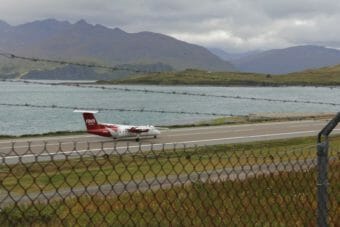
A turboprop on the runway in Unalaska
A Ravn Alaska plane at Unalaska’s Tom Madsen Airport. (Photo by Theo Greenly/KUCB)

Unalaska Fire Captain Ben Knowles was elated when he heard the news: after roughly two years of waiting, he could use his Alaska Airlines miles to purchase flights to Unalaska. Like most locals, the firefighter relies on using the mileage sharing program to afford steep airline tickets on and off the remote Aleutian island.

But that excitement quickly turned to anger and frustration when he found out just how many miles it would cost.

“Oh, great, thanks…40,000 miles,” Knowles said. “I can fly first class from Anchorage to New York for 40,000 miles. Why would I want to spend 40,000 miles on a Ravn flight that takes three hours, and my bags aren’t gonna get there, or I might not make it?”

The exorbitant cost of air travel has become a — if not the — major topic of conversation in Unalaska.

With Russia’s invasion of Ukraine earlier this year, fuel costs spiked across the nation, inciting a rise in air travel costs. Then a slew of factors compounded the problem: inflation, bad weather, pilot shortages and loads of people traveling sent those prices even higher. And in Unalaska, 800 air miles from Anchorage, nestled between the Bering Sea and the North Pacific Ocean, those costs are landing a hard blow.

It costs more miles to fly from Anchorage to Unalaska than it costs to fly to Paris.

If you’re paying cash, a one-way ticket off the island on Ravn Alaska — the regional airline that services the community — will be a minimum of about $650, but is usually closer to $750. And if you want a refundable ticket, it’ll be nearly $950, which is more than a seat on the average charter.

Even Sen. Lisa Murkowski, who visited Unalaska in August for a matter unrelated to travel, opened a speech by addressing the airfare issue.

“The cost of an airplane ticket to get out here is attention-getting,” she said. “When it’s close to $1,000 one-way to move you and your family, that’s a problem. When you have multiple cancellations and the airport packed with people, trying to come and trying to go, that’s a problem.”

It’s pretty much always been expensive to fly to and from Unalaska. It’s a doozy of a trip, involving inclement Aleutian weather and a very small runway surrounded by water and mountains.

Still, recent airfare hikes are bringing some Unalaskans to their breaking point.

“It makes everybody rethink their life moving forward,” said Unalaska City School District Superintendent Dr. Robbie Swint Jr. “And I will say, I am rethinking mine too.”

A man stands at a gate in Unalaska's airport looking out at a Ravn plane on the tarmac.
A Ravn Alaska plane at Unalaska’s Tom Madsen Airport. (Photo by Theo Greenly/KUCB)

As costs rise, spirits drop

Up until a few months ago, locals could get a one-way ticket to or from Anchorage on a Ravn Alaska flight for around $400-450 with the company’s Aleutian resident fare. But Ravn abruptly ended that program this summer. Around the same time, ticket prices began jumping. And recently, Ravn announced they would be charging for all bags, citing increased operation and fuel costs. Previously, Alaska residents were able to check two free bags.

Swint said he left the island with his family at the beginning of summer. When he went to book his tickets back, he got a startling surprise.

“Ravn did all this pretty much at one time,” he said. “We went out in June with one price, and then when we came back, it almost doubled.”

The cost for him and his family of six to leave the island is around $7,000 now, and that’s just airfare and just one-way, he said.

“I mean just to travel back and forth to Anchorage, just to Anchorage, you’re not doing anything else, no hotel, no car rental, no food, no travel — if you want to go somewhere else — it’s astronomical right now,” Swint said.

Soaring airline prices aren’t unique to the island. A June report by Adobe Analytics found that prices for domestic airlines had risen about 47% around the nation since the start of the year. But Unalaska’s remoteness and the fact that it’s an island provide particularly unique challenges.

Ravn is the only airline currently providing the island with regular commercial air service to Anchorage. Charters are available through a few different companies, but several don’t offer individual seat sales. Charters also might have to make a stop or two on the way and ticket sales are generally last-minute and will probably cost just as much or more than a commercial flight.

And while Ravn and Alaska Airlines started allowing customers to purchase Ravn tickets by redeeming their Alaska Airlines miles in April, most people are still paying cash because it costs a huge amount of miles to get to or from Anchorage. Travelers used to be able to redeem a flight between Anchorage and Unalaska for about 10,000 miles, under a similar mileage program with a now-defunct airline that covered the region.

Ravn Alaska CEO Rob McKinney told KUCB that Ravn has “no control over how many miles Alaska Airlines charges for redemption.”

But Tim Thompson, a spokesperson for Alaska Airlines, told KUCB Ravn does have a choice between two award levels.

Neither McKinney nor Thompson would specify which level Ravn chose.

KUCB also made multiple queries to McKinney asking why Ravn opted to eliminate the Aleutian rate altogether, rather than raise the price. McKinney didn’t directly address those questions, but did respond in an email saying the company’s fuel cost has more than doubled over the past two years, and labor has averaged a 60% increase. He said they’re only pricing tickets based on their costs to operate to Unalaska.

Still, Unalaska Mayor Vince Tutiakoff Sr. said he’s disappointed that Ravn removed the Aleutian resident pricing, and voiced concern that community members will be forced to leave the island in light of these increasing expenses.

“A majority of our people who live here year-round depend on the opportunity to leave and go out for a vacation with their family, and a lot of them don’t make what is necessary to get out today,” he said.

Local organizations take a hit

Ravn offers discounts to certain organizations in the city, like the school district. And even though the airline sometimes gives priority to clinic patients who need to get to Anchorage but may not be in bad enough shape to require a medevac, some still struggle to fly out.

So much so, that they’re avoiding seeking medical care all together, according to Dr. Megan Sarnecki, medical director for the Iliuliuk Family and Health Services clinic.

“Now people are hesitant to go in at all because of the cost of just flying [to Anchorage],” Sarnecki said. “If your insurance doesn’t cover travel, you’re not going to get your colonoscopy and you’re probably not even going to go get that cardiology workup. So people are putting stuff off.”

She says that can be dangerous, leaving her and her staff facing scary questions like, “are we sitting on a cancer because this person can’t afford to fly in?”

Sarneck said even folks who can afford to fly are often making those trips on their own, rather than with family members.

“People are going off and getting chemo and their family can’t go be there with them,” Sarnecki said. “It’s heartbreaking.”

The clinic isn’t the only local institution taking a hit. High school principal, athletic director and longtime community member Jim Wilson said the cost of flying right now is a huge hurdle for the district.

“If you’re a young teacher making $55,000 a year, and you need to spend $5,000 to $10,000 of that on airfare, it’s difficult to make it,” Wilson said. “And so I think it’s going to impact, not only teacher retention, but I also think we’re going to see it ultimately impact — I really, truly believe — the size of the community as well. People are having to make really hard decisions about whether they want to stay or go.”

There’s no extra money in the school’s budget to help offset the cost of increased ticket prices, he said. That means fewer students will be able to travel for events. He said coaches, staff and families will have to find new ways to come up with extra money, if they want their students to compete.

“They will need to fundraise an additional amount for every one of those tickets, which is going to be anywhere from $1,500 to $2,000, depending on the price,” Wilson said.

Searching for solutions

Part of Unalaska’s problem is its notoriously challenging runway. Landing a small plane in the temperamental Aleutian weather is difficult, but it’s the only current option.

There is some glimmer of hope on Unalaska’s horizons, though. Many locals have been awaiting the return of the Saab 2000 aircraft — a larger plane that previously flew to the island, prior to its involvement in a fatal crash in 2019.

And this week, that return took a significant step towards materializing, when a Saab 2000 aircraft touched down in Unalaska Sept. 14 as part of a test run by Aleutian Airways, a new regional airline operated by Sterling Airways.

Representatives from the new regional airline previously told KUCB that they would begin offering regular flights to the island in fall 2021. Now, almost a year later, the company has run its first test flight to the island with hopes to begin selling flights soon. The airline still needs to get certification through the Federal Aviation Administration and launch a schedule, which representatives from the company said they anticipate in the fall.

A turbo prop about to land in Unalaska
A Ravn Alaska plane on its final approach at Unalaska’s Tom Madsen Airport. (Photo by Theo Greenly/KUCB)

While many locals were excited to see the Saab 2000 on the Tom Madsen runway and the promise of competition that comes with it, the new airline doesn’t guarantee lower ticket prices for Unalaskans.

Meanwhile, city officials said they are working to arrange meetings with Ravn and Alaska Airlines, as well as the Alaska Department of Transportation and the FAA to discuss ways of alleviating current airfare costs.

There are also tentative plans to renovate Unalaska’s airport in the future, but the groundbreaking for those expansions would be millions of dollars and years away.

For now, the city is looking at appropriating some of the funding for that renovation plan toward more immediate concerns, according to Acting City Manager Bil Homka.

“I think we as a city would rather put money towards that immediate need,” Homka said. “If we can get a million dollars just to fund local airfares and spend $1,000 each, that would be about 1,000 flights, at least for locals. It’s not a permanent fix. We haven’t applied yet. We’re still looking into what we can do and what the requirements are.”

Like Homka said, some of the solutions the city is looking at aren’t permanent. They might only patch up the problem for now and most are still a ways out from actually happening. In the meantime, locals will just have to wait out the storm — or fork out the cash to leave the island, if they can afford it.

Cargo ship snags very old anchor in Bristol Bay

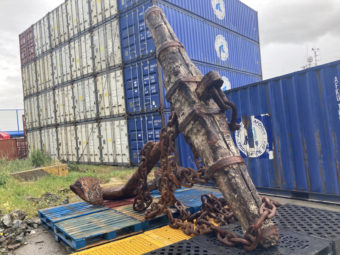
A big, rusty, old iron-and-wood anchor sitting on pallets next to a stack of shipping containers
Anchor dropped off by a cargo ship in Unalaska. (Photo by Laurelin Kruse/KUCB)

A very old anchor showed up at the dock in Unalaska on Saturday. A cargo ship accidentally pulled it up while in Bristol Bay for the salmon fishery. Now someone in Unalaska has to figure out when and where that anchor came from, and how to preserve it.

Andy Pillon is the terminal manager for the cold storage company Kloosterboer, where the anchor was dropped off on Saturday. He says the refrigerated cargo ship Orange Sea had been anchored in Bristol Bay, taking on salmon. And when it heaved up its own anchor, another one came up attached to it.

“We knew they were coming with an anchor fouled on their anchor, because that’s not unusual,” said Pillon. “We just didn’t know this would be the anchor that was coming.”

By Pillon’s estimate, the anchor weighs close to 6,000 pounds. It’s made of iron and wood, and though a few barnacles are attached here and there, it’s been well preserved by the ocean water.

When Pillon and others at the dock first researched the anchor with a quick Google search, they thought it might date back to the 1600s. Pillon has since been in touch with an expert at a maritime salvage company who, at first glance, said the anchor likely dates somewhere closer to 1850.

No one from the salvage company was available for an interview on Thursday.

Pillon says the anchor is a piece of history and wants to preserve and showcase it here in Unalaska.

“We became the custodians of a really neat maritime artifact,” said Pillon. “So let’s take care of it. We’ll put it somewhere around here [where] people can come to look at it. And hopefully, in that process, we’ll learn more about it.”

For now, Pillon says the anchor is going back in the water. He was told by a preservation expert that’s the best way to keep it in shape until he can make plans to preserve it on land. After all, the water has kept this anchor intact for more than a century already.

Ship begins laying cable that will bring high-speed internet to the Aleutians

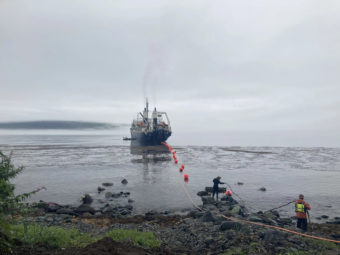
A ship leaving Unalaska dragging a heavy cable behind it
The C/S IT Intrepid begins deploying subsea fiber in Unalaska. (Photo by Laurelin Kruse/KUCB)

Work has started to lay 800 miles of subsea fiber-optic cable that project engineers say will bring high-speed internet to Unalaska and Akutan by the end of the year.

“What you will get in Unalaska is what you would get here in Anchorage,” said GCI Rural Affairs Director Jen Nelson. “It’s going to open up so many capabilities, whether it be education, commerce, or entertainment.”

GCI began surveying for the cable network — called the AU Aleutians Fiber Project — in 2017. Last week, the ship responsible for laying the cable left Unalaska for Kodiak.

Geoff Dunlop is the captain of the C/S IT Intrepid, the 377-foot ship that’s laying the cable.

“Planning a cable route is much like planning a railroad, or a goat trail,” he said. “You take the path of least risk and least resistance. Cables don’t like going over things. They want to follow a contour.”

To find the best possible route, engineers surveyed the geology and marine habitat of the ocean floor. They also met with local fishermen to make sure the cable isn’t in a position where it could get dug up by trawlers.

Once the route was set, the cable had to be specifically engineered to fit the conditions of where it will sit on the ocean floor.

The IT Intrepid typically lays cable at speeds from one to two-and-a-half miles per hour.

While en route to Larsen Bay on Kodiak, the ship will lay cable to Akutan, Sand Point, King Cove and Chignik Bay. It’s expected to complete its work by early fall.

Dunlop said bringing internet to these remote communities is part of a bigger picture — creating infrastructure for the globe.

“The reality is that there’s literally hundreds of thousands if not millions of kilometers of cable on the bottom laid by people like ourselves,” said Dunlop. “It’s not just a local event where small islands are being interconnected. It’s the global network.”

If all goes according to plan, Unalaska and Akutan will have high-speed internet by the end of this year. Service to Sand Point and King Cove will follow by the end of 2023, and Chignik Bay and Larsen Bay in late 2024.
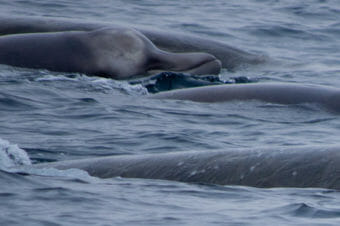
Body of beaked whale floats up off Unalaska

Three beaked whales surfacing
Baird’s beaked whales seen off Monterey in 2014. The whale found dead off Unalaska may have been a Baird’s beaked whale, but it’s not certain yet. (Creative Commons photo by Fred Hochstaedter)

The U.S. Coast Guard had an unusual wildlife spotting off the coast of Unalaska last month: the body of a beaked whale.

The whale was found floating near Makushin Bay.

Researchers say it’s rare to see beaked whales, so even spotting a dead one provides an opportunity to learn more about the animals. The whales live in the cold ocean waters and dive more than 3,000 feet down to feed on fish and squid.

“They’re very deep divers, and we don’t know a lot about them,” said Mandy Keogh, the Alaska regional stranding coordinator for the Marine Mammal Stranding Network. “When they’re done diving, they might sit at the surface for a little while, but then they’re gone again.”

A floating whale carcass
The beaked whale’s carcass floating near Makushin Bay. (U.S. Coast Guard photo)

Keogh said it appears the whale spotted last month was a Baird’s beaked whale, but it hasn’t been confirmed yet.

The Coast Guard had reported the whale to the 24-hour stranding hotline.

The hotline is part of a statewide program run by the National Oceanic and Atmospheric Administration. People can call in to report animals that are caught in fishing nets or stranded on beaches. Or, in the case of the beaked whale, floating in the water.

When possible, a team of local volunteers responds. If the animal is injured, they do what they can to help. If it’s dead, they take measurements and samples. The data helps researchers learn about individual animals and monitor populations.

In the case of the beaked whale, the stranding network was unable to send out volunteers due to the location of the animal. But Keogh said researchers are using photographs of the whale to determine information such as species, sex and whether there are any signs of trauma.

Keogh underscored the importance of people reporting stranded mammals to the hotline. Stranding reports can act as an early alarm system that something is wrong with an entire population. Keogh said this helped NOAA realize ice seals were dying in huge numbers in the Bering Sea in 2018.

We saw an unusually large number of ice seals being reported stranded dead along the shores. And that is particularly concerning because those animals are of subsistence importance,” she said.

You can report stranded, injured, and dead marine mammals to the 24-hour Stranding Hotline at 877-925-7773.

Army Corps teaches Unalaskans how not to get blown up by WWII-era munitions

A grenade, a box of bullets, and other unexploded munitions laid out on a table
Grenades, chemical weapons and other munitions have been turning up on the island’s hiking trails and beaches for decades. (Photo by Theo Greenly/KUCB)

The U.S. Army Corps of Engineers visited Unalaska in late June to teach Unalaskans about unexploded munitions.

The U.S. military left lots of unexploded ordnance when they were stationed in the Aleutian Islands during World War II. And grenades, chemical weapons and other munitions have been turning up on the island’s hiking trails and beaches for decades.

Brian McComas put in 20 years as an explosive ordnance master blaster and is now a safety specialist with the corps. He taught the class participants about the 3 R’s of explosives safety: recognize, retreat and report.

“So you want to recognize, ‘Hey this might be an ordnance item, let me get out of the area,’” McComas said.

McComas stressed the importance of leaving the same way you came in because there may be more explosives in the area.

“And then you call the police department, or the local authority that responds to your area,” McComas said.

But recognizing ordnance isn’t always so easy. McComas said things can change appearances after sitting outside for years or decades. Even he’s been fooled.

McComas said he once responded to a call on an Air Force base, where they found a shell.

“I just looked at it, and I said, ‘That’s a VW muffler.’ Because that’s what it looked like. And after contacting my office and doing research, it was a 1900s projectile, or mortar, called a Stokes mortar,” McComas said.

Rylee Lekanoff attended one of the Unalaska trainings. The 11th-grader grew up in Unalaska, and despite such a prevalence of unexploded ordnance in the area, she said she didn’t learn about proper protocol in school. Rather, it was her family who taught her.

“I heard a little bit about it growing up from my family. From my grandparents. One time my dad and a couple of his friends were out hiking, and they found a live grenade,” Lekanoff said.

The U.S. Army Corps of Engineers has made several trips to Unalaska lately to clean up old military sites. They plan to clean up petroleum contamination early this fall. But it’s a long and slow process, and Unalaskans will likely be dealing with military debris for many decades to come.

EPA fines Air Force for mismanaging hazardous waste on Shemya

A large trapezoidal structure on treeless ground
The COBRA DANE radar at Eareckson Air Station on Shemya Island. The U.S. military began activities on Shemya during World War II. In the 1990s, the Air Force built a more modern station and has maintained a presence there since. (Photo by Chief Petty Officer Brandon Rail/Alaskan NORAD Region, Alaskan Com.)

The United States Air Force has agreed to pay more than $200,000 in fines for mismanaging hazardous waste on Shemya Island in the far Western Aleutians. Shemya is about 500 miles from mainland Russia and about 1,500 miles west of Anchorage.

The U.S. Environmental Protection Agency wrote in a June 23 statement that the Air Force had stored hazardous waste without a permit at Eareckson Air Station, improperly storing tons of toxic waste fuel and oil, hazardous paints, hydrochloric acid and other chemicals as well as waste items like batteries and aerosol cans.

The Air Force agreed to pay $206,811 in penalties, as well as to properly dispose of around 55,000 pounds of hazardous waste by the end of June 2022.

Ed Kowalski, a spokesperson for the EPA, said he’s “grateful that the Air Force has acknowledged its mistakes and stepped up to its responsibilities to fix the problem.”

The U.S. military presence began on Shemya during World War II. In the 1990s, the Air Force built a more modern station and has maintained a presence there since.

Site notifications
Update notification options
Subscribe to notifications