Aleutians

‘We got a tired Tustumena’: State to open bids for long-awaited ferry replacement

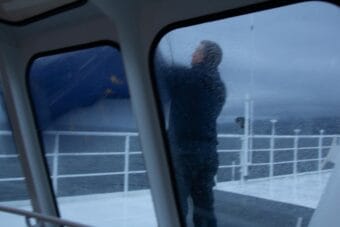
A man on a ferry deck, seen through a rain-splattered window, brings down an Alaska state flag in the rain.
A crew member on the Tustumena in August 2024. (Theo Greenly/KUCB)

The Trusty Tusty, the Rusty Tusty — the Alaska ferry Tustumena has a few different nicknames. In the Aleutians, where the ship doubles as the only restaurant for many small villages along the route, people call it the McTusty.

“We’re going to have dinner,” Ellie Hoblet said when the Tustumena docked in False Pass on Aug. 8. “There’s no other places to get food.”

Hoblet was there with a handful of others from the fishing village of about 30 residents.

“Best restaurant in town,” Calum Hoblet said. “The clam chowder and the chicken strips, that’s the best.”

Herman, Timothy and Anna Tepper have grown up in False Pass and Kodiak, where they frequently travel on the ferry. “My favorite food on the Tustumena is the chicken tenders,” Timothy said during the ferry’s stop in False Pass in August 2025. (Theo Greenly/KUCB)

The Tustumena is more than just a ferry: it’s a lifeline for Aleutian communities. Barging in freight can be prohibitively expensive, so the ferry is a cheaper alternative. And a $350 ferry ticket is often the only way people in the Aleutians can afford to travel out of their communities — a one-way flight from False Pass to Anchorage costs more than $1,000.

But the aging vessel doesn’t make it up and down the chain as often as it used to. Meanwhile, the state’s efforts to replace it have been postponed and delayed for years, leading to reduced service and canceled sailings while the ferry undergoes repairs.

A vehicle waiting for the Tustumena on the dock in Cold Bay in August 2025. (Theo Greenly/KUCB)

The ship also doesn’t sail as late into the year anymore. Captain John Mayer says one reason for that is to avoid inclement weather.

“I’m far more prudent in the weather I choose to go out in because she is a 61-year-old ship,” Mayer said. “When I first started here, it wouldn’t be unusual to leave the harbor in 20-foot seas. Now I don’t even think about that.”

Before the pandemic, the Tustumena made two Aleutian chain runs each month during the summer. In earlier years, they sailed into October, when the crew handed out pumpkins for the famed “Pumpkin Run.”

“When we would pull into port, say, for Sandpoint, the whole town would be on the dock,” Mayer said. “Total chaos.”

Akutan residents collecting pumpkins from the Tustumena in October 2011. (Ian Dickson/Alaska Desk)

Mayer has worked on the Tustumena for about 25 years, working his way up to captain in 2015. He says he hopes a new ferry will mean they can sail as late and as often as before.

“Maybe with the new ship we can, because it could just be more resistant to heavier weather,” he said.

But improved ferry service won’t happen until the state builds the Tustumena’s replacement. That’s been in the works for over a decade, but it wasn’t made official until Gov. Mike Dunleavy announced the project in 2021. The Alaska Department of Transportation solicited for builders the next year, but nobody bid.

The Tustumena crew prepares to leave Sand Point in June 2024. (Theo Greenly/KUCB)

Craig Tornga, the ferry system’s marine director, told the marine highway’s advisory board at its July 25 meeting that they’d finally be going out to bid this fall.

“We got a tired Tustumena that needs a replacement,” Tornga told the board.

He said one of the biggest challenges is a requirement that 70% of the money spent on the project goes to American companies, a point that Captain Mayer also made.

“That’s been very exasperating,” Mayer said. “They simply do not make the systems you need for a new ship in this country.”

The original target date for replacing the Tustumena was 2027. Despite the fact that the project hasn’t gone out to bid yet, and despite the fact nobody bid on it the last time, Tornga told the board that they’re still trying to get the replacement ferry on the water at the end of 2028. But he said that date could change once they accept a bid and get a more realistic timeline.

Tornga said the marine highway system is meeting with potential bidders later this month, when he’ll give another progress report.

The Tustumena’s galley in August 2024. (Theo Greenly/KUCB)

Back in False Pass, on board the Tustumena, the galley was packed at 6:30 p.m., right when the ferry was supposed to leave. Standing in the galley, Mayer started to sound more like a restaurant manager than a boat captain.

“To-go order? Anybody here to go? Everyone staying on board?” he asked.

He said he didn’t want to set sail for Akutan while folks from False Pass were still waiting for food from the best restaurant in town.

Regional airline Ravn Alaska calls it quits

A man stands at a gate in Unalaska's airport looking out at a Ravn plane on the tarmac.
A Ravn Alaska plane at Unalaska’s Tom Madsen Airport. (Photo by Theo Greenly/KUCB)

Regional air carrier Ravn Alaska announced on its website Thursday that it was closing, effective immediately.

A brief note on the site said Ravn was “no longer operating flights in Alaska” and that the company appreciated its years of service.

The Alaska-based airline had struggled since launching in late 2020, laying off staff and eliminating routes.

It first cancelled its route to Dillingham in 2022, less than a year after starting service to Bristol Bay. Just last year, the company laid off 130 employees. Most recently, Ravn announced it would stop serving the Bering Sea island community of St. Paul this fall.

The company’s former CEO, Rob McKinney, left his role last year, and Tom Hsieh — the president of Ravn Alaska’s parent company, FLOAT Alaska LLC — stepped into the top leadership position. Around the same time, the company announced it would cease flights to the Aleutians, including to Unalaska and Sand Point.

Hsieh did not respond to requests for comment Thursday.

Ravn Alaska had previously taken over service to the Aleutians from RavnAir, purchasing its license but operating as a distinct company.

Several regional airlines have stepped in to fill the gaps in rural Alaska communities. Aleutian Airways began serving Dutch Harbor and Sand Point in 2023. Last month, Kenai Aviation was accepted as the Essential Air Service provider to St. Paul, though it recently announced that service would begin about six weeks behind schedule due to aircraft maintenance.

Correction: This story has been updated to correct the years in which Ravn’s layoffs occurred.

Aleutian communities on edge after massive earthquake sends waves to U.S. coasts

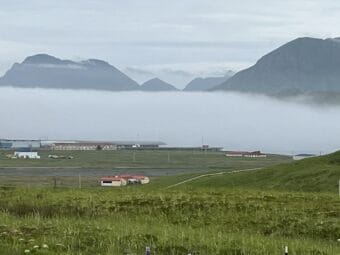
looking down on buildings in the distance from a green hillside. mountains and fog in the background
The City of Adak seen from the island’s tsunami shelter on Bering Hill Tuesday, July 30, 2025. (Courtesy of Breck Craig)

A tsunami advisory was lifted for the Aleutians and the Pribilof Islands Wednesday morning, after one of the most powerful earthquakes ever recorded struck off the coast of Russia’s Kamchatka Peninsula at about 3:25 p.m. Alaska time.
The magnitude 8.8 earthquake sparked tsunami warnings across the Pacific and sent a series of waves to the coastlines of several states and countries, including Japan and Russia, where damage was reported.

The largest wave in Alaska, at 2.7 feet, hit Adak Island at 11:21 Tuesday night, according to the U.S. Tsunami Warning System, which is part of the National Weather Service.

Adak City Manager Breck Craig and most of the community of about 50 people gathered to wait for the wave at the Bering Hill Chapel on Tuesday evening. A wave was forecasted to arrive at 5:40 p.m., but Craig said he saw no sign of one. He said people cleared out around 7 p.m.

“Everybody still went home and loaded up their trucks and gassed up their vehicles and got their generators gassed up, and we were all ready, in case, you know something happened,” Craig said Wednesday morning.

He said he didn’t get much sleep Tuesday night.

“I slept in my clothes like everybody else in town, I think, did,” Craig said.

Craig said people in Adak didn’t feel the initial magnitude 8.8 earthquake or any of its aftershocks. And thankfully, he said, they haven’t found any damage.

“We checked the pier. We checked the small boat harbor. We’re still in the process of just checking things, just to be double sure,” Craig said. “Even small waves, you know, can do damage. So far, we’re not finding anything.”

Craig said the town’s emergency systems were ready for the alert — they’d just held a tsunami siren test Friday.

“The downside of that was we had to make sure we said ‘Hey, this is not another test. This is real, please evacuate to the tsunami center,'” Craig said.

Other communities in the western Aleutians also saw tsunami waves — including Atka and Nikolski, which both had observed wave heights of over a foot, according to the National Weather Service. Waves of just under a foot were also observed in Unalaska.

Dave Snider, a tsunami warning coordinator with the National Tsunami Warning Center, said there may still be some unusual currents and water levels in coastal communities over the next several days.

“Don’t be surprised if that happens, and be extra cautious in places that you’re familiar with. Every community knows their coastline better than anybody else,” he said.

A tsunami warning had initially been in effect for communities along the western Aleutian Chain, including Atka and Adak, as well as the Pribilofs. An advisory remains in effect for parts of the California coastline as of Wednesday afternoon.

People in those places are advised to stay out of the water and away from beaches and waterways.

A magnitude of 8.8 would make this one of the ten largest earthquakes ever recorded worldwide, and the largest in more than a decade.

KUCB’s Sofia Stuart-Rasi and Theo Greenly contributed reporting.

Tsunami warning lifted for Aleutians, advisory still in effect following M8.8 earthquake in Russia

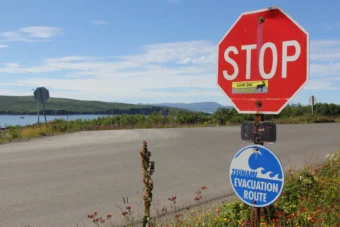
A sign marking a tsunami evacuation route in Sand Point, Alaska on July 29, 2025. (Theo Greenly/KDSP)

A tsunami warning was lifted for Alaska communities in the western Aleutians on Tuesday evening, after a magnitude 8.8 earthquake struck off the coast of
Russia’s Kamchatka Peninsula at about 3:25 p.m. Alaska time. A tsunami advisory is still in effect for the western Aleutians, including Adak, Atka and Amchitka.

A tsunami warning had initially been in effect for communities along the western Aleutian Chain, including Unalaska, Atka, Adak and the Pribilofs.

An update at 5:27 p.m. Alaska time canceled the tsunami watch for the Alaska Peninsula east of Chignik Bay as well as southern and Southeast Alaska, after an alert had been issued earlier that day for much of the state’s coast.

A map showing the tsunami warning area along the southern Alaska coastline
(Courtesy of U.S. Tsunami Warning System)

Much of the U.S. West Coast also remains under a tsunami advisory, with parts of California and Hawaii still under a warning.

A tsunami warning means people should evacuate inland or to higher ground. Under an advisory, people are advised to stay out of the water and away from beaches and waterways.

The Tsunami Warning Center said that waves of a foot or under had been observed in communities across the Aleutians, including Unalaska, St. Paul and Nikolski. Adak and Atka saw wave heights of over one foot, according to the center, with waves in Atka measuring 1.4-feet.

“A tsunami did occur,” said Dave Snider, a tsunami warning coordinator with the center. “A tsunami is not just one wave, it’s a series of powerful waves. And so it’s entirely possible that the first wave is not the largest and may not be the last.”

Snider said there may still be some unusual currents and water levels in coastal communities over the next several days.

“Don’t be surprised if that happens, and be extra cautious in places that you’re familiar with. Every community knows their coastline better than anybody else,” he said.

In Adak, City Manager Breck Craig and most of the community gathered to wait for the wave at the Bering Hill Chapel on Tuesday evening. The town’s village public safety officer, Mike Lejarzar, peered out to Kuluk Bay with his binoculars, looking for any signs of a tsunami.

“Are you seeing anything, Mike?” Craig asked. “You don’t see anything?”

A wave was forecasted to arrive at 5:40 p.m., but Craig saw no sign of one.

Craig said that by then, most of the town had evacuated to the chapel, which acts as the city’s tsunami shelter.

“We sounded the tsunami siren and collected everybody up and got everybody up here,” Craig said. “We’re all just kind of hanging out, waiting for what they’re thinking is a one foot or three foot wave maybe to come in.”

Craig said everyone had gone home by about 7 p.m., but the city would stay vigilant and watch any updates over the next 15 hours. According to the National Weather Service, tsunamis are a series of waves, and a large tsunami can continue for hours or days in some locations.

In Atka, one of the westernmost communities in the Aleutian Chain, Mayor Luke Snigaroff said that no wave had materialized as of 6:12 p.m., but roughly two dozen residents in the Unangax̂ village had evacuated to high ground.

“We’re still under warning,” Snigaroff said in a telephone interview. “Everybody’s up at the water treatment plant or the quarantine shelter.”

A magnitude of 8.8 would make this one of the ten largest earthquakes ever recorded worldwide, and the largest in more than a decade.

KUCB’s Maggie Nelson and Theo Greenly contributed reporting.

Alaska’s ‘Nazi Creek’ is no more, as federal geographic names board approves traditional alternative

This map from the U.S. Geological Survey shows the former Nazi Creek on Little Kiska Island. (U.S. Geological Survey photo)

A small creek on Alaska’s Little Kiska Island has been renamed, more than 80 years after it was named after Germany’s Nazi Party by World War II soldiers fighting in the Aleutians.

Nazi Creek was the last landmark in the United States to bear the Nazi name. Its new name is Kaxchim Chiĝanaa, meaning either “gizzard creek” or “creek or river belonging to gizzard island” in Unangam Tunuu, the language of the Indigenous Unangax̂ people.

On Thursday, the Domestic Names Committee of the U.S. Board on Geographic Names voted 17-0 to approve the new name, without discussion.

The board’s decision allows the federal government to officially change the creek’s name in federal databases that are the official repository of geographic names. That repository is used by federal agencies and commercial companies that provide maps to the general public.

The board also approved the renaming of nearby “Nip Hill,” named by soldiers using a derogatory term for Japanese people. That hill was renamed “Kaxchim Qayaa,” or “gizzard hill,” again using the traditional name for Little Kiska Island, which is not far from Kiska Island, site of a World War II battle.

Michael Livingston, an employee of the Aleutian Pribilof Islands Association, has been working for almost two years to have the names changed. Moses Dirks, an expert on Unangam Tunuu, recommended the new names.

“I think that’s pretty awesome. I think elders … and others are happy about it. It really should have never been there in the first place,” Livingston said of Thursday’s vote.

“Like one of my teachers … used to say, if you know something that can make our community better, our villages better, be brave and stand up and say something about it, do something about it,” Livingston said.

The new names were previously recommended by the Alaska Historical Commission, which considered them in April. The changes were endorsed by local Native tribes and Native corporations, the Museum of the Aleutians, the manager of the Alaska Maritime National Wildlife Refuge, Congregation Beth Sholom of Anchorage, and the Alaska Chapter of the Japanese American Citizens League, among others.

Kiska Island is located 242 miles west of Adak, at the far end of the Aleutian Islands. The area has been mostly uninhabited since World War II, when invading Japanese forces took 42 people on Attu Island prisoner. More than half died in Japanese internment camps.

The United States forcibly relocated almost 900 Unangax̂ residents of the Aleutian Islands, housing them in unsuitable internment camps in Southeast Alaska and elsewhere. Many became sick and died from the conditions imposed by the government.

Aleutian Islands residents subsequently received reparations from the federal government under legislation that also paid reparations to Japanese Americans also interned during the war.

Livingston’s work isn’t yet complete. He’s also seeking to rename Quisling Cove, a small body of water named after the Norwegian Nazi collaborator Vidkun Quisling. That name change remains pending.

Bering Sea snow crab season kicks off for first time in 3 years

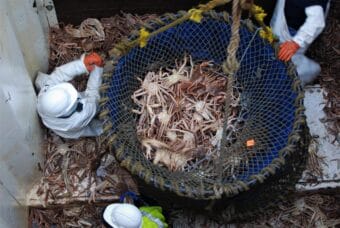
Three men emptying a crab pot on a fishing boat
Crew from the Silver Spray empty snow crab pots while fishing in the Bering Sea. (Courtesy of Bill Prout)

Earlier this month, commercial snow crabs started hitting Unalaska’s docks again for the first time in nearly three years.

The Bering Sea snow crab fishery reopened in mid-October, after billions of the crab disappeared and the fishery was shut down in October 2022. This season’s first catch was delivered on Jan. 15. Opilio, or snow crab, is generally fished in the new year and into the early spring. The season runs through May.

Alaska Department of Fish and Game area management biologist Ethan Nichols said nine vessels are actively participating in the Bering Sea commercial fishery.

“The fleet is just getting started, for the most part,” Nichols said. “Fishing so far — the reports from the grounds — there seems to be good numbers of nice, new shell, large snow crab on the far northern portions of the grounds.”

Nichols said right now the number of keepers per pot, also known as CPUE or catch per unit effort, is somewhat low coming in at 134, but that will increase as the season progresses.

“That’s only coming from a handful of our first deliveries, and that includes some prospecting by vessels early on in the season,” he said. “So far, the highest CPUEs are being seen on the northern portion of the grounds. And as vessels get more dialed in on those hot spots or those productive areas of fishing, they’ll be coming with full loads of crab that are more reflective of the hot spots on the grounds.”

Fishermen were allotted about 4.72 million pounds of snow crab this season. That’s pretty low compared to historic catch limits. About 17% of that had been harvested as of Friday morning.

Normally, some of that harvest would be processed in St. Paul. But this year, everything is coming to Unalaska because Trident didn’t open their plant to process crab on the Pribilof Island, which is the only processor in the northern region.

Nichols said it sounds like processing the extra crab in Unalaska is going smoothly. He said it’s made some of their work at Fish and Game a little easier too.

“It’s just made our sampling a little bit more streamlined, just really in terms of travel logistics this time of year, not having to battle getting in and out of the Pribilofs with weather and flight availability and all that,” Nichols said.

He said he expects to see a total of about 15 vessels participate in this year’s fishery. Four vessels have already finished up and checked out of the fishery. Fish ticket prices are coming in at around $3 per pound, according to Nichols.

Meanwhile, eight vessels are registered for the Western Bering Sea Tanner crab fishery. Less than 10% of that total harvest has been caught so far. Nichols said they expect more vessels to start targeting bairdi, or Tanner crab, as they finish up with snow crab. Harvesters have until the end of March to catch the Tanner crabs.

And the Pacific cod pot fishery in state waters opened up Tuesday for boats 58 feet and under. Nichols said he expects about 20 vessels to kick that off. They have a harvest level of roughly 44 million pounds, which is just about the same as last year’s catch limit.

Site notifications
Update notification options
Subscribe to notifications