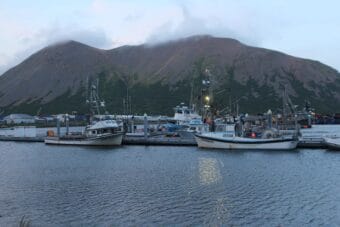
Peter Pan Seafood Co., the state-backed processing company that has faced dire financial troubles recently, announced Friday it was ceasing operations.
“We’re saddened to share that Peter Pan Seafoods will be halting operations at its processing plants, leading to the discontinuation of both summer and winter production cycles for the foreseeable future,” the company said in a Facebook post Friday night.
The company has faced mounting troubles, including legal claims from fishermen of back-owed payments for unpaid seafood deliveries.
Silver Bay Seafoods recently announced it would acquire Peter Pan’s Valdez facility, as well as operate Peter Pan’s facilities in Dillingham and Port Moller during the 2024 salmon season. It never specified, however, if the King Cove plant would be included.
“This is so sad because I (worked up in King Cove) from ‘96 through last summer,” one commenter posted. “I have good memories from King Cove and the plant, have my kids in the school for a few years.”
King Cove, a community of around 800 residents, relies on the processing facility as its main economic engine. The city already faced hardship when Peter Pan opted last minute not to open for winter’s “A” season, forcing local fishing boats to scramble for new facilities where they could deliver their catch.
“Thanks for waiting until the last possible minute before you told the community of King Cove,” another person commented. “Wouldn’t even tell the fishing fleet of King Cove face to face what was happening, we all have to find out on Facebook.”
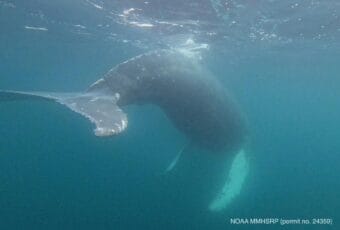
Experts say the whale looked good and that it was swimming normally. Once it got further out, it picked up some speed and took a nice deep dive. (From NOAA)
On April 1, a young humpback whale was found tied up in what was likely fishing line and anchored down in a busy area in Iliuliuk Bay. Four days later, a group of whale entanglement experts carefully cut the line wrapped around the humpback’s mouth and tail.
Ed Lyman, an entanglement response coordinator for the Hawaiian Islands Humpback Whale National Marine Sanctuary, thinks the whale was a two-year-old male who got hogtied while feeding in the area.
“(He) gets the line wrapped up in the mouth, panics, and twirls up,” Lyman said. “Suddenly, he’s got it on his tail as well — between the mouth and tail.”
It is unclear what type of fishing gear weighed down the 30-foot whale, but it gave enough slack for him to come up for air.
Lyman said the rescue process takes time. He has participated in 120 whale entanglements and said even though entanglements can be life-threatening for whales, they are not an immediate threat. He said whales are large animals, and disentangling can be deadly if not done carefully.
“So they have time on their side; we have time on our side,” Lyman said. “I’ve never been involved in entanglement where the animals died in a day or two.”
It’s unclear what type of fishing gear was weighing down the 30-foot whale, but it did give enough slack for the humpback to come up for air. (From NOAA)
The Alaska Department of Fish and Game in Dutch Harbor received a call about the entangled whale from locals who noticed that the humpback was breathing and unable to move freely.
It was then reported to marine traffic in the area. The U.S. Coast Guard in Alaska and the nonprofit organization Marine Exchange of Alaska posted a digital map displaying the entangled humpback, warning vessels entering the harbor to avoid the hazard.
Asia Beder, the state’s assistant area management biologist for Dutch Harbor, appreciated the patience shown by the community of Unalaska. She says it played a vital role in the successful rescue of the humpback whale.
“I know this was a very emotional story and event for the community,” she said. “By giving us reports, keeping the distance, and allowing us time, I think that created this into a success story.”
Local ADFG staff received expert advice on capturing footage of the whale entanglement using a camera attached to a pole. They said it helped whale experts determine specialized tools required for the rescue operation.
Sadie Wright, a large-whale entanglement response coordinator for the National Oceanic and Atmospheric Administration, is based in Juneau and has participated in 15 whale entanglements. She said whales can sometimes free themselves from entanglements. However, based on the photos and reports collected from the Unalaska community, it was clear that this whale needed help.
“It was a life-threatening entanglement, and we determined it needed an advanced response,” she said. “So reporting is essential.”
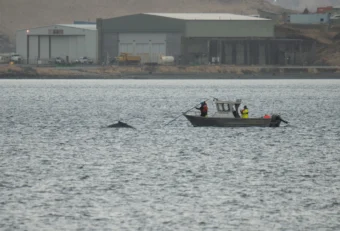
The Alaska Department of Fish and Game’s Ethan Nichols captained the primary vessel involved in freeing an entangled humpback whale in Unalaska’s Iliuliuk Bay on April 5, 2024. (Sofia Stuart-Rasi/KUCB)
The actual rescue took two days. On a boat, local Fish and Game biologists and visiting whale experts gathered data from specialized tools. They floated around the whale and sometimes over it. The team used a large pole with a hook knife at the end of it, and a camera attached, so they could see in real time where the knife was cutting the rope underwater.
“We knew which line we wanted to cut first, and then second, to try to encourage the rope to then come off by itself to slide off the animal,” Wright said, “which eventually happened.”
Lyman said the whale cooperated during the rescue and even seemed curious at times.
“It would almost rise up a little bit more and lean over a little bit,” he said. “Like, ‘What are you guys doing? Why are you here?’ You know, that kind of thing.”
After the whale was cut loose, the team followed it out of the bay and into the Bering Sea. They said the whale looked good and was swimming normally. Once it got further out, it picked up some speed and took a nice deep dive. Lyman said there’s a good chance the humpback will be fine.
“You know, I would almost bet on it, and I’m not a betting man,” he said.
The whale rescue team recommends not putting unnecessary objects in the water and reducing the use of floating lines to prevent whale entanglements.
The young humpback whale is currently identifiable with a string-like mark on its dorsal fin, which the team thinks is from when the whale was trying to break free from the gear.
The entangled whale was first reported on Monday evening in Iliuliuk Bay. (Sofia Stuart-Rasi/KUCB)
A humpback whale is now free in Unalaska after being tied up for at least four days. The entangled whale was first reported on Monday evening in Iliuliuk Bay.
Officials from the National Oceanic and Atmospheric Administration and the Alaska Department of Fish and Game were able to free the whale Friday morning. The team included Ed Lyman, a large whale entanglement response coordinator from Hawaii, and Sadie Wright, a biologist from Juneau. They both flew into Dutch Harbor Thursday morning and worked on detangling the whale until late Thursday afternoon. They resumed work the following morning at sunrise and freed the whale around 10 a.m. The whale swam out of the bay and into the Bering Sea.
Julie Fair, a spokesperson for NOAA, said additional information about the rescue will be provided later.
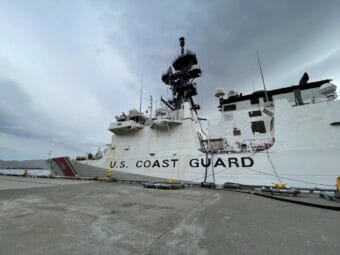
During the entanglement process, U.S. Coast Guard personnel were present on a nearby boat, and officials used a drone during the operation.
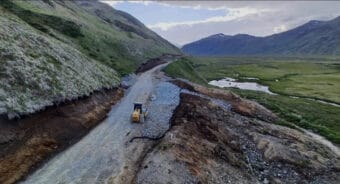
The Makushin Geothermal Project began building a corridor to the site of the proposed power plant in 2021. (Courtesy Of Ounalashka Corp./Chena Power LLC)
The City of Unalaska is pulling out of the Makushin geothermal project after the city council on Tuesday rejected new terms requested by the company building the project. The project’s goal was to harness energy from an active volcano to power the community, which has relied on diesel since World War II.
It was the fourth time that the joint venture between the Ounalashka Corp. and Chena Power, called OCCP, asked to amend its terms for the roughly $200 million project. This time they wanted to raise the rate they would charge the city for electricity.
City Manager Bil Homka said in a memo last week that he encouraged city council not to agree to the rate hike and to let the power purchase agreement expire.
While council members all voiced general support for the project, the consensus was that they had lost confidence that the project would be completed on a reasonable timeline.
“I’ve been in full support of this and I want to see this thing go through, but at the same time, we’ve done more than enough,” said Councilmember Alejandro “Bong” Tungul. “We’ve done three resolution amendments to extend it, and I still don’t see anything that will get it moved forward.”
Representatives of the project pushed back against some of the claims made in the council packet, including that the project would be unable to secure funding.
“We acknowledge the frustration that all parties have and are experiencing due to the project delivery timelines,” said Program Manager Dave Mathhews in a memo to city council. “OCCP does have financing and is proceeding with project development.”
Local resident Travis Swangel was among several community members who spoke out in favor of the geothermal project. He called the project “one of the most important and pivotal projects in the community’s history” and urged the city to be patient.
Councilmember Shari Coleman made a request to the city to allow a six-month extension for the geothermal project to find funding, but she was unable to find support and the motion was denied, effectively ending the city’s participation in the project.
A bald eagle takes off near Unalaska Bay. (Berett Wilber/KUCB)
A viral TikTok video posted on Jan. 20 brought Unalaska eagles to screens across the world. It was produced by Eryn Whittern, who moved to Unalaska in April of last year.
“When my husband first told me about it, I was like, ‘Unalaska? What are you talking about?’” Whittern said. “That’s pretty much what everyone’s reaction is on TikTok, too, because it sounds so weird.”
“Weird” is one way of putting it. Unalaska is an industrial town on an island wedged between the Pacific Ocean and the Bering Sea. It runs on diesel power and the might of the fishing industry. When it isn’t being pummeled by wind and rain, its natural beauty is nothing short of breathtaking. In the summer, wildflowers dot the island’s emerald-green hills and, during migratory months, whales breach in the safety of its bays.
It’s only fair that influencers might want to plant their flags here and make adventure content. But Whittern’s online presence is decidedly modest. She posts videos from her hikes and usually doesn’t “break the internet,” so to speak. That changed when she uploaded something originally meant for friends and family.
Last month, Whittern posted a TikTok video that has since racked up millions of views. It’s not of a dazzling vista or of wildlife running free in the Aleutian tundra. It takes place at the Unalaska City Landfill — and readers should know that it does contain some astonished profanity.
“I was going to the dump with my trash, and there were a ton of eagles there,” Whittern said. “There’s always a bunch, but there was an exceptional amount that day.”
The video opens with a dirty bald eagle, milling around by itself. Then Whittern pans to another eagle. And another. One flaps across the shot and a new tableau is revealed: the interior of the landfill baler building, with a whole flock of eagles perched atop a trash pile. Whittern pans to a walkway near the ceiling, its railing lined with over a dozen birds.
Comments poured in from all over the world. Many viewers had no idea Unalaska existed until they saw Whittern’s post. One skeptic, however, didn’t think the video was filmed in Alaska at all.
“A person commented that I’m not really from Alaska,” Whittern said. “I’m just faking it to get clout. The reasoning was that in the video, we didn’t have any snow.”
As for future posts, Whittern’s plans remain unclear. She said some of the comments she got on the viral video made her apprehensive to post again. But there are still things she wants to capture that would be hard to find anywhere else.
“Now I have all these followers and I’m like, ‘Should I post something?’,” Whittern said. “Even when I was driving here, there were a couple of eagles sitting on the light posts, and they had their wings out — they’re drying their wings. I was like, ‘I bet you people haven’t seen that before.’”
Regardless of what Whittern does next, one thing is certain: there will be no shortage of Unalaska oddities waiting for their moment in the spotlight.
Massacre Bay at Attu. the westernmost of Alaska’s Aleutian Island, is seen on Aug. 23. 2017. Waters around the Aleutian Islands recorded their highest winter temperatures since 1900, according to an annual ecosystem status report issued by the National Oceanic and Atmospheric Administration’s Fisheries Service. (Photo by Lisa Hupp/U.S. Fish and Wildlife Service)
The waters off Alaska’s Aleutian Islands registered the warmest winter temperatures in over a century, part of a decade-long period of warming, according to a report issued by the National Oceanic and Atmospheric Administration.
The record-high temperatures in the western and central Aleutians moderated later in the year but warmer-than-normal conditions persisted for the rest of the year throughout the waters around the 1,100 mile chain extending from southwestern Alaska, according to the 2023 NOAA Fisheries Ecosystem Status report for the region.
The Aleutians report is one of three annual ecosystem status reports issued by NOAA Fisheries for marine areas of Alaska. The reports, compiled by large teams of scientists, were released earlier this month and presented to the North Pacific Fishery Management Council, the panel that sets regulated commercial fishing in federal waters off Alaska.
The annual reports provide snapshots of current conditions and clues about future conditions in a warming climate, information needed to manage fish harvests and other activities, NOAA Fisheries said in a statement.
“Warming at rates four times faster than the rest of the ocean, Alaska’s Arctic ecosystems are a bellwether for climate change. Now more than ever having ecosystem and climate-related data and information is essential to support adaptive resource management and resilient commercial, recreational and subsistence fisheries, and rural and coastal communities,” Robert Foy, director of NOAA’s Alaska Fisheries Science Center, said in the statement.
The Bering Sea and other marine waters off Alaska produce more than half of the nation’s commercially harvested seafood.
In the Aleutians, the fish most vulnerable to the warm condition are Pacific cod, according to the Aleutian ecosystem status report. There are several reasons for that, NOAA Fisheries biologist Ivonne Ortiz told the council in her presentation of the report.
“Pacific cod has a very narrow range of temperatures for the eggs to hatch,” Ortiz said. That range, from 3 degrees to 6 degrees, has been exceeded in the waters, she said.
Higher temperatures also increase Pacific cod’s energy needs, Ortiz said. “The cost of living is higher, the cost of growing, feeding, pooping, having sex, swimming around is higher, so they need to either consume prey that has higher caloric content or consume more prey to make up for that,” she said. But high-quality food for Pacific cod is less available in the Aleutian region, she said.
Also vulnerable and sensitive to higher temperatures are Atka mackerel, an important species for commercial harvests, according to the ecosystem status report. But pink salmon originating from eastern Kamchatka, on the Russian side of the ocean, appear to be thriving, with the third-highest population on record, the report said.
With warming temperatures come higher risks of algal toxins, and the past year’s record provides evidence of the association. Mussels found in June at Sand Point, Unalaska, False Point and Akutan, communities in the eastern Aleutians or at the western tip of the Alaska Peninsula, had levels of paralytic shellfish toxins that were 47 times the amount deemed safe for human consumption, according to the Aleutians ecosystem status report.
‘Cooled, but not cool’
The Bering Sea and Gulf of Alaska are recovering from extreme marine heatwaves that struck in recent years, according to the ecosystem status reports issued for those regions. Temperatures there have returned to more normal levels, but the unprecedented heatwaves have lingering effects, according to the reports.
The Bering Sea remains warmer than the long-term average, though it has cooled since the heatwaves, NOAA Fisheries biologist Elizabeth Siddon told the North Pacific Fishery Management Council in her presentation of the report.
“It has cooled but is not cool,” she said.
Ecosystem conditions there are mixed, complex and in some cases not easily explained, Siddon said.
On the negative side, some crab stocks have continued the decline that forced disruptive harvest closures, according to the report for that marine region. In the northern part of the Bering Sea, jellyfish – a less-nutritious prey for other fish in the food web and a competitor with groundfish for food – are proliferating. In the southern part of the eastern Bering Sea, there has been continuation of a decade-long slide in production of high-quality plankton that is the base of the food chains. This year, the concentration hit the lowest levels in several years in that part of the Bering Sea, Siddon said. Conversely, there was a continuation of a trend to high levels of coccolithophores, a type of phytoplankton that are considered poor quality food for the food web, she said.
On the positive side, according to the Bering Sea ecosystem report, were some increases in juvenile Chinook and chum salmon found in the northern region, hinting at possible improvement for Western Alaska salmon runs that collapsed in recent years. There was improved reproduction success for some seabirds, a result that follows years of successive bird die-offs, the report said.
In the Gulf of Alaska, where the marine heatwaves caused Pacific cod stocks to crash so drastically that harvests there were canceled in recent years, there is a continuing pattern of low populations of cod, as well as low population halibut and arrowtooth flounder, according to that region’s ecosystem status report. But populations of sablefish and perch, both commercially important species, continue to increase, according to the report.
On the lookout for El Nino effects
The spring warming that is expected with the ongoing El Nino weather pattern could further jar the Gulf of Alaska, NOAA Fisheries biologist Bridget Ferriss said in her presentation to the council.
Since larvae and juvenile groundfish are the most sensitive to changes in water temperature, warming seas could potentially harm the larvae of cod, pollock and northern rock sole, NOAA Fisheries biologist Bridget Ferriss told the council. “These wouldn’t be the fish that we’re fishing on next year,” she said. However, that could harm future years’ stocks, she said. Some adults could be vulnerable, too, because warming would diminish quality and fat levels of zooplankton, she said.
Potentially vulnerable adult fish like pollock won’t necessarily be fewer in number, but their bodies might be changed, Ferriss said. “We might just see skinnier fish next year as they have a little bit of a poorer zooplankton prey base to feed upon,” she said.
Potentially benefiting from El Nino-driven warmth are sablefish, which have thrived in recent years, along with arrowtooth flounder, southern rock sole and halibut larvae, Ferriss said.
Marine heatwaves have profound effects, research has shown.
A new study details how the unusually warm conditions in the Bering Sea in 2018 – a year with the least amount of winter sea ice since records began in 1850 – altered the phytoplankton populations that make up the base of the food web.
Normally, spring sunlight stimulates algal growth on the underside of sea ice, and the algae continues to bloom as the ice melts. That phytoplankton later drops to the seafloor, serving as food for bottom-dwelling species that are part of what is classified as the benthic zone. But when ice is missing, the spring phytoplankton bloom occurs in open water, nourishing marine creatures swimming closer to the sea surface, considered the pelagic zone, but not reaching the benthic zone at the bottom.
Benthic species include clams and snails, which in turn are eaten by mammals like walruses and seals. Pelagic species include salmon, pollock and herring and fish-eating seabirds.
The new study, by scientists with NOAA, the University of Washington and other institutions, tracks the different Bering Sea spring blooms that occurred from 1998 to 2018. It found that while the timing of spring blooms did not shift over that period, the characteristics of the blooms did change.
If the pattern of warm years intensifies, the shift in spring phytoplankton blooms will continue to favor the pelagic species, even in the northern reaches of the Bering Sea, the study authors said.
Close
Update notification options
Subscribe to notifications
Subscribe
Get notifications about news related to the topics you care about. You can unsubscribe anytime.