Aleutians

Attu’s last survivor remembered for his leadership and forgiveness

The last surviving person from Attu, Gregory Golodoff, passed away earlier this month at the age of 84. (Lisa Hupp/U.S. Fish And Wildlife Service)

Gregory Golodoff was sitting in a sod house when the soldiers arrived.

“We had heard machine-gun fire from this side, this side, you know. I forgot who it was told us they’re coming from this side, they’re coming from that,” Golodoff said in a 2018 interview — 75 years after the Battle of Attu.

The Japanese Imperial Army invaded the Unangax̂ village in 1942, where the three-year-old Golodoff lived with his family.

Golodoff was the last surviving person who was born and lived in Attu, the last island in the Aleutian Chain before reaching Russia.

His death on Nov. 17 marks the end of an era when there were still people alive who had lived in the now-lost village.

The Japanese army occupied the island for three months before taking all 42 Attu residents to Japan as prisoners of war.

a building
The building in Otaru, Japan, where Golodoff and his family were first taken upon arriving in Japan, seen in 2017. (Rachel Mason/National Park Service)

Golodoff’s entire family was imprisoned in a dormitory in the port city of Otaru, about 500 miles north of Tokyo. The next three years were full of disease and malnourishment, straddling the brink of starvation.

“We would just get a bowl of rice a day or sometimes a salted herring,” Golodoff said.

He remembered the cooks taking pity on him and treating him like “a pet.”

a newspaper clipping
The Oct. 3, 1945 issue of the Daily Alaska Empire newspaper reports that the surviving Attuan POWs have been released. (The Daily Alaska Empire)

“I was a cute little guy, I guess, because a Japanese cook scraped burned rice from the pot and would bring it to me,” he recalled.

People who knew Golodoff throughout his life have remarked at how little resentment he felt toward his captors. That empathy shows even in those early memories.

“Well, gosh, we were hungry, but so were the Japanese,” he said. “The Japanese were starving, too.”

Trying to forget

Only half of the Attuan POWs survived the experience. Golodoff lived through it, as did his mother, older brother, Nick, and his sister, Elizabeth. But many of their family members didn’t make it, including Golodoff’s father, who died of disease in Japan.

“We cremated all of them,” Golodoff said. “All the people that died in Japan.”

Those who did survive were released when the war ended, but couldn’t return home. Many homes had been destroyed, and the United States government judged it too difficult to relocate the freed POWs back to Attu.

Instead, the village was abandoned and the survivors moved to other communities. Golodoff and his family settled in Atka, an Unangax̂ village about 500 miles east of Attu.

Those who died in Japan were also brought to Atka to be laid to rest.

“They brought ‘em all back in three coffins,” Golodoff said. “All the ashes in three coffins and buried by the church in Atka.”

Golodoff spent most of his life in Atka. He practiced subsistence, hunted, fished and said he stayed too busy to think much about the war.

“I didn’t have time to wonder about anything, because most of the time we had to hunt for food, you know, go out and fish and stuff like that,” he said.

He joined the Army, was stationed in Germany, and then moved back to Atka. He ran the village store, and became the tribal president in the 1980s when Atka saw significant growth, including the construction of a new school and a subdivision about a mile from the old village.

In all those years after the war, Golodoff said the survivors didn’t want to talk about what happened. He didn’t even speak about it with his mother.

“She never told me anything. They don’t want to talk about anything like that. They’d rather forget it,” he said.

But a new generation of Attuan descendants are talking about it. Crystal Dushkin grew up in Atka, but her great-grandmother was from Attu.

“A lot of people refer to the Aleutian Campaign as the ‘Forgotten War,’” Dushkin said in a 2017 interview with KUCB. “But our people have never forgotten it. It’s never lapsed from our memory.”

Dushkin is one of the many people who work tirelessly to preserve Unangax̂ culture and the memory of Attu.

“That’s what I wish for the younger generation, as well,” she said. “To always hold on to what our ancestors taught us. To always remember them, and to make sure that they teach it to their children and grandchildren so that it’s never forgotten.”

two children
Gregory Golodoff and his sister, Elizabeth Golodoff Kudrin, on Atka Island, sometime between 1946-1947. (Courtesy National Park Service, University Of Washington Press and Ethel Ross Oliver)

Then and now

People often compare the Aleutian Campaign to the attack on Pearl Harbor, but Pearl Harbor was an attack from the sky. The Battle of Attu, and a similar one on the Aleutian Island of Kiska, mark the only times the Japanese actually invaded the United States. The Aleutian Campaign was the first time foreign forces occupied American soil since the War of 1812.

In 2012, the National Parks Service held a meeting for all the Attuan descendants and survivors. Golodoff wanted to meet other descendants, but he also wanted to connect with other surviving POWs.

“I was going to see my peers,” he said. “Then I went there, I was disappointed. Nobody survived except us.”

There were only three survivors left. Greg, his brother Nick, and his sister Elizabeth Kudrin.

“I guess we just lived the longest. That’s all,” he said.

Nick Golodoff passed away two years after the reunion, leaving just Gregory and Elizabeth.

And then, in February of this year, Elizabeth passed away.

Lost but not forgotten

Gregory Golodoff passed away in Anchorage on Nov. 17 at the age of 84.

Gregory Golodoff
Golodoff was the very last person on Earth who was born and lived in Attu, a village lost to war — the last American citizen whose home was occupied by a foreign force. (Chrissy Roes/Aleutian Pribilof Islands Association, Inc.)

Ten days later, dozens of people came to St. Innocent Cathedral in Anchorage to pay their respects.

Moses Dirks is an Unangax̂ scholar and a friend of Golodoff from Atka. He said as a child, he looked up to Golodoff, who was a good role model in the community.

“He was always helpful, and he was always willing to help the people there in Atka for many years,” Dirks said.

Golodoff’s niece, Joanna Thompson, said she admired how her uncle would never show anger or resentment for what happened to him.

“Uncle Greg just turned it into something else,” she said. “He could have been one of the other children that passed. So he was lucky to be alive, and he just found joy in every day.”

Dimitri Philemonof, the CEO of the Aleutian Pribilof Islands Association, described Golodoff as a quiet and humble man.

a church
Gregory Golodoff passed away in Anchorage on Nov. 17 at the age of 84. Ten days later, dozens of people came to St. Innocent Cathedral in Anchorage to pay their respects. (Courtesy Isabella Iparraguirre)

“Throughout his life, he has been a great leader,” he said. “I never saw him hate or anything of that sort. I think that says a lot for the Aleut people.”

Golodoff was the very last person on Earth who was born and lived in Attu, a village lost to war — the last American citizen whose home was occupied by a foreign force. But to Golodoff, those were just the facts of his life.

“It’s just something that happened. Things will happen. We’re all going to experience something,” he said. “We’re not really here. From dust we came, to the dust our bodies will return. So we don’t die, as far as I’m concerned. We don’t die. We might depart from our bodies, but that’s about it.”

Golodoff was buried at Anchorage Memorial Park Cemetery on Nov. 27.

Gregory Golodoff, the last surviving person from Attu, has died

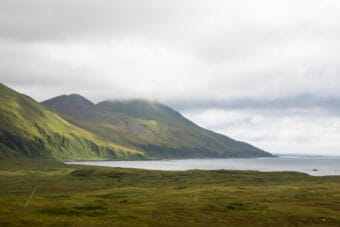
Attu village was located in Chichagof Harbor before the Attuans were taken as prisoners during World War II and then forbidden to return home. (Photo by Zoe Sobel/KUCB)
The old village of Attu was in Chichagof Harbor. (Zoë  Sobel/KUCB)

The last surviving person from Attu, Gregory Golodoff, passed away earlier this month at the age of 84.

Golodoff was a young child in 1942 when the Japanese Imperial Army invaded his village in the western Aleutians. The Battle of Attu was the last major action of the Aleutian Islands campaign of World War II.
All 42 Attuans living in the village were taken to Japan as prisoners, including Golodoff. Only about half of them survived the experience.

Attu was abandoned after the war, and most of the returning Attuans settled in Atka, about 500 miles from their home.

Gregory Golodoff and his sister, Elizabeth Golodoff Kudrin , photographed on Atka Island, sometime between 1946-1947. (Courtesy Of National Park Service, University Of Washington Press and Ethel Ross Oliver)

Golodoff spent most of his life in Atka. He was the tribal president in the 1980s when Atka saw significant growth, including the building of a new subdivision and a new school.

His sister, Elizabeth Kudrin, passed away earlier this year. They were the last two living people who were born and lived in Attu.

Gregory Golodoff was living in Anchorage with his wife when he passed away on Nov. 17. His funeral service will take place at St. Innocent Russian Orthodox Cathedral in Anchorage on Monday, Nov. 27.

Warming seas helped cause Alaska’s snow crab crash, scientists say

Three men emptying a crab pot on a fishing boat
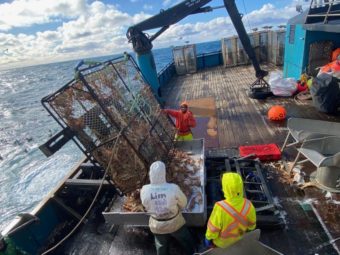
Crew from the Silver Spray empty snow crab pots while fishing in the Bering Sea. (Courtesy of Bill Prout)

When scientists estimated that more than 10 billion snow crab had disappeared from the Eastern Bering Sea between 2018 and 2021, industry stakeholders and fisheries scientists had several ideas about where they’d gone.

Some thought bycatch, disease, cannibalism, or crab fishing, while others believed it could be predation from other sea animals like Pacific cod.

But now, scientists say they’ve distinguished the most likely cause for the disappearance. The culprit is a marine heatwave between 2018 and 2019, according to a new study authored by a group of scientists with the National Oceanic and Atmospheric Administration.

Mike Litzow is a co-author of the study and the director for NOAA’s Kodiak lab. He said starvation mediated by increased temperatures caused the collapse.

“Really the crab were not able to get the food they needed,” Litzow said. “They were just outstripping the resources that were available to them.” 

According to Litzow and his fellow researchers, the crab faced a number of compounding factors: First, higher temperatures meant increased metabolism so they needed more food; on top of that, there was less space for the crab to forage that food; and finally, the crab were just smaller than usual.

Researchers took data from the many possible hypotheses for the disappearance and they examined it alongside the data they have on the collapse. They examined possible mortality from a range of sources, including directed fishing from the snow crab industry as well as bitter crab syndrome — a fatal disease among crustaceans caused by parasites — and trawl bycatch.

The take-home message is really that none of those other proposed mechanisms explains the collapse with the data we have,” Litzow said.

He said it’s tough to know what the collapse from increased ocean temperatures could mean for other species, but it’s safe to say we’ll probably see more marine heatwaves like this, and they’re likely to be bigger and more frequent, as the world continues warming.

As we’re seeing these big surprising collapses, there is a general awareness that we have to build: we’re going to see more of those,” he said. “We need systems that can be resilient to those really outsized, surprising events.”

More carbon dioxide in the atmosphere means warmer temperatures, Litzow said, which is bad news for the cold-loving snow crab. And more greenhouse gasses also mean more acidic oceans, which can also be dangerous for some crab.

Carbon dioxide that we release through fossil fuels is also taken up by the oceans and has the effect of reducing the pH of the ocean — it makes it more acidic,” Litzow explained. “Because crab use calcium carbonate in their exoskeleton, they’re vulnerable to that acidification because calcium carbonate dissolves more and more easily as pH goes down.”

The good news — at least for snow crab — is they’re not as sensitive to ocean acidification as other species.

“In our lab in Kodiak, we’ve run a bunch of different studies over the years looking at different crab species in different ages — life history stages — in terms of how vulnerable they are to acidification,” he said. “And the good news is it looks like snow crab are one of the more resilient species — like we don’t see a strong effect for snow crab the way we do for red king crab or the way we do for Tanner crab.”

Alaska’s snow crab fishery has been closed since 2022, when regulators declared the population overfished.
The snow crab crash in combination with a two-year closure of Bristol Bay red king crab was a devastating blow to Alaska’s lucrative crab fishery, and it left some harvesters and coastal communities, such as St. Paul Island, looking for other sources of income.

Late last year, the Secretary of Commerce announced a disaster declaration for both fisheries to assist communities affected by the closures. That funding has historically taken years to reach fishermen and communities. Some Bering Sea harvesters are still waiting on disaster relief from 2019 requests.

While the bigger picture is still pretty grim — crab have been declining in Alaska since about the early 80s — Litzow said there’s still lots of cold water in Alaska’s seas and with it, hope for the spindly crustaceans.

“Snow crab have bounced all over the place,” he said. “Historically, there have been ups and downs — there have been previous overfished declarations. And we’re certainly hopeful as we see small crab showing up in the survey in 2022 and 2023.”

But, Litzow said, the rebound could take some time.

“If conditions stay reasonable for the next, say, four years, we should expect this crab to grow up to the size where they can start to support the fishery,” he said.

The snow crab crash really blindsided Alaska’s industry, and more similar surprises are likely on their way, according to Litzow. He said the more dependent a community or fishermen are on a single fishery, the more vulnerable they will be.

While diversification may be one of the most productive solutions to these kinds of startling crashes, Litzow said it’s also likely one of the most challenging.

“We have this management system where everyone has access — it’s allocated in a certain way, or everyone has gear, vessels that’s really specialized for just this particular kind of fishery,” he said. “And then when those surprises and those disruptions come along, it’s hard in practice for people to have a backup.”

Like other research, Litzow said this study isn’t the final answer, but he said it is an important step.

“It really does a great job of framing out our expectations,” he said. “We should not expect that the crab were just gone somewhere else, down on the Slope, or up in Russia, or anything like that. I think this study really makes it clear that they died, and gives us our best explanation for why that happened.”

Military responds after hunter finds large artillery shell in Izembek National Wildlife Refuge

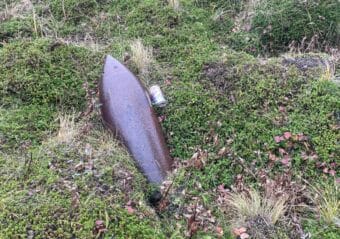
The shell was approximately 12 inches in diameter and four feet long (soda can for reference). Powell said that particular type of round was first manufactured in 1943, during WWII but could have been built anytime up to the 1990s. (Courtesy Of Harold “Hap” Kremer)

A group of explosives experts from Joint Base Elmendorf–Richardson traveled to Cold Bay, near the western end of the Alaska Peninsula, on Oct. 30 in response to a local hunter’s report of what appeared to be a large unexploded artillery shell. The ordnance was found in the middle of the federally protected Izembek National Wildlife Refuge, a key habitat for many migratory birds and other wildlife.

U.S. Air Force Staff Sgt. Tyrone Powell, the explosives ordnance disposal team leader for the mission, confirmed the hunter did find an unexploded military round.

“It’s big artillery,” Powell said. “When we pulled it out of the ground, it weighed probably six or 700 pounds. It took four of us to pull it out.”

The shell was about 12 inches in diameter and four feet long. Powell said that particular type of round was first manufactured in 1943, during WWII but could have been built anytime up to the 1990s.

“What was interesting about the round, it was actually split open, so there was no more explosive on the inside. It had to have been underneath the ground for a pretty long time for that to happen,” Powell said.

Courtesy Of Harold “Hap” Kremer

Photographs of the munition show that the surrounding area has several large divots in the tundra, which point to former military operations — the U.S. military built a base in the area during the 1940s.

“It looks like it used to be a demolition area for old ordnance,” Powell said. “What we think it was, was one of these old pieces of ordnance … got kicked out of where it was getting blown up. Those sorts of things get buried in the soil, and eventually, they work their way to the surface.”

The military team used explosives to dispose of the munition where it was found — in the middle of the 315,000 acre refuge, which contains one of the world’s largest eelgrass beds.

Noise pollution can have a negative effect on wildlife. But representatives from the refuge said they monitored the birds on nearby lakes before the detonation and that they were still there afterward with little reaction.

Izembek is a crucial habitat for a quarter million migratory birds. That includes the Pacific black brant, a rare type of goose whose entire population stops in the refuge at exactly this time of year during its fall migration.

The refuge said the detonation occurred away from the majority of migrating waterfowl and was not near the eelgrass beds where the brants feed.

Conservation group plans to sue federal government over deaths of orcas in trawl nets

Orcas spotted in the Bering Sea in August 2023. (Courtesy Dustin Unignax̂ Newman)

The Center for Biological Diversity is preparing to sue the federal government for allegedly failing to protect killer whales from trawlers in the Bering Sea.

The trawl fleet in the Bering Sea and Aleutian Islands has come under fire in recent weeks. The backlash follows a report from the National Oceanic and Atmospheric Administration that said 10 orcas were hauled up in trawl nets over the last year, nine of which died.

The conservation group said in a Monday statement that NOAA Fisheries must uphold its duty to protect the killer whales, which are protected by the Marine Mammal Protection Act.

The national conservation group said the trawlers are catching lots of non-targeted species, or bycatch, in defiance of conservation laws.

It’s not a new issue for orcas to get caught up in fishing gear, but the recent numbers are a jump up from previous years. The trawl fishery association Groundfish Forum said their boats have reported a recent uptick in orca encounters. Climate change may play a role in the increased sightings, as many ocean species adapt to new conditions.

The conservation group announced they would file a lawsuit if NOAA Fisheries did not adequately address the allegations within 60 days.

Alaska pollock trawlers are feeling pressure over salmon bycatch. This reporter went to see for himself

Deckhand Martin Vasquez walks through a pile of fish as they transfer from the net to holds underneath the deck of the Northern Hawk factory trawler on Sunday, Aug. 6, 2023 in the Bering Sea. (Loren Holmes/ADN)

Bering Sea factory trawlers scoop up tens of thousands of pollock at a time, and pressure is intensifying to avoid catching salmon as populations of chum and chinook have plummeted in recent years, causing closures for subsistence harvesting.

The trawlers are not entirely to blame — warming oceans due to human-caused climate change are almost certainly a factor — but they have drawn the ire of salmon advocates from Western Alaska to Washington D.C.

For a recent story in the Anchorage Daily News, in conjunction with the Pulitzer Center, fisheries reporter Hal Bernton visited a Bering Sea factory trawler to see how its crew caught and processed pollock, and also how the captain works to keep salmon bycatch low.

And while Bernton has reported from the decks of much smaller boats, he says the factory trawlers are like floating cities.

Listen:

The following transcript has been lightly edited for clarity.

Hal Bernton: This is a 341-foot vessel that I went out on, the Northern Hawk, with a crew of 129 people. And most of them work below the deck in a fish factory that, basically when the fishing is reasonable, operates 24 hours a day. Then there are these incredible fillet machines that will fillet 180 fish a minute, and the job of the human is basically to just feed the machine 24 hours a day. And it’s kind of mind-numbing work. Your hands move constantly to make sure the fish are positioned correctly.

Casey Grove: So these are the folks I feel like they could say, “Hey, you know, I just work here.” But there are a lot of folks outside of that, that have pretty strong feelings about trawling. And it kind of comes down to pollock versus salmon, right? And crab also, but a lot of people are talking about salmon bycatch. Can you remind me what that conflict is?

Hal Bernton: Sure. They remove a huge amount of fish every year, more than a million metric tons. It’s up over 2 billion pounds of fish. And this has been happening for decades, first by foreign fleets who fished off the Alaska coast and then more recently by the U.S. fleets. And specifically, in recent years, as the western Alaska chum salmon runs have collapsed, they do catch during the summer months, like when I was out, some chum salmon. And there’s been tremendous concern, as subsistence and commercial harvests in western Alaska have been shut down across a lot of areas in recent years, about that bycatch.

Now it is kind of complicated, because a lot of the chum they catch would actually go back to Asia. But about 18 to 20% of these fish, depending on the year, would be returning to western Alaska. So there’s no cap on how many of those fish they can catch. And there’s a tremendous interest, and pressure, from tribal groups and others to basically set some limits on how many chum can be caught. And the pressure is really on these guys. Now, when I was out, staying away from chum was a big priority for the fleet.

Casey Grove: And that seems pretty tough, right? Because, I think you noted in your story, that often the salmon and the pollock will be kind of at the same depth and in the same areas. So can you talk about that? I mean, how difficult is it to actually avoid salmon when you’re trying to catch pollock?

Hal Bernton: Well, there are cameras, at least in the factory trawler nets. And when you look at these cameras, by the time you see these fish, sometimes you can see the salmon actually coming into the net, but by then it’s kind of too late. When the skipper sees that there are dozens of salmon coming in along with the pollock, they move to another area. It’s not always a sure thing, when they move, that there will be less or maybe there won’t be enough pollock. So it’s been a challenge.

Casey Grove: Maybe another thing that complicates this a little bit further, and I think, you know, some people would say this is a positive for the pollock fishing fleet out there, is that some of those boats are, in a way, owned by Kuskokwim River communities. Can you explain that? How did that come to be?

Hal Bernton: That was a really interesting thing for me that I wanted to explore, to understand, is that increasingly, the pollock fleet, although they may go down to Seattle every year at the end of the harvest for boat work and everything else, and essentially are home-ported in Seattle, increasingly, shares of the boats are owned by six Alaska nonprofits that are invested with shares of the pollock harvests through federal action. And the boat, the vessel I went on, the Northern Hawk, is 100% owned by the CDQ group Coastal Villages Region Fund that represents some 20 communities in western Alaska. So those same communities have been hard hit by the collapse of the chum runs in recent years. So there’s been a lot of pressure and increasingly tension with tribes who feel that there needs to be more restrictions, and they have filed actions, a lawsuit in federal courts, trying to force the federal regulators to reconsider the levels of pollock and restrict the harvest.

Casey Grove: Yeah. Well, in that effort to bring fewer chum salmon aboard as bycatch, what sort of technological innovations did you see?

Hal Bernton: Well, basically, they call it a salmon excluder. It’s a hole in the net with a light. The salmon are strong swimmers, so the idea is that, even if they get in the net, they can swim through this hole, they’d be attracted to the light, and get back out to freedom. And that does save some salmon, but it’s far from 100%. So there’s an effort now, a researcher, to do what’s called a more active excluder, where if the cameras picked up salmon coming into the nets, this sort of ramp would drop down and literally herd the salmon to the hole. And that device could certainly help as long as you were watching the net to see, and the cameras to see, when those salmon were coming in. And that might be ready in a couple of years. There’s also efforts to speed up the genetic testing of the salmon so that you could know right away, at least within a day or so or two, rather than months later, hey, were are these coming from Russia and going back to Russia? So not so big of concern? Or are they going back to western Alaska and, hey, there’s a really big concern, so we need to stay away from that area? Because right now that genetic testing happens, but not until way after the fact.

Casey Grove: Interesting, yeah. So, you know, there are a lot of layers to this, a lot of different opinions. We haven’t even talked about the prospect of an ocean heat wave and kind of that that huge existential problem of climate change, which is clearly at play here. But aside from that, when people talk about salmon bycatch and pollock trawling, where do you see this issue going from here?

Hal Bernton: Well, clearly, the federal council is wrestling to put some limits on the fleet. And I think the fleet knows that, one way or another, and they’re saying, “Give us this sort of flexibility to sort of do it ourselves.” Because there are these cooperatives, there’s information sharing, there’s hotspots that are developed fairly quickly, where the fleet can know, hey, don’t go there, because there’s a lot of chum. And they’re sort of saying, “Hey, let us continue along this path.” And the tribes are saying, “We don’t trust you. We think there needs to be a hard cap, and much more serious restrictions on what you do. We’ve, our people, our communities, have sacrificed so much, and now it’s time for the trawl fleet to feel some pain.”

And of course, the CDQ groups and the tribes, some of them are representing the same regions and in very different capacities now, so there’s a lot of more tension between CDQs and the tribes that plays out in these meetings of the North Pacific Fishery Management Council, which is set up by Congress to go ahead and recommend and set harvest rules that are then finalized through NOAA Fisheries. Unfortunately, it’s a long convoluted process. There’s a lot of people who are very, very frustrated with the council process. There are industry officials that serve on the council, and it’s including one representative now, a council member, from Coastal Villages who was just appointed, so there’s increasing tension and frustration in some of these meetings.

Site notifications
Update notification options
Subscribe to notifications