Aleutians

Mount Shishaldin simmers down after explosive eruption

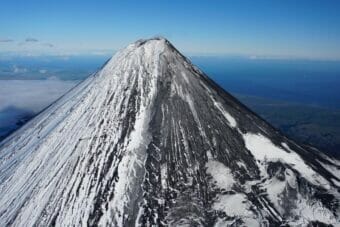
Shishaldin is the highest peak in the Aleutian chain, rising 9,373 feet, and is located near the center of Unimak Island, about 20 miles from the small fishing community of False Pass. (David Fee/Courtesy of Alaska Volcano Observatory

Mount Shishaldin has simmered down after a Friday eruption sent an ash cloud across the eastern Aleutians, prompting the Alaska Volcano Observatory to raise the aviation color code to red.

This was the stratovolcano’s latest eruption in a summer of increased activity.

Shishaldin is the highest peak in the Aleutian chain, rising 9,373 feet. It’s near the center of Unimak Island, about 20 miles from the small fishing community of False Pass.

The observatory said things slowed down quickly after Friday’s eruption and activity has returned to pre-eruptive levels.

Alaska Volcano Observatory reports ‘explosive eruption’ at Mt. Shishaldin

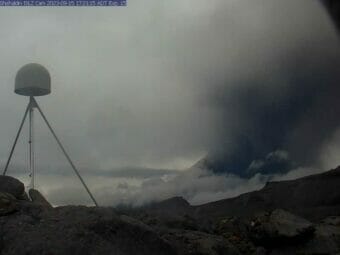
Ash emissions from Shishaldin Volcano captured on an Alaska Volcano Observatory webcam on Sept. 15, 2023. (Courtesy of AVO/USGS)

Mount Shishaldin in the eastern Aleutians is erupting, marking the latest event in a summer of increased activity at the volcano. The Alaska Volcano Observatory said “an explosive eruption” began shortly after 5 p.m. Friday.

“Ash is currently being produced and is drifting to the east below the cloud deck,” the volcano watch group reported.

The stratovolcano is near the center of Unimak Island, about 20 miles from False Pass, a fishing community with around 350 residents.

The National Weather Service issued a statement Friday evening warning of possible “trace ashfall” in False Pass, King Cove and Cold Bay.
Intermittent eruptions at Shishaldin have been disrupting air travel since July, one of which spewed ash as high as 40,000 feet.

The current aviation color code has been raised to red.

Crew member on Alaska factory trawler dies after possible ammonia exposure

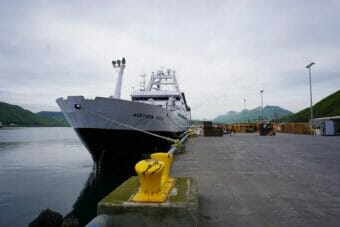
The Northern Eagle docked in Unalaska/Dutch Harbor in July 2020. (Hope McKenney/KUCB)

A crew member on an American Seafoods factory trawler died at sea last week, likely from an ammonia leak on board.

U.S. Coast Guard Petty Officer Second Class John Highwater said they received a satellite call from the Northern Eagle at about 4 a.m. Friday.

“One of their crew members was found unresponsive in one of their engineering spaces,” Highwater said. “They believe there was an ammonia leak somewhere in the vessel that caused the person to fall unconscious.”

Jeremy Baum, the Alaska Wildlife Trooper stationed in Unalaska/Dutch Harbor, identified the crew member as First Engineer David Kuma from Ghana, in West Africa.

Forty-three-year-old Kuma was found unresponsive just after 12 a.m. that morning, according to Highwater.

The nearly 350-foot vessel was already en route to Unalaska/Dutch Harbor when they made the call to the Coast Guard. Highwater said it would have taken Coast Guard crew longer to reach the vessel than for the trawler to head to port.

Unalaska’s Fire Chief Ben Knowles said the Northern Eagle reached Unalaska around 5 a.m. the next day — roughly 24 hours after the distress call. From there, the case was turned over to local responders.

“The fire department, along with NOAA, the U.S. Coast Guard Marine Safety Detachment and the Alaska State Troopers boarded the vessel around 6 a.m., once they were all tied up, and began the investigation into the incident,” said Knowles.

He said Kuma was pronounced dead prior to arriving at port. The Unalaska Fire Department assisted troopers with their investigation, provided decontamination and offered grief counseling for the vessel, according to Knowles.

“We were able to hold some listening sessions and just kind of make sure that the crew members were able to have someone to talk to,” he said.

American Seafoods brought Kuma’s family to the island, according to Knowles.

“We are here to offer our services to them,” he said. “And we’re hoping that they can find some healing in this process.”

The Coast Guard, troopers and NOAA Enforcement are investigating the incident.

Kuma’s body was sent off island to the State Medical Examiner’s Office on Tuesday for an autopsy, according to Wildlife Trooper Baum.

American Seafoods declined a request for comment.

After 200 years, a traditional Unangax̂ boat is making a comeback

The latest official launch happened at Sand Point Culture Camp, on July 24. That day, Ethan Petticrew, one of the teachers at camp, sat in the boat’s stern and called the strokes, while others chanted in Unangam Tunuu and beat drums. (Theo Greenly/KUCB)

Dozens of people packed Sand Point’s harbor on July 24. Some crowded the small dock while others sat along a wall overlooking the water.

They were there to watch a group of a dozen people board a long, wooden-framed boat. It was open, like a canoe, but this was a niĝilax̂, a traditional Unangax̂ boat, made from a wooden frame and wrapped in animal skins.

The community built this niĝilax̂ in the spring, but they’ve been waiting for the launch for much longer — it had been 200 years in the making.

During the Russian fur trade, the Russians took notice of our ancestors’ ability to move mass amounts, to move villages, to move their cargo, and ultimately to escape the Russians during the fur trade,” said Amy Mack, one of many people who helped organize the niĝilax̂ build.

She explained to the crowd that their ancestors used the boat like a cargo ship, and that worried the colonizers. They were able to move entire villages and warriors with ease with this one boat.

To ensure that our ancestors were completely at the disposal of the Russians, sadly, all the niĝilax̂ were destroyed,” Mack said.

But this summer, the niĝilax̂ has returned. Four communities have built them this year, after studying historical documents, sketches, and artifacts to learn how they were made – one in Sand Point, one in Atka, one in Anchorage, and one in a town in Northern California, where many Unangax̂ people were relocated during the Russian days. Three of the communities have since launched the traditional Unangax̂ boat that hasn’t been seen since the 1800s.

The latest official launch happened at Sand Point Culture Camp, on July 24. That day, Ethan Petticrew, one of the teachers at camp, sat in the boat’s stern and called the strokes, while others chanted in Unangam Tunuu and beat drums.

The group paddled out into the bay and circled Range Island, a small, rocky outcrop about a mile from the dock.

The crew pulled back up to the dock about an hour after pushing off, where Unangax̂ dancers from Atka and Sand Point, greeted the crew with traditional fanfare.

“This is such a moving experience, I’m going to cry,” said Petticrew. “People haven’t done this since the 1800s. This is such a spiritual moment, I feel so connected to my great grandparents. I feel like I’m paddling with my great grandparents.”

Many people suggested names for the nigilax̂ but, ultimately, Amy Mack said the choice was obvious.

Unangam Anĝii, which translates to “Unangax̂ Spirit.”

“We chose that name because we are Unangan people, and we want that spirit of our ancestors to come back,” Mack said.

After the paddle, the niĝilax̂ was hoisted onto the dock and stored at the tribal office. But the Aleutians won’t have to wait another 200 years for the next boat: already, a fifth niĝilax̂ is being built and will be water-ready soon in Unalaska.

Navy warships dispatched to Aleutians after Chinese, Russian military spotted in region

Several U.S. Navy warships docked in Unalaska last week, after 11 Chinese and Russian military ships were found operating in the region. (Andy Lusk/KUCB)

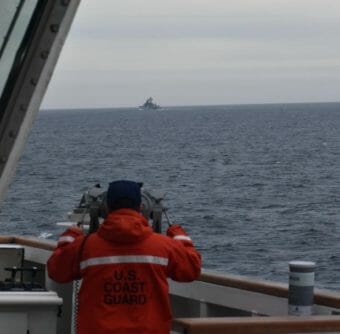
Navy warships were dispatched to the Aleutians last week after 11 Chinese and Russian military ships were found operating in the region.

The exact location of the foreign ships was not disclosed, but a military spokesperson from the U.S. Northern Command said the foreign patrol ships remained in international waters and were not considered a threat.

Still, U.S. Sens. Lisa Murkowski and Dan Sullivan issued a statement Saturday saying the incident shows why the military should expand its presence in Alaska to protect U.S. interests.

“This is a stark reminder of Alaska’s proximity to both China and Russia, as well as the essential role our state plays in our national defense and territorial sovereignty,” Murkowski said.

Her office offered additional assurances to Aleutian communities.

“Because this is a military operation, we are limited with what we can say,” said Joe Plesha, a spokesperson with Murkowski’s office. He assured Unalaskans the senator was “taking this incursion very seriously.”

China has sent naval ships to the Bering Sea off Alaska’s shores before, in what U.S. analysts often say is a provocative gesture. The first-known incident was in 2015, coinciding with then-President Barack Obama’s visit to Alaska.

In August of 2021, the U.S. Coast Guard encountered a flotilla of Chinese warships 46 miles off the Aleutian Islands. And the following year, on a routine patrol, a Coast Guard cutter found a group of Russian and Chinese warships traveling together through the Bering Sea.

Sen. Sullivan said in the statement he was glad to see a tougher response to these warships, which “sends a strong message to Xi Jinping and Putin that the United States will not hesitate to protect and defend our vital national interests in Alaska.”

Unalaska’s city and tribal officials have been weighing the island’s ability to host a larger U.S. military presence. Community leaders are promoting Dutch Harbor as a key port in the nation’s Arctic plan, as melting ice opens shipping lanes and allows for more foreign military transits.

Trident’s new processing plant in Unalaska will be the largest in North America

Trident Seafoods is constructing a state-of-the-art facility to process fish in Unalaska. Representatives say they expect to be online in 2027. (Hope McKenny/KUCB)

Trident Seafoods has begun building the first bunkhouses at its to-be processing plant in Unalaska’s Captains Bay, progressing on a timeline the seafood titan says would make it operational by 2027.

The Aleutian Islands and Bering Sea region is home to some of the world’s most productive fishing grounds. It’s where most Alaska pollock comes from, the whitefish found in fish sticks and McDonald’s Filet-O-Fish sandwiches worldwide. And a lot of that fish is processed at the giant Trident Seafoods plant in Akutan.

But aging infrastructure and decades of wear prompted the seafood company to plan a new facility.

“Status quo in Akutan isn’t an option,” said Stefanie Moreland, a spokesperson for the company. “We can’t be operating a plant and making the kinds of changes and improvements that we need to within the facility that we’re running currently in Akutan.”

The company began a feasibility study in 2017 to explore ways to upgrade its Akutan plant. They tested things like building designs and energy efficiencies, but ultimately, representatives from the company said a complete rebuild was the only reasonable option.

Trident began constructing a dock on Captains Bay in Unalaska in spring 2022, after its subsidiary, LFS, acquired a tidelands lease from the City of Unalaska.

“We started in ‘22 [with] rock removal, rock crushing, getting kind of a building site ready,” said Jarred Brand, the site manager for the project. “We built over 1,500 feet of sheet pile dock, and we needed to let that settle for a year.”

Now, they are grading the site, working on a fendering system, and building the first bunkhouse.

While the company didn’t specify the size of the new plant, Brand said it would be at least as large as the Akutan plant, currently the largest processing facility in North America.

“We’re not getting any smaller,” Brand said.

Brand said the new plant will focus on automation, renewable energy, and on 100% protein capture — that is, being so efficient that not a scrap of fish is left to pump out to sea.

“In our industry, there’s a lot of waste that goes out the outfall pipes,” Brand said. “So we’ve been working on this process for quite some time, knowing that the future is 100% capture and putting it into a sellable product.”

Integrating the new plant into the city’s existing infrastructure poses a whole other set of variables.

Unalaska City Manager Bil Homka said considerations like power generation, plumbing and road access all pose serious challenges.

“We have diced this thing like a Rubik’s Cube, except it’s almost like a Rubik’s rectangle, just to kind of make it stranger,” Homka said. “You see all the parts … you twist one here, you twist one there and see how it works.”

The City of Unalaska is the community’s primary electricity provider, but the diesel power station doesn’t produce enough energy to power the new plant.

“Our existing power house only has room for one more generator,” Homka said. “And it’s only a maximum output of [about] four and a half megawatts, so we’d still be short.”

Many seafood processors provide their own energy, often through a combination of diesel and fish oil, but Trident says it wants to avoid power production.

The seafood company is hopeful about another potential energy source in the works: the Makushin Geothermal Project.

The community has been trying to tap nearby Makushin Volcano for geothermal energy since at least the 1980s. After decades of false starts, a contractor is currently working on the project — nothing is guaranteed, but Homka said the timing could dovetail with the new seafood facility.

“Wonderful if it all syncs up timing-wise between when Trident will be online and when geothermal will be ready,” Homka said. “Timing is of an amazing essence.”

The Trident crew is currently building bunkhouses and the geothermal crew is building an access road. Both projects are slated to come online in 2027.

Site notifications
Update notification options
Subscribe to notifications