Aleutians

Juneau flights among growing list of cancellations across Alaska due to Kamchatka eruption

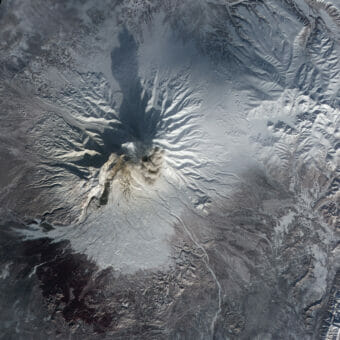
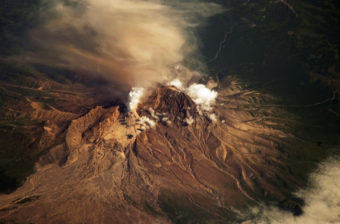
On February 17, 2008, the skies above Shiveluch Volcano in Russia’s Far East were clear and calm, allowing the ASTER instrument on NASAs Terra satellite to catch this view of a column of ash from a recent eruption seemingly frozen in the air over the mountain. The southern slopes of the snow-covered volcano were brown with ash. (NASA image)

The eruption of a volcano this week on Russia’s Kamchatka Peninsula has prompted Alaska flight cancellations, including some flights in and out of Juneau.

Monday saw Shiveluch Volcano’s largest eruption in nearly 60 years with ash exploding at least 50,000 feet into the air. While the bulk of that cloud is to the southwest of Alaska around the western Aleutians, a ribbon of volcanic gas and a little ash reached the mainland on Wednesday.

Airline spokesperson Tim Thompson said that on Wednesday, the airline had canceled eight flights between Western Alaska airports and Anchorage. Those flights were to Adak, Bethel, Dillingham and King Salmon.

Alaska Rep. Mary Peltola was among those affected by the eruption overnight Wednesday, after her flight from Honolulu to Anchorage was turned back due to the ash plume. On Thursday morning she and other passengers were on the ground again in Honolulu, waiting for a chance to return home.

U.S. Rep. Mary Peltola waits in the Honolulu Airport.
U.S. Rep. Mary Peltola waits in the Honolulu Airport on April 13, 2023. (Photo by Hope McKenney/KBBI)

Juneau flights affected

Cancellations spread across the state on Thursday, and a Twitter post from the airline Thursday morning recommending passengers check their flight status.

As of 7 a.m. Alaska time Thursday, Alaska Airlines reported canceling 23 flights due to ash from the volcano.

So far, cancellations include Thursday morning flights from Anchorage to Juneau, Juneau to Sitka, and Juneau to Yakutat. Flight 64’s departure from Anchorage to Juneau has been delayed by at least 4 hours. Juneau airport manager Patty Wahto said other afternoon and evening flights were also listed as delayed.
Andy Kline, marketing manager for Alaska Seaplanes, said the company canceled flights from Klawock and Sitka to Juneau, and from Juneau to Haines and Skagway.

“We had one flight that was going to Hoonah when we got the call to cancel flights, so it landed in Hoonah and it’s there,” he said late Thursday morning.

The Alaska Seaplanes flight from Juneau to Petersburg was delayed but did depart in the early afternoon.

A massive cloud

Dave Schneider, a research geophysicist with the Alaska Volcano Observatory in Anchorage, says lava from the Shiveluch volcano forms a dome, parts of which periodically collapse and create ash clouds.

“What happened a couple days ago was much more significant,” he said. “It’s still too early to really know exactly what went on, but I surmise that a large part of the lava dome that’s been growing for years collapsed and unleashed a pretty good sized eruption.”

The massive cloud was initially moving west, blanketing villages in Russia with a thick layer of ash. But as another weather system came in, it started moving east, toward Alaska. And parts of the cloud are peeling off. As of Wednesday, the ash was still out in the western Aleutians.

“But bits and pieces of it are sort of getting pulled off, sort of like you’re making toffee, and you can pull a branch off, and it’ll sort of go off in its own direction,” Schneider said.

Check out satellite imagery of the cloud here

One cloud actually passed over Dillingham on Wednesday, though Schneider said it was mainly sulfur dioxide gas and contained very little ash.

“Both of those are part of the volcanic cloud that was produced,” he said. “And with satellites, we’re able to track those and that helps the weather service issue forecasts and sort of see where the cloud is and where it’s moving.”

The volcano’s emissions decreased on Wednesday, and Schneider said that while there’s no guaranteeing exactly when the cloud will disperse, that’s a fair sign that travel could soon be back to normal.

This is a developing story. Check back for updates.

KTOO’s Katie Anastas and KBBI’s Hope McKenney contributed to this story.

Alaska not expecting ash from Kamchatka eruption, for now

The Shiveluch volcano as seen from the International Space Station in July 2007. Photo: NASA via public domain.

Alaska scientists are watching a massive volcanic eruption on Russia’s Kamchatka Peninsula. So far, it does not appear to be sending ash to mainland parts of the state.

Shiveluch Volcano began spewing ash high into the atmosphere on Monday — up to at least 50,000 feet — and the huge ash cloud was drifting east.

Hans Schwaiger, a research geophysicist with the Alaska Volcano Observatory, said the eruption is not expected to create any ash deposits on the ground in Alaska, but that could change.

“Yeah, it could easily move further across the Aleutians towards Dutch Harbor. It could affect, maybe, Southeast Alaska,” he said. “We’ll just have to see. It’s still putting out ash.”

The Shiveluch volcano’s approximate location. (Image courtesy Google Maps)

For now, Schwaiger said, the ash is affecting air traffic in the region, which includes the far western Aleutians. Nearly 3 inches of ash has dropped on a nearby village.

He said the Alaska Volcano Observatory and its international partners will continue to monitor the situation.

Eruption risk down for 2 Aleutian volcanoes

Tanaga in November 2012. (Roger Clifford/Alaska Volcano Observatory/U.S. Geological Survey)

Scientists last week warned that two Aleutian volcanoes were at a heightened risk to erupt following an intense series of earthquakes nearby.

Since then, they’ve lowered the risk levels on Tanaga and Takawangha. But they’re continuing to watch for any signs the volcanoes could still erupt in the future.

John Lyons is a research geophysicist with the Alaska Volcano Observatory, which studies volcanoes like the ones on Tanaga Island and watches out for potential hazards. They keep an eye on the volcanoes on the island with satellites and six remote monitoring sites.

“We had seen seismic unrest going back into the fall of 2022 at Takawangha Volcano,” Lyons said.

Swarms of earthquakes, like the one at Takawangha, can be precursors to volcanic eruptions.

Two weeks ago, Lyons said the unrest started underneath its neighbor, at the Tanaga Volcano.

“At the same time, the earthquakes got shallower — they moved up toward the surface,” he said.

That’s when the observatory upped the risk to color-code orange, which means a volcano is showing signs of unrest with an increased potential to erupt. Activity peaked between March 9 and 11.

But Lyons said after that, the rate, intensity and magnitude of the earthquakes happening there all began to drop — plus, observers weren’t noticing other signs of volcanic activity, like steaming.

“This was last Thursday,” he said. “At that point, we felt pretty good lowering the color code from orange to yellow.”

That means the observatory is seeing signs of unrest of the volcano but doesn’t think those signs are going to lead to what Lyons calls “imminent eruptive activity.”

“Yellow is like an advisory level,” Lyons said. “It’s kind of like, heads up, this isn’t background activity — there are still earthquakes ongoing. I think in the last week, we’ve had maybe 15 or so magnitude 2-plus earthquakes, which are pretty big for volcanoes.”

Still, he said those are a step down from the magnitude 3-plus earthquakes the observatory was picking up earlier in the month.

Lyons said his office is continuing to keep an eye on activities at Tanaga and Takawanga and that they’ll be ready to raise the alert level again, if needed. You can find daily updates on the volcanoes here. Lyons said there isn’t much of a concern about the human impacts of the volcanoes, since Tanaga Island is uninhabited and the closest community to the volcanoes is Adak, 60 miles away.

Small businesses affected by Alaska crab crash may be eligible for low-interest federal loans

Small businesses that were impacted by the crab crashes between Oct. of 2022 and May of this year are eligible to apply. (Maggie Nelson/KUCB)

The U.S. Small Business Administration is offering special disaster loans to some businesses hurt by the recent red king crab and snow crab closures.

The federal agency announced last month that certain entities, like small agricultural coops or aquaculture businesses, as well as most private nonprofit organizations are eligible for low-interest loans of up to $2 million. Interest rates range from below 2% to about 3%, depending on the type of organization.

The SBA declared a disaster following a relief request from Gov. Mike Dunleavy for the crab fisheries closures in the Bering Sea and Bristol Bay. Along with U.S. Rep. Mary Peltola, Dunleavy requested a total of nearly $290 million from the federal government last year — the estimated total exvessel loss for both fisheries since 2021. It generally takes years for that kind of money to reach the hands of fishermen and others affected by similar disasters.

“We’re committed to providing federal disaster loans swiftly and efficiently, with a customer-centric approach to help businesses and communities recover and rebuild,” said SBA Administrator Isabella Casillas Guzman.

Small businesses affected by the crab crashes between October of 2022 and May of this year are eligible to apply.

The loans can be used to cover debts, payroll and other bills that couldn’t be paid because of the recent crashes. The deadline to apply is Nov. 9.

Business owners and nonprofit organizers interested in applying can do so online. The Alaska Small Business Development Center is also offering help with applications. Email rural@aksbdc.org for more information.

2 Aleutian volcanoes on watch for potential eruption

Tanaga Volcano from the northeast on May 23, 2021 (M.W. Loewen/Alaska Volcano Observatory)

Two western Aleutian volcanoes are showing signs of unrest, signaling the potential for an eruption in the coming days or weeks.

Tanaga and Takawangha Volcanoes are about 60 miles west of Adak. Earthquake activity started increasing near Tanaga on March 4, with Takawangha following on March 8, according to the Alaska Volcano Observatory.

“It certainly appears that there’s magma moving at a shallow level beneath the volcanoes,” said U.S. Geological Survey Geologist Tim Orr. “But it’s uncertain right now if they will erupt — or which one will erupt.”

Tanaga and Takawangha are 5 miles apart on uninhabited Tanaga Island.

Recent earthquake activity under Tanaga Island. (Max Kaufman/Alaska Volcano Observatory)

Due to the volcanoes’ remoteness and close proximity to one another, records of their historical eruptions aren’t perfectly clear. Tanaga’s last recorded eruption was in 1914. There are no recorded historical eruptions at Takawangha, but scientists say it’s possible some eruptions attributed to Tanaga may have actually come from Takawangha.

Orr said the observatory is monitoring the volcanoes’ current activity by satellite and through reports from people passing by.

“We don’t really have eyes on the volcano, except from space,” said Orr. “It’s possible that people in the area — mariners or pilots in the area — might spot something happening and report it to us. We rely on a lot of different sources to determine whether a volcano has erupted.”

If the volcanoes erupt, Orr said ashfall would certainly affect air travel in the area — just how much would depend on the wind.

Elizabeth Kudrin remembered as ‘great survivor’ of World War II

Elizabeth Golodoff Kudrin and her brother, Gregory Golodoff, photographed on Atka Island, sometime between 1946-1947, after they had begun to recover from the starvation they experienced during their stay in Japan, where they were housed as prisoners of war until 1945. Of the seven Golodoff children taken to Otaru, Hokkaido, three died from beriberi, a vitamin B deficiency caused by malnutrition, which leads to painful nerve damage and heart disease. (Photo Courtesy Of National Park Service, University Of Washington Press And Ethel Ross Oliver)

In the Russian Orthodox tradition, a week of memorial services concluded last month for Elizabeth Kudrin, a woman whose family says her legacy is that of a “great survivor.”

Kudrin died just a few days after her 82nd birthday. She was born on Attu, a tiny island in the far Western Aleutians in 1941 — the same year that Japanese planes bombed Pearl Harbor. In June of 1942, more than a thousand Japanese soldiers invaded Attu.

Elizabeth was just a baby, the youngest of seven children, when she and her parents, Olean and Lavrenti Golodoff, along with her family, were taken captive.

In September, the Golodoffs, and the rest of the islanders, were taken to Japan as prisoners of war.

About 40 arrived in Otaru on the northern island of Hokkaido, where they were housed in a big, shabby dormitory. About half of them died by the end of World War II, including Elizabeth’s father, two brothers and one sister.

Kudrin’s husband George says his wife’s passing marks the end of an era. He calls her “the matriarch of matriarchs, the last mom from Attu.”

Elizabeth and George Kudrin were a very close couple. In January this year, they celebrated 50 years of marriage. This photo was taken a few weeks before her death on Feb. 19. (Photo by Helena Schmitz)

Her death leaves only one survivor from Attu, her older brother Greg.

Although Kudrin and his wife were a close couple, he says she never talked about the war, partly because she was too young to remember what happened — and what memories she did have were too painful to dwell upon.

Elizabeth’s older brother, Nick Golodoff, described the hunger and starvation in his book, Attu Boy. He said the daily ration, near the end of the war, was only a quarter of a bowl of watered-down rice.

Rachel Mason, a National Park Service historian, says the timing of their evacuation from Attu, which came after the summer fishing season, turned out to be key to their survival.

“The Japanese told the Attuans to pack as much as they could of their subsistence foods, so they brought dried fish,” Mason said. “And that I think saved them, because at least until their fish rain out, they ate fairly well in Japan.”

Mason said Elizabeth’s mother did what she could to keep her children from starving.

“She was reduced to finding orange peels on the ground to feed her children,” she said.

Those who survived the war were not allowed to return home to Attu, which today remains uninhabited. The federal government resettled Elizabeth, her mother and three brothers in the neighboring island of Atka, where her husband George grew up. He remembers stories about how people were puzzled to hear mysterious sounds from this newly arrived four-year-old girl.

“She used to sing Japanese,” Kudrin said. “She used to go under the table and sing Japanese.”

But Kudrin says his wife had no memory of that.

Ray Hudson, a historian who has written extensively about the Aleutians, says the people of Attu are now lost to the footnotes of history, but what happened should not be forgotten.

“These were American citizens and subject to a very high death toll,” Hudson said. “So really, the capture of the Attu people in 1942 sealed the fate of Attu Island in many ways.”

Hudson says prior to the Japanese military invasion, a number of Aleutian villages had disappeared, but Attu was a thriving community.

“The villagers would trap fox, go fishing and made a good living,” Hudson said.

The women, he said, still made the tightly woven baskets that the Aleutians are famous for. But the war changed everything.

“People like Elizabeth are the victims of forces really beyond their control,” said Hudson, who said he was always impressed by her unfailing graciousness. “People like Elizabeth showed amazing courage and resoluteness to start over.”

Hudson said when Elizabeth was taken to Japan, she had to deal with people who didn’t speak her language, Unangam Tunuu. And when her family moved to Atka, she had to learn a new dialect.

“So there’s always this constant reinventing of yourself. And I think Elizabeth showed that resolve and a spirit of renewal that is really in the Unangax people.”

Elizabeth’s family says her life was full of hardships. She lost her first husband in a boating tragedy and outlived four of her five children.

“Anĝaĝinam iĝamanaa,” George Kudrin says in Unagam Tunuu. “She was a good person and she just loved you.

Elizabeth’s husband George says he marveled at Elizabeth’s ability to channel hardship into kindness and compassion for others.

Elizabeth Kudrin, her son Bill Dushkin and newborn grandson, Ivaan William Chalanax Dushkin. (Courtesy of Crystal Dushkin)

Her daughter-in-law, Crystal Dushkin, said she became a role model to young women in Atka.

“Seeing her example of strength and resilience, in all that she endured in her lifetime, was a real inspiration,” Dushkin said.

Dushkin believes she was also an important tie to the past, whose struggles have helped the younger generation understand the impacts of historical trauma, and how even today, the fallout from war continues.

Dushkin says she grew up hearing adults talk about the war.

“From a young age, I remember knowing that there had been a war, hearing about the war,” she said. “Everybody would always talk about before the war. That was kind of how stories started.”

She says some of these stories frightened her.

“Anytime I heard the plane flying overhead over our village, I would run inside the house, because I thought the plane was going to drop a bomb on our village, because that’s what I grew up hearing about — that planes dropped bombs,” Dushkin said.

Crystal and her husband, Bill Dushkin, love their life on Atka, but as today’s Russian fighter jets — and most recently, a Chinese spy balloon — have crossed into Alaskan air space, they say Elizabeth’s story serves as a reminder that far-flung places like Atka and Attu are still vulnerable, that they could once again be caught in the crossfire between nations. Attu is the only place on American soil that has been occupied by a foreign country since the War of 1812.

“It’s just amazing that it even happened back then, that one of our islands was taken over by a foreign country,” Dushkin said. “But yeah, it could happen here again. You never know.”

Elizabeth Kudrin gave her son, Bill Dushkin, a copy of When the Wind was a River on his 30th birthday. The cover photo of Elizabeth taken when she was a child prisoner of war, with the number 30 on her dress. It wasn’t until he was an adult that Dushkin learned he was adopted, and that Elizabeth was his mother. He says the photo helped him understand her decision.

Dushkin is Elizabeth’s son, whom she gave up for adoption. It’s a complicated story, one that he began to understand when she gave him a book for his 30th birthday — one that had her picture on the cover — the little girl, who would later become his mother, a prisoner of war, with the number 30 on the front of her dress

Elizabeth’s husband George has two words to sum up his wife’s life and legacy.

“Ayagam Kayutuu,” he says in Unangam Tunuu. “Strong woman.”

It was Elizabeth Kudrin’s strength and resilience that made her a part of Alaska history, which passed with her on Feb. 19 — a woman with a story that few Alaskans, and ever fewer Americans, know.

Editor’s note: Michael Livingston, an Unangan historian, contributed to this story. 

Site notifications
Update notification options
Subscribe to notifications