Aleutians

Alaska crab fishery collapse seen as warning about Bering Sea transformation

""
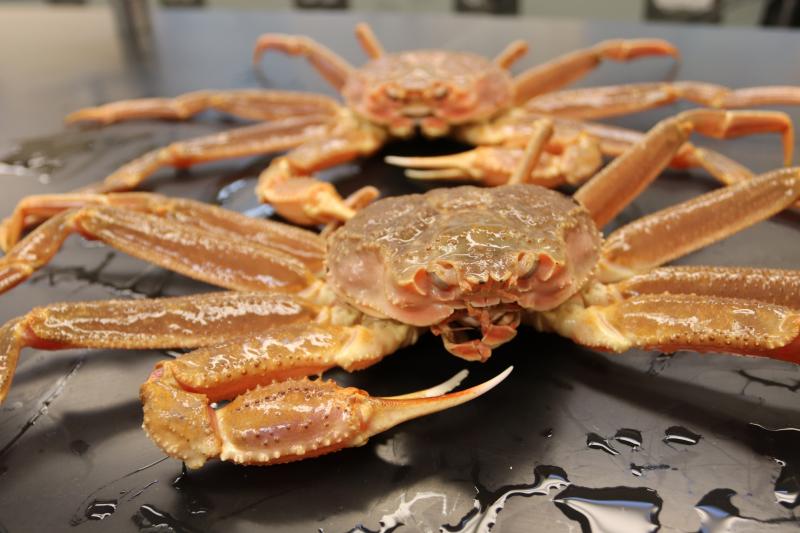
Bering Sea snow crab support an iconic Alaska seafood harvest, but a crash in population since 2018 has triggered the first-ever closure of the fishery. (Photo provided by National Oceanic and Atmospheric Administration)

Less than five years ago, prospects appeared bright for Bering Sea crab fishers. Stocks were abundant and healthy, federal biologists said, and prices were near all-time highs.

Now two dominant crab harvests have been canceled for lack of fish. For the first time, the Alaska Department of Fish and Game in October canceled the 2022-2023 harvest of Bering Sea snow crab, and it also announced the second consecutive year of closure for another important harvest, that of Bristol Bay red king crab.

What has happened between then and now? A sustained marine heat wave that prevented ice formation in the Bering Sea for two winters, thus vastly altering ocean conditions and fish health.

“We lost billions of snow crab in a matter of months,” said Bob Foy, director of the National Oceanic and Atmospheric Administration’s Alaska Fisheries Science Center, at a public forum held Dec. 12 at the Anchorage Museum of History and Art. “We don’t have a smoking gun, if you will. We don’t have one particular event that impacted the snow crab — except the heat wave.”

That heat wave is now over, but its effects linger. A NOAA survey showed an 80% decline in Bering Sea snow crab, from 11.7 billion in 2018 to 1.9 billion this year. It could take six to 10 years to recover, experts told members of the North Pacific Fishery Management Council, which wrapped up a 10-day meeting in Anchorage on Wednesday.

Snow crab may be the “poster child” of climate change, council member Bill Tweit said during deliberations on a rebuilding program that was ultimately approved at the meeting, but much more will be affected by the long-term changes in the ocean.

“It’s going to be more and more a problematic question for us among a broader range of species than just snow crab,” Tweit said.

In the short term, loss of the snow and red king crab harvests is devastating. Direct losses from harvest cancellations this year amount to $287.7 million, according to state estimates. Local governments are suffering, too, like the Aleut community of St. Paul, which relies on the crab harvests for more than 90% of its tax revenue.

""
Close-up view of an Alaska king crab is seen in 2019. (Photo by Julia Brownlee/National Oceanic and Atmospheric Administration)

There are limits to what the North Pacific Fishery Management Council can do to manage crab stocks. Crab harvests are managed by the state, even for stocks existing in federal waters, though the council and federal agencies provide support and scientific information to assist and cooperate in that management. However, the council and associated federal agencies do have the power to regulate other fisheries that might affect the crab – and that is what crab fishermen and crab-dependent communities asked them to do.

Alaska Bering Sea Crabbers, a nonprofit trade organization, petitioned the council to use its emergency powers to ban all fishing for six months in areas designated as protected zones for red king crab. In those areas, crabs mate and molt, spending much of their time in a vulnerable soft-shell stage. That puts the crabs at high risk for being crushed and killed by trawl nets that hit or scrape the seafloor, the organization argued.

Warm temperatures may have wiped out much of the crab population, but that is not something that can be corrected immediately, said Jamie Goen, Alaska Bering Sea Crabbers’ executive director.

“Our concern as crab fishermen is we need to focus on the things we do have control over, and that’s really fishing impacts and habitat protections,” she said at the museum forum, which was organized by the Anchorage Daily News and the Seattle Times.

The council ultimately declined to take such emergency action, which critics said might not be effective and would have unintended consequences. They include pushing the trawl fleet into different territory, where there might be higher incidental catch of salmon or other problems. Instead, the council opted for a plan to study alternatives that include possible fishery closures in the key red king crab mating and molting areas. And the snow crab rebuilding plan it approved leaves open the possibility of a small harvest conducted as the stock recovers, which is important to industry representatives who voiced concerns about losing their position in the wider seafood markets.

“Once you lose that space at the buffet table and they fill it with shrimp or lobster, it’s really hard to get that back,” said John Iani, president of the North Pacific Crab Association, a Seattle-based organization of processing companies.

There is plenty of competition for the market slice held by Alaska snow crab and red king crab.

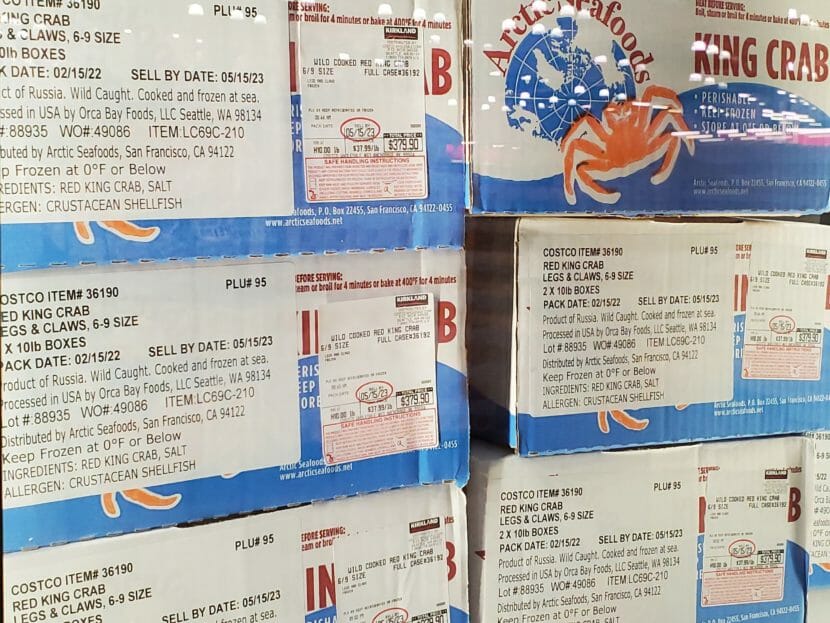
Stockpiles of Russian king crab are still being sold – even recently at an Anchorage Costco – though the U.S. government has banned further imports of Russian fish due to Russia’s invasion of Ukraine. Snow crab is harvested in eastern Canada, where stocks remain healthy, and in the Barents Sea off Scandinavia, where it is a relatively new species.

There is other Alaska crab on the market, too, though not as celebrated. Harvests of golden king crab, a species smaller than red king crab, are proceeding, and a relatively small harvest of red king crab in Norton Sound, in the Nome area, that is expected to open in 2023, though in two recent years it was shut down because of low stocks. Dungeness crab harvests continue in Alaska, as in other West Coast states. The Alaska Department of Fish and Game last week announced that a tanner crab season will open in 2023 in the Aleutians area.
A stack of boxes of king crab
Russian king crab is displayed at a Costco in Anchorage on Nov. 14. The crab, from the Barents Sea, was distributed by Arctic Seafoods of San Francisco, and was part of inventory stockpiled before the U.S. government banned fish important from Russia. (Photo by Yereth Rosen/Alaska Beacon)

There are other positive signs in the Alaska marine environment, according to the ecosystem reports presented to the council.

After successive years of low ice and high temperatures, a normal freeze returned to the Bering Sea last winter, scientists told the council. That resulted in the return this summer of an average-sized “cold pool” – the section of ultra-chilled water that serves as a thermal barrier separating habitats in the northern and southern Bering Sea. Seabird populations, many of them substantially reduced in recent years, are now showing reproductive successes, the scientists said. Some fish populations, including pollock and Bristol Bay-bound sockeye salmon, have actually thrived in the warmer conditions, the scientists said.

But there are also persistent signs of trouble. Ocean temperatures in certain areas, like the Aleutians, remain high. Steller sea lions, an endangered population in western Alaska, continue to decline in the western Aleutians. Northern fur seals, which congregate in the Pribilof Islands, are in a long-term decline.

The future of the Bering Sea appears to depend on whether humans take action to reduce greenhouse gas emissions that are warming the planet, NOAA fisheries biologist Elizabeth Siddon told the council on Dec. 11.

A “high-mitigation” scenario, with big reductions in greenhouse gas emissions, will result by the end of the century in “a Bering Sea that’s only slightly warmer but pretty similar to current conditions,” Siddon said. But under a business-as-usual scenario, with very little progress to reduce greenhouse gas emissions, the Bering Sea will be “much warmer than we would have observed to date,” she said.

Foy, speaking at the museum event, said the peak Bering Sea temperatures seen during the heat wave are unlikely to become normal anytime soon. But marine heat waves are expected to become more frequent, overlaying an ongoing and gradual rise in ocean temperatures, he said.

“It’s the impact on an ecosystem of those heat waves that worry scientists the most,” he said. “Because the data shows that the animals can’t adapt. If they can’t move, if they can’t grow, if you don’t get enough year classes in a row to sustain a fishery, then that’s when we have difficulty of fishery and communities and large-scale economic issues.”
Commercial Tanner crab fishery opens in Eastern Aleutians for the first time in 5 years

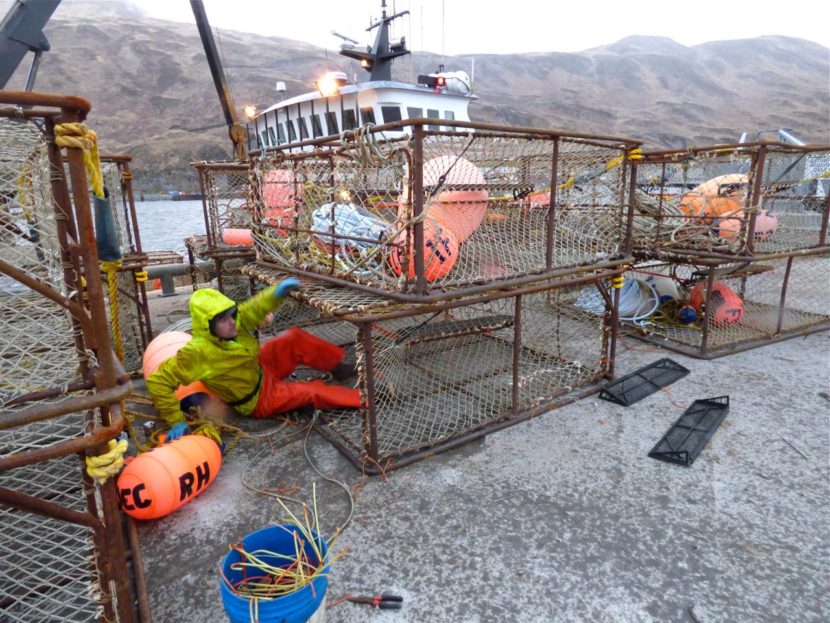
An Unalaska fisherman prepares for tanner crab season. (Photo by KUCB)

There will be a Tanner crab season in the Eastern Aleutians for the first time in five years, according to the Alaska Department of Fish and Game.

And while that’s great news for the fishery, only one section of the district will open — Makushin/Skan Bay, on the western side of Unalaska Island.

The other two sections — Unalaska/Kalekta Bay and Akutan — will remain closed.

Each year the Alaska Department of Fish and Game conducts a bottom trawl survey for Tanner crab in the Eastern Aleutian District. They can only open a commercial Tanner crab fishery when the abundance of mature male Tanner crab meets or exceeds stock size thresholds.

And even though the Akutan Sections and Unalaska/Kalekta Bay Sections didn’t reach those thresholds, Makushin/Skan Bay did for the first time since 2018.

Ethan Nichols is the assistant area management biologist for shellfish at the Dutch Harbor Fish and Game office. And he said the opening is a good sign.

“We’re pretty excited about the fishery and Makushin this year, because we’re seeing more legal crab than we’ve seen in quite a few years. And we feel that this year’s removal is pretty conservative,” Nichols said.

That removal refers to the general harvest level — how much crab people can catch.

The level this year is 49,000 pounds, which is the second largest there’s been since the Makushin section of the fishery was established in 2004.

The fishery opens on Jan. 15, 2023 at noon.

DOT pursues hybrid design for Tustumena replacement

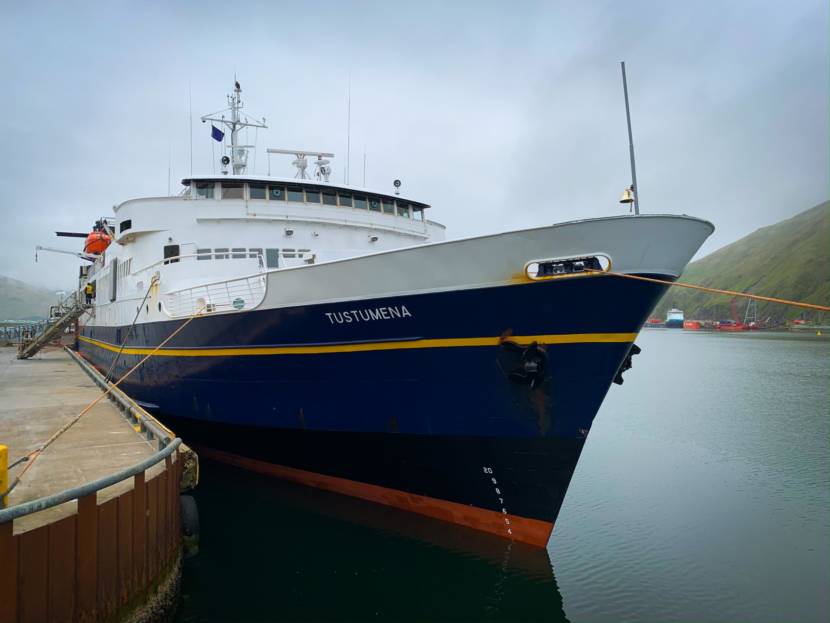
The 300-foot ocean-class ferry Tustumena is nearly six decades old. (Photo by Hope McKenney/KUCB)

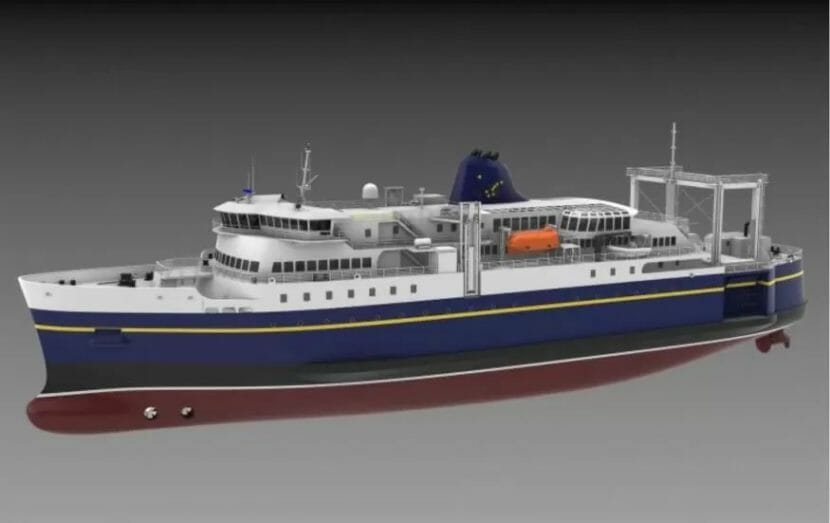
The vessel that eventually replaces the aging state ferry Tustumena is likely to be a battery-powered diesel-electric hybrid. That’s as the Alaska Marine Highway System leverages federal infrastructure funding to green up its fleet.

Greg Jennings, special projects liaison with the state transportation department, told the Alaska Marine Highway Operations Board on Friday that the state sees electric propulsion as a big part of the ferry system’s future.

“I would definitely say that there is no way batteries won’t be a part of any future marine transportation environment in the State of Alaska,” Jennings said. “Just because that’s where the industry and the regulations are going. It’s where the funding is going.”

The 300-foot ocean-class ferry Tustumena is nearly six decades old. The plan for its replacement now includes a room for housing batteries with the potential to expand.

Jennings says the decision to install batteries on the vessel opens a lot of doors.

“The beauty of this battery installation is it gives us the flexibility to do a lot of things we couldn’t do before,” he said.

The Tustumena’s two diesel engines currently use about 150 gallons of fuel per hour at cruising speed. Jennings says adding electric power will allow captains to use just one diesel engine at times. He says that’s expected to cut fuel consumption by 1%.

“So if you look year over year, over the lifetime use of the vessel, that’s a major savings to the state,” Jennings said. “One percent may not sound like a lot, but in ship design, you go to immense lengths to get 1% savings, because it’s like every day you operate that vessel, that’s 1% you’re saving fuel.”

This image shows a rendering of the Tustumena replacement vessel. The Alaska Department of Transportation is pursuing an updated design that includes a room for housing batteries for hybrid diesel-electric power. (Image courtesy of Alaska DOT)

State transportation officials estimate that adding batteries to the vessel would add millions to the new ferry’s estimated $200-$250 million price tag. But Jennings says the state expects to lean on federal money to help pay for it — the federal infrastructure law passed last year includes more than $1 billion in ferry funding.

“With the infrastructure funding that’s available to the state, much of that is very much centered around efficiency and modern technologies,” said Jennings. “And it behooves us to try to make use of that, you know, if we cannot, for some reason funding doesn’t come through, it is not a drastic step to remove the battery from the vessel and just say, you know, we don’t have funding, we’re just not going to do that part of it.”

The state is in conversations with the U.S. Coast Guard and American Bureau of Shipping for what kinds of safety measures should be in place for the hybrid ferry.

Jennings says adding battery power to the Tustumena replacement vessel — known as the TRV — will allow the state to learn about the technology and prepare for other projects in the future.

“We’re looking at operating the TRV for the next 50 years, you know, nominally,” Jennings said. “And if we don’t design in some capacity for batterie now, the state’s going to have to pay a much bigger cost in the future to try to fit it into a vessel that wasn’t designed for it. So again, there’s a really big future proofing benefit to this.”

He says adding batteries to the design will not affect the timeline. The new vessel is still scheduled to be ready for service in 2027.

The ferry system is also seeking $46 million in federal grant money for an all-electric ferry to conduct shorter day routes.

Editor’s note: This story originally ran on Oct. 18.

Another Aleutian volcano is showing signs of unrest

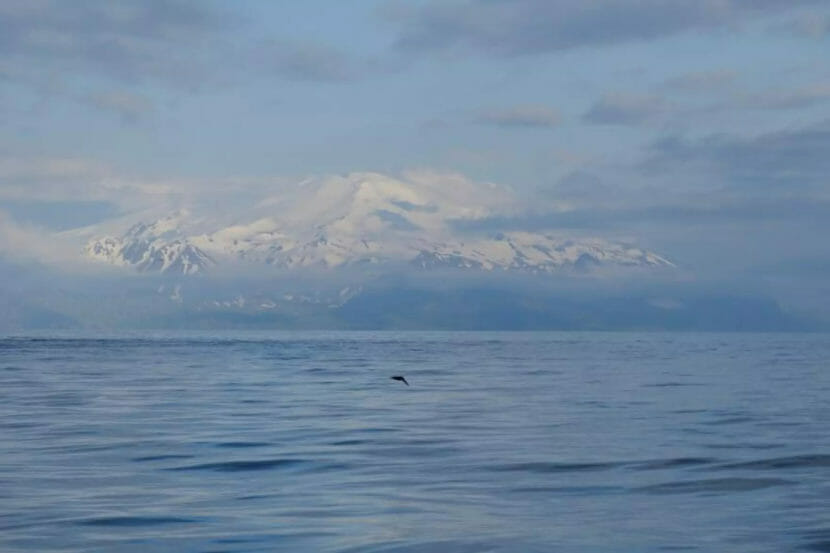
A snowy volcano, partly obscured by clouds, seen from across calm seas.
The east flank of Takawangha on June 10, 2021. (Loewen, M. /Alaska Volcano Observatory/U.S. Geological Survey)

Four Aleutian volcanoes have been under elevated alert levels for about a year. Now they’ve been joined by a fifth.

The new one is Takawangha, which rises 4,753 feet out of the Bering Sea in the far western Aleutians.

The Alaska Volcano Observatory put Takawangha on its watch list when a swarm of earthquakes with magnitudes between two and three intensified around the volcano.

John Lyons, a research geophysicist at AVO, said swarms often point to volcanic activity.

“That typically indicates that there’s been magma or volcanic fluid there,” Lyons said. “A swarm of earthquakes can often precede activity at the surface, including an eruption.”

The swarm began on Nov. 18, prompting the Alaska Volcano Observatory to move the volcano’s aviation color code to yellow, which means it’s showing elevated levels of activity but not erupting.

Active lava fountaining at Great Sitkin volcano on Aug. 5, 2021. (courtesy of Peggy Kruse)

The other four volcanoes are Great Sitkin, Cleveland, Pavlof and Semisopochnoi. Most have been moving in and out of the yellow and orange advisory levels. “Orange” means that an eruption is likely or already happening, but it’s not creating major hazards.

Five volcanoes rumbling at the same time might sound like a lot, but Lyons said it’s not uncommon for the state.

“There’s so many active volcanoes in Alaska, having five that have an elevated color code isn’t really extraordinary,” Lyons said.

Takawangha is about 55 miles west of Adak and could threaten the city of around 200 people should it erupt, but Lyons said the current advisory level is no cause for concern.

“The potential hazard to people in Adak is very low right now. And because the volcano is so well monitored, and because the Alaska Volcano Observatory is keeping an eye on it, there will be signs and we will catch those signs and put out timely notices if there’s any change in activity,” he said.

As of Monday, the swarm was still continuing at Takawangha and the color code remained at yellow.

Unalaskans hope new regional airline means better local air service

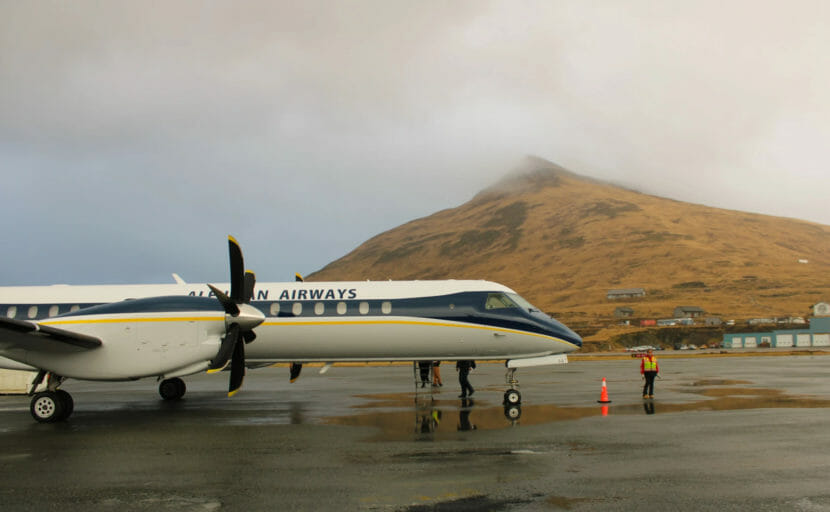
A turbo prop on the ground at the airport in Unalaska, with Mount Ballyhoo in the background.
Aleutian Airways’ inaugural flight marked the first commercial flight on a Saab 2000 to Unalaska since 2019. (Photo by Maggie Nelson/KUCB)

New regional airline Aleutian Airways touched down at Unalaska’s Tom Madsen Airport on Nov. 16., and with it arrived the hope of more stable and affordable air service to the remote Aleutian Island.

The roughly 15 passengers on board Aleutian Airways’ inaugural flight from Anchorage were greeted by a few dozen cheering Unalaskans, including local officials from the city and school district.

“It’s nice to see change,” said local Karley Parker. “And it’s a very welcome change. I’m glad that we have options. It’s much needed here in Unalaska, for competition and rates and just getting people off the island.”

Parker was one of the passengers on the fully booked return flight back to Anchorage. She’s lived in Unalaska most of her life and said she’s excited to have airfare options in general, but also to be able to catch a shorter flight.

The new regional carrier, which is operated by Sterling Airways, flies to Unalaska Mondays through Fridays on its Saab 2000 aircraft, which is a high-speed turboprop plane that holds around 50 passengers.

Previously, Ravn Alaska was the only airline offering regularly scheduled flights between Unalaska and Anchorage. Ravn flies smaller and slightly slower DeHavilland Dash 8 planes, which were used in place of the Saab after the same kind of aircraft — a Saab 2000 — crashed at the end of the runway during a commercial PenAir flight, killing one passenger in 2019.

Aleutian Airways’ Wednesday flight was the first time since that crash that a Saab 2000 had flown commercially to the island. A National Transportation and Safety Board investigation revealed that bad wiring, lax oversight and poor judgment were all factors in the fatal crash, which sparked a hailstorm of unreliable and expensive air service to and from the island.

Previously, Alaska Airlines flew jets from the Ted Stevens International Airport in Anchorage. But in 2004, the mainline carrier pulled its fleet from Unalaska due to weather cancellations and safety concerns over the island’s short, 4,500 foot runway. PenAir continued to service the island under an agreement with Alaska Airlines until the 2019 crash. But since Alaska Airlines stopped flying to Unalaska, there has been just one airline providing regularly scheduled service at any one time. And at certain points following the crash, Unalaska has been left without any commercial flights.

Unalaska, which is about 800 air miles from Anchorage and home to the nation’s largest fishing port by volume, has a year-round population of about 4,500 residents. But during peak fishing seasons, that number doubles. The region, while remote, is an industrial hub for the fishing industry and sees significant foot traffic from both locals coming and going for work and vacation, as well as the thousands of industry workers arriving for seasonal employment.

Flights on the new airline will cost about the same as other options. A one-way ticket off the island on Aleutian Airways and Ravn costs a minimum of about $650 but is usually closer to $750. And if you want a refundable ticket, it’ll be nearly $950, which is more than a seat on the average charter. Those skyrocketing airfare costs have local officials worrying about the future of the remote but vital fishing town.

But with Aleutian Airways’ entrance onto the regional market, some Unalaskans hope there is improvement on the horizon. For Denise Rankin, president of the Ounalashka Corporation, it’s a breath of fresh air to see the new regional airline’s puffin logo hanging above Unalaska’s check-in counter.

She said she came to the inaugural landing to show support for the new airline and say hello to some of the folks flying in.

“I think it brings some hope to community members that eventually the prices might come down to where they can travel more and bring some stability back. I hope,” Rankin said.

Rankin grew up on the island and until recently, she said she hadn’t left in about four years.

“Having a larger flight that can carry your bags with you is really important,” she said. “And I’m hoping that it will bring down some of the flight prices. But airfare was one of the main reasons we weren’t traveling. It was really expensive.”

Unalaska’s former Mayor and a contractor for the new carrier, Frank Kelty, was one of the first folks to deboard the plane and walk into the Tom Madsen Airport, as Rankin and dozens of others greeted them.

“We’re going to have dependable fast service to Unalaska,” Kelty said. “This morning, we made it in two hours flat, left at 7:30 and got here at 9:30. We’re going to do our best to provide a great service and we look forward to working with the community.”

He was joined by Aleutian Airways CEO Wayne Heller, who shared in the excitement about the inaugural flight.

“I couldn’t be happier,” Heller said. “I’m grinning from ear to ear.”

But the overall feeling of enthusiasm and hope that many felt about the flight doesn’t ensure lower airfare costs. Currently, Aleutian Airways’ prices are nearly identical to what Ravn Alaska offers. And Heller said he’s not sure what prices will look like going forward.

“Everything has gotten more expensive in the last couple of years,” Heller said. “Planes, employees, fuel — a myriad of different things that go into running an airline are a lot more costly than they once were. There’s a level that you have to get to in order to be able to provide service. So a lot will depend on what our load factors are in and out of Dutch Harbor. And we’ll adjust from there.”

As for the question that is likely on many local’s minds: will the new airline allow travelers to use their Alaska Airlines miles to buy Aleutian Airways flights? Heller said maybe… eventually.

It’s something on our long term plans,” he said.

The company plans to increase service and begin offering weekend flights starting Dec. 26 to help accommodate the influx of industry workers coming to the island for the upcoming winter fishing season.

The Aleutian Islands could become a hub for zero-emissions shipping

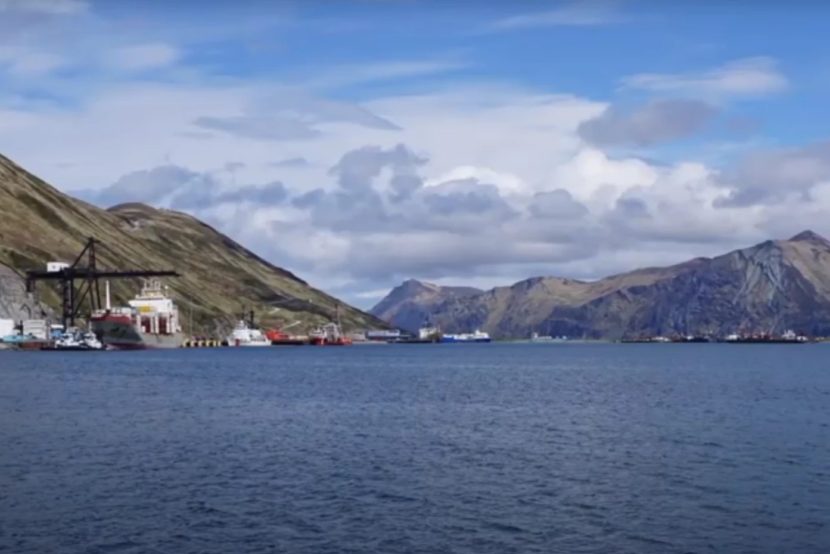
The International Port of Dutch Harbor presents the perfect fuel stop for hydrogen-powered container ships making the trip from Shanghai to Long Beach. (Hope McKenney/KUCB)

It started with a question: Is it possible for the large container ships traveling from China to the United States to make the trip using renewable fuel sources?

The international shipping industry largely runs on petroleum. The sector emits about a billion tons of carbon dioxide and other greenhouse gasses annually, according to a study published by the United Nations.

So a group of researchers at an independent nonprofit, the International Council on Clean Transportation, are looking into what it would take to transition petroleum-run ships into using zero-emission fuels.

What they found could put the Aleutian Islands right at the center of it all.

ICCT researcher Elise Georgeff has been investigating hydrogen as a potential replacement fuel. First, her team calculated how many ships could cross the Pacific Ocean using the existing hydrogen technology.

“About 43% [of existing ships] could be powered by using hydrogen fuel cells,” Georgeff said.

Fuel cells are similar to batteries, but instead of holding a charge from another source, they create a charge from fuel they store.

Georgeff found that almost half of the ships traveling from China to California could make the same trip with hydrogen fuel cells. As for the other half, the ICCT team determined that those ships would need to make a pit stop along the way to refuel.

“About 99% of the ships that couldn’t make the Pacific route before, if they just added one refueling stop — think a little gas stop on the way — they could attain the route,” Georgeff said.

This would essentially create a zero-emission shipping lane, or what many industry experts refer to as a “green corridor.”

Unalaska and Adak islands in the Aleutians are in perfect locations to become pit stops in a trans-Pacific green corridor. Most of the international ships crossing from west to east follow the same path, and those two communities are right in the middle: about halfway through one of the world’s busiest shipping lanes.

“Because of their strategic location, they could be a first player in this green corridor that’s already been talked about, between China and the United States,” Georgeff said.

Establishing a green corridor could yield significant economic benefits for Adak and Unalaska. The ICCT study estimates a market of more than $1 billion a year, if the Aleutians become a full-fledged hydrogen hub.

The United Nations has called for global leaders to work towards decarbonization of maritime shipping. And the Biden Administration has pledged to work with the U.N. to develop hydrogen and renewable energies in the American shipping industry.

The 2022 United Nations Climate Change Conference takes place next month in Egypt, when global leaders are expected to discuss global greenhouse emission standards for the maritime shipping sector.

Site notifications
Update notification options
Subscribe to notifications